

Eye movement desensitization and reprocessing for mental health problems: a systematic review and meta-analysis
Open accessThe DOI matches its Crossref record; 52 of the 52 references it cites were found in a registry or an index.
Abstract
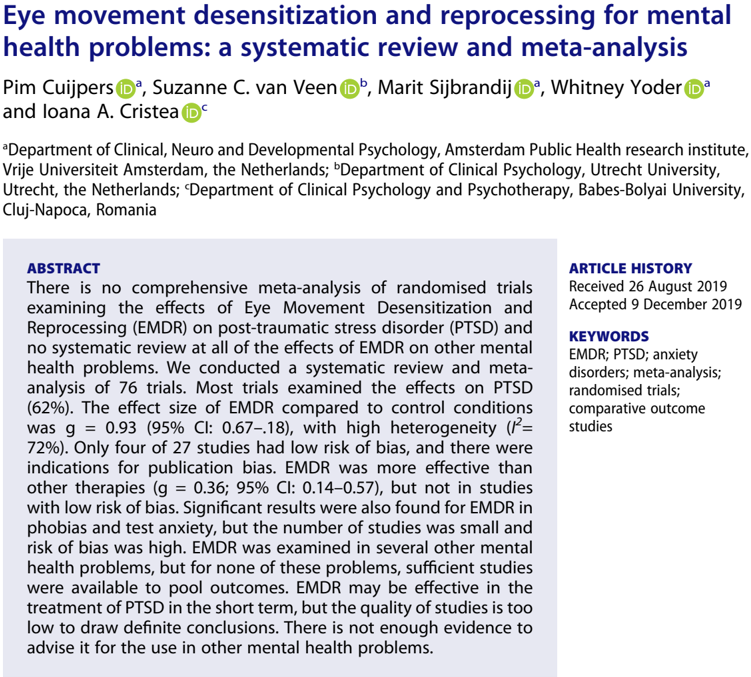
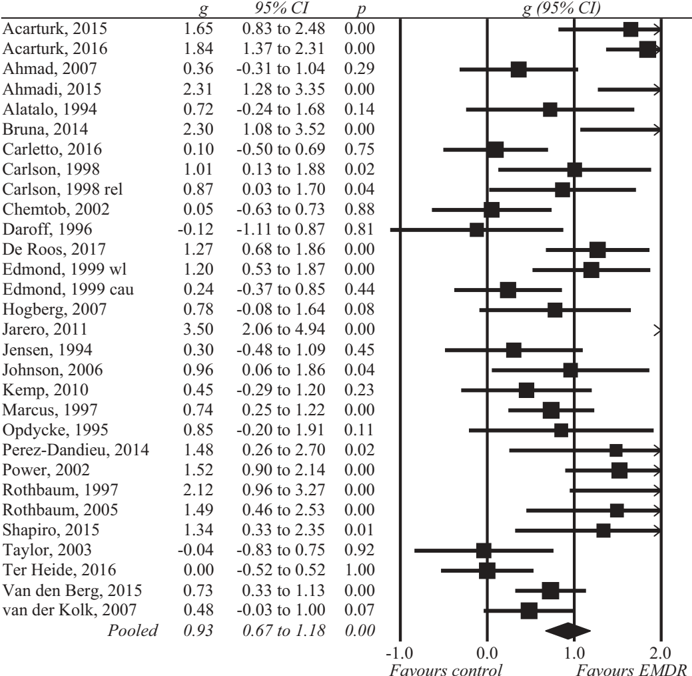
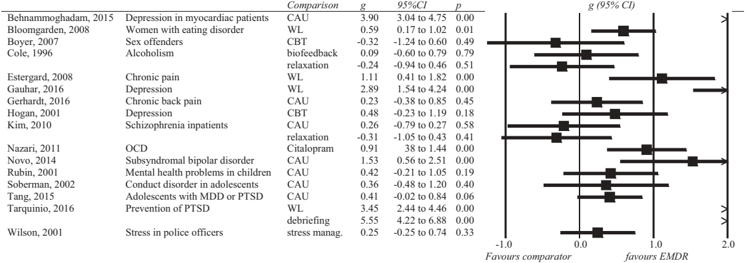
There is no comprehensive meta-analysis of randomised trials examining the effects of Eye Movement Desensitization and Reprocessing (EMDR) on post-traumatic stress disorder (PTSD) and no systematic review at all of the effects of EMDR on other mental health problems. We conducted a systematic review and meta-analysis of 76 trials. Most trials examined the effects on PTSD (62%). The effect size of EMDR compared to control conditions was g = 0.93 (95% CI: 0.67–.18), with high heterogeneity (I2= 72%). Only four of 27 studies had low risk of bias, and there were indications for publication bias. EMDR was more effective than other therapies (g = 0.36; 95% CI: 0.14–0.57), but not in studies with low risk of bias. Significant results were also found for EMDR in phobias and test anxiety, but the number of studies was small and risk of bias was high. EMDR was examined in several other mental health problems, but for none of these problems, sufficient studies were available to pool outcomes. EMDR may be effective in the treatment of PTSD in the short term, but the quality of studies is too low to draw definite conclusions. There is not enough evidence to advise it for the use in other mental health problems.
Overview
The claims and statistics of this paper haven’t been checked yet.
Free: it reads the open-access text and checks the first 5 claims that cite a source we can check. Create a free account to check every claim.
Integrity signals
Registry
Cites
Statistics
Figures




Verification
Claims the paper makes
The claims and statistics of this paper haven’t been checked yet.
Free: it reads the open-access text and checks the first 5 claims that cite a source we can check. Create a free account to check every claim.
Claims other papers make about this one
Each is checked against this paper’s own text: does it say what the citing paper says it does?
The source backs part of the claim, not all of it — or backs it for a different population, condition or comparison.
In the citing paper
“but the majority have methodological limitations, including the risk of bias, small samples, and the lack of an active control condition [38, 40].”
From Eye movement desensitization and reprocessing (EMDR) therapy or supportive counseling prior to exposure therapy in patients with panic disorder: study protocol for a multicenter randomized controlled trial (IMPROVE) (2023) · cites this paper as [38]
Experimental — accuracy not yet measuredThe source backs part of the claim, not all of it — or backs it for a different population, condition or comparison.
In the citing paper
“Preliminary research has also shown promising results of clinical interventions that specifically focus on threat imagery in anxiety disorders, such as imagery rescripting [34–37] or EMDR therapy [38–40].”
From Eye movement desensitization and reprocessing (EMDR) therapy or supportive counseling prior to exposure therapy in patients with panic disorder: study protocol for a multicenter randomized controlled trial (IMPROVE) (2023) · cites this paper as [38]
Experimental — accuracy not yet measuredThe source backs part of the claim, not all of it — or backs it for a different population, condition or comparison.
In the citing paper
“Researcher allegiance bias is problematic in psychotherapy research [121, 122], including studies about EMDR therapy efficacy in anxiety disorders [38, 40].”
From Eye movement desensitization and reprocessing (EMDR) therapy or supportive counseling prior to exposure therapy in patients with panic disorder: study protocol for a multicenter randomized controlled trial (IMPROVE) (2023) · cites this paper as [38]
Experimental — accuracy not yet measuredThe source backs part of the claim, not all of it — or backs it for a different population, condition or comparison.
In the citing paper
“a recent meta-analysis suggests a high risk of bias across many of the studies included, and relatively small effect sizes for treatment efficacy [66].”
From Psychological Interventions for Survivors of Intimate Partner Violence in Humanitarian Settings: An Overview of the Evidence and Implementation Considerations (2022) · cites this paper as [66]
Experimental — accuracy not yet measuredThe source backs part of the claim, not all of it — or backs it for a different population, condition or comparison.
In the citing paper
“EMDR has been considered a highly effective treatment for PTS symptoms, including among survivors of sexual violence [65], though recent meta-analysis findings suggest that it is not effective for addressing other problems long term [66].”
From Psychological Interventions for Survivors of Intimate Partner Violence in Humanitarian Settings: An Overview of the Evidence and Implementation Considerations (2022) · cites this paper as [66]
Experimental — accuracy not yet measured
1 more claim about this paper
Create a free account to see every claim other papers make about this one.
Self-check
Percentages, sums and reported differences re-computed from the paper’s own numbers.
The self-check needs the paper’s full text.
Citations
Cites
Statistical Power Analysis for the Behavioral Sciences
Muller, K. (1989) · Technometrics · doi:10.1080/00401706.1989.10488618 · Cited by 99,167
Measuring inconsistency in meta-analyses
Higgins, J. P. T., Thompson, S. G., Deeks, J. J., & Altman, D. G. (2003) · BMJ · doi:10.1136/bmj.327.7414.557 · Cited by 63,139
Statistical Power Analysis for the Behavioral Sciences (2nd ed.).
Lachenbruch, P. A., & Cohen, J. (1989) · Journal of the American Statistical Association · doi:10.2307/2290095 · Cited by 37,395
The Cochrane Collaboration's tool for assessing risk of bias in randomised trials
Higgins, J. P. T., Altman, D. G., Gotzsche, P. C., Juni, P., Moher, D., Oxman, A. D., Savovic, J., Schulz, K. F., Weeks, L., Sterne, J. A. C., et al. (2011) · BMJ · doi:10.1136/bmj.d5928 · Cited by 33,817 · cited 1×
“Risk of bias of included studies was assessed using five criteria of the “Risk of bias” assessment tool, developed by the Cochrane Collaboration (Higgins et al., 2011).”
Borenstein, M., Hedges, L. V., Higgins, J. P. T., & Rothstein, H. R. (2009) · doi:10.1002/9780470743386 · Cited by 14,225 · cited 3×
“Metaregression analyses were conducted according to the Knapp–Hartung procedures using the restricted maximum likelihood approach as implemented in CMA (Borenstein et al., 2009).”
MethodDuval, S., & Tweedie, R. (2000) · Biometrics · doi:10.1111/j.0006-341x.2000.00455.x · Cited by 14,099 · cited 1×
“Indications for publication bias were examined with Duval and Tweedie’s trim and fill procedure (Duval & Tweedie, 2000), which yields an estimate of the effect size after the publication bias has been taken into account, and with Egger’s test for the asymmetry of the funnel plot.”
MethodStatistical Methods for Meta-Analysis
Wasserman, S., Hedges, L. V., & Olkin, I. (1988) · Journal of Educational Statistics · doi:10.2307/1164953 · Cited by 10,326
Borenstein, M., Hedges, L. V., Higgins, J. P. T., & Rothstein, H. R. (2021) · doi:10.1002/9781119558378 · Cited by 9,799
Statistical Methods for Meta-Analysis.
Freeman, P. R., Hedges, L. V., & Olkin, I. (1986) · Biometrics · doi:10.2307/2531069 · Cited by 4,784
Mediators and Mechanisms of Change in Psychotherapy Research
Kazdin, A. E. (2007) · Annual Review of Clinical Psychology · doi:10.1146/annurev.clinpsy.3.022806.091432 · Cited by 2,504 · cited 1×
“Trials can show if a treatment works, but to show how a treatment works is much more complicated and requires an extensive range of different types of treatments (Kazdin, 2007).”
Background
Research works printed but not linked: 2
- Borenstein, M., Higgins, J., Hedges, L. V., & Rothstein, H. R. (2017). Basics of meta-analysis: I2 is not an absolute measure of heterogeneity. Research Synthesis and Methods , 8 , 5 -18. doi:10.1002/ jrsm.v8.1 · doi:10.1002/jrsm.v8.1
- Cuijpers, P. (2016). Meta-analyses in mental health research; A practical guide . Amsterdam: Vrije Universiteit. Retrieved from http://bit.do/meta-analysis
Cited by
Items 101–159 of 159
Susanty, E., Sijbrandij, M., Srisayekti, W., Suparman, Y., & Huizink, A. C. (2024) · BMC Psychiatry · doi:10.1186/s12888-024-06420-9 · Cited by 6
“The scarcity of trial studies conducted in the current study has been a major obstacle to believing in the additional contribution of EMs in EMDR [80].”
Self-citationGardoki-Souto, I., de la Torre, O. M., Hogg, B., Redolar-Ripoll, E., Martínez-Sadurní, L., Fontana-McNally, M., Blanch, J. M., Lupo, W., Pérez, V., Raduà, J., et al. (2024) · Trials · doi:10.1186/s13063-024-08708-3 · Cited by 2
Buijssen, H. (2021) · Springer eBooks · doi:10.1007/978-3-662-62827-0_4 · Cited by 1
Berührung ein Lebensmittel: Einfluss auf die körperliche und geistige Gesundheit
Müller, S. M. (2022) · Springer eBooks · doi:10.1007/978-3-662-64012-8_8 · Cited by 1
Infertility, Grief, and Trauma Related to Fathering
Eddy, B. P., Trujillo-DeFronzo, A., & Turns, B. (2022) · Springer eBooks · doi:10.1007/978-3-031-14498-1_11 · Cited by 2
Individual Differences in Response to Trauma
Paris, J. (2022) · Oxford University Press eBooks · doi:10.1093/med/9780197615768.003.0002 · Cited by 1
Childhood Trauma and Posttraumatic Stress Disorder
Paris, J. (2022) · Oxford University Press eBooks · doi:10.1093/med/9780197615768.003.0005 · Cited by 1
An Alternative Approach in the Treatment of Anxiety Disorders: Current DirectionsPreprint
Antos, Z., Zackiewicz, K., Tomaszek, N., Modzelewski, S., & Waszkiewicz, N. (2024) · Preprints.org · doi:10.20944/preprints202406.1166.v1 · Cited by 1
Eye Movement Desensitization and Reprocessing
Stöfsel, M. (2020) · Bohn Stafleu van Loghum eBooks · doi:10.1007/978-90-368-2501-6_8
Andere verwerkingstechnieken bij trauma
Stöfsel, M. (2020) · Bohn Stafleu van Loghum eBooks · doi:10.1007/978-90-368-2501-6_10
Houben, S. T. L. (2021) · Research Publications (Maastricht University) · doi:10.26481/dis.20210527sh
Advances in Psychotherapy for Posttraumatic Stress Disorder
Krauss, A., Begović, E., Harper, K. L., & Teng, E. J. (2021) · Advances in Psychiatry and Behavioral Health · doi:10.1016/j.ypsc.2021.05.005
Creating Silver Linings: Modifying negative mental imagery in anxiety
Landkroon, E. (2021) · Utrecht University Repository (Utrecht University) · doi:10.33540/651
Church, D., Kip, K., & Stapleton, P. (2022) · The Journal of Nervous and Mental Disease · doi:10.1097/nmd.0000000000001439 · Cited by 3
Does Trauma Cause Posttraumatic Stress Disorder?
Paris, J. (2022) · Oxford University Press eBooks · doi:10.1093/med/9780197615768.003.0001
Trauma in Historical and Social Perspective
Paris, J. (2022) · Oxford University Press eBooks · doi:10.1093/med/9780197615768.003.0003
Trauma and the Science of Memory
Paris, J. (2022) · Oxford University Press eBooks · doi:10.1093/med/9780197615768.003.0006
Paris, J. (2022) · Oxford University Press eBooks · doi:10.1093/med/9780197615768.003.0009
(2022) · Oxford University Press eBooks · doi:10.1093/med/9780197615768.002.0005
Treatment for Posttraumatic Stress Disorder
Paris, J. (2022) · Oxford University Press eBooks · doi:10.1093/med/9780197615768.003.0008
Paris, J. (2022) · Oxford University Press eBooks · doi:10.1093/med/9780197615768.003.0004
(2022) · Oxford University Press eBooks · doi:10.1093/med/9780197615768.002.0006
(2022) · Oxford University Press eBooks · doi:10.1093/med/9780197615768.002.0003
Mahon, D. (2023) · Emerald Group Publishing Limited eBooks · doi:10.1108/978-1-80455-732-720231003
Srikosai, S., Khamfou, C., Thakham, A., Wongmueang, J., Thippunya, K., Wongpothi, U., & Tailangkha, P. (2023) · INTERNATIONAL JOURNAL OF SCIENTIFIC RESEARCH · doi:10.36106/ijsr/7832526
Rodrigues, R. S. (2022) · Congresso Internacional de Direitos Humanos de Coimbra (CIDHCoimbra) · doi:10.29327/1163602.7-14
Driessen, H. P. A., Morsink, S., Busschbach, J. J. V., Hoogendijk, W. J. G., & Kranenburg, L. W. (2023) · SSRN Electronic Journal · doi:10.2139/ssrn.4495140
Harvey, L. R., & Kullock, C. (2023) · Oxford University Press eBooks · doi:10.1093/oxfordhb/9780192898357.013.42
Effects of Massages and Other Touch Interventions on Various Diseases
Mueller, S. M. (2023) · Springer eBooks · doi:10.1007/978-3-662-67860-2_8
Biomedical and public health studies on susceptibility to post-traumatic stress disorder
Jowf, G. I. A. (2023) · Research Publications (Maastricht University) · doi:10.26481/dis.20230906ga
Dominguez, S. K., & Lee, C. W. (2024) · Oxford University Press eBooks · doi:10.1093/oxfordhb/9780192898357.013.7
EMDR: An Empirically Supported Therapy
McMullen, S., & Lee, C. W. (2024) · Oxford University Press eBooks · doi:10.1093/oxfordhb/9780192898357.013.47
EMDR Therapy and the Working Memory Hypothesis
Smith, C. S., & Farrell, D. P. (2024) · Oxford University Press eBooks · doi:10.1093/oxfordhb/9780192898357.013.46
McLean, C. P., & Rosenfeld, E. A. (2025) · Cambridge University Press eBooks · doi:10.1017/9781009086264.007
Advances in the Management of Trauma Disorders
Hamlett, G. E., Schiffer, M. B., Hershfield, J., & Kirk, N. P. V. (2025) · Advances in Psychiatry and Behavioral Health · doi:10.1016/j.ypsc.2025.02.007
Chan, O., Mu, M., Debus, A., Dohan, M., Nicholls, D., Wallang, P. M., & Breen, K. C. (2025) · Mental Health and Digital Technologies · doi:10.1108/mhdt-02-2025-0014 · Cited by 1
Steven, H., Schwartz, Z. A., & Blum, A. W. (2025) · Cambridge University Press eBooks · doi:10.1017/9781009280099.014
Psychological Trauma and Posttraumatic Psychopathology in Animals
McMillan, F. D. (2025) · CABI eBooks · doi:10.1079/9781800624313.0012
A common denominator: PTSD, rapid eye movements, and fear extinction
Uzoigwe, C. E. (2025) · Proceedings of the National Academy of Sciences · doi:10.1073/pnas.2511191122
Hudson, M., Chaudhary, N. I., & Johnson, M. I. (2025) · Healthcare and Rehabilitation · doi:10.1016/j.hcr.2025.100037 · Cited by 4
Gette, J. A., Prakash, K., Saraiya, T. C., Blakey, S. M., & Hien, D. A. (2026) · Springer eBooks · doi:10.1007/978-3-031-57159-6_78-1
Pouabizan, M. K., Ndiaye, S. M., Dembélé, D. S., Ba, S. S., & Barba, N. (2026) · European Journal of Trauma & Dissociation · doi:10.1016/j.ejtd.2026.100633
Pape, V. R., Barczyk, F., von Klitzing, C., Fitting, C., Stingl, M., Schäflein, E., & Wolkenhauer, O. (2026) · medRxiv · doi:10.64898/2026.01.08.26343688
A “Decisive Moment” Confirms the Origins of EMDR and Draws Attention to Other Claims
Rosen, G., & Pankratz, L. (2026) · Journal of Contemporary Psychotherapy · doi:10.1007/s10879-026-09713-0
“…2010; Scudellari, 2015) because the story relies on the widely held yet scientifically untenable proposition appraisal is consistent with the finding that EMDR is no more effective than other exposure-based treatments when expectancy and allegiance effects are controlled (Cuijpers et al., 2020).”
O’Leary, D., Mulvaney, P., Moore, L., O’Connor, L., Rooney, B., & Gaynor, K. (2026) · European Journal of Trauma & Dissociation · doi:10.1016/j.ejtd.2026.100669 · Cited by 1
Boakye, D. S., Kumah, E., Setordzi, M., & Adjorlolo, S. (2026) · Discover Mental Health · doi:10.1007/s44192-026-00461-0
“…extensive evidence base for PTSD and related conditions, and is recommended by the WHO as a potential intervention to address mental health problems linked to sexual violence and intimate partner violence when delivered by trained professionals with an understanding of violence against women [51].”
Höfels, S., Frost, E., Prestwich, A., & O'Connor, D. B. (2026) · Neuroscience & Biobehavioral Reviews · doi:10.1016/j.neubiorev.2026.106818 · Cited by 2
Corcelles, M. X. B., Schuengel, C., Smit, M. J., & Moeyaert, M. (2026) · Trauma Violence & Abuse · doi:10.1177/15248380261455829
Yıldız, N., & Hüseyin Zahid, K. A. R. A. (2026) · Journal of Human Behavior in the Social Environment · doi:10.1080/10911359.2026.2714458
Wülfing, P., Spitzer, C., Leibowitz, J., Pilling, S., Fonagy, P., Montague, P. R., & Nolte, T. (2026) · Acta Psychiatrica Scandinavica · doi:10.1111/acps.70131
Yang, H., Xiong, Z., Chen, X., Wo, Y., Tang, H., Qiao, M., Chen, Y., & Wang, Z. (2026) · BMC Psychology · doi:10.1186/s40359-026-05349-w
“…after exposure to extremely threatening or horrific events, such as military combat, sexual assault, natural disasters, or serious accidents [1–3] The disorder is characterized by intrusive re-experiencing, avoidance of trauma-related stimuli, negative alterations in cognition and mood, and…”
InfluentialKotz, K. J., Gilgoff, R., Gassen, J., Bhushan, D., Schuetz, J. P., Barrera, W., McClendon, D., & Slavich, G. M. (2026) · Family Medicine and Community Health · doi:10.1136/fmch-2026-003963
Kruisinga, S., Matthijssen, S. J. M. A., & Zuidersma, M. (2026) · European Journal of Psychotraumatology · doi:10.1080/20008066.2026.2702141
“In addition, our effect size was also comparable to that of RCTs comparing the effects of in-person EMDR with waiting-list conditions (Hedges’ g = 1.13) (Cuijpers et al., 2020).”
InfluentialDing, Z., Fung, H. H.-L., & Chan, A. S.-Y. (2026) · Digital Health · doi:10.1177/20552076261484692
“Eye movement desensitization and reprocessing (EMDR) is one of the techniques that have demonstrated effectiveness in treating post-traumatic stress disorder (PTSD), phobias, and test anxiety, 18 as well as in reducing depressive symptoms.”
Gholami, L., Faridouni, Z., Griffiths, M. D., Kord, Z., Mirzaee, M. S., Karimi, Z., & Behnammoghadam, M. (2026) · Iranian Journal of Nursing and Midwifery Research · doi:10.4103/ijnmr.ijnmr_134_25
“[20] In the present study, EMDR was selected as an intervention because it was proposed that this type of therapy would target and improve the problem of cognitive failure among nurses.”
Pratique de l'EMDR avec les enfants, les adolescents et leur famille
Tarquinio, P., Silvestre, M., Morris-Smith, J., Gizard, M.-F., & Bassan, F. (2025) · Dunod eBooks · doi:10.3917/dunod.tarqu.2025.02.0018
Laugharne, R. A., Loizou, M., Varga, M. N., Lin, S., Lennard, S., Srdanovic, B. D., Farrell, R. P., & Shankar, R. (2026) · Healthcare Technology Letters · doi:10.1049/htl2.70098
“There are evidence-based treatments for PTSD, including certain talking therapies [ 4–6 ].”
Zabalia, M. (2026) · Neuropsychiatrie de l Enfance et de l Adolescence · doi:10.1016/j.neurenf.2026.10.002
Metadata
- Authors
- Cuijpers, P., Veen, S. C. V., Sijbrandij, M., Yoder, W., & Cristea, I. A.
- Affiliations
- Amsterdam Public Health (NL)
- Utrecht University (NL)
- Babeș-Bolyai University (RO)
- Corresponding author
- Cuijpers, Pim
- Venue
- Cognitive Behaviour Therapy
- Publisher
- Informa UK Limited
- Published
- 2020-02-11
- Volume
- 49
- Issue
- 3
- Pages
- 165-180
- ISSN
- 1650-6073 (ISSN-L)
- 1651-2316
- OpenAlex
- W2967192873
- Semantic Scholar
- 1e4931a4b62188fb9186dfb3080a0d040494ad5e
- Cited by
- 159
- References
- 52
- Citations by year
- 2026: 18 · 2025: 22 · 2024: 19 · 2023: 29 · 2022: 41 · 2021: 22 · 2020: 8
- FWCI
- 1.96
- Type
- journal article
- Language
- en
- Open access
- hybrid
- doi.org
- Licence
- Locations
- Cognitive Behaviour Therapy (publishedVersion, cc-by-nc-nd)
- PubMed (publishedVersion)
- VU Research Portal (publishedVersion, other-oa)
- Padua Research Archive (University of Padova) (submittedVersion, cc-by-nc-nd)
- Data Archiving and Networked Services (DANS) (submittedVersion, other-oa)
- Topics
- Social Sciences › Psychology › Clinical Psychology › Posttraumatic Stress Disorder Research
- Social Sciences › Psychology › Clinical Psychology › Psychotherapy Techniques and Applications
- Social Sciences › Psychology › Clinical Psychology › Psychoanalysis and Psychopathology Research
- Keywords
- EMDR, post-traumatic stress disorder, phobia, test anxiety, psychotherapy, psychotherapy efficacy, risk of bias, publication bias
- MeSH terms
- Mental Disorders, Humans, Stress Disorders, Post-Traumatic, Eye Movement Desensitization Reprocessing
About these checks
Registry, retraction, Cites and statistics results are computed, not judged, with one exception: a printed reference that no index lists is read once by a model before it counts as a citation error. Claims are extracted by a model and kept only when their quote appears verbatim in the text; each cited source is then checked, with a model’s help, for whether it says what the claim relies on. Those verdicts can be wrong — read the claim’s quote and the cited source before relying on one.
Statistics and arithmetic are recomputed, not judged.
Confidence bands are shown only for fields calibrated on our annotated test set. None is calibrated yet, so no band is shown.
What counts as a claim ›How we measure confidence ›How we check this ›
Are you an author, or do you see a problem with this page? Request a review
Data sources
Bibliographic data: Semantic Scholar, OpenAlex, Crossref.
Contains information from the Semantic Scholar Academic Graph Datasets, made available under the ODC Attribution License (ODC-BY 1.0).
Semantic Scholar’s data is described in: Kinney, R., et al. (2023). The Semantic Scholar Open Data Platform. arXiv:2301.10140.
