

Eye movement desensitization and reprocessing for mental health problems: a systematic review and meta-analysis
Open accessThe DOI matches its Crossref record; 52 of the 52 references it cites were found in a registry or an index.
Abstract
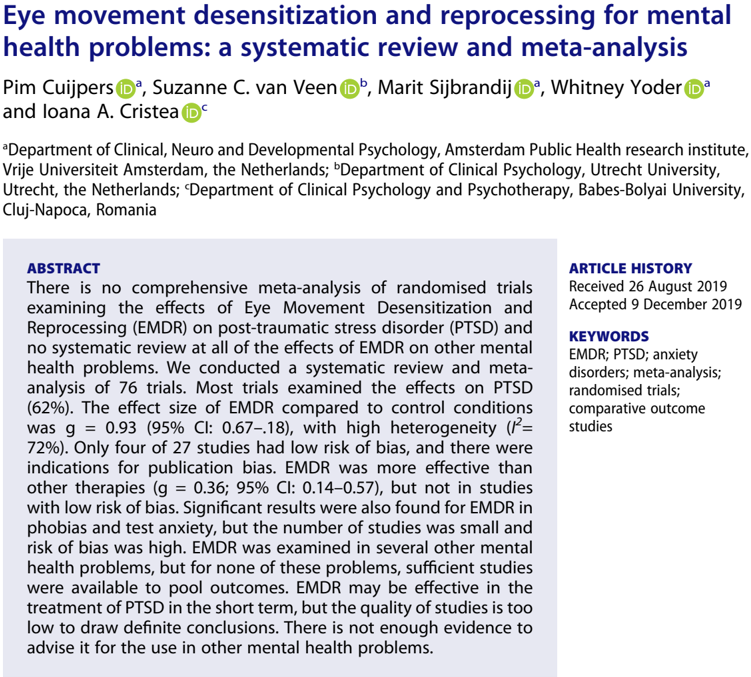
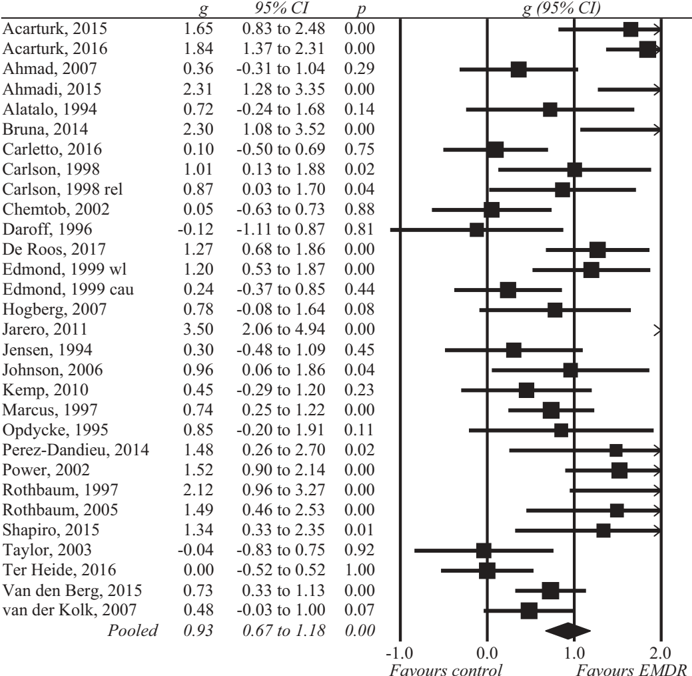
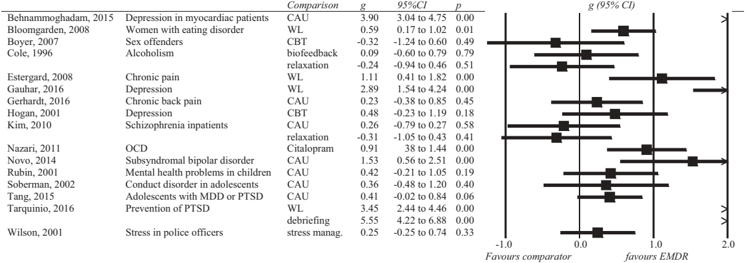
There is no comprehensive meta-analysis of randomised trials examining the effects of Eye Movement Desensitization and Reprocessing (EMDR) on post-traumatic stress disorder (PTSD) and no systematic review at all of the effects of EMDR on other mental health problems. We conducted a systematic review and meta-analysis of 76 trials. Most trials examined the effects on PTSD (62%). The effect size of EMDR compared to control conditions was g = 0.93 (95% CI: 0.67–.18), with high heterogeneity (I2= 72%). Only four of 27 studies had low risk of bias, and there were indications for publication bias. EMDR was more effective than other therapies (g = 0.36; 95% CI: 0.14–0.57), but not in studies with low risk of bias. Significant results were also found for EMDR in phobias and test anxiety, but the number of studies was small and risk of bias was high. EMDR was examined in several other mental health problems, but for none of these problems, sufficient studies were available to pool outcomes. EMDR may be effective in the treatment of PTSD in the short term, but the quality of studies is too low to draw definite conclusions. There is not enough evidence to advise it for the use in other mental health problems.
Overview
The claims and statistics of this paper haven’t been checked yet.
Free: it reads the open-access text and checks the first 5 claims that cite a source we can check. Create a free account to check every claim.
Integrity signals
Registry
Cites
Statistics
Figures




Verification
Claims the paper makes
The claims and statistics of this paper haven’t been checked yet.
Free: it reads the open-access text and checks the first 5 claims that cite a source we can check. Create a free account to check every claim.
Claims other papers make about this one
Each is checked against this paper’s own text: does it say what the citing paper says it does?
The source backs part of the claim, not all of it — or backs it for a different population, condition or comparison.
In the citing paper
“but the majority have methodological limitations, including the risk of bias, small samples, and the lack of an active control condition [38, 40].”
From Eye movement desensitization and reprocessing (EMDR) therapy or supportive counseling prior to exposure therapy in patients with panic disorder: study protocol for a multicenter randomized controlled trial (IMPROVE) (2023) · cites this paper as [38]
Experimental — accuracy not yet measuredThe source backs part of the claim, not all of it — or backs it for a different population, condition or comparison.
In the citing paper
“Preliminary research has also shown promising results of clinical interventions that specifically focus on threat imagery in anxiety disorders, such as imagery rescripting [34–37] or EMDR therapy [38–40].”
From Eye movement desensitization and reprocessing (EMDR) therapy or supportive counseling prior to exposure therapy in patients with panic disorder: study protocol for a multicenter randomized controlled trial (IMPROVE) (2023) · cites this paper as [38]
Experimental — accuracy not yet measuredThe source backs part of the claim, not all of it — or backs it for a different population, condition or comparison.
In the citing paper
“Researcher allegiance bias is problematic in psychotherapy research [121, 122], including studies about EMDR therapy efficacy in anxiety disorders [38, 40].”
From Eye movement desensitization and reprocessing (EMDR) therapy or supportive counseling prior to exposure therapy in patients with panic disorder: study protocol for a multicenter randomized controlled trial (IMPROVE) (2023) · cites this paper as [38]
Experimental — accuracy not yet measuredThe source backs part of the claim, not all of it — or backs it for a different population, condition or comparison.
In the citing paper
“a recent meta-analysis suggests a high risk of bias across many of the studies included, and relatively small effect sizes for treatment efficacy [66].”
From Psychological Interventions for Survivors of Intimate Partner Violence in Humanitarian Settings: An Overview of the Evidence and Implementation Considerations (2022) · cites this paper as [66]
Experimental — accuracy not yet measuredThe source backs part of the claim, not all of it — or backs it for a different population, condition or comparison.
In the citing paper
“EMDR has been considered a highly effective treatment for PTS symptoms, including among survivors of sexual violence [65], though recent meta-analysis findings suggest that it is not effective for addressing other problems long term [66].”
From Psychological Interventions for Survivors of Intimate Partner Violence in Humanitarian Settings: An Overview of the Evidence and Implementation Considerations (2022) · cites this paper as [66]
Experimental — accuracy not yet measured
1 more claim about this paper
Create a free account to see every claim other papers make about this one.
Self-check
Percentages, sums and reported differences re-computed from the paper’s own numbers.
The self-check needs the paper’s full text.
Citations
Cites
Statistical Power Analysis for the Behavioral Sciences
Muller, K. (1989) · Technometrics · doi:10.1080/00401706.1989.10488618 · Cited by 99,167
Measuring inconsistency in meta-analyses
Higgins, J. P. T., Thompson, S. G., Deeks, J. J., & Altman, D. G. (2003) · BMJ · doi:10.1136/bmj.327.7414.557 · Cited by 63,139
Statistical Power Analysis for the Behavioral Sciences (2nd ed.).
Lachenbruch, P. A., & Cohen, J. (1989) · Journal of the American Statistical Association · doi:10.2307/2290095 · Cited by 37,395
The Cochrane Collaboration's tool for assessing risk of bias in randomised trials
Higgins, J. P. T., Altman, D. G., Gotzsche, P. C., Juni, P., Moher, D., Oxman, A. D., Savovic, J., Schulz, K. F., Weeks, L., Sterne, J. A. C., et al. (2011) · BMJ · doi:10.1136/bmj.d5928 · Cited by 33,817 · cited 1×
“Risk of bias of included studies was assessed using five criteria of the “Risk of bias” assessment tool, developed by the Cochrane Collaboration (Higgins et al., 2011).”
Borenstein, M., Hedges, L. V., Higgins, J. P. T., & Rothstein, H. R. (2009) · doi:10.1002/9780470743386 · Cited by 14,225 · cited 3×
“Metaregression analyses were conducted according to the Knapp–Hartung procedures using the restricted maximum likelihood approach as implemented in CMA (Borenstein et al., 2009).”
MethodDuval, S., & Tweedie, R. (2000) · Biometrics · doi:10.1111/j.0006-341x.2000.00455.x · Cited by 14,099 · cited 1×
“Indications for publication bias were examined with Duval and Tweedie’s trim and fill procedure (Duval & Tweedie, 2000), which yields an estimate of the effect size after the publication bias has been taken into account, and with Egger’s test for the asymmetry of the funnel plot.”
MethodStatistical Methods for Meta-Analysis
Wasserman, S., Hedges, L. V., & Olkin, I. (1988) · Journal of Educational Statistics · doi:10.2307/1164953 · Cited by 10,326
Borenstein, M., Hedges, L. V., Higgins, J. P. T., & Rothstein, H. R. (2021) · doi:10.1002/9781119558378 · Cited by 9,799
Statistical Methods for Meta-Analysis.
Freeman, P. R., Hedges, L. V., & Olkin, I. (1986) · Biometrics · doi:10.2307/2531069 · Cited by 4,784
Mediators and Mechanisms of Change in Psychotherapy Research
Kazdin, A. E. (2007) · Annual Review of Clinical Psychology · doi:10.1146/annurev.clinpsy.3.022806.091432 · Cited by 2,504 · cited 1×
“Trials can show if a treatment works, but to show how a treatment works is much more complicated and requires an extensive range of different types of treatments (Kazdin, 2007).”
BackgroundBasics of meta‐analysis: I 2 is not an absolute measure of heterogeneity
Borenstein, M., Higgins, J. P. T., Hedges, L. V., & Rothstein, H. R. (2017) · Research Synthesis Methods · doi:10.1002/jrsm.1230 · Cited by 1,848
Freeman, A. M. (2001) · The Journal of Clinical Psychiatry · doi:10.4088/jcp.v62n1112 · Cited by 1,666
Uncertainty in heterogeneity estimates in meta-analyses
Ioannidis, J. P. A., Patsopoulos, N. A., & Evangelou, E. (2007) · BMJ · doi:10.1136/bmj.39343.408449.80 · Cited by 1,254
(2006) · Journal of Traumatic Stress · doi:10.1002/(issn)1573-6598 · Cited by 1,209
Albeck, J. H. (2001) · American Journal of Psychotherapy · doi:10.1176/appi.psychotherapy.2001.55.2.295 · Cited by 973
Efficacy of the eye movement desensitization procedure in the treatment of traumatic memories
Shapiro, F. (1989) · Journal of Traumatic Stress · doi:10.1002/jts.2490020207 · Cited by 964 · cited 2×
“An intervention was considered to be EMDRwhen it referred to EMDR as developed by Shapiro (1989).”
BackgroundMethodCusack, K., Jonas, D. E., Forneris, C. A., Wines, C., Sonis, J., Middleton, J. C., Feltner, C., Brownley, K. A., Olmsted, K. R., Greenblatt, A., et al. (2016) · Clinical Psychology Review · doi:10.1016/j.cpr.2015.10.003 · Cited by 865 · cited 2×
“We also checked the references of earlier meta-analyses (Boccia et al., 2015; Bisson & Andrew, 2007; Chen et al., 2014, 2015; Cusack et al., 2016; Ehring et al., 2014; Gillies et al., 2013; Lee & Cuijpers, 2013; Moreno-Alcázar et al., 2017).”
MethodSize of Treatment Effects and Their Importance to Clinical Research and Practice
Kraemer, H. C., & Kupfer, D. J. (2006) · Biological Psychiatry · doi:10.1016/j.biopsych.2005.09.014 · Cited by 850 · cited 1×
“Numbers-neededto-be-treated (NNT) were calculated using the formulae provided by Kraemer and Kupfer (2006).”
MethodThe Role of Common Factors in Psychotherapy Outcomes
Cuijpers, P., Reijnders, M., & Huibers, M. J. H. (2019) · Annual Review of Clinical Psychology · doi:10.1146/annurev-clinpsy-050718-095424 · Cited by 748
Self-citationPsychological treatment of post-traumatic stress disorder (PTSD)
Bisson, J., & Andrew, M. (2005) · Cochrane Database of Systematic Reviews · doi:10.1002/14651858.cd003388.pub2 · Cited by 654
Prolonged Exposure versus Eye Movement Desensitization and Reprocessing (EMDR) for PTSD rape victims
Rothbaum, B. O., Astin, M. C., & Marsteller, F. (2005) · Journal of Traumatic Stress · doi:10.1002/jts.20069 · Cited by 458
Ehring, T., Welboren, R., Morina, N., Wicherts, J. M., Freitag, J., & Emmelkamp, P. M. G. (2014) · Clinical Psychology Review · doi:10.1016/j.cpr.2014.10.004 · Cited by 373
The efficacy of non-directive supportive therapy for adult depression: A meta-analysis
Cuijpers, P., Driessen, E., Hollon, S. D., van Oppen, P., Barth, J., & Andersson, G. (2012) · Clinical Psychology Review · doi:10.1016/j.cpr.2012.01.003 · Cited by 369 · cited 1×
“For studies comparing EMDR with other therapies, we also examined researcher allegiance using four criteria adapted from Cuijpers et al. (2012).”
MethodSelf-citationA meta-analysis of the contribution of eye movements in processing emotional memories
Lee, C. W., & Cuijpers, P. (2013) · Journal of Behavior Therapy and Experimental Psychiatry · doi:10.1016/j.jbtep.2012.11.001 · Cited by 367 · cited 6×
“We also checked the references of earlier meta-analyses (Boccia et al., 2015; Bisson & Andrew, 2007; Chen et al., 2014, 2015; Cusack et al., 2016; Ehring et al., 2014; Gillies et al., 2013; Lee & Cuijpers, 2013; Moreno-Alcázar et al., 2017).”
BackgroundMethodResultInfluentialSelf-citationCarlson, J. G., Chemtob, C. M., Rusnak, K., Hedlund, N. L., & Muraoka, M. Y. (1998) · Journal of Traumatic Stress · doi:10.1023/a:1024448814268 · Cited by 257 · cited 1×
“…oth = Other; PI = prediction interval; PTSD = post-traumatic stress disorder; rel = relaxation; USA = United States of America. aAccording to the random effects model. bIn two studies, EMDR was compared with two different control conditions (Carlson et al., 1998; Edmond et al., 1999).”
ResultGillies, D., Taylor, F., Gray, C., O'Brien, L., & D'Abrew, N. (2012) · Cochrane Database of Systematic Reviews · doi:10.1002/14651858.cd006726.pub2 · Cited by 239
Chen, Y.-R., Hung, K.-W., Tsai, J.-C., Chu, H., Chung, M.-H., Chen, S.-R., Liao, Y.-M., Ou, K.-L., Chang, Y.-C., & Chou, K.-R. (2014) · PLoS ONE · doi:10.1371/journal.pone.0103676 · Cited by 222
Herbert, J. (2000) · Clinical Psychology Review · doi:10.1016/s0272-7358(99)00017-3 · Cited by 210 · cited 1×
“Although EMDR received considerable skepticism from the scientific community when it first appeared in the late 1980s (Herbert et al., 2000; McNally, 2013), it has been examined since then in dozens of randomized trials.”
BackgroundBarrowcliff, A. L., Gray, N. S., Freeman, T. C., & MacCulloch, M. J. (2004) · Journal of Forensic Psychiatry & Psychology · doi:10.1080/14789940410001673042 · Cited by 189 · cited 1×
“The first model suggests that EMDR elicit an orienting response (Barrowcliff et al., 2004; Lee & Cuijpers, 2013; Schubert et al., 2010).”
BackgroundDiehle, J., Opmeer, B. C., Boer, F., Mannarino, A. P., & Lindauer, R. J. L. (2015) · European Child & Adolescent Psychiatry · doi:10.1007/s00787-014-0572-5 · Cited by 170
Acarturk, C., Konuk, E., Cetinkaya, M., Senay, I., Sijbrandij, M., Gulen, B., & Cuijpers, P. (2016) · Psychological Medicine · doi:10.1017/s0033291716001070 · Cited by 165
Self-citationGillies, D., Taylor, F., Gray, C., O'Brien, L., & D'Abrew, N. (2013) · Evidence-Based Child Health: A Cochrane Review Journal · doi:10.1002/ebch.1916 · Cited by 154 · cited 1×
“We also checked the references of earlier meta-analyses (Boccia et al., 2015; Bisson & Andrew, 2007; Chen et al., 2014, 2015; Cusack et al., 2016; Ehring et al., 2014; Gillies et al., 2013; Lee & Cuijpers, 2013; Moreno-Alcázar et al., 2017).”
MethodChen, L., Zhang, G., Hu, M., & Liang, X. (2015) · Journal of Nervous & Mental Disease · doi:10.1097/nmd.0000000000000306 · Cited by 147 · cited 1×
“We also checked the references of earlier meta-analyses (Boccia et al., 2015; Bisson & Andrew, 2007; Chen et al., 2014, 2015; Cusack et al., 2016; Ehring et al., 2014; Gillies et al., 2013; Lee & Cuijpers, 2013; Moreno-Alcázar et al., 2017).”
MethodThe effectiveness of EMDR with adult female survivors of childhood sexual abuse
Edmond, T., Rubin, A., & Wambach, K. G. (1999) · Social Work Research · doi:10.1093/swr/23.2.103 · Cited by 135 · cited 1×
“…oth = Other; PI = prediction interval; PTSD = post-traumatic stress disorder; rel = relaxation; USA = United States of America. aAccording to the random effects model. bIn two studies, EMDR was compared with two different control conditions (Carlson et al., 1998; Edmond et al., 1999).”
ResultSchubert, S. J., Lee, C. W., & Drummond, P. D. (2010) · Journal of Anxiety Disorders · doi:10.1016/j.janxdis.2010.06.024 · Cited by 132
Jarero, I., Artigas, L., & Luber, M. (2011) · Journal of EMDR Practice and Research · doi:10.1891/1933-3196.5.3.82 · Cited by 129 · cited 1×
“…effect size and in the second one we included only the smallest effect size. cAcarturk et al., 2016; Ahmadi, Hazrati, Ahmadizadeh, & Noohi, 2015; Jarero et al., 2011; Ter Heide, Mooren, van de Schoot, de Jongh, & Kleber, 2016). dCannot be calculated when the number of studies is smaller than 3.”
Backgroundvan den Hout, M., Engelhard, I. M., Beetsma, D. J. V., Slofstra, C., Hornsveld, H. K., Houtveen, J. H., & Leer, A. (2011) · Journal of Behavior Therapy and Experimental Psychiatry · doi:10.1016/j.jbtep.2011.03.004 · Cited by 122 · cited 3×
“The second well-examined model for how EMDR works is based on the fact that the working memory has only limited capacity (van den Hout et al., 2011).”
BackgroundResultInfluentialMoreno-Alcázar, A., Treen, D., Valiente-Gómez, A., Sio-Eroles, A., Pérez, V., Amann, B. L., & Radua, J. (2017) · Frontiers in Psychology · doi:10.3389/fpsyg.2017.01750 · Cited by 109 · cited 2×
“We also checked the references of earlier meta-analyses (Boccia et al., 2015; Bisson & Andrew, 2007; Chen et al., 2014, 2015; Cusack et al., 2016; Ehring et al., 2014; Gillies et al., 2013; Lee & Cuijpers, 2013; Moreno-Alcázar et al., 2017).”
MethodNovo, P., Landín-Romero, R., Raduà, J., Viçens, V., Fernández, I., Garcia, F., Pomarol‐Clotet, E., McKenna, P. J., Shapiro, F., & Amann, B. L. (2014) · Psychiatry Research · doi:10.1016/j.psychres.2014.05.012 · Cited by 105 · cited 1×
“…current stressful situations, and future difficulties play an important role in these disorders, and EMDR can help in processing these, for example, in bipolar disorder (Novo et al., 2014), conduct disorder (Soberman, Greenwald, & Rule, 2002) or eating disorders (Bloomgarden & Calogero, 2008).”
BackgroundSoberman, G. B., Greenwald, R., & Rule, D. L. (2002) · Journal of Aggression, Maltreatment & Trauma · doi:10.1300/j146v06n01_11 · Cited by 95
ter Heide, F. J. J., Mooren, T. M., van de Schoot, R., de Jongh, A., & Kleber, R. J. (2016) · British Journal of Psychiatry · doi:10.1192/bjp.bp.115.167775 · Cited by 78
Cusack, K., & Spates, C. R. (1999) · Journal of Anxiety Disorders · doi:10.1016/s0887-6185(98)00041-3 · Cited by 64 · cited 1×
“…PTSD = post-traumatic stress disorder. aAccording to the random effects model. bNone of the studies had low risk of bias. cIn the 10th study (Cusack & Spates, 1999), full EMDR was compared with EMDR without the explicit cognitive elements included in the treatment. dThis cannot be…”
Jarero, I., Amaya, C., Givaudan, M., & Miranda, A. (2013) · Journal of EMDR Practice and Research · doi:10.1891/1933-3196.7.2.55 · Cited by 64
Staring, A. B. P., van den Berg, D. P. G., Cath, D. C., Schoorl, M., Engelhard, I. M., & Korrelboom, C. W. (2016) · Behaviour Research and Therapy · doi:10.1016/j.brat.2016.04.002 · Cited by 62 · cited 2×
“EMDR was compared with other therapies in the treatment of anxiety disorders in nine trials, but only one had lower risk of bias (Staring et al., 2016).”
BackgroundResultGerhardt, A., Leisner, S., Hartmann, M., Janke, S., Seidler, G. H., Eich, W., & Tesarz, J. (2016) · Frontiers in Psychiatry · doi:10.3389/fpsyt.2016.00201 · Cited by 56 · cited 1×
“Only one of the studies had low risk of bias (Gerhardt et al., 2016).”
BackgroundBloomgarden, A., & Calogero, R. M. (2008) · Eating Disorders · doi:10.1080/10640260802370598 · Cited by 50 · cited 1×
“…current stressful situations, and future difficulties play an important role in these disorders, and EMDR can help in processing these, for example, in bipolar disorder (Novo et al., 2014), conduct disorder (Soberman, Greenwald, & Rule, 2002) or eating disorders (Bloomgarden & Calogero, 2008).”
BackgroundOn Eye Movements and Animal Magnetism
McNally, R. J. (1999) · Journal of Anxiety Disorders · doi:10.1016/s0887-6185(99)00020-1 · Cited by 33 · cited 1×
“In other words, “what is effective in EMDR is not new, and what is new is not effective” (McNally, 1999).”
BackgroundAhmadi, K., Hazrati, M., Ahmadizadeh, M., & Noohi, S. (2015) · Acta medica Indonesiana · Cited by 32
EMDR therapy for PTSD after motor vehicle accidents: meta-analytic evidence for specific treatment
Boccia, M., Piccardi, L., Cordellieri, P., Guariglia, C., & Giannini, A. M. (2015) · Frontiers in Human Neuroscience · doi:10.3389/fnhum.2015.00213 · Cited by 30 · cited 2×
“…treatment of PTSD with large effect sizes compared to control conditions, and comparable effects compared to cognitive behavioral therapies (Boccia et al., 2015; Bisson & Andrew, 2007; Chen et al., 2014; Chen, Zhang, Hu, & Liang, 2015; Cusack et al., 2016; Ehring et al., 2014; Gillies,…”
BackgroundMethodSalkovskis, P. M. (2002) · Evidence-Based Mental Health · doi:10.1136/ebmh.5.1.13 · Cited by 10 · cited 1×
“…work is properly cited, and is not altered, transformed, or built upon in any way. cognitive behavioral elements that are included, most notably exposure to the traumatic memory, and that the eye movements do not have a specific contribution to the improvement of patients (Salkovskis, 2002).”
BackgroundThe Evolving Conceptualization and Treatment of PTSD: A Very Brief History
McNally, R. J. (2013) · PsycEXTRA Dataset · doi:10.1037/e649082013-004 · Cited by 3
Barbero (2014) · doi:10.1016/j · Cited by 1
Research works printed but not linked: 2
- Borenstein, M., Higgins, J., Hedges, L. V., & Rothstein, H. R. (2017). Basics of meta-analysis: I2 is not an absolute measure of heterogeneity. Research Synthesis and Methods , 8 , 5 -18. doi:10.1002/ jrsm.v8.1 · doi:10.1002/jrsm.v8.1
- Cuijpers, P. (2016). Meta-analyses in mental health research; A practical guide . Amsterdam: Vrije Universiteit. Retrieved from http://bit.do/meta-analysis
Cited by
Exposure therapy for PTSD: A meta-analysis
McLean, C. P., Levy, H. C., Miller, M. L., & Tolin, D. F. (2022) · Clinical Psychology Review · doi:10.1016/j.cpr.2021.102115 · Cited by 273
Treatment of Posttraumatic Stress Disorder: A State-of-the-art Review
Burback, L., Brémault-Phillips, S., Nijdam, M. J., McFarlane, A., & Vermetten, E. (2024) · Current Neuropharmacology · doi:10.2174/1570159x21666230428091433 · Cited by 208
Post-traumatic Stress Disorder
Merians, A. N., Spiller, T. R., Harpaz‐Rotem, I., Krystal, J. H., & Pietrzak, R. H. (2022) · Medical Clinics of North America · doi:10.1016/j.mcna.2022.04.003 · Cited by 132
A Public Health Perspective of Post-Traumatic Stress Disorder
Jowf, G. I. A., Ahmed, Z. T., An, N., Reijnders, R. A., Ambrosino, E., Rutten, B. P. F., de Nijs, L., & Eijssen, L. (2022) · International Journal of Environmental Research and Public Health · doi:10.3390/ijerph19116474 · Cited by 112
EMDR as Treatment Option for Conditions Other Than PTSD: A Systematic Review
Scelles, C., & Bulnes, L. C. (2021) · Frontiers in Psychology · doi:10.3389/fpsyg.2021.644369 · Cited by 91
Metadata
- Authors
- Cuijpers, P., Veen, S. C. V., Sijbrandij, M., Yoder, W., & Cristea, I. A.
- Affiliations
- Amsterdam Public Health (NL)
- Utrecht University (NL)
- Babeș-Bolyai University (RO)
- Corresponding author
- Cuijpers, Pim
- Venue
- Cognitive Behaviour Therapy
- Publisher
- Informa UK Limited
- Published
- 2020-02-11
- Volume
- 49
- Issue
- 3
- Pages
- 165-180
- ISSN
- 1650-6073 (ISSN-L)
- 1651-2316
- OpenAlex
- W2967192873
- Semantic Scholar
- 1e4931a4b62188fb9186dfb3080a0d040494ad5e
- Cited by
- 159
- References
- 52
- Citations by year
- 2026: 18 · 2025: 22 · 2024: 19 · 2023: 29 · 2022: 41 · 2021: 22 · 2020: 8
- FWCI
- 1.96
- Type
- journal article
- Language
- en
- Open access
- hybrid
- doi.org
- Licence
- Locations
- Cognitive Behaviour Therapy (publishedVersion, cc-by-nc-nd)
- PubMed (publishedVersion)
- VU Research Portal (publishedVersion, other-oa)
- Padua Research Archive (University of Padova) (submittedVersion, cc-by-nc-nd)
- Data Archiving and Networked Services (DANS) (submittedVersion, other-oa)
- Topics
- Social Sciences › Psychology › Clinical Psychology › Posttraumatic Stress Disorder Research
- Social Sciences › Psychology › Clinical Psychology › Psychotherapy Techniques and Applications
- Social Sciences › Psychology › Clinical Psychology › Psychoanalysis and Psychopathology Research
- Keywords
- EMDR, post-traumatic stress disorder, phobia, test anxiety, psychotherapy, psychotherapy efficacy, risk of bias, publication bias
- MeSH terms
- Mental Disorders, Humans, Stress Disorders, Post-Traumatic, Eye Movement Desensitization Reprocessing
About these checks
Registry, retraction, Cites and statistics results are computed, not judged, with one exception: a printed reference that no index lists is read once by a model before it counts as a citation error. Claims are extracted by a model and kept only when their quote appears verbatim in the text; each cited source is then checked, with a model’s help, for whether it says what the claim relies on. Those verdicts can be wrong — read the claim’s quote and the cited source before relying on one.
Statistics and arithmetic are recomputed, not judged.
Confidence bands are shown only for fields calibrated on our annotated test set. None is calibrated yet, so no band is shown.
What counts as a claim ›How we measure confidence ›How we check this ›
Are you an author, or do you see a problem with this page? Request a review
Data sources
Bibliographic data: Semantic Scholar, OpenAlex, Crossref.
Contains information from the Semantic Scholar Academic Graph Datasets, made available under the ODC Attribution License (ODC-BY 1.0).
Semantic Scholar’s data is described in: Kinney, R., et al. (2023). The Semantic Scholar Open Data Platform. arXiv:2301.10140.
