

Eye movement desensitization and reprocessing for mental health problems: a systematic review and meta-analysis
Open accessThe DOI matches its Crossref record; 52 of the 52 references it cites were found in a registry or an index.
Abstract
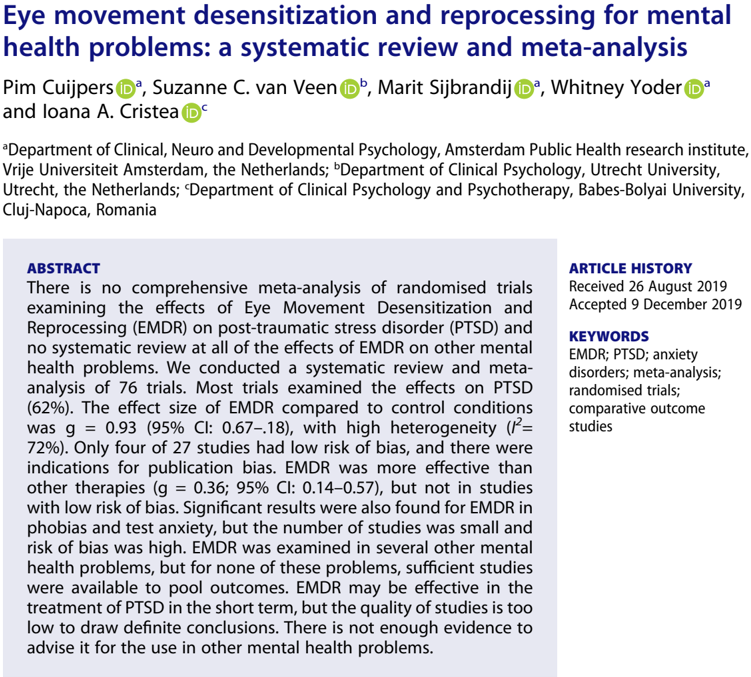
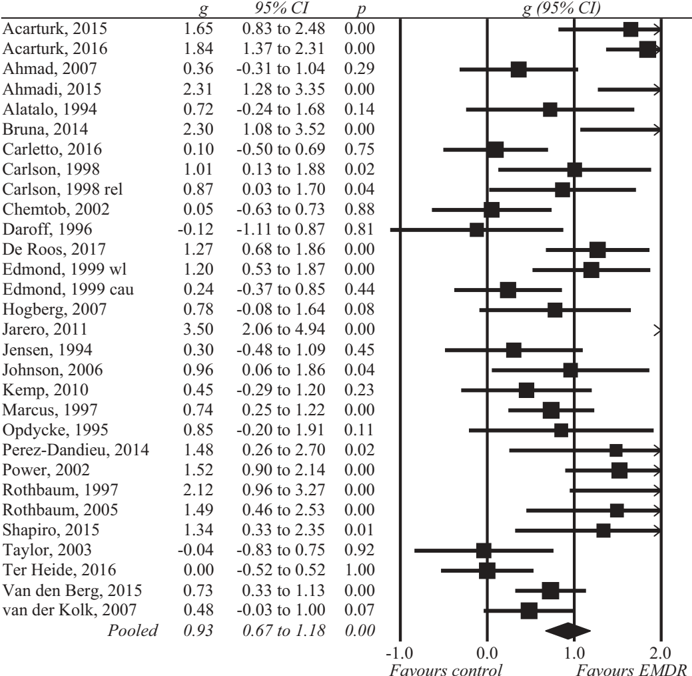
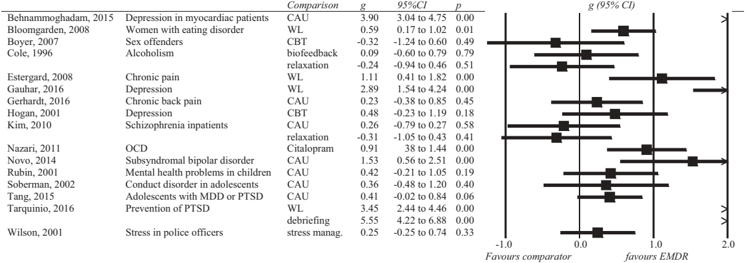
There is no comprehensive meta-analysis of randomised trials examining the effects of Eye Movement Desensitization and Reprocessing (EMDR) on post-traumatic stress disorder (PTSD) and no systematic review at all of the effects of EMDR on other mental health problems. We conducted a systematic review and meta-analysis of 76 trials. Most trials examined the effects on PTSD (62%). The effect size of EMDR compared to control conditions was g = 0.93 (95% CI: 0.67–.18), with high heterogeneity (I2= 72%). Only four of 27 studies had low risk of bias, and there were indications for publication bias. EMDR was more effective than other therapies (g = 0.36; 95% CI: 0.14–0.57), but not in studies with low risk of bias. Significant results were also found for EMDR in phobias and test anxiety, but the number of studies was small and risk of bias was high. EMDR was examined in several other mental health problems, but for none of these problems, sufficient studies were available to pool outcomes. EMDR may be effective in the treatment of PTSD in the short term, but the quality of studies is too low to draw definite conclusions. There is not enough evidence to advise it for the use in other mental health problems.
Overview
The claims and statistics of this paper haven’t been checked yet.
Free: it reads the open-access text and checks the first 5 claims that cite a source we can check. Create a free account to check every claim.
Integrity signals
Registry
Cites
Statistics
Figures




Verification
Claims the paper makes
The claims and statistics of this paper haven’t been checked yet.
Free: it reads the open-access text and checks the first 5 claims that cite a source we can check. Create a free account to check every claim.
Claims other papers make about this one
Each is checked against this paper’s own text: does it say what the citing paper says it does?
The source backs part of the claim, not all of it — or backs it for a different population, condition or comparison.
In the citing paper
“but the majority have methodological limitations, including the risk of bias, small samples, and the lack of an active control condition [38, 40].”
From Eye movement desensitization and reprocessing (EMDR) therapy or supportive counseling prior to exposure therapy in patients with panic disorder: study protocol for a multicenter randomized controlled trial (IMPROVE) (2023) · cites this paper as [38]
Experimental — accuracy not yet measuredThe source backs part of the claim, not all of it — or backs it for a different population, condition or comparison.
In the citing paper
“Preliminary research has also shown promising results of clinical interventions that specifically focus on threat imagery in anxiety disorders, such as imagery rescripting [34–37] or EMDR therapy [38–40].”
From Eye movement desensitization and reprocessing (EMDR) therapy or supportive counseling prior to exposure therapy in patients with panic disorder: study protocol for a multicenter randomized controlled trial (IMPROVE) (2023) · cites this paper as [38]
Experimental — accuracy not yet measuredThe source backs part of the claim, not all of it — or backs it for a different population, condition or comparison.
In the citing paper
“Researcher allegiance bias is problematic in psychotherapy research [121, 122], including studies about EMDR therapy efficacy in anxiety disorders [38, 40].”
From Eye movement desensitization and reprocessing (EMDR) therapy or supportive counseling prior to exposure therapy in patients with panic disorder: study protocol for a multicenter randomized controlled trial (IMPROVE) (2023) · cites this paper as [38]
Experimental — accuracy not yet measuredThe source backs part of the claim, not all of it — or backs it for a different population, condition or comparison.
In the citing paper
“a recent meta-analysis suggests a high risk of bias across many of the studies included, and relatively small effect sizes for treatment efficacy [66].”
From Psychological Interventions for Survivors of Intimate Partner Violence in Humanitarian Settings: An Overview of the Evidence and Implementation Considerations (2022) · cites this paper as [66]
Experimental — accuracy not yet measuredThe source backs part of the claim, not all of it — or backs it for a different population, condition or comparison.
In the citing paper
“EMDR has been considered a highly effective treatment for PTS symptoms, including among survivors of sexual violence [65], though recent meta-analysis findings suggest that it is not effective for addressing other problems long term [66].”
From Psychological Interventions for Survivors of Intimate Partner Violence in Humanitarian Settings: An Overview of the Evidence and Implementation Considerations (2022) · cites this paper as [66]
Experimental — accuracy not yet measured
1 more claim about this paper
Create a free account to see every claim other papers make about this one.
Self-check
Percentages, sums and reported differences re-computed from the paper’s own numbers.
The self-check needs the paper’s full text.
Citations
Cites
Statistical Power Analysis for the Behavioral Sciences
Muller, K. (1989) · Technometrics · doi:10.1080/00401706.1989.10488618 · Cited by 99,167
Measuring inconsistency in meta-analyses
Higgins, J. P. T., Thompson, S. G., Deeks, J. J., & Altman, D. G. (2003) · BMJ · doi:10.1136/bmj.327.7414.557 · Cited by 63,139
Statistical Power Analysis for the Behavioral Sciences (2nd ed.).
Lachenbruch, P. A., & Cohen, J. (1989) · Journal of the American Statistical Association · doi:10.2307/2290095 · Cited by 37,395
The Cochrane Collaboration's tool for assessing risk of bias in randomised trials
Higgins, J. P. T., Altman, D. G., Gotzsche, P. C., Juni, P., Moher, D., Oxman, A. D., Savovic, J., Schulz, K. F., Weeks, L., Sterne, J. A. C., et al. (2011) · BMJ · doi:10.1136/bmj.d5928 · Cited by 33,817 · cited 1×
“Risk of bias of included studies was assessed using five criteria of the “Risk of bias” assessment tool, developed by the Cochrane Collaboration (Higgins et al., 2011).”
Borenstein, M., Hedges, L. V., Higgins, J. P. T., & Rothstein, H. R. (2009) · doi:10.1002/9780470743386 · Cited by 14,225 · cited 3×
“Metaregression analyses were conducted according to the Knapp–Hartung procedures using the restricted maximum likelihood approach as implemented in CMA (Borenstein et al., 2009).”
MethodDuval, S., & Tweedie, R. (2000) · Biometrics · doi:10.1111/j.0006-341x.2000.00455.x · Cited by 14,099 · cited 1×
“Indications for publication bias were examined with Duval and Tweedie’s trim and fill procedure (Duval & Tweedie, 2000), which yields an estimate of the effect size after the publication bias has been taken into account, and with Egger’s test for the asymmetry of the funnel plot.”
MethodStatistical Methods for Meta-Analysis
Wasserman, S., Hedges, L. V., & Olkin, I. (1988) · Journal of Educational Statistics · doi:10.2307/1164953 · Cited by 10,326
Borenstein, M., Hedges, L. V., Higgins, J. P. T., & Rothstein, H. R. (2021) · doi:10.1002/9781119558378 · Cited by 9,799
Statistical Methods for Meta-Analysis.
Freeman, P. R., Hedges, L. V., & Olkin, I. (1986) · Biometrics · doi:10.2307/2531069 · Cited by 4,784
Mediators and Mechanisms of Change in Psychotherapy Research
Kazdin, A. E. (2007) · Annual Review of Clinical Psychology · doi:10.1146/annurev.clinpsy.3.022806.091432 · Cited by 2,504 · cited 1×
“Trials can show if a treatment works, but to show how a treatment works is much more complicated and requires an extensive range of different types of treatments (Kazdin, 2007).”
Background
Research works printed but not linked: 2
- Borenstein, M., Higgins, J., Hedges, L. V., & Rothstein, H. R. (2017). Basics of meta-analysis: I2 is not an absolute measure of heterogeneity. Research Synthesis and Methods , 8 , 5 -18. doi:10.1002/ jrsm.v8.1 · doi:10.1002/jrsm.v8.1
- Cuijpers, P. (2016). Meta-analyses in mental health research; A practical guide . Amsterdam: Vrije Universiteit. Retrieved from http://bit.do/meta-analysis
Cited by
Exposure therapy for PTSD: A meta-analysis
McLean, C. P., Levy, H. C., Miller, M. L., & Tolin, D. F. (2022) · Clinical Psychology Review · doi:10.1016/j.cpr.2021.102115 · Cited by 273
Treatment of Posttraumatic Stress Disorder: A State-of-the-art Review
Burback, L., Brémault-Phillips, S., Nijdam, M. J., McFarlane, A., & Vermetten, E. (2024) · Current Neuropharmacology · doi:10.2174/1570159x21666230428091433 · Cited by 208
Post-traumatic Stress Disorder
Merians, A. N., Spiller, T. R., Harpaz‐Rotem, I., Krystal, J. H., & Pietrzak, R. H. (2022) · Medical Clinics of North America · doi:10.1016/j.mcna.2022.04.003 · Cited by 132
A Public Health Perspective of Post-Traumatic Stress Disorder
Jowf, G. I. A., Ahmed, Z. T., An, N., Reijnders, R. A., Ambrosino, E., Rutten, B. P. F., de Nijs, L., & Eijssen, L. (2022) · International Journal of Environmental Research and Public Health · doi:10.3390/ijerph19116474 · Cited by 112
EMDR as Treatment Option for Conditions Other Than PTSD: A Systematic Review
Scelles, C., & Bulnes, L. C. (2021) · Frontiers in Psychology · doi:10.3389/fpsyg.2021.644369 · Cited by 91
Hudays, A., Gallagher, R. D., Hazazi, A., Arishi, A., & Bahari, G. (2022) · International Journal of Environmental Research and Public Health · doi:10.3390/ijerph192416836 · Cited by 89
“EMDR treatment is one of the psychological treatments and has been debated about its efficacy for treating PTSD patients [12,13].”
BackgroundTarquinio, C., Brennstuhl, M.-J., Rydberg, J. A., Bassan, F., Peter, L., Tarquinio, C. L., Auxéméry, Y., Rotonda, C., & Tarquinio, P. (2021) · Issues in Mental Health Nursing · doi:10.1080/01612840.2020.1818014 · Cited by 61
“EMDR therapy’s effectiveness in the treatment of PTSD has been clearly confirmed by several randomized controlled trials and meta-analyses (Bisson & Andrex, 2007; Bradley et al., 2005; Chen et al., 2014; Cuijpers et al., 2020; Lee & Cuijpers, 2013; Maxfield & Hyer, 2002; Seidler & Wagner, 2006; Van Etten & Taylor, 199…”
MethodWright, S. L., Karyotaki, E., Cuijpers, P. J., Bisson, J. I., Papola, D., Witteveen, A. B., Suliman, S., Spies, G., Ahmadi, K., Capezzani, L., et al. (2024) · Psychological Medicine · doi:10.1017/s0033291723003446 · Cited by 84
Self-citationEye movement desensitization and reprocessing for depression: a systematic review and meta-analysis
Carletto, S., Malandrone, F., Berchialla, P., Oliva, F., Colombi, N., Hase, M., Hofmann, A., & Ostacoli, L. (2021) · European Journal of Psychotraumatology · doi:10.1080/20008198.2021.1894736 · Cited by 72
“Moreover, in recent years EMDR has been applied to the treatment of psychiatric disorders beyond PTSD, such as depression, although it is not currently recommended by the guidelines (Cuijpers et al., 2020; Valiente-Gómez et al., 2017).”
MethodPTSD treatment in times of COVID-19: A systematic review of the effects of online EMDR
Lenferink, L. I. M., Meyerbröker, K., & Boelen, P. A. (2020) · Psychiatry Research · doi:10.1016/j.psychres.2020.113438 · Cited by 56
Belief traps: Tackling the inertia of harmful beliefs
Scheffer, M., Borsboom, D., Nieuwenhuis, S., & Westley, F. R. (2022) · Proceedings of the National Academy of Sciences · doi:10.1073/pnas.2203149119 · Cited by 66
“Finally, methods that utilize alternate bilateral sensory stimulation such as Eye Movement Desensitization and Reprocessing (EMDR) may be speculated to target neural mechanisms that act to destabilize associations (73), although the effectiveness and generality of these approaches in therapy is still subject to resear…”
MethodBelief in Unconscious Repressed Memory Persists
Otgaar, H., Howe, M. L., Dodier, O., Lilienfeld, S. O., Loftus, E. F., Lynn, S. J., Merckelbach, H. L. G. J., & Patihis, L. (2021) · Perspectives on Psychological Science · doi:10.1177/1745691621990628 · Cited by 63
“We hope that Brewin would agree with us that it is worthwhile to inform students, clinicians, and legal professionals about research that casts doubt on this phenomenon, including studies of retractors (i.e., people who have repudiated earlier claims of being abused; e.g., de Rivera, 2000).”
BackgroundBrewerton, T. D. (2023) · Frontiers in Psychiatry · doi:10.3389/fpsyt.2023.1149433 · Cited by 46
Mertens, G., Lund, M., & Engelhard, I. M. (2021) · Acta Psychologica · doi:10.1016/j.actpsy.2021.103424 · Cited by 40
EMDR Therapy as a Transdiagnostic Psychotherapy
Dominguez, S. K. (2023) · Oxford University Press eBooks · doi:10.1093/oxfordhb/9780192898357.013.18 · Cited by 32
Pintado, I. S., & Rasines-Laudes, P. (2023) · Psicothema · doi:10.7334/psicothema2022.309 · Cited by 41
“In line with Cuijpers et al. (2020), thinking that EMDR works only from the behavioral or cognitive-behavioral component of the technique seems reductionist, ignoring the holistic nature of the eight phases.”
InfluentialPost-traumatic stress disorder following childbirth: a neglected cause
Ahsan, A., Nadeem, A., Habib, A., Basaria, A. A. A., Tariq, R., & Raufi, N. K. (2023) · Frontiers in Global Women s Health · doi:10.3389/fgwh.2023.1273519 · Cited by 30
“EMDR is a type of therapy that uses eye movements or other forms of rhythmic, bilateral stimulation to help individuals process traumatic memories and reduce distressing symptoms (17).”
BackgroundMcGowan, I. W., Fisher, N., Havens, J., & Proudlock, S. (2021) · BMC Psychiatry · doi:10.1186/s12888-021-03571-x · Cited by 23
“33) [57] across 23 studies using EMDR delivered in the same room as the client for the treatment of PTSD, and a large pooled effect size across 10 studies for the treatment of anxiety disorders (Hedges g = 1.”
BackgroundAzimisefat, P., de Jongh, A., de Jongh, A., Kanske, P., & Jamshidi, F. (2022) · Frontiers in Psychology · doi:10.3389/fpsyg.2022.919148 · Cited by 28
“For instance, individuals with specific phobias demonstrate commonalities with PTSD such as experiencing intrusive, disturbing, and frightening memories of earlier events associated with their phobic condition (De Jongh et al., 2002; Oosterink et al., 2009).”
BackgroundInfluentialOtgaar, H., Houben, S. T. L., Rassin, E., & Merckelbach, H. L. G. J. (2021) · Memory · doi:10.1080/09658211.2021.1966043 · Cited by 31
“EMDR is widely applied to treat people with Posttraumatic Stress Disorder (Cuijpers et al.,2020).”
MethodAsselbergs, J., van Bentum, J. S., Riper, H. M., Cuijpers, P. J., Holmes, E. A., & Sijbrandij, M. (2023) · Journal of Psychiatric Research · doi:10.1016/j.jpsychires.2023.01.028 · Cited by 24
Self-citationDriessen, H. P. A., Morsink, S., Busschbach, J. J. V., Hoogendijk, W. J. G., & Kranenburg, L. W. (2024) · European Journal of Psychotraumatology · doi:10.1080/20008066.2024.2341577 · Cited by 23
“The 2020 meta-analysis on the e ff ects of EMDR-therapy for mental health problems of Cuij-pers et al. included trials only, and found a large e ff ect size of EMDR-therapy for PTSD ( g = 0.93) (Cuijpers et al., 2020).”
InfluentialA Case for Translation From the Clinic to the Laboratory
Kredlow, M. A., de Voogd, L. D., & Phelps, E. A. (2022) · Perspectives on Psychological Science · doi:10.1177/17456916211039852 · Cited by 29
“EMDR is also used to treat other mental-health conditions (for review, see Cuijpers et al., 2020) such as mood disorders, anxiety disorders, substance-use disorders, and chronic pain, although there is less evidence to support these uses.”
MethodSeok, J., & Kim, J. I. (2024) · Journal of Clinical Medicine · doi:10.3390/jcm13185633 · Cited by 23
“A recent review of the effectiveness of EMDR therapy for major depression indicated that EMDR may be potentially effective for treating depression; however, it also highlighted methodological issues within the included studies [32,34].”
BackgroundResultEMDR therapy for misophonia: A pilot study of case series
Jager, I., Vulink, N., de Roos, C., & Denys, D. (2021) · European Journal of Psychotraumatology · doi:10.1080/20008198.2021.1968613 · Cited by 18
Lakin, D. P., García-Moreno, C., & Roesch, E. (2022) · International Journal of Environmental Research and Public Health · doi:10.3390/ijerph19052916 · Cited by 18
Lenferink, L. I. M., de Keijser, J., Smid, G. E., & Boelen, P. A. (2020) · Traumatology An International Journal · doi:10.1037/trm0000253 · Cited by 17
Sweetman, J., Knapp, P., McMillan, D., Fairhurst, C. M., Delgadillo, J., & Hewitt, C. E. (2022) · Psychotherapy Research · doi:10.1080/10503307.2022.2140616 · Cited by 23
“…the treatments offered by IAPT services such as guided self-help and cognitive behavioural therapy, are often beneficial (Barlow et al., 2000; Cuijpers et al., 2010, 2020; Norton & Price, 2007; Vernmark et al., 2010), and the service delivery of these is considered effective (Wakefield et…”
BackgroundAn Efficient System for Eye Movement Desensitization and Reprocessing (EMDR) Therapy: A Pilot Study
Goga, N., Boiangiu, C.-A., Vasilăţeanu, A., Popovici, A.-F., Drăgoi, M.-V., Popovici, R., Gancea, I. O., Pîrlog, M. C., Popa, R. C., & Hadăr, A. (2022) · Healthcare · doi:10.3390/healthcare10010133 · Cited by 19
“A more recent meta-analysis showed that EMDR treatment is efficient in reducing PTSD symptoms [6] and other mental health problems such as anxiety and depression [7,8].”
MethodNiemeyer, H., Lorbeer, N., Mohr, J., Baer, E., & Knaevelsrud, C. (2021) · Journal of Affective Disorders · doi:10.1016/j.jad.2021.12.056 · Cited by 20
Susanty, E., Sijbrandij, M., Srisayekti, W., Suparman, Y., & Huizink, A. C. (2022) · Frontiers in Psychology · doi:10.3389/fpsyg.2022.845520 · Cited by 14
Self-citationKranenburg, L. W., Bijma, H. H., Eggink, A. J., Knijff, E. M., & Lambregtse-van den Berg, M. P. (2022) · Frontiers in Psychology · doi:10.3389/fpsyg.2021.797901 · Cited by 14
“So far however, data on treatment programs for this group are limited and indeed recent studies emphasize the need for exploration of effective interventions for perinatal PTSD in mothers (de Bruijn et al., 2020; Grekin et al., 2021).”
BackgroundInfluentialStrelchuk, D., Turner, K. M., Smith, S., Bisson, J. I., Wiles, N., & Zammit, S. (2023) · European Journal of Psychotraumatology · doi:10.1080/20008066.2023.2281182 · Cited by 51
“The e ff ectiveness of in-person EMDR for PTSD has been widely examined (Cuijpers et al., 2020).”
BackgroundWaterman, L. Z., & Cooper, M. (2020) · BJPsych Open · doi:10.1192/bjo.2020.92 · Cited by 15
“5 Furthermore, two more recent meta-analyses comparing EMDR therapy with other therapies for PTSD found that EMDR was superior in reducing total PTSD scores, 6,7 particularly for reducing intrusive thoughts and arousal severity, 6 although studies were found to be at a high risk of bias.”
Landkroon, E., Salemink, E., & Engelhard, I. M. (2021) · Journal of Behavior Therapy and Experimental Psychiatry · doi:10.1016/j.jbtep.2021.101639 · Cited by 14
Kaur, K., Asnaani, A., Levy, H. C., Miller, M. L., Tolin, D. F., & McLean, C. P. (2024) · Journal of Clinical Psychology · doi:10.1002/jclp.23727 · Cited by 18
Revisiting the Origins of EMDR
Rosen, G. M. (2023) · Journal of Contemporary Psychotherapy · doi:10.1007/s10879-023-09582-x · Cited by 12
Feasibility of EMDR in Older Adults with PTSD to Reduce Frailty and Improve Quality of Life
Gielkens, E. M. J., Turksma, K., Kranenburg, L. W., Stas, L., Sobczak, S., van Alphen, S. P. J., & Rossi, G. M. P. (2022) · Clinical Gerontologist · doi:10.1080/07317115.2022.2114397 · Cited by 15
“A meta-analysis (Cuijpers, Veen, Sijbrandij, Yoder, & Cristea, 2020) showed EMDR to be more effective than control conditions ( g = 0.93).”
InfluentialVersluis, A., de Jongh, A., Mevissen, L., Schuengel, C., Bakkum, L., & Didden, R. (2025) · European Journal of Psychotraumatology · doi:10.1080/20008066.2025.2495642 · Cited by 11
“Although brief tracks of trauma-focused treatment have generally been found to reduce the severity of PTSD symptoms (Hoppen et al., 2023; Voorendonk et al., 2023), this may not necessarily translate into changes in behavioural problems (Cuijpers et al., 2020).”
Zimmerman, J. A., & Marcus, D. K. (2024) · Clinical Psychology & Psychotherapy · doi:10.1002/cpp.2974 · Cited by 12
Beyond Pharmacology: A Narrative Review of Alternative Therapies for Anxiety Disorders
Antos, Z., Zackiewicz, K., Tomaszek, N., Modzelewski, S., & Waszkiewicz, N. (2024) · Diseases · doi:10.3390/diseases12090216 · Cited by 22
“However, both this analysis and earlier ones [178] point to a need for even better methodologically designed studies.”
BackgroundLiu, A. Y., Gubbels, J., & de Castro, B. O. (2024) · Clinical Child and Family Psychology Review · doi:10.1007/s10567-024-00503-5 · Cited by 15
“Psychological therapies for PTSD usually have sustaining effects at one-year follow-up as meta-analyses have shown (Bisson et al., 2007; Cuijpers et al., 2020).”
A FLASH OF HOPE: Eye Movement Desensitization and Reprocessing (EMDR) Therapy.
Gainer, D. M., Alam, S., Alam, H., & Redding, H. (2020) · Innovations in clinical neuroscience · Cited by 31
Valedi, S., MoradiBaglooei, M., Ranjbaran, M., Chegini, V., Griffiths, M. D., & Alimoradi, Z. (2022) · BMC Psychology · doi:10.1186/s40359-022-00757-0 · Cited by 11
“Results of a current systematic review confirmed the lack of high quality studies regarding the effectiveness of EMDR on different mental health outcomes including unpleasant traumas [42] and other mental health problems [43].”
BackgroundMertens, G., van Dis, E. A. M., Krypotos, A., & Engelhard, I. M. (2021) · Journal of Anxiety Disorders · doi:10.1016/j.janxdis.2021.102447 · Cited by 12
Effectiveness of EMDR for decreasing symptoms of over‐arousal: A meta‐analysis
Balkin, R. S., Lenz, A. S., Russo, G. M., Powell, B. W., & Gregory, H. M. (2021) · Journal of Counseling & Development · doi:10.1002/jcad.12418 · Cited by 8
EMDR Therapy and PTSD: A Goal-Directed Predictive Processing Perspective
Vanderschoot, T., & Dessel, P. V. (2022) · Journal of EMDR Practice and Research · doi:10.1891/emdr-2022-0009 · Cited by 12
Eye movement desensitisation and reprocessing: part 1 – theory, procedure and use in PTSD
Udo, I. I., Javinsky, T.-R., & Awani, T. (2022) · BJPsych Advances · doi:10.1192/bja.2022.32 · Cited by 8
“Considering the more recent of these studies, a systematic review and meta-analysis by Cuijpers et al (2020) analysed 77 studies and came to the conclusion that EMDR had a large treatment effect size when compared with control conditions in the short-term treatment of PTSD.”
Snoek, A., van den End, A., Beekman, A. T. F., Dekker, J., Aarts, I., Blankers, M., Vriend, C., van den Heuvel, O. A., Lommerse, N. M., & Thomaes, K. (2025) · Psychotherapy and Psychosomatics · doi:10.1159/000544918 · Cited by 11
“The large treatment effects found in the current study align with prior research regarding the ef fi cacy of EMDR treatment [59] and DBT-PTSD [35].”
Myths of Trauma: Why Adversity Does Not Necessarily Make Us Sick
Paris, J. (2022) · doi:10.1093/med/9780197615768.001.0001 · Cited by 13
Kip, A., Iseke, L. N., Papola, D., Gastaldon, C., Barbui, C., & Morina, N. (2022) · Clinical Psychology Review · doi:10.1016/j.cpr.2022.102239 · Cited by 11
Cox, K. S., & Codd, R. T. (2023) · Research on Social Work Practice · doi:10.1177/10497315231206754 · Cited by 8
“Dismantling studies have shown that the most unique element of EMDR, alternating eye movements, are not necessary (Cuijpers et al., 2020), though a previous meta-analysis disputes this (Lee & Cuijpers, 2013).”
BackgroundKip, A., Ritter, L., Hoppen, T. H., Papola, D., Ostuzzi, G., Barbui, C., & Morina, N. (2025) · Journal of Anxiety Disorders · doi:10.1016/j.janxdis.2025.103017 · Cited by 17
Williams, T. R., Lynch, E., Jones, P., Bass, J. E., & Harrison, R. (2022) · IntechOpen eBooks · doi:10.5772/intechopen.103911 · Cited by 8
Pink, J., Ghomi, M., Smart, T., & Richardson, T. H. (2022) · Journal of EMDR Practice and Research · doi:10.1891/emdr-2022-0029 · Cited by 7
STAIR and STAIR/NT as a Treatment for Posttraumatic Stress: A Systematic Review
Lorbeer, N., Knaevelsrud, C., & Niemeyer, H. (2023) · Verhaltenstherapie · doi:10.1159/000526592 · Cited by 13
“…high efficacy of trauma-focused cognitive behavioral therapy for the treatment of PTSD, particularly prolonged exposure (PE), cognitive processing therapy (CPT), and cognitive therapy (CT), as well as eye movement desensitization and reprocessing (EMDR) [Cuijpers et al., 2020; Lewis et al., 2020].”
BackgroundClonidine for post-traumatic stress disorder: a systematic review of the current evidence
Marchi, M., Grenzi, P., & Boks, M. P. (2024) · European Journal of Psychotraumatology · doi:10.1080/20008066.2024.2366049 · Cited by 9
“This suggests that future research could investigate the potential bene fi ts of combining clonidine with PTSD-speci fi c psychotherapies such as eye movement desensitization and reprocessing (EMDR) (Cuijpers et al., 2020), also bearing in mind preliminary evidence of the impact of clonidine in memory consolidation (Gro…”
BackgroundInfluentialRadcliffe, P. J., & Patihis, L. (2025) · Memory · doi:10.1080/09658211.2025.2498929 · Cited by 8
Willis, N., Dowling, A. P. C., Deehan, T., & O'Reilly, G. (2022) · European Journal of Trauma & Dissociation · doi:10.1016/j.ejtd.2022.100308 · Cited by 14
Güçlü, A., & Alkar, Ö. Y. (2021) · Türk Psikoloji Yazıları · doi:10.31828/tpy1301996120210108m000032 · Cited by 6
Lorbeer, N., Knaevelsrud, C., & Niemeyer, H. (2022) · Verhaltenstherapie · doi:10.1159/000525756 · Cited by 5
“…insbesondere der Prolongierten Exposition (PE), der Kognitiven Prozesstherapie (Cognitive Processing Therapy, CPT) und der Kognitiven Therapie (Cognitive Therapy, CT) sowie des Eye Movement Desensitization and Reprocessing (EMDR) zur Behandlung der PTBS [Cuijpers et al., 2020; Lewis et al., 2020].”
BackgroundLazzaroni, E., Tosi, D., Pontiggia, S., Ermolli, R., Borghesi, L., Rigamonti, V., Frisone, E., & Piconi, S. (2022) · Frontiers in Psychology · doi:10.3389/fpsyg.2022.1059134 · Cited by 5
“EMDR is a well-established treatment for posttraumatic stress disorder (Cuijpers et al., 2020).”
BackgroundEye-Tracking Technology and its Application in Neuroscience
Pavlenko, V. D., Shamanina, T. V., & Chori, V. (2023) · IEEE International Conference on Intelligent Data Acquisition and Advanced Computing Systems: Technology and Applications (IDAACS) · doi:10.1109/idaacs58523.2023.10348754 · Cited by 17
“In line with contemporary PTSD care protocols, two psychotherapeutic methods are often recommended: Eye Movement Desensitization and Reprocessing (EMDR) [5]-[7] and Cognitive Behavioural Therapy (CBT) [8]-[10].”
MethodCorrigendum Compounds Errors and Again Fails to Support the Specificity of Acupoint Tapping
Spielmans, G. I., & Rosen, G. M. (2022) · The Journal of Nervous and Mental Disease · doi:10.1097/nmd.0000000000001376 · Cited by 5
Endhoven, B., De Cort, K., Matthijssen, S. J. M. A., de Jongh, A., van Minnen, A., Duits, P., Schruers, K. R. J., van Dis, E. A. M., Krypotos, A. M., Gerritsen, L., et al. (2023) · BMC Psychiatry · doi:10.1186/s12888-022-04320-4 · Cited by 4
“Several randomized controlled trials found that EMDR therapy focused on past aversive events reduces anxiety symptoms [39, 40], but the majority have methodological limitations, including the risk of bias, small samples, and the lack of an active control condition [38, 40].”
Backgroundvan Schie, K., & van Veen, S. C. (2025) · Current Opinion in Psychology · doi:10.1016/j.copsyc.2025.102155 · Cited by 5
Self-citationBolstering family therapy: Assimilating EMDR into ABFT in youth residential treatment
Dellorco, M., Lynch, O., Ziegelmeyer, E., Roeske, M., Winston‐Lindeboom, P., & Diamond, G. S. (2024) · Family Process · doi:10.1111/famp.13050 · Cited by 4
Phaf, R. H. (2023) · New Ideas in Psychology · doi:10.1016/j.newideapsych.2023.101026 · Cited by 5
van Geusau, V. A., de Jongh, A., Nuijs, M. D., Brouwers, T. C., Moerbeek, M., & Matthijssen, S. J. M. A. (2023) · Frontiers in Psychiatry · doi:10.3389/fpsyt.2023.1278052 · Cited by 9
Laugharne, R. A., Farid, M. M., James, C. J., Dutta, A., Mould, C., Molten, N., Laugharne, J. D. E., & Shankar, R. (2023) · Healthcare Technology Letters · doi:10.1049/htl2.12055 · Cited by 6
The politics of humanitarian aid: A case study of EMDR in Cambodia
Jordan, L. S., Seponski, D. M., Kelley, A. N., & Krpo, N. (2022) · Psychotherapy and Politics International · doi:10.24135/ppi.v20i1and2.07 · Cited by 5
Villegas-Ortega, J., Gálvez-Arévalo, R. A., Castilla-Encinas, A. M., Gutiérrez-González, B., Apolitano-Cárdenas, C., Alvarez-Arias, P. M. A., Paredes-Ángeles, R., & Taype-Rondán, Á. (2025) · Journal of Affective Disorders · doi:10.1016/j.jad.2025.120134 · Cited by 7
de Behrends, M. R. (2021) · Journal of EMDR Practice and Research · doi:10.1891/emdr-d-20-00026 · Cited by 4
“However, they argue for the need for more research to explore the long-term efficacy of EMDR therapy in anxiety disorders (Cuijpers et al., 2020; Yunitri et al., 2020).”
BackgroundTrauma and PTSD in the Perinatal Period
Hopkins, T. A., & Hellberg, S. N. (2021) · Springer eBooks · doi:10.1007/978-3-030-71497-0_16 · Cited by 4
Kaptan, S. K., & Brayne, M. (2021) · Counselling and Psychotherapy Research · doi:10.1002/capr.12479 · Cited by 8
The Eyes and Emotion Regulation: Helpful Tips for Counselors
Chrones, D., Martin, G. C., & Beeson, E. T. (2023) · Journal of Mental Health Counseling · doi:10.17744/mehc.45.1.04 · Cited by 3
Wetherell, S. (2026) · Annals of Psychophysiology · doi:10.29052/2412-3188.v9.i2.2022.67-75 · Cited by 5
Meckling, H. I., Nauta, M. H., van Hout, W. J. P. J., & Wessel, I. (2024) · Memory · doi:10.1080/09658211.2024.2307925 · Cited by 8
“EMDR is thought to be an e ff ective treatment for PTSD (Cusack et al., 2016; but see also Cuijpers et al., 2020), and consensus treatment guidelines for PTSD recommend it as one of the trauma-focused psychological interventions (see also Martin et al., 2021).”
THE EFFECT OF PHYSICAL FITNESS TO CHANGE HUMAN HEALTH AND IMPROVE THE QUALITY OF LIFE
Su, K., Jung, W.-J., Zhang, G., & Zhao, N. (2021) · Revista Brasileira de Medicina do Esporte · doi:10.1590/1517-8692202127032021_0095 · Cited by 3
Rosser, B. A., Agostinis, A., & Bond, J. (2023) · Journal of EMDR Practice and Research · doi:10.1891/emdr-2023-0009 · Cited by 3
Clients’ Experiences of Eye Movement Desensitization and Reprocessing Therapy
Hammond, M., Ryan, C., & Dwyer, A. (2023) · Journal of EMDR Practice and Research · doi:10.1891/emdr-2023-0018 · Cited by 5
Duhigg, C. C., David, J., Arenas, R. M., Quinn, D. K., Hubbard, H. I., Smith, T. B., & Richardson, J. D. (2025) · Aphasiology · doi:10.1080/02687038.2025.2467234 · Cited by 3
“Subsequent testing by Berg et al. (2009), in a sample of 92–100 participants across five phases of data collection (including ~31% people with aphasia), reported moderate correlation with the Beck Depression Inventory (BDI; Beck et al., 1961) ( r = .52) at 18 months post-stroke (although non-significance for people wi…”
InfluentialAjele, K. W., Ramonkga, B. N., & Idemudia, E. S. (2026) · Journal of EMDR Practice and Research · doi:10.34133/jemdr.0033 · Cited by 3
Complex post-traumatic stress disorder: a breakthrough in treating personality disorders
Tomalski, R., & Pietkiewicz, I. J. (2020) · Psychiatria i Psychologia Kliniczna · doi:10.15557/pipk.2020.0006 · Cited by 3
van der Asdonk, S., Kesarlal, A. R., Schuengel, C., Draaisma, N., de Roos, C., Zuidgeest, K., Rippe, R. C. A., & Alink, L. R. A. (2022) · Trials · doi:10.1186/s13063-022-06902-9 · Cited by 6
Lemkes, A. C., Struijs, S. Y., Littel, M., Ekkers, W. D. J., & van den Berg, J. F. (2024) · Journal of EMDR Practice and Research · doi:10.1891/emdr-2024-0002 · Cited by 2
Commentary: EMDR, RCTs, and the Proliferation of Trademarked Acronyms
Rosen, G. M., van der Does, W. A. J., Gaudiano, B. A., Pankratz, L., Spielmans, G. I., Hollon, S. D., & Davison, G. C. (2023) · Journal of Contemporary Psychotherapy · doi:10.1007/s10879-023-09606-6 · Cited by 2
“…1997; Devilly, 2002; Herbert et al., 2000; Lohr et al., 2015; Rosen, 1999); the confound of allegiance effects impacting randomized controlled trials (RCTs; Cuijpers et al., 2020); and the method's trademarked status, proprietary workshops and other promotional efforts (Herbert et al., 2000).”
Posttraumatic Stress Disorder, Personality Disorders, and Complex Posttraumatic Stress Disorder
Paris, J. (2022) · Oxford University Press eBooks · doi:10.1093/med/9780197615768.003.0007 · Cited by 1
Adegbesan, O. A., & Ofole, N. M. (2023) · Global Journal of Health Science · doi:10.5539/gjhs.v15n5p12 · Cited by 6
Bates, A. S., Golding, H., Rushbrook, S. C., Highfield, J. A., Pattison, N. A., Baldwin, D. S., Grocott, M. P. W., & Cusack, R. (2024) · BMJ Open · doi:10.1136/bmjopen-2023-081969 · Cited by 1
“25 Case studies with ICU survivors 26 27 and our own novel work with survivors of COVID- 19-related critical illness 28 also show promise, underscoring the need for systematic evaluation in this population.”
BackgroundEye movement desensitisation and reprocessing for survivors of life-threatening medical events
Bates, A. S., Baldwin, D. S., Pattison, N. A., Moyses, H. E., Huneke, N. T. M., Cortese, S., Grocott, M. P. W., & Cusack, R. (2024) · Cochrane Database of Systematic Reviews · doi:10.1002/14651858.cd015640 · Cited by 1
Dönmez, E., & Güzel, H. Ş. (2025) · Psikiyatride Guncel Yaklasimlar - Current Approaches in Psychiatry · doi:10.18863/pgy.1561033 · Cited by 2
Susanty, E., Sijbrandij, M., van der Mee, D. J., Srisayekti, W., Suparman, Y., & Huizink, A. C. (2025) · Journal of Behavior Therapy and Experimental Psychiatry · doi:10.1016/j.jbtep.2025.102052 · Cited by 3
Self-citationEye Movement Desensitization and Reprocessing for Chronic Pain: A Systematic Review
Singla, A., Futela, P., Arora, K., Toussaint, L. L., Ahmad, Z., Baptista, A. M., Anstine, C. V., Hurt, R. T., Philpot, L. M., & Mohabbat, A. B. (2025) · Journal of Integrative and Complementary Medicine · doi:10.1177/27683605251362035 · Cited by 3
“10,11 Indeed, previous systematic reviews have suggested that EMDR has ef fi cacy for chronic pain.”
Nuances in the memory undermining effects of EMDR and imagery rescripting
Otgaar, H., & Houben, S. T. L. (2025) · Current Opinion in Psychology · doi:10.1016/j.copsyc.2025.102198 · Cited by 2
Treating complex PTSD with Schema Therapy, ImRs and EMDR: a review and case study
van Hemert, M. T. C., de Jong, P. M., Brouwer, T. R., Zoon, L., Gunst, E., Claes, L., & Morrens, M. (2025) · European Journal of Psychotraumatology · doi:10.1080/20008066.2025.2573616 · Cited by 3
“Despite TF-CBT and EMDR’s efficacy, concerns exist regarding study quality, publication bias, and limited advantage over placebo (Bhat-tacharya et al., 2022; Cuijpers et al., 2020).”
Ajele, K. W., & Idemudia, E. S. (2025) · Journal of EMDR Practice and Research · doi:10.34133/jemdr.0017 · Cited by 1
Boosting memory activation to target aversive memories in dual-task interventions
Nuijs, M. D., Theunissen, T. P. M., van Schie, K., Brouwers, T. C., Cort, K. D., Schruers, K. R. J., & Matthijssen, S. J. M. A. (2025) · European Journal of Psychotraumatology · doi:10.1080/20008066.2025.2581537 · Cited by 1
“Although EMDR therapy is effective in reducing PTSD symptoms in patients with a PTSD diagnosis (e.g. Cuijpers et al., 2020), about one in four patients do not show a clinically significant decrease in these symptoms after EMDR therapy (Cusack et al., 2016).”
Estimation psychophysiological state via nonlinear dynamic integral models
Pavlenko, V. D., Shamanina, T. V., & Chori, V. (2023) · Applied Aspects of Information Technology · doi:10.15276/aait.06.2023.8 · Cited by 2
Is there a place for EMDR in neurology?
Magne, H. (2023) · Revue Neurologique · doi:10.1016/j.neurol.2023.10.016 · Cited by 1
Metadata
- Authors
- Cuijpers, P., Veen, S. C. V., Sijbrandij, M., Yoder, W., & Cristea, I. A.
- Affiliations
- Amsterdam Public Health (NL)
- Utrecht University (NL)
- Babeș-Bolyai University (RO)
- Corresponding author
- Cuijpers, Pim
- Venue
- Cognitive Behaviour Therapy
- Publisher
- Informa UK Limited
- Published
- 2020-02-11
- Volume
- 49
- Issue
- 3
- Pages
- 165-180
- ISSN
- 1650-6073 (ISSN-L)
- 1651-2316
- OpenAlex
- W2967192873
- Semantic Scholar
- 1e4931a4b62188fb9186dfb3080a0d040494ad5e
- Cited by
- 159
- References
- 52
- Citations by year
- 2026: 18 · 2025: 22 · 2024: 19 · 2023: 29 · 2022: 41 · 2021: 22 · 2020: 8
- FWCI
- 1.96
- Type
- journal article
- Language
- en
- Open access
- hybrid
- doi.org
- Licence
- Locations
- Cognitive Behaviour Therapy (publishedVersion, cc-by-nc-nd)
- PubMed (publishedVersion)
- VU Research Portal (publishedVersion, other-oa)
- Padua Research Archive (University of Padova) (submittedVersion, cc-by-nc-nd)
- Data Archiving and Networked Services (DANS) (submittedVersion, other-oa)
- Topics
- Social Sciences › Psychology › Clinical Psychology › Posttraumatic Stress Disorder Research
- Social Sciences › Psychology › Clinical Psychology › Psychotherapy Techniques and Applications
- Social Sciences › Psychology › Clinical Psychology › Psychoanalysis and Psychopathology Research
- Keywords
- EMDR, post-traumatic stress disorder, phobia, test anxiety, psychotherapy, psychotherapy efficacy, risk of bias, publication bias
- MeSH terms
- Mental Disorders, Humans, Stress Disorders, Post-Traumatic, Eye Movement Desensitization Reprocessing
About these checks
Registry, retraction, Cites and statistics results are computed, not judged, with one exception: a printed reference that no index lists is read once by a model before it counts as a citation error. Claims are extracted by a model and kept only when their quote appears verbatim in the text; each cited source is then checked, with a model’s help, for whether it says what the claim relies on. Those verdicts can be wrong — read the claim’s quote and the cited source before relying on one.
Statistics and arithmetic are recomputed, not judged.
Confidence bands are shown only for fields calibrated on our annotated test set. None is calibrated yet, so no band is shown.
What counts as a claim ›How we measure confidence ›How we check this ›
Are you an author, or do you see a problem with this page? Request a review
Data sources
Bibliographic data: Semantic Scholar, OpenAlex, Crossref.
Contains information from the Semantic Scholar Academic Graph Datasets, made available under the ODC Attribution License (ODC-BY 1.0).
Semantic Scholar’s data is described in: Kinney, R., et al. (2023). The Semantic Scholar Open Data Platform. arXiv:2301.10140.
