

The DOI matches its Crossref record; 31 of the 31 references it cites were found in a registry or an index.
Fast food consumption among young adolescents aged 12–15 years in 54 low- and middle-income countries
Open accessAbstract
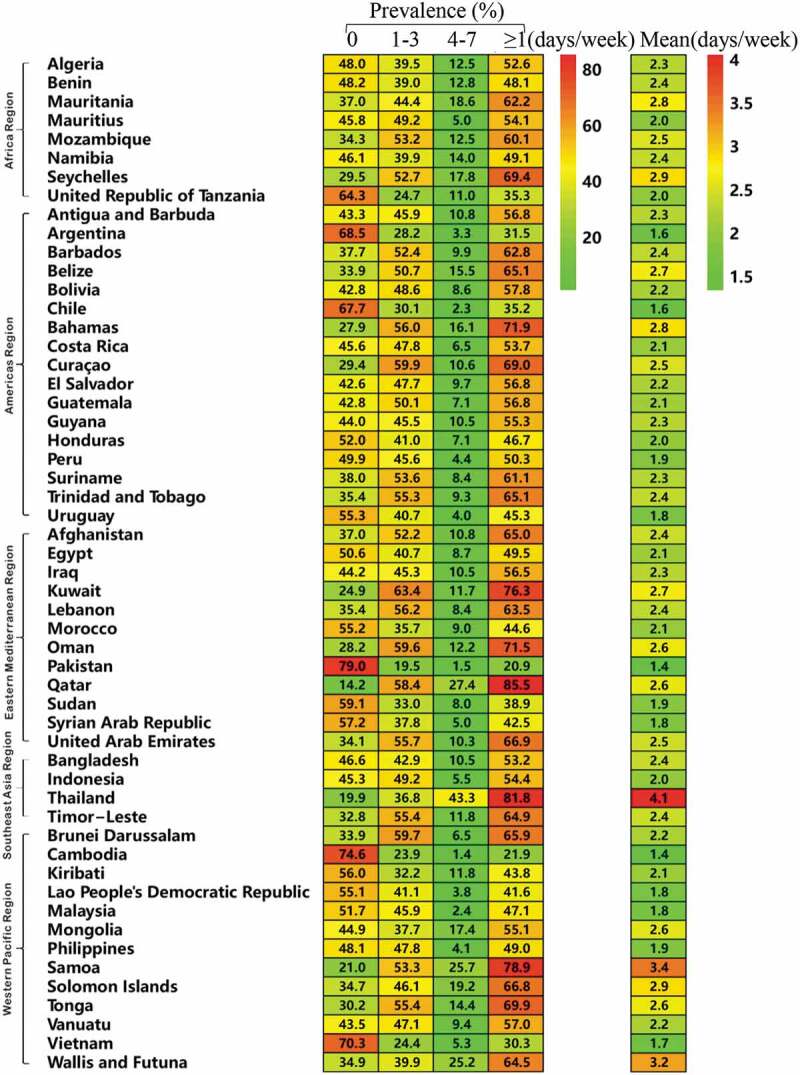
BACKGROUND: Most countries worldwide, especially low- and middle-income countries (LMICs), are facing an increasing prevalence of fast-food consumption and multiple burdens of malnutrition among young adolescents. OBJECTIVE: To compare the prevalence of fast-food consumption among young adolescents in LMICs. METHODS: We used data from the most recent Global School-Based Student Health Survey (2009-2015), which had been collected using a standardized questionnaire. The weighted prevalence and 95% confidential intervals of fast-food consumption were calculated overall and in subgroups stratified by age, sex, and nutritional status. The pooled overall and regional estimates were obtained using a random-effects model. Heterogeneity was assessed using the I2 statistic. The associated risk factors for fast-food consumption were explored using logistic regression analysis. RESULTS: Our study comprised 153,496 young adolescents (46.90% boys) from 54 LMICs. Overall, approximately 55.2% (51.3-59.1%) of the adolescents consumed fast food at least 1 day per week, and 10.3% (8.3-12.4%) did so 4-7 days per week. The prevalence of fast-food consumption 4-7 days per week was lowest in the Americas (8.3%; 6.7-9.9%) and highest in Southeast Asia (17.7%; 2.3-33.2%). At a country level, the prevalence was lowest in Pakistan (1.5%; 1.0-2.0%) and highest in Thailand (43.3%; 40.4-46.1%). Furthermore, in subgroups stratified by nutritional status, the prevalence was lowest in the obesity group (6.6%; 4.5-8.7%). Factors such as age, sex, BMI, food insecurity, fruit consumption, vegetable consumption, soft-drink consumption, smoking, physical activity level, and sedentary behavior level were found to be correlated with fast-food consumption. CONCLUSIONS: The identified high prevalence of fast-food consumption among young adolescents in LMICs indicates the urgent need to prioritize the implementation of healthy-diet promotion programs to improve adolescent health in these countries.
Overview
The claims and statistics of this paper haven’t been checked yet.
Run the check — free, no account needed. It reads the open-access text and checks the sources it cites.
Integrity signals
Registry
Cites
Statistics
Figures
Verification
Claims the paper makes
The claims and statistics of this paper haven’t been checked yet.
Run the check — free, no account needed. It reads the open-access text and checks the sources it cites.
Claims other papers make about this one
Each is checked against this paper’s own text: does it say what the citing paper says it does?
The source backs part of the claim, not all of it — or backs it for a different population, condition or comparison.
In the citing paper
“Adolescents in both low- and middle-income countries (LMICs) and high-income countries (HICs) frequently have diets that are calorie-dense yet nutrient-deficient, marked by excessive consumption of sugar-sweetened beverage (SSB), ultra-processed foods, and insufficient intake of FV [11–13].”
From School-based healthy eating interventions for adolescents aged 10–19 years: an umbrella review (2024) · cites this paper as [11]
Experimental — accuracy not yet measured
Self-check
Percentages, sums and reported differences re-computed from the paper’s own numbers.
The self-check needs the paper’s full text.
Citations
Cites
Global nutrition transition and the pandemic of obesity in developing countries
Popkin, B. M., Adair, L. S., & Ng, S. W. (2012) · Nutrition Reviews · doi:10.1111/j.1753-4887.2011.00456.x · Cited by 4,313 · cited 1×
“Globally, young adolescents, especially those in lowand middle-income countries (LMICs), are experiencing a nutritional transition in the form of a dramatic shift in food-consumption patterns from their respective countries’ traditional diet to a Westernized diet [1,2].”
BackgroundPereira, M. A., Kartashov, A. I., Ebbeling, C. B., Van Horn, L., Slattery, M. L., Jacobs, D. R., & Ludwig, D. S. (2005) · The Lancet · doi:10.1016/s0140-6736(04)17663-0 · Cited by 1,348 · cited 1×
“Such unhealthy dietary habits in youth are thus associated with an increased risk of obesity [7], cardiovascular disease [8], type 2 diabetes [9], and cancer [10] in later adulthood.”
Undue reliance on I 2 in assessing heterogeneity may mislead
Rücker, G., Schwarzer, G., Carpenter, J. R., & Schumacher, M. (2008) · BMC Medical Research Methodology · doi:10.1186/1471-2288-8-79 · Cited by 1,287
Obesity and the food system transformation in Latin America
Popkin, B. M., & Reardon, T. (2018) · Obesity Reviews · doi:10.1111/obr.12694 · Cited by 629 · cited 1×
“Examples include marketing controls, including the enaction and enforcement of regulations to limit the advertisement and sale of fast food [30], attaching front-of-pack supplementary nutritional labels, and implementing formula fast-foods contain less salt, saturated fat, trans-fat, sugar, and energy [30]; implementi…”
BackgroundNutrition in adolescents: physiology, metabolism, and nutritional needs
Das, J. K., Salam, R. A., Thornburg, K. L., Prentice, A. M., Campisi, S., Lassi, Z. S., Koletzko, B., & Bhutta, Z. A. (2017) · Annals of the New York Academy of Sciences · doi:10.1111/nyas.13330 · Cited by 597 · cited 1×
“Failure to meet nutrient requirements during adolescence can result in growth retardation, impaired organ remodeling, and micronutrient deficiencies [6].”
BackgroundPowell, L. M., & Nguyen, B. T. (2013) · JAMA Pediatrics · doi:10.1001/jamapediatrics.2013.417 · Cited by 346
Determinants of takeaway and fast food consumption: a narrative review
Janssen, H. G., Davies, I. G., Richardson, L. D., & Stevenson, L. (2017) · Nutrition Research Reviews · doi:10.1017/s0954422417000178 · Cited by 303 · cited 1×
“Notably, fast-food consumption among young adolescents in LMICs has increased significantly in recent decades [11].”
BackgroundNutritional challenges and health implications of takeaway and fast food
Jaworowska, A., Blackham, T., Davies, I. G., & Stevenson, L. (2013) · Nutrition Reviews · doi:10.1111/nure.12031 · Cited by 230 · cited 1×
“Fast food is a common component of Westernstyle diets, and is energy-dense, nutrient-poor, low in fiber and micronutrients, and high in refined grains, sodium, and sugar [3,4].”
BackgroundCaleyachetty, R., Thomas, G. N., Kengne, A. P., Echouffo-Tcheugui, J. B., Schilsky, S., Khodabocus, J., & Uauy, R. D. (2018) · American Journal of Clinical Nutrition · doi:10.1093/ajcn/nqy105 · Cited by 207 · cited 2×
“In addition, as multiple burdens of malnutrition are common in young adolescents in LMICs [13], we also performed subgroup analyses stratified by nutritional status.”
MethodManyanga, T., El-Sayed, H. F., Doku, D. T., & Randall, J. R. (2014) · BMC Public Health · doi:10.1186/1471-2458-14-887 · Cited by 204 · cited 1×
“Consistent with our findings, another research also found that obesity was not associated with fast-food consumption among adolescents [26].”
Result
Cited by
Sorted by citations
Items 101–134 of 134
Nasir, M., Junaid, K., Arshad, A., & Rafique, S. (2023) · Annals of King Edward Medical University · doi:10.21649/akemu.v23i4.5411
Fahlevi, M., Dandi, M., Matroji, F. J., & Asetya, D. R. (2024) · IOP Conference Series Earth and Environmental Science · doi:10.1088/1755-1315/1324/1/012130
“This relationship between perceived benefit and purchase intention, as observed in prior research [8,50], is affirmed by our study in the context of hydroponic products, emphasizing its importance in the consumer decision-making process.”
BackgroundResultBarrett, R., Zuckerman, M. K., Dudgeon, M. R., & Armelagos, G. J. (2024) · doi:10.1093/oso/9780192843135.003.0005
Minaker, L. M., Menko, P., & Olona, D. (2024) · Public Health Nutrition · doi:10.1017/s1368980024000983
“A more recent study using data from fifty-four countries participating in the same survey found that 55 % of adolescents consumed fast food at least once per week, and 10 % did so between 4 and 7 d per week (18) .”
BackgroundEdukasi Gizi Remaja Saat Terjadi Pergeseran Konsumsi Makanan Tradisional dan Fast Food di Indonesia
Briawan, D., Khomsan, K., Alfiah, A., Nasution, N., & Putri, P. (2022) · Policy Brief Pertanian Kelautan dan Biosains Tropika · doi:10.29244/agro-maritim.0402.252-255
Yu, F., & Xi, T. (2024) · American Journal of Health Behavior · doi:10.5993/ajhb.48.3.15
Addressing Global Food Security Through Cellular Agriculture
Hamad, A. M. A. (2024) · Advances in environmental engineering and green technologies book series · doi:10.4018/979-8-3693-4115-5.ch010
Gaikwad, S., Asokan, D., Mall, A., Sharma, S. K., & Pardeshi, G. S. (2024) · World Journal of Biology Pharmacy and Health Sciences · doi:10.30574/wjbphs.2024.19.2.0553
Anwar, S., Syed, Q. A., Saleh, M., Akram, M. S., Sultan, G., Khalid, S., Ishaq, A., Abdi, G., & Aadil, R. M. (2024) · Journal of Agriculture and Food Research · doi:10.1016/j.jafr.2024.101568
Ywgne, J., Werneck, A. O., Bizzozero‐Peroni, B., Christófaro, D. G. D., Monteiro, F. C., Pinheiro, I. K. A. D. S., Sadarangani, K. P., Tassitano, R. M., & da Silva, D. R. P. (2025) · Revista Brasileira de Atividade Física & Saúde · doi:10.12820/rbafs.29e0374
Prevalence and frequency of fast food consumption among university of Zambia students
Malama, E. (2025) · Journal of Current Research in Food Science · doi:10.22271/foodsci.2025.v6.i1f.231
Marcadores de consumo alimentar de adolescentes
Souza, L. O., Targino, I. S., Andrade, J. C., da Silva, D. G., & Voci, S. M. (2025) · Segurança Alimentar e Nutricional · doi:10.20396/san.v31i00.8677420
Deng, Y., Zhao, L., Guo, L., Zhang, Y. L., Lan, Y., Mou, Y., Ran, W., Liu, L., Shi, Z., & Zhao, Y. (2025) · Frontiers in Nutrition · doi:10.3389/fnut.2025.1593587
Żwirska, J., Błaszczyk-Bębenek, E., Bolesławska, I., Jagielski, P., Ostachowska-Gąsior, A., & Kawalec, P. (2025) · Frontiers in Public Health · doi:10.3389/fpubh.2025.1592361 · Cited by 3
“Including such socioeconomic considerations would provide a more nuanced understanding of the findings and could inform more targeted public health interventions (52, 53).”
Saha, S., & Biswas, R. (2025) · BMC Nutrition · doi:10.1186/s40795-025-01166-3
“Empirical evidence suggests that girls from Southeast Asian and African countries exhibit more frequent consumption of FF compared to American and Western girls, primarily due to a lack of knowledge and awareness, as well as government policies and initiatives to restrict FF marketing [17].”
Lebiedowska, A., Kamińska, M., Krusiec‐Świdergoł, B., Błońska‐Fajfrowska, B., & Hartman‐Petrycka, M. (2025) · Nutrients · doi:10.3390/nu17213487
“This observation has been confirmed by studies which have found an association between increased consumption of fast food and increased consumption of non-alcoholic carbonated drinks, usually with a sweet taste [46,47], as well as a decrease in the consumption of fruit and vegetables [48].”
Kent, M. P., Bagnato, M., Remedios, L., Guimarães, J. S., Gillis, G., Soto, C., Hatoum, F., & Pritchard, M. (2024) · Figshare · doi:10.6084/m9.figshare.26741051
Massarweh, A. Z., Kennedy, L., Saleh, A., Al-Thani, A., & Rajabi, A. A. (2026) · Frontiers in Nutrition · doi:10.3389/fnut.2025.1721023
Yusuf, R. A., & Awalia, N. (2025) · Physical Activity Nutrition and Health Sciences Journal · doi:10.65280/panhsj.v1i1.33
Pandey, S., Kausar, A., Savanur, M., Gupta, K., & Kauser, D. (2026) · Journal of Hunger & Environmental Nutrition · doi:10.1080/19320248.2026.2620414
“6,10,12,22 Li et al. 25 found that the highest frequency of “fast food” consumption was noted in South east Asia.”
Nishan, M. N. H., Uddin, A., Hossain, M. A., Jahan, S., & Mashreky, S. R. (2026) · Nutrition and Metabolic Insights · doi:10.1177/11786388251414004
“11 Despite the growing body of evidence on the adverse effects of such dietary patterns, there is a significant gap in specific knowledge about the dynamics of these patterns among school-going children, particularly in developing countries like Bangladesh.”
The status of young adolescent health & well-being: Nutrition
Caskey, M. M., & Mertens, S. Β. (2026) · Middle School Journal · doi:10.1080/00940771.2026.2618961
Ansarifard, L., Dahi, A. A., Behzadinezhad, S., Hamedi, A., Asadollahi, A., Golab, F. G., Sendall, M. C., & Jeihooni, A. K. (2026) · Journal of Health Population and Nutrition · doi:10.1186/s41043-026-01320-y
“Global studies indicate that in more than 54 low-and middle-income nations, between 40% and 70% of adolescents aged 12 to 15 years consume fast food at least once per week [6].”
Faisal, A., NURSHAD, M. O., Alam, M. T., & BARUA, A. (2026) · medRxiv · doi:10.64898/2026.04.24.26351719
Tan, L. K., Chong, G. Y., Cheng, S. H., Ghazali, S. M., & Kee, C. C. (2026) · Nutrients · doi:10.3390/nu18111833
“A negative association between frequent fast-food consumption and overweight/obesity was observed in the present study, which contradicts with the findings from the published literature [51,52].”
Fast Food Consumption and Health Outcomes: Scoping Review with ☸️SAIMSARA
SAIMSARA (2026) · SAIMSARA Journal · doi:10.62487/saimsara8f9909ae
Khetan, M., Paliwal, P., Sharma, R., Meghwal, M., Yogi, T., Sangwan, R. K., & Babu, B. V. (2026) · PLoS ONE · doi:10.1371/journal.pone.0351408
“Environmental factors, including access to nutritious food and health literacy, further shape adolescent health behaviors and require targeted interventions for effective NCD prevention [19,20].”
Buyinza, T., Buzigi, E., Liu, S., Bukenya, J. N., Sando, M. M., Bärnighausen, T., Guwatudde, D., & Ndejjo, R. (2026) · Implementation Science Communications · doi:10.1186/s43058-026-01072-0
From Awareness to Action: A Mixed-Methods Study on Mindful Eating Among Adolescents
Uygur, S. S. (2026) · Child and Adolescent Social Work Journal · doi:10.1007/s10560-026-01163-w
Hypercalciuria, an Old but still Bold issue in Children
Gheissari, A., Merrikhi, A., Madihi, Y., & Mousavi, M. (2026) · International Journal of Preventive Medicine · doi:10.4103/ijpvm.ijpvm_295_24
Factors Affecting Menstrual Cycles Among Adolescents in Singaraja Bali: A Qualitative Study
Arini, L. A., & Dyantari, P. E. Y. (2026) · Ganesha Medicine · doi:10.23887/gm.v6i1.104221
Fast Food Culture in Saudi Arabia: Trends, Challenges, and Impacts
Ahmed, A. R., & Elkatry, H. O. (2026) · Springer eBooks · doi:10.1007/978-3-032-33565-4_17
Kundu, S., Anam, M., Rajesh, P., & Ahmed, F. (2026) · Discover Public Health · doi:10.1186/s12982-026-03092-6
“Excessive consumption of sugar-sweetened beverages and ultra-processed foods, combined with inadequate intake of fruits and vegetables, is common [23, 24].”
InfluentialKamaraj, N., Rajasekar, V. D., Deena, D. S., & Ezhilarasan, S. (2026) · Journal of Research in Health Sciences · doi:10.34172/jrhs.13908
Metadata
- Authors
- Li, L., Sun, N., Zhang, L., Xu, G., Liu, J., Hu, J., Zhang, Z., Lou, J., Deng, H., Shen, Z., & Han, L.
- Affiliations
- Ningbo University (CN)
- Ningbo College of Health Sciences (CN)
- Harbin Medical University (CN)
- Weifang Medical University (CN)
- Nutrition Department, Yuyao People’s Hospital, Yuyao, Zhejiang, PR China
- Ningbo Medical Center Lihuili Hospital (CN)
- Ningbo No. 2 Hospital (CN)
- Corresponding author
- Shen, Zhisen
- Han, Liyuan
- ORCID
- Venue
- Global Health Action
- Publisher
- Informa UK Limited
- Published
- 2020-08-07
- Volume
- 13
- Issue
- 1
- Pages
- 1795438-1795438
- ISSN
- 1654-9716 (ISSN-L)
- 1654-9880
- PMC
- PMC7480506
- OpenAlex
- W3047735631
- Cited by
- 135
- References
- 31
- Citations by year
- 2026: 17 · 2025: 22 · 2024: 33 · 2023: 19 · 2022: 30 · 2021: 12 · 2020: 2
- FWCI
- 9.96
- Type
- journal article
- Language
- en
- Open access
- gold
- doi.org
- Licence
- Locations
- Global Health Action (publishedVersion, cc-by)
- PubMed Central (publishedVersion, cc-by)
- PubMed (publishedVersion)
- DOAJ (DOAJ: Directory of Open Access Journals) (submittedVersion, cc-by-sa)
- Funders
- National Key R&D Program of China (2017YFC1310902)
- National Natural Science Foundation of China (U1503223)
- Ningbo Health Branding Subject Fund (PPXK2018-02)
- Sanming Project of Medicine in Shenzhen (SZSM201803080)
- K.C. Wong Magna Fund of Ningbo University
- Topics
- Health Sciences › Nursing › Nutrition and Dietetics › Nutrition, Health and Food Behavior
- Health Sciences › Medicine › Public Health, Environmental and Occupational Health › Obesity, Physical Activity, Diet
- Health Sciences › Medicine › Public Health, Environmental and Occupational Health › Consumer Attitudes and Food Labeling
- Keywords
- fast food consumption, early adolescents, low- and middle-income countries, prevalence, nutritional status, obesity, food insecurity, soft drink consumption, fruit and vegetable intake, sedentary behavior, physical activity, smoking, healthy eating promotion, adolescent nutrition
- MeSH terms
- Adolescent, Child, Developing Countries, Diet, Female, Health Surveys, Humans, Male, Nutritional Status, Risk Factors, Prevalence, Fast Foods
About these checks
Registry, retraction, Cites and statistics results are computed, not judged, with one exception: a printed reference that no index lists is read once by a model before it counts as a citation error. Claims are extracted by a model and kept only when their quote appears verbatim in the text; each cited source is then checked, with a model’s help, for whether it says what the claim relies on. Those verdicts can be wrong — read the claim’s quote and the cited source before relying on one.
Statistics and arithmetic are recomputed, not judged.
Confidence bands are shown only for fields calibrated on our annotated test set. None is calibrated yet, so no band is shown.
What counts as a claim ›How we measure confidence ›How we check this ›
Are you an author, or do you see a problem with this page? Request a review
