

The DOI matches its Crossref record; 31 of the 31 references it cites were found in a registry or an index.
Fast food consumption among young adolescents aged 12–15 years in 54 low- and middle-income countries
Open accessAbstract
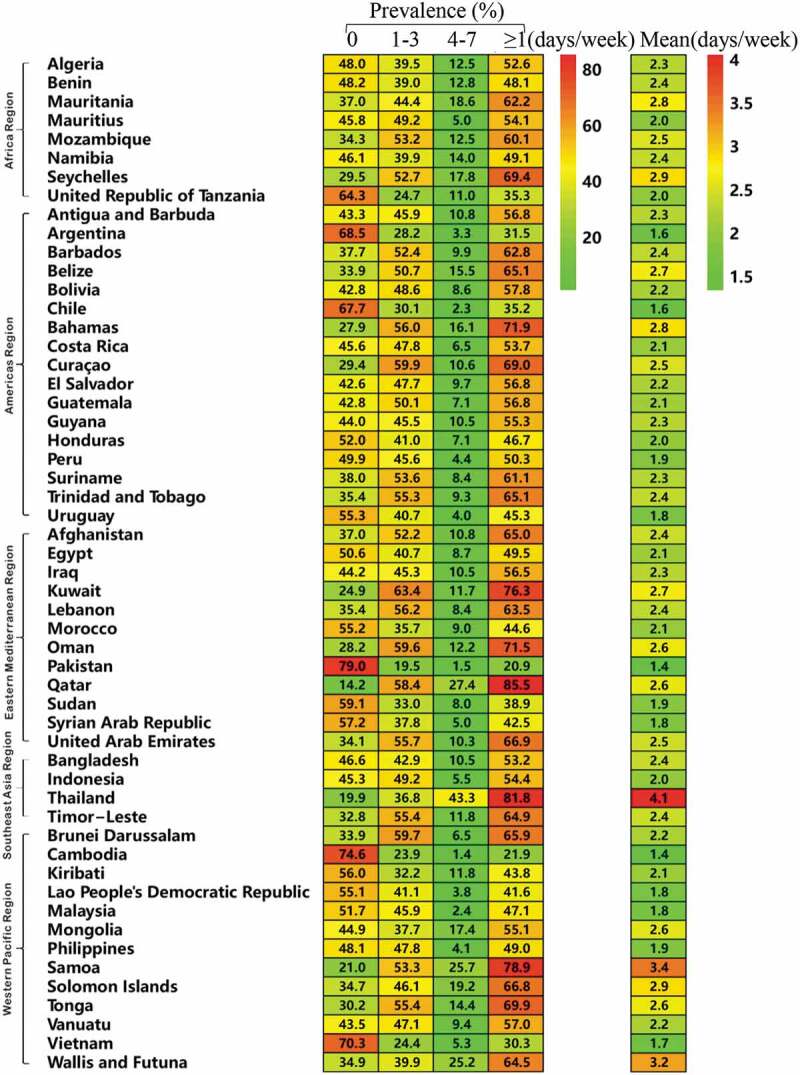
BACKGROUND: Most countries worldwide, especially low- and middle-income countries (LMICs), are facing an increasing prevalence of fast-food consumption and multiple burdens of malnutrition among young adolescents. OBJECTIVE: To compare the prevalence of fast-food consumption among young adolescents in LMICs. METHODS: We used data from the most recent Global School-Based Student Health Survey (2009-2015), which had been collected using a standardized questionnaire. The weighted prevalence and 95% confidential intervals of fast-food consumption were calculated overall and in subgroups stratified by age, sex, and nutritional status. The pooled overall and regional estimates were obtained using a random-effects model. Heterogeneity was assessed using the I2 statistic. The associated risk factors for fast-food consumption were explored using logistic regression analysis. RESULTS: Our study comprised 153,496 young adolescents (46.90% boys) from 54 LMICs. Overall, approximately 55.2% (51.3-59.1%) of the adolescents consumed fast food at least 1 day per week, and 10.3% (8.3-12.4%) did so 4-7 days per week. The prevalence of fast-food consumption 4-7 days per week was lowest in the Americas (8.3%; 6.7-9.9%) and highest in Southeast Asia (17.7%; 2.3-33.2%). At a country level, the prevalence was lowest in Pakistan (1.5%; 1.0-2.0%) and highest in Thailand (43.3%; 40.4-46.1%). Furthermore, in subgroups stratified by nutritional status, the prevalence was lowest in the obesity group (6.6%; 4.5-8.7%). Factors such as age, sex, BMI, food insecurity, fruit consumption, vegetable consumption, soft-drink consumption, smoking, physical activity level, and sedentary behavior level were found to be correlated with fast-food consumption. CONCLUSIONS: The identified high prevalence of fast-food consumption among young adolescents in LMICs indicates the urgent need to prioritize the implementation of healthy-diet promotion programs to improve adolescent health in these countries.
Overview
The claims and statistics of this paper haven’t been checked yet.
Run the check — free, no account needed. It reads the open-access text and checks the sources it cites.
Integrity signals
Registry
Cites
Statistics
Figures
Verification
Claims the paper makes
The claims and statistics of this paper haven’t been checked yet.
Run the check — free, no account needed. It reads the open-access text and checks the sources it cites.
Claims other papers make about this one
Each is checked against this paper’s own text: does it say what the citing paper says it does?
The source backs part of the claim, not all of it — or backs it for a different population, condition or comparison.
In the citing paper
“Adolescents in both low- and middle-income countries (LMICs) and high-income countries (HICs) frequently have diets that are calorie-dense yet nutrient-deficient, marked by excessive consumption of sugar-sweetened beverage (SSB), ultra-processed foods, and insufficient intake of FV [11–13].”
From School-based healthy eating interventions for adolescents aged 10–19 years: an umbrella review (2024) · cites this paper as [11]
Experimental — accuracy not yet measured
Self-check
Percentages, sums and reported differences re-computed from the paper’s own numbers.
The self-check needs the paper’s full text.
Citations
Cites
Global nutrition transition and the pandemic of obesity in developing countries
Popkin, B. M., Adair, L. S., & Ng, S. W. (2012) · Nutrition Reviews · doi:10.1111/j.1753-4887.2011.00456.x · Cited by 4,313 · cited 1×
“Globally, young adolescents, especially those in lowand middle-income countries (LMICs), are experiencing a nutritional transition in the form of a dramatic shift in food-consumption patterns from their respective countries’ traditional diet to a Westernized diet [1,2].”
BackgroundPereira, M. A., Kartashov, A. I., Ebbeling, C. B., Van Horn, L., Slattery, M. L., Jacobs, D. R., & Ludwig, D. S. (2005) · The Lancet · doi:10.1016/s0140-6736(04)17663-0 · Cited by 1,348 · cited 1×
“Such unhealthy dietary habits in youth are thus associated with an increased risk of obesity [7], cardiovascular disease [8], type 2 diabetes [9], and cancer [10] in later adulthood.”
Undue reliance on I 2 in assessing heterogeneity may mislead
Rücker, G., Schwarzer, G., Carpenter, J. R., & Schumacher, M. (2008) · BMC Medical Research Methodology · doi:10.1186/1471-2288-8-79 · Cited by 1,287
Obesity and the food system transformation in Latin America
Popkin, B. M., & Reardon, T. (2018) · Obesity Reviews · doi:10.1111/obr.12694 · Cited by 629 · cited 1×
“Examples include marketing controls, including the enaction and enforcement of regulations to limit the advertisement and sale of fast food [30], attaching front-of-pack supplementary nutritional labels, and implementing formula fast-foods contain less salt, saturated fat, trans-fat, sugar, and energy [30]; implementi…”
BackgroundNutrition in adolescents: physiology, metabolism, and nutritional needs
Das, J. K., Salam, R. A., Thornburg, K. L., Prentice, A. M., Campisi, S., Lassi, Z. S., Koletzko, B., & Bhutta, Z. A. (2017) · Annals of the New York Academy of Sciences · doi:10.1111/nyas.13330 · Cited by 597 · cited 1×
“Failure to meet nutrient requirements during adolescence can result in growth retardation, impaired organ remodeling, and micronutrient deficiencies [6].”
BackgroundPowell, L. M., & Nguyen, B. T. (2013) · JAMA Pediatrics · doi:10.1001/jamapediatrics.2013.417 · Cited by 346
Determinants of takeaway and fast food consumption: a narrative review
Janssen, H. G., Davies, I. G., Richardson, L. D., & Stevenson, L. (2017) · Nutrition Research Reviews · doi:10.1017/s0954422417000178 · Cited by 303 · cited 1×
“Notably, fast-food consumption among young adolescents in LMICs has increased significantly in recent decades [11].”
BackgroundNutritional challenges and health implications of takeaway and fast food
Jaworowska, A., Blackham, T., Davies, I. G., & Stevenson, L. (2013) · Nutrition Reviews · doi:10.1111/nure.12031 · Cited by 230 · cited 1×
“Fast food is a common component of Westernstyle diets, and is energy-dense, nutrient-poor, low in fiber and micronutrients, and high in refined grains, sodium, and sugar [3,4].”
BackgroundCaleyachetty, R., Thomas, G. N., Kengne, A. P., Echouffo-Tcheugui, J. B., Schilsky, S., Khodabocus, J., & Uauy, R. D. (2018) · American Journal of Clinical Nutrition · doi:10.1093/ajcn/nqy105 · Cited by 207 · cited 2×
“In addition, as multiple burdens of malnutrition are common in young adolescents in LMICs [13], we also performed subgroup analyses stratified by nutritional status.”
MethodManyanga, T., El-Sayed, H. F., Doku, D. T., & Randall, J. R. (2014) · BMC Public Health · doi:10.1186/1471-2458-14-887 · Cited by 204 · cited 1×
“Consistent with our findings, another research also found that obesity was not associated with fast-food consumption among adolescents [26].”
ResultBraithwaite, I. E., Stewart, A. W., Hancox, R. J., Beasley, R. W., Murphy, R., Mitchell, E. A., & the ISAAC Phase Three Study Group (2014) · BMJ Open · doi:10.1136/bmjopen-2014-005813 · Cited by 193 · cited 1×
“In our study, height and weight in the GSHSs were self-reported [27]; thus, the prevalence of Table 3.”
BackgroundStory, M. T., & Faulkner, P. (1990) · American Journal of Public Health · doi:10.2105/ajph.80.6.738 · Cited by 190
Mistry, S. K., & Puthussery, S. (2015) · Public Health · doi:10.1016/j.puhe.2014.12.004 · Cited by 190 · cited 4×
“Currently, McDonald’s, Kentucky Fried Chicken (KFC), and Pizza Hut are dominant fast-food chains in these LMICs [16].”
BackgroundResultInfluentialBeal, T., Morris, S. S., & Tumilowicz, A. (2019) · Food and Nutrition Bulletin · doi:10.1177/0379572119848287 · Cited by 174 · cited 4×
“All of the statistical analyses were performed using SAS version 9.4 (SAS Institute, Cary, NC) and STATA version 12.0 (STATA Corporation; College Station, TX).”
BackgroundMethodInfluentialHare‐Bruun, H., Nielsen, B., Kristensen, P. L., Møller, N. C., Togo, P., & Heitmann, B. L. (2011) · BMC Public Health · doi:10.1186/1471-2458-11-311 · Cited by 81
Obesity Prevention: Strategies and Challenges in Latin America
Cominato, L., Biagio, G. F. D., Lellis, D., Franco, R. R., Mancini, M. C., & de Melo, M. E. (2018) · Current Obesity Reports · doi:10.1007/s13679-018-0311-1 · Cited by 74 · cited 2×
“Under this plan, these countries have taken a series of measures to improve the food environment [22], such as (i) implementing new policies to improve school nutrition, including nutritional guidelines for school meals and school meal programs (currently, approximately 85 million students receive daily school meals i…”
BackgroundAshdown‐Franks, G., Vancampfort, D., Firth, J., Smith, L., Sabiston, C. M., Stubbs, B., & Koyanagi, A. (2019) · International Journal of Behavioral Nutrition and Physical Activity · doi:10.1186/s12966-019-0796-3 · Cited by 68
Kato, I., Tominaga, S., & Kuroishi, T. (1987) · PubMed · Cited by 63
Exporting Diabetes Mellitus to Asia
Pan, A., Malik, V., & Hu, F. B. (2012) · Circulation · doi:10.1161/circulationaha.112.115923 · Cited by 58
Time Trends in Fast Food Consumption and Its Association with Obesity among Children in China
Xue, H., Wu, Y. F., Wang, X., & Wang, Y. (2016) · PLoS ONE · doi:10.1371/journal.pone.0151141 · Cited by 58
Cultural resistance to fast‐food consumption? A study of youth in North Eastern Thailand
Seubsman, S., Kelly, M. J., Yuthapornpinit, P., & Sleigh, A. C. (2009) · International Journal of Consumer Studies · doi:10.1111/j.1470-6431.2009.00795.x · Cited by 47 · cited 3×
“Globally, young adolescents, especially those in lowand middle-income countries (LMICs), are experiencing a nutritional transition in the form of a dramatic shift in food-consumption patterns from their respective countries’ traditional diet to a Westernized diet [1,2].”
BackgroundFast-food consumers in Singapore: demographic profile, diet quality and weight status
Whitton, C., Ma, Y., Bastian, A., Chan, M. F., & Chew, L. (2013) · Public Health Nutrition · doi:10.1017/s1368980013001997 · Cited by 44 · cited 1×
“Such unhealthy dietary habits in youth are thus associated with an increased risk of obesity [7], cardiovascular disease [8], type 2 diabetes [9], and cancer [10] in later adulthood.”
BackgroundUrban, L. E., WEBER, J. L., Heyman, M. B., Schichtl, R., Verstraete, S. G., Lowery, N., Das, S. K., Schleicher, M. M., Rogers, G. T., Economos, C. D., et al. (2016) · Journal of the Academy of Nutrition and Dietetics · doi:10.1016/j.jand.2015.11.009 · Cited by 43 · cited 1×
“increasing the relative price of fast food by imposing taxes and then using these taxes to subsidize healthy food products) [31]; strengthening the cooperation of schools and families, providing nutrition knowledge and health education, limiting the number of fast-food outlets in schools and neighborhoods, teaching tr…”
BackgroundMazidi, M., & Speakman, J. R. (2018) · Journal of the American Heart Association · doi:10.1161/jaha.117.007651 · Cited by 42 · cited 1×
“Such unhealthy dietary habits in youth are thus associated with an increased risk of obesity [7], cardiovascular disease [8], type 2 diabetes [9], and cancer [10] in later adulthood.”
BackgroundCetthakrikul, N., Phulkerd, S., Jindarattanaporn, N., Sacks, G., & Tangcharoensathien, V. (2019) · Globalization and Health · doi:10.1186/s12992-019-0458-x · Cited by 38 · cited 2×
“Therefore, although key actions have been taken by the Thai government, such as nutritional labelling, providing nutrition claims [20], and the use of Guideline Daily Amounts [20,21], these actions appear to be inadequate.”
BackgroundCzarnocińska, J., Wądołowska, L., Lonnie, M., Kowalkowska, J., Jeżewska-Zychowicz, M., & Babicz-Zielińska, E. (2020) · Nutrition Journal · doi:10.1186/s12937-020-00546-8 · Cited by 32 · cited 1×
“Previous studies have shown that SES was negatively associated with fast-food consumption [28,29].”
ResultPongutta, S., Chongwatpol, P., Tantayapirak, P., & Vandevijvere, S. (2018) · Public Health Nutrition · doi:10.1017/s1368980017003792 · Cited by 31 · cited 2×
“Therefore, although key actions have been taken by the Thai government, such as nutritional labelling, providing nutrition claims [20], and the use of Guideline Daily Amounts [20,21], these actions appear to be inadequate.”
BackgroundKee, C. C., Cheong, Y. L., Lim, K. H., Ghazali, S. M., Huey, T. C., Ibrahim, M. K. C., Baharudin, A., Man, C. S., Cheah, Y. K., Ahmad, N. A., et al. (2019) · International Journal of Environmental Research and Public Health · doi:10.3390/ijerph16040593 · Cited by 29 · cited 1×
“increasing the relative price of fast food by imposing taxes and then using these taxes to subsidize healthy food products) [31]; strengthening the cooperation of schools and families, providing nutrition knowledge and health education, limiting the number of fast-food outlets in schools and neighborhoods, teaching tr…”
BackgroundNishtar, S., FARUQUI, A. M. A., Mattu, M. A., Mohamud, K. B., & Ahmed, A. (2004) · PubMed · Cited by 25
Wasay, M., Zaidi, S. A., Khan, M., & Jooma, R. (2014) · PubMed · Cited by 23
The need for dietary guidelines in Pakistan.
Iqbal, R., Tahir, S., & Ghulamhussain, N. (2017) · PubMed · Cited by 4
Cited by
Sorted by citations
Maternal diet disrupts the placenta-brain axis in a sex-specific manner
Ceasrine, A. M., Devlin, B. A., Bolton, J. L., Green, L. A., Jo, Y. C., Huynh, C., Patrick, B., Washington, K., Sánchez, C., Joo, F., et al. (2022) · Nature Metabolism · doi:10.1016/j.bbi.2022.07.117 · Cited by 104
George, C., Echouffo-Tcheugui, J. B., Jaar, B. G., Okpechi, I. G., & Kengne, A. P. (2022) · BMC Medicine · doi:10.1186/s12916-022-02438-6 · Cited by 91
“prevalence, underpinned by poor nutrition [2] and physical inactivity [3].”
BackgroundYouness, R. A., Dawoud, A., Eltahtawy, O., & Farag, M. A. (2022) · Nutrition & Metabolism · doi:10.1186/s12986-022-00696-y · Cited by 99
National Cancer Registry of Pakistan: First Comprehensive Report of Cancer Statistics 2015-2019
Ikram, A., Pervez, S., Khadim, M. T., Sohaib, M., Uddin, H., Badar, F., Masood, A. I., Khattak, Z. I. A., Naz, S., Rahat, T., et al. (2023) · Journal of College of Physicians And Surgeons Pakistan · doi:10.29271/jcpsp.2023.06.625 · Cited by 43
Shawon, M. S. R., Rouf, R. R., Jahan, E., Hossain, F. B., Mahmood, S., Gupta, R. D., Islam, M. I., Kibria, G. M. A., & Islam, S. M. S. (2023) · Scientific Reports · doi:10.1038/s41598-023-49500-8 · Cited by 49
Metadata
- Authors
- Li, L., Sun, N., Zhang, L., Xu, G., Liu, J., Hu, J., Zhang, Z., Lou, J., Deng, H., Shen, Z., & Han, L.
- Affiliations
- Ningbo University (CN)
- Ningbo College of Health Sciences (CN)
- Harbin Medical University (CN)
- Weifang Medical University (CN)
- Nutrition Department, Yuyao People’s Hospital, Yuyao, Zhejiang, PR China
- Ningbo Medical Center Lihuili Hospital (CN)
- Ningbo No. 2 Hospital (CN)
- Corresponding author
- Shen, Zhisen
- Han, Liyuan
- ORCID
- Venue
- Global Health Action
- Publisher
- Informa UK Limited
- Published
- 2020-08-07
- Volume
- 13
- Issue
- 1
- Pages
- 1795438-1795438
- ISSN
- 1654-9716 (ISSN-L)
- 1654-9880
- PMC
- PMC7480506
- OpenAlex
- W3047735631
- Cited by
- 135
- References
- 31
- Citations by year
- 2026: 17 · 2025: 22 · 2024: 33 · 2023: 19 · 2022: 30 · 2021: 12 · 2020: 2
- FWCI
- 9.96
- Type
- journal article
- Language
- en
- Open access
- gold
- doi.org
- Licence
- Locations
- Global Health Action (publishedVersion, cc-by)
- PubMed Central (publishedVersion, cc-by)
- PubMed (publishedVersion)
- DOAJ (DOAJ: Directory of Open Access Journals) (submittedVersion, cc-by-sa)
- Funders
- National Key R&D Program of China (2017YFC1310902)
- National Natural Science Foundation of China (U1503223)
- Ningbo Health Branding Subject Fund (PPXK2018-02)
- Sanming Project of Medicine in Shenzhen (SZSM201803080)
- K.C. Wong Magna Fund of Ningbo University
- Topics
- Health Sciences › Nursing › Nutrition and Dietetics › Nutrition, Health and Food Behavior
- Health Sciences › Medicine › Public Health, Environmental and Occupational Health › Obesity, Physical Activity, Diet
- Health Sciences › Medicine › Public Health, Environmental and Occupational Health › Consumer Attitudes and Food Labeling
- Keywords
- fast food consumption, early adolescents, low- and middle-income countries, prevalence, nutritional status, obesity, food insecurity, soft drink consumption, fruit and vegetable intake, sedentary behavior, physical activity, smoking, healthy eating promotion, adolescent nutrition
- MeSH terms
- Adolescent, Child, Developing Countries, Diet, Female, Health Surveys, Humans, Male, Nutritional Status, Risk Factors, Prevalence, Fast Foods
About these checks
Registry, retraction, Cites and statistics results are computed, not judged, with one exception: a printed reference that no index lists is read once by a model before it counts as a citation error. Claims are extracted by a model and kept only when their quote appears verbatim in the text; each cited source is then checked, with a model’s help, for whether it says what the claim relies on. Those verdicts can be wrong — read the claim’s quote and the cited source before relying on one.
Statistics and arithmetic are recomputed, not judged.
Confidence bands are shown only for fields calibrated on our annotated test set. None is calibrated yet, so no band is shown.
What counts as a claim ›How we measure confidence ›How we check this ›
Are you an author, or do you see a problem with this page? Request a review
