

Theoretical explanations for maintenance of behaviour change: a systematic review of behaviour theories
Open accessThe DOI matches its Crossref record; 117 of the 118 references it cites were found in a registry or an index; none of the 17 sources its claims cite is checked for support yet.
Abstract
BACKGROUND: Behaviour change interventions are effective in supporting individuals in achieving temporary behaviour change. Behaviour change maintenance, however, is rarely attained. The aim of this review was to identify and synthesise current theoretical explanations for behaviour change maintenance to inform future research and practice. METHODS: Potentially relevant theories were identified through systematic searches of electronic databases (Ovid MEDLINE, Embase, PsycINFO). In addition, an existing database of 80 theories was searched, and 25 theory experts were consulted. Theories were included if they formulated hypotheses about behaviour change maintenance. Included theories were synthesised thematically to ascertain overarching explanations for behaviour change maintenance. Initial theoretical themes were cross-validated. FINDINGS: One hundred and seventeen behaviour theories were identified, of which 100 met the inclusion criteria. Five overarching, interconnected themes representing theoretical explanations for behaviour change maintenance emerged. Theoretical explanations of behaviour change maintenance focus on the differential nature and role of motives, self-regulation, resources (psychological and physical), habits, and environmental and social influences from initiation to maintenance. DISCUSSION: There are distinct patterns of theoretical explanations for behaviour change and for behaviour change maintenance. The findings from this review can guide the development and evaluation of interventions promoting maintenance of health behaviours and help in the development of an integrated theory of behaviour change maintenance.
Overview
CoChat Summary
TL;DR
This systematic review identified 117 behaviour theories, of which 100 met inclusion criteria, and synthesised five interconnected theoretical themes explaining behaviour change maintenance: maintenance motives, self-regulation, resources, habits, and environmental/social influences. It concludes that theoretical explanations for maintenance differ from those for initiation and can guide intervention development and an integrated theory of behaviour change maintenance.
Key findings
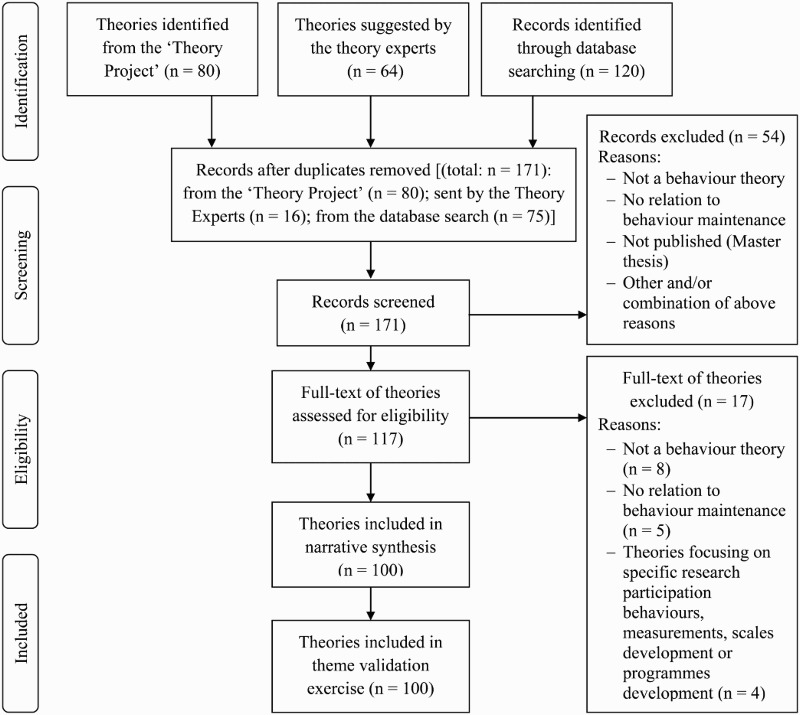
- Of 117 behaviour theories identified, 100 met inclusion criteria; 73 were behaviour specific, and 53 of those explained health-related behaviours. Twenty-six theories were both behaviour specific and population specific.
- Five overarching, interconnected themes emerged: (1) maintenance motives, (2) self-regulation, (3) resources, (4) habit, and (5) environmental and social influences.
- Cross-validation by 10 health psychology researchers showed high agreement on theme allocation (Krippendorff’s α = 0.87).
- Forty-three included theories involved assumptions of dynamic reciprocity, and many behavioural theories do not explicitly address behavioural maintenance. Expert suggestions most commonly included the transtheoretical model (n = 11), HAPA (n = 10), social cognitive theory (n = 9), Marlatt’s relapse prevention theory (n = 9), Rothman’s theory of maintenance (n = 8), self-determination theory (n = 7), and habit theories (n = 6).
Methods
- Systematic review of behaviour theories. Theories were identified through Ovid MEDLINE, Embase, and PsycINFO searches (no time limit; search updated 1 March 2014), an existing database of 80 theories, and consultation with 40 theory experts (25 replied).
- Inclusion criteria: theories published in any language before 1 March 2014 that formulated hypotheses about behaviour change maintenance. Exclusions included animal behaviour theories, theories exclusively based on animal research, and unpublished dissertations/theses. Screening was conducted by two reviewers.
- Data extraction recorded verbatim and interpreted statements about maintenance. Explanatory hypotheses were synthesised thematically into themes and subthemes, then cross-validated by 10 health psychology researchers; inter-rater agreement was calculated as Krippendorff’s α.
Limitations
- Stated: the review drew mainly on theories designed and/or assessed in health-related behaviour contexts, so generalisability to other contexts and behaviours requires testing; many theories lack systematic empirical evaluations; the themes require further evaluation, development, and testing; individual theories may be more relevant for detailed predictions; and it cannot be ruled out that a different set of themes would have represented the data equally well or better.
- Evident from the text: the review synthesises theoretical explanations rather than empirically testing them, and it reports no meta-analytic effect sizes or outcome data for maintenance interventions.
Model-written summary. Check it against the paper before relying on it.
Integrity signals
Registry
Cites
Statistics
Figures
Verification
Claims the paper makes
0 Valid · 1 Not valid · 9 Not checked · 58 Own results and interpretations
A result the paper reports from its own data — it cites no other source for it, so there is none to check. The quote shows it is in the paper.
In the paper
“Themes focus on the changing roles of motives, self-regulation, habits, resources and contextual factors from initial behaviour change to successful maintenance.”
§ Theoretical explanations for maintenance of behaviour change: a systematic review of behaviour theories > Results > How do current theories explain behaviour change maintenance?
plain- Asserted: passes — The authors put it forward as true.
- Checkable: passes — It can be checked against evidence.
- Load-bearing: passes — The paper’s conclusions depend on it.
- Based: passes — The paper gives a reason why it holds.
A result the paper reports from its own data — it cites no other source for it, so there is none to check. The quote shows it is in the paper.
In the paper
“For the remaining theories where differential explanatory hypotheses for initiation and maintenance could be derived, theory-guided thematic analysis resulted in five overarching interrelated themes (Table 2).”
§ Theoretical explanations for maintenance of behaviour change: a systematic review of behaviour theories > Results > How do current theories explain behaviour change maintenance?
plain- Asserted: passes — The authors put it forward as true.
- Checkable: passes — It can be checked against evidence.
- Load-bearing: passes — The paper’s conclusions depend on it.
- Based: passes — The paper gives a reason why it holds.
A result the paper states — it cites no source for it, so there is none to check. The quote shows it is in the paper.
In the paper
“Many behavioural theories do not explicitly address the issue of behavioural maintenance.”
§ Theoretical explanations for maintenance of behaviour change: a systematic review of behaviour theories > Results > How do current theories explain behaviour change maintenance?
plain- Asserted: passes — The authors put it forward as true.
- Checkable: passes — It can be checked against evidence.
- Load-bearing: passes — The paper’s conclusions depend on it.
- Based: passes — The paper gives a reason why it holds.
None of the sources cited for this claim have been checked yet.
In the paper
“While previous reviews have focused on behaviour change (Cane, O'Connor, & Michie, 2012; Michie et al., 2005), this is the first review to specifically assess theoretical explanations for behaviour change maintenance.”
§ Theoretical explanations for maintenance of behaviour change: a systematic review of behaviour theories > Discussion > Comparison with other studies
What the sources say
- Not checked yetcites Cane, O'Connor, & Michie, 2012
- Not checked yetcites Michie et al., 2005
plain- Asserted: passes — The authors put it forward as true.
- Checkable: passes — It can be checked against evidence.
- Load-bearing: passes — The paper’s conclusions depend on it.
- Based: passes — The paper gives a reason why it holds.
A result the paper states — it cites no source for it, so there is none to check. The quote shows it is in the paper.
In the paper
“This review examined and summarised 100 theories that explicitly or implicitly explain how individuals maintain new behaviours.”
§ Theoretical explanations for maintenance of behaviour change: a systematic review of behaviour theories > Discussion > Implications for health behaviour change maintenance and conclusions
plain- Asserted: passes — The authors put it forward as true.
- Checkable: passes — It can be checked against evidence.
- Load-bearing: passes — The paper’s conclusions depend on it.
- Based: passes — The paper gives a reason why it holds.
34 more claims
Create a free account to see all 68 claims and to verify the 17 references still open.
- It may state two separate claims as one. 14
- Probably not a substantial claim. 21
Claims other papers make about this one
Each is checked against this paper’s own text: does it say what the citing paper says it does?
The source backs part of the claim, not all of it — or backs it for a different population, condition or comparison.
In the citing paper
“Aspects of psychological flexibility central to chronic disease management include: (1) recognizing and adapting to situational demands, (2) shifting perspective when personal or social functioning is compromised; (3) balancing competing desires, needs, and life domains, and (4) being committed to behaviors that are consistent with deeply held values (17,18).”
From Addressing emotional distress to improve outcomes in adults with type 1 diabetes: Protocol for ACT1VATE randomized controlled trial (2024) · cites this paper as [18]
Experimental — accuracy not yet measuredThe source backs part of the claim, not all of it — or backs it for a different population, condition or comparison.
In the citing paper
“Self-efficacy is a key to the adoption and maintenance of of healthier and less risky behaviours (Kwasnicka et al., 2016).”
From Reading for pleasure in childhood and adolescent healthy behaviours: Longitudinal associations using the Millennium Cohort Study (2020) · cites this paper as Kwasnicka et al., 2016
Experimental — accuracy not yet measuredThe source backs part of the claim, not all of it — or backs it for a different population, condition or comparison.
In the citing paper
“Furthermore, behaviors that consistently resulted in large weight loss in the first year following bariatric surgery may appear to be more difficult and less rewarding once weight loss diminishes and stops (84, 85).”
From Behavioral Interventions to Attenuate Driven Overeating and Weight Regain After Bariatric Surgery (2022) · cites this paper as [85]
Experimental — accuracy not yet measuredThe check wasn’t confident either way, so it gives no verdict — never disputed.
In the citing paper
“These four aspects of psychological flexibility are well positioned to explain successful behavioral maintenance toward healthy living in a real-life context (Kwasnicka et al., 2016).”
From Acceptance and Commitment Therapy for Health Behavior Change: A Contextually-Driven Approach (2018) · cites this paper as Kwasnicka et al., 2016
Experimental — accuracy not yet measuredIn the citing paper
“While these approaches can be helpful to a degree, the magnitude of health problems and the maintenance of health behavior change suggests that alternatives are needed (Kwasnicka et al., 2016).”
From Acceptance and Commitment Therapy for Health Behavior Change: A Contextually-Driven Approach (2018) · cites this paper as Kwasnicka et al., 2016
Self-check
Percentages, sums and reported differences re-computed from the paper’s own numbers.
Each contradiction between two passages listed here was confirmed by an independent check.
Rated minor: it would not touch a result — a value no result rests on, a p-value that stays on the same side of the significance level, or a conflict that is clerical, resolved elsewhere in the paper, or outside its own findings.
In the paper
§ Theoretical explanations for maintenance of behaviour change: a systematic review of behaviour theories > Results > How do current theories explain behaviour change maintenance?
“| (3) Resources | People are successful in maintaining behaviour if their psychological and physical resources are plentiful |”
§ Theoretical explanations for maintenance of behaviour change: a systematic review of behaviour theories > Results > Theme 3. Habits
“### Theme 3. Habits”
Citations
Cites
The theory of planned behavior
Ajzen, I. (1991) · Organizational Behavior and Human Decision Processes · doi:10.1016/0749-5978(91)90020-t · Cited by 90,587
Preferred Reporting Items for Systematic Reviews and Meta-Analyses: the PRISMA statement
Moher, D., Liberati, A., Tetzlaff, J., Altman, D. G., & for the PRISMA Group (2009) · BMJ · doi:10.1136/bmj.b2535 · Cited by 83,823
Ryan, R. M., & Deci, E. L. (2000) · American Psychologist · doi:10.1037//0003-066x.55.1.68 · Cited by 54,599 · cited 3×
“Thus, to maintain a new behaviour a sense of relatedness must be developed (self-determination theory – Deci & Ryan, 2000; Ryan & Deci, 2000).”
Preferred reporting items for systematic reviews and meta-analyses: the PRISMA Statement.
(2009) · PubMed Central · Cited by 44,859
Preferred reporting items for systematic reviews and meta-analyses: The PRISMA statement
Moher, D., Liberati, A., Tetzlaff, J., Altman, D. G., & the PRISMA Group* (2009) · Annals of Internal Medicine · doi:10.7326/0003-4819-151-4-200908180-00135 · Cited by 37,554
The "what" and "why" of goal pursuits: Human needs and the self-determination of behavior
Deci, E. L., & Ryan, R. M. (2000) · Psychological Inquiry · doi:10.1207/s15327965pli1104_01 · Cited by 34,210
Intrinsic Motivation and Self-Determination in Human Behavior
Deci, E. L., & Ryan, R. M. (1985) · doi:10.1007/978-1-4899-2271-7 · Cited by 26,772
Content Analysis: An Introduction to its Methodology.
Shelley, M., & Krippendorff, K. (1984) · Journal of the American Statistical Association · doi:10.2307/2288384 · Cited by 24,312
Intrinsic Motivation and Self-Determination in Human Behavior
Miller, K. A., Deci, E. L., & Ryan, R. M. (1988) · Contemporary Sociology · doi:10.2307/2070638 · Cited by 15,312
An Integrative Theory of Intergroup Conflict
Tajfel, H., & Turner, J. (2000) · Organizational Identity · doi:10.1093/oso/9780199269464.003.0005 · Cited by 12,487
Research works printed but not linked: 5
- Bandura A. 1986 Social foundations of thought and action: A social cognitive theory Englewood Cliffs, NJ Prentice-Hall
- 10.1207/s15327965pli1104_01 · DOI · Paper page
- Pavlov I. P. 1927 Conditioned reflexes London Oxford University Press
- Skinner B. F. 1953 Science and human behaviour New York Macmillan
- Triandis H. C. 1977 Interpersonal behavior Monterey Brooks/Cole Publishing Company
Cited by
Items 701–800 of 1,000
Motta-Yanac, E., Riley, V., Ellis, N. J., Mankoo, A., & Gidlow, C. J. (2025) · International Journal of Medical Informatics · doi:10.1016/j.ijmedinf.2024.105755 · Cited by 5
Lifestyle discussions facilitate self-management in RA: a qualitative study of patients’ perceptions
af Hagelsrum, K. D., Larsson, I., Bremander, A., Einarsson, J. T., Lindqvist, E., & Mogård, E. (2024) · BMC Rheumatology · doi:10.1186/s41927-024-00433-3 · Cited by 7
Richards, O. K., & Veinot, T. C. (2025) · ACM Transactions on Computer-Human Interaction · doi:10.1145/3719347 · Cited by 6
Baretta, D., Rüttimann, C. L., Amrein, M. A., & Inauen, J. (2025) · JMIR mhealth and uhealth · doi:10.2196/57191 · Cited by 6
Ringin, E., Dunstan, D. W., Meyer, D., McIntyre, R. S., Owen, N. G., Berk, M., Rossell, S. L., Hallgren, M. Å., & Rheenen, T. E. V. (2025) · Acta Psychiatrica Scandinavica · doi:10.1111/acps.70011 · Cited by 6
How habitual is everyday life? An ecological momentary assessment study
Rebar, A. L., Vincent, G. E., Kovac, K., & Gardner, B. (2025) · Psychology and Health · doi:10.1080/08870446.2025.2561149 · Cited by 7
Pu, B., & Huang, K. (2025) · Frontiers in Public Health · doi:10.3389/fpubh.2025.1697273 · Cited by 10
Zhang, B., Chen, Z., Liao, Q., Zhang, H., Fang, Y., Wang, W., Song, H., Lau, E. Y. Y., Tse, A. C. Y., Lo, S. K., et al. (2026) · JAMA Network Open · doi:10.1001/jamanetworkopen.2025.56927 · Cited by 8
Zetterberg, H., Flink, I. K., Spörndly-Nees, S., Wagner, S., Karlsten, R., & Åsenlöf, P. (2022) · International Journal of Environmental Research and Public Health · doi:10.3390/ijerph19031509 · Cited by 7
Intervention fidelity assessment: A sub‐study of the Norfolk Diabetes Prevention Study (NDPS)
Withers, T. M., Garner, N. J., Thorley, C. S., Kellett, J., Price, L., Auckland, S., Sheldon, J., Howe, A. C., Pascale, M., Smith, J. R., et al. (2023) · British Journal of Health Psychology · doi:10.1111/bjhp.12651 · Cited by 7
Incorporating handgrip strength examination into dietetic practice: A quality improvement project
Sandhu, R., & Lee, T. (2023) · Nutrition in Clinical Practice · doi:10.1002/ncp.10972 · Cited by 7
Grimmett, C., Corbett, T. K., Bradbury, K. J., Morton, K., May, C. R., Pinto, B. M., & Foster, C. L. (2023) · Journal of Cancer Survivorship · doi:10.1007/s11764-023-01434-w · Cited by 7
Designing Robots for Marketplace Success: A Case Study with Technology for Behavior and Habit Change
Randall, N., & Šabanović, S. (2024) · International Journal of Social Robotics · doi:10.1007/s12369-023-01093-y · Cited by 9
Krishnasamy, V., Kumari, M. J., Jayaseelan, V., Shanmugam, R., & Sadan, V. (2024) · Journal of Education and Health Promotion · doi:10.4103/jehp.jehp_1411_23 · Cited by 9
Curran, M., Larade, N., Özakinci, G., Tymowski-Gionet, G., & Dombrowski, S. U. (2024) · Health Psychology and Behavioral Medicine · doi:10.1080/21642850.2024.2416505 · Cited by 6
Self-citationHao, A., Yin, C., & Dogot, T. (2024) · Journal of Environmental Management · doi:10.1016/j.jenvman.2024.123302 · Cited by 7
Chen, Y., Ng, M. S. N., Zhang, M., & Chan, C. W. H. (2025) · Cancer Nursing · doi:10.1097/ncc.0000000000001450 · Cited by 6
Thal, S. B., Bright, S. J., Ntoumanis, N., MYERS, B. J., Jones, J., & Quested, E. (2025) · Psychology of sport and exercise · doi:10.1016/j.psychsport.2025.102829 · Cited by 6
Hintsa, E., Hagger, M. S., Lintunen, T., Hamilton, K., & Knittle, K. P. (2025) · Applied Psychology Health and Well-Being · doi:10.1111/aphw.70016 · Cited by 7
Nalukwago, J., ALAII, J. A., van den Borne, B. H. P., Bukuluki, P., Kimbowa, M., Bockh, E., Coutinho, S., & Crutzen, R. (2019) · Health Education Research · doi:10.1093/her/cyz032 · Cited by 9
Interventions for Child Drowning Reduction in the Indian Sundarbans: Perspectives from the Ground
Gupta, M., Roy, S. B., Panda, R. K., Konwar, P., & Jagnoor, J. (2020) · Children · doi:10.3390/children7120291 · Cited by 7
Kariuki, J. K., Gibbs, B. B., Rockette‐Wagner, B., Cheng, J. S.-C., Burke, L. E., Erickson, K. I., Kline, C. E., Méndez, D. D., & Sereika, S. M. (2021) · International Journal of Behavioral Medicine · doi:10.1007/s12529-020-09947-9 · Cited by 6
Audsley, S., Kendrick, D., Logan, P., & Orton, E. (2021) · Pilot and Feasibility Studies · doi:10.1186/s40814-021-00844-w · Cited by 7
Experiment in a Box (XB): An Interactive Technology Framework for Sustainable Health Practices
schraefel, M. C., Muresan, G. C., & Hekler, E. B. (2021) · Frontiers in Computer Science · doi:10.3389/fcomp.2021.661890 · Cited by 5
Covid-19: Decision-Making in Public Health
de Caestecker, L., & von Wissmann, B. (2021) · The Journal of the Royal College of Physicians of Edinburgh · doi:10.4997/jrcpe.2021.238 · Cited by 5
Whittenbury, K., Kroll, L., Dubicka, B., & Bull, E. R. (2022) · BJPsych Open · doi:10.1192/bjo.2022.7 · Cited by 7
Conner, M. T., & Norman, P. E. (2021) · Elsevier eBooks · doi:10.1016/b978-0-12-818697-8.00060-1 · Cited by 16
Labonté, K., Knaüper, B., Dubé, L., Yang, N., & Nielsen, D. E. (2022) · Obesity Science & Practice · doi:10.1002/osp4.603 · Cited by 5
“Power of words”: impact, concerns and applications of nonviolent communication training
Korlipara, M., & Shah, H. (2022) · European journal of training and development · doi:10.1108/ejtd-03-2022-0030 · Cited by 19
Dumuid, D., Mellow, M. L., Stanford, T., Chong, K. H., Sawyer, S. M., Smith, A. E., Rasmussen, C. L., Wade, A. T., & Olds, T. (2022) · Journal of Activity Sedentary and Sleep Behaviors · doi:10.1186/s44167-022-00005-1 · Cited by 7
Lloyd, I., Furtado, T., German, A. J., Watkins, F., Christley, R., & Westgarth, C. (2023) · Anthrozoös · doi:10.1080/08927936.2023.2166714 · Cited by 6
Cheng, S., Vanluyten, K., Ward, P., Seghers, J., & Iserbyt, P. (2023) · Physical Education and Sport Pedagogy · doi:10.1080/17408989.2023.2194897 · Cited by 5
Kaiser, J. L., Hamer, D. H., Juntunen, A., Ngoma, T., Fink, G., Schueler, J., Rockers, P. C., Biemba, G., & Scott, N. (2023) · American Journal of Tropical Medicine and Hygiene · doi:10.4269/ajtmh.22-0604 · Cited by 8
Can the effects of high school culinary nutrition education be sustained into adulthood?
Fredericks, L., Utter, J., Tang, L., Shah, A., Lofts, C. W., Parry, J. M., & Koch, P. A. (2023) · Health Education Journal · doi:10.1177/00178969231178593 · Cited by 9
Dhumal, T., Scott, V., Powers, R. L., & Kelly, K. M. (2023) · Journal of the American Pharmacists Association · doi:10.1016/j.japh.2023.09.004 · Cited by 5
Santos, F., & Teixeira, D. (2023) · Kinesiology Review · doi:10.1123/kr.2023-0021 · Cited by 6
McAlpine, T., Mullan, B. A., & Dorina, I. (2024) · Psychology and Health · doi:10.1080/08870446.2024.2372649 · Cited by 5
From bars to breakthroughs: the application of self-determination theory to offender programs
Youssef, C. (2024) · Journal of Forensic Psychiatry and Psychology · doi:10.1080/14789949.2024.2390122 · Cited by 8
Voi, S., & Sainsbury, K. (2019) · Psychology and Health · doi:10.1080/08870446.2019.1579912 · Cited by 6
Gavin, K. L., Wolfson, J. A., Pereira, M. A., Sherwood, N. E., & Linde, J. A. (2019) · Journal of Physical Activity and Health · doi:10.1123/jpah.2018-0135 · Cited by 5
Hamamatsu, Y., Ide, H., Kakinuma, M., & Furui, Y. (2020) · JMIR mhealth and uhealth · doi:10.2196/16159 · Cited by 7
Addressing Underserved Populations and Disparities in Behavior Change
Schüz, B., & Hooper, M. W. (2020) · Cambridge University Press eBooks · doi:10.1017/9781108677318.027 · Cited by 8
Mathews, E., Sauzet, O., & Thankappan, K. R. (2021) · Wellcome Open Research · doi:10.12688/wellcomeopenres.16618.1 · Cited by 6
Ramly, E., Lauver, D., Gilmore‐Bykovskyi, A. L., & Bartels, C. M. (2021) · Implementation Science Communications · doi:10.1186/s43058-021-00155-4 · Cited by 7
Chen, C., Finne, E., Kopp, A., & Jekauc, D. (2021) · Frontiers in Psychology · doi:10.3389/fpsyg.2021.628993 · Cited by 12
Qualitative study of Stroke Survivors’ Perceptions of Secondary Prevention
Lin, B., Zhang, Z., Thrift, A. G., Wang, W., Mei, Y., Guo, Y., Liu, L., Liu, F., & Xue, L. (2021) · Journal of Advanced Nursing · doi:10.1111/jan.15079 · Cited by 7
Tong, K. K., Wu, A. M. S., & Chen, J. H. (2022) · Journal of Gambling Studies · doi:10.1007/s10899-021-10104-4 · Cited by 8
Weiland, A., Reiband, N., Schäffeler, N., Zurstiege, G., Giel, K. E., Zipfel, S., & Mack, I. (2022) · Life · doi:10.3390/life12060779 · Cited by 13
Personal and contextual determinants of COVID-19 vaccination intention: a vignette study
Morbée, S., Waterschoot, J., Yzerbyt, V. Y., Klein, O., Luminet, O., Schmitz, M., den Bergh, O. V., Oost, P. V., Craene, S. D., & Vansteenkiste, M. (2022) · Expert Review of Vaccines · doi:10.1080/14760584.2022.2105212 · Cited by 7
Theory-Based Approaches and Determinants of Disease Prevention Behaviours
Thaivalappil, A. (2022) · The Atrium (University of Guelph) · doi:10.1177/11786302221129955 · Cited by 1
Zolfaghari, M., Meshkovska, B., Banik, A., Kamphuis, C. B. M., Kopainsky, B., Łuszczyńska, A., Murrin, C. M., & Lien, N. (2022) · European Journal of Public Health · doi:10.1093/eurpub/ckac054 · Cited by 5
Latrille, C., Chapel, B., Héraud, N., Bughin, F., Hayot, M., & Boiché, J. (2023) · Digital Health · doi:10.1177/20552076221150744 · Cited by 9
Kirwan, R., Newson, L., McCullough, D., Butler, T., Davies, I. G., & de Heredia, F. P. (2023) · Frontiers in Nutrition · doi:10.3389/fnut.2023.1043391 · Cited by 6
Surgeon perspectives on the STITCH trial: a mixed methods study
Cochrun, S. L., Herbey, I. I., Ivankova, N. V., Nikolian, V. C., Jansen, J. O., & Parmar, A. D. (2023) · Surgical Endoscopy · doi:10.1007/s00464-023-10086-x · Cited by 6
Brandt, T., Schinköthe, T., & Schmidt, A. (2023) · Journal of Functional Morphology and Kinesiology · doi:10.3390/jfmk8020058 · Cited by 7
Behaviour therapy for obesity in older adults
Koca, M., Dobbie, L. J., Ciudin, A., & Halil, M. G. (2024) · European Journal of Internal Medicine · doi:10.1016/j.ejim.2024.10.022 · Cited by 6
It's About Time: Answering the Call for Greater Precision in Research and Practice
Rothman, A. J. (2019) · Applied Psychology Health and Well-Being · doi:10.1111/aphw.12158 · Cited by 5
Smiddy, M. P., Murphy, O. M., Savage, E., Fitzgerald, A. J., FitzGerald, S. F., & Browne, J. P. (2020) · Epidemiology and Infection · doi:10.1017/s095026882000076x · Cited by 5
Holmberg, R., Gustavsson, J., & Bonander, C. (2021) · PLoS ONE · doi:10.1371/journal.pone.0253054 · Cited by 7
Improving Nutrition Research in Nephrology: An Appetite for Change
Campbell, K. L., Palmer, S. C., & Johnson, D. W. (2017) · American Journal of Kidney Diseases · doi:10.1053/j.ajkd.2017.02.006 · Cited by 6
da Costa, A. C. (2020) · Digital Library of Theses and Dissertations (Universidade de São Paulo) · doi:10.11606/d.7.2020.tde-25022021-100640 · Cited by 5
Making health a habit: Progress in habit theory and its application in real‐world settings
Gardner, B., Rebar, A. L., & Zhang, C. (2025) · Applied Psychology Health and Well-Being · doi:10.1111/aphw.70064 · Cited by 10
van Maaren, L. C., Aben, N., van Kesteren, J., Struben, V. M. D., Stals, M., Barwari, K., Stárková, J., van Muilekom, E. H. A. M., Visser, J., Postema, A. W., et al. (2024) · Journal of Clinical Medicine · doi:10.3390/jcm13247529 · Cited by 5
RETRACTED: HealthLINE: A messaging chatbot for supporting chronic disease self-management
Wang, Y., Hsu, M., & Wang, M. Y.-F. (2025) · Digital Health · doi:10.1177/20552076251394891 · Cited by 7
RetractedCunningham, C., O’Doherty, M., Neill, R. D., Adams, M., Kee, F., Cupples, M., Hardeman, W., Simpson, E. E. A., MURPHY, M. H., Callaghan, C., et al. (2024) · Journal of Ageing and Longevity · doi:10.3390/jal4010003 · Cited by 5
Behavioral Nudges to Encourage Appropriate Antimicrobial Use Among Health Professionals in Uganda
Ross, A., Meacham, P. J., Waswa, J. P., Joshi, M. P., Hafner, T., Godby, S., Johnson, C., Londhe, S., Aibo, D., Kwikiriza, G., et al. (2024) · Antibiotics · doi:10.3390/antibiotics13111016 · Cited by 8
Eekholm, S., Samuelson, K. A. M., Ahlström, G., & Lindhardt, T. (2024) · Nursing Reports · doi:10.3390/nursrep14040297 · Cited by 7
Turoń, K., Kubik, A., FOLĘGA, P., Wilk, A., Bindzár, P., & Truong, B. N. M. (2025) · Applied Sciences · doi:10.3390/app15020658 · Cited by 7
Yang, M.-R., Singh, R., Haugen, M., Duff, A., Shoop, J., Morgan, E. R., Rossoff, J. E., Weinstein, J. L., Heneghan, M. B., & Badawy, S. M. (2025) · European Journal Of Haematology · doi:10.1111/ejh.14386 · Cited by 4
Carvalho, M., Morrissey, E. C., Dunne, P., Drury, A., Byrne, M., & McSharry, J. (2025) · Diabetic Medicine · doi:10.1111/dme.70032 · Cited by 4
Cox, E. R., Gajanand, T., Keating, S. E., Brown, W. J., Coombes, J. S., & Burton, N. W. (2025) · Journal of Physical Activity and Health · doi:10.1123/jpah.2024-0808 · Cited by 7
Analysing longitudinal wearable physical activity data using non-stationary time series models
Angel, M. D., Nunes, M. A., Peacock, O. J., Cranwell, E. J., & Thompson, D. (2025) · International Journal of Behavioral Nutrition and Physical Activity · doi:10.1186/s12966-025-01779-8 · Cited by 9
Positive Psychology and Health Behavior Change in Lifestyle Medicine: A Narrative Review
Matthews, S. M. (2025) · American Journal of Lifestyle Medicine · doi:10.1177/15598276251367691 · Cited by 7
Hand, L. K., Nelson, E., Glaser, A., Russell, J. A., Baber, G., Gratton, M., Barry, A., Bock, K. J., & Siengsukon, C. F. (2025) · Age and Ageing · doi:10.1093/ageing/afaf287 · Cited by 4
The Theory of Hedonic Motivation
Williams, D. M. (2019) · Cambridge University Press eBooks · doi:10.1017/9781316275047.017 · Cited by 4
Changing Behavior in the Digital Age
Kavanagh, D. J. (2020) · Cambridge University Press eBooks · doi:10.1017/9781108677318.029 · Cited by 20
Development of a Questionnaire Measuring Preventive Behaviors at Work
Lecours, A., Beaulieu, A.-A., Poulin, V., Nastasia, I., & St‐Hilaire, F. (2021) · Journal of Occupational Rehabilitation · doi:10.1007/s10926-020-09955-2 · Cited by 5
Sustaining Abstinence from Social Media: Results from a Seven-Day Facebook Break
Vaghefi, I. (2021) · International Academic Mindtrek Conference (Mindtrek) · doi:10.1145/3464327.3464337 · Cited by 6
Precision Food Parenting: A Proposed Conceptual Model and Research Agenda
Baranowski, T., Thompson, D. I., Hughes, S. O., & O’Connor, T. M. (2021) · Nutrients · doi:10.3390/nu13103650 · Cited by 4
Banwell, E., Salhi, L., Hanley, T., & Facey‐Campbell, N. (2022) · Counselling and Psychotherapy Research · doi:10.1002/capr.12584 · Cited by 9
Novoradovskaya, E., Mullan, B. A., & Hasking, P. A. (2022) · Evaluation and Program Planning · doi:10.1016/j.evalprogplan.2022.102203 · Cited by 6
Gittins, H., Dandy, N., Wynne‐Jones, S., & Morrison, V. (2023) · Wellbeing Space and Society · doi:10.1016/j.wss.2023.100160 · Cited by 9
Wade-Mcbane, K., King, A., Urch, C., Johansson, L., & Wells, M. (2023) · BMJ Open · doi:10.1136/bmjopen-2023-072367 · Cited by 5
Kebede, N., Mohammed, Y., Kasaye, M. D., & Zewdie, A. (2023) · Diabetes Metabolic Syndrome and Obesity · doi:10.2147/dmso.s431146 · Cited by 8
Barnes, J. C., Dayer, A. A., Gramza, A., Sketch, M., Dwyer, A. M., & Iovanna, R. (2023) · Journal of Soil and Water Conservation · doi:10.2489/jswc.2023.00215 · Cited by 7
Blomqvist, A., Bäck, M., Klompstra, L. V., Strömberg, A., & Jaarsma, T. (2024) · BMC Medical Informatics and Decision Making · doi:10.1186/s12911-024-02452-z · Cited by 6
Bertram, W., Penfold, C. M., Glynn, J., Johnson, E., Burston, A., Rayment, D., Howells, N., White, S. P., Wylde, V., Gooberman‐Hill, R., et al. (2024) · BMJ Open · doi:10.1136/bmjopen-2023-078785 · Cited by 4
Chia, E. L., Chirwa, P. W., & Nsubuga, F. W. (2024) · Small-scale Forestry · doi:10.1007/s11842-024-09566-2 · Cited by 5
Gallagher, D., Spyreli, E., Anderson, A. S., Bridges, S., Cardwell, C. R., Coulman, E., Dombrowski, S. U., Free, C., Heaney, S., Hoddinott, P., et al. (2024) · BMJ Open · doi:10.1136/bmjopen-2024-084075 · Cited by 6
Self-citationDeterminants of Long-Term Water and Energy Conservation Behavior: An Integrated Review
Ambaum, M., Corten, R., Lambooij, M., van der Aa, M., van Harreveld, F., & Buskens, V. (2024) · Sustainability · doi:10.3390/su16114399 · Cited by 9
Compassion as an Integrative and Integrating Therapeutic Process
Gilbert, P. (2024) · Oxford University Press eBooks · doi:10.1093/oso/9780198888727.003.0011 · Cited by 4
Gallego, M. D., Bagozzi, R. P., Bueno, S., & Montes, F. J. R. (2024) · Behavioral Sciences · doi:10.3390/bs14110975 · Cited by 12
Diaz, M., Patino, E. O., Oliver, S., Tiab, S. S., Salazar, N., Song, J., Dong, L., Sarfan, L. D., Susman, E. S., Agnew, E. R., et al. (2024) · Trials · doi:10.1186/s13063-024-08599-4 · Cited by 10
Dorhout, B. G., Wezenbeek, N. L. W., de Groot, C. P. G. M., & Grootswagers, P. (2025) · JMIR Formative Research · doi:10.2196/54392 · Cited by 5
Coates, A., Fair, H. L., Lea, E. J., & Doherty, K. (2025) · International Journal for Equity in Health · doi:10.1186/s12939-025-02386-6 · Cited by 7
Cryptocurrency in Vietnam: A deep dive into adoption factors and their interactions
Nguyen, T. L., Sipko, J., & Pham, V. (2025) · Journal of Open Innovation Technology Market and Complexity · doi:10.1016/j.joitmc.2025.100501 · Cited by 8
Manneville, F., Omorou, A. Y., Legrand, K., Lecomte, E., Rydberg, J. A., Briançon, S., & Guillemin, F. (2021) · Preventive Medicine · doi:10.1016/j.ypmed.2021.106668 · Cited by 5
COVID-19 and Project ECHO Driving Innovations in Rural Pain Care and Education
Savage, S. R., Youngren, K., Kravic, J. N., Olson, C., Pilchik, D., Broglio, K., & Brackett, C. D. (2021) · Pain Medicine · doi:10.1093/pm/pnab191 · Cited by 4
Gjertsen, T. I., Helvik, A., & Følling, I. S. (2021) · BMC Public Health · doi:10.1186/s12889-021-11374-8 · Cited by 5
Oliveira, D., Knight, H., Jones, K. A., Ogollah, R. O., & Orrell, M. W. (2021) · Aging & Mental Health · doi:10.1080/13607863.2021.1984393 · Cited by 5
Metadata
- Authors
- Kwasnicka, D., Dombrowski, S. U., White, M., & Sniehotta, F.
- Affiliations
- University of Stirling (GB)
- University of Cambridge (GB)
- United Kingdom Clinical Research Collaboration (GB)
- Corresponding author
- Sniehotta, Falko
- Venue
- Health Psychology Review
- Publisher
- Informa UK Limited
- Published
- 2016-03-07
- Volume
- 10
- Issue
- 3
- Pages
- 277-296
- ISSN
- 1743-7199 (ISSN-L)
- 1743-7202
- PMC
- PMC4975085
- OpenAlex
- W2265901161
- Cited by
- 1,476
- References
- 118
- Citations by year
- 2026: 143 · 2025: 176 · 2024: 207 · 2023: 163 · 2022: 182 · 2021: 197 · 2020: 181 · 2019: 112 · 2018: 70 · 2017: 34 · 2016: 8
- FWCI
- 12.02
- Type
- journal article
- Language
- en
- Open access
- hybrid
- doi.org
- Licence
- Locations
- Health Psychology Review (publishedVersion, cc-by)
- PubMed Central (publishedVersion, cc-by)
- PubMed (publishedVersion)
- Minerva Access (University of Melbourne) (submittedVersion, cc-by)
- Stirling Online Research Repository (University of Stirling) (submittedVersion, cc-by)
- eSpace (Curtin University) (submittedVersion, cc-by)
- Newcastle University ePrints (Newcastle Univesity) (cc-by)
- Funders
- Wellcome Trust
- United Kingdom Clinical Research Collaboration
- National Institute for Health and Care Research
- British Heart Foundation
- Curtin University of Technology
- Medical Research Council (MR/K02325X/1, MR/J000477/1)
- Economic and Social Research Council (ESRC-3000021026, 3000021026)
- Topics
- Social Sciences › Psychology › Applied Psychology › Behavioral Health and Interventions
- Social Sciences › Psychology › Developmental and Educational Psychology › Behavioral and Psychological Studies
- Health Sciences › Health Professions › General Health Professions › Health Policy Implementation Science
- Keywords
- behavior maintenance, behaviour change theory, health behavior, self-regulation, motivation, habit, psychological resources, physical resources
- MeSH terms
- Self-Control, Behavior Therapy, Habits, Humans, Individuality, Learning, Models, Psychological, Motivation, Personal Satisfaction, Social Support, Health Behavior
About these checks
Registry, retraction, Cites and statistics results are computed, not judged, with one exception: a printed reference that no index lists is read once by a model before it counts as a citation error. Claims are extracted by a model and kept only when their quote appears verbatim in the text; each cited source is then checked, with a model’s help, for whether it says what the claim relies on. Those verdicts can be wrong — read the claim’s quote and the cited source before relying on one.
A language model drew the claims from the paper on 2026-10-04, under version 3 of the claim definition (model deepseek-v4.1-flash, prompt extract-v3).
A second model labelled each claim on 2026-10-04 (model jev-1.13-20260917, definition revision gold-guideline-v0.2).
Statistics and arithmetic are recomputed, not judged.
Confidence bands are shown only for fields calibrated on our annotated test set. None is calibrated yet, so no band is shown.
What counts as a claim ›How we measure confidence ›How we check this ›
Are you an author, or do you see a problem with this page? Request a review
Data sources
Bibliographic data: Semantic Scholar, OpenAlex, Crossref.
Contains information from the Semantic Scholar Academic Graph Datasets, made available under the ODC Attribution License (ODC-BY 1.0).
Semantic Scholar’s data is described in: Kinney, R., et al. (2023). The Semantic Scholar Open Data Platform. arXiv:2301.10140.
