

Theoretical explanations for maintenance of behaviour change: a systematic review of behaviour theories
Open accessThe DOI matches its Crossref record; 117 of the 118 references it cites were found in a registry or an index; none of the 17 sources its claims cite is checked for support yet.
Abstract
BACKGROUND: Behaviour change interventions are effective in supporting individuals in achieving temporary behaviour change. Behaviour change maintenance, however, is rarely attained. The aim of this review was to identify and synthesise current theoretical explanations for behaviour change maintenance to inform future research and practice. METHODS: Potentially relevant theories were identified through systematic searches of electronic databases (Ovid MEDLINE, Embase, PsycINFO). In addition, an existing database of 80 theories was searched, and 25 theory experts were consulted. Theories were included if they formulated hypotheses about behaviour change maintenance. Included theories were synthesised thematically to ascertain overarching explanations for behaviour change maintenance. Initial theoretical themes were cross-validated. FINDINGS: One hundred and seventeen behaviour theories were identified, of which 100 met the inclusion criteria. Five overarching, interconnected themes representing theoretical explanations for behaviour change maintenance emerged. Theoretical explanations of behaviour change maintenance focus on the differential nature and role of motives, self-regulation, resources (psychological and physical), habits, and environmental and social influences from initiation to maintenance. DISCUSSION: There are distinct patterns of theoretical explanations for behaviour change and for behaviour change maintenance. The findings from this review can guide the development and evaluation of interventions promoting maintenance of health behaviours and help in the development of an integrated theory of behaviour change maintenance.
Overview
CoChat Summary
TL;DR
This systematic review identified 117 behaviour theories, of which 100 met inclusion criteria, and synthesised five interconnected theoretical themes explaining behaviour change maintenance: maintenance motives, self-regulation, resources, habits, and environmental/social influences. It concludes that theoretical explanations for maintenance differ from those for initiation and can guide intervention development and an integrated theory of behaviour change maintenance.
Key findings
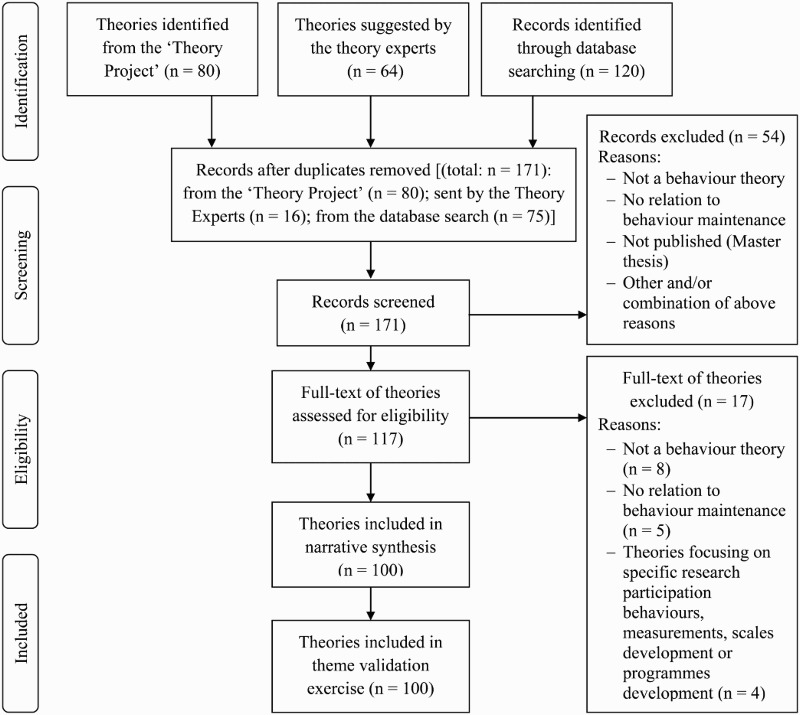
- Of 117 behaviour theories identified, 100 met inclusion criteria; 73 were behaviour specific, and 53 of those explained health-related behaviours. Twenty-six theories were both behaviour specific and population specific.
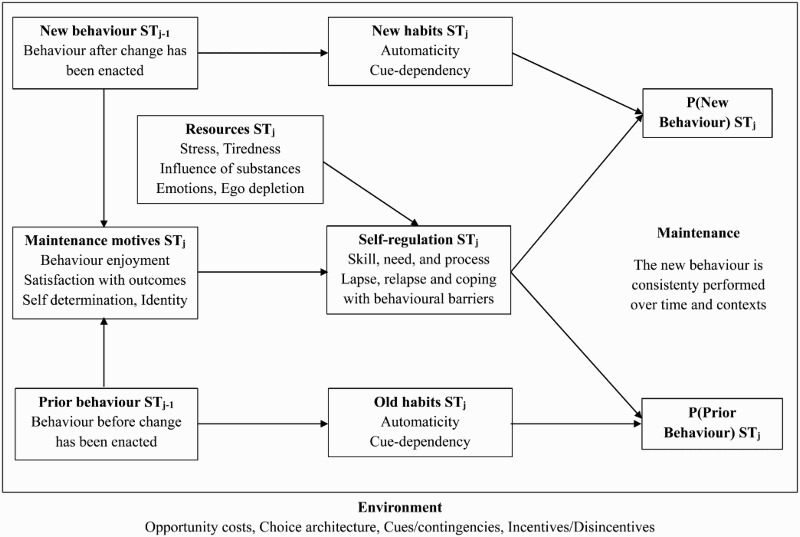
- Five overarching, interconnected themes emerged: (1) maintenance motives, (2) self-regulation, (3) resources, (4) habit, and (5) environmental and social influences.
- Cross-validation by 10 health psychology researchers showed high agreement on theme allocation (Krippendorff’s α = 0.87).
- Forty-three included theories involved assumptions of dynamic reciprocity, and many behavioural theories do not explicitly address behavioural maintenance. Expert suggestions most commonly included the transtheoretical model (n = 11), HAPA (n = 10), social cognitive theory (n = 9), Marlatt’s relapse prevention theory (n = 9), Rothman’s theory of maintenance (n = 8), self-determination theory (n = 7), and habit theories (n = 6).
Methods
- Systematic review of behaviour theories. Theories were identified through Ovid MEDLINE, Embase, and PsycINFO searches (no time limit; search updated 1 March 2014), an existing database of 80 theories, and consultation with 40 theory experts (25 replied).
- Inclusion criteria: theories published in any language before 1 March 2014 that formulated hypotheses about behaviour change maintenance. Exclusions included animal behaviour theories, theories exclusively based on animal research, and unpublished dissertations/theses. Screening was conducted by two reviewers.
- Data extraction recorded verbatim and interpreted statements about maintenance. Explanatory hypotheses were synthesised thematically into themes and subthemes, then cross-validated by 10 health psychology researchers; inter-rater agreement was calculated as Krippendorff’s α.
Limitations
- Stated: the review drew mainly on theories designed and/or assessed in health-related behaviour contexts, so generalisability to other contexts and behaviours requires testing; many theories lack systematic empirical evaluations; the themes require further evaluation, development, and testing; individual theories may be more relevant for detailed predictions; and it cannot be ruled out that a different set of themes would have represented the data equally well or better.
- Evident from the text: the review synthesises theoretical explanations rather than empirically testing them, and it reports no meta-analytic effect sizes or outcome data for maintenance interventions.
Model-written summary. Check it against the paper before relying on it.
Integrity signals
Registry
Cites
Statistics
Figures
Verification
Claims the paper makes
0 Valid · 1 Not valid · 9 Not checked · 58 Own results and interpretations
A result the paper reports from its own data — it cites no other source for it, so there is none to check. The quote shows it is in the paper.
In the paper
“Themes focus on the changing roles of motives, self-regulation, habits, resources and contextual factors from initial behaviour change to successful maintenance.”
§ Theoretical explanations for maintenance of behaviour change: a systematic review of behaviour theories > Results > How do current theories explain behaviour change maintenance?
plain- Asserted: passes — The authors put it forward as true.
- Checkable: passes — It can be checked against evidence.
- Load-bearing: passes — The paper’s conclusions depend on it.
- Based: passes — The paper gives a reason why it holds.
A result the paper reports from its own data — it cites no other source for it, so there is none to check. The quote shows it is in the paper.
In the paper
“For the remaining theories where differential explanatory hypotheses for initiation and maintenance could be derived, theory-guided thematic analysis resulted in five overarching interrelated themes (Table 2).”
§ Theoretical explanations for maintenance of behaviour change: a systematic review of behaviour theories > Results > How do current theories explain behaviour change maintenance?
plain- Asserted: passes — The authors put it forward as true.
- Checkable: passes — It can be checked against evidence.
- Load-bearing: passes — The paper’s conclusions depend on it.
- Based: passes — The paper gives a reason why it holds.
A result the paper states — it cites no source for it, so there is none to check. The quote shows it is in the paper.
In the paper
“Many behavioural theories do not explicitly address the issue of behavioural maintenance.”
§ Theoretical explanations for maintenance of behaviour change: a systematic review of behaviour theories > Results > How do current theories explain behaviour change maintenance?
plain- Asserted: passes — The authors put it forward as true.
- Checkable: passes — It can be checked against evidence.
- Load-bearing: passes — The paper’s conclusions depend on it.
- Based: passes — The paper gives a reason why it holds.
None of the sources cited for this claim have been checked yet.
In the paper
“While previous reviews have focused on behaviour change (Cane, O'Connor, & Michie, 2012; Michie et al., 2005), this is the first review to specifically assess theoretical explanations for behaviour change maintenance.”
§ Theoretical explanations for maintenance of behaviour change: a systematic review of behaviour theories > Discussion > Comparison with other studies
What the sources say
- Not checked yetcites Cane, O'Connor, & Michie, 2012
- Not checked yetcites Michie et al., 2005
plain- Asserted: passes — The authors put it forward as true.
- Checkable: passes — It can be checked against evidence.
- Load-bearing: passes — The paper’s conclusions depend on it.
- Based: passes — The paper gives a reason why it holds.
A result the paper states — it cites no source for it, so there is none to check. The quote shows it is in the paper.
In the paper
“This review examined and summarised 100 theories that explicitly or implicitly explain how individuals maintain new behaviours.”
§ Theoretical explanations for maintenance of behaviour change: a systematic review of behaviour theories > Discussion > Implications for health behaviour change maintenance and conclusions
plain- Asserted: passes — The authors put it forward as true.
- Checkable: passes — It can be checked against evidence.
- Load-bearing: passes — The paper’s conclusions depend on it.
- Based: passes — The paper gives a reason why it holds.
34 more claims
Create a free account to see all 68 claims and to verify the 17 references still open.
- It may state two separate claims as one. 14
- Probably not a substantial claim. 21
Claims other papers make about this one
Each is checked against this paper’s own text: does it say what the citing paper says it does?
The source backs part of the claim, not all of it — or backs it for a different population, condition or comparison.
In the citing paper
“Aspects of psychological flexibility central to chronic disease management include: (1) recognizing and adapting to situational demands, (2) shifting perspective when personal or social functioning is compromised; (3) balancing competing desires, needs, and life domains, and (4) being committed to behaviors that are consistent with deeply held values (17,18).”
From Addressing emotional distress to improve outcomes in adults with type 1 diabetes: Protocol for ACT1VATE randomized controlled trial (2024) · cites this paper as [18]
Experimental — accuracy not yet measuredThe source backs part of the claim, not all of it — or backs it for a different population, condition or comparison.
In the citing paper
“Self-efficacy is a key to the adoption and maintenance of of healthier and less risky behaviours (Kwasnicka et al., 2016).”
From Reading for pleasure in childhood and adolescent healthy behaviours: Longitudinal associations using the Millennium Cohort Study (2020) · cites this paper as Kwasnicka et al., 2016
Experimental — accuracy not yet measuredThe source backs part of the claim, not all of it — or backs it for a different population, condition or comparison.
In the citing paper
“Furthermore, behaviors that consistently resulted in large weight loss in the first year following bariatric surgery may appear to be more difficult and less rewarding once weight loss diminishes and stops (84, 85).”
From Behavioral Interventions to Attenuate Driven Overeating and Weight Regain After Bariatric Surgery (2022) · cites this paper as [85]
Experimental — accuracy not yet measuredThe check wasn’t confident either way, so it gives no verdict — never disputed.
In the citing paper
“These four aspects of psychological flexibility are well positioned to explain successful behavioral maintenance toward healthy living in a real-life context (Kwasnicka et al., 2016).”
From Acceptance and Commitment Therapy for Health Behavior Change: A Contextually-Driven Approach (2018) · cites this paper as Kwasnicka et al., 2016
Experimental — accuracy not yet measuredIn the citing paper
“While these approaches can be helpful to a degree, the magnitude of health problems and the maintenance of health behavior change suggests that alternatives are needed (Kwasnicka et al., 2016).”
From Acceptance and Commitment Therapy for Health Behavior Change: A Contextually-Driven Approach (2018) · cites this paper as Kwasnicka et al., 2016
Self-check
Percentages, sums and reported differences re-computed from the paper’s own numbers.
Each contradiction between two passages listed here was confirmed by an independent check.
Rated minor: it would not touch a result — a value no result rests on, a p-value that stays on the same side of the significance level, or a conflict that is clerical, resolved elsewhere in the paper, or outside its own findings.
In the paper
§ Theoretical explanations for maintenance of behaviour change: a systematic review of behaviour theories > Results > How do current theories explain behaviour change maintenance?
“| (3) Resources | People are successful in maintaining behaviour if their psychological and physical resources are plentiful |”
§ Theoretical explanations for maintenance of behaviour change: a systematic review of behaviour theories > Results > Theme 3. Habits
“### Theme 3. Habits”
Citations
Cites
The theory of planned behavior
Ajzen, I. (1991) · Organizational Behavior and Human Decision Processes · doi:10.1016/0749-5978(91)90020-t · Cited by 90,587
Preferred Reporting Items for Systematic Reviews and Meta-Analyses: the PRISMA statement
Moher, D., Liberati, A., Tetzlaff, J., Altman, D. G., & for the PRISMA Group (2009) · BMJ · doi:10.1136/bmj.b2535 · Cited by 83,823
Ryan, R. M., & Deci, E. L. (2000) · American Psychologist · doi:10.1037//0003-066x.55.1.68 · Cited by 54,599 · cited 3×
“Thus, to maintain a new behaviour a sense of relatedness must be developed (self-determination theory – Deci & Ryan, 2000; Ryan & Deci, 2000).”
Preferred reporting items for systematic reviews and meta-analyses: the PRISMA Statement.
(2009) · PubMed Central · Cited by 44,859
Preferred reporting items for systematic reviews and meta-analyses: The PRISMA statement
Moher, D., Liberati, A., Tetzlaff, J., Altman, D. G., & the PRISMA Group* (2009) · Annals of Internal Medicine · doi:10.7326/0003-4819-151-4-200908180-00135 · Cited by 37,554
The "what" and "why" of goal pursuits: Human needs and the self-determination of behavior
Deci, E. L., & Ryan, R. M. (2000) · Psychological Inquiry · doi:10.1207/s15327965pli1104_01 · Cited by 34,210
Intrinsic Motivation and Self-Determination in Human Behavior
Deci, E. L., & Ryan, R. M. (1985) · doi:10.1007/978-1-4899-2271-7 · Cited by 26,772
Content Analysis: An Introduction to its Methodology.
Shelley, M., & Krippendorff, K. (1984) · Journal of the American Statistical Association · doi:10.2307/2288384 · Cited by 24,312
Intrinsic Motivation and Self-Determination in Human Behavior
Miller, K. A., Deci, E. L., & Ryan, R. M. (1988) · Contemporary Sociology · doi:10.2307/2070638 · Cited by 15,312
An Integrative Theory of Intergroup Conflict
Tajfel, H., & Turner, J. (2000) · Organizational Identity · doi:10.1093/oso/9780199269464.003.0005 · Cited by 12,487
Research works printed but not linked: 5
- Bandura A. 1986 Social foundations of thought and action: A social cognitive theory Englewood Cliffs, NJ Prentice-Hall
- 10.1207/s15327965pli1104_01 · DOI · Paper page
- Pavlov I. P. 1927 Conditioned reflexes London Oxford University Press
- Skinner B. F. 1953 Science and human behaviour New York Macmillan
- Triandis H. C. 1977 Interpersonal behavior Monterey Brooks/Cole Publishing Company
Cited by
Items 101–200 of 1,000
Habit Mechanisms and Behavioural Complexity
Mullan, B. A., & Novoradovskaya, E. (2018) · Springer eBooks · doi:10.1007/978-3-319-97529-0_5 · Cited by 75
Hidano, A., Enticott, G., Christley, R., & Gates, M. C. (2018) · Frontiers in Veterinary Science · doi:10.3389/fvets.2018.00137 · Cited by 74
Kwaśnicka, D., Dombrowski, S. U., White, M., & Sniehotta, F. F. (2019) · Psychology and Health · doi:10.1080/08870446.2019.1579913 · Cited by 61
Self-citationAdherence to the Physical Distancing Measures during the COVID‐19 Pandemic: A HAPA‐Based Perspective
Beeckman, M., Paepe, A. L. D., Alboom, M. V., Maes, S., Wauters, A., Baert, F., Kissi, A., Veirman, E., Ryckeghem, D. M. L. V., & Poppe, L. (2020) · Applied Psychology Health and Well-Being · doi:10.1111/aphw.12242 · Cited by 66
Functional Mechanisms of Health Behavior Change Techniques: A Conceptual Review
Michaelsen, M. M., & Esch, T. (2022) · Frontiers in Psychology · doi:10.3389/fpsyg.2022.725644 · Cited by 67
Döbler, A., Herbeck Belnap, B., Pollmann, H., Farin, E., Raspe, H., & Mittag, O. (2018) · Rehabilitation Psychology · doi:10.1037/rep0000224 · Cited by 55
Shi, W., Ghisi, G. L. D. M., Zhang, L., Hyun, K. K., Pakosh, M. T., & Gallagher, R. D. (2022) · European Journal of Cardiovascular Nursing · doi:10.1093/eurjcn/zvac001 · Cited by 65
Office workers' perspectives on physical activity and sedentary behaviour: a qualitative study
Landais, L. L., Jelsma, J. G. M., Dotinga, I. R., Timmermans, D. R. M., Verhagen, E. A. L. M., & Damman, O. C. (2022) · BMC Public Health · doi:10.1186/s12889-022-13024-z · Cited by 88
Warner, L. M., & French, D. (2020) · Cambridge University Press eBooks · doi:10.1017/9781108677318.032 · Cited by 79
Narrative Review and Analysis of the Use of “Lifestyle” in Health Psychology
Brivio, F., Viganò, A., Paterna, A., Palena, N., & Greco, A. (2023) · International Journal of Environmental Research and Public Health · doi:10.3390/ijerph20054427 · Cited by 113
Young, I., Thaivalappil, A., Greig, J. D., Meldrum, R. J., & Waddell, L. A. (2018) · International Journal of Environmental Health Research · doi:10.1080/09603123.2018.1476846 · Cited by 61
Behavior Change Techniques Incorporated in Fitness Trackers: Content Analysis
Chia, G. L. C., Anderson, A., & McLean, L. A. (2019) · JMIR mHealth and uHealth · doi:10.2196/12768 · Cited by 50
Experiences of initiating and maintaining a vegan diet among young adults: A qualitative study
Williams, E., Vardavoulia, A., Lally, P. J., & Gardner, B. (2022) · Appetite · doi:10.1016/j.appet.2022.106357 · Cited by 60
Binning, J., Woodburn, J., Bus, S. A., & Barn, R. (2018) · Diabetes/Metabolism Research and Reviews · doi:10.1002/dmrr.3105 · Cited by 55
Chew, H. S. J., Sim, K. L. D., Cao, X., & Chair, S. Y. (2019) · International Journal of Behavioral Medicine · doi:10.1007/s12529-019-09798-z · Cited by 65
Changing Behavior Using Ecological Models
Salmon, J., Hesketh, K. D., Arundell, L., Downing, K. L., & Biddle, S. (2020) · Cambridge University Press eBooks · doi:10.1017/9781108677318.017 · Cited by 91
Thom, G., Dombrowski, S. U., Brosnahan, N., Algindan, Y. Y., Rosario Lopez-Gonzalez, M., Roditi, G., Lean, M. E. J., & Malkova, D. (2020) · European Journal of Clinical Nutrition · doi:10.1038/s41430-020-0568-9 · Cited by 49
Self-citationNguyen, D. V. M., Vu, A. T., Ross, V., Brijs, T., Wets, G., & Brijs, K. (2021) · Safety Science · doi:10.1016/j.ssci.2021.105514 · Cited by 54
Martinengo, L., Jabir, A. I., Goh, W. W. T., Lo, N. Y. W., Ho, M.-H. R., Kowatsch, T., Atun, R., Michie, S., & Tudor Car, L. (2022) · Journal of Medical Internet Research · doi:10.2196/39243 · Cited by 49
Kwasnicka, D., Dombrowski, S. U., White, M., & Sniehotta, F. F. (2017) · Psychology & Health · doi:10.1080/08870446.2017.1293057 · Cited by 49
Self-citationBaker, J. A., Berzins, K. M., Canvin, K., Benson, I., Kellar, I., Wright, J. M., López, R. R., Duxbury, J. A., Kendall, T., & Stewart, D. (2021) · Health Services and Delivery Research · doi:10.3310/hsdr09050 · Cited by 63
Semwal, M., Whiting, P., Bajpai, R., Bajpai, S., Kyaw, B. M., & Tudor Car, L. (2019) · Journal of Medical Internet Research · doi:10.2196/13000 · Cited by 48
Flaherty, S. J., McCarthy, M. B., Collins, A., & McAuliffe, F. M. (2019) · Journal of Marketing Management · doi:10.1080/0267257x.2019.1576756 · Cited by 57
Brown, M. J., McCann, E., Truesdale, M., Linden, M., & Marsh, L. (2020) · International Journal of Environmental Research and Public Health · doi:10.3390/ijerph17207568 · Cited by 65
Predicting medical tourism behavioural intention using social cognition models
Seow, A. N., Choong, Y. O., Moorthy, K., & Choong, C. (2020) · Tourism Review · doi:10.1108/tr-06-2019-0267 · Cited by 54
Nudging healthier food choices in a cafeteria setting: A sequential multi-intervention field study
Bauer, J. M., Bietz, S., Rauber, J., & Reisch, L. A. (2021) · Appetite · doi:10.1016/j.appet.2021.105106 · Cited by 56
Dean, A. J., Kneebone, S., Tull, F., Lauren, N., & Smith, L. D. G. (2021) · Resources Conservation and Recycling · doi:10.1016/j.resconrec.2021.105531 · Cited by 55
Sainsbury, K., Halmos, E. P., Knowles, S., Mullan, B., & Tye-Din, J. A. (2018) · Appetite · doi:10.1016/j.appet.2018.02.023 · Cited by 46
Saaka, M., Wemah, K., Kizito, F., & Hoeschle‐Zeledon, I. (2021) · Journal of Nutritional Science · doi:10.1017/jns.2021.35 · Cited by 46
Digital Media for Behavior Change: Review of an Emerging Field of Study
Evans, W. D., Abroms, L. C., Broniatowski, D. A., Napolitano, M. A., Arnold, J., Ichimiya, M., & Agha, S. (2022) · International Journal of Environmental Research and Public Health · doi:10.3390/ijerph19159129 · Cited by 69
Rawson, T. M., Moore, L. S. P., Tivey, A., Tsao, A., Gilchrist, M. J., Charani, E., & Holmes, A. H. (2017) · Antimicrobial Resistance and Infection Control · doi:10.1186/s13756-017-0170-7 · Cited by 51
Newton, T., & Asimakopoulou, K. G. (2017) · BDJ · doi:10.1038/sj.bdj.2017.659 · Cited by 54
Kloek, C. J. J., Bossen, D., de Bakker, D. H., Veenhof, C., & Dekker, J. (2017) · Journal of Medical Internet Research · doi:10.2196/jmir.8108 · Cited by 53
Sunio, V., Schmöcker, J., & Kim, J. (2018) · Transportation Research Part F Traffic Psychology and Behaviour · doi:10.1016/j.trf.2018.08.017 · Cited by 55
Kwaśnicka, D., Ntoumanis, N., Hunt, K., Gray, C. M., Newton, R. U., Gucciardi, D. F., Thøgersen‐Ntoumani, C., Olson, J. L., McVeigh, J. A., Kerr, D. A., et al. (2020) · PLoS Medicine · doi:10.1371/journal.pmed.1003136 · Cited by 55
Bartels, S. L., van Knippenberg, R. J. M., Dassen, F. C. M., Asaba, E., Patomella, A.-H., Malinowsky, C., Verhey, F. R. J., & de Vugt, M. E. (2019) · Internet Interventions · doi:10.1016/j.invent.2019.100283 · Cited by 45
Sainsbury, K., & Marques, M. M. (2018) · Appetite · doi:10.1016/j.appet.2017.10.017 · Cited by 45
Sevild, C. H., Niemiec, C. P., Bru, L. E., Dyrstad, S. M., & Husebø, A. M. L. (2020) · BMC Public Health · doi:10.1186/s12889-020-09111-8 · Cited by 62
Changing Behavior Using Self-Determination Theory
Hagger, M. S., Hankonen, N. E., Chatzisarantis, N. L. D., & Ryan, R. M. (2020) · Cambridge University Press eBooks · doi:10.1017/9781108677318.008 · Cited by 90
Arden, M. A., Hutchings, M., Whelan, P., Drabble, S. J., Beever, D., Bradley, J. M., Hind, D., Ainsworth, J., Maguire, C., Cantrill, H., et al. (2021) · Pilot and Feasibility Studies · doi:10.1186/s40814-020-00739-2 · Cited by 44
The concept of akrasia as the foundation for a dual systems theory of addiction
Heather, N. (2020) · Behavioural Brain Research · doi:10.1016/j.bbr.2020.112666 · Cited by 46
Iturbe, I., Echeburúa, E., & Maíz, E. (2021) · Clinical Psychology & Psychotherapy · doi:10.1002/cpp.2695 · Cited by 57
Heino, M. T. J., Proverbio, D., Marchand, G. C., Resnicow, K., & Hankonen, N. E. (2022) · Health Psychology Review · doi:10.1080/17437199.2022.2146598 · Cited by 66
My cup of tea: Behaviour change intervention to promote use of reusable hot drink cups
Novoradovskaya, E., Mullan, B. A., Hasking, P. A., & Uren, H. V. (2020) · Journal of Cleaner Production · doi:10.1016/j.jclepro.2020.124675 · Cited by 60
Falon, S. L., Kangas, M., & Crane, M. F. (2021) · Anxiety Stress & Coping · doi:10.1080/10615806.2021.1910676 · Cited by 61
Physical Activity among Adults Residing in 11 Countries during the COVID-19 Pandemic Lockdown
Ding, K., Yang, J. G., Chin, M.-K., Sullivan, L., Durstine, J. L., Violant, V., Demirhan, G., de Oliveira, N. R. C., Popeska, B., Kuan, G., et al. (2021) · International Journal of Environmental Research and Public Health · doi:10.3390/ijerph18137056 · Cited by 54
Obesity Hurts: The Why and How of Integrating Weight Reduction With Chronic Pain Management
Malfliet, A., Marnef, A. Q., Nijs, J., Clarys, P., Huybrechts, I., Elma, Ö., Yılmaz, S. T., & Deliens, T. (2021) · Physical Therapy · doi:10.1093/ptj/pzab198 · Cited by 49
Phelan, S., Halfman, T., Pinto, A. M., & Foster, G. D. (2020) · Obesity · doi:10.1002/oby.22685 · Cited by 43
“, exercise after breakfast) was found to produce automaticity (30), allowing the behaviors to occur with less reported intentional effort (30,31).”
BackgroundThe Norwegian Healthy Life Centre Study: A pragmatic RCT of physical activity in primary care
Samdal, G. B., Meland, E., Eide, G. E., Berntsen, S., Abildsnes, E., Stea, T. H., & Mildestvedt, T. (2018) · Scandinavian Journal of Public Health · doi:10.1177/1403494818785260 · Cited by 49
Perceived Social Support and Sustained Physical Activity During the COVID-19 Pandemic
Hailey, V., Fisher, A., Hamer, M., & Fancourt, D. E. (2022) · International Journal of Behavioral Medicine · doi:10.1007/s12529-022-10125-2 · Cited by 58
Mahony, R., Blake, C. M., Matthews, J. J., Donoghue, G. O., & Cunningham, C. (2018) · Physiotherapy Theory and Practice · doi:10.1080/09593985.2018.1457112 · Cited by 60
Kris-Etherton, P. M., Petersen, K. S., Després, J.-P., Braun, L., de Ferranti, S. D., Furie, K. L., Lear, S. A., Lobelo, F., Morris, P. B., Sacks, F. M., et al. (2021) · Circulation · doi:10.1161/cir.0000000000001014 · Cited by 43
Clarkson, P., Stephenson, A., Grimmett, C., Cook, K., Clark, C., Muckelt, P. E., O’Gorman, P., Saynor, Z., Adams, J., Stokes, M., et al. (2022) · DIGITAL HEALTH · doi:10.1177/20552076221089778 · Cited by 43
“30,31 Time-based de fi nitions for maintenance of PA have more recently focused on 3 – 6 months after the end of the intervention.”
Keller, J., Roitzheim, C., Radtke, T., Schenkel, K., & Schwarzer, R. (2021) · JMIR mhealth and uhealth · doi:10.2196/26397 · Cited by 47
Qama, E., Rubinelli, S., & Diviani, N. (2022) · BMJ Open · doi:10.1136/bmjopen-2022-066647 · Cited by 49
Job, J. R., Fjeldsoe, B. S., Eakin, E. G., & Reeves, M. M. (2018) · Obesity Reviews · doi:10.1111/obr.12648 · Cited by 41
Lloyd, M., Skelton, D. A., Mead, G. E., Williams, B., & van Wijck, F. (2018) · Brain and Behavior · doi:10.1002/brb3.1000 · Cited by 40
Wang, X., Wu, Y., Meng, Z., Li, J., Li, X., Sun, X., & Zang, S. (2023) · Journal of Medical Internet Research · doi:10.2196/44225 · Cited by 41
Assessing Effectiveness of a Nonhuman Animal Welfare Education Program for Primary School Children
Hawkins, R. D., Williams, J. M., & Scottish Society for the Prevention of Cruelty to Animals (2017) · Journal of Applied Animal Welfare Science · doi:10.1080/10888705.2017.1305272 · Cited by 49
Hulse, L. M. (2022) · Transportation Research Part F Traffic Psychology and Behaviour · doi:10.1016/j.trf.2022.12.007 · Cited by 39
Pilegaard, M. S., la Cour, K., Oestergaard, L. G., Johnsen, A. T., Lindahl-Jacobsen, L. E., Højris, I., & Brandt, Å. (2018) · Palliative Medicine · doi:10.1177/0269216317747199 · Cited by 46
Planning and Implementation Intention Interventions
Rhodes, R. E., Grant, S. J., & de Bruijn, G. (2020) · Cambridge University Press eBooks · doi:10.1017/9781108677318.039 · Cited by 49
Attitudes and Persuasive Communication Interventions
Hamilton, K., & Johnson, B. T. (2020) · Cambridge University Press eBooks · doi:10.1017/9781108677318.031 · Cited by 61
Changing Behavior Using Habit Theory
Orbell, S., & Verplanken, B. (2020) · Cambridge University Press eBooks · doi:10.1017/9781108677318.013 · Cited by 64
Fisher behaviour in coastal and marine fisheries
Andrews, E. J., Pittman, J. B., & Armitage, D. R. (2020) · Fish and Fisheries · doi:10.1111/faf.12529 · Cited by 40
Teh, K., Quek, I. P., & Tang, W. E. (2021) · BMC Pregnancy and Childbirth · doi:10.1186/s12884-021-04089-6 · Cited by 46
Salisbury, C. E., Hyde, M. K., Cooper, E. T., Stennett, R., Gomersall, S. R., & Skinner, T. L. (2023) · Journal of Cancer Survivorship · doi:10.1007/s11764-023-01377-2 · Cited by 50
Karlsson, L., Gerdle, B. U. C., Takala, E., Andersson, G., & Larsson, B. K. (2018) · Journal of Pain Research · doi:10.2147/jpr.s149826 · Cited by 48
Hayes, T., Sharma, M., Shahbazi, M., Sung, J. H., Bennett, R., & Reese-Smith, J. Y. (2019) · Health Promotion Perspectives · doi:10.15171/hpp.2019.02 · Cited by 39
Changing Behavior: A Theory- and Evidence-Based Approach
Hagger, M. S., Cameron, L. D., Hamilton, K., Hankonen, N. E., & Lintunen, T. (2020) · Cambridge University Press eBooks · doi:10.1017/9781108677318.001 · Cited by 63
Chillón, P., Gálvez‐Fernández, P., Huertas‐Delgado, F. J., Herrador‐Colmenero, M., Barranco-Ruíz, Y., Villa‐González, E., Aranda-Balboa, M. J., Saucedo‐Araujo, R. G., Campos-Garzón, P., Molina-Soberanes, D., et al. (2021) · International Journal of Environmental Research and Public Health · doi:10.3390/ijerph18042066 · Cited by 41
Effects of a Mobile App to Promote Social Participation on Older Adults: Randomized Controlled Trial
Kawaguchi, K., Nakagomi, A., Ide, K., & Kondo, K. (2024) · Journal of Medical Internet Research · doi:10.2196/64196 · Cited by 47
An intervention designed to investigate habit formation in a novel health behaviour
Mergelsberg, E. L. P., Mullan, B. A., Allom, V., & Scott, A. J. (2020) · Psychology and Health · doi:10.1080/08870446.2020.1779272 · Cited by 44
Tarrant, M., Haslam, C., Carter, M., Calitri, R., & Haslam, S. A. (2020) · Cambridge University Press eBooks · doi:10.1017/9781108677318.044 · Cited by 43
Characterizing and predicting person-specific, day-to-day, fluctuations in walking behavior
Chevance, G., Baretta, D., Heino, M. T. J., Perski, O., Olthof, M., Klasnja, P., Hekler, E. B., & Godino, J. (2021) · PLoS ONE · doi:10.1371/journal.pone.0251659 · Cited by 48
Arnold, T., Haubrick, K. K., Klasko-Foster, L. B., Rogers, B. G., Barnett, A., Ramirez- Sanchez, N. A., Bertone, Z., & Gaudiano, B. A. (2022) · Journal of Contextual Behavioral Science · doi:10.1016/j.jcbs.2022.05.005 · Cited by 37
Could habits hold the key to weight loss maintenance? A narrative review
Cleo, G., Isenring, E., Thomas, R., & Glasziou, P. (2017) · Journal of Human Nutrition and Dietetics · doi:10.1111/jhn.12456 · Cited by 36
Using Smartphone‐Based Support Groups to Promote Healthy Eating in Daily Life: A Randomised Trial
Inauen, J., Bolger, N. P., Shrout, P. E., Stadler, G., Amrein, M. A., Rackow, P., & Scholz, U. (2017) · Applied Psychology Health and Well-Being · doi:10.1111/aphw.12093 · Cited by 42
Judah, G., Mullan, B. A., Yee, M., Johansson, L., Allom, V., & Liddelow, C. (2020) · International Journal of Behavioral Medicine · doi:10.1007/s12529-020-09906-4 · Cited by 43
Wilkie, L., Arroyo, P., Conibeer, H., Kemp, A. H., & Fisher, Z. (2021) · Frontiers in Psychology · doi:10.3389/fpsyg.2021.648286 · Cited by 35
Karloh, M., Matias, T. S., de Oliveira, J. M., de Lima, F. F., Pinheiro, D. H. A., Barbosa, G. B., Furlanetto, K. C., & Carvalho, C. R. F. (2023) · Brazilian Journal of Physical Therapy · doi:10.1016/j.bjpt.2023.100574 · Cited by 50
Sersli, S., DeVries, D. N., Gislason, M., Scott, N. A., & Winters, M. (2018) · Transportation Research Part A Policy and Practice · doi:10.1016/j.tra.2018.07.012 · Cited by 43
Quested, E., Kwaśnicka, D., Thøgersen‐Ntoumani, C., Gucciardi, D. F., Kerr, D. A., Hunt, K., Robinson, S., Morgan, P. J., Newton, R. U., Gray, C. M., et al. (2018) · BMJ Open · doi:10.1136/bmjopen-2018-022663 · Cited by 43
Husband, C., Higgins, J., & Rhodes, R. E. (2019) · Health Psychology and Behavioral Medicine · doi:10.1080/21642850.2019.1600407 · Cited by 40
Rodrigues, A., Haste, A., Penn, L., Bell, R., Summerbell, C., White, M., Adamson, A., & Sniehotta, F. F. (2020) · BMC Health Services Research · doi:10.1186/s12913-020-05160-2 · Cited by 35
Self-citationChanging Behavior Using Integrated Theories
Hagger, M. S., & Hamilton, K. (2020) · Cambridge University Press eBooks · doi:10.1017/9781108677318.015 · Cited by 51
Psychology of physical activity: a 30-year reflection on correlates, barriers, and theory
Biddle, S., Gorely, T., Faulkner, G., & Mutrie, N. (2022) · International Journal of Sport and Exercise Psychology · doi:10.1080/1612197x.2022.2147261 · Cited by 42
Development of strategies to support home-based exercise adherence after stroke: a Delphi consensus
Mahmood, A., Deshmukh, A. S., Natarajan, M., Marsden, D. L., Vyslysel, G., Padickaparambil, S., Shwetha, T. S., Direito, A., Senthil Kumaran, D., Girish, N., et al. (2022) · BMJ Open · doi:10.1136/bmjopen-2021-055946 · Cited by 44
Negotiating discord in sustainability transformations
Patterson, J., Feola, G., & Kim, R. E. (2024) · Proceedings of the National Academy of Sciences · doi:10.1073/pnas.2310186121 · Cited by 47
Mansfield, L., Hall, J., Smith, L., Rasch, M., Reeves, E., Dewitt, S. H., & Gardner, B. (2018) · PLoS ONE · doi:10.1371/journal.pone.0198483 · Cited by 45
Flaherty, S. J., McCarthy, M. B., Collins, A., McCafferty, C., & McAuliffe, F. M. (2021) · European Journal of Marketing · doi:10.1108/ejm-06-2019-0531 · Cited by 44
Borek, A., Santillo, M., Wanat, M., Butler, C., & Tonkin-Crine, S. K. (2022) · JAC-Antimicrobial Resistance · doi:10.1093/jacamr/dlac007 · Cited by 48
Safiri, S., Nejadghaderi, S. A., Karamzad, N., Carson‐Chahhoud, K., Bragazzi, N. L., Sullman, M. J. M., Almasi‐Hashiani, A., Mansournia, M. A., Collins, G. S., Kaufman, J. S., et al. (2022) · Cancer · doi:10.1002/cncr.34111 · Cited by 43
Arnautovska, U., Kesby, J. P., Korman, N., Rebar, A. L., Chapman, J., Warren, N., Rossell, S. L., Dark, F. L., & Siskind, D. J. (2022) · Neuropsychiatric Disease and Treatment · doi:10.2147/ndt.s393775 · Cited by 40
O’Dwyer, T., Maguire, S., Mockler, D., Durcan, L., & Wilson, F. (2019) · Rheumatology International · doi:10.1007/s00296-019-04270-3 · Cited by 43
Ginja, S., Gallagher, S. M., & Keenan, M. (2019) · International Journal of Environmental Health Research · doi:10.1080/09603123.2019.1682127 · Cited by 43
Atoloye, A. T., Savoie‐Roskos, M. R., Guenther, P. M., & Durward, C. M. (2021) · Journal of Nutrition Education and Behavior · doi:10.1016/j.jneb.2021.03.006 · Cited by 38
Behavioural approaches to recruitment and retention in clinical trials: a systematic mapping review
Coffey, T., Duncan, E., Morgan, H. M., Lawrie, L., & Gillies, K. (2022) · BMJ Open · doi:10.1136/bmjopen-2021-054854 · Cited by 41
Lundqvist, S., Börjesson, M., Cider, Å., Hagberg, L., Ottehall, C. B., Sjöström, J., & Larsson, M. E. H. (2020) · Trials · doi:10.1186/s13063-020-04727-y · Cited by 39
Gray, C. M., Wyke, S., Zhang, R., Anderson, A. S., Barry, S., Brennan, G., Briggs, A. H., Boyer, N., Bunn, C., Donnachie, C., et al. (2018) · Public Health Research · doi:10.3310/phr06090 · Cited by 37
Metadata
- Authors
- Kwasnicka, D., Dombrowski, S. U., White, M., & Sniehotta, F.
- Affiliations
- University of Stirling (GB)
- University of Cambridge (GB)
- United Kingdom Clinical Research Collaboration (GB)
- Corresponding author
- Sniehotta, Falko
- Venue
- Health Psychology Review
- Publisher
- Informa UK Limited
- Published
- 2016-03-07
- Volume
- 10
- Issue
- 3
- Pages
- 277-296
- ISSN
- 1743-7199 (ISSN-L)
- 1743-7202
- PMC
- PMC4975085
- OpenAlex
- W2265901161
- Cited by
- 1,476
- References
- 118
- Citations by year
- 2026: 143 · 2025: 176 · 2024: 207 · 2023: 163 · 2022: 182 · 2021: 197 · 2020: 181 · 2019: 112 · 2018: 70 · 2017: 34 · 2016: 8
- FWCI
- 12.02
- Type
- journal article
- Language
- en
- Open access
- hybrid
- doi.org
- Licence
- Locations
- Health Psychology Review (publishedVersion, cc-by)
- PubMed Central (publishedVersion, cc-by)
- PubMed (publishedVersion)
- Minerva Access (University of Melbourne) (submittedVersion, cc-by)
- Stirling Online Research Repository (University of Stirling) (submittedVersion, cc-by)
- eSpace (Curtin University) (submittedVersion, cc-by)
- Newcastle University ePrints (Newcastle Univesity) (cc-by)
- Funders
- Wellcome Trust
- United Kingdom Clinical Research Collaboration
- National Institute for Health and Care Research
- British Heart Foundation
- Curtin University of Technology
- Medical Research Council (MR/K02325X/1, MR/J000477/1)
- Economic and Social Research Council (ESRC-3000021026, 3000021026)
- Topics
- Social Sciences › Psychology › Applied Psychology › Behavioral Health and Interventions
- Social Sciences › Psychology › Developmental and Educational Psychology › Behavioral and Psychological Studies
- Health Sciences › Health Professions › General Health Professions › Health Policy Implementation Science
- Keywords
- behavior maintenance, behaviour change theory, health behavior, self-regulation, motivation, habit, psychological resources, physical resources
- MeSH terms
- Self-Control, Behavior Therapy, Habits, Humans, Individuality, Learning, Models, Psychological, Motivation, Personal Satisfaction, Social Support, Health Behavior
About these checks
Registry, retraction, Cites and statistics results are computed, not judged, with one exception: a printed reference that no index lists is read once by a model before it counts as a citation error. Claims are extracted by a model and kept only when their quote appears verbatim in the text; each cited source is then checked, with a model’s help, for whether it says what the claim relies on. Those verdicts can be wrong — read the claim’s quote and the cited source before relying on one.
A language model drew the claims from the paper on 2026-10-04, under version 3 of the claim definition (model deepseek-v4.1-flash, prompt extract-v3).
A second model labelled each claim on 2026-10-04 (model jev-1.13-20260917, definition revision gold-guideline-v0.2).
Statistics and arithmetic are recomputed, not judged.
Confidence bands are shown only for fields calibrated on our annotated test set. None is calibrated yet, so no band is shown.
What counts as a claim ›How we measure confidence ›How we check this ›
Are you an author, or do you see a problem with this page? Request a review
Data sources
Bibliographic data: Semantic Scholar, OpenAlex, Crossref.
Contains information from the Semantic Scholar Academic Graph Datasets, made available under the ODC Attribution License (ODC-BY 1.0).
Semantic Scholar’s data is described in: Kinney, R., et al. (2023). The Semantic Scholar Open Data Platform. arXiv:2301.10140.
