

Theoretical explanations for maintenance of behaviour change: a systematic review of behaviour theories
Open accessThe DOI matches its Crossref record; 117 of the 118 references it cites were found in a registry or an index; none of the 17 sources its claims cite is checked for support yet.
Abstract
BACKGROUND: Behaviour change interventions are effective in supporting individuals in achieving temporary behaviour change. Behaviour change maintenance, however, is rarely attained. The aim of this review was to identify and synthesise current theoretical explanations for behaviour change maintenance to inform future research and practice. METHODS: Potentially relevant theories were identified through systematic searches of electronic databases (Ovid MEDLINE, Embase, PsycINFO). In addition, an existing database of 80 theories was searched, and 25 theory experts were consulted. Theories were included if they formulated hypotheses about behaviour change maintenance. Included theories were synthesised thematically to ascertain overarching explanations for behaviour change maintenance. Initial theoretical themes were cross-validated. FINDINGS: One hundred and seventeen behaviour theories were identified, of which 100 met the inclusion criteria. Five overarching, interconnected themes representing theoretical explanations for behaviour change maintenance emerged. Theoretical explanations of behaviour change maintenance focus on the differential nature and role of motives, self-regulation, resources (psychological and physical), habits, and environmental and social influences from initiation to maintenance. DISCUSSION: There are distinct patterns of theoretical explanations for behaviour change and for behaviour change maintenance. The findings from this review can guide the development and evaluation of interventions promoting maintenance of health behaviours and help in the development of an integrated theory of behaviour change maintenance.
Overview
CoChat Summary
TL;DR
This systematic review identified 117 behaviour theories, of which 100 met inclusion criteria, and synthesised five interconnected theoretical themes explaining behaviour change maintenance: maintenance motives, self-regulation, resources, habits, and environmental/social influences. It concludes that theoretical explanations for maintenance differ from those for initiation and can guide intervention development and an integrated theory of behaviour change maintenance.
Key findings
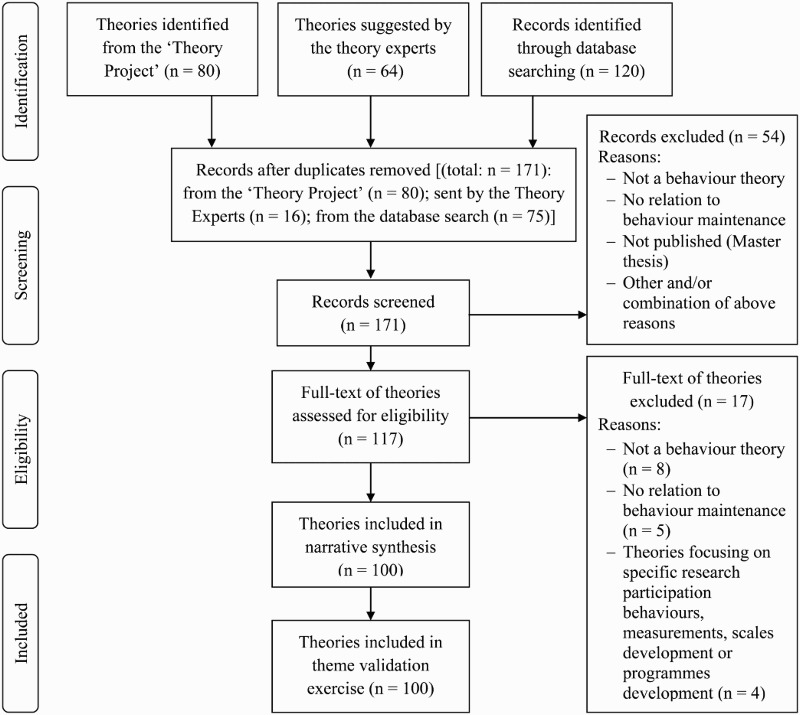
- Of 117 behaviour theories identified, 100 met inclusion criteria; 73 were behaviour specific, and 53 of those explained health-related behaviours. Twenty-six theories were both behaviour specific and population specific.
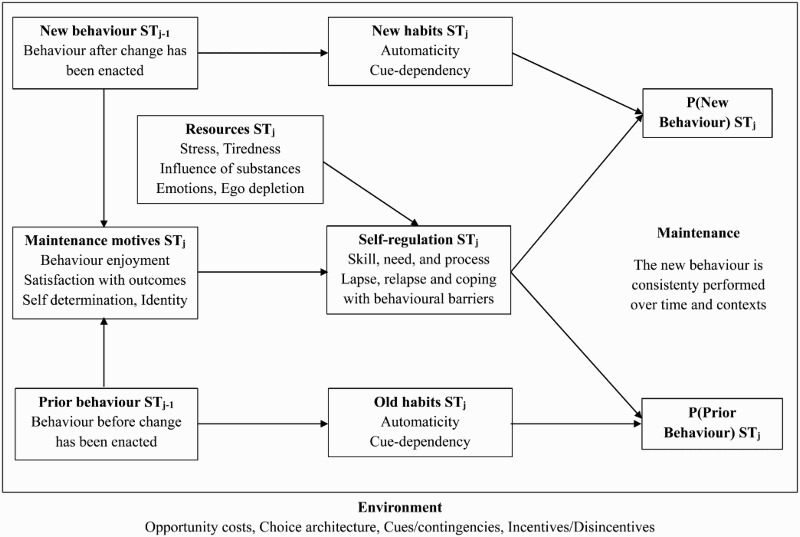
- Five overarching, interconnected themes emerged: (1) maintenance motives, (2) self-regulation, (3) resources, (4) habit, and (5) environmental and social influences.
- Cross-validation by 10 health psychology researchers showed high agreement on theme allocation (Krippendorff’s α = 0.87).
- Forty-three included theories involved assumptions of dynamic reciprocity, and many behavioural theories do not explicitly address behavioural maintenance. Expert suggestions most commonly included the transtheoretical model (n = 11), HAPA (n = 10), social cognitive theory (n = 9), Marlatt’s relapse prevention theory (n = 9), Rothman’s theory of maintenance (n = 8), self-determination theory (n = 7), and habit theories (n = 6).
Methods
- Systematic review of behaviour theories. Theories were identified through Ovid MEDLINE, Embase, and PsycINFO searches (no time limit; search updated 1 March 2014), an existing database of 80 theories, and consultation with 40 theory experts (25 replied).
- Inclusion criteria: theories published in any language before 1 March 2014 that formulated hypotheses about behaviour change maintenance. Exclusions included animal behaviour theories, theories exclusively based on animal research, and unpublished dissertations/theses. Screening was conducted by two reviewers.
- Data extraction recorded verbatim and interpreted statements about maintenance. Explanatory hypotheses were synthesised thematically into themes and subthemes, then cross-validated by 10 health psychology researchers; inter-rater agreement was calculated as Krippendorff’s α.
Limitations
- Stated: the review drew mainly on theories designed and/or assessed in health-related behaviour contexts, so generalisability to other contexts and behaviours requires testing; many theories lack systematic empirical evaluations; the themes require further evaluation, development, and testing; individual theories may be more relevant for detailed predictions; and it cannot be ruled out that a different set of themes would have represented the data equally well or better.
- Evident from the text: the review synthesises theoretical explanations rather than empirically testing them, and it reports no meta-analytic effect sizes or outcome data for maintenance interventions.
Model-written summary. Check it against the paper before relying on it.
Integrity signals
Registry
Cites
Statistics
Figures
Verification
Claims the paper makes
0 Valid · 1 Not valid · 9 Not checked · 58 Own results and interpretations
A result the paper reports from its own data — it cites no other source for it, so there is none to check. The quote shows it is in the paper.
In the paper
“Themes focus on the changing roles of motives, self-regulation, habits, resources and contextual factors from initial behaviour change to successful maintenance.”
§ Theoretical explanations for maintenance of behaviour change: a systematic review of behaviour theories > Results > How do current theories explain behaviour change maintenance?
plain- Asserted: passes — The authors put it forward as true.
- Checkable: passes — It can be checked against evidence.
- Load-bearing: passes — The paper’s conclusions depend on it.
- Based: passes — The paper gives a reason why it holds.
A result the paper reports from its own data — it cites no other source for it, so there is none to check. The quote shows it is in the paper.
In the paper
“For the remaining theories where differential explanatory hypotheses for initiation and maintenance could be derived, theory-guided thematic analysis resulted in five overarching interrelated themes (Table 2).”
§ Theoretical explanations for maintenance of behaviour change: a systematic review of behaviour theories > Results > How do current theories explain behaviour change maintenance?
plain- Asserted: passes — The authors put it forward as true.
- Checkable: passes — It can be checked against evidence.
- Load-bearing: passes — The paper’s conclusions depend on it.
- Based: passes — The paper gives a reason why it holds.
A result the paper states — it cites no source for it, so there is none to check. The quote shows it is in the paper.
In the paper
“Many behavioural theories do not explicitly address the issue of behavioural maintenance.”
§ Theoretical explanations for maintenance of behaviour change: a systematic review of behaviour theories > Results > How do current theories explain behaviour change maintenance?
plain- Asserted: passes — The authors put it forward as true.
- Checkable: passes — It can be checked against evidence.
- Load-bearing: passes — The paper’s conclusions depend on it.
- Based: passes — The paper gives a reason why it holds.
None of the sources cited for this claim have been checked yet.
In the paper
“While previous reviews have focused on behaviour change (Cane, O'Connor, & Michie, 2012; Michie et al., 2005), this is the first review to specifically assess theoretical explanations for behaviour change maintenance.”
§ Theoretical explanations for maintenance of behaviour change: a systematic review of behaviour theories > Discussion > Comparison with other studies
What the sources say
- Not checked yetcites Cane, O'Connor, & Michie, 2012
- Not checked yetcites Michie et al., 2005
plain- Asserted: passes — The authors put it forward as true.
- Checkable: passes — It can be checked against evidence.
- Load-bearing: passes — The paper’s conclusions depend on it.
- Based: passes — The paper gives a reason why it holds.
A result the paper states — it cites no source for it, so there is none to check. The quote shows it is in the paper.
In the paper
“This review examined and summarised 100 theories that explicitly or implicitly explain how individuals maintain new behaviours.”
§ Theoretical explanations for maintenance of behaviour change: a systematic review of behaviour theories > Discussion > Implications for health behaviour change maintenance and conclusions
plain- Asserted: passes — The authors put it forward as true.
- Checkable: passes — It can be checked against evidence.
- Load-bearing: passes — The paper’s conclusions depend on it.
- Based: passes — The paper gives a reason why it holds.
34 more claims
Create a free account to see all 68 claims and to verify the 17 references still open.
- It may state two separate claims as one. 14
- Probably not a substantial claim. 21
Claims other papers make about this one
Each is checked against this paper’s own text: does it say what the citing paper says it does?
The source backs part of the claim, not all of it — or backs it for a different population, condition or comparison.
In the citing paper
“Aspects of psychological flexibility central to chronic disease management include: (1) recognizing and adapting to situational demands, (2) shifting perspective when personal or social functioning is compromised; (3) balancing competing desires, needs, and life domains, and (4) being committed to behaviors that are consistent with deeply held values (17,18).”
From Addressing emotional distress to improve outcomes in adults with type 1 diabetes: Protocol for ACT1VATE randomized controlled trial (2024) · cites this paper as [18]
Experimental — accuracy not yet measuredThe source backs part of the claim, not all of it — or backs it for a different population, condition or comparison.
In the citing paper
“Self-efficacy is a key to the adoption and maintenance of of healthier and less risky behaviours (Kwasnicka et al., 2016).”
From Reading for pleasure in childhood and adolescent healthy behaviours: Longitudinal associations using the Millennium Cohort Study (2020) · cites this paper as Kwasnicka et al., 2016
Experimental — accuracy not yet measuredThe source backs part of the claim, not all of it — or backs it for a different population, condition or comparison.
In the citing paper
“Furthermore, behaviors that consistently resulted in large weight loss in the first year following bariatric surgery may appear to be more difficult and less rewarding once weight loss diminishes and stops (84, 85).”
From Behavioral Interventions to Attenuate Driven Overeating and Weight Regain After Bariatric Surgery (2022) · cites this paper as [85]
Experimental — accuracy not yet measuredThe check wasn’t confident either way, so it gives no verdict — never disputed.
In the citing paper
“These four aspects of psychological flexibility are well positioned to explain successful behavioral maintenance toward healthy living in a real-life context (Kwasnicka et al., 2016).”
From Acceptance and Commitment Therapy for Health Behavior Change: A Contextually-Driven Approach (2018) · cites this paper as Kwasnicka et al., 2016
Experimental — accuracy not yet measuredIn the citing paper
“While these approaches can be helpful to a degree, the magnitude of health problems and the maintenance of health behavior change suggests that alternatives are needed (Kwasnicka et al., 2016).”
From Acceptance and Commitment Therapy for Health Behavior Change: A Contextually-Driven Approach (2018) · cites this paper as Kwasnicka et al., 2016
Self-check
Percentages, sums and reported differences re-computed from the paper’s own numbers.
Each contradiction between two passages listed here was confirmed by an independent check.
Rated minor: it would not touch a result — a value no result rests on, a p-value that stays on the same side of the significance level, or a conflict that is clerical, resolved elsewhere in the paper, or outside its own findings.
In the paper
§ Theoretical explanations for maintenance of behaviour change: a systematic review of behaviour theories > Results > How do current theories explain behaviour change maintenance?
“| (3) Resources | People are successful in maintaining behaviour if their psychological and physical resources are plentiful |”
§ Theoretical explanations for maintenance of behaviour change: a systematic review of behaviour theories > Results > Theme 3. Habits
“### Theme 3. Habits”
Citations
Cites
The theory of planned behavior
Ajzen, I. (1991) · Organizational Behavior and Human Decision Processes · doi:10.1016/0749-5978(91)90020-t · Cited by 90,587
Preferred Reporting Items for Systematic Reviews and Meta-Analyses: the PRISMA statement
Moher, D., Liberati, A., Tetzlaff, J., Altman, D. G., & for the PRISMA Group (2009) · BMJ · doi:10.1136/bmj.b2535 · Cited by 83,823
Ryan, R. M., & Deci, E. L. (2000) · American Psychologist · doi:10.1037//0003-066x.55.1.68 · Cited by 54,599 · cited 3×
“Thus, to maintain a new behaviour a sense of relatedness must be developed (self-determination theory – Deci & Ryan, 2000; Ryan & Deci, 2000).”
Preferred reporting items for systematic reviews and meta-analyses: the PRISMA Statement.
(2009) · PubMed Central · Cited by 44,859
Preferred reporting items for systematic reviews and meta-analyses: The PRISMA statement
Moher, D., Liberati, A., Tetzlaff, J., Altman, D. G., & the PRISMA Group* (2009) · Annals of Internal Medicine · doi:10.7326/0003-4819-151-4-200908180-00135 · Cited by 37,554
The "what" and "why" of goal pursuits: Human needs and the self-determination of behavior
Deci, E. L., & Ryan, R. M. (2000) · Psychological Inquiry · doi:10.1207/s15327965pli1104_01 · Cited by 34,210
Intrinsic Motivation and Self-Determination in Human Behavior
Deci, E. L., & Ryan, R. M. (1985) · doi:10.1007/978-1-4899-2271-7 · Cited by 26,772
Content Analysis: An Introduction to its Methodology.
Shelley, M., & Krippendorff, K. (1984) · Journal of the American Statistical Association · doi:10.2307/2288384 · Cited by 24,312
Intrinsic Motivation and Self-Determination in Human Behavior
Miller, K. A., Deci, E. L., & Ryan, R. M. (1988) · Contemporary Sociology · doi:10.2307/2070638 · Cited by 15,312
An Integrative Theory of Intergroup Conflict
Tajfel, H., & Turner, J. (2000) · Organizational Identity · doi:10.1093/oso/9780199269464.003.0005 · Cited by 12,487
Research works printed but not linked: 5
- Bandura A. 1986 Social foundations of thought and action: A social cognitive theory Englewood Cliffs, NJ Prentice-Hall
- 10.1207/s15327965pli1104_01 · DOI · Paper page
- Pavlov I. P. 1927 Conditioned reflexes London Oxford University Press
- Skinner B. F. 1953 Science and human behaviour New York Macmillan
- Triandis H. C. 1977 Interpersonal behavior Monterey Brooks/Cole Publishing Company
Cited by
Items 201–300 of 1,000
Darwinian Hedonism and the Epidemic of Unhealthy Behavior
Williams, D. M. (2019) · Cambridge University Press eBooks · doi:10.1017/9781316275047 · Cited by 41
A snapshot of food-based dietary guidelines implementation in selected countries
Wijesinha‐Bettoni, R., Khosravi, A., Ramos, A. I., Sherman, J., Hernández-Garbanzo, Y., Molina, V., Vargas, M., & Hachem, F. (2021) · Global Food Security · doi:10.1016/j.gfs.2021.100533 · Cited by 32
Kahlert, D., Unyi-Reicherz, A., Stratton, G., Larsen, T. M., Fogelholm, M., Raben, A., & Schlicht, W. M. (2016) · Frontiers in Psychology · doi:10.3389/fpsyg.2016.01136 · Cited by 36
Evolutionary learning processes as the foundation for behaviour change
Crutzen, R., & Peters, G.-J. (2017) · Health Psychology Review · doi:10.1080/17437199.2017.1362569 · Cited by 41
Influence of paraquat on dopaminergic transporter in the rat brain.
Ossowska, K., Wardas, J., Kuter, K. Z., Nowak, P. G., Dąbrowska, J., Bortel, A. B., Labus, Ł., Kwieciński, A., Krygowska‐Wajs, A., & Wolfarth, S. (2005) · PubMed · Cited by 42
Gibbs, K., Wilkie, L., Jarman, J., Barker-Smith, A., Kemp, A. H., & Fisher, Z. (2022) · PLOS ONE · doi:10.1371/journal.pone.0266388 · Cited by 31
Changing Behavior Using the Transtheoretical Model
DiClemente, C. C., & Graydon, M. M. (2020) · Cambridge University Press eBooks · doi:10.1017/9781108677318.010 · Cited by 39
Mapping the Landscape of Digital Health Intervention Strategies: 25-Year Synthesis
Liu, S., Ma, J., Sun, M., Zhang, C., Gao, Y., & Xu, J. (2025) · Journal of Medical Internet Research · doi:10.2196/59027 · Cited by 44
Pylkkönen, M., Tolvanen, A. J., Hublin, C., Kaartinen, J., Karhula, K., Puttonen, S., Sihvola, M., & Sallinen, M. (2018) · Accident Analysis & Prevention · doi:10.1016/j.aap.2018.05.008 · Cited by 38
Chen, C., Zhang, T., Gu, X., Lee, J., Ren, S., & Wang, H. (2019) · International Journal of Environmental Research and Public Health · doi:10.3390/ijerph17010104 · Cited by 35
Roordink, E. M., Steenhuis, I. H., Kroeze, W., Schoonmade, L. J., Sniehotta, F. F., & van Stralen, M. M. (2021) · Psychology and Health · doi:10.1080/08870446.2021.1981900 · Cited by 39
Self-citationTabaczynski, A., Bastas, D., Whitehorn, A., & Trinh, L. (2022) · Journal of Cancer Survivorship · doi:10.1007/s11764-021-01156-x · Cited by 31
Liu, J., Zeng, M., Wang, D., Zhang, Y., Shang, B., & Ma, X. (2022) · Frontiers in Psychology · doi:10.3389/fpsyg.2021.695241 · Cited by 45
Clocking self-regulation: why time of day matters for health psychology
Millar, B. M. (2017) · Health Psychology Review · doi:10.1080/17437199.2017.1316673 · Cited by 37
Kamarova, S., Gagné, M., Holtrop, D., & Dunlop, P. D. (2024) · Journal of Organizational Behavior · doi:10.1002/job.2832 · Cited by 64
Harjumaa, M., Absetz, P., Ermes, M., Mattila, E., Männikkö, R., Tilles‐Tirkkonen, T., Lintu, N., Schwab, U., Umer, A., Leppänen, J., et al. (2020) · JMIR Diabetes · doi:10.2196/15219 · Cited by 39
Changing Behavior Using the Health Belief Model and Protection Motivation Theory
Orbell, S., Zahid, H., & Henderson, C. J. (2020) · Cambridge University Press eBooks · doi:10.1017/9781108677318.004 · Cited by 42
Barrett, S., Begg, S. J., O’Halloran, P., Howlett, O., Lawrence, J., & Kingsley, M. (2021) · International Journal of Behavioral Nutrition and Physical Activity · doi:10.1186/s12966-020-01076-6 · Cited by 34
Asbjørnsen, R. A., Hjelmesaeth, J. S., Smedsrød, M. L., Wentzel, J., Ollivier, M., Clark, M. M., van Gemert‐Pijnen, J. E. W. C., & Nes, L. S. (2022) · JMIR Human Factors · doi:10.2196/37372 · Cited by 34
Efficacy of habit-based weight loss interventions: A systematic review and meta-analysis
Cleo, G., Beller, E., Glasziou, P., Isenring, E., & Thomas, R. (2020) · Journal of Behavioral Medicine · doi:10.1007/s10865-019-00100-w · Cited by 28
Biehl, A., & Stathopoulos, A. (2020) · Journal of Transport & Health · doi:10.1016/j.jth.2020.100897 · Cited by 34
Changing Hearts and Minds in the Equestrian World One Behaviour at a Time
Wolframm, I., Douglas, J. E., & Pearson, G. (2023) · Animals · doi:10.3390/ani13040748 · Cited by 51
Riemann-Lorenz, K., Wienert, J., Streber, R., Motl, R. W., Coote, S. B., & Heesen, C. (2019) · Disability and Rehabilitation · doi:10.1080/09638288.2019.1584253 · Cited by 36
Mak, H. W., & Fancourt, D. (2020) · Preventive Medicine · doi:10.1016/j.ypmed.2019.105889 · Cited by 43
Behavioral Interventions to Attenuate Driven Overeating and Weight Regain After Bariatric Surgery
Ames, G. E., Koball, A. M., & Clark, M. M. (2022) · Frontiers in Endocrinology · doi:10.3389/fendo.2022.934680 · Cited by 28
Zoubi, F. A., Mayo, N. E., Rochette, A., & Thomas, A. (2018) · Implementation Science · doi:10.1186/s13012-018-0844-4 · Cited by 35
Changing Behavior by Changing Environments
Marteau, T. M., Fletcher, P. C., Hollands, G. J., & Munafo, M. R. (2020) · Cambridge University Press eBooks · doi:10.1017/9781108677318.014 · Cited by 35
Teixeira, D., Rodrigues, F. F., Machado, S. E. D. C., Cid, L., & Monteiro, D. (2021) · Frontiers in Psychology · doi:10.3389/fpsyg.2021.682480 · Cited by 50
Khunti, K., Griffin, S. J., Brennan, A., Dallosso, H. M., Davies, M. J., Eborall, H., Edwardson, C. L., Gray, L. J., Hardeman, W., Heathcote, L., et al. (2021) · Health Technology Assessment · doi:10.3310/hta25770 · Cited by 36
The Unifying Theory of Physical Activity
Matias, T. S., & Piggin, J. (2022) · Quest · doi:10.1080/00336297.2021.2024442 · Cited by 37
Locher, C., Messerli, M., Gaab, J., & Gerger, H. (2019) · AIDS Patient Care and STDs · doi:10.1089/apc.2018.0164 · Cited by 29
Notley, C. J., Ward, E., Dawkins, L., & Holland, R. (2020) · Addiction · doi:10.1111/add.15226 · Cited by 28
Protogerou, C., McHugh, R. K., & Johnson, B. T. (2020) · Health Psychology Review · doi:10.1080/17437199.2019.1707104 · Cited by 30
Scheerman, K., Schoenmakers, A. H. C., Meskers, C. G. M., & Maier, A. B. (2021) · Geriatric Nursing · doi:10.1016/j.gerinurse.2021.02.013 · Cited by 29
Wang, S. D., Intille, S. S., Ponnada, A., Do, B., Rothman, A., & Dunton, G. F. (2022) · JMIR Research Protocols · doi:10.2196/36666 · Cited by 30
Hohberg, V., Fuchs, R., Gerber, M., Künzler, D., Paganini, S., & Faude, O. (2022) · Sports Medicine - Open · doi:10.1186/s40798-022-00489-w · Cited by 27
Gardner, B. (2022) · Current Research in Behavioral Sciences · doi:10.1016/j.crbeha.2022.100081 · Cited by 35
Wang, X., Wong, Y. D., Kim, T. Y., & Yuen, K. F. (2023) · Electronic Commerce Research and Applications · doi:10.1016/j.elerap.2023.101273 · Cited by 37
Text Messages With Financial Incentives for Men With Obesity: A Randomized Clinical Trial
Hoddinott, P., O’Dolan, C., Macaulay, L., Dombrowski, S. U., Swingler, J., Cotton, S. C., Avenell, A., Getaneh, A. M., Gray, C. M., Hunt, K., et al. (2024) · JAMA · doi:10.1001/jama.2024.7064 · Cited by 32
Self-citationBoekhout, J. M., Berendsen, B., Peels, D. A., Bolman, C. A. W., & Lechner, L. (2018) · International Journal of Environmental Research and Public Health · doi:10.3390/ijerph15020346 · Cited by 32
Gumport, N. B., Dolsen, E. A., & Harvey, A. G. (2019) · Behaviour Research and Therapy · doi:10.1016/j.brat.2019.103504 · Cited by 27
Water, Sanitation, and Hygiene (WASH)
Weber, N., Rajasingham, A., Patrick, M., Martinsen, A. L., & Handzel, T. (2018) · Cambridge University Press eBooks · doi:10.1017/9781107477261.012 · Cited by 27
Vézina‐Im, L., & Beaulieu, D. (2019) · Current Nutrition Reports · doi:10.1007/s13668-019-0275-0 · Cited by 28
Changing health behaviours in rheumatology: an introduction to behavioural economics
Ogdie, A., & Asch, D. A. (2019) · Nature Reviews Rheumatology · doi:10.1038/s41584-019-0336-1 · Cited by 28
Using Person-Reported Outcomes (PROs) to Motivate Young People with Diabetes
de Wit, M., Versloot, J., Zenlea, I. S., & Goethals, E. R. (2020) · Current Diabetes Reports · doi:10.1007/s11892-020-01305-z · Cited by 29
Design, Implementation, and Evaluation of Behavior Change Interventions: A Ten-Task Guide
Abraham, C., & Denford, S. (2020) · Cambridge University Press eBooks · doi:10.1017/9781108677318.019 · Cited by 36
Changing Behavior Using the Reflective-Impulsive Model
Deutsch, R., & Strack, F. (2020) · Cambridge University Press eBooks · doi:10.1017/9781108677318.012 · Cited by 36
COVID-19: Assessing the impact of lockdown on recreational athletes
Martin, A. M., Champ, F. M., & Franklin, Z. C. (2021) · Psychology of sport and exercise · doi:10.1016/j.psychsport.2021.101978 · Cited by 32
Morris, J. H., Irvine, L. A., Dombrowski, S. U., McCormack, B. G., van Wijck, F., & Lawrence, M. (2022) · BMJ Open · doi:10.1136/bmjopen-2021-058563 · Cited by 27
Self-citationMurray, J., French, D., Patterson, C., Kee, F., Gough, A., Tang, J., & Hunter, R. F. (2019) · Journal of Medical Internet Research · doi:10.2196/11394 · Cited by 28
Hung, L.-Y., Wang, S.-M., & Yeh, T. (2023) · Marine Pollution Bulletin · doi:10.1016/j.marpolbul.2023.114933 · Cited by 51
Arrazat, L., Cambriels, C., Noan, C. L., Nicklaus, S., & Marty, L. (2024) · International Journal of Behavioral Nutrition and Physical Activity · doi:10.1186/s12966-024-01624-4 · Cited by 34
Keller, J., Hohl, D. H., Hosoya, G., Heuse, S., Scholz, U., Łuszczyńska, A., & Knoll, N. (2020) · Psychology of sport and exercise · doi:10.1016/j.psychsport.2020.101710 · Cited by 27
Robinson, L., Arden, M. A., Dawson, S., Walters, S. J., Wildman, M. J., & Stevenson, M. (2022) · Health Psychology Review · doi:10.1080/17437199.2022.2034516 · Cited by 34
Rand, M., Goyder, E., Norman, P. E., & Womack, R. (2020) · Psychology of sport and exercise · doi:10.1016/j.psychsport.2020.101771 · Cited by 38
Dyadic Behavior Change Interventions
Scholz, U., Berli, C., Lüscher, J., & Knoll, N. (2020) · Cambridge University Press eBooks · doi:10.1017/9781108677318.043 · Cited by 29
Söderlund, A., & Wågert, P. V. H. (2021) · Journal of Clinical Medicine · doi:10.3390/jcm10020303 · Cited by 31
Practitioners’ views on shared decision-making implementation: A qualitative study
Ankolekar, A., Steffensen, K. D., Olling, K., Dekker, A. L. A. J., Wee, L., Roumen, C., Hasannejadasl, H., & Fijten, R. (2021) · PLoS ONE · doi:10.1371/journal.pone.0259844 · Cited by 28
Lai, M. Y. C., Mong, M. S. A., Cheng, L. J., & Lau, Y. (2023) · Nursing and Health Sciences · doi:10.1111/nhs.13011 · Cited by 25
Williams, S. N., Dienes, K., Jaheed, J., Wardman, J. K., & Petts, J. (2023) · Philosophical Transactions of the Royal Society A Mathematical Physical and Engineering Sciences · doi:10.1098/rsta.2023.0129 · Cited by 39
Health psychology and climate change: time to address humanity’s most existential crisis
Papies, E. K., Nielsen, K. S., & Soares, V. A. (2024) · Health Psychology Review · doi:10.1080/17437199.2024.2309242 · Cited by 34
Developing Behavior Change Interventions
Hankonen, N. E., & Hardeman, W. (2020) · Cambridge University Press eBooks · doi:10.1017/9781108677318.021 · Cited by 42
Lewis, A., Harvey, G., Hogan, M., & Kitson, A. A. (2018) · International Journal of Nursing Studies · doi:10.1016/j.ijnurstu.2018.12.016 · Cited by 23
Wang, P., Ko, N., Chang, Y., Wu, C.-F., Lu, W.-H., & Yen, C. (2020) · International Journal of Environmental Research and Public Health · doi:10.3390/ijerph17186827 · Cited by 29
Assessing information security behaviour: a self-determination theory perspective
Gangire, Y., da Veiga, A., & Herselman, M. (2021) · Information and Computer Security · doi:10.1108/ics-11-2020-0179 · Cited by 17
Lubas, M. M., & Szklo‐Coxe, M. (2018) · Adolescent Research Review · doi:10.1007/s40894-018-0100-9 · Cited by 31
Rothman, A. J., Klein, W. M. P., & Sheeran, P. (2020) · Cambridge University Press eBooks · doi:10.1017/9781108677318.020 · Cited by 30
Hyland, J., Henchion, M. M., Olomo, O., Attard, J., & Gaffey, J. (2024) · British Food Journal · doi:10.1108/bfj-01-2023-0058 · Cited by 22
Brandt, T., Schwandner, C. T. L., & Schmidt, A. (2024) · Frontiers in Public Health · doi:10.3389/fpubh.2024.1347825 · Cited by 23
Intervention effects on physical activity identity: a systematic review and meta-analysis
Rhodes, R. E., Wierts, C. M., Kullman, S. M., Magel, E., & Strachan, S. M. (2024) · Health Psychology Review · doi:10.1080/17437199.2024.2412996 · Cited by 32
Cross, V., Stanford, J., Gómez‐Martín, M., Collins, C. E., Robertson, S., & Clarke, E. D. (2024) · Nutrition Reviews · doi:10.1093/nutrit/nuae149 · Cited by 32
Abós, Á., Sevil‐Serrano, J., Clemente, J. A. J., Lanaspa, E. G., & García‐González, L. (2019) · The Journal of Experimental Education · doi:10.1080/00220973.2019.1681349 · Cited by 29
Huffman, M. K., & Amireault, S. (2020) · The Gerontologist · doi:10.1093/geront/gnaa087 · Cited by 24
Lang, S., Gibson, S., Ng, K. W., & Truby, H. (2020) · Obesity Reviews · doi:10.1111/obr.13172 · Cited by 26
Buzasi, E., Kurakata, H., Gandhi, A., Birch, H. L., Zarnegar, R., & Best, L. M. (2021) · Pain · doi:10.1097/j.pain.0000000000002302 · Cited by 24
Lin, B., Zhang, Z., Guo, Y., Wang, W., Mei, Y., Wang, S., Tong, Y., Shuaib, N., & Cheung, D. S. K. (2021) · Health Expectations · doi:10.1111/hex.13335 · Cited by 23
Groce, J. E., & Cook, C. N. (2021) · Journal of Environmental Management · doi:10.1016/j.jenvman.2021.114355 · Cited by 27
Sheeran, P., Wright, C. E., Listrom, O., Klein, W. M. P., & Rothman, A. J. (2023) · Annals of Behavioral Medicine · doi:10.1093/abm/kaad002 · Cited by 22
Knapová, L., Cho, Y. W., Chow, S., Kühnová, J., & Elavsky, S. (2023) · Psychology of sport and exercise · doi:10.1016/j.psychsport.2023.102566 · Cited by 29
Imagery, Visualization, and Mental Simulation Interventions
Hagger, M. S., & Conroy, D. (2020) · Cambridge University Press eBooks · doi:10.1017/9781108677318.033 · Cited by 25
Changing Behavior Using the Common-Sense Model of Self-Regulation
Cameron, L. D., Fleszar‐Pavlović, S. E., & Khachikian, T. (2020) · Cambridge University Press eBooks · doi:10.1017/9781108677318.005 · Cited by 34
Haynes, A. S., Gilchrist, H., Oliveira, J. S., Grunseit, A. C., Sherrington, C., Lord, S. R., & Tiedemann, A. (2022) · BMC Public Health · doi:10.1186/s12889-022-12818-5 · Cited by 24
Maisto, S. A., Hallgren, K. A., Roos, C. R., Swan, J. E., & Witkiewitz, K. (2020) · Journal of Consulting and Clinical Psychology · doi:10.1037/ccp0000615 · Cited by 21
“Theoretical models of the maintenance of behavior change (Kwasnicka et al., 2016) are fundamental to such a research program.”
BackgroundMoving Beyond Raising Awareness: Addressing Barriers
Arlinghaus, K. R., Vaughan, E. M., Kirschmann, J. M., & Johnston, C. A. (2024) · American Journal of Lifestyle Medicine · doi:10.1177/15598276241274114 · Cited by 26
Wang, T., Ma, H., Ge, H., Sun, Y., Kwok, T. T.-O., Liu, X., Wang, Y., Lau, W. K., & Zhang, W. (2025) · International Journal of Nursing Studies · doi:10.1016/j.ijnurstu.2025.105037 · Cited by 55
Leach, H. J., Potter, K., & Hidde, M. C. (2019) · Journal of Physical Activity and Health · doi:10.1123/jpah.2018-0667 · Cited by 25
A systematic review on self‐determination theory in physical education
SAUGY, J. J., Drouet, O., Millet, G. P., & Lentillon‐Kaestner, V. (2019) · Translational Sports Medicine · doi:10.1002/tsm2.121 · Cited by 37
Cardiovascular Risk Factor Knowledge and Behaviors Among Low-Income Urban Women in Mysore, India
Krupp, K., Wilcox, M. L., Srinivas, A., Srinivas, V., Madhivanan, P., & Bastida, E. (2020) · The Journal of Cardiovascular Nursing · doi:10.1097/jcn.0000000000000657 · Cited by 27
Bjerre, N., Holm, L., Veje, N., Quist, J. S., Færch, K., & Hempler, N. F. (2022) · Appetite · doi:10.1016/j.appet.2022.106034 · Cited by 25
Leunis, S., Vandecruys, M., Cornelissen, V., Craenenbroeck, A. H. V., Geest, S. D., Monbaliu, D. R. L., & Smet, S. D. (2022) · Kidney and Dialysis · doi:10.3390/kidneydial2020029 · Cited by 24
Stults‐Kolehmainen, M., Gilson, T. A., SantaBarbara, N. J., McKee, P. C., Sinha, R., Bartholomew, J. B., Boullosa, D. A., Budnick, C. J., Bueno, F. A., Haughton, A. D., et al. (2023) · Frontiers in Sports and Active Living · doi:10.3389/fspor.2023.1033619 · Cited by 32
Sandercock, V., & Andrade, J. (2018) · Journal of Obesity · doi:10.1155/2018/1035871 · Cited by 32
Almli, I., Haugdahl, H. S., Sandsæter, H. L., Rich-Edwards, J. W., & Horn, J. (2020) · BMC Pregnancy and Childbirth · doi:10.1186/s12884-020-2769-6 · Cited by 26
Dagnall, N., Drinkwater, K. G., Denovan, A., & Walsh, R. S. (2020) · Frontiers in Communication · doi:10.3389/fcomm.2020.00071 · Cited by 26
FEEdBACk: An ICT-Based Platform to Increase Energy Efficiency through Buildings’ Consumer Engagement
Soares, F. J., Madureira, A., Pagès, A., Barbosa, A., Coelho, A. F., Cassola, F., Ribeiro, F., Viana, J., Andrade, J., Dorokhova, M., et al. (2021) · Energies · doi:10.3390/en14061524 · Cited by 26
Madigan, C. D., Grimmett, C., Sweet, S. N., Daley, A., Kettle, V. E., Phillips, B., & Graham, H. (2024) · International Journal of Behavioral Medicine · doi:10.1007/s12529-024-10335-w · Cited by 32
Vermeer, J. R., Greef, T. V.-D., van den Broek, J. L. P. M., de Louw, B., van Steenbergen, G. J., van Veghel, D., & Dekker, L. (2025) · European Heart Journal · doi:10.1093/eurheartj/ehaf689 · Cited by 30
Engagement of Stakeholders in the Design, Evaluation, and Implementation of Complex Interventions
Hudson, J. L., Moon, Z., Hughes, L. D., & Moss-Morris, R. E. (2020) · Cambridge University Press eBooks · doi:10.1017/9781108677318.024 · Cited by 29
Nathan, N., Murawski, B., Hope, K. G., Young, S., Sutherland, R., Hodder, R. K., Booth, D., Toomey, E. C., Yoong, S. L., Reilly, K., et al. (2020) · International Journal of Environmental Research and Public Health · doi:10.3390/ijerph17144998 · Cited by 23
Metadata
- Authors
- Kwasnicka, D., Dombrowski, S. U., White, M., & Sniehotta, F.
- Affiliations
- University of Stirling (GB)
- University of Cambridge (GB)
- United Kingdom Clinical Research Collaboration (GB)
- Corresponding author
- Sniehotta, Falko
- Venue
- Health Psychology Review
- Publisher
- Informa UK Limited
- Published
- 2016-03-07
- Volume
- 10
- Issue
- 3
- Pages
- 277-296
- ISSN
- 1743-7199 (ISSN-L)
- 1743-7202
- PMC
- PMC4975085
- OpenAlex
- W2265901161
- Cited by
- 1,476
- References
- 118
- Citations by year
- 2026: 143 · 2025: 176 · 2024: 207 · 2023: 163 · 2022: 182 · 2021: 197 · 2020: 181 · 2019: 112 · 2018: 70 · 2017: 34 · 2016: 8
- FWCI
- 12.02
- Type
- journal article
- Language
- en
- Open access
- hybrid
- doi.org
- Licence
- Locations
- Health Psychology Review (publishedVersion, cc-by)
- PubMed Central (publishedVersion, cc-by)
- PubMed (publishedVersion)
- Minerva Access (University of Melbourne) (submittedVersion, cc-by)
- Stirling Online Research Repository (University of Stirling) (submittedVersion, cc-by)
- eSpace (Curtin University) (submittedVersion, cc-by)
- Newcastle University ePrints (Newcastle Univesity) (cc-by)
- Funders
- Wellcome Trust
- United Kingdom Clinical Research Collaboration
- National Institute for Health and Care Research
- British Heart Foundation
- Curtin University of Technology
- Medical Research Council (MR/K02325X/1, MR/J000477/1)
- Economic and Social Research Council (ESRC-3000021026, 3000021026)
- Topics
- Social Sciences › Psychology › Applied Psychology › Behavioral Health and Interventions
- Social Sciences › Psychology › Developmental and Educational Psychology › Behavioral and Psychological Studies
- Health Sciences › Health Professions › General Health Professions › Health Policy Implementation Science
- Keywords
- behavior maintenance, behaviour change theory, health behavior, self-regulation, motivation, habit, psychological resources, physical resources
- MeSH terms
- Self-Control, Behavior Therapy, Habits, Humans, Individuality, Learning, Models, Psychological, Motivation, Personal Satisfaction, Social Support, Health Behavior
About these checks
Registry, retraction, Cites and statistics results are computed, not judged, with one exception: a printed reference that no index lists is read once by a model before it counts as a citation error. Claims are extracted by a model and kept only when their quote appears verbatim in the text; each cited source is then checked, with a model’s help, for whether it says what the claim relies on. Those verdicts can be wrong — read the claim’s quote and the cited source before relying on one.
A language model drew the claims from the paper on 2026-10-04, under version 3 of the claim definition (model deepseek-v4.1-flash, prompt extract-v3).
A second model labelled each claim on 2026-10-04 (model jev-1.13-20260917, definition revision gold-guideline-v0.2).
Statistics and arithmetic are recomputed, not judged.
Confidence bands are shown only for fields calibrated on our annotated test set. None is calibrated yet, so no band is shown.
What counts as a claim ›How we measure confidence ›How we check this ›
Are you an author, or do you see a problem with this page? Request a review
Data sources
Bibliographic data: Semantic Scholar, OpenAlex, Crossref.
Contains information from the Semantic Scholar Academic Graph Datasets, made available under the ODC Attribution License (ODC-BY 1.0).
Semantic Scholar’s data is described in: Kinney, R., et al. (2023). The Semantic Scholar Open Data Platform. arXiv:2301.10140.
