

Atypical frontal-posterior synchronization of Theory of Mind regions in autism during mental state attribution
Open accessThe DOI matches its Crossref record; 80 of the 80 references it cites were found in a registry or an index.
Abstract
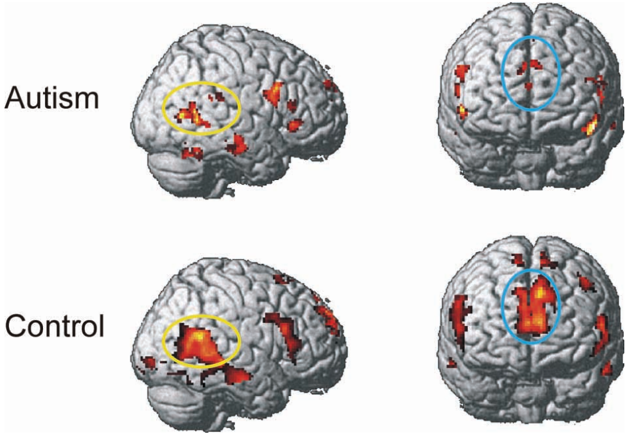
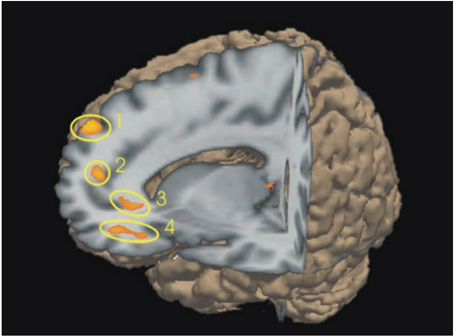
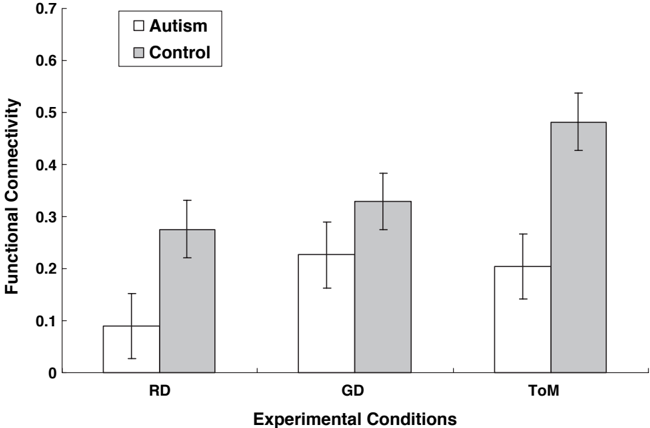
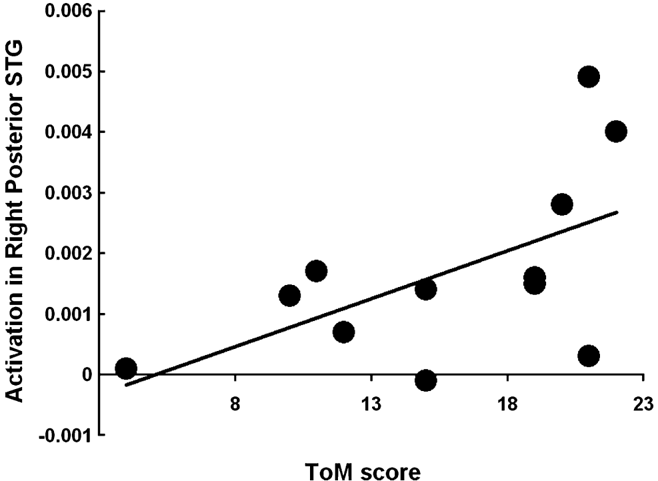
This study used fMRI to investigate the functioning of the Theory of Mind (ToM) cortical network in autism during the viewing of animations that in some conditions entailed the attribution of a mental state to animated geometric figures. At the cortical level, mentalizing (attribution of metal states) is underpinned by the coordination and integration of the components of the ToM network, which include the medial frontal gyrus, the anterior paracingulate, and the right temporoparietal junction. The pivotal new finding was a functional underconnectivity (a lower degree of synchronization) in autism, especially in the connections between frontal and posterior areas during the attribution of mental states. In addition, the frontal ToM regions activated less in participants with autism relative to control participants. In the autism group, an independent psychometric assessment of ToM ability and the activation in the right temporoparietal junction were reliably correlated. The results together provide new evidence for the biological basis of atypical processing of ToM in autism, implicating the underconnectivity between frontal regions and more posterior areas.
Overview
The claims and statistics of this paper haven’t been checked yet.
Free: it reads the open-access text and checks the first 5 claims that cite a source we can check. Create a free account to check every claim.
Integrity signals
Registry
Cites
Statistics
Figures
Verification
Claims the paper makes
The claims and statistics of this paper haven’t been checked yet.
Free: it reads the open-access text and checks the first 5 claims that cite a source we can check. Create a free account to check every claim.
Self-check
Percentages, sums and reported differences re-computed from the paper’s own numbers.
The self-check needs the paper’s full text.
Citations
Cites
Tzourio-Mazoyer, N., Landeau, B., Papathanassiou, D., Crivello, F., Etard, O., Delcroix, N., Mazoyer, B., & Joliot, M. (2002) · NeuroImage · doi:10.1006/nimg.2001.0978 · Cited by 16,319
Statistical parametric maps in functional imaging: A general linear approach
Friston, K. J., Holmes, A. P., Worsley, K. J., Poline, J. ‐., Frith, C. D., & Frackowiak, R. S. J. (1994) · Human Brain Mapping · doi:10.1002/hbm.460020402 · Cited by 9,688 · cited 3×
“To compare the participating groups in terms of the distribution of activation, the data were analyzed using SPM99.”
Lord, C., Rutter, M., & Le Couteur, A. (1994) · Journal of Autism and Developmental Disorders · doi:10.1007/bf02172145 · Cited by 9,065 · cited 1×
“The diagnosis of autism was established using two structured research diagnostic instruments, the ADI-R (Autism Diagnostic Interview—Revised; Lord, Rutter, & LeCouteur, 1994 ) and the ADOS-G (Autism Diagnostic Observation Schedule—Generic, Lord et al, 2000 ), supplemented with confirmation by expert opinion.”
Does the autistic child have a “theory of mind” ?
Baron-Cohen, S., Leslie, A. M., & Frith, U. (1985) · Cognition · doi:10.1016/0010-0277(85)90022-8 · Cited by 8,599 · cited 1×
“Even though difficulty with Theory of Mind (ToM) processing in autism has been demonstrated in many studies (e.g., Baron-Cohen, Leslie, & Frith, 1985; Baron-Cohen, Campbell, Karmiloff-Smith, Grant, & Walker, 1995; Leekam & Perner, 1991; Perner, Frith, Leslie, & Leekam, 1989; Reed & Peterson, 1990; Swettenham, 1996; Sw…”
Lord, C., Risi, S., Lambrecht, L., Cook, E. H., Leventhal, B. L., DiLavore, P. C., Pickles, A., & Rutter, M. (2000) · Journal of Autism and Developmental Disorders · doi:10.1023/a:1005592401947 · Cited by 7,520 · cited 3×
“…of autism was established using two structured research diagnostic instruments, the ADI-R (Autism Diagnostic Interview*Revised; Lord, Rutter, & LeCouteur, 1994) and the ADOS-G (Autism Diagnostic Observation Schedule*Generic, Lord et al., 2000), supplemented with confirmation by expert opinion.”
Meeting of minds: the medial frontal cortex and social cognition
Amodio, D. M., & Frith, C. D. (2006) · Nature Reviews Neuroscience · doi:10.1038/nrn1884 · Cited by 3,782 · cited 2×
“From an anatomical perspective, major afferents to the medial frontal regions come from the dorsolateral prefrontal cortex, temporal pole, anterior superior temporal gyrus, parietotemporal cortex, and posterior cingulate cortex (Barbas, Ghashghaei, Dombrowski, & Rempel-Clower, 1999; Carmichael & Price, 1996; see Amodi…”
Gusnard, D. A., Akbudak, E., Shulman, G. L., & Raichle, M. E. (2001) · Proceedings of the National Academy of Sciences · doi:10.1073/pnas.071043098 · Cited by 2,997 · cited 1×
“The medial prefrontal cortex has been credited with involvement in any kind of thought that uses the self as a referent (Gusnard, Akbudak, Shulman, & Raichle, 2001 ), the anterior paracingulate cortex is believed to be involved in the decoupling mechanism that distinguishes mental states from reality (Gallagher & Frit…”
Happé, F. G. E. (1994) · Journal of Autism and Developmental Disorders · doi:10.1007/bf02172093 · Cited by 2,352 · cited 2×
“…ability The brain activation in two regions of interest (the medial frontal gyrus, and the right posterior superior temporal gyrus), which are associated with processing of ToM, was correlated with the ToM score of the autism participants from the Happé strange stories test (Happé, 1994).”
People thinking about thinking peopleThe role of the temporo-parietal junction in “theory of mind”
Saxe, R., & Kanwisher, N. (2003) · NeuroImage · doi:10.1016/s1053-8119(03)00230-1 · Cited by 2,316 · cited 1×
“Others argue that the right temporoparietal junction is the central player in mental state reasoning, not only collating but also processing the cues to compute a mental state (Saxe & Kanwisher, 2003).”
Functional imaging of ‘theory of mind’
Gallagher, H. L., & Frith, C. D. (2003) · Trends in Cognitive Sciences · doi:10.1016/s1364-6613(02)00025-6 · Cited by 2,092 · cited 6×
“Gallagher and Frith (2003) propose that while the posterior superior temporal sulcus provides the cues for mentalizing, the medial prefrontal cortex does the mental state reasoning.”
Influential
Research works printed but not linked: 2
- Brothers, L. (1990). The social brain: A project for integrating primate behavior and neurophysiology in a new domain. Concepts in Neuroscience, 1, 27Á 51.
- Buxhoeveden, D. P., Semendeferi, K., Schenker, N., & Courchesne, E. (2004). Decreased cell column spa- cing in autism [abstract]. Social Neuroscience, 30, 582.
Cited by
Items 301–343 of 343
Craig, A. S. (2016) · eScholarship (California Digital Library)
The neural basis of mentalizing deficits experienced by adults with autism spectrum disorder
Cole, E. J. (2017) · White Rose eTheses Online (University of Leeds, The University of Sheffield, University of York)
Társas vakság és annak korrelátumai autizmus spektrum zavarban
Szabó, M. K. (2018) · Iskolakultúra · doi:10.17543/iskkult.2018.1-2.35
Black, M. H. (2018) · eSpace (Curtin University)
Doherty, B. R. (2016) · Oxford University Research Archive (ORA) (University of Oxford) · doi:10.5287/ora-noyxr55ve
Cognition sociale et cerveau social dans les troubles du développement de l’enfant
Rechtman, E. (2018) · theses.fr (ABES) · doi:10.70675/c7a9c225z5375z4cf0zab8bz5d07233fa4d9 · Cited by 1
The Director Task Fails to Differentiate Young Adult Theory of Mind Abilities: An IRT Analysis.
Sokolov, M., & Logan, J. S. (2019) · eScholarship (California Digital Library)
Experience Dependent Sensorimotor Functioning in Adults with Severe Autism Spectrum Disorder
Oulton, J. (2019) · Liverpool John Moores University · doi:10.24377/ljmu.t.00011673 · Cited by 1
“Therefore, action observation is intact in autism, even if mentalising is not (Castelli et al., 2002; Kana et al., 2009).”
BackgroundDuarte, F. C., & de Deus, D. M. V. (2020) · REVISTA HUM@NAE
Alteraciones en la conectividad funcional en el autismo: un estudio mediante magnetoencelofalografía
Pascual, T. (2019) · LA Referencia (Red Federada de Repositorios Institucionales de Publicaciones Científicas) · Cited by 2
Zhang, F. (2020) · Ghent University Academic Bibliography (Ghent University)
Brain Networks Involved in Higher Cognitive Functions in Adults with Autism Spectrum Disorder
Yuk, V. (2020) · TSpace (University of Toronto)
Processus d'apprentissage et de catégorisation chez les enfants autistes
Nader, A.-M. (2020) · Archipel (Université du Québec à Montréal)
(2010) · Current Opinion in Neurology · doi:10.1097/wco.0b013e328338cade
(2010) · Wiley eBooks · doi:10.1002/9781444325461.biblio
Liang, Y. (2022) · International Conference on Networking, Communications and Information Technology (NetCIT) · doi:10.1109/netcit57419.2022.00130
“To meet the needs of auxiliary diagnosis of autistic children, this paper adopts the cross research method of corpus in the field of linguistics and artificial intelligence in the field of computer science, selects Chinese autistic children and their matched normal development children, collects their multimodal narra…”
MethodA Review of Research on Moral Development in Children with Autism Spectrum Disorder
贾, 庆. (2023) · Advances in Psychology · doi:10.12677/ap.2023.1311622
Social cognitive and interactive abilities in autismPreprint
Thaler, H., Albantakis, L., & Schilbach, L. (2021) · PsyArXiv (OSF Preprints) · doi:10.31234/osf.io/et8uv_v1
“Using the animated triangle task, another study with autistic and non-autistic adults (N = 24) observed lower functional connectivity within the frontal and posterior parts of the TOM network in autistic participants, although there was no difference in behavioral performance (Kana et al., 2009).”
Li, Y., Zhu, Y., Geng, Y., Feng, D., Guan, S., Li, D., Mei, L., Ding, X., Ying, Y., Tang, J., et al. (2025) · bioRxiv (Cold Spring Harbor Laboratory) · doi:10.1101/2025.06.18.660087
Zielinski, B. A., Prigge, M. B. D., Nielsen, J. A., & Lainhart, J. E. (2013) · Springer eBooks · doi:10.1007/978-1-4614-6843-1_7
K. Kana, R., A. Keller, T., L. Cherkassky, V., J. Minshew, N., & Just, M. A. (2018) · KiltHub Repository · doi:10.1184/r1/6613616
Self-citationExpertise visuospatiale chez les personnes autistes : quels sont les mécanismes cérébraux impliqués?
D. Thérien, V. (2023) · Archipel (Université du Québec à Montréal)
Smith, R. E. W. (2023) · UCL Discovery (University College London)
MRI-based morphometry during neurodevelopment
de la Parra, A. C. (2020) · eScholarship@McGill (McGill) · doi:10.82308/1275 · Cited by 1
Machine learning is revolutionising preventive healthcare and patient monitoring: a review
Kohli, Y., Kohli, M., Kohli, A., Uma, M., & Sethuramalingam, P. (2025) · International Journal of Artificial Intelligence in Healthcare · doi:10.1504/ijaih.2025.149245
Li, H., Wang, Y., Chang, L., Yi, L., Siu, L. N., & Zhang, J. (2026) · PsyCh Journal · doi:10.1002/pchj.70060
de Jesus, L. A. G. (2024) · LA Referencia (Red Federada de Repositorios Institucionales de Publicaciones Científicas)
Durrleman, S. (2026) · Autism and child psychopathology series · doi:10.1007/978-3-032-11141-8_7
Saitovitch, A. (2014) · theses.fr (ABES) · doi:10.70675/ddd5f246z0fe4z4134z8a28z27d0a24aed40
Rang social, système dopaminergique et réponse au stress
Battivelli, D. (2019) · theses.fr (ABES) · doi:10.70675/b11d29f4z1bf3z4003z81f9z8c69988b277b
Processus prédictifs lors du traitements de stimuli socio-émotionnels chez les adultes autistes
Lacroix, A. (2022) · theses.fr (ABES) · doi:10.70675/f1cca367zf868z4321z9c65zf006c18dd124
Sulcation corticale et symptomatologie de l’autisme : études en IRM
Burckard, S. (2024) · theses.fr (ABES) · doi:10.70675/430f72c3z7116z4115z8ca4z7a5c76731877
Li, Z., Zeng, G., Liu, Z., Wen, H., Cui, Y., & Zhang, Q. (2026) · Biomedical Signal Processing and Control · doi:10.1016/j.bspc.2026.110301
Emotion Regulation and Autism: A Literature Review
Bethea, Q. (2026) · Mississippi State University · doi:10.54718/ocdg6769
Willem, H. (2026) · Undergraduate Research in Natural and Clinical Science and Technology (URNCST) Journal · doi:10.26685/urncst.940 · Cited by 1
“This has been shown to contribute to the social difficulties that characterize ASD [33–35].”
Gao, B., Lin, L., Smith, R. C., Tobe, R. H., Zamora, D., Wang, L., Li, X., Shi, X., Zhang, H., Shao, P., et al. (2026) · Biological Psychiatry · doi:10.1016/j.biopsych.2026.06.007 · Cited by 1
Li, Y., Zhu, Y., Geng, Y., Feng, D., Guan, S., Li, D., Zhang, Y., Mei, L., Ding, X., Xu, Q., et al. (2026) · Annals of the New York Academy of Sciences · doi:10.1111/nyas.70401
Deep TMS in Psychiatric Disorders: Current Evidence
Thakur, A., Biswas, T., & Mishra, B. R. (2026) · Current Behavioral Neuroscience Reports · doi:10.1007/s40473-026-00336-2
“Functional neuroimaging studies have demonstrated reduced bilateral activation of the anterior paracingulate cortex in children with ASD during theory of mind tasks [63, 64].”
Bradstreet, L. E. (2014) · Digital Archive @ GSU · doi:10.57709/6416202
Metadata
- Authors
- Kana, R. K., Keller, T. A., Cherkassky, V. L., Minshew, N. J., & Just, M. A.
- Affiliations
- University of Alabama at Birmingham (US)
- Carnegie Mellon University (US)
- University of Pittsburgh (US)
- Corresponding author
- Kana, Rajesh K.
- Venue
- Social Neuroscience
- Publisher
- Informa UK Limited
- Published
- 2009-04
- Volume
- 4
- Issue
- 2
- Pages
- 135-152
- ISSN
- 1747-0919 (ISSN-L)
- 1747-0927
- PMC
- PMC3086301
- OpenAlex
- W2116442163
- Cited by
- 319
- References
- 80
- Citations by year
- 2026: 8 · 2025: 8 · 2024: 6 · 2023: 16 · 2022: 15 · 2021: 14 · 2020: 16 · 2019: 13 · 2018: 19 · 2017: 21 · 2016: 15 · 2015: 26 · 2014: 30 · 2013: 26 · 2012: 29
- FWCI
- 9.85
- Type
- journal article
- Language
- en
- Open access
- green
- www.ncbi.nlm.nih.gov
- Locations
- Social Neuroscience (publishedVersion)
- PubMed (publishedVersion)
- PubMed Central (acceptedVersion)
- Figshare (submittedVersion, cc-by)
- KiltHub Repository (submittedVersion)
- KiltHub Repository
- Funders
- King's College London
- Menzies Centre for Australian Studies, King's College London, University of London
- National Institute of Child Health and Human Development (HD 35469)
- Eunice Kennedy Shriver National Institute of Child Health and Human Development (P01HD035469, HD35469, U19HD035469, P50HD055748)
- Topics
- Life Sciences › Neuroscience › Cognitive Neuroscience › Autism Spectrum Disorder Research
- Social Sciences › Psychology › Developmental and Educational Psychology › Child and Animal Learning Development
- Social Sciences › Psychology › Social Psychology › Action Observation and Synchronization
- Keywords
- autism spectrum disorder, theory of mind, mental state attribution, functional connectivity, right temporoparietal junction, medial frontal gyrus, mentalization
- MeSH terms
- Adolescent, Adult, Analysis of Variance, Autistic Disorder, Brain Mapping, Corpus Callosum, Female, Frontal Lobe, Humans, Image Processing, Computer-Assisted, Magnetic Resonance Imaging, Male, Mental Processes, Models, Psychological, Neural Pathways, Neuropsychological Tests, Oxygen, Photic Stimulation, Psychometrics, Reaction Time, Temporal Lobe, Young Adult
About these checks
Registry, retraction, Cites and statistics results are computed, not judged, with one exception: a printed reference that no index lists is read once by a model before it counts as a citation error. Claims are extracted by a model and kept only when their quote appears verbatim in the text; each cited source is then checked, with a model’s help, for whether it says what the claim relies on. Those verdicts can be wrong — read the claim’s quote and the cited source before relying on one.
Statistics and arithmetic are recomputed, not judged.
Confidence bands are shown only for fields calibrated on our annotated test set. None is calibrated yet, so no band is shown.
What counts as a claim ›How we measure confidence ›How we check this ›
Are you an author, or do you see a problem with this page? Request a review
Data sources
Bibliographic data: Semantic Scholar, OpenAlex, Crossref.
Contains information from the Semantic Scholar Academic Graph Datasets, made available under the ODC Attribution License (ODC-BY 1.0).
Semantic Scholar’s data is described in: Kinney, R., et al. (2023). The Semantic Scholar Open Data Platform. arXiv:2301.10140.
