

Older residents’ perceptions of family involvement in residential care
Open accessThe DOI matches its Crossref record; 43 of the 43 references it cites were found in a registry or an index.
Abstract
AIM: This study explored the Chinese older people's perceptions regarding family involvement and specific factors influencing family involvement in residential care homes. BACKGROUND: Family involvement in residential care home is a multi-dimensional construct that connects the resident with their family, friends, neighbours and care professionals to facilitate their physical, psycho-emotional and social well-being. However, it remains unclear as to what Chinese residents perceive as the meaning of involving the family and components of it that are important to later live. MATERIAL AND METHODS: A descriptive qualitative study using semi-structured interviews was conducted in two residential care homes in Macao. Ten Chinese residents were purposively sampled. The interview data were taped-recorded and transcribed. Fieldnotes and visitors' records were collected. The data were content-analyzed. RESULTS: Chinese residents' perceptions of family involvement were captured by four themes: components of family involvement, factors influencing family involvement, impacts of family involvement on residents' lives, and promoting family involvement strategies. CONCLUSION: Findings provided insights for geriatric care providers to acknowledge the contributions that family members can make to be more involved in the residents' live, and to strengthen relationships. Family involvement can also help to facilitate sense of blessing and feelings of achievements for the residents.
Overview
The claims and statistics of this paper haven’t been checked yet.
Free: it reads the open-access text and checks the first 5 claims that cite a source we can check. Create a free account to check every claim.
Integrity signals
Registry
Cites
Statistics
Figures
Verification
Claims the paper makes
The claims and statistics of this paper haven’t been checked yet.
Free: it reads the open-access text and checks the first 5 claims that cite a source we can check. Create a free account to check every claim.
Claims other papers make about this one
Each is checked against this paper’s own text: does it say what the citing paper says it does?
The source backs part of the claim, not all of it — or backs it for a different population, condition or comparison.
In the citing paper
“According to Lao et al. (2019), adult children often consistently refuse to visit parents living in care homes, some even leaving periods over one year between visits.”
From Filial Piety, Generativity and Older Adults’ Wellbeing and Loneliness in Denmark and China (2022) · cites this paper as Lao et al., 2019
Experimental — accuracy not yet measured
Self-check
Percentages, sums and reported differences re-computed from the paper’s own numbers.
The self-check needs the paper’s full text.
Citations
Cites
Content Analysis: An Introduction to its Methodology.
Shelley, M., & Krippendorff, K. (1984) · Journal of the American Statistical Association · doi:10.2307/2288384 · Cited by 24,312
Qualitative Inquiry and Research Design: Choosing Among Five Approaches
Lewis, S. (2015) · Health Promotion Practice · doi:10.1177/1524839915580941 · Cited by 22,105
Qualitative inquiry and research design: Choosing among five approaches, 2nd ed.
Creswell, J. W. (2007) · Cited by 4,999
How to plan and perform a qualitative study using content analysis
Bengtsson, M. (2016) · NursingPlus Open · doi:10.1016/j.npls.2016.01.001 · Cited by 4,616 · cited 1×
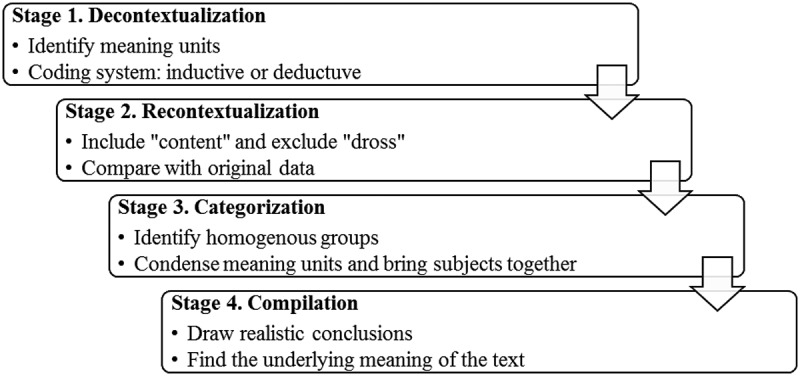
“Figure 1 depicts the stepwise approach to content analysis as guided by Bengtsson (2016).”
MethodThe Barthel ADL Index: A reliability study
Collin, C., Wade, D. T., Davies, S., & Horne, V. (1988) · International Disability Studies · doi:10.3109/09638288809164103 · Cited by 2,734
(1995) · Medical Entomology and Zoology · Cited by 2,472
An Introduction to Research Methods
(2019) · Data Collection Research Methods in Applied Linguistics · doi:10.5040/9781350025875.ch-001 · Cited by 2,362
Moodley, P. (2009) · Indo-Pacific Journal of Phenomenology · Cited by 860
Chiu, H. F. K., Lee, H., Chung, W., & Kwong, P. K. (1994) · Hong Kong journal of psychiatry · Cited by 531
Twinn, S. (1997) · Journal of Advanced Nursing · doi:10.1046/j.1365-2648.1997.1997026418.x · Cited by 361 · cited 2×
“The guidelines used was suggested by Twinn (1997) and worked with bilingual translators who were fully competent in both languages, had a healthcare background and possessed experiences to understand the contexts in which the data were collected.”
BackgroundMethodFilial piety in contemporary Chinese societies: a comparative study of Taiwan, Hong Kong, and China.
Yeh, K.-H., Yi, C.-C., Tsao, W.-C., & Wan, P.-S. (2013) · International Sociology · doi:10.1177/0268580913484345 · Cited by 350
Family Perceptions of Care in a Nursing Home
Bowers, B. J. (1988) · The Gerontologist · doi:10.1093/geront/28.3.361 · Cited by 304 · cited 1×
“Bowers (1988) purported that family involvement of older residents should focus on maintaining family connectedness, promoting the older person’s recovery and participating in the care home environment.”
BackgroundDoes social participation by the elderly reduce mortality and cognitive impairment?
Hsu, H. C. (2007) · Aging & Mental Health · doi:10.1080/13607860701366335 · Cited by 278 · cited 1×
“AConfucian proverb “obey your children when you are old” can influence an older person’s attitude and expectations towards their children, and views towards family and social support as one essential component of successful ageing (Hsu, 2007).”
BackgroundPrevalence of dementia in Chinese elderly in Hong Kong
Chiu, H. F. K., Lam, L. C. W., Chi, I., Leung, T., Li, S. W., Law, W. T., Chung, D. W. S., Fung, H. H. L., Kan, P. S., Lum, C. M., et al. (1998) · Neurology · doi:10.1212/wnl.50.4.1002 · Cited by 210
Tsai, H.-H., Tsai, Y.-F., Wang, H.-H., Chang, Y.-C., & Chu, H. H. (2010) · Aging & Mental Health · doi:10.1080/13607863.2010.501057 · Cited by 197
Outcomes of Family Involvement in Care Intervention for Caregivers of Individuals With Dementia
Maas, M. L., Reed, D., Park, M., Specht, J. P., Schutte, D., Kelley, L. S., Swanson, E. A., Trip-Reimer, T., & Buckwalte, K. C. (2004) · Nursing Research · doi:10.1097/00006199-200403000-00003 · Cited by 169 · cited 1×
“It also extends bonding with adult children to maintain parent–children relationship, perform filial piety and adopt positive attitudes to continue with caring responsibilities (Kellet, 2007; Mass et al., 2004).”
Placing Elderly Parents in Institutions in Urban China: A Reinterpretation of Filial Piety
Zhan, H. J., Feng, X., & Luo, B. (2008) · Research on Aging · doi:10.1177/0164027508319471 · Cited by 164
(2008) · Sage eBooks · doi:10.4135/9781412963909.n349 · Cited by 164
“You Don't Want to Burden Them”: Older Adults' Views on Family Involvement in Care
Cahill, E., Lewis, L. M., Barg, F. K., & Bogner, H. R. (2009) · Journal of Family Nursing · doi:10.1177/1074840709337247 · Cited by 142
Family and staff perceptions of the role of families in nursing homes
Ryan, A. A., & Scullion, H. F. (2000) · Journal of Advanced Nursing · doi:10.1046/j.1365-2648.2000.01521.x · Cited by 139 · cited 2×
“This can enable family members to contribute to decision-making by facilitating effective communication between themselves and the homes (Gaugler, 2005).”
An Introduction to Research Methods
Bright, B. P. (1998) · Cited by 125
Supporting Family Involvement in Long-Term Residential Care: Promising Practices for Relational Care
Barken, R., & Lowndes, R. H. (2017) · Qualitative Health Research · doi:10.1177/1049732317730568 · Cited by 108
Teeri, S., Leino‐Kilpi, H., & Valimaki, M. A. (2006) · Nursing Ethics · doi:10.1191/0969733006ne830oa · Cited by 104
Collaboration and control: nurses’ constructions of the role of family in nursing home care
Bauer, M. (2006) · Journal of Advanced Nursing · doi:10.1111/j.1365-2648.2006.03789.x · Cited by 88 · cited 2×
“…seem that greater family involvement could be due to the family being hopeful of the resident’s recovery, ensuring the continuity of ongoing care, and possibly making up for the guilt of spending less time to take care of them (Bauer, 2006; Bern-Klug & Forbes-Thompson, 2008; Tsai & Tsai, 2012).”
BackgroundBuckley, C., & McCarthy, G. (2009) · Geriatric Nursing · doi:10.1016/j.gerinurse.2009.09.001 · Cited by 74 · cited 3×
“These positive psychosocial and emotional achievements are similar to those of previous studies in western countries (BernKlug & Forbes-Thompson, 2008; Buckley & McCarthy, 2009; Whitaker, 2009).”
The role of the family in institutional long‐term care: cultural management of filial piety in China
Zhan, H. J., Feng, Z., Chen, Z., & Feng, X. (2011) · International Journal of Social Welfare · doi:10.1111/j.1468-2397.2011.00808.x · Cited by 72
Family Members' Responsibilities to Nursing Home Residents: “She Is the Only Mother I Got”
Bern‐Klug, M., & Forbes-Thompson, S. (2008) · Journal of Gerontological Nursing · doi:10.3928/00989134-20080201-02 · Cited by 68 · cited 2×
“…seem that greater family involvement could be due to the family being hopeful of the resident’s recovery, ensuring the continuity of ongoing care, and possibly making up for the guilt of spending less time to take care of them (Bauer, 2006; Bern-Klug & Forbes-Thompson, 2008; Tsai & Tsai, 2012).”
BackgroundFamily involvement in the institutional eldercare context. Towards a new understanding
Whitaker, A. (2008) · Journal of Aging Studies · doi:10.1016/j.jaging.2008.12.006 · Cited by 64 · cited 5×
“Therefore, family involvement has impeccable importance in connecting the residents with their family members, friends, neighbours and healthcare professionals to promote their physical, psycho-emotional and social well-being (BernKlug & Forbes-Thompson, 2008; Buckley & McCarthy, 2009; Ryan & Scullion, 2000; Whitaker,…”
BackgroundResultInfluentialTransition to residential care: experiences of elderly Chinese people in Hong Kong
Lee, D. (1999) · Journal of Advanced Nursing · doi:10.1046/j.1365-2648.1999.01196.x · Cited by 64 · cited 1×
“Other researchers have revealed the Chinese values of harmony, balance and collectivism (Lee, 1999), and a consideration for the psychoemotional support of care as a component of the quality of family care (Chao & Roth, 2005).”
Dimensions of quality in long‐term care facilities in Taiwan
Chao, S., & Roth, P. A. (2005) · Journal of Advanced Nursing · doi:10.1111/j.1365-2648.2005.03632.x · Cited by 62 · cited 3×
“Other researchers have revealed the Chinese values of harmony, balance and collectivism (Lee, 1999), and a consideration for the psychoemotional support of care as a component of the quality of family care (Chao & Roth, 2005).”
BackgroundResultFamily Involvement in Nursing Homes: Are Family Caregivers Getting What They Want?
Reid, R. C., & Chappell, N. L. (2017) · Journal of Applied Gerontology · doi:10.1177/0733464815602109 · Cited by 57
Seizing possibilities for positive family caregiving in nursing homes
Kellett, U. (2007) · Journal of Clinical Nursing · doi:10.1111/j.1365-2702.2006.01844.x · Cited by 49 · cited 2×
“This finding is congruent with other studies in both Chinese and overseas society (Chao & Roth, 2005; Creswell, 2007; Kellet, 2007; Whitaker, 2009).”
Port, C. L. (2004) · The Gerontologist · doi:10.1093/geront/44.6.770 · Cited by 49 · cited 6×
“Despite these less favourable factors that can lessen family involvement as already mentioned in previous studies (Fukahori et al., 2006; Natan, 2008; Port, 2004), this study highlighted that the residents state of health and illness would take precedence over these unfavourable factors.”
InfluentialChou, Y., Kröger, T., & Pu, C. (2014) · European Journal of Ageing · doi:10.1007/s10433-014-0322-z · Cited by 46
Perceptions of nurses, families, and residents in nursing homes concerning residents' needs
Natan, M. B. (2008) · International Journal of Nursing Practice · doi:10.1111/j.1440-172x.2008.00687.x · Cited by 33 · cited 3×
“Such finding is congruent with prior studies that found poorer relationship between resident– family–staff could affect negatively on the frequency and duration of family visit (Fukahori et al., 2006; Gaugler et al., 2003; Natan, 2008; Port, 2004).”
BackgroundResultPredictors of Family Involvement in Residential Long-Term Care
Gaugler, J. E., Anderson, K. A., & Leach, C. R. (2004) · Journal of Gerontological Social Work · doi:10.1300/j083v42n01_02 · Cited by 30 · cited 2×
“Such finding is congruent with prior studies that found poorer relationship between resident– family–staff could affect negatively on the frequency and duration of family visit (Fukahori et al., 2006; Gaugler et al., 2003; Natan, 2008; Port, 2004).”
BackgroundResultFactors related to family visits to nursing home residents in Japan
Fukahori, H., Matsui, N., Mizuno, Y., Yamamoto‐Mitani, N., Sugai, Y., & Sugishita, C. (2007) · Archives of Gerontology and Geriatrics · doi:10.1016/j.archger.2006.10.001 · Cited by 29 · cited 3×
“Such finding is congruent with prior studies that found poorer relationship between resident– family–staff could affect negatively on the frequency and duration of family visit (Fukahori et al., 2006; Gaugler et al., 2003; Natan, 2008; Port, 2004).”
BackgroundResultFamily members’ perceived meaning of visiting nursing home residents in Taiwan
Tsai, H., & Tsai, Y. (2011) · Journal of Advanced Nursing · doi:10.1111/j.1365-2648.2011.05737.x · Cited by 24
Resident challenges with daily life in Chinese long-term care facilities: A qualitative pilot study
Song, Y., Scales, K., Anderson, R. A., Wu, B., & Corazzini, K. (2017) · Geriatric Nursing · doi:10.1016/j.gerinurse.2017.05.001 · Cited by 18
Promoting Family Involvement in Long-Term Care Settings: A Guide to Programs That Work
Brickner, M. (2006) · Care management journals · Cited by 15
Tamiya, N., Chen, L.-M., & Sugisawa, H. (2009) · Social Behavior and Personality An International Journal · doi:10.2224/sbp.2009.37.3.393 · Cited by 13
Effects of family caregivers on the use of formal long‐term care in S outh K orea
Kim, E., Cho, E., & Lee, N. (2013) · International Nursing Review · doi:10.1111/inr.12057 · Cited by 12
The Structure of Family Practices in Multifunctional Long-Term Care in a Small Group Home in Japan
Yamazaki, A., & Kawahara, T. (2017) · Home Health Care Management & Practice · doi:10.1177/1084822317734181 · Cited by 3
Research works printed but not linked: 3
- Dahlberg K., Dahlberg H., & Nyström M. (2008). Reflective life world research (2nd ed.). Lund: Studentlitteratur.
- Polit D. F., & Beck C. T. (2008). Essential of nursing research: Appraising evidence for nursing practice (7th ed.). Philadelphia: Lippincott Williams & Wilkins.
- Streubert Speziale H. J., & Carpenter D. R. (2011). Qualitative research in nursing: Advancing the humanistic imperatives (5th ed.). Philadelphia: Lippincott Williams and Wilkins.
Cited by
O'Caoimh, R., O'Donovan, M. R., Monahan, M. P., Dalton O'Connor, C., Buckley, C., Kilty, C., Fitzgerald, S., Hartigan, I., & Cornally, N. (2020) · Frontiers in Psychiatry · doi:10.3389/fpsyt.2020.585373 · Cited by 132
“Visitors (family members and friends) also assist with personal care (10, 11).”
BackgroundReimagining Family Involvement in Residential Long-Term Care
Gaugler, J. E., & Mitchell, L. L. (2021) · Journal of the American Medical Directors Association · doi:10.1016/j.jamda.2021.12.022 · Cited by 97
Filial Piety, Generativity and Older Adults’ Wellbeing and Loneliness in Denmark and China
Ren, P., Emiliussen, J., Christiansen, R., Engelsen, S., & Klausen, S. H. (2022) · Applied Research in Quality of Life · doi:10.1007/s11482-022-10053-z · Cited by 62
Torku, A., Chan, A. P. C., Yung, E. H. K., & Seo, J. (2021) · Building and Environment · doi:10.1016/j.buildenv.2021.108298 · Cited by 42
Torku, A., Chan, A. P. C., Yung, E. H. K., & Seo, J. (2022) · Building and Environment · doi:10.1016/j.buildenv.2022.109533 · Cited by 41
Metadata
- Authors
- Lao, S. S. W., Low, L. P. L., & Wong, K. K. Y.
- Affiliations
- Kiang Wu Hospital (CN)
- Saint Francis University (HK)
- Corresponding author
- Low, Lisa Pau Le
- ORCID
- Low, Lisa Pau Le
- Venue
- International Journal of Qualitative Studies on Health and Well-being
- Publisher
- Informa UK Limited
- Published
- 2019-01
- Volume
- 14
- Issue
- 1
- Pages
- 1611298-1611298
- ISSN
- 1748-2623 (ISSN-L)
- 1748-2631
- PMC
- PMC6522931
- OpenAlex
- W2944446457
- Cited by
- 40
- References
- 43
- Citations by year
- 2026: 4 · 2025: 2 · 2024: 8 · 2023: 5 · 2022: 12 · 2021: 4 · 2020: 5
- FWCI
- 7.15
- Type
- journal article
- Language
- en
- Open access
- gold
- doi.org
- Licence
- Locations
- International Journal of Qualitative Studies on Health and Well-Being (publishedVersion, cc-by)
- PubMed Central (publishedVersion, cc-by)
- PubMed (publishedVersion)
- DOAJ (DOAJ: Directory of Open Access Journals) (submittedVersion, cc-by-sa)
- Topics
- Health Sciences › Medicine › Geriatrics and Gerontology › Geriatric Care and Nursing Homes
- Social Sciences › Sociology and Political Science › Intergenerational Family Dynamics and Caregiving
- Social Sciences › Life-span and Life-course Studies › Aging, Elder Care, and Social Issues
- Keywords
- family involvement, care homes, older adults, Chinese older adults, resident perceptions, family relationships, elderly care, social well-being, Macau
- MeSH terms
- Activities of Daily Living, Aged, Aged, 80 and over, China, Delivery of Health Care, Family, Female, Homes for the Aged, Humans, Interpersonal Relations, Health Knowledge, Attitudes, Practice, Male, Nursing Homes, Quality of Life, Surveys and Questionnaires, Social Support, Intergenerational Relations, Caregivers, Spouses, Adult Children, Comprehension, Qualitative Research, Meals
About these checks
Registry, retraction, Cites and statistics results are computed, not judged, with one exception: a printed reference that no index lists is read once by a model before it counts as a citation error. Claims are extracted by a model and kept only when their quote appears verbatim in the text; each cited source is then checked, with a model’s help, for whether it says what the claim relies on. Those verdicts can be wrong — read the claim’s quote and the cited source before relying on one.
Statistics and arithmetic are recomputed, not judged.
Confidence bands are shown only for fields calibrated on our annotated test set. None is calibrated yet, so no band is shown.
What counts as a claim ›How we measure confidence ›How we check this ›
Are you an author, or do you see a problem with this page? Request a review
Data sources
Bibliographic data: Semantic Scholar, OpenAlex, Crossref.
Contains information from the Semantic Scholar Academic Graph Datasets, made available under the ODC Attribution License (ODC-BY 1.0).
Semantic Scholar’s data is described in: Kinney, R., et al. (2023). The Semantic Scholar Open Data Platform. arXiv:2301.10140.
