

Temporal associations between cultural identity conflict and psychological symptoms among Syrian young adults with refugee backgrounds: a four-wave longitudinal study
Open accessThe DOI matches its Crossref record; 53 of the 56 references it cites were found in a registry or an index; none of the 52 sources its claims cite is checked for support yet.
Abstract
Objectives: The current study examined temporal associations between cultural identity conflict and psychological symptoms (posttraumatic stress [PTS] and anxiety/depression) in Syrian young adults, who recently migrated to the Netherlands. It was hypothesized that cultural identity conflict predicts intraindividual changes in PTS and anxiety/depression symptoms, in a course of one year, adjusting for trait-like stable invariant levels of both constructs.Methods: Data were obtained from Karakter, a four-wave longitudinal study, with a sample of 158 Syrian young adults with refugee backgrounds (n = 96 at wave 4); 69% men and age range 18-35. Levels of cultural identity conflict, PTS, and anxiety/depression were assessed four times, over 13 months.Results: Random intercept cross-lagged panel model analyses showed relative stability in levels of cultural identity conflict, PTS, and anxiety/depression from one wave to the next. No significant concurrent associations were found between deviations from people's usual levels of cultural identity conflict and PTS symptoms. Additionally, the results revealed two significant negative cross-lagged associations between cultural identity conflict and PTS. No cross-lagged associations were found between cultural identity conflict and anxiety/depression, except one negative directional effect from anxiety/depression at wave 2 to cultural identity conflict at wave 3.Conclusions: Findings indicate that after accounting for between-person differences, cultural identity conflict and psychological symptoms refer to stable, within-person processes over time. We speculate that early intervention focused on PTS, anxiety/depression as well as experienced cultural identity conflict may prevent these problems from becoming chronic, among Syrians with refugee backgrounds in the post-migration context.
Overview
CoChat Summary
TL;DR
In a four-wave longitudinal study of 158 Syrian young adults with refugee backgrounds in the Netherlands, cultural identity conflict, posttraumatic stress (PTS), and anxiety/depression showed relative within-person stability over 13 months. Random intercept cross-lagged panel models found no expected positive cross-lagged associations; only two negative cross-lagged effects between cultural identity conflict and PTS and one negative effect from anxiety/depression at wave 2 to cultural identity conflict at wave 3 emerged.
Key findings
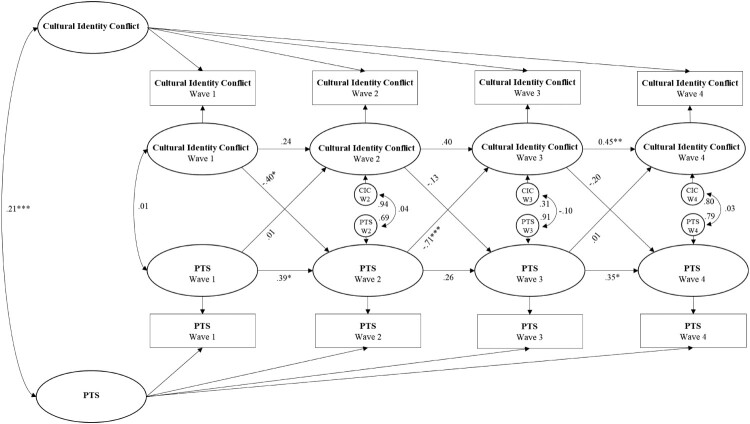
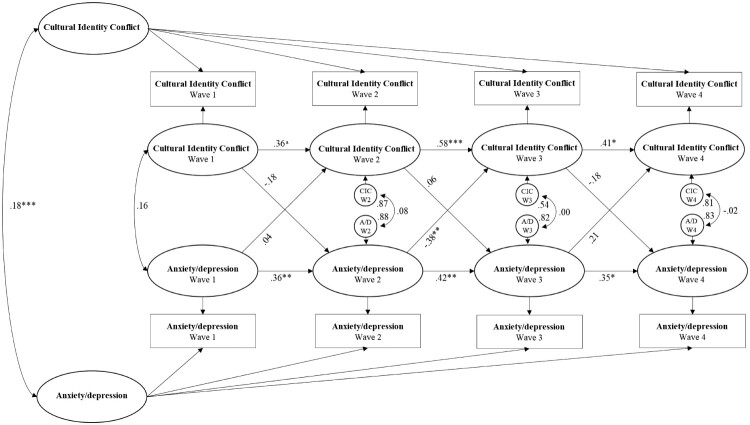
- Cultural identity conflict, PTS, and anxiety/depression showed relative stability from one wave to the next; significant autoregressive effects were found for cultural identity conflict (W3 to W4), PTS (W1 to W2 and W3 to W4), and both cultural identity conflict and anxiety/depression.
- No significant concurrent associations were found between deviations from people’s usual levels of cultural identity conflict and PTS symptoms, and none were found in the anxiety/depression model.
- Two significant negative cross-lagged associations emerged between cultural identity conflict and PTS: cultural identity conflict at W1 negatively predicted PTS at W2, and PTS at W2 negatively predicted cultural identity conflict at W3.
- No cross-lagged associations were found between cultural identity conflict and anxiety/depression, except one negative directional effect from anxiety/depression at W2 to cultural identity conflict at W3.
Methods
- Data came from Karakter, a four-wave longitudinal study with 158 Syrian young adults with refugee backgrounds in the Netherlands (n = 96 at wave 4); 69% were men, age range 18–35 (M = 27.82, SD = 4.71), and mean length of stay in the Netherlands was 37.82 months (SD = 14.47). Assessments occurred four times over 13 months, approximately 3 months apart.
- Cultural identity conflict was measured with the 20-item Ethno-Cultural Identity Conflict Scale (ECIC-S); anxiety/depression with the 4-item Patient Health Questionnaire-4 (PHQ-4); and PTS with the first 16 items of the 45-item Harvard Trauma Questionnaire Part IV.
- Analyses included descriptive statistics, Pearson correlations, and two random intercept cross-lagged panel models in Mplus Version 8, with standardized coefficients; model fit was interpreted using RMSEA < .06, CFI > .95, and TLI > .95.
Limitations
- The paper states that small sample sizes (n < 100) can result in low statistical power and biased parameter estimates; although W1 had n = 158, the sample decreased toward W4 (n = 96), and the model complexity with relatively small sample size may have led to overfitting.
- The paper states that inclusion criteria (being in the Netherlands 6–60 months) and the likelihood that individuals with severe mental health problems were less likely to participate limit generalizability to the Syrian refugee population; most participants were highly educated (60.7%) and had been granted residency (91.8%), and 69% identified with the male gender.
- Evident from the text: attrition reduced the sample from n = 158 at W1 to n = 96 at W4, and all key measures were self-report questionnaires rather than diagnostic interviews.
Model-written summary. Check it against the paper before relying on it.
Integrity signals
Registry
Cites
Statistics
Figures
Verification
Claims the paper makes
0 Valid · 0 Not valid · 38 Not checked · 58 Own results and interpretations
A result the paper reports from its own data — it cites no other source for it, so there is none to check. The quote shows it is in the paper.
In the paper
“No significant concurrent associations were found between deviations from people’s usual levels of cultural identity conflict and PTS symptoms.”
- Also stated in: § Random intercept cross-lagged models · plain
“No significant concurrent associations were found between deviations from people’s usual levels of cultural identity conflict and PTS symptoms.”
- Also stated in: § Discussion · plain
“No concurrent associations were observed between deviations from people’s usual levels of cultural identity conflict and psychological symptoms (PTS and anxiety/depression).”
§ Temporal associations between cultural identity conflict and psychological symptoms among Syrian young adults with refugee backgrounds: a four-wave longitudinal study > Abstract
plainn = 158- Asserted: passes — The authors put it forward as true.
- Checkable: passes — It can be checked against evidence.
- Load-bearing: passes — The paper’s conclusions depend on it.
- Based: passes — The paper gives a reason why it holds.
- Also stated in: § Random intercept cross-lagged models · plain
A result the paper reports from its own data — it cites no other source for it, so there is none to check. The quote shows it is in the paper.
In the paper
“Significant autoregressive effects were found for both cultural identity conflict and anxiety/depression symptoms.”
§ Temporal associations between cultural identity conflict and psychological symptoms among Syrian young adults with refugee backgrounds: a four-wave longitudinal study > Results > Random intercept cross-lagged models
plainstates an association- Asserted: passes — The authors put it forward as true.
- Checkable: passes — It can be checked against evidence.
- Load-bearing: unclear — It is unclear whether the paper’s conclusions depend on it.
- Based: passes — The paper gives a reason why it holds.
A result the paper reports from its own data — it cites no other source for it, so there is none to check. The quote shows it is in the paper.
In the paper
“Additionally, greater deviations from one’s usual level of PTS symptoms at W2 were predictive of lesser deviations from one’s usual level of cultural identity conflict at W3.”
§ Temporal associations between cultural identity conflict and psychological symptoms among Syrian young adults with refugee backgrounds: a four-wave longitudinal study > Results > Random intercept cross-lagged models
plainstates a cause- Asserted: passes — The authors put it forward as true.
- Checkable: passes — It can be checked against evidence.
- Load-bearing: unclear — It is unclear whether the paper’s conclusions depend on it.
- Based: passes — The paper gives a reason why it holds.
A result the paper reports from its own data — it cites no other source for it, so there is none to check. The quote shows it is in the paper.
In the paper
“For the model with cultural identity conflict and PTS, indices were χ2(9) = 9.808, p < .37, CFI = 0.999, TLI = 0.996, RMSEA = .024.”
§ Temporal associations between cultural identity conflict and psychological symptoms among Syrian young adults with refugee backgrounds: a four-wave longitudinal study > Results > Random intercept cross-lagged models
plain- Asserted: passes — The authors put it forward as true.
- Checkable: passes — It can be checked against evidence.
- Load-bearing: passes — The paper’s conclusions depend on it.
- Based: passes — The paper gives a reason why it holds.
A result the paper states — it cites no source for it, so there is none to check. The quote shows it is in the paper.
In the paper
“Specifically, lesser deviations from trait levels of anxiety/depression predicted greater deviations from trait levels of cultural identity conflict.”
§ Temporal associations between cultural identity conflict and psychological symptoms among Syrian young adults with refugee backgrounds: a four-wave longitudinal study > Discussion
plainstates a cause- Asserted: passes — The authors put it forward as true.
- Checkable: passes — It can be checked against evidence.
- Load-bearing: passes — The paper’s conclusions depend on it.
- Based: passes — The paper gives a reason why it holds.
38 more claims
Create a free account to see all 96 claims and to verify the 44 references still open.
- It may state two separate claims as one. 33
- The quote only partly states this claim. 1
- Probably not a substantial claim. 36
Statistics recomputed
Every reported test result, recomputed from its test statistic and degrees of freedom. A result shows as not adding up only once an independent check has confirmed it.
- Not confirmedχ²(9) = 5.142reported p < .82 · recomputed p = .822
“χ2(9) = 5.142, p < .82”
- Consistentχ²(9) = 9.808reported p < .37 · recomputed p = .366
“χ2(9) = 9.808, p < .37”
Self-check
Percentages, sums and reported differences re-computed from the paper’s own numbers.
Each contradiction between two passages listed here was confirmed by an independent check.
Rated minor: it would not touch a result — a value no result rests on, a p-value that stays on the same side of the significance level, or a conflict that is clerical, resolved elsewhere in the paper, or outside its own findings.
In the paper
§ Temporal associations between cultural identity conflict and psychological symptoms among Syrian young adults with refugee backgrounds: a four-wave longitudinal study > Methods > Measures
“Item scores were summed such that a higher score indicated more PTS symptoms.”
§ Temporal associations between cultural identity conflict and psychological symptoms among Syrian young adults with refugee backgrounds: a four-wave longitudinal study > Results > Descriptive statistics and bivariate associations between the study variables
“| W1 | 157 | 2.02 | 0.57 | 1–4 |”
Citations
Cites
Hu, L., & Bentler, P. M. (1999) · Structural Equation Modeling A Multidisciplinary Journal · doi:10.1080/10705519909540118 · Cited by 108,788
A cognitive model of posttraumatic stress disorder
Ehlers, A., & Clark, D. M. (2000) · Behaviour Research and Therapy · doi:10.1016/s0005-7967(99)00123-0 · Cited by 6,147
An Ultra-Brief Screening Scale for Anxiety and Depression: The PHQ–4
Kroenke, K., Spitzer, R. L., Williams, J. B. W., & Löwe, B. (2009) · Psychosomatics · doi:10.1016/s0033-3182(09)70864-3 · Cited by 4,261
Ethnic identity in adolescents and adults: Review of research.
Phinney, J. S. (1990) · Psychological Bulletin · doi:10.1037/0033-2909.108.3.499 · Cited by 3,798
Acculturation: Living successfully in two cultures
Berry, J. W. (2005) · International Journal of Intercultural Relations · doi:10.1016/j.ijintrel.2005.07.013 · Cited by 2,498
Porter, M., & Haslam, N. (2005) · JAMA · doi:10.1001/jama.294.5.602 · Cited by 1,793
Ethnic Identity, Immigration, and Well‐Being: An Interactional Perspective
Phinney, J. S., Horenczyk, G., Liebkind, K., & Vedder, P. (2001) · Journal of Social Issues · doi:10.1111/0022-4537.00225 · Cited by 1,643
MOLLICA, R. F., CASPI-YAVIN, Y., BOLLINI, P., TRUONG, T., TOR, S., & LAVELLE, J. (1992) · The Journal of Nervous and Mental Disease · doi:10.1097/00005053-199202000-00008 · Cited by 1,489
Long-term mental health of war-refugees: a systematic literature review
Bogic, M., Njoku, A., & Priebe, S. (2015) · BMC International Health and Human Rights · doi:10.1186/s12914-015-0064-9 · Cited by 1,166 · cited 1×
“Research has consistently indicated that rates of psychological symptoms are higher among recently resettled people who have experienced war-related events and unsafety in home countries, compared to non-war affected general populations (Bogic et al., 2015; Patanè et al., 2022).”
Blackmore, R., Boyle, J. A., Fazel, M., Ranasinha, S., Gray, K. M., Fitzgerald, G., Misso, M., & Gibson-Helm, M. (2020) · PLOS Medicine · doi:10.1371/journal.pmed.1003337 · Cited by 949
Mental Health of Cambodian Refugees 2 Decades After Resettlement in the United States
Marshall, G. N. (2005) · JAMA · doi:10.1001/jama.294.5.571 · Cited by 667
Migration, cultural bereavement and cultural identity
Bhugra, D., & Becker, M. (2005) · PubMed · Cited by 587
Correa-Velez, I., Gifford, S. M., & Barnett, A. G. (2010) · Social Science & Medicine · doi:10.1016/j.socscimed.2010.07.018 · Cited by 540
Mental health and psychosocial wellbeing of Syrians affected by armed conflict
Hassan, G., Ventevogel, P., Jefee-Bahloul, H., Barkil-Oteo, A., & Kirmayer, L. J. (2016) · Epidemiology and Psychiatric Sciences · doi:10.1017/s2045796016000044 · Cited by 514
Chen, W., Hall, B. J., Ling, L., & Renzaho, A. M. (2017) · The Lancet Psychiatry · doi:10.1016/s2215-0366(17)30032-9 · Cited by 382 · cited 2×
“…in the country of residence (e.g. challenges during resettlement and adaptation to a new culture) are equally or even more important risk factors for long-term psychological symptoms in refugee populations (Chen et al., 2017; Hassan et al., 2016; Sleijpen et al., 2017; Tingvold et al., 2015).”
Tinghög, P., Malm, A., Arwidson, C., Sigvardsdotter, E., Lundin, A., & Saboonchi, F. (2017) · BMJ Open · doi:10.1136/bmjopen-2017-018899 · Cited by 377
Carswell, K., Blackburn, P., & Barker, C. (2011) · International Journal of Social Psychiatry · doi:10.1177/0020764009105699 · Cited by 349
Ryan, D., Dooley, B., & Benson, C. (2008) · Journal of Refugee Studies · doi:10.1093/jrs/fem047 · Cited by 308
Woodall, A., Morgan, C., Sloan, C., & Howard, L. (2010) · BMC Psychiatry · doi:10.1186/1471-244x-10-103 · Cited by 281
Shoeb, M., Weinstein, H., & Mollica, R. (2007) · International Journal of Social Psychiatry · doi:10.1177/0020764007078362 · Cited by 272
Gleeson, C., Frost, R., Sherwood, L., Shevlin, M., Hyland, P., Halpin, R., Murphy, J., & Silove, D. (2020) · European Journal of Psychotraumatology · doi:10.1080/20008198.2020.1793567 · Cited by 220
Prevalence of mental disorders in refugees and asylum seekers: a systematic review and meta-analysis
Patanè, M., Ghane, S., Karyotaki, E., Cuijpers, P., Schoonmade, L., Tarsitani, L., & Sijbrandij, M. (2022) · Global Mental Health · doi:10.1017/gmh.2022.29 · Cited by 189
Georgiadou, E., Zbidat, A., Schmitt, G. M., & Erim, Y. (2018) · Frontiers in Psychiatry · doi:10.3389/fpsyt.2018.00393 · Cited by 173
Power Analysis for the Random Intercept Cross-Lagged Panel Model Using the powRICLPM R-Package
Mulder, J. D. (2022) · Structural Equation Modeling A Multidisciplinary Journal · doi:10.1080/10705511.2022.2122467 · Cited by 169
Shuxian, W., Renzaho, A. M. N., Hall, B. J., Shi, L., Ling, L., & Chen, W. L. (2020) · The Lancet Psychiatry · doi:10.1016/s2215-0366(20)30422-3 · Cited by 139
Giuliani, C., Tagliabue, S., & Regalia, C. (2018) · Europe’s Journal of Psychology · doi:10.5964/ejop.v14i1.1434 · Cited by 137
Lives on hold: A qualitative study of young refugees’ resilience strategies
Sleijpen, M., Mooren, T., Kleber, R. J., & Boeije, H. R. (2017) · Childhood · doi:10.1177/0907568217690031 · Cited by 120
Self-citationAcarturk, C., McGrath, M., Roberts, B., Ilkkursun, Z., Cuijpers, P., Sijbrandij, M., Sondorp, E., Ventevogel, P., McKee, M., Fuhr, D. C., et al. (2021) · Social Psychiatry and Psychiatric Epidemiology · doi:10.1007/s00127-020-01941-6 · Cited by 115 · cited 1×
“%) have been observed in Syrian people who have fled their country (Acarturk et al., 2021; Georgiadou et al., 2018; Hassan et al., 2016; Sijbrandij et al., 2020; Tinghög et al., 2017).”
Garcini, L. M., Murray, K. E., Zhou, A., Klonoff, E. A., Myers, M. G., & Elder, J. P. (2016) · Journal of Immigrant & Refugee Studies · doi:10.1080/15562948.2014.998849 · Cited by 105
Groen, S., Richters, A., Laban, C. J., & Devillé, W. L. J. M. (2017) · Culture Medicine and Psychiatry · doi:10.1007/s11013-016-9514-7 · Cited by 98
Speyer, L. G., Ushakova, A., Blakemore, S., Murray, A. L., & Kievit, R. (2022) · Structural Equation Modeling A Multidisciplinary Journal · doi:10.1080/10705511.2022.2096613 · Cited by 94
Schock, K., Böttche, M., Rosner, R., Wenk-Ansohn, M., & Knaevelsrud, C. (2016) · European Journal of Psychotraumatology · doi:10.3402/ejpt.v7.32106 · Cited by 87
A cross-cultural comparison of the ultrabrief mental health screeners PHQ-4 and SF-12 in Germany.
Tibubos, A. N., & Kröger, H. (2020) · Psychological Assessment · doi:10.1037/pas0000814 · Cited by 66
The Construction and Validation of a Measure of Ethno-Cultural Identity Conflict
Ward, C., Stuart, J., & Kus, L. (2011) · Journal of Personality Assessment · doi:10.1080/00223891.2011.558872 · Cited by 60
Course of Mental Health in Refugees—A One Year Panel Survey
Kaltenbach, E., Schauer, M., Hermenau, K., Elbert, T. R., & Schalinski, I. (2018) · Frontiers in Psychiatry · doi:10.3389/fpsyt.2018.00352 · Cited by 58
A threatened identity: The mental health status of Syrian refugees in Egypt and its etiology
Kira, I. A., Shuwiekh, H., Rice, K., Al Ibraheem, B., & Aljakoub, J. (2017) · Identity · doi:10.1080/15283488.2017.1340163 · Cited by 56
Social determinants of emotional well-being in new refugees in the UK
Campbell, M. R., Mann, K. D., Moffatt, S., Dave, M., & Pearce, M. S. (2018) · Public Health · doi:10.1016/j.puhe.2018.07.022 · Cited by 55
Psychological distress is influenced by length of stay in resettled Iraqi refugees in Australia
Uribe Guajardo, M. G., Slewa-Younan, S., Smith, M., Eagar, S., & Stone, G. (2016) · International Journal of Mental Health Systems · doi:10.1186/s13033-016-0036-z · Cited by 55
Neuner, F. (2022) · Clinical Psychology Review · doi:10.1016/j.cpr.2022.102219 · Cited by 52
Waiting for kin: a longitudinal study of family reunification and refugee mental health in Germany
Löbel, L.-M., & Jacobsen, J. (2021) · Journal of Ethnic and Migration Studies · doi:10.1080/1369183x.2021.1884538 · Cited by 49
Psychological stages of the refugee process: A model for therapeutic interventions.
Gonsalves, C. J. (1992) · Professional Psychology: Research and Practice · doi:10.1037/0735-7028.23.5.382 · Cited by 49
Development of personal identity among refugee adolescents: Facilitating elements and obstacles
Ndengeyingoma, A., de Montigny, F., & Miron, J.-M. (2013) · Journal of Child Health Care · doi:10.1177/1367493513496670 · Cited by 45
Mezzich, J. E., Ruipérez, M. A., Yoon, G., Liu, J., & Zapata-Vega, M. I. (2009) · Culture Medicine and Psychiatry · doi:10.1007/s11013-009-9142-6 · Cited by 41
Cultural bereavement, culture shock and culture conflict: adjustments and reactions
Bhugra, D., Wojcik, W., & Gupta, S. (2010) · Cambridge University Press eBooks · doi:10.1017/cbo9780511760990.013 · Cited by 34
Handiso, D. W., Belsti, Y., Boyle, J. A., Paul, E. M., Shawyer, F., & Enticott, J. (2023) · International Journal of Mental Health and Addiction · doi:10.1007/s11469-023-01172-1 · Cited by 32
Refugees and the post-migration environment
Fazel, M. S. (2018) · BMC Medicine · doi:10.1186/s12916-018-1155-y · Cited by 24
Chung, J. M., Meijer, L., Zonneveld, R., Al Sawaf, Z., Alajak, K., Moopen, N., Rahim, H., Çiftçi, L., Alisic, E., Stellar, J. E., et al. (2022) · European Journal of Personality · doi:10.1177/08902070221081319 · Cited by 21
Self-citationMann, S. K., Roberts, L. R., & Montgomery, S. (2017) · Issues in Mental Health Nursing · doi:10.1080/01612840.2017.1283376 · Cited by 20
Yılmaz, E., Tamam, L., & Cengisiz, C. (2024) · Frontiers in Psychiatry · doi:10.3389/fpsyt.2024.1352288 · Cited by 19
Tingvold, L., Vaage, A. B., Allen, J., Wentzel-Larsen, T., van Ta, T., & Hauff, E. (2015) · Transcultural Psychiatry · doi:10.1177/1363461515572208 · Cited by 18
Dang, H.-A. H., Trinh, T., & Verme, P. (2023) · Health Economics · doi:10.1002/hec.4750 · Cited by 16
Applying the ADAPT Psychosocial Model to War-Affected Children and Adolescents
Yohani, S. (2015) · Sage Open · doi:10.1177/2158244015604189 · Cited by 10
Problem Management Plus (PM+) for Syrian refugees in the Netherlands
Sijbrandij, M., de Graaff, A. M., Cuijpers, P. J., & Kieft, B. (2020) · European Journal of Public Health · doi:10.1093/eurpub/ckaa165.628 · Cited by 6
Rahim, H. F., Mooren, T. T. M., Knipscheer, J. W., van den Brink, F., Chung, J. M., Laceulle, O. M., & Boelen, P. A. (2023) · Journal of Clinical Psychology · doi:10.1002/jclp.23492 · Cited by 5
Self-citationChung, J. M., Meijer, L., Zonneveld, R., Sawaf, Z. A., Alajak, K., Moopen, N., Rahim, H., Çiftçi, L., Alisic, E., Stellar, J. E., et al. (2021) · doi:10.31234/osf.io/xvqrs · Cited by 5
Self-citationDang, H.-A. H., Trinh, T., & Verme, P. (2022) · SSRN Electronic Journal · doi:10.2139/ssrn.4114303 · Cited by 2
Research works printed but not linked: 1
- Bot, H. (2020). Communicatie en interactie met een anderstalige patiënt. In J. De Jong & R. van Dijk (redactie), Handboek Culturele Psychiatrie & Psychotherapie (pp. 229– 249). Boom | De Tijdstroom.
Cited by
Choufani, M. R., Larson, K. L., & Prannik, M. Y. (2025) · Nursing Reports · doi:10.3390/nursrep15070263 · Cited by 6
Yetim, O., Tamam, L., Efe, A., Çakır, R., Çokluk, G. F., & Alleil, İ. S. (2026) · Research Square · doi:10.21203/rs.3.rs-10059357/v1
Metadata
- Authors
- Rahim, H. F., Mooren, T. T. M., Knipscheer, J. W., Chung, J. M., Laceulle, O. M., & Boelen, P. A.
- Affiliations
- Utrecht University (NL)
- University of Toronto Mississauga (CA)
- Corresponding author
- Rahim, Haza F.
- ORCID
- Venue
- European Journal of Psychotraumatology
- Publisher
- Informa UK Limited
- Published
- 2025-06-24
- Volume
- 16
- Issue
- 1
- Pages
- 2511524-2511524
- ISSN
- 2000-8066 (ISSN-L)
- PMC
- PMC12884984
- OpenAlex
- W4411611869
- Semantic Scholar
- ef87a48fdede04697fa217c5442866b208afd50d
- Cited by
- 2
- References
- 55
- Citations by year
- 2026: 1 · 2025: 1
- FWCI
- 1.21
- Type
- journal article
- Language
- en
- Open access
- gold
- doi.org
- Licence
- Locations
- European Journal of Psychotraumatology (publishedVersion, cc-by-nc)
- Europe PMC (PubMed Central) (publishedVersion, cc-by-nc)
- PubMed Central (publishedVersion, cc-by-nc)
- PubMed (publishedVersion)
- DOAJ (DOAJ: Directory of Open Access Journals) (submittedVersion)
- Utrecht University Repository (Utrecht University) (submittedVersion, other-oa)
- Funders
- John Templeton Foundation
- Topics
- Social Sciences › Psychology › Clinical Psychology › Migration, Health and Trauma
- Social Sciences › Sociology and Political Science › Racial and Ethnic Identity Research
- Social Sciences › Sociology and Political Science › Migration, Refugees, and Integration
- Keywords
- post-traumatic stress, anxiety, depression, Syrian refugees, young adults, refugee mental health, within-person change, temporal association, cross-lagged panel model, early intervention, post-migration
- MeSH terms
- Adolescent, Adult, Anxiety, Conflict, Psychological, Depression, Female, Humans, Longitudinal Studies, Male, Netherlands, Refugees, Social Identification, Stress Disorders, Post-Traumatic, Syria, Young Adult
About these checks
Registry, retraction, Cites and statistics results are computed, not judged, with one exception: a printed reference that no index lists is read once by a model before it counts as a citation error. Claims are extracted by a model and kept only when their quote appears verbatim in the text; each cited source is then checked, with a model’s help, for whether it says what the claim relies on. Those verdicts can be wrong — read the claim’s quote and the cited source before relying on one.
A language model drew the claims from the paper on 2026-11-27, under version 3 of the claim definition (model deepseek-v4.1-flash, prompt extract-v3).
A second model labelled each claim on 2026-11-27 (model jev-1.13-20260917, definition revision gold-guideline-v0.2).
Statistics and arithmetic are recomputed, not judged.
Confidence bands are shown only for fields calibrated on our annotated test set. None is calibrated yet, so no band is shown.
What counts as a claim ›How we measure confidence ›How we check this ›
Are you an author, or do you see a problem with this page? Request a review
Data sources
Bibliographic data: Semantic Scholar, OpenAlex, Crossref.
Contains information from the Semantic Scholar Academic Graph Datasets, made available under the ODC Attribution License (ODC-BY 1.0).
Semantic Scholar’s data is described in: Kinney, R., et al. (2023). The Semantic Scholar Open Data Platform. arXiv:2301.10140.
