

The DOI matches its Crossref record; 63 of the 63 references it cites were found in a registry or an index.
Trauma and PTSD in the WHO World Mental Health Surveys
Open accessAbstract
Background: Although post-traumatic stress disorder (PTSD) onset-persistence is thought to vary significantly by trauma type, most epidemiological surveys are incapable of assessing this because they evaluate lifetime PTSD only for traumas nominated by respondents as their ‘worst.’Objective: To review research on associations of trauma type with PTSD in the WHO World Mental Health (WMH) surveys, a series of epidemiological surveys that obtained representative data on trauma-specific PTSD.Method: WMH Surveys in 24 countries (n = 68,894) assessed 29 lifetime traumas and evaluated PTSD twice for each respondent: once for the ‘worst’ lifetime trauma and separately for a randomly-selected trauma with weighting to adjust for individual differences in trauma exposures. PTSD onset-persistence was evaluated with the WHO Composite International Diagnostic Interview.Results: In total, 70.4% of respondents experienced lifetime traumas, with exposure averaging 3.2 traumas per capita. Substantial between-trauma differences were found in PTSD onset but less in persistence. Traumas involving interpersonal violence had highest risk. Burden of PTSD, determined by multiplying trauma prevalence by trauma-specific PTSD risk and persistence, was 77.7 person-years/100 respondents. The trauma types with highest proportions of this burden were rape (13.1%), other sexual assault (15.1%), being stalked (9.8%), and unexpected death of a loved one (11.6%). The first three of these four represent relatively uncommon traumas with high PTSD risk and the last a very common trauma with low PTSD risk. The broad category of intimate partner sexual violence accounted for nearly 42.7% of all person-years with PTSD. Prior trauma history predicted both future trauma exposure and future PTSD risk.Conclusions: Trauma exposure is common throughout the world, unequally distributed, and differential across trauma types with respect to PTSD risk. Although a substantial minority of PTSD cases remits within months after onset, mean symptom duration is considerably longer than previously recognized.
Overview
The claims and statistics of this paper haven’t been checked yet.
Run the check — free, no account needed. It reads the open-access text and checks the sources it cites.
Integrity signals
Registry
Cites
Statistics
Figures
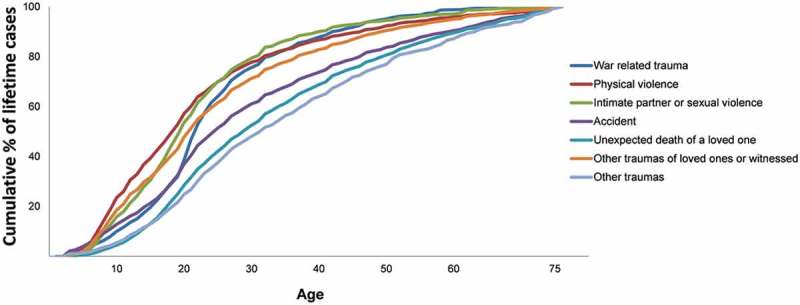
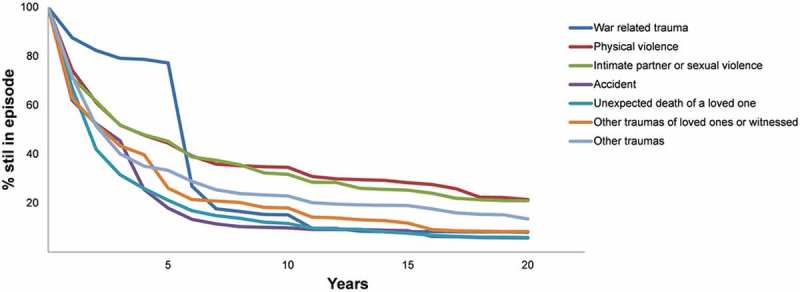
Verification
Claims the paper makes
The claims and statistics of this paper haven’t been checked yet.
Run the check — free, no account needed. It reads the open-access text and checks the sources it cites.
Claims other papers make about this one
Each is checked against this paper’s own text: does it say what the citing paper says it does?
The source backs part of the claim, not all of it — or backs it for a different population, condition or comparison.
In the citing paper
“there is some evidence from cross-sectional studies that younger individuals have higher risk of PTSD (Brewin et al., 2000; Kessler et al., 2017)”
From PTSD in the Year Following Sexual Assault: A Meta-Analysis of Prospective Studies (2023) · cites this paper as Kessler et al., 2017
Experimental — accuracy not yet measuredThe source backs part of the claim, not all of it — or backs it for a different population, condition or comparison.
In the citing paper
“Sexual assault (SA) is a highly prevalent global public health problem and a robust predictor of posttraumatic stress disorder (PTSD), substance use disorder (SUD), and suicidality.”
From Drug-facilitated sexual assault, impaired trauma memory, and implications for mental health treatment (2022) · cites this paper as Kessler et al., 2017
Experimental — accuracy not yet measuredThe source backs part of the claim, not all of it — or backs it for a different population, condition or comparison.
In the citing paper
“which apart from EDs tends to be a chronic disorder (31–33).”
From The integrated treatment of eating disorders, posttraumatic stress disorder, and psychiatric comorbidity: a commentary on the evolution of principles and guidelines (2023) · cites this paper as [31]
Experimental — accuracy not yet measured
Self-check
Percentages, sums and reported differences re-computed from the paper’s own numbers.
The self-check needs the paper’s full text.
Citations
Cites
The Measurement of Observer Agreement for Categorical Data
Landis, J. R., & Koch, G. G. (1977) · Biometrics · doi:10.2307/2529310 · Cited by 81,148
Kessler, R. C., & Üstün, T. B. (2004) · International Journal of Methods in Psychiatric Research · doi:10.1002/mpr.168 · Cited by 4,771
Self-citationPredictors of posttraumatic stress disorder and symptoms in adults: a meta-analysis
Ozer, E. J., Best, S. R., Lipsey, T. L., & Weiss, D. S. (2003) · Psychological Bulletin · doi:10.1037/0033-2909.129.1.52 · Cited by 3,322
Childhood adversities and adult psychopathology in the WHO World Mental Health Surveys
Kessler, R. C., McLaughlin, K. A., Green, J. G., Gruber, M. J., Sampson, N. A., Zaslavsky, A. M., Aguilar-Gaxiola, S., Alhamzawi, A. O., Alonso, J., Angermeyer, M., et al. (2010) · British Journal of Psychiatry · doi:10.1192/bjp.bp.110.080499 · Cited by 2,640
Self-citationTolin, D. F., & Foa, E. B. (2006) · Psychological Bulletin · doi:10.1037/0033-2909.132.6.959 · Cited by 2,197
The global burden of mental disorders: An update from the WHO World Mental Health (WMH) surveys
Kessler, R. C., Aguilar-Gaxiola, S., Alonso, J., Chatterji, S., Lee, S., Ormel, J., Üstün, T. B., & Wang, P. S. (2009) · Epidemiologia e Psichiatria Sociale · doi:10.1017/s1121189x00001421 · Cited by 1,895
Self-citationResilience as a dynamic concept
Rutter, M. (2012) · Development and Psychopathology · doi:10.1017/s0954579412000028 · Cited by 1,853
Wang, P. S., Aguilar-Gaxiola, S., Alonso, J., Angermeyer, M. C., Borges, G., Bromet, E. J., Bruffaerts, R., de Girolamo, G., de Graaf, R., Gureje, O., et al. (2007) · The Lancet · doi:10.1016/s0140-6736(07)61414-7 · Cited by 1,655 · cited 1×
“Roughly half of people with PTSD in high income countries and about half that number in low or middle income countries seek some type of treatment (Koenen et al., 2017), but the type and duration of treatment seldom meet even minimal standards for treatment adequacy (Wang et al., 2007).”
BackgroundSelf-citationBenjet, C., Bromet, E., Karam, E. G., Kessler, R. C., McLaughlin, K. A., Ruscio, A. M., Shahly, V., Stein, D. J., Petukhova, M., Hill, E., et al. (2016) · Psychological Medicine · doi:10.1017/s0033291715001981 · Cited by 1,458
Self-citationPosttraumatic stress disorder in the world mental health surveys
Koenen, K. C., Ratanatharathorn, A., Ng, L., McLaughlin, K. A., Bromet, E. J., Stein, D. J., Karam, E. G., Meron Ruscio, A., Benjet, C., Scott, K., et al. (2017) · Psychological Medicine · doi:10.1017/s0033291717000708 · Cited by 1,453
Self-citation
Research works printed but not linked: 3
- Kessler R. C., 2008, The WHO World Mental Health Surveys: Global perspectives on the epidemiology of mental disorders
- Schaeffer N. C., 2000, The science of self-report: Implications for research and practice, 105
- Stein D. J., Mental disorders around the world: Facts and figures from the World Mental Health Surveys
Cited by
Sorted by citations
Cénat, J. M., Blais-Rochette, C., Kokou-Kpolou, C. K., Noorishad, P.-G., Mukunzi, J. N., McIntee, S.-E., Dalexis, R. D., Goulet, M.-A., & Labelle, P. R. (2021) · Psychiatry Research · doi:10.1016/j.psychres.2020.113599 · Cited by 952
Post-traumatic stress disorder: clinical and translational neuroscience from cells to circuits
Ressler, K. J., Berretta, S., Bolshakov, V. Y., Rosso, I. M., Meloni, E. G., Rauch, S. L., & Carlezon, W. A. (2022) · Nature Reviews Neurology · doi:10.1038/s41582-022-00635-8 · Cited by 572
Complex post-traumatic stress disorder
Maercker, A., Cloître, M., Bachem, R., Schlumpf, Y. R., Khoury, B. A., Hitchcock, C., & Bohus, M. (2022) · The Lancet · doi:10.1016/s0140-6736(22)00821-2 · Cited by 517
Association of Stress-Related Disorders With Subsequent Autoimmune Disease
Song, H., Fang, F., Tómasson, G., Arnberg, F. K., Mataix‐Cols, D., de la Cruz, L. F., Almqvist, C., Fall, K., & Valdimarsdóttir, U. A. (2018) · JAMA · doi:10.1001/jama.2018.7028 · Cited by 438
Coventry, P. A., Meader, N., Melton, H., Temple, M., Dale, H., Wright, K., Cloitre, M., Karatzias, T., Bisson, J., Roberts, N. P., et al. (2020) · PLoS Medicine · doi:10.1371/journal.pmed.1003262 · Cited by 358
Metadata
- Authors
- Kessler, R. C., Aguilar-Gaxiola, S., Alonso, J., Benjet, C., Bromet, E. J., Cardoso, G., Degenhardt, L., de Girolamo, G., Dinolova, R. V., Ferry, F., Florescu, S., Gureje, O., Haro, J. M., Huang, Y., Karam, E. G., Kawakami, N., Lee, S., Lepine, J.-P., Levinson, D., Navarro-Mateu, F., Pennell, B.-E., Piazza, M., Posada-Villa, J., Scott, K. M., Stein, D. J., Ten Have, M., Torres, Y., Viana, M. C., Petukhova, M. V., Sampson, N. A., Zaslavsky, A. M., & Koenen, K. C.
- Affiliations
- Harvard University (US)
- Center for Reducing Health Disparities, UC Davis Health System, Sacramento, CA, USA
- Universitat Pompeu Fabra (ES)
- Instituto Nacional de Psiquiatría Ramón de la Fuente Muñiz (MX)
- Stony Brook University (US)
- Lisbon Institute of Global Mental Health (PT)
- UNSW Sydney (AU)
- Unit of Epidemiological and Evaluation Psychiatry, Istituti di Ricovero e Cura a Carattere Scientifico (IRCCS)-St. John of God Clinical Research Centre, Brescia, Italy
- National Center of Public Health and Analyses (BG)
- University of Ulster (GB)
- National School of Public Health, Management and Professional Development (RO)
- University College Hospital, Ibadan (NG)
- Centro de Investigación Biomédica en Red de Salud Mental (ES)
- Peking University (CN)
- University of Balamand (LB)
- The University of Tokyo (JP)
- Chinese University of Hong Kong (HK)
- Psychiatrie non sectorisée, Hôpital Lariboisière- Fernand Widal, Assistance Publique Hôpitaux de Paris, Paris, France
- Israel Ministry of Health (IL)
- UDIF-SM, Subdirección General de Planificación, Innovación y Cronicidad, Servicio Murciano de Salud, IMIB-Arrixaca, CIBERESP-Murcia, Murcia, Spain
- University of Michigan (US)
- Universidad Peruana Cayetano Heredia (PE)
- Colegio Mayor de Cundinamarca University, Faculty of Social Sciences, Bogotá, Colombia
- University of Otago (NZ)
- University of Cape Town (ZA)
- Department of Epidemiology, Trimbos-Instituut, Netherlands Institute of Mental Health and Addiction, Utrecht, Netherlands
- Universidad CES (CO)
- Department of Social Medicine, Federal University of Espírito Santo, Vitoria, Brazil
- Corresponding author
- Kessler, Ronald C.
- ORCID
- Kessler, Ronald C.
- Alonso, Jordi
- Benjet, Corina
- Bromet, Evelyn J.
- Cardoso, Graça
- Degenhardt, Louisa
- Dinolova, Rumyana V.
- Ferry, Finola
- Florescu, Silvia
- Gureje, Oye
- Haro, Josep Maria
- Huang, Yueqin
- Karam, Elie G.
- Kawakami, Norito
- Piazza, Marina
- Scott, Kate M.
- Stein, Dan J.
- Torres, Yolanda
- Petukhova, Maria V.
- Sampson, Nancy A.
- Zaslavsky, Alan M.
- Koenen, Karestan C.
- Venue
- European Journal of Psychotraumatology
- Publisher
- Informa UK Limited
- Published
- 2017-07-31
- Volume
- 8
- Issue
- sup5
- Pages
- 1353383-1353383
- ISSN
- 2000-8066 (ISSN-L)
- PMC
- PMC5632781
- OpenAlex
- W2740846930
- Cited by
- 1,661
- References
- 63
- Citations by year
- 2026: 228 · 2025: 281 · 2024: 239 · 2023: 216 · 2022: 217 · 2021: 188 · 2020: 155 · 2019: 87 · 2018: 46 · 2017: 2
- FWCI
- 98.37
- Type
- journal article
- Language
- en
- Open access
- gold
- doi.org
- Licence
- Locations
- European Journal of Psychotraumatology (publishedVersion, cc-by)
- Universidade Nova de Lisboa's Repository (Universidade Nova de Lisboa) (publishedVersion, other-oa)
- PubMed Central (publishedVersion, cc-by)
- PubMed (publishedVersion)
- RECERCAT (Consorci de Serveis Universitaris de Catalunya) (publishedVersion, other-oa)
- DOAJ (DOAJ: Directory of Open Access Journals) (submittedVersion)
- Repositori digital de la UPF (Universitat Pompeu Fabra) (submittedVersion, cc-by)
- Portuguese National Funding Agency for Science, Research and Technology (RCAAP Project by FCT) (submittedVersion, other-oa)
- UNSWorks (University of New South Wales, Sydney, Australia) (submittedVersion, cc-by)
- Funders
- Fogarty International Center (FIRCA R03-TW006481)
- National Institute of Mental Health (R01 MH093612-01, R01 MH070884, U01-MH60220)
- National Research Council of Science and Technology (Mexico) (CB-2010-01-155221)
- Robert Wood Johnson Foundation (Grant 044708)
- U.S. Public Health Service (R01 DA016558, R01-MH069864, R13-MH066849)
- Topics
- Social Sciences › Psychology › Clinical Psychology › Posttraumatic Stress Disorder Research
- Social Sciences › Psychology › Clinical Psychology › Child Abuse and Trauma
- Social Sciences › Psychology › Clinical Psychology › Migration, Health and Trauma
- Keywords
- post-traumatic stress disorder, trauma type, interpersonal violence, sexual assault, rape, stalking, intimate partner sexual violence, trauma exposure
About these checks
Registry, retraction, Cites and statistics results are computed, not judged, with one exception: a printed reference that no index lists is read once by a model before it counts as a citation error. Claims are extracted by a model and kept only when their quote appears verbatim in the text; each cited source is then checked, with a model’s help, for whether it says what the claim relies on. Those verdicts can be wrong — read the claim’s quote and the cited source before relying on one.
Statistics and arithmetic are recomputed, not judged.
Confidence bands are shown only for fields calibrated on our annotated test set. None is calibrated yet, so no band is shown.
What counts as a claim ›How we measure confidence ›How we check this ›
Are you an author, or do you see a problem with this page? Request a review
