

The DOI matches its Crossref record; 26 of the 27 references it cites were found in a registry or an index.
The impact of parental posttraumatic stress disorder on parenting: a systematic review
Open accessAbstract
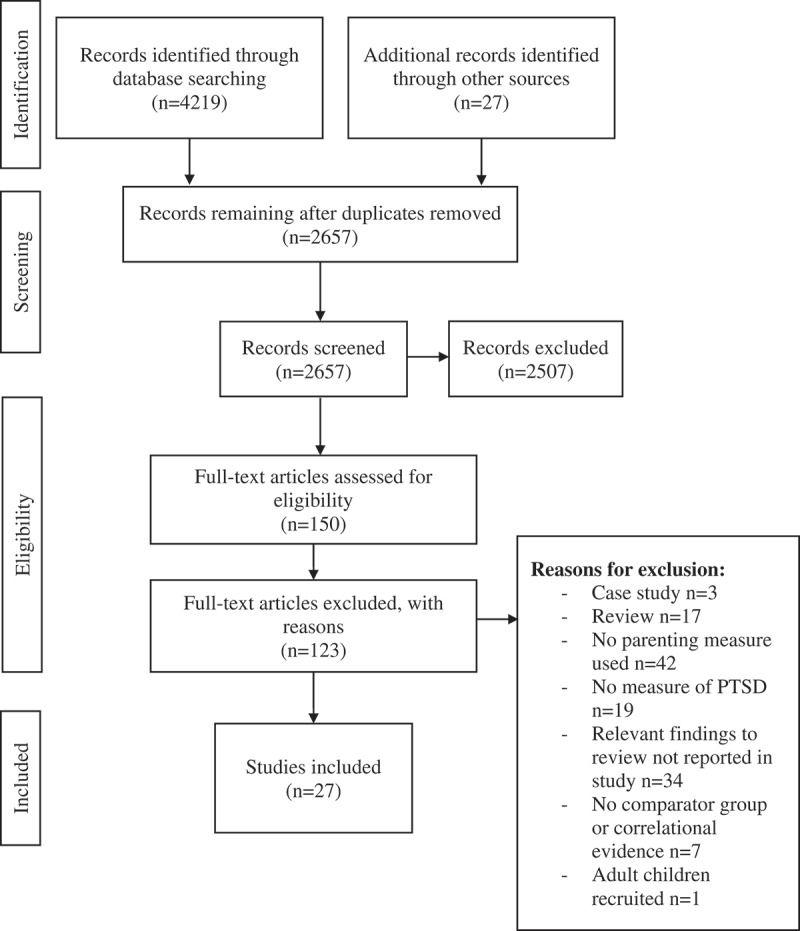
Background: Posttraumatic stress disorder (PTSD) is a serious and debilitating disorder that can develop following exposure to a traumatic event. Where parents develop PTSD, it may have an impact on their parenting role.Objective: The objective was to review the existing evidence base on parental PTSD, examining whether parental PTSD has an impact on key parenting domains.Method: A comprehensive web-based search identified 27 quantitative studies that examined parental PTSD in relation to parenting domains.Results: Several parenting domains were investigated including: parenting satisfaction, parenting stress, the parent–child relationship, and specific parenting practices. Sample sizes ranged from 19 to 3931 parents. A range of parental traumas were investigated, including traumatic birth experiences, military trauma, and intimate partner violence. Findings indicated associations between parental PTSD and several domains of parenting, but there were inconsistencies across studies.Conclusions: Findings suggested that parental PTSD is associated with impaired functioning across a number of parenting domains, including increased levels of parenting stress, lower parenting satisfaction, less optimal parent–child relationships, and more frequent use of negative parenting practices, such as overt hostility and controlling behaviours. However, methodological limitations across the literature as a whole limited the potential to infer causal impacts of PTSD on parenting. Further study is also needed to advance our current understanding around the impact of different trauma types on parenting domains.
Overview
The claims and statistics of this paper haven’t been checked yet.
Run the check — free, no account needed. It reads the open-access text and checks the sources it cites.
Integrity signals
Registry
Cites
Statistics
Figures
Verification
Claims the paper makes
The claims and statistics of this paper haven’t been checked yet.
Run the check — free, no account needed. It reads the open-access text and checks the sources it cites.
Claims other papers make about this one
Each is checked against this paper’s own text: does it say what the citing paper says it does?
The source backs part of the claim, not all of it — or backs it for a different population, condition or comparison.
In the citing paper
“A systematic review by Christie and colleagues (85) provided evidence for the association between parental PTSD and impaired functioning across a number of parenting domains, including increased levels of parenting stress, parenting satisfaction, and suboptimal parent–child relationships.”
From Mothering, Substance Use Disorders and Intergenerational Trauma Transmission: An Attachment-Based Perspective (2019) · cites this paper as [85]
Experimental — accuracy not yet measuredThe source backs part of the claim, not all of it — or backs it for a different population, condition or comparison.
In the citing paper
“Unique to PTSD, symptoms including hypervigilance or readily distracted attention can hinder one’s ability to caregive [14, 15].”
From Exploring the effects of mental health on bonding and caregiving among pregnant and postpartum persons with likely depression and/or PTSD in South Africa: a qualitative analysis (2026) · cites this paper as [14]
Experimental — accuracy not yet measured
Self-check
Percentages, sums and reported differences re-computed from the paper’s own numbers.
The self-check needs the paper’s full text.
Citations
Cites
Diagnostic and Statistical Manual of Mental Disorders
American Psychiatric Association (2013) · doi:10.1176/appi.books.9780890425596 · Cited by 116,369
Preferred Reporting Items for Systematic Reviews and Meta-Analyses: the PRISMA statement
Moher, D., Liberati, A., Tetzlaff, J., Altman, D. G., & for the PRISMA Group (2009) · BMJ · doi:10.1136/bmj.b2535 · Cited by 83,823
Preferred Reporting Items for Systematic Reviews and Meta-Analyses: The PRISMA Statement
Moher, D., Liberati, A., Tetzlaff, J., Altman, D. G., & The PRISMA Group (2009) · PLoS Medicine · doi:10.1371/journal.pmed.1000097 · Cited by 64,042
Preferred reporting items for systematic reviews and meta-analyses: the PRISMA Statement.
(2009) · PubMed Central · Cited by 44,859
Wang, G., Ma, R., Qiao, G., Wada, K., Aizawa, Y., & Satoh, T. (2015) · Integrative Medicine International · doi:10.1159/000368408 · Cited by 18,762
Posttraumatic Stress Disorder in the National Comorbidity Survey
Kessler, R. C. (1995) · Archives of General Psychiatry · doi:10.1001/archpsyc.1995.03950240066012 · Cited by 10,379
The Infant's Response to Entrapment between Contradictory Messages in Face-to-Face Interaction
Tronick, E., Als, H., Adamson, L., Wise, S., & Brazelton, T. B. (1978) · Journal of the American Academy of Child Psychiatry · doi:10.1016/s0002-7138(09)62273-1 · Cited by 1,880 · cited 1×
“…study (N = 19), Ionio et al. (2014) found that higher scores of maternal PTSD twomonths post-birth were cross-sectionally correlated with parenting during the still face paradigm (twominute blocks of normal play, followed by still face, then a ‘reunion’ episode; see Tronick et al., 1978).”
BackgroundObject relations, dependency, and attachment: a theoretical review of the infant-mother relationship
Ainsworth, M. D. S. (1969) · Child Development · doi:10.2307/1127008 · Cited by 1,461 · cited 1×
“The use of the Strange Situation Paradigm (Ainsworth, 1969) to measure attachment was a major strength of this research, but larger scale studies of this type are needed to confirm the findings.”
MethodAppraising the Evidence: Reviewing Disparate Data Systematically
Hawker, S., Payne, S., Kerr, C., Hardey, M., & Powell, J. (2002) · Qualitative Health Research · doi:10.1177/1049732302238251 · Cited by 1,216
Parenting stress and child adjustment: Some old hypotheses and new questions.
Deater-Deckard, K. D. (1998) · Clinical Psychology Science and Practice · doi:10.1111/j.1468-2850.1998.tb00152.x · Cited by 1,183
Cited by
Sorted by citations
Items 201–206 of 206
Gurgel, A. L., O’rourke, D., & Mendes, H. G. (2026) · Psychology Health & Medicine · doi:10.1080/13548506.2026.2729847
Understanding the impact of military trauma on women in Israel: An exploratory study
Toporek, M., & Haim-Dahan, R. (2026) · Military Psychology · doi:10.1080/08995605.2026.2734632
Maly-Motta, H. L., Lochner, S., Linberg, A., & Kuger, S. (2026) · Children and Youth Services Review · doi:10.1016/j.childyouth.2026.109301
Rogers, M., Williamson, V., Thorsteinsson, E., Greenberg, N. L., Gossner, M., Johnson, A., Ren, Y., Sims, M., Siebler, P., Hébert, M. L., et al. (2026) · European Journal of Psychotraumatology · doi:10.1080/20008066.2026.2732729
Healing and Parenting: Interrupting Harm, Nurturing Futures
Powell, A. (2026) · Springer eBooks · doi:10.1007/978-3-032-37725-8_7
Londoño, T., Villanueva, E. G., Gulbas, L. E., & Zayas, L. H. (2026) · Families in Society The Journal of Contemporary Social Services · doi:10.1177/10443894261468825
Metadata
- Authors
- Christie, H., Hamilton-Giachritsis, C., Alves-Costa, F., Tomlinson, M., & Halligan, S. L.
- Affiliations
- University of Bath (GB)
- King's College London (GB)
- Stellenbosch University (ZA)
- Corresponding author
- Halligan, Sarah L.
- ORCID
- Venue
- European Journal of Psychotraumatology
- Publisher
- Informa UK Limited
- Published
- 2019-01-14
- Volume
- 10
- Issue
- 1
- Pages
- 1550345-1550345
- ISSN
- 2000-8066 (ISSN-L)
- PMC
- PMC6338266
- OpenAlex
- W2908615599
- Cited by
- 207
- References
- 27
- Citations by year
- 2026: 38 · 2025: 40 · 2024: 28 · 2023: 30 · 2022: 21 · 2021: 21 · 2020: 25 · 2019: 3
- FWCI
- 2.77
- Type
- journal article
- Language
- en
- Open access
- gold
- doi.org
- Licence
- Locations
- European Journal of Psychotraumatology (publishedVersion, cc-by)
- Europe PMC (PubMed Central) (publishedVersion, cc-by)
- PubMed Central (publishedVersion, cc-by)
- PubMed (publishedVersion)
- DOAJ (DOAJ: Directory of Open Access Journals) (submittedVersion, cc-by-sa)
- Edinburgh Research Explorer (University of Edinburgh) (submittedVersion, cc-by)
- Funders
- British Academy (PM140174)
- Economic and Social Research Council (ES/K006290/1)
- National Department of Health (0000000)
- Topics
- Social Sciences › Psychology › Clinical Psychology › Posttraumatic Stress Disorder Research
- Health Sciences › Medicine › Public Health, Environmental and Occupational Health › Maternal Mental Health During Pregnancy and Postpartum
- Social Sciences › Psychology › Clinical Psychology › Child Abuse and Trauma
- Keywords
- post-traumatic stress disorder, parental PTSD, parenting, parental stress, parenting satisfaction, parent-child relationship, birth trauma, military trauma, intimate partner violence, parental trauma
About these checks
Registry, retraction, Cites and statistics results are computed, not judged, with one exception: a printed reference that no index lists is read once by a model before it counts as a citation error. Claims are extracted by a model and kept only when their quote appears verbatim in the text; each cited source is then checked, with a model’s help, for whether it says what the claim relies on. Those verdicts can be wrong — read the claim’s quote and the cited source before relying on one.
Statistics and arithmetic are recomputed, not judged.
Confidence bands are shown only for fields calibrated on our annotated test set. None is calibrated yet, so no band is shown.
What counts as a claim ›How we measure confidence ›How we check this ›
Are you an author, or do you see a problem with this page? Request a review
