

Language control in bilinguals: The adaptive control hypothesis
Open accessThe DOI matches its Crossref record; 62 of the 62 references it cites were found in a registry or an index; none of the 36 sources its claims cite is checked for support yet.
Abstract
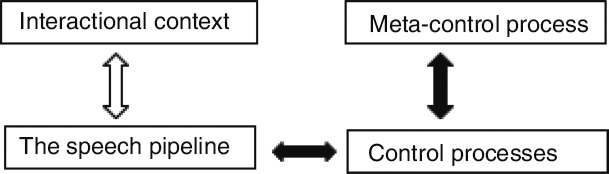
Speech comprehension and production are governed by control processes. We explore their nature and dynamics in bilingual speakers with a focus on speech production. Prior research indicates that individuals increase cognitive control in order to achieve a desired goal. In the adaptive control hypothesis we propose a stronger hypothesis: Language control processes themselves adapt to the recurrent demands placed on them by the interactional context. Adapting a control process means changing a parameter or parameters about the way it works (its neural capacity or efficiency) or the way it works in concert, or in cascade, with other control processes (e.g., its connectedness). We distinguish eight control processes (goal maintenance, conflict monitoring, interference suppression, salient cue detection, selective response inhibition, task disengagement, task engagement, opportunistic planning). We consider the demands on these processes imposed by three interactional contexts (single language, dual language, and dense code-switching). We predict adaptive changes in the neural regions and circuits associated with specific control processes. A dual-language context, for example, is predicted to lead to the adaptation of a circuit mediating a cascade of control processes that circumvents a control dilemma. Effective test of the adaptive control hypothesis requires behavioural and neuroimaging work that assesses language control in a range of tasks within the same individual.
Overview
CoChat Summary
TL;DR
The paper proposes the adaptive control hypothesis: bilingual language control processes themselves adapt to the recurrent demands of three interactional contexts—single-language, dual-language, and dense code-switching—by changing parameters such as neural capacity, efficiency, or coordination. It identifies eight control processes and predicts context-specific behavioural and neural adaptations, especially a dual-language adaptation that circumvents a control dilemma.
Key findings
- The paper distinguishes eight control processes: goal maintenance, conflict monitoring, interference suppression, salient cue detection, selective response inhibition, task disengagement, task engagement, and opportunistic planning.
- It contrasts three interactional contexts: single-language, dual-language, and dense code-switching. Table 1 indicates that single-language context increases demand on goal maintenance and interference control; dual-language context increases demand on goal maintenance, interference control, salient cue detection, selective response inhibition, task disengagement, and task engagement; dense code-switching increases demand on opportunistic planning.
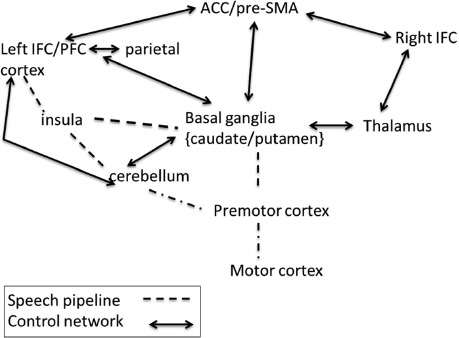
- The hypothesis predicts that dual-language speakers adapt a cascade linking salient cue detection to selective response inhibition, task disengagement, and task engagement to circumvent the control dilemma in which suppression reduces flexibility to switch. Dense code-switching is predicted to adapt a left frontal–right cerebellar circuit for morphosyntactic integration, while single-language context is associated with left inferior regions for suppressing the nontarget language.
- No original quantitative results are reported; the paper is theoretical and offers illustrative behavioural and neuroimaging predictions.
Methods
- Theoretical/review paper with no participants or new empirical data; it proposes the adaptive control hypothesis and derives testable predictions.
- It synthesizes prior work on bilingual language control, cognitive control, neuroimaging, and neuropsychology, using three interactional contexts and eight control processes as an organizing framework.
- The main analysis is conceptual: a table of context-dependent demands and illustrative predictions for behavioural tasks (e.g., cued language switching, Stroop) and neural circuits; it calls for within-individual behavioural and neuroimaging tests across a range of tasks.
Limitations
- The authors state that their illustrative predictions may prove false and that there may be no systematic behavioural or neural differences as a function of interactional context.
- The authors acknowledge circular causation: interactional context may shape adaptive response, but individual differences in predispositions and genetic make-up constrain such effects; they assume individual variation in executive control and sociality is normally distributed.
- The text makes evident that the hypothesis is programmatic and untested in this paper; contexts are idealized, speakers may experience mixtures of contexts, and factors such as proficiency, sensitivity to interaction cost, neuropharmacology, and genetic variation may moderate predicted adaptations.
Model-written summary. Check it against the paper before relying on it.
Integrity signals
Registry
Cites
Statistics
Figures
Verification
Claims the paper makes
0 Valid · 0 Not valid · 30 Not checked · 57 Own results and interpretations
In the paper
“Strikingly, the use of more than one language appears to be a further important factor shaping individual performance on such tasks (e.g., Bialystok, Craik, Green, & Gollan, 2009, for a review).”
§ Language control in bilinguals: The adaptive control hypothesis > Abstract
What the sources say
- Not checked yetcites Bialystok, Craik, Green, & Gollan, 2009 matched to “Bilingual Minds” (2009) source
hedgedstates an association- Asserted: passes — The authors put it forward as true.
- Checkable: passes — It can be checked against evidence.
- Load-bearing: passes — The paper’s conclusions depend on it.
- Based: passes — The paper gives a reason why it holds.
A conclusion the paper draws from its own results — it cites no other source for it, so there is none to check. The quote shows it is in the paper.
In the paper
“In other words, any learning effects during the experiment should be observed earlier for speakers from an interactional context that is best suited to the experimental conditions.”
§ Language control in bilinguals: The adaptive control hypothesis > THE ADAPTIVE CONTROL HYPOTHESIS > Testing the adaptive control hypothesis
plainstates an association- Asserted: passes — The authors put it forward as true.
- Checkable: passes — It can be checked against evidence.
- Load-bearing: passes — The paper’s conclusions depend on it.
- Based: passes — The paper gives a reason why it holds.
In the paper
“acknowledged a role of the pre-SMA in initiating speech in language switching (see Luk et al., 2012, for further discussion).”
§ Language control in bilinguals: The adaptive control hypothesis > THE ADAPTIVE CONTROL HYPOTHESIS > Neuroimaging predictions
What the sources say
- Not checked yetcites Luk et al., 2012 matched to “Cognitive control for language switching in bilinguals: A quantitative meta-analysis of functional neuroimaging studies” (2012) source
plainstates an association- Asserted: passes — The authors put it forward as true.
- Checkable: passes — It can be checked against evidence.
- Load-bearing: unclear — It is unclear whether the paper’s conclusions depend on it.
- Based: passes — The paper gives a reason why it holds.
In the paper
“In Figure 2 we include a direct link between frontal cortex and the right cerebellum as a further circuit involved in language control (Fabbro, Moretti, & Bava, 2000).”
§ Language control in bilinguals: The adaptive control hypothesis > THE ADAPTIVE CONTROL HYPOTHESIS > Neuroimaging predictions
What the sources say
- Not checked yetcites Fabbro, Moretti, & Bava, 2000 matched to “Language impairments in patients with cerebellar lesions” (2000) source
plainstates an association- Asserted: passes — The authors put it forward as true.
- Checkable: passes — It can be checked against evidence.
- Load-bearing: passes — The paper’s conclusions depend on it.
- Based: passes — The paper gives a reason why it holds.
In the paper
“Reperfusion of the cerebellum reduces such symptoms (Marien, Engelborghs, Fabbro, & De Deyn, 2001).”
§ Language control in bilinguals: The adaptive control hypothesis > THE ADAPTIVE CONTROL HYPOTHESIS > Neuroimaging predictions
What the sources say
- Not checked yetcites Marien, Engelborghs, Fabbro, & De Deyn, 2001 matched to “The Lateralized Linguistic Cerebellum: A Review and a New Hypothesis” (2001) source
plainstates a cause- Asserted: passes — The authors put it forward as true.
- Checkable: passes — It can be checked against evidence.
- Load-bearing: unclear — It is unclear whether the paper’s conclusions depend on it.
- Based: passes — The paper gives a reason why it holds.
43 more claims
Create a free account to see all 87 claims and to verify the 30 references still open.
- Probably not a substantial claim. 23
- It may state two separate claims as one. 25
Claims other papers make about this one
Each is checked against this paper’s own text: does it say what the citing paper says it does?
In the citing paper
“Alternating between languages requires not only activation of words in the to-be-attended language but also inhibition of words in the language that should no longer be used (‘language control’; Green & Abutalebi, 2013).”
From Language proficiency drives listening-related fatigue in those who communicate in English as their second language (2026) · cites this paper as Green & Abutalebi, 2013
In the citing paper
“Previous work highlights the cognitive demands of switching between multiple languages within a conversation (Green & Abutalebi, 2013).”
From Language proficiency drives listening-related fatigue in those who communicate in English as their second language (2026) · cites this paper as Green & Abutalebi, 2013
Citations
Cites
Miyake, A., Friedman, N. P., Emerson, M. J., Witzki, A. H., Howerter, A., & Wager, T. D. (2000) · Cognitive Psychology · doi:10.1006/cogp.1999.0734 · Cited by 15,798
Clark, H. H. (1996) · doi:10.1017/cbo9780511620539 · Cited by 5,123
Conflict monitoring and anterior cingulate cortex: an update
Botvinick, M. M., Cohen, J. D., & Carter, C. S. (2004) · Trends in Cognitive Sciences · doi:10.1016/j.tics.2004.10.003 · Cited by 3,623
Anterior Cingulate Conflict Monitoring and Adjustments in Control
Kerns, J. G., Cohen, J. D., MacDonald, A. W., Cho, R. Y., Stenger, V. A., & Carter, C. S. (2004) · Science · doi:10.1126/science.1089910 · Cited by 2,891 · cited 4×
“In addition, there is a demand on frontal structures linked to conflict monitoring and interference suppression (e.g., Kerns et al., 2004) and to parietal regions (and frontal regions) associated with task changes.”
BackgroundInfluentialMental control of the bilingual lexico-semantic system
GREEN, D. W. (1998) · Bilingualism Language and Cognition · doi:10.1017/s1366728998000133 · Cited by 2,807
Self-citationUsing language: Communicative acts
Clark, H. H. (1996) · Cited by 2,721
Using language: Index of names
Clark, H. H. (1996) · Cited by 2,720
The variable nature of cognitive control: a dual mechanisms framework
Braver, T. S. (2012) · Trends in Cognitive Sciences · doi:10.1016/j.tics.2011.12.010 · Cited by 2,482 · cited 1×
“One way to recognise the interplay of these processes is to distinguish proactive control processes that establish a task goal from reactive control processes that limit interference with it (Braver, 2012).”
BackgroundInverted-U–Shaped Dopamine Actions on Human Working Memory and Cognitive Control
Cools, R., & D'Esposito, M. (2011) · Biological Psychiatry · doi:10.1016/j.biopsych.2011.03.028 · Cited by 1,673 · cited 2×
“Neuroimaging data also implicate distinct neural regions in task switching and interference control (e.g., Cools & D’Esposito, 2011).”
BackgroundBilingual language production: The neurocognition of language representation and control
Abutalebi, J., & Green, D. (2007) · Journal of Neurolinguistics · doi:10.1016/j.jneuroling.2006.10.003 · Cited by 1,302 · cited 2×
“In previous papers (e.g., Abutalebi & Green, 2007, 2008), we reviewed work showing that both cortical and subcortical structures are involved in language control and language switching (see Luk, Green, Abutalebi, & Grady, 2012, for a recent metaanalysis).”
BackgroundSelf-citation
Cited by
Items 901–1,000 of 2,166
García‐Sierra, A., & Ramírez‐Esparza, N. (2025) · Bilingualism Language and Cognition · doi:10.1017/s1366728925000148 · Cited by 8
Processing linguistic variation through dual mechanisms of cognitive control
Berry, G. M. (2016) · Linguistics Vanguard · doi:10.1515/lingvan-2016-0033 · Cited by 8
Chondrogianni, V., & Butcher, M. (2023) · Studies in Second Language Acquisition · doi:10.1017/s0272263123000293 · Cited by 8
Cognitive control states and traits modulate lexical competition during word production
Zhang, S., Kang, K., Zhong, J., Yu, H., Ip, C.-T., & Zhang, H. (2025) · Scientific Reports · doi:10.1038/s41598-025-10039-5 · Cited by 8
Chen, J., Wang, J., zhaxi, C., Xiong, Y., & Zhang, C. (2022) · International Journal of Bilingualism · doi:10.1177/13670069221123760 · Cited by 8
Executive control, brain aging and bilingualism
Gold, B. T. (2015) · Cortex · doi:10.1016/j.cortex.2015.06.014 · Cited by 8
Agostini, V., Apperly, I. A., & Krott, A. (2025) · Bilingualism Language and Cognition · doi:10.1017/s1366728925000069 · Cited by 8
Multivariate decoding methods reveal how speaking two dialects affects executive functions
Wu, Y. J., Dang, Q., Zhang, Z., Zhang, H., & Guo, T. (2023) · European Journal of Neuroscience · doi:10.1111/ejn.15918 · Cited by 8
Meanness trumps language: Lack of foreign language effect in early bilinguals’ moral choices
Flexas, A., Penadés, R. L., Aguilar-Mediavilla, E. M., & Adrover‐Roig, D. (2023) · PLoS ONE · doi:10.1371/journal.pone.0294523 · Cited by 8
Graph structure analysis of speech production among second language learners of Spanish and Chinese
Botezatu, M. R., Weissheimer, J., Ribeiro, M., Guo, T., Finger, I., & Mota, N. B. (2022) · Frontiers in Psychology · doi:10.3389/fpsyg.2022.940269 · Cited by 8
Heritage speakers reveal the dynamics of bilingual language regulation
Santacruz, J. H., Torres, J., & Kroll, J. F. (2025) · Bilingualism Language and Cognition · doi:10.1017/s1366728925000203 · Cited by 8
Filipović, L. (2022) · Frontiers in Communication · doi:10.3389/fcomm.2022.822517 · Cited by 8
Code-switching: A processing burden, or a valuable resource for prediction?
Tomić, A., & Kroff, J. R. V. (2021) · Bilingual processing and acquisition · doi:10.1075/bpa.12.07tom · Cited by 8
Capacity, load, and effort in translation, interpreting and bilingualism
Seeber, K., & Amos, R. M. (2023) · Routledge eBooks · doi:10.4324/9781003109020-22 · Cited by 8
Cross-linguistic influences in bilingual morphosyntactic acquisition
Chondrogianni, V. (2023) · Bilingual processing and acquisition · doi:10.1075/bpa.16.12cho · Cited by 8
QUALE DIDATTICA PER LE LINGUE MINORITARIE? APPROCCI E MODELLI PER UN’EDUCAZIONE PLURILINGUE
Micali, I. (2023) · Italiano LinguaDue · doi:10.54103/2037-3597/20434 · Cited by 8
Language change in small-scale multilingual societies: Trees, waves, and magnets?
Good, J. (2023) · Oxford University Press eBooks · doi:10.1093/oso/9780192845818.003.0024 · Cited by 8
Petrosyan, S., Strangmann, I. M., Nichols, E., Meijer, E., Briceño, E. M., Narayanan, S. S., Lee, J., & Rentería, M. A. (2025) · Neuropsychology · doi:10.1037/neu0000988 · Cited by 8
Glimois, L. (2019) · OhioLink ETD Center (Ohio Library and Information Network) · Cited by 8
Chang, X., Huang, X.-Y., Zou, X.-Z., Wang, P., & Wang, P. (2023) · Cognitive Processing · doi:10.1007/s10339-023-01137-1 · Cited by 8
Individual variability and neuroplastic changes
Green, D. W. (2014) · Applied Psycholinguistics · doi:10.1017/s0142716414000228 · Cited by 8
Self-citationMarton, K., Gehebe, T., & Pazuelo, L. (2019) · Seminars in Speech and Language · doi:10.1055/s-0039-1692962 · Cited by 7
Antoniou, K., & Spanoudis, G. C. (2024) · Bilingualism Language and Cognition · doi:10.1017/s1366728924000506 · Cited by 7
Ouzia, J., Bright, P., & Filippi, R. (2019) · Behavioral Sciences · doi:10.3390/bs9080089 · Cited by 7
Smith, S. A., Briggs, J. G., Pothier, H., & Garcia, J. N. (2017) · Applied Linguistics · doi:10.1093/applin/amx038 · Cited by 7
Effects of experience and directionality on cognitive load in dialogue interpreting
Adler, A. (2024) · Translation Cognition & Behavior · doi:10.1075/tcb.24005.adl · Cited by 7
Brain structure correlates of foreign language learning experiences
Wang, X., Kim, J.-Y., Kim, J., Choi, Y., Ha, E.-G., Kim, D., Sul, S., Yang, S. J., & Song, H.-J. (2025) · Frontiers in Human Neuroscience · doi:10.3389/fnhum.2025.1663218 · Cited by 7
Bilingualism and Executive Function
Poarch, G. J., & Gastmann, F. (2026) · Wiley eBooks · doi:10.1002/9781405198431.wbeal0099 · Cited by 7
Language and thought: The lexicon and beyond
Landau, B. (2022) · Oxford University Press eBooks · doi:10.1093/oxfordhb/9780198845003.013.5 · Cited by 7
Self-regulated learning strategies in L1 and L2 reading
Reyes, M., Morales, J., & Bajo, M. T. (2024) · Bilingualism Language and Cognition · doi:10.1017/s1366728924000683 · Cited by 7
Wolfsthurn, S. V. G. Z., Gupta, A., Pablos, L., & Schiller, N. O. (2022) · Bilingualism Language and Cognition · doi:10.1017/s1366728922000426 · Cited by 7
Linguistic distance affects executive performance in trilinguals
Сергеевна, Н. М., Myachykov, A. V., Abutalebi, J., Юрьевич, Ш. Ю., & Gallo, F. (2025) · Acta Psychologica · doi:10.1016/j.actpsy.2025.105276 · Cited by 7
Self-citationBilingualism Predicts Affective Theory of Mind in Autistic Adults
Cummings, K. K., Greene, R. K., Cernasov, P., Kan, D. D. D., Parish‐Morris, J., Dichter, G. S., & Kinard, J. L. (2024) · Journal of Speech Language and Hearing Research · doi:10.1044/2024_jslhr-23-00431 · Cited by 7
Becoming Bilingual through Additive Immersive Programs
Juan-Garau, M., & Lyster, R. (2018) · Cambridge University Press eBooks · doi:10.1017/9781316831922.012 · Cited by 7
Attentional abilities of children enrolled in immersion education in French-speaking Belgium
Simonis, M., Galand, B., Hiligsmann, P., & Szmalec, A. (2020) · International Journal of Bilingual Education and Bilingualism · doi:10.1080/13670050.2020.1856033 · Cited by 7
Garcia, D. L., & Gollan, T. H. (2024) · Neuropsychology · doi:10.1037/neu0000943 · Cited by 7
Mapping caudal inferior parietal cortex supports the hypothesis about a modulating cortical area
Mofrad, F. T., & Schiller, N. O. (2022) · NeuroImage · doi:10.1016/j.neuroimage.2022.119441 · Cited by 7
Neurocognitive Effects of Multilingualism Throughout the Lifespan
Claussenius‐Kalman, H. L., & Hernández, A. E. (2019) · Wiley eBooks · doi:10.1002/9781119387725.ch32 · Cited by 7
Gullifer, J. W., & Titone, D. A. (2020) · PsyArXiv (OSF Preprints) · doi:10.31234/osf.io/7jq3w · Cited by 7
Dynamic neuroplasticity of language networks: The intersection of bilingualism and epilepsy
Stasenko, A., Kaestner, E. J., Schadler, A. J., Reyes, A., Urbanic, C., Helm, J. L., Saldana, D. G., Carollo-Duprey, G., Połczyńska, M. M., Benjamin, C. F. A., et al. (2025) · Proceedings of the National Academy of Sciences · doi:10.1073/pnas.2422742122 · Cited by 7
Liu, H., Li, B., Wang, X., & He, Y. (2020) · Cognitive Neurodynamics · doi:10.1007/s11571-020-09594-6 · Cited by 7
A shared linguistic system of multilingual representations
Slabakova, R. (2023) · Studies in bilingualism · doi:10.1075/sibil.65.02sla · Cited by 7
Xie, N., Li, B., Zhang, M., & Liu, H. (2018) · International Journal of Bilingualism · doi:10.1177/1367006918781073 · Cited by 7
Neveu, A., Goldrick, M., Kleinman, D., Salmon, D. P., & Gollan, T. H. (2024) · Neuropsychologia · doi:10.1016/j.neuropsychologia.2024.108948 · Cited by 7
Schwieter, J. W., Festman, J., & Ferreira, A. (2021) · Linguistica Antverpiensia New Series – Themes in Translation Studies · doi:10.52034/lanstts.v19i0.531 · Cited by 7
Yee, J., DeLuca, V., & Pliatsikas, C. (2023) · Cambridge University Press eBooks · doi:10.1017/9781108957823.023 · Cited by 7
Effects of healthy ageing and bilingualism on attention networks
Markiewicz, R., Rahman, F., Fernandes, E. G., Limachya, R., Wetterlin, A., Wheeldon, L. R., & Segaert, K. (2024) · Bilingualism Language and Cognition · doi:10.1017/s1366728924000154 · Cited by 7
Kennis, N., Zheng, X., de Bruin, A., & Piai, V. (2024) · Bilingualism Language and Cognition · doi:10.1017/s1366728924000452 · Cited by 7
Shared translation in second language activates unrelated words in first language
Hao, Y., Luo, Y., Lin-Hong, K. H.-Y., & Yan, M. (2023) · Psychonomic Bulletin & Review · doi:10.3758/s13423-023-02405-z · Cited by 7
Cognitive problems in older adults: Can bilingualism help?
Craik, F. I. M. (2017) · Studies in bilingualism · doi:10.1075/sibil.53.02cra · Cited by 7
Zuo, M., Schwieter, J. W., Cao, N., & Liu, H. (2022) · International Journal of Bilingualism · doi:10.1177/13670069221086302 · Cited by 7
Individual differences in cognitive control advantages of elderly late Dutch-English bilinguals
Keijzer, M. C. J., & Schmid, M. S. (2017) · Studies in bilingualism · doi:10.1075/sibil.53.05kei · Cited by 7
Understanding Language Attrition through Orthography
Margaretto, B. B., Gallo, F., Юрьевич, П. М., Юрьевич, Ш. Ю., Kreiner, H., & Myachykov, A. V. (2021) · Languages · doi:10.3390/languages6040199 · Cited by 7
Visualizing the knowledge domain of code-switching: a bibliometric review
Xiao-ping, L., Yu, L., & Liu, J. (2021) · Interdisciplinary Science Reviews · doi:10.1080/03080188.2021.1945283 · Cited by 7
DeLuca, V. (2024) · Journal of Multilingual Theories and Practices · doi:10.1558/jmtp.25486 · Cited by 7
Amos, R. M. (2020) · Archive ouverte UNIGE (University of Geneva) · doi:10.13097/archive-ouverte/unige:148890 · Cited by 7
The Case for Contextual Linguistic Diversity in Bilingualism Research
Wigdorowitz, M. (2024) · Journal of Multilingual Theories and Practices · doi:10.3138/jmtp-24140 · Cited by 7
Hansen, E., Slawny, C., & Kaushanskaya, M. (2025) · Bilingualism Language and Cognition · doi:10.1017/s1366728924000804 · Cited by 7
Goriot, C. (2019) · Radboud Repository (Radboud University) · Cited by 7
Rocafiguera Montanyà, N. D. (2023) · Repositori digital de la UPF (Universitat Pompeu Fabra) · Cited by 7
Suhonen, L.-V. (2020) · Lund University Publications (Lund University) · Cited by 7
Conceptual transfer: Roots, assumptions, and current scope
Jarvis, S. (2023) · Language Interaction and Acquisition · doi:10.1075/lia.22011.jar · Cited by 7
Editorial: Second language learning and neuroplasticity: individual differences
Yang, J., Cao, F., van Heuven, W. J. B., & Mei, L. (2024) · Frontiers in Psychology · doi:10.3389/fpsyg.2024.1417238 · Cited by 7
Cross-linguistic influence during real-time sentence processing in bilingual children and adults
Dijk, C. N. V. (2021) · Radboud Repository (Radboud University) · doi:10.48273/lot0598 · Cited by 7
Boerma, T., van Witteloostuijn, M., & Blom, E. (2022) · Languages · doi:10.3390/languages7020108 · Cited by 6
Bilingualism and Education: Bridging Cognitive Science Research to Language Learning
Luk, G., & Kroll, J. F. (2019) · Cambridge University Press eBooks · doi:10.1017/9781108235631.013 · Cited by 6
Contributions of pragmatics to word learning and interpretation
Grigoroglou, M., & Papafragou, A. (2022) · Oxford University Press eBooks · doi:10.1093/oxfordhb/9780198845003.013.21 · Cited by 6
Executive functioning: perspectives on neurotrophic activity and pharmacology
Sun, M. (2018) · Behavioural Pharmacology · doi:10.1097/fbp.0000000000000427 · Cited by 6
Xia, L., Sorace, A., Vega‐Mendoza, M., Deng, X., & Bak, T. H. (2025) · International Journal of Bilingualism · doi:10.1177/13670069241307606 · Cited by 6
Xie, W., & Ng, B. C. (2024) · International Journal of Bilingualism · doi:10.1177/13670069241292540 · Cited by 6
Xie, Z., & Zhong, Q. (2023) · International Journal of Bilingualism · doi:10.1177/13670069231181254 · Cited by 6
Chen, H.-C., & Yow, W. Q. (2023) · Frontiers in Language Sciences · doi:10.3389/flang.2023.1165388 · Cited by 6
de Bruin, A., & McGarrigle, R. (2024) · Quarterly Journal of Experimental Psychology · doi:10.1177/17470218231173638 · Cited by 3
Tayar, V. G., Saad, J., Sheikh, W. G. E., & Roukoz, C. (2024) · Developmental Neuropsychology · doi:10.1080/87565641.2024.2378891 · Cited by 6
Do trilingual individuals exhibit an advantage over bilinguals in executive function tasks?
Chen, J., Ci, J., & Liu, F. (2025) · Acta Psychologica · doi:10.1016/j.actpsy.2025.105354 · Cited by 6
Bilingualism, Language Development and Processing across the Lifespan
Herschensohn, J. (2022) · Bilingual processing and acquisition · doi:10.1075/bpa.15 · Cited by 6
Geng, L., Zhao, X., Xu, Q., Wu, H., Hu, X., Liu, Z., Ming, L., Xue, Z., Yue, C., & Yang, Y. (2024) · Cerebral Cortex · doi:10.1093/cercor/bhae042 · Cited by 6
Smith, J., Bent, C. A., Green, C. C., Woollacott, A., & Hudry, K. (2020) · Autism & Developmental Language Impairments · doi:10.1177/2396941519899684 · Cited by 6
African Languages and Human Language Technologies
Roux, J. C., & Ndinga-Koumba-Binza, H. S. (2019) · Cambridge University Press eBooks · doi:10.1017/9781108283991.022 · Cited by 6
African Languages in Urban Contexts
Hollington, A., & Nassenstein, N. (2019) · Cambridge University Press eBooks · doi:10.1017/9781108283991.018 · Cited by 6
Caira, T., Declerck, M., & Struys, E. (2025) · Frontiers in Education · doi:10.3389/feduc.2024.1520791 · Cited by 6
The neural mechanisms of bilinguals’ creativity: A neuroimaging study
Yang, Y., Li, Y., & Gu, J. (2025) · Journal of Neurolinguistics · doi:10.1016/j.jneuroling.2025.101245 · Cited by 6
Luque, A., Koronkiewicz, B., Issa, B. I., Faretta‐Stutenberg, M., & Bowden, H. W. (2025) · Frontiers in Language Sciences · doi:10.3389/flang.2024.1400587 · Cited by 6
Multilingualism, Speech Disfluencies, and Stuttering: A Scoping Review
Aslan, G., & Eggers, K. (2025) · Journal of Speech Language and Hearing Research · doi:10.1044/2025_jslhr-24-00479 · Cited by 6
Cognitive Effects of Bilingualism
Poarch, G. J. (2022) · Routledge eBooks · doi:10.4324/9781003018872-39 · Cited by 6
Dual-Language Use and Cognitive Function Among Mexican Americans Aged 65 and Older
Downer, B. G., Milani, S. A., Grasso, S. M., Lucas, F. L., & Mehta, N. K. (2024) · Journal of Alzheimer s Disease · doi:10.3233/jad-231187 · Cited by 6
Khodos, I., & Moskovsky, C. (2020) · Linguistic Approaches to Bilingualism · doi:10.1075/lab.19064.kho · Cited by 6
Peñaloza, C., Marte, M. J., Billot, A., & Kiran, S. (2025) · Cortex · doi:10.1016/j.cortex.2025.05.017 · Cited by 6
Tracing development of song memory with fMRI in zebra finches after a second tutoring experience
Arya, P., Petkova, S. P., Kulkarni, P. P., Kolodny, N. H., & Gobes, S. M. H. (2023) · Communications Biology · doi:10.1038/s42003-023-04724-2 · Cited by 6
Gallo, F., Terekhina, L., Abutalebi, J., Юрьевич, Ш. Ю., & Myachykov, A. V. (2025) · Brain and Cognition · doi:10.1016/j.bandc.2025.106308 · Cited by 6
Self-citationVaughn, K. A., Tamber-Rosenau, B. J., & Hernández, A. E. (2023) · Bilingualism Language and Cognition · doi:10.1017/s1366728923000834 · Cited by 6
Bidialectal variety switching: the effects of language use and social contexts
Zeng, W., Shea, C., Beckman, J. N., & Kutlu, E. (2024) · Frontiers in Language Sciences · doi:10.3389/flang.2023.1302027 · Cited by 6
Language Processing in Arabic Diglossia: Evidence for Memory-Based Automaticity
Hashem, R. (2022) · International Journal of Cognition and Behaviour · doi:10.23937/2690-3172/1710014 · Cited by 6
Raisman-Carlovich, A. J., Arias‐Trejo, N., & Carrasco‐Ortíz, H. (2024) · Second language Research · doi:10.1177/02676583241244606 · Cited by 6
Tabori, A. T., & Pyers, J. E. (2024) · Bilingualism Language and Cognition · doi:10.1017/s1366728924000385 · Cited by 6
Language control in bimodal bilinguals: multimodality and serial order
Green, D. W. (2015) · Bilingualism Language and Cognition · doi:10.1017/s1366728915000383 · Cited by 6
Self-citationTwo bee oar knot too be: the effects of orthography and bilingualism on spoken homophone production
Barr, P., Biedermann, B., & Nickels, L. (2022) · Language Cognition and Neuroscience · doi:10.1080/23273798.2022.2027992 · Cited by 6
AoA-L2 and Usage-L2 modulate the functional neuroplasticity of the subcortex
Liu, X., Gao, Z., Liu, W., He, X., & Wang, N. (2023) · Brain and Language · doi:10.1016/j.bandl.2023.105323 · Cited by 6
Ma, D., Wang, X., & Gao, X. (2021) · International Journal of Bilingualism · doi:10.1177/13670069211054599 · Cited by 6
Structural neural correlates of habitual code-switching practices in bilingualsPreprint
Kořenář, M., Treffers‐Daller, J., & Pliatsikas, C. (2022) · PsyArXiv (OSF Preprints) · doi:10.31234/osf.io/2zebp · Cited by 6
Metadata
- Authors
- Green, D. W., & Abutalebi, J.
- Affiliations
- University College London (GB)
- Vita-Salute San Raffaele University (IT)
- Corresponding author
- Green, David W.
- Venue
- Journal of Cognitive Psychology
- Publisher
- Informa UK Limited
- Published
- 2013-05-24
- Volume
- 25
- Issue
- 5
- Pages
- 515-530
- ISSN
- 2044-5911 (ISSN-L)
- 2044-592X
- PMC
- PMC4095950
- OpenAlex
- W2128442137
- Cited by
- 2,163
- References
- 62
- Citations by year
- 2026: 264 · 2025: 271 · 2024: 222 · 2023: 211 · 2022: 197 · 2021: 160 · 2020: 154 · 2019: 254 · 2018: 164 · 2017: 90 · 2016: 82 · 2015: 61 · 2014: 27 · 2013: 3
- FWCI
- 21.17
- Type
- journal article
- Language
- en
- Open access
- hybrid
- doi.org
- Licence
- cc-by
- Locations
- Journal of Cognitive Psychology (publishedVersion, cc-by)
- PubMed Central (publishedVersion, cc-by)
- Europe PMC (PubMed Central) (publishedVersion, cc-by)
- PubMed (publishedVersion)
- UCL Discovery (University College London) (submittedVersion)
- Archivio Istituzionale della Ricerca - Università Vita-Salute San Raffaele (submittedVersion)
- Topics
- Life Sciences › Neuroscience › Cognitive Neuroscience › Neurobiology of Language and Bilingualism
- Social Sciences › Psychology › Developmental and Educational Psychology › Language Development and Disorders
- Life Sciences › Neuroscience › Cognitive Neuroscience › Neural and Behavioral Psychology Studies
- Keywords
- language control, bilingualism, cognitive control, speech production, code-switching, control processes, interference suppression, conflict monitoring, task disengagement, task engagement, goal maintenance, opportunistic planning, neural circuits
About these checks
Registry, retraction, Cites and statistics results are computed, not judged, with one exception: a printed reference that no index lists is read once by a model before it counts as a citation error. Claims are extracted by a model and kept only when their quote appears verbatim in the text; each cited source is then checked, with a model’s help, for whether it says what the claim relies on. Those verdicts can be wrong — read the claim’s quote and the cited source before relying on one.
A language model drew the claims from the paper on 2026-11-24, under version 3 of the claim definition (model deepseek-v4.1-flash, prompt extract-v3).
A second model labelled each claim on 2026-11-24 (model jev-1.13-20260917, definition revision gold-guideline-v0.2).
Statistics and arithmetic are recomputed, not judged.
Confidence bands are shown only for fields calibrated on our annotated test set. None is calibrated yet, so no band is shown.
What counts as a claim ›How we measure confidence ›How we check this ›
Are you an author, or do you see a problem with this page? Request a review
Data sources
Bibliographic data: Semantic Scholar, OpenAlex, Crossref.
Contains information from the Semantic Scholar Academic Graph Datasets, made available under the ODC Attribution License (ODC-BY 1.0).
Semantic Scholar’s data is described in: Kinney, R., et al. (2023). The Semantic Scholar Open Data Platform. arXiv:2301.10140.
