

Language control in bilinguals: The adaptive control hypothesis
Open accessThe DOI matches its Crossref record; 62 of the 62 references it cites were found in a registry or an index; none of the 36 sources its claims cite is checked for support yet.
Abstract
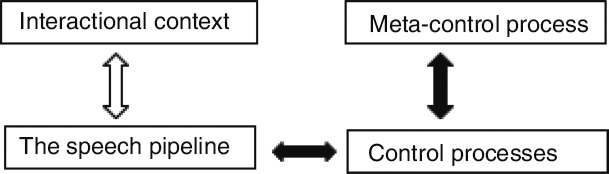
Speech comprehension and production are governed by control processes. We explore their nature and dynamics in bilingual speakers with a focus on speech production. Prior research indicates that individuals increase cognitive control in order to achieve a desired goal. In the adaptive control hypothesis we propose a stronger hypothesis: Language control processes themselves adapt to the recurrent demands placed on them by the interactional context. Adapting a control process means changing a parameter or parameters about the way it works (its neural capacity or efficiency) or the way it works in concert, or in cascade, with other control processes (e.g., its connectedness). We distinguish eight control processes (goal maintenance, conflict monitoring, interference suppression, salient cue detection, selective response inhibition, task disengagement, task engagement, opportunistic planning). We consider the demands on these processes imposed by three interactional contexts (single language, dual language, and dense code-switching). We predict adaptive changes in the neural regions and circuits associated with specific control processes. A dual-language context, for example, is predicted to lead to the adaptation of a circuit mediating a cascade of control processes that circumvents a control dilemma. Effective test of the adaptive control hypothesis requires behavioural and neuroimaging work that assesses language control in a range of tasks within the same individual.
Overview
CoChat Summary
TL;DR
The paper proposes the adaptive control hypothesis: bilingual language control processes themselves adapt to the recurrent demands of three interactional contexts—single-language, dual-language, and dense code-switching—by changing parameters such as neural capacity, efficiency, or coordination. It identifies eight control processes and predicts context-specific behavioural and neural adaptations, especially a dual-language adaptation that circumvents a control dilemma.
Key findings
- The paper distinguishes eight control processes: goal maintenance, conflict monitoring, interference suppression, salient cue detection, selective response inhibition, task disengagement, task engagement, and opportunistic planning.
- It contrasts three interactional contexts: single-language, dual-language, and dense code-switching. Table 1 indicates that single-language context increases demand on goal maintenance and interference control; dual-language context increases demand on goal maintenance, interference control, salient cue detection, selective response inhibition, task disengagement, and task engagement; dense code-switching increases demand on opportunistic planning.
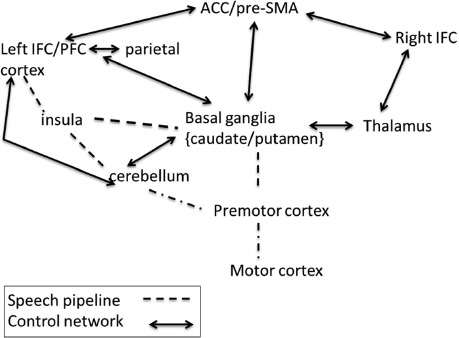
- The hypothesis predicts that dual-language speakers adapt a cascade linking salient cue detection to selective response inhibition, task disengagement, and task engagement to circumvent the control dilemma in which suppression reduces flexibility to switch. Dense code-switching is predicted to adapt a left frontal–right cerebellar circuit for morphosyntactic integration, while single-language context is associated with left inferior regions for suppressing the nontarget language.
- No original quantitative results are reported; the paper is theoretical and offers illustrative behavioural and neuroimaging predictions.
Methods
- Theoretical/review paper with no participants or new empirical data; it proposes the adaptive control hypothesis and derives testable predictions.
- It synthesizes prior work on bilingual language control, cognitive control, neuroimaging, and neuropsychology, using three interactional contexts and eight control processes as an organizing framework.
- The main analysis is conceptual: a table of context-dependent demands and illustrative predictions for behavioural tasks (e.g., cued language switching, Stroop) and neural circuits; it calls for within-individual behavioural and neuroimaging tests across a range of tasks.
Limitations
- The authors state that their illustrative predictions may prove false and that there may be no systematic behavioural or neural differences as a function of interactional context.
- The authors acknowledge circular causation: interactional context may shape adaptive response, but individual differences in predispositions and genetic make-up constrain such effects; they assume individual variation in executive control and sociality is normally distributed.
- The text makes evident that the hypothesis is programmatic and untested in this paper; contexts are idealized, speakers may experience mixtures of contexts, and factors such as proficiency, sensitivity to interaction cost, neuropharmacology, and genetic variation may moderate predicted adaptations.
Model-written summary. Check it against the paper before relying on it.
Integrity signals
Registry
Cites
Statistics
Figures
Verification
Claims the paper makes
0 Valid · 0 Not valid · 30 Not checked · 57 Own results and interpretations
In the paper
“Strikingly, the use of more than one language appears to be a further important factor shaping individual performance on such tasks (e.g., Bialystok, Craik, Green, & Gollan, 2009, for a review).”
§ Language control in bilinguals: The adaptive control hypothesis > Abstract
What the sources say
- Not checked yetcites Bialystok, Craik, Green, & Gollan, 2009 matched to “Bilingual Minds” (2009) source
hedgedstates an association- Asserted: passes — The authors put it forward as true.
- Checkable: passes — It can be checked against evidence.
- Load-bearing: passes — The paper’s conclusions depend on it.
- Based: passes — The paper gives a reason why it holds.
A conclusion the paper draws from its own results — it cites no other source for it, so there is none to check. The quote shows it is in the paper.
In the paper
“In other words, any learning effects during the experiment should be observed earlier for speakers from an interactional context that is best suited to the experimental conditions.”
§ Language control in bilinguals: The adaptive control hypothesis > THE ADAPTIVE CONTROL HYPOTHESIS > Testing the adaptive control hypothesis
plainstates an association- Asserted: passes — The authors put it forward as true.
- Checkable: passes — It can be checked against evidence.
- Load-bearing: passes — The paper’s conclusions depend on it.
- Based: passes — The paper gives a reason why it holds.
In the paper
“acknowledged a role of the pre-SMA in initiating speech in language switching (see Luk et al., 2012, for further discussion).”
§ Language control in bilinguals: The adaptive control hypothesis > THE ADAPTIVE CONTROL HYPOTHESIS > Neuroimaging predictions
What the sources say
- Not checked yetcites Luk et al., 2012 matched to “Cognitive control for language switching in bilinguals: A quantitative meta-analysis of functional neuroimaging studies” (2012) source
plainstates an association- Asserted: passes — The authors put it forward as true.
- Checkable: passes — It can be checked against evidence.
- Load-bearing: unclear — It is unclear whether the paper’s conclusions depend on it.
- Based: passes — The paper gives a reason why it holds.
In the paper
“In Figure 2 we include a direct link between frontal cortex and the right cerebellum as a further circuit involved in language control (Fabbro, Moretti, & Bava, 2000).”
§ Language control in bilinguals: The adaptive control hypothesis > THE ADAPTIVE CONTROL HYPOTHESIS > Neuroimaging predictions
What the sources say
- Not checked yetcites Fabbro, Moretti, & Bava, 2000 matched to “Language impairments in patients with cerebellar lesions” (2000) source
plainstates an association- Asserted: passes — The authors put it forward as true.
- Checkable: passes — It can be checked against evidence.
- Load-bearing: passes — The paper’s conclusions depend on it.
- Based: passes — The paper gives a reason why it holds.
In the paper
“Reperfusion of the cerebellum reduces such symptoms (Marien, Engelborghs, Fabbro, & De Deyn, 2001).”
§ Language control in bilinguals: The adaptive control hypothesis > THE ADAPTIVE CONTROL HYPOTHESIS > Neuroimaging predictions
What the sources say
- Not checked yetcites Marien, Engelborghs, Fabbro, & De Deyn, 2001 matched to “The Lateralized Linguistic Cerebellum: A Review and a New Hypothesis” (2001) source
plainstates a cause- Asserted: passes — The authors put it forward as true.
- Checkable: passes — It can be checked against evidence.
- Load-bearing: unclear — It is unclear whether the paper’s conclusions depend on it.
- Based: passes — The paper gives a reason why it holds.
43 more claims
Create a free account to see all 87 claims and to verify the 30 references still open.
- Probably not a substantial claim. 23
- It may state two separate claims as one. 25
Claims other papers make about this one
Each is checked against this paper’s own text: does it say what the citing paper says it does?
In the citing paper
“Alternating between languages requires not only activation of words in the to-be-attended language but also inhibition of words in the language that should no longer be used (‘language control’; Green & Abutalebi, 2013).”
From Language proficiency drives listening-related fatigue in those who communicate in English as their second language (2026) · cites this paper as Green & Abutalebi, 2013
In the citing paper
“Previous work highlights the cognitive demands of switching between multiple languages within a conversation (Green & Abutalebi, 2013).”
From Language proficiency drives listening-related fatigue in those who communicate in English as their second language (2026) · cites this paper as Green & Abutalebi, 2013
Citations
Cites
Miyake, A., Friedman, N. P., Emerson, M. J., Witzki, A. H., Howerter, A., & Wager, T. D. (2000) · Cognitive Psychology · doi:10.1006/cogp.1999.0734 · Cited by 15,798
Clark, H. H. (1996) · doi:10.1017/cbo9780511620539 · Cited by 5,123
Conflict monitoring and anterior cingulate cortex: an update
Botvinick, M. M., Cohen, J. D., & Carter, C. S. (2004) · Trends in Cognitive Sciences · doi:10.1016/j.tics.2004.10.003 · Cited by 3,623
Anterior Cingulate Conflict Monitoring and Adjustments in Control
Kerns, J. G., Cohen, J. D., MacDonald, A. W., Cho, R. Y., Stenger, V. A., & Carter, C. S. (2004) · Science · doi:10.1126/science.1089910 · Cited by 2,891 · cited 4×
“In addition, there is a demand on frontal structures linked to conflict monitoring and interference suppression (e.g., Kerns et al., 2004) and to parietal regions (and frontal regions) associated with task changes.”
BackgroundInfluentialMental control of the bilingual lexico-semantic system
GREEN, D. W. (1998) · Bilingualism Language and Cognition · doi:10.1017/s1366728998000133 · Cited by 2,807
Self-citationUsing language: Communicative acts
Clark, H. H. (1996) · Cited by 2,721
Using language: Index of names
Clark, H. H. (1996) · Cited by 2,720
The variable nature of cognitive control: a dual mechanisms framework
Braver, T. S. (2012) · Trends in Cognitive Sciences · doi:10.1016/j.tics.2011.12.010 · Cited by 2,482 · cited 1×
“One way to recognise the interplay of these processes is to distinguish proactive control processes that establish a task goal from reactive control processes that limit interference with it (Braver, 2012).”
BackgroundInverted-U–Shaped Dopamine Actions on Human Working Memory and Cognitive Control
Cools, R., & D'Esposito, M. (2011) · Biological Psychiatry · doi:10.1016/j.biopsych.2011.03.028 · Cited by 1,673 · cited 2×
“Neuroimaging data also implicate distinct neural regions in task switching and interference control (e.g., Cools & D’Esposito, 2011).”
BackgroundBilingual language production: The neurocognition of language representation and control
Abutalebi, J., & Green, D. (2007) · Journal of Neurolinguistics · doi:10.1016/j.jneuroling.2006.10.003 · Cited by 1,302 · cited 2×
“In previous papers (e.g., Abutalebi & Green, 2007, 2008), we reviewed work showing that both cortical and subcortical structures are involved in language control and language switching (see Luk, Green, Abutalebi, & Grady, 2012, for a recent metaanalysis).”
BackgroundSelf-citation
Cited by
Two new Later Stone Age sites from the Final Pleistocene in the Falémé Valley, eastern Senegal
Ndiaye, M., Lespez, L., Tribolo, C., Rassé, M., Hadjas, I., Davidoux, S., Huysecom, É., & Douze, K. (2024) · Monash University Research Portal (Monash University) · doi:10.3929/ethz-b-000667478 · Cited by 23,868
The bilingual adaptation: How minds accommodate experience
Bialystok, E. (2017) · Psychological Bulletin · doi:10.1037/bul0000099 · Cited by 906
“Recognizing the limits of inhibition as an explanation, Green and Abutalebi (2013) recently expanded the IC model to provide a more detailed description of the processes responsible for bilingual language selection and the implications for cognition.”
BackgroundMethodIs bilingualism associated with enhanced executive functioning in adults? A meta-analytic review.
Lehtonen, M., Soveri, A., Laine, A., Järvenpää, J., de Bruin, A., & Antfolk, J. (2018) · Psychological Bulletin · doi:10.1037/bul0000142 · Cited by 632
Neuroimaging of language control in bilinguals: neural adaptation and reserve
ABUTALEBI, J., & GREEN, D. W. (2016) · Bilingualism: Language and Cognition · doi:10.1017/s1366728916000225 · Cited by 531
Self-citationAnderson, J. A. E., Mak, L., Keyvani Chahi, A., & Bialystok, E. (2018) · Behavior Research Methods · doi:10.3758/s13428-017-0867-9 · Cited by 438
DeLuca, V., Rothman, J., Bialystok, E., & Pliatsikas, C. (2019) · Proceedings of the National Academy of Sciences · doi:10.1073/pnas.1811513116 · Cited by 435
Kroll, J. F., Dussias, P. E., Bice, K., & Perrotti, L. (2015) · Annual Review of Linguistics · doi:10.1146/annurev-linguist-030514-124937 · Cited by 427
A control process model of code-switching
Green, D. W., & Wei, L. (2014) · Language, Cognition and Neuroscience · doi:10.1080/23273798.2014.882515 · Cited by 378
Self-citationThe Advantages of Bilingualism Debate
Antoniou, M. (2019) · Annual Review of Linguistics · doi:10.1146/annurev-linguistics-011718-011820 · Cited by 373
Uncovering Small-Scale Multilingualism
Lüpke, F. (2016) · Critical multilingualism studies · doi:10.2458/cms.6634 · Cited by 358
Characterizing the social diversity of bilingualism using language entropy
Gullifer, J. W., & Titone, D. (2020) · Bilingualism: Language and Cognition · doi:10.1017/s1366728919000026 · Cited by 330
Is there a bilingual advantage in the ANT task? Evidence from children
Antón, E., Duñabeitia, J. A., Estévez, A., Hernández, J. A., Castillo, A., Fuentes, L. J., Davidson, D. J., & Carreiras, M. (2014) · Frontiers in Psychology · doi:10.3389/fpsyg.2014.00398 · Cited by 323
SURRAIN, S., & LUK, G. (2019) · Bilingualism: Language and Cognition · doi:10.1017/s1366728917000682 · Cited by 309
Understanding structural plasticity in the bilingual brain: The Dynamic Restructuring Model
Pliatsikas, C. (2020) · Bilingualism: Language and Cognition · doi:10.1017/s1366728919000130 · Cited by 274
The influence of language-switching experience on the bilingual executive control advantage
VERREYT, N., WOUMANS, E., VANDELANOTTE, D., SZMALEC, A., & DUYCK, W. (2016) · Bilingualism: Language and Cognition · doi:10.1017/s1366728914000352 · Cited by 273
Two Languages in Mind: Bilingualism as a Tool to Investigate Language, Cognition, and the Brain
Kroll, J. F., Bobb, S. C., & Hoshino, N. (2014) · Current Directions in Psychological Science · doi:10.1177/0963721414528511 · Cited by 267
The impact of bilingualism on brain reserve and metabolic connectivity in Alzheimer's dementia
Perani, D., Farsad, M., Ballarini, T., Lubian, F., Malpetti, M., Fracchetti, A., Magnani, G., March, A., & Abutalebi, J. (2017) · Proceedings of the National Academy of Sciences · doi:10.1073/pnas.1610909114 · Cited by 263
Self-citationAn experimental approach to linguistic representation
Branigan, H. P., & Pickering, M. J. (2017) · Behavioral and Brain Sciences · doi:10.1017/s0140525x16002028 · Cited by 259
Translanguaging challenges in multilingual classrooms: scholar, teacher and student perspectives
Ticheloven, A., Blom, E., Leseman, P. P. M., & McMonagle, S. (2019) · International Journal of Multilingualism · doi:10.1080/14790718.2019.1686002 · Cited by 256
de Bruin, A. (2019) · Behavioral Sciences · doi:10.3390/bs9030033 · Cited by 251
“Following recent arguments about the importance of interactional context [29,30], researchers should describe not just the amount of language switching but also the way bilinguals switch between their languages.”
BackgroundResultInfluentialNeural correlates of cognitive processing in monolinguals and bilinguals
Grundy, J. G., Anderson, J. A. E., & Bialystok, E. (2017) · Annals of the New York Academy of Sciences · doi:10.1111/nyas.13333 · Cited by 248
Hartanto, A., & Yang, H. (2016) · Cognition · doi:10.1016/j.cognition.2016.01.016 · Cited by 244
“Intrasentential code-switching is voluntary and implicates opportunistic planning—i.e., using whatever comes most readily to hand (e.g., Gollan & Ferreira, 2009; Green & Abutalebi, 2013).”
BackgroundThe Handbook of the Neuroscience of Multilingualism
DeLuca, V., Miller, D., Pliatsikas, C., & Rothman, J. (2019) · Wiley eBooks · doi:10.1002/9781119387725 · Cited by 235
Multilingualism in Rural Africa
Carlo, P. D., Good, J., & Diba, R. A. O. (2016) · Oxford University Press eBooks · doi:10.1093/acrefore/9780199384655.013.227 · Cited by 233
Third Language Acquisition and Linguistic Transfer
Rothman, J., González Alonso, J., & Puig-Mayenco, E. (2019) · Cambridge University Press eBooks · doi:10.1017/9781316014660 · Cited by 230
Blanco-Elorrieta, E., & Pylkkänen, L. (2017) · The Journal of Neuroscience · doi:10.1523/jneurosci.0553-17.2017 · Cited by 228
“Last, our results constitute the first empirical evidence to support the adaptive control hypothesis proposed by Green and Abutalebi (2013) and show that language control processes adapt to the demands of the interactional context.”
ResultThe Cambridge Handbook of Bilingualism
(2018) · Cambridge University Press eBooks · doi:10.1017/9781316831922 · Cited by 228
How does bilingualism modify cognitive function? Attention to the mechanism
Bialystok, E., & Craik, F. I. M. (2022) · Psychonomic Bulletin & Review · doi:10.3758/s13423-022-02057-5 · Cited by 227
Interactional context mediates the consequences of bilingualism for language and cognition.
Beatty-Martínez, A. L., Navarro-Torres, C. A., Dussias, P. E., Bajo, M. T., Guzzardo Tamargo, R. E., & Kroll, J. F. (2020) · Journal of Experimental Psychology: Learning, Memory, and Cognition · doi:10.1037/xlm0000770 · Cited by 225
“A recent framework to characterize how distinct social environments may impose different demands on cognitive control for bilinguals has been proposed as the adaptive control hypothesis (Green & Abutalebi, 2013).”
BackgroundResultInfluentialLinguistic Features and Typologies in Languages Commonly Referred to as ‘Nilo-Saharan’
Dimmendaal, G. J., Ahland, C., Jakobi, A., & Lojenga, C. K. (2019) · The Cambridge Handbook of African Linguistics · doi:10.1017/9781108283991.011 · Cited by 223
Gullifer, J. W., Chai, X. J., Whitford, V., Pivneva, I., Baum, S., Klein, D., & Titone, D. (2018) · Neuropsychologia · doi:10.1016/j.neuropsychologia.2018.04.037 · Cited by 209
The Benefits of Multilingualism to the Personal and Professional Development of Residents of the US
Kroll, J. F., & Dussias, P. E. (2017) · Foreign Language Annals · doi:10.1111/flan.12271 · Cited by 207
The Cambridge Handbook of African Linguistics
(2019) · Cambridge University Press eBooks · doi:10.1017/9781108283991 · Cited by 200
Meta-Analysis Reveals a Bilingual Advantage That Is Dependent on Task and Age
Ware, A. T., Kirkovski, M., & Lum, J. A. G. (2020) · Frontiers in Psychology · doi:10.3389/fpsyg.2020.01458 · Cited by 197
Lüpke, F. (2018) · BRILL eBooks · doi:10.1163/9789004363397_011 · Cited by 194
Neural basis of bilingual language control
Calabria, M., Costa, A., Green, D. W., & Abutalebi, J. (2018) · Annals of the New York Academy of Sciences · doi:10.1111/nyas.13879 · Cited by 190
Self-citationBilingual language processing: A meta-analysis of functional neuroimaging studies
Sulpizio, S., Del Maschio, N., Fedeli, D., & Abutalebi, J. (2020) · Neuroscience & Biobehavioral Reviews · doi:10.1016/j.neubiorev.2019.12.014 · Cited by 190
Self-citationAbutalebi, J., Canini, M., Della Rosa, P. A., Green, D. W., & Weekes, B. S. (2015) · Journal of Neurolinguistics · doi:10.1016/j.jneuroling.2014.09.008 · Cited by 189
“More recent theoretical work (Abutalebi & Green, 2007; Green & Abutalebi, 2013) supports the relevance of left parietal regions in the maintenance and implementation of task representations during bilingual language production.”
Self-citationRethinking multilingual experience through a Systems Framework of Bilingualism
Titone, D. A., & Tiv, M. (2022) · Bilingualism Language and Cognition · doi:10.1017/s1366728921001127 · Cited by 187
Cognitive Advantages of Bilingual Children in Different Sociolinguistic Contexts
Blom, E., Boerma, T., Bosma, E., Cornips, L. M. E. A., & Everaert, E. (2017) · Frontiers in Psychology · doi:10.3389/fpsyg.2017.00552 · Cited by 184
Bilingual experience shapes language processing: Evidence from codeswitching
Beatty‐Martínez, A. L., & Dussias, P. E. (2017) · Journal of Memory and Language · doi:10.1016/j.jml.2017.04.002 · Cited by 184
Language Control in Bilinguals: Monitoring and Response Selection
Branzi, F. M., Della Rosa, P. A., Canini, M., Costa, A., & Abutalebi, J. (2016) · Cerebral Cortex · doi:10.1093/cercor/bhv052 · Cited by 181
“…effects related to the potential differences between the control mechanisms involved at the level of specific lexical items or at the level of language sets, in the same aforementioned areas included in the Abutalebi and Green model (e.g., Abutalebi and Green 2007, 2008; Green and Abutalebi 2013).”
BackgroundMethodInfluentialSelf-citationL1 and L2 processing in the bilingual brain: A meta-analysis of neuroimaging studies
Liu, H., & Cao, F. (2016) · Brain and Language · doi:10.1016/j.bandl.2016.05.013 · Cited by 178
“This finding fits well with the adaptive control hypothesis which argues that brain networks that support bilingual processing change with the nature of the bilingualism (Green & Abutalebi, 2013).”
Paap, K. R., Myuz, H. A., Anders, R. T., Bockelman, M. F., Mikulinsky, R., & Sawi, O. M. (2017) · Journal of Cognitive Psychology · doi:10.1080/20445911.2016.1248436 · Cited by 176
“Green and Abutalebi (2013) allowed that their predictions may prove false and that there may be”
BackgroundMicrovariation in multilingual situations: The importance of property-by-property acquisition
Westergaard, M. (2021) · Second Language Research · doi:10.1177/0267658319884116 · Cited by 172
Immersive bilingualism reshapes the core of the brain
Pliatsikas, C., DeLuca, V., Moschopoulou, E., & Saddy, D. (2016) · Brain Structure and Function · doi:10.1007/s00429-016-1307-9 · Cited by 172
Ecological Validity in Bilingualism Research and the Bilingual Advantage
Blanco-Elorrieta, E., & Pylkkänen, L. (2018) · Trends in Cognitive Sciences · doi:10.1016/j.tics.2018.10.001 · Cited by 171
Bilingual infants control their languages as they listen
Byers-Heinlein, K., Morin-Lessard, E., & Lew-Williams, C. (2017) · Proceedings of the National Academy of Sciences · doi:10.1073/pnas.1703220114 · Cited by 169
“Second, whereas many theories of bilingualism have pointed to the important role of language monitoring and control during speech production (44, 45), our research demonstrates the operation of similar mechanisms in language comprehension across the lifespan.”
BackgroundBilingualism, dementia, cognitive and neural reserve
Perani, D., & Abutalebi, J. (2015) · Current Opinion in Neurology · doi:10.1097/wco.0000000000000267 · Cited by 169
“Moreover, both mechanisms should be detectable as neuroplastic changes that are best expressed as adaptive effects in the neural regions and circuits that mediate the specific demands of bilingual language processing [36].”
BackgroundSelf-citationPhonetic variation in bilingual speech: A lens for studying the production–comprehension link
Fricke, M., Kroll, J. F., & Dussias, P. E. (2016) · Journal of Memory and Language · doi:10.1016/j.jml.2015.10.001 · Cited by 169
Voluntary language switching: When and why do bilinguals switch between their languages?
de Bruin, A., Samuel, A. G., & Duñabeitia, J. A. (2018) · Journal of Memory and Language · doi:10.1016/j.jml.2018.07.005 · Cited by 168
“In Green and Abutalebi's (2013) Adaptive Control Hypothesis, three bilingual language contexts are described that are associated with different levels of language control.”
BackgroundEnglish only? Monolinguals in linguistically diverse contexts have an edge in language learning
Bice, K., & Kroll, J. F. (2019) · Brain and Language · doi:10.1016/j.bandl.2019.104644 · Cited by 168
Blanco-Elorrieta, E., & Pylkkänen, L. (2016) · The Journal of Neuroscience · doi:10.1523/jneurosci.2597-15.2016 · Cited by 167
“Crucially, our results suggest that, in addition to the context in which an interaction occurs (Green and Abutalebi, 2013), the role a bilingual individual fulfills within that interaction also determines the neural networks involved, relying on the dlPFC when performing language-switching in…”
BackgroundThe neuroanatomy of bilingualism: how to turn a hazy view into the full picture
García-Pentón, L., Fernández García, Y., Costello, B., Duñabeitia, J. A., & Carreiras, M. (2016) · Language, Cognition and Neuroscience · doi:10.1080/23273798.2015.1068944 · Cited by 167
The effects of bilingualism on executive functions: an updated quantitative analysis
Grundy, J. G. (2020) · Journal of Cultural Cognitive Science · doi:10.1007/s41809-020-00062-5 · Cited by 164
Executive control in bilinguals: A concise review on fMRI studies
Pliatsikas, C., & Luk, G. (2016) · Bilingualism Language and Cognition · doi:10.1017/s1366728916000249 · Cited by 164
Desirable Difficulties in Vocabulary Learning
BJorK, R. A., & Kroll, J. F. (2015) · The American Journal of Psychology · doi:10.5406/amerjpsyc.128.2.0241 · Cited by 160
“Much of the recent work on these consequences of bilingualism is focused on executive function and on the ways in which the brain networks that support executive function are tuned in response to the ways in which the two languages are used (Green & Abutalebi, 2013; Kroll & Bialystok, 2013).”
BackgroundBilingualism protects anterior temporal lobe integrity in aging
Abutalebi, J., Canini, M., Della Rosa, P. A., Sheung, L. P., Green, D. W., & Weekes, B. S. (2014) · Neurobiology of Aging · doi:10.1016/j.neurobiolaging.2014.03.010 · Cited by 159
“In general, neuroplastic changes in the bilingual brain are best interpreted as adaptations to the specific demands of bilingual processing (Green and Abutalebi, 2013).”
BackgroundSelf-citationLanguage Control and Code-switching
Green, D. W. (2018) · Languages · doi:10.3390/languages3020008 · Cited by 159
Self-citationReactive and proactive control in bilingual word production: An investigation of influential factors
Ma, F., Li, S., & Guo, T. (2015) · Journal of Memory and Language · doi:10.1016/j.jml.2015.08.004 · Cited by 158
Aging in two languages: Implications for public health
Bialystok, E., Abutalebi, J., Bak, T. H., Burke, D. M., & Kroll, J. F. (2016) · Ageing Research Reviews · doi:10.1016/j.arr.2016.03.003 · Cited by 157
Self-citationDuration and extent of bilingual experience modulate neurocognitive outcomes
DeLuca, V., Rothman, J., Bialystok, E., & Pliatsikas, C. (2019) · NeuroImage · doi:10.1016/j.neuroimage.2019.116222 · Cited by 156
A review on the electroencephalography markers of Stroop executive control processes
Heidlmayr, K. D.-M., Kihlstedt, M., & Isel, F. (2020) · Brain and Cognition · doi:10.1016/j.bandc.2020.105637 · Cited by 155
Primed codeswitching in spontaneous bilingual dialogue
Fricke, M., & Kootstra, G. J. (2016) · Journal of Memory and Language · doi:10.1016/j.jml.2016.04.003 · Cited by 155
No evidence for reduced Simon cost in elderly bilinguals and bidialectals
Kirk, N. W., Fiala, L., Scott-Brown, K. C., & Kempe, V. (2014) · Journal of Cognitive Psychology · doi:10.1080/20445911.2014.929580 · Cited by 154
Bilingualism modulates dual mechanisms of cognitive control: evidence from ERPs.
Morales, J., Yudes, C., Gómez-Ariza, C. J., & Bajo, M. T. (2015) · Neuropsychologia · doi:10.1016/j.neuropsychologia.2014.11.014 · Cited by 152
“A more integrative view proposes that control might be exerted by a dynamic combination of proactive and reactive executive mechanisms rather than by a single process that would be modulated by demands of the situation (Costa et al., 2006; De Groot and Christoffels, 2006; Festman and Münte, 2012; Green and Abutalebi,…”
BackgroundResultInfluentialOn the phantom-like appearance of bilingualism effects on neurocognition: (How) should we proceed?
Leivada, E., Westergaard, M. R., Duñabeitia, J. A., & Rothman, J. (2020) · Bilingualism Language and Cognition · doi:10.1017/s1366728920000358 · Cited by 151
Brain functional plasticity associated with the emergence of expertise in extreme language control
Hervais‐Adelman, A., Moser‐Mercer, B., & Golestani, N. (2015) · NeuroImage · doi:10.1016/j.neuroimage.2015.03.072 · Cited by 147
Simultaneous interpretation selectively influences working memory and attentional networks
Morales, J., Padilla, F. M., Gómez‐Ariza, C. J., & Bajo, M. T. (2015) · Acta Psychologica · doi:10.1016/j.actpsy.2014.12.004 · Cited by 146
Codeswitching: A Bilingual Toolkit for Opportunistic Speech Planning
Beatty‐Martínez, A. L., Navarro‐Torres, C. A., & Dussias, P. E. (2020) · Frontiers in Psychology · doi:10.3389/fpsyg.2020.01699 · Cited by 146
DeLuca, V., Segaert, K., Mazaheri, A., & Krott, A. (2020) · Journal of Neurolinguistics · doi:10.1016/j.jneuroling.2020.100930 · Cited by 143
Verbal and nonverbal cognitive control in bilinguals and interpreters.
Woumans, E., Ceuleers, E., der Linden, L. V., Szmalec, A., & Duyck, W. (2015) · Journal of Experimental Psychology Learning Memory and Cognition · doi:10.1037/xlm0000107 · Cited by 142
Neurolinguistic Relativity: How Language Flexes Human Perception and Cognition
Thierry, G. (2016) · Language Learning · doi:10.1111/lang.12186 · Cited by 138
Language Endangerment and Language Documentation in Africa
Lüpke, F. (2019) · Cambridge University Press eBooks · doi:10.1017/9781108283991.015 · Cited by 137
Bubbico, G., Chiacchiaretta, P., Parenti, M., di Marco, M., Panara, V., Sepede, G., Ferretti, A., & Perrucci, M. G. (2019) · Frontiers in Neuroscience · doi:10.3389/fnins.2019.00423 · Cited by 137
Heritage languages: A language contact approach
Aalberse, S., Backus, A., & Muysken, P. (2019) · Studies in Bilingualism · doi:10.1075/sibil.58 · Cited by 136
Pot, A., Keijzer, M. C. J., & de Bot, K. (2018) · Brain Sciences · doi:10.3390/brainsci8050092 · Cited by 136
Bonfieni, M., Branigan, H. P., Pickering, M. J., & Sorace, A. (2019) · Acta Psychologica · doi:10.1016/j.actpsy.2018.11.004 · Cited by 135
Gullifer, J. W., Kousaie, S., Gilbert, A. C., Grant, A. M., Giroud, N., Coulter, K., Klein, D., Baum, S. R., Phillips, N. A., & Titone, D. A. (2020) · Applied Psycholinguistics · doi:10.1017/s0142716420000521 · Cited by 135
BOGULSKI, C. A., Bice, K., & Kroll, J. F. (2018) · Bilingualism Language and Cognition · doi:10.1017/s1366728918000858 · Cited by 135
Cooking pasta in La Paz: Bilingualism, bias and the replication crisis
Bak, T. H. (2016) · Linguistic Approaches to Bilingualism · doi:10.1075/lab.16002.bak · Cited by 130
Language switching decomposed through MEG and evidence from bimodal bilinguals
Blanco-Elorrieta, E., Emmorey, K. D., & Pylkkänen, L. (2018) · Proceedings of the National Academy of Sciences · doi:10.1073/pnas.1809779115 · Cited by 130
Uncovering the Mechanisms Responsible for Why Language Learning May Promote Healthy Cognitive Aging
Antoniou, M., & Wright, S. M. (2017) · Frontiers in Psychology · doi:10.3389/fpsyg.2017.02217 · Cited by 127
Neuroanatomical Evidence in Support of the Bilingual Advantage Theory
Olulade, O. A., Jamal, N. I., Koo, D. S., Perfetti, C. A., LaSasso, C. J., & Eden, G. F. (2015) · Cerebral Cortex · doi:10.1093/cercor/bhv152 · Cited by 126
Neuroemergentism: A framework for studying cognition and the brain
Hernández, A. E., Claussenius‐Kalman, H. L., Ronderos, J., Castilla-Earls, A. P., Sun, L., Weiss, S. D., & Young, D. R. (2018) · Journal of Neurolinguistics · doi:10.1016/j.jneuroling.2017.12.010 · Cited by 124
Early bilingualism, language attainment, and brain development
Berken, J. A., Gracco, V. L., & Klein, D. (2016) · Neuropsychologia · doi:10.1016/j.neuropsychologia.2016.08.031 · Cited by 123
The concept of inhibition in bilingual control.
Declerck, M., & Koch, I. (2023) · Psychological Review · doi:10.1037/rev0000367 · Cited by 122
Rosselli, M., Ardila, A., Lalwani, L. N., & Vélez-Uribe, I. (2015) · Bilingualism Language and Cognition · doi:10.1017/s1366728915000309 · Cited by 120
Giovannoli, J., Martella, D., Federico, F., Pirchio, S., & Casagrande, M. (2020) · Frontiers in Psychology · doi:10.3389/fpsyg.2020.574789 · Cited by 119
There are no language switching costs when codeswitching is frequent
Adamou, E., & Shen, X. R. (2017) · International Journal of Bilingualism · doi:10.1177/1367006917709094 · Cited by 119
Blanco-Elorrieta, E., & Caramazza, A. (2021) · Cognition · doi:10.1016/j.cognition.2021.104625 · Cited by 119
IDENTIFYING A THRESHOLD FOR THE EXECUTIVE FUNCTION ADVANTAGE IN BILINGUAL CHILDREN
CAT, C. D., Gusnanto, A., & Serratrice, L. (2017) · Studies in Second Language Acquisition · doi:10.1017/s0272263116000486 · Cited by 118
Bilingualism trains specific brain circuits involved in flexible rule selection and application
Stocco, A., & Prat, C. S. (2014) · Brain and Language · doi:10.1016/j.bandl.2014.07.005 · Cited by 116
Bilingualism and domain-general cognitive functions from a neural perspective: A systematic review
Tao, L., Wang, G., Zhu, M., & Cai, Q. (2021) · Neuroscience & Biobehavioral Reviews · doi:10.1016/j.neubiorev.2021.02.029 · Cited by 116
What about proactive language control?
Declerck, M. (2019) · Psychonomic Bulletin & Review · doi:10.3758/s13423-019-01654-1 · Cited by 115
The effect of script similarity on executive control in bilinguals
Coderre, E. L., & van Heuven, W. J. B. (2014) · Frontiers in Psychology · doi:10.3389/fpsyg.2014.01070 · Cited by 115
Linguistic immersion and structural effects on the bilingual brain: a longitudinal study
DeLuca, V., Rothman, J., & Pliatsikas, C. (2018) · Bilingualism Language and Cognition · doi:10.1017/s1366728918000883 · Cited by 114
Is bilingualism associated with better working memory capacity? A meta-analysis
Monnier, C., Boiché, J., Armandon, P., Baudoin, S., & Bellocchi, S. (2021) · International Journal of Bilingual Education and Bilingualism · doi:10.1080/13670050.2021.1908220 · Cited by 112
Working memory capacity: Is there a bilingual advantage?
Ratiu, I., & Azuma, T. (2014) · Journal of Cognitive Psychology · doi:10.1080/20445911.2014.976226 · Cited by 111
Hartanto, A., & Yang, H. (2020) · Journal of Experimental Psychology: General · doi:10.1037/xge0000672 · Cited by 90
Metadata
- Authors
- Green, D. W., & Abutalebi, J.
- Affiliations
- University College London (GB)
- Vita-Salute San Raffaele University (IT)
- Corresponding author
- Green, David W.
- Venue
- Journal of Cognitive Psychology
- Publisher
- Informa UK Limited
- Published
- 2013-05-24
- Volume
- 25
- Issue
- 5
- Pages
- 515-530
- ISSN
- 2044-5911 (ISSN-L)
- 2044-592X
- PMC
- PMC4095950
- OpenAlex
- W2128442137
- Cited by
- 2,163
- References
- 62
- Citations by year
- 2026: 264 · 2025: 271 · 2024: 222 · 2023: 211 · 2022: 197 · 2021: 160 · 2020: 154 · 2019: 254 · 2018: 164 · 2017: 90 · 2016: 82 · 2015: 61 · 2014: 27 · 2013: 3
- FWCI
- 21.17
- Type
- journal article
- Language
- en
- Open access
- hybrid
- doi.org
- Licence
- cc-by
- Locations
- Journal of Cognitive Psychology (publishedVersion, cc-by)
- PubMed Central (publishedVersion, cc-by)
- Europe PMC (PubMed Central) (publishedVersion, cc-by)
- PubMed (publishedVersion)
- UCL Discovery (University College London) (submittedVersion)
- Archivio Istituzionale della Ricerca - Università Vita-Salute San Raffaele (submittedVersion)
- Topics
- Life Sciences › Neuroscience › Cognitive Neuroscience › Neurobiology of Language and Bilingualism
- Social Sciences › Psychology › Developmental and Educational Psychology › Language Development and Disorders
- Life Sciences › Neuroscience › Cognitive Neuroscience › Neural and Behavioral Psychology Studies
- Keywords
- language control, bilingualism, cognitive control, speech production, code-switching, control processes, interference suppression, conflict monitoring, task disengagement, task engagement, goal maintenance, opportunistic planning, neural circuits
About these checks
Registry, retraction, Cites and statistics results are computed, not judged, with one exception: a printed reference that no index lists is read once by a model before it counts as a citation error. Claims are extracted by a model and kept only when their quote appears verbatim in the text; each cited source is then checked, with a model’s help, for whether it says what the claim relies on. Those verdicts can be wrong — read the claim’s quote and the cited source before relying on one.
A language model drew the claims from the paper on 2026-11-24, under version 3 of the claim definition (model deepseek-v4.1-flash, prompt extract-v3).
A second model labelled each claim on 2026-11-24 (model jev-1.13-20260917, definition revision gold-guideline-v0.2).
Statistics and arithmetic are recomputed, not judged.
Confidence bands are shown only for fields calibrated on our annotated test set. None is calibrated yet, so no band is shown.
What counts as a claim ›How we measure confidence ›How we check this ›
Are you an author, or do you see a problem with this page? Request a review
Data sources
Bibliographic data: Semantic Scholar, OpenAlex, Crossref.
Contains information from the Semantic Scholar Academic Graph Datasets, made available under the ODC Attribution License (ODC-BY 1.0).
Semantic Scholar’s data is described in: Kinney, R., et al. (2023). The Semantic Scholar Open Data Platform. arXiv:2301.10140.
