

Language control in bilinguals: The adaptive control hypothesis
Open accessThe DOI matches its Crossref record; 62 of the 62 references it cites were found in a registry or an index; none of the 36 sources its claims cite is checked for support yet.
Abstract
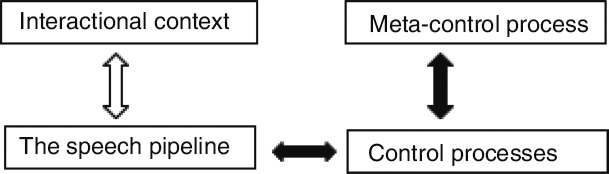
Speech comprehension and production are governed by control processes. We explore their nature and dynamics in bilingual speakers with a focus on speech production. Prior research indicates that individuals increase cognitive control in order to achieve a desired goal. In the adaptive control hypothesis we propose a stronger hypothesis: Language control processes themselves adapt to the recurrent demands placed on them by the interactional context. Adapting a control process means changing a parameter or parameters about the way it works (its neural capacity or efficiency) or the way it works in concert, or in cascade, with other control processes (e.g., its connectedness). We distinguish eight control processes (goal maintenance, conflict monitoring, interference suppression, salient cue detection, selective response inhibition, task disengagement, task engagement, opportunistic planning). We consider the demands on these processes imposed by three interactional contexts (single language, dual language, and dense code-switching). We predict adaptive changes in the neural regions and circuits associated with specific control processes. A dual-language context, for example, is predicted to lead to the adaptation of a circuit mediating a cascade of control processes that circumvents a control dilemma. Effective test of the adaptive control hypothesis requires behavioural and neuroimaging work that assesses language control in a range of tasks within the same individual.
Overview
CoChat Summary
TL;DR
The paper proposes the adaptive control hypothesis: bilingual language control processes themselves adapt to the recurrent demands of three interactional contexts—single-language, dual-language, and dense code-switching—by changing parameters such as neural capacity, efficiency, or coordination. It identifies eight control processes and predicts context-specific behavioural and neural adaptations, especially a dual-language adaptation that circumvents a control dilemma.
Key findings
- The paper distinguishes eight control processes: goal maintenance, conflict monitoring, interference suppression, salient cue detection, selective response inhibition, task disengagement, task engagement, and opportunistic planning.
- It contrasts three interactional contexts: single-language, dual-language, and dense code-switching. Table 1 indicates that single-language context increases demand on goal maintenance and interference control; dual-language context increases demand on goal maintenance, interference control, salient cue detection, selective response inhibition, task disengagement, and task engagement; dense code-switching increases demand on opportunistic planning.
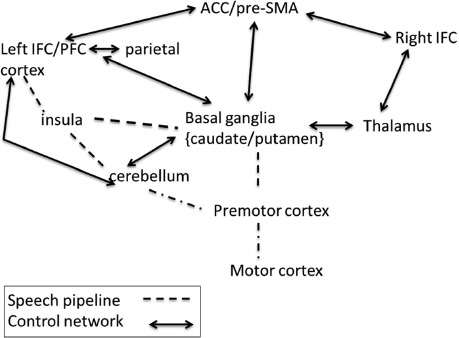
- The hypothesis predicts that dual-language speakers adapt a cascade linking salient cue detection to selective response inhibition, task disengagement, and task engagement to circumvent the control dilemma in which suppression reduces flexibility to switch. Dense code-switching is predicted to adapt a left frontal–right cerebellar circuit for morphosyntactic integration, while single-language context is associated with left inferior regions for suppressing the nontarget language.
- No original quantitative results are reported; the paper is theoretical and offers illustrative behavioural and neuroimaging predictions.
Methods
- Theoretical/review paper with no participants or new empirical data; it proposes the adaptive control hypothesis and derives testable predictions.
- It synthesizes prior work on bilingual language control, cognitive control, neuroimaging, and neuropsychology, using three interactional contexts and eight control processes as an organizing framework.
- The main analysis is conceptual: a table of context-dependent demands and illustrative predictions for behavioural tasks (e.g., cued language switching, Stroop) and neural circuits; it calls for within-individual behavioural and neuroimaging tests across a range of tasks.
Limitations
- The authors state that their illustrative predictions may prove false and that there may be no systematic behavioural or neural differences as a function of interactional context.
- The authors acknowledge circular causation: interactional context may shape adaptive response, but individual differences in predispositions and genetic make-up constrain such effects; they assume individual variation in executive control and sociality is normally distributed.
- The text makes evident that the hypothesis is programmatic and untested in this paper; contexts are idealized, speakers may experience mixtures of contexts, and factors such as proficiency, sensitivity to interaction cost, neuropharmacology, and genetic variation may moderate predicted adaptations.
Model-written summary. Check it against the paper before relying on it.
Integrity signals
Registry
Cites
Statistics
Figures
Verification
Claims the paper makes
0 Valid · 0 Not valid · 30 Not checked · 57 Own results and interpretations
In the paper
“Strikingly, the use of more than one language appears to be a further important factor shaping individual performance on such tasks (e.g., Bialystok, Craik, Green, & Gollan, 2009, for a review).”
§ Language control in bilinguals: The adaptive control hypothesis > Abstract
What the sources say
- Not checked yetcites Bialystok, Craik, Green, & Gollan, 2009 matched to “Bilingual Minds” (2009) source
hedgedstates an association- Asserted: passes — The authors put it forward as true.
- Checkable: passes — It can be checked against evidence.
- Load-bearing: passes — The paper’s conclusions depend on it.
- Based: passes — The paper gives a reason why it holds.
A conclusion the paper draws from its own results — it cites no other source for it, so there is none to check. The quote shows it is in the paper.
In the paper
“In other words, any learning effects during the experiment should be observed earlier for speakers from an interactional context that is best suited to the experimental conditions.”
§ Language control in bilinguals: The adaptive control hypothesis > THE ADAPTIVE CONTROL HYPOTHESIS > Testing the adaptive control hypothesis
plainstates an association- Asserted: passes — The authors put it forward as true.
- Checkable: passes — It can be checked against evidence.
- Load-bearing: passes — The paper’s conclusions depend on it.
- Based: passes — The paper gives a reason why it holds.
In the paper
“acknowledged a role of the pre-SMA in initiating speech in language switching (see Luk et al., 2012, for further discussion).”
§ Language control in bilinguals: The adaptive control hypothesis > THE ADAPTIVE CONTROL HYPOTHESIS > Neuroimaging predictions
What the sources say
- Not checked yetcites Luk et al., 2012 matched to “Cognitive control for language switching in bilinguals: A quantitative meta-analysis of functional neuroimaging studies” (2012) source
plainstates an association- Asserted: passes — The authors put it forward as true.
- Checkable: passes — It can be checked against evidence.
- Load-bearing: unclear — It is unclear whether the paper’s conclusions depend on it.
- Based: passes — The paper gives a reason why it holds.
In the paper
“In Figure 2 we include a direct link between frontal cortex and the right cerebellum as a further circuit involved in language control (Fabbro, Moretti, & Bava, 2000).”
§ Language control in bilinguals: The adaptive control hypothesis > THE ADAPTIVE CONTROL HYPOTHESIS > Neuroimaging predictions
What the sources say
- Not checked yetcites Fabbro, Moretti, & Bava, 2000 matched to “Language impairments in patients with cerebellar lesions” (2000) source
plainstates an association- Asserted: passes — The authors put it forward as true.
- Checkable: passes — It can be checked against evidence.
- Load-bearing: passes — The paper’s conclusions depend on it.
- Based: passes — The paper gives a reason why it holds.
In the paper
“Reperfusion of the cerebellum reduces such symptoms (Marien, Engelborghs, Fabbro, & De Deyn, 2001).”
§ Language control in bilinguals: The adaptive control hypothesis > THE ADAPTIVE CONTROL HYPOTHESIS > Neuroimaging predictions
What the sources say
- Not checked yetcites Marien, Engelborghs, Fabbro, & De Deyn, 2001 matched to “The Lateralized Linguistic Cerebellum: A Review and a New Hypothesis” (2001) source
plainstates a cause- Asserted: passes — The authors put it forward as true.
- Checkable: passes — It can be checked against evidence.
- Load-bearing: unclear — It is unclear whether the paper’s conclusions depend on it.
- Based: passes — The paper gives a reason why it holds.
43 more claims
Create a free account to see all 87 claims and to verify the 30 references still open.
- Probably not a substantial claim. 23
- It may state two separate claims as one. 25
Claims other papers make about this one
Each is checked against this paper’s own text: does it say what the citing paper says it does?
In the citing paper
“Alternating between languages requires not only activation of words in the to-be-attended language but also inhibition of words in the language that should no longer be used (‘language control’; Green & Abutalebi, 2013).”
From Language proficiency drives listening-related fatigue in those who communicate in English as their second language (2026) · cites this paper as Green & Abutalebi, 2013
In the citing paper
“Previous work highlights the cognitive demands of switching between multiple languages within a conversation (Green & Abutalebi, 2013).”
From Language proficiency drives listening-related fatigue in those who communicate in English as their second language (2026) · cites this paper as Green & Abutalebi, 2013
Citations
Cites
Miyake, A., Friedman, N. P., Emerson, M. J., Witzki, A. H., Howerter, A., & Wager, T. D. (2000) · Cognitive Psychology · doi:10.1006/cogp.1999.0734 · Cited by 15,798
Clark, H. H. (1996) · doi:10.1017/cbo9780511620539 · Cited by 5,123
Conflict monitoring and anterior cingulate cortex: an update
Botvinick, M. M., Cohen, J. D., & Carter, C. S. (2004) · Trends in Cognitive Sciences · doi:10.1016/j.tics.2004.10.003 · Cited by 3,623
Anterior Cingulate Conflict Monitoring and Adjustments in Control
Kerns, J. G., Cohen, J. D., MacDonald, A. W., Cho, R. Y., Stenger, V. A., & Carter, C. S. (2004) · Science · doi:10.1126/science.1089910 · Cited by 2,891 · cited 4×
“In addition, there is a demand on frontal structures linked to conflict monitoring and interference suppression (e.g., Kerns et al., 2004) and to parietal regions (and frontal regions) associated with task changes.”
BackgroundInfluentialMental control of the bilingual lexico-semantic system
GREEN, D. W. (1998) · Bilingualism Language and Cognition · doi:10.1017/s1366728998000133 · Cited by 2,807
Self-citationUsing language: Communicative acts
Clark, H. H. (1996) · Cited by 2,721
Using language: Index of names
Clark, H. H. (1996) · Cited by 2,720
The variable nature of cognitive control: a dual mechanisms framework
Braver, T. S. (2012) · Trends in Cognitive Sciences · doi:10.1016/j.tics.2011.12.010 · Cited by 2,482 · cited 1×
“One way to recognise the interplay of these processes is to distinguish proactive control processes that establish a task goal from reactive control processes that limit interference with it (Braver, 2012).”
BackgroundInverted-U–Shaped Dopamine Actions on Human Working Memory and Cognitive Control
Cools, R., & D'Esposito, M. (2011) · Biological Psychiatry · doi:10.1016/j.biopsych.2011.03.028 · Cited by 1,673 · cited 2×
“Neuroimaging data also implicate distinct neural regions in task switching and interference control (e.g., Cools & D’Esposito, 2011).”
BackgroundBilingual language production: The neurocognition of language representation and control
Abutalebi, J., & Green, D. (2007) · Journal of Neurolinguistics · doi:10.1016/j.jneuroling.2006.10.003 · Cited by 1,302 · cited 2×
“In previous papers (e.g., Abutalebi & Green, 2007, 2008), we reviewed work showing that both cortical and subcortical structures are involved in language control and language switching (see Luk, Green, Abutalebi, & Grady, 2012, for a recent metaanalysis).”
BackgroundSelf-citation
Cited by
Items 2,101–2,166 of 2,166
ADVANTAGES OF BEING BILINGUAL IN TERMS OF COGNITIVE DEVELOPMENT
Shaymonkulovna, K. S. (2023) · Theoretical & Applied Science · doi:10.15863/tas.2023.07.123.27
de Souza, L. P. (2025) · Lume (Universidade Federal do Rio Grande do Sul)
Pavani Pavani, A., S, E. E. L., Vasuja Devi, M., & Satyanarayana Rao, T. S. (2024) · Current Trends in Biotechnology and Pharmacy · doi:10.5530/ctbp.2024.3.35
Mizuguchi, S., & Tateishi, K. (2020) · Proceedings of the Linguistic Society of America · doi:10.3765/plsa.v5i1.4668
The Bilingual's Languages in Interaction
Grosjean, F. (2022) · Wiley eBooks · doi:10.1002/9781394260386.ch7
Awada, L., & Köpke, B. (2024) · HAL · doi:10.13140/rg.2.2.26424.51200
MULTILINGUALISM AS THE KEY TO COMPETENCY DEVELOPMENT IN STUDENTS OF NON-LINGUISTIC SPECIALTIES
Luchentsova, I. S., & Bohdan, A. V. (2024) · Innovate Pedagogy · doi:10.32782/2663-6085/2024/77.28
Mültecilere Yönelik Türkçe Eğitiminde Güncel Çalışma Eğilimleri
ATİLA, B. A. (2024) · Bidge Yayınları eBooks · doi:10.70269/10.70269/6371673938
Spinelli, G., & Sulpizio, S. (2025) · PsyArXiv (OSF Preprints) · doi:10.31234/osf.io/tzjw8_v2
Language Context Flexibly Modulates Language Control MechanismsPreprint
Timmer, K., Wolna, A., Szewczyk, J., & Wodniecka, Z. (2025) · SSRN Electronic Journal · doi:10.2139/ssrn.5155536
Reverse cueing effects in L2 production: Another dissociation from conflict tasks
Spinelli, G., & Sulpizio, S. (2026) · Bilingualism Language and Cognition · doi:10.1017/s1366728926101278
Thomas, E., Som, B., & Shrivastava, A. (2025) · SSRN Electronic Journal · doi:10.2139/ssrn.5245274
Research Techniques and the Bilingual Brain
Guerrero, S. L. (2025) · Wiley eBooks · doi:10.1002/9781405198431.wbeal1010.pub2
Grosjean, François. (2024). On bilinguals and bilingualism
Zhong, Z. (2025) · Bilingual Research Journal · doi:10.1080/15235882.2025.2508375
Grosso, V., Gutiérrez, G. A., & Arantzeta, M. (2025) · IkerGazte Nazioarteko ikerketa euskaraz · doi:10.26876/ikergazte.vi.01.20
Kumar, S. N., Kapiley, K., & Mishra, R. K. (2025) · International Journal of Bilingualism · doi:10.1177/13670069251345700
The influence of the global linguistic context on the lexical choice of Kazakh-Russian bilinguals
Kolmykova, I. S. (2025) · Litera · doi:10.25136/2409-8698.2025.11.76478
Cognitive Processing and Conceptualization in Tamil: A Psycholinguistic Review
Prasanna Prabhu, D. (2025) · Tamilmanam International Research Journal of Tamil Studies · doi:10.63300/tm0402112517
Pirzadeh, M., Golshaie, R., & Momenian, M. (2024) · PolyU Institutional Research Archive (Hong Kong Polytechnic University) · doi:10.22108/jrl.2023.139015.1796
Kořenář, M. (2022) · CentAUR (University of Reading) · doi:10.48683/1926.00116927
Reading and language comprehension in bilingual children and adolescents
Oh, J. H. J. (2024) · eScholarship@McGill (McGill) · doi:10.82308/41498
Socio-cognitive advantages in early second language learners and young bilinguals
Agostini, V. (2021) · University of Birmingham Institutional Research Archive (University of Birmingham)
Strangmann, I. M. (2022) · CUNY Academic Works (City University of New York)
The construction of new ‘student’ identity: Focusing on Chinese pre-sessional English learners
Huang, N. (2022) · White Rose eTheses Online (University of Leeds, The University of Sheffield, University of York)
The Effects of multilingualism and Music Experience on Tone and Vowel Discrimination Ability
Dezfuly, N. A. (2021) · Scholarship@Western (Western University)
Ramos Knudsen, S. (2019) · University Library of Skövde (University of Skövde)
ЛОНГИТЮДНЫЕ ИССЛЕДОВАНИЯ ОБЪЕМА РАБОЧЕЙ ПАМЯТИ У СТУДЕНТОВ-СИНХРОНИСТОВ
Владимировна, Р. Н. (n.d.) · CyberLeninK (CyberLeninka)
Taylor, C. L. (2020) · NVA (Nasjonalt vitenarkiv)
¿El cambio de lengua voluntario facilita la producción léxica de los bilingües?
Ugarte Mota, M. (2019) · Communities in ADDI (Universidad del Pais Vasco)
The Shape of the Bilingual Mental Lexicon: Testing the Cognate Continuum
Fahey, D. (2021) · Scholar Commons (University of South Carolina)
Olson, D. J. (2025) · Issues in Hispanic and Lusophone linguistics · doi:10.1075/ihll.45.02ols
The, N. H., Du, T. T., Phuong, H. T. B., Huong, N. T. K., Triet, A. M., Thuy, N. T. L., Tu, P. N. T., & Xuan, N. T. (2026) · Journal of Language Teaching and Research · doi:10.17507/jltr.1701.09
Educazione al plurilinguismo con lingue di minoranza. Ricerche ed esperienze a confronto
Cordin, P. (2025) · Institutional Research Information System (Università degli Studi di Trento)
Re-imagining assessment – creating spaces for sustainable multilingual and multi-competence testing
Hofer, B. (2026) · Innovation in Language Learning and Teaching · doi:10.1080/17501229.2026.2620621
He, G. (2026) · Lecture Notes in Education Psychology and Public Media · doi:10.54254/2753-7048/2026.ht31771
Communicative Adaptations After Laryngectomy: Syntactic Complexity and Gesture Use
Neijman, M., van Rooy, B., Pfau, R., Son, R. J. J. H. V., & van den Brekel, M. W. M. (2026) · International Journal of Language & Communication Disorders · doi:10.1111/1460-6984.70206
Kapiley, K., & Mishra, R. K. (2026) · Bilingualism Language and Cognition · doi:10.1017/s1366728926101102
Switching Codes, Shaping Selves: Investigating Bangladeshi Undergraduates’ Linguistic Practices
Shela, T. I., & Hassan, K. M. (2025) · International Journal of Multilingualism and Languages for Specific purposes · doi:10.52919/ijmlsp.v7i02.126
Emotional expression and linguistic identity in a multilingual Morocco
Yassine, N. (2025) · Macrosociolinguistics and Minority Languages · doi:10.22363/2949-5997-2025-3-1-71-80
Language Attrition and Multilingualism
González, P. V., & Schmid, M. S. (2026) · Wiley eBooks · doi:10.1002/9781405198431.wbeal0060.pub2
独自スピーキングタスクを用いたネイティブ中国語話者の前頭前野における活性化の比較 : 日本語能力の影響
Cong, L., & Li, C. (2021) · Hiroshima University Institutional Repository
Phonological Perception Awareness: A Study with Bilinguals
Alotaibi, A. N. (2026) · World Journal of English Language · doi:10.5430/wjel.v16n5p51
Automatically Detecting Code-Switching Between Nigerian Pidgin English and EnglishPreprint
Ogbonda, G., & Teahan, W. J. (2026) · Research Square · doi:10.21203/rs.3.rs-9706554/v1
Rosales, K. P. C., Londo, L. G. L., Vargas, D. J. A., Mazabanda, T. B. I., & Urgilez, Á. P. S. (2026) · Sage Sphere of Technology Sciences Discoveries And Society · doi:10.63688/jdpgqx56
CODE SWITCHING AND IDENTITY NEGOTIATION IN MULTILINGUAL SOCIETIES: A SOCIOLINGUISTIC PERSPECTIVE
Kizi, T. I. I. L. (2026) · Liberal Journal of Language & Literature Review · doi:10.5281/zenodo.20503308
Жукова, А., Євтушевська, О., & Сибірцева, Л. (2026) · Вісник науки та освіти · doi:10.52058/2786-6165-2026-5(47)-3303-3313
The cognition of dialect variation: evaluating the relationship to bilingualism
Maher, Z. K., & van Hell, J. G. (2026) · Frontiers in Language Sciences · doi:10.3389/flang.2026.1784593
Language Acquisition in Early Childhood: Cognitive and Social Influences on Multilingual Development
Sandhu, M. N. (2026) · The Sankalpa: International Journal of Management Decisions
Language Acquisition in Early Childhood: Cognitive and Social Influences on Multilingual Development
Voss, A. R. (2026) · Phyton
Hafidhoh, H. (2025) · Journal of Psycho Linguistics
Language Control over Structural Representation in Bilinguals
Barragán-Diaz, A. (2026) · scholarworks - UTEP (The University of Texas at El Paso)
Kielellisen harjaantuneisuuden vaikutus toiminnanohjauksen merkitykseen kielenvaihtotilanteissa
Laine, F., & Uutela-Lynd, S. (2026) · UTUPub (University of Turku)
Bibi, M., Munir, W., & Ali, I. (2025) · Research consortium archive.
Kielikontekstin vaikutus kielen vaihtokustannukseen sanantuottotehtävissä
Siikala, J., & Tamminen, R. (2026) · UTUPub (University of Turku)
Shereen, A. (2026) · Journal for Current Sign
A psycholinguistic investigation of code-switching among bilingual Igbo–English speakers
Anidobe, C. J. (2025) · Ákụ́óyìbó Nsugbe Journal of the School of Languages
Hasanah, N., Haryadi, A. M., & Lestari, A. A. (2026) · ALINEA Jurnal Bahasa Sastra dan Pengajarannya · doi:10.58218/alinea.v6i3.4370
Hopp, H., van Dijk, C. N., & Şafak, D. F. (2026) · Language · doi:10.1017/s0097850726000172
Agulló-Baldó, M. T., & Halbach, A. (2026) · Education Sciences · doi:10.3390/educsci16111798
Light-Verb Innovation and Bilingual Predicate Creativity in Pashto-English: A Morpheme-Level AuditPreprint
KHAN, A. A., & Khalid, A. (2026) · Research Square · doi:10.21203/rs.3.rs-10812879/v1
Lam, K., & Hu, Z. (2026) · Lecture Notes in Education Psychology and Public Media · doi:10.54254/2753-7048/2027.38675
AoA shapes neural mechanisms of selective attention in bilinguals through delta-band trackingPreprint
Alex, P., Theron-Grimaldi, S., Klimovich‐Gray, A., & Božić, M. (2026) · doi:10.33774/coe-2026-fssj7
Trilingual Language Control: Conceptual Boundaries, Mechanisms, and Evidence
Wang, Y., & Li, T. (2026) · Brain Sciences · doi:10.3390/brainsci16111261
Phonological interference and leadership framing in Odumeje's testimony discourse
Abe, E. E., Adewumi, A. T., & Osimen, G. U. (2026) · Cogent Arts and Humanities · doi:10.1080/23311983.2026.2734665
Liu, Y., & Biase, B. D. (2026) · International Journal of Bilingualism · doi:10.1177/13670069261505733
Metadata
- Authors
- Green, D. W., & Abutalebi, J.
- Affiliations
- University College London (GB)
- Vita-Salute San Raffaele University (IT)
- Corresponding author
- Green, David W.
- Venue
- Journal of Cognitive Psychology
- Publisher
- Informa UK Limited
- Published
- 2013-05-24
- Volume
- 25
- Issue
- 5
- Pages
- 515-530
- ISSN
- 2044-5911 (ISSN-L)
- 2044-592X
- PMC
- PMC4095950
- OpenAlex
- W2128442137
- Cited by
- 2,163
- References
- 62
- Citations by year
- 2026: 264 · 2025: 271 · 2024: 222 · 2023: 211 · 2022: 197 · 2021: 160 · 2020: 154 · 2019: 254 · 2018: 164 · 2017: 90 · 2016: 82 · 2015: 61 · 2014: 27 · 2013: 3
- FWCI
- 21.17
- Type
- journal article
- Language
- en
- Open access
- hybrid
- doi.org
- Licence
- cc-by
- Locations
- Journal of Cognitive Psychology (publishedVersion, cc-by)
- PubMed Central (publishedVersion, cc-by)
- Europe PMC (PubMed Central) (publishedVersion, cc-by)
- PubMed (publishedVersion)
- UCL Discovery (University College London) (submittedVersion)
- Archivio Istituzionale della Ricerca - Università Vita-Salute San Raffaele (submittedVersion)
- Topics
- Life Sciences › Neuroscience › Cognitive Neuroscience › Neurobiology of Language and Bilingualism
- Social Sciences › Psychology › Developmental and Educational Psychology › Language Development and Disorders
- Life Sciences › Neuroscience › Cognitive Neuroscience › Neural and Behavioral Psychology Studies
- Keywords
- language control, bilingualism, cognitive control, speech production, code-switching, control processes, interference suppression, conflict monitoring, task disengagement, task engagement, goal maintenance, opportunistic planning, neural circuits
About these checks
Registry, retraction, Cites and statistics results are computed, not judged, with one exception: a printed reference that no index lists is read once by a model before it counts as a citation error. Claims are extracted by a model and kept only when their quote appears verbatim in the text; each cited source is then checked, with a model’s help, for whether it says what the claim relies on. Those verdicts can be wrong — read the claim’s quote and the cited source before relying on one.
A language model drew the claims from the paper on 2026-11-24, under version 3 of the claim definition (model deepseek-v4.1-flash, prompt extract-v3).
A second model labelled each claim on 2026-11-24 (model jev-1.13-20260917, definition revision gold-guideline-v0.2).
Statistics and arithmetic are recomputed, not judged.
Confidence bands are shown only for fields calibrated on our annotated test set. None is calibrated yet, so no band is shown.
What counts as a claim ›How we measure confidence ›How we check this ›
Are you an author, or do you see a problem with this page? Request a review
Data sources
Bibliographic data: Semantic Scholar, OpenAlex, Crossref.
Contains information from the Semantic Scholar Academic Graph Datasets, made available under the ODC Attribution License (ODC-BY 1.0).
Semantic Scholar’s data is described in: Kinney, R., et al. (2023). The Semantic Scholar Open Data Platform. arXiv:2301.10140.
