

Language control in bilinguals: The adaptive control hypothesis
Open accessThe DOI matches its Crossref record; 62 of the 62 references it cites were found in a registry or an index; none of the 36 sources its claims cite is checked for support yet.
Abstract
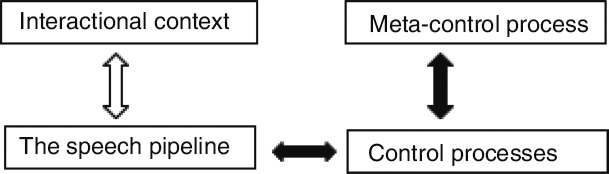
Speech comprehension and production are governed by control processes. We explore their nature and dynamics in bilingual speakers with a focus on speech production. Prior research indicates that individuals increase cognitive control in order to achieve a desired goal. In the adaptive control hypothesis we propose a stronger hypothesis: Language control processes themselves adapt to the recurrent demands placed on them by the interactional context. Adapting a control process means changing a parameter or parameters about the way it works (its neural capacity or efficiency) or the way it works in concert, or in cascade, with other control processes (e.g., its connectedness). We distinguish eight control processes (goal maintenance, conflict monitoring, interference suppression, salient cue detection, selective response inhibition, task disengagement, task engagement, opportunistic planning). We consider the demands on these processes imposed by three interactional contexts (single language, dual language, and dense code-switching). We predict adaptive changes in the neural regions and circuits associated with specific control processes. A dual-language context, for example, is predicted to lead to the adaptation of a circuit mediating a cascade of control processes that circumvents a control dilemma. Effective test of the adaptive control hypothesis requires behavioural and neuroimaging work that assesses language control in a range of tasks within the same individual.
Overview
CoChat Summary
TL;DR
The paper proposes the adaptive control hypothesis: bilingual language control processes themselves adapt to the recurrent demands of three interactional contexts—single-language, dual-language, and dense code-switching—by changing parameters such as neural capacity, efficiency, or coordination. It identifies eight control processes and predicts context-specific behavioural and neural adaptations, especially a dual-language adaptation that circumvents a control dilemma.
Key findings
- The paper distinguishes eight control processes: goal maintenance, conflict monitoring, interference suppression, salient cue detection, selective response inhibition, task disengagement, task engagement, and opportunistic planning.
- It contrasts three interactional contexts: single-language, dual-language, and dense code-switching. Table 1 indicates that single-language context increases demand on goal maintenance and interference control; dual-language context increases demand on goal maintenance, interference control, salient cue detection, selective response inhibition, task disengagement, and task engagement; dense code-switching increases demand on opportunistic planning.
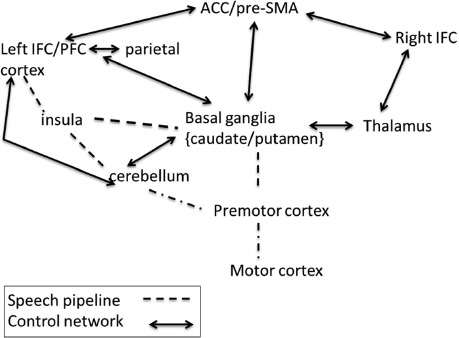
- The hypothesis predicts that dual-language speakers adapt a cascade linking salient cue detection to selective response inhibition, task disengagement, and task engagement to circumvent the control dilemma in which suppression reduces flexibility to switch. Dense code-switching is predicted to adapt a left frontal–right cerebellar circuit for morphosyntactic integration, while single-language context is associated with left inferior regions for suppressing the nontarget language.
- No original quantitative results are reported; the paper is theoretical and offers illustrative behavioural and neuroimaging predictions.
Methods
- Theoretical/review paper with no participants or new empirical data; it proposes the adaptive control hypothesis and derives testable predictions.
- It synthesizes prior work on bilingual language control, cognitive control, neuroimaging, and neuropsychology, using three interactional contexts and eight control processes as an organizing framework.
- The main analysis is conceptual: a table of context-dependent demands and illustrative predictions for behavioural tasks (e.g., cued language switching, Stroop) and neural circuits; it calls for within-individual behavioural and neuroimaging tests across a range of tasks.
Limitations
- The authors state that their illustrative predictions may prove false and that there may be no systematic behavioural or neural differences as a function of interactional context.
- The authors acknowledge circular causation: interactional context may shape adaptive response, but individual differences in predispositions and genetic make-up constrain such effects; they assume individual variation in executive control and sociality is normally distributed.
- The text makes evident that the hypothesis is programmatic and untested in this paper; contexts are idealized, speakers may experience mixtures of contexts, and factors such as proficiency, sensitivity to interaction cost, neuropharmacology, and genetic variation may moderate predicted adaptations.
Model-written summary. Check it against the paper before relying on it.
Integrity signals
Registry
Cites
Statistics
Figures
Verification
Claims the paper makes
0 Valid · 0 Not valid · 30 Not checked · 57 Own results and interpretations
In the paper
“Strikingly, the use of more than one language appears to be a further important factor shaping individual performance on such tasks (e.g., Bialystok, Craik, Green, & Gollan, 2009, for a review).”
§ Language control in bilinguals: The adaptive control hypothesis > Abstract
What the sources say
- Not checked yetcites Bialystok, Craik, Green, & Gollan, 2009 matched to “Bilingual Minds” (2009) source
hedgedstates an association- Asserted: passes — The authors put it forward as true.
- Checkable: passes — It can be checked against evidence.
- Load-bearing: passes — The paper’s conclusions depend on it.
- Based: passes — The paper gives a reason why it holds.
A conclusion the paper draws from its own results — it cites no other source for it, so there is none to check. The quote shows it is in the paper.
In the paper
“In other words, any learning effects during the experiment should be observed earlier for speakers from an interactional context that is best suited to the experimental conditions.”
§ Language control in bilinguals: The adaptive control hypothesis > THE ADAPTIVE CONTROL HYPOTHESIS > Testing the adaptive control hypothesis
plainstates an association- Asserted: passes — The authors put it forward as true.
- Checkable: passes — It can be checked against evidence.
- Load-bearing: passes — The paper’s conclusions depend on it.
- Based: passes — The paper gives a reason why it holds.
In the paper
“acknowledged a role of the pre-SMA in initiating speech in language switching (see Luk et al., 2012, for further discussion).”
§ Language control in bilinguals: The adaptive control hypothesis > THE ADAPTIVE CONTROL HYPOTHESIS > Neuroimaging predictions
What the sources say
- Not checked yetcites Luk et al., 2012 matched to “Cognitive control for language switching in bilinguals: A quantitative meta-analysis of functional neuroimaging studies” (2012) source
plainstates an association- Asserted: passes — The authors put it forward as true.
- Checkable: passes — It can be checked against evidence.
- Load-bearing: unclear — It is unclear whether the paper’s conclusions depend on it.
- Based: passes — The paper gives a reason why it holds.
In the paper
“In Figure 2 we include a direct link between frontal cortex and the right cerebellum as a further circuit involved in language control (Fabbro, Moretti, & Bava, 2000).”
§ Language control in bilinguals: The adaptive control hypothesis > THE ADAPTIVE CONTROL HYPOTHESIS > Neuroimaging predictions
What the sources say
- Not checked yetcites Fabbro, Moretti, & Bava, 2000 matched to “Language impairments in patients with cerebellar lesions” (2000) source
plainstates an association- Asserted: passes — The authors put it forward as true.
- Checkable: passes — It can be checked against evidence.
- Load-bearing: passes — The paper’s conclusions depend on it.
- Based: passes — The paper gives a reason why it holds.
In the paper
“Reperfusion of the cerebellum reduces such symptoms (Marien, Engelborghs, Fabbro, & De Deyn, 2001).”
§ Language control in bilinguals: The adaptive control hypothesis > THE ADAPTIVE CONTROL HYPOTHESIS > Neuroimaging predictions
What the sources say
- Not checked yetcites Marien, Engelborghs, Fabbro, & De Deyn, 2001 matched to “The Lateralized Linguistic Cerebellum: A Review and a New Hypothesis” (2001) source
plainstates a cause- Asserted: passes — The authors put it forward as true.
- Checkable: passes — It can be checked against evidence.
- Load-bearing: unclear — It is unclear whether the paper’s conclusions depend on it.
- Based: passes — The paper gives a reason why it holds.
43 more claims
Create a free account to see all 87 claims and to verify the 30 references still open.
- Probably not a substantial claim. 23
- It may state two separate claims as one. 25
Claims other papers make about this one
Each is checked against this paper’s own text: does it say what the citing paper says it does?
In the citing paper
“Alternating between languages requires not only activation of words in the to-be-attended language but also inhibition of words in the language that should no longer be used (‘language control’; Green & Abutalebi, 2013).”
From Language proficiency drives listening-related fatigue in those who communicate in English as their second language (2026) · cites this paper as Green & Abutalebi, 2013
In the citing paper
“Previous work highlights the cognitive demands of switching between multiple languages within a conversation (Green & Abutalebi, 2013).”
From Language proficiency drives listening-related fatigue in those who communicate in English as their second language (2026) · cites this paper as Green & Abutalebi, 2013
Citations
Cites
Miyake, A., Friedman, N. P., Emerson, M. J., Witzki, A. H., Howerter, A., & Wager, T. D. (2000) · Cognitive Psychology · doi:10.1006/cogp.1999.0734 · Cited by 15,798
Clark, H. H. (1996) · doi:10.1017/cbo9780511620539 · Cited by 5,123
Conflict monitoring and anterior cingulate cortex: an update
Botvinick, M. M., Cohen, J. D., & Carter, C. S. (2004) · Trends in Cognitive Sciences · doi:10.1016/j.tics.2004.10.003 · Cited by 3,623
Anterior Cingulate Conflict Monitoring and Adjustments in Control
Kerns, J. G., Cohen, J. D., MacDonald, A. W., Cho, R. Y., Stenger, V. A., & Carter, C. S. (2004) · Science · doi:10.1126/science.1089910 · Cited by 2,891 · cited 4×
“In addition, there is a demand on frontal structures linked to conflict monitoring and interference suppression (e.g., Kerns et al., 2004) and to parietal regions (and frontal regions) associated with task changes.”
BackgroundInfluentialMental control of the bilingual lexico-semantic system
GREEN, D. W. (1998) · Bilingualism Language and Cognition · doi:10.1017/s1366728998000133 · Cited by 2,807
Self-citationUsing language: Communicative acts
Clark, H. H. (1996) · Cited by 2,721
Using language: Index of names
Clark, H. H. (1996) · Cited by 2,720
The variable nature of cognitive control: a dual mechanisms framework
Braver, T. S. (2012) · Trends in Cognitive Sciences · doi:10.1016/j.tics.2011.12.010 · Cited by 2,482 · cited 1×
“One way to recognise the interplay of these processes is to distinguish proactive control processes that establish a task goal from reactive control processes that limit interference with it (Braver, 2012).”
BackgroundInverted-U–Shaped Dopamine Actions on Human Working Memory and Cognitive Control
Cools, R., & D'Esposito, M. (2011) · Biological Psychiatry · doi:10.1016/j.biopsych.2011.03.028 · Cited by 1,673 · cited 2×
“Neuroimaging data also implicate distinct neural regions in task switching and interference control (e.g., Cools & D’Esposito, 2011).”
BackgroundBilingual language production: The neurocognition of language representation and control
Abutalebi, J., & Green, D. (2007) · Journal of Neurolinguistics · doi:10.1016/j.jneuroling.2006.10.003 · Cited by 1,302 · cited 2×
“In previous papers (e.g., Abutalebi & Green, 2007, 2008), we reviewed work showing that both cortical and subcortical structures are involved in language control and language switching (see Luk, Green, Abutalebi, & Grady, 2012, for a recent metaanalysis).”
BackgroundSelf-citation
Cited by
Items 601–700 of 2,166
The importance of language use when studying the neuroanatomical basis of bilingualism
de Bruin, A., & Sala, S. D. (2015) · Language Cognition and Neuroscience · doi:10.1080/23273798.2015.1082608 · Cited by 18
Chung-Fat-Yim, A., Poarch, G. J., Comishen, K. J., & Bialystok, E. (2021) · Brain and Language · doi:10.1016/j.bandl.2021.105011 · Cited by 18
Switching between newly learned languages impacts executive control
Jiao, L., Liu, C., Schwieter, J. W., & Chen, B. (2021) · Psychophysiology · doi:10.1111/psyp.13888 · Cited by 18
Goriot, C., Unsworth, S., van Hout, R. W. N. M., Broersma, M., & McQueen, J. M. (2019) · Linguistic Approaches to Bilingualism · doi:10.1075/lab.18082.gor · Cited by 18
Testing Indicators of Translation Expertise in an Intralingual Task
Whyatt, B. (2018) · HERMES - Journal of Language and Communication in Business · doi:10.7146/hjlcb.v0i57.106194 · Cited by 18
Perovic, A., Đurđević, D. F., & Halupka-Rešetar, S. (2022) · Memory & Cognition · doi:10.3758/s13421-022-01345-8 · Cited by 17
Morphology and The Mental Lexicon: Three questions about decomposition
Embick, D., Creemers, A., & Davies, A. J. G. (2022) · Oxford University Press eBooks · doi:10.1093/oxfordhb/9780198845003.013.17 · Cited by 17
Pulido, M. F. (2020) · Neuropsychologia · doi:10.1016/j.neuropsychologia.2020.107732 · Cited by 17
Weber, K., Luther, L., Indefrey, P., & Hagoort, P. (2016) · Brain Connectivity · doi:10.1089/brain.2015.0383 · Cited by 17
L2 proficiency predicts inhibitory ability in L1-dominant speakers
Hui, N. Y., Yuan, M., Fong, M. C., & Wang, W. Y. (2020) · International Journal of Bilingualism · doi:10.1177/1367006920914399 · Cited by 17
Schug, A. K., Brignoni‐Pérez, E., Jamal, N. I., & Eden, G. F. (2022) · Human Brain Mapping · doi:10.1002/hbm.26008 · Cited by 17
Köpke, B., Howells, R. K. R., Cortelazzo, F., Péran, P., Boissezon, X. D., & Lubrano, V. (2021) · Journal of Neurolinguistics · doi:10.1016/j.jneuroling.2021.100988 · Cited by 17
The impact of individual differences on cross-language activation of meaning by phonology
Friesen, D. C., Whitford, V., Titone, D. A., & Jared, D. (2019) · Bilingualism Language and Cognition · doi:10.1017/s1366728919000142 · Cited by 17
The effect of second-language vocabulary on word retrieval in the native language
Higby, E., Donnelly, S., Yoon, J., & Obler, L. K. (2019) · Bilingualism Language and Cognition · doi:10.1017/s136672891900049x · Cited by 17
Documenting heritage language experience using questionnaires
Tomić, A., Rodina, Y., Bayram, F., & CAT, C. D. (2023) · Frontiers in Psychology · doi:10.3389/fpsyg.2023.1131374 · Cited by 17
Second language learning tunes the language control network: a longitudinal fMRI study
Liu, C., de Bruin, A., Jiao, L., Li, Z., & Wang, R. (2020) · Language Cognition and Neuroscience · doi:10.1080/23273798.2020.1856898 · Cited by 17
The sensitivity to context modulates executive control: Evidence from Malayalam–English bilinguals
Rafeekh, R., & Mishra, R. K. (2020) · Bilingualism Language and Cognition · doi:10.1017/s1366728920000528 · Cited by 17
Regulation and Control: What Bimodal Bilingualism Reveals about Learning and Juggling Two Languages
Frederiksen, A. T., & Kroll, J. F. (2022) · Languages · doi:10.3390/languages7030214 · Cited by 17
The influence of bilingual language experience on executive control: An ERPs study
Jiao, L., Zhang, Y., Plummer, P., Liu, C., & Chen, B. (2018) · Journal of Neurolinguistics · doi:10.1016/j.jneuroling.2018.12.002 · Cited by 17
Bobb, S. C., Nauck, L. Y. D., Altvater‐Mackensen, N., Holzen, K. V., & Mani, N. (2016) · Bilingual processing and acquisition · doi:10.1075/bpa.2.03bob · Cited by 17
Individual and Sociolinguistic Differences in Language Background Predict Stroop Performance
Freeman, M. R., Anthony, J. J. D. R., Marian, V., & Blumenfeld, H. K. (2022) · Frontiers in Communication · doi:10.3389/fcomm.2022.865965 · Cited by 17
Do bilinguals generalize estar more than monolinguals and what is the role of conceptual transfer?
Adamou, E., Pascale, S. D., Márkina, Y. G., & Padure, C. (2018) · International Journal of Bilingualism · doi:10.1177/1367006918812175 · Cited by 17
Code-Switching in Translation: Linguistic Analysis of Multilingual Texts and their Translations
Alzain, M. (2024) · International Journal of Linguistics Literature & Translation · doi:10.32996/ijllt.2024.7.10.12 · Cited by 17
Privitera, A. J., & Weekes, B. (2022) · International Journal of Bilingualism · doi:10.1177/13670069221121498 · Cited by 16
Heidlmayr, K. D.-M., Doré-Mazars, K., Aparicio, X., & Isel, F. (2016) · PLoS ONE · doi:10.1371/journal.pone.0165029 · Cited by 16
Oh, J. H. J., Bertone, A., & Luk, G. (2022) · International Journal of Bilingual Education and Bilingualism · doi:10.1080/13670050.2022.2093098 · Cited by 16
Mofrad, F. T., & Schiller, N. O. (2019) · Cognitive Neuroscience · doi:10.1080/17588928.2019.1696764 · Cited by 16
Lifelong bilingualism, cognitive reserve and Alzheimer’s disease: A review of findings
Gold, B. T. (2016) · Linguistic Approaches to Bilingualism · doi:10.1075/lab.14028.gol · Cited by 16
How permeable are native and non-native syntactic processing to crosslinguistic influence?
Grüter, T., & Hopp, H. (2021) · Journal of Memory and Language · doi:10.1016/j.jml.2021.104281 · Cited by 16
Foreign Language Learning from Early Childhood to Young Adulthood
Muñoz, C., & Spada, N. M. (2018) · Cambridge University Press eBooks · doi:10.1017/9781316831922.013 · Cited by 16
Changes in Native Sentence Processing Related to Bilingualism: A Systematic Review and Meta-Analysis
Román, P., & Gómez‐Gómez, I. (2022) · Frontiers in Psychology · doi:10.3389/fpsyg.2022.757023 · Cited by 16
The Measurement of Bilingual Abilities
Treffers‐Daller, J. (2018) · Cambridge University Press eBooks · doi:10.1017/9781316831922.016 · Cited by 16
Yeter, Ö., Evcen, E., Rabagliati, H., & Özge, D. (2023) · Cognitive Development · doi:10.1016/j.cogdev.2023.101412 · Cited by 16
Language and agingPreprint
Peelle, J. E. (2019) · PsyArXiv (OSF Preprints) · doi:10.31234/osf.io/xp29u · Cited by 16
Subcortical and cerebellar volume differences in bilingual and monolingual children: An ABCD study
Nguyen, M. V. H., Xu, Y., Vaughn, K. A., & Hernández, A. E. (2023) · Developmental Cognitive Neuroscience · doi:10.1016/j.dcn.2023.101334 · Cited by 16
Attentional orienting abilities in bilinguals: Evidence from a large infant sample
Arredondo, M. M., Aslin, R. Ν., Zhang, M., & Werker, J. F. (2022) · Infant Behavior and Development · doi:10.1016/j.infbeh.2021.101683 · Cited by 16
Examining the relation between bilingualism and age of symptom onset in frontotemporal dementia
de Leon, J., Grasso, S. M., Allen, I. E., Escueta, D. P., Vega, Y., Eshghavi, M., Watson, C., Dronkers, N. F., Gorno‐Tempini, M. L., & Henry, M. L. (2023) · Bilingualism Language and Cognition · doi:10.1017/s1366728923000226 · Cited by 16
Bilingualism, cognitive reserve and Alzheimer’s disease: A review of findings
Gold, B. T. (2017) · Studies in bilingualism · doi:10.1075/sibil.53.09gol · Cited by 16
Processing Code-Switching in Algerian Bilinguals: Effects of Language Use and Semantic Expectancy
Kheder, S., & Kaan, E. (2016) · Frontiers in Psychology · doi:10.3389/fpsyg.2016.00248 · Cited by 16
Brito, N. H., Greaves, A., Leon-Santos, A., Fifer, W. P., & Noble, K. G. (2020) · Bilingualism Language and Cognition · doi:10.1017/s1366728920000334 · Cited by 16
Early childhood bilingualism: effects on brain structure and function
Goksan, S., Argyri, F., Clayden, J. D., Liegeois, F. J., & Wei, L. (2020) · F1000Research · doi:10.12688/f1000research.23216.1 · Cited by 16
Claussenius‐Kalman, H. L., Vaughn, K. A., Archila‐Suerte, P., & Hernández, A. E. (2020) · Annals of the New York Academy of Sciences · doi:10.1111/nyas.14491 · Cited by 16
On the specificity of bilingual language control: A study with Parkinson's disease patients
Cattaneo, G., Costa, A., Gironell, A., & Calabria, M. (2019) · Bilingualism Language and Cognition · doi:10.1017/s136672891900004x · Cited by 16
Abou-Ghazaleh, A., Khateb, A., & Nevat, M. (2019) · Brain Topography · doi:10.1007/s10548-019-00735-7 · Cited by 16
Effect of Cognitive Style on Language Control During Joint Language Switching: An ERP Study
Zhang, M., Wang, X., Wang, F., & Liu, H. (2019) · Journal of Psycholinguistic Research · doi:10.1007/s10936-019-09682-7 · Cited by 16
Bhatia, D., Prasad, S. G., Sake, K., & Mishra, R. K. (2017) · PLoS ONE · doi:10.1371/journal.pone.0169284 · Cited by 16
Koutamanis, E., Kootstra, G. J., Dijkstra, T., & Unsworth, S. (2024) · Applied Psycholinguistics · doi:10.1017/s0142716424000158 · Cited by 16
Fadlon, J., Li, C., Prior, A., & Gollan, T. H. (2019) · Cognition · doi:10.1016/j.cognition.2019.06.002 · Cited by 16
Meykadeh, S., Golfam, A., Batouli, S. A. H., & Sommer, W. (2021) · Frontiers in Human Neuroscience · doi:10.3389/fnhum.2021.728549 · Cited by 16
Effect of bilingualism on anticipatory oculomotor control
Singh, J. P., & Mishra, R. K. (2016) · International Journal of Bilingualism · doi:10.1177/1367006915572398 · Cited by 16
Li, C., Midgley, K. J., Ferreira, V. S., Holcomb, P. J., & Gollan, T. H. (2023) · Brain and Language · doi:10.1016/j.bandl.2023.105367 · Cited by 16
Trilingual parallel processing: Do the dominant languages grab all the attention?
Pathak, L. S., Vulchanova, M., Pathak, P., & Mishra, R. K. (2024) · Bilingualism Language and Cognition · doi:10.1017/s1366728924000257 · Cited by 16
Carlson, M. T. (2018) · Language and Speech · doi:10.1177/0023830918767208 · Cited by 16
Togato, G., Paredes, N., Macizo, P., & Bajo, M. T. (2015) · Applied Linguistics · doi:10.1093/applin/amv054 · Cited by 16
Boundaries and Bridges: Language Contact in Multilingual Ecologies
Yakpo, K., & Muysken, P. C. (2017) · De Gruyter eBooks · doi:10.1515/9781614514886 · Cited by 16
On The Dynamics of Lexical Access In Two or More Languages
Kroll, J. F., Bice, K., Botezatu, M. R., & Zirnstein, M. (2022) · Oxford University Press eBooks · doi:10.1093/oxfordhb/9780198845003.013.26 · Cited by 15
Wen, Z., Teng, M. F., Han, L., & Zeng, Y. (2022) · Brain Sciences · doi:10.3390/brainsci12060729 · Cited by 15
An Investigation of the Multilingual and Bi-dialectal Advantage in Executive Control.
Antoniou, K., & Spanoudis, G. C. (2020) · Ktisis at Cyprus University of Technology (Cyprus University of Technology) · Cited by 15
Jiang, S., Meng, Y., & Chen, B. (2024) · Journal of Memory and Language · doi:10.1016/j.jml.2024.104527 · Cited by 15
Neurodevelopment of the Executive Functions
Kalbfleisch, L. (2017) · Elsevier eBooks · doi:10.1016/b978-0-12-803676-1.00007-6 · Cited by 15
Lexical Selection and Competition in Bilinguals
Santesteban, M., & Schwieter, J. W. (2020) · Cambridge University Press eBooks · doi:10.1017/9781316535967.007 · Cited by 15
The neural basis of word production
Nozari, N. (2022) · Oxford University Press eBooks · doi:10.1093/oxfordhb/9780198845003.013.12 · Cited by 15
Robinson, M. G., & Sorace, A. (2018) · European Journal of Psychology of Education · doi:10.1007/s10212-018-0377-x · Cited by 15
Ronderos, J., Zuk, J., Hernández, A. E., & Vaughn, K. A. (2024) · Human Brain Mapping · doi:10.1002/hbm.26608 · Cited by 15
Chang, V. C.-Y., & Chen, I.-F. (2023) · Frontiers in Psychology · doi:10.3389/fpsyg.2023.1196910 · Cited by 15
Microcontact and syntactic theory
D’Alessandro, R., Andriani, L., Frasson, A., Pinto, M., Sorgini, L., & Terenghi, S. (2025) · Oxford University Press eBooks · doi:10.1093/9780191987731.003.0003 · Cited by 15
Chen, M., Ma, F., Wu, J., Li, S., Zhang, Z., Fu, Y., Lu, C., & Guo, T. (2020) · Journal of Neurolinguistics · doi:10.1016/j.jneuroling.2020.100887 · Cited by 15
Oscillatory brain responses to processing code-switches in the presence of others
Tomić, A., & Kaan, E. (2022) · Brain and Language · doi:10.1016/j.bandl.2022.105139 · Cited by 15
Heikkola, L. M., Kuzmina, E., & Jensen, B. U. (2021) · Aphasiology · doi:10.1080/02687038.2021.1950607 · Cited by 15
Degree of bilingualism and executive function in early childhood
Nguyen, M. V. H., Hutchison, L. A., Norvell, G., Mead, D. L., & Winsler, A. (2023) · Language and Cognition · doi:10.1017/langcog.2023.46 · Cited by 15
The Cost of Being Bilingual: The Example of Verbal Fluency and Switching
Altarriba, J., & Kazanas, S. A. (2017) · Springer eBooks · doi:10.1007/978-3-319-64099-0_5 · Cited by 15
Madrazo, A. R., & Bernardo, A. B. I. (2018) · Psychological Studies · doi:10.1007/s12646-018-0439-9 · Cited by 15
Bilingualism in a Case of the Non-fluent/agrammatic Variant of Primary Progressive Aphasia
Karpathiou, N., Papatriantafyllou, J. D., & Kambanaros, M. (2018) · Frontiers in Communication · doi:10.3389/fcomm.2018.00052 · Cited by 15
Factors affecting cross-language activation and language mixing in bilingual aphasia: A case study
Hameau, S., Dmowski, U., & Nickels, L. (2022) · Aphasiology · doi:10.1080/02687038.2022.2081960 · Cited by 15
The impact of Relative Language Distance on Bilingual Language Control – a functional imaging studyPreprint
Ramanujan, K. (2019) · bioRxiv (Cold Spring Harbor Laboratory) · doi:10.1101/771212 · Cited by 15
Neuroplasticity and cognitive reserve effects in the Caudate Nucleus of young bilingual adults
Gallo, F., Terekhina, L., Юрьевич, Ш. Ю., & Myachykov, A. V. (2023) · Bilingualism Language and Cognition · doi:10.1017/s1366728923000457 · Cited by 15
Whitford, V., & Luk, G. (2019) · Studies in bilingualism · doi:10.1075/sibil.57.05whi · Cited by 15
Bilinguals are better than monolinguals in detecting manipulative discourse
Leivada, E., Mitrofanova, N., & Westergaard, M. R. (2021) · PLoS ONE · doi:10.1371/journal.pone.0256173 · Cited by 15
Increased processing speed in young adult bilinguals: evidence from source memory judgments
Grant, A. M., & Dennis, N. A. (2016) · Bilingualism Language and Cognition · doi:10.1017/s1366728916000729 · Cited by 15
Cognate facilitation in single- and dual-language contexts in bilingual children’s word processing
Koutamanis, E., Kootstra, G. J., Dijkstra, T., & Unsworth, S. (2023) · Linguistic Approaches to Bilingualism · doi:10.1075/lab.23009.kou · Cited by 15
Tomczak, E., & Whyatt, B. (2022) · The International Journal of Translation and Interpreting Research · doi:10.12807/ti.114202.2022.a08 · Cited by 15
Soares, S. M. P., Prystauka, Y., DeLuca, V., Poch, C., & Rothman, J. (2024) · NeuroImage · doi:10.1016/j.neuroimage.2024.120786 · Cited by 15
Rossi, E., Diaz, M., Kroll, J. F., & Dussias, P. E. (2017) · Frontiers in Psychology · doi:10.3389/fpsyg.2017.00342 · Cited by 14
Haft, S. L., Gys, C. L., Bunge, S. A., Uchikoshi, Y., & Zhou, Q. (2021) · Early Education and Development · doi:10.1080/10409289.2021.1912548 · Cited by 14
Jost, L. B., Pestalozzi, M. I., Cazzoli, D., Mouthon, M., Müri, R. M., & Annoni, J. (2020) · Brain Topography · doi:10.1007/s10548-020-00779-0 · Cited by 14
Cognitive Persistence and Executive Function in the Multilingual Brain During Aging
Teubner-Rhodes, S. E. (2020) · Frontiers in Psychology · doi:10.3389/fpsyg.2020.568702 · Cited by 14
Multilingualism and verbal short-term/working memory: Evidence from academics
Fyndanis, V., Cameron, S., Hansen, P. B., Norvik, M. I., & Simonsen, H. G. (2022) · Bilingualism Language and Cognition · doi:10.1017/s1366728922000621 · Cited by 14
Kubota, M., Chevalier, N., & Sorace, A. (2020) · Journal of Neurolinguistics · doi:10.1016/j.jneuroling.2020.100906 · Cited by 14
Sanchez-Azanza, V. A., Penadés, R. L., Aguilar-Mediavilla, E. M., & Adrover‐Roig, D. (2020) · International Journal of Bilingualism · doi:10.1177/1367006920902525 · Cited by 14
Talking the talk: Considering forced language-switching in the workplace
Seitz, S. R., & Smith, S. A. (2021) · Human Resource Management Review · doi:10.1016/j.hrmr.2021.100833 · Cited by 14
Tuning to languages: experience-based approaches to the language science of bilingualism
Beatty‐Martínez, A. L., & Dussias, P. E. (2018) · Linguistics Vanguard · doi:10.1515/lingvan-2017-0034 · Cited by 14
Carter, A. D., & Sisco, S. T. (2024) · Career Development International · doi:10.1108/cdi-07-2023-0211 · Cited by 14
Botezatu, M. R., Guo, T., Kroll, J. F., Peterson, S. G., & Garcia, D. L. (2021) · Studies in Second Language Acquisition · doi:10.1017/s0272263121000188 · Cited by 14
Prefrontal sensitivity to changes in language form and semantic content during speech production
Zhang, Y., Wang, K., Yue, C., Gao, S., Huang, P., Wang, T., Wen, X., Qiu, J., & Wu, Y. J. (2019) · Brain and Language · doi:10.1016/j.bandl.2019.04.001 · Cited by 14
Bilingualism-induced language change: what can change, when, and why?
Hawkins, J. A., & Filipović, L. (2024) · Linguistics Vanguard · doi:10.1515/lingvan-2023-0089 · Cited by 14
Purmohammad, M., Vorwerg, C., & Abutalebi, J. (2022) · Bilingualism Language and Cognition · doi:10.1017/s1366728921001103 · Cited by 14
Self-citationPathological Language-Switching/Mixing and Its Relationship to Domain-General Cognitive Control
Fyndanis, V., & Lehtonen, M. (2021) · Routledge eBooks · doi:10.4324/9781003125815-14 · Cited by 14
Liu, Y., Qi, R., & Biase, B. D. (2020) · Journal of Second Language Studies · doi:10.1075/jsls.00014.liu · Cited by 14
A new look at the question of the bilingual advantage: Dual mechanisms of cognitive control
Dash, T., Berroir, P., Saidi, L. G., Adrover‐Roig, D., & Ansaldo, A. I. (2019) · Linguistic Approaches to Bilingualism · doi:10.1075/lab.18036.das · Cited by 14
Jiao, L., Duan, X., Liu, C., & Chen, B. (2021) · Journal of Neurolinguistics · doi:10.1016/j.jneuroling.2021.101036 · Cited by 14
Metadata
- Authors
- Green, D. W., & Abutalebi, J.
- Affiliations
- University College London (GB)
- Vita-Salute San Raffaele University (IT)
- Corresponding author
- Green, David W.
- Venue
- Journal of Cognitive Psychology
- Publisher
- Informa UK Limited
- Published
- 2013-05-24
- Volume
- 25
- Issue
- 5
- Pages
- 515-530
- ISSN
- 2044-5911 (ISSN-L)
- 2044-592X
- PMC
- PMC4095950
- OpenAlex
- W2128442137
- Cited by
- 2,163
- References
- 62
- Citations by year
- 2026: 264 · 2025: 271 · 2024: 222 · 2023: 211 · 2022: 197 · 2021: 160 · 2020: 154 · 2019: 254 · 2018: 164 · 2017: 90 · 2016: 82 · 2015: 61 · 2014: 27 · 2013: 3
- FWCI
- 21.17
- Type
- journal article
- Language
- en
- Open access
- hybrid
- doi.org
- Licence
- cc-by
- Locations
- Journal of Cognitive Psychology (publishedVersion, cc-by)
- PubMed Central (publishedVersion, cc-by)
- Europe PMC (PubMed Central) (publishedVersion, cc-by)
- PubMed (publishedVersion)
- UCL Discovery (University College London) (submittedVersion)
- Archivio Istituzionale della Ricerca - Università Vita-Salute San Raffaele (submittedVersion)
- Topics
- Life Sciences › Neuroscience › Cognitive Neuroscience › Neurobiology of Language and Bilingualism
- Social Sciences › Psychology › Developmental and Educational Psychology › Language Development and Disorders
- Life Sciences › Neuroscience › Cognitive Neuroscience › Neural and Behavioral Psychology Studies
- Keywords
- language control, bilingualism, cognitive control, speech production, code-switching, control processes, interference suppression, conflict monitoring, task disengagement, task engagement, goal maintenance, opportunistic planning, neural circuits
About these checks
Registry, retraction, Cites and statistics results are computed, not judged, with one exception: a printed reference that no index lists is read once by a model before it counts as a citation error. Claims are extracted by a model and kept only when their quote appears verbatim in the text; each cited source is then checked, with a model’s help, for whether it says what the claim relies on. Those verdicts can be wrong — read the claim’s quote and the cited source before relying on one.
A language model drew the claims from the paper on 2026-11-24, under version 3 of the claim definition (model deepseek-v4.1-flash, prompt extract-v3).
A second model labelled each claim on 2026-11-24 (model jev-1.13-20260917, definition revision gold-guideline-v0.2).
Statistics and arithmetic are recomputed, not judged.
Confidence bands are shown only for fields calibrated on our annotated test set. None is calibrated yet, so no band is shown.
What counts as a claim ›How we measure confidence ›How we check this ›
Are you an author, or do you see a problem with this page? Request a review
Data sources
Bibliographic data: Semantic Scholar, OpenAlex, Crossref.
Contains information from the Semantic Scholar Academic Graph Datasets, made available under the ODC Attribution License (ODC-BY 1.0).
Semantic Scholar’s data is described in: Kinney, R., et al. (2023). The Semantic Scholar Open Data Platform. arXiv:2301.10140.
