

Reassessing the most popularly suggested measurement models and measurement invariance of the Maslach Burnout Inventory – human service survey among Vietnamese healthcare professionals
Open accessThe DOI matches its Crossref record; 58 of the 61 references it cites were found in a registry or an index, and 2 are not checked yet; 3 of the 16 sources its claims cite were checked for support.
Abstract
Background Despite its popularity, Maslach Burnout Inventory-Human Service Survey (MBI-HSS)’s factorial structure has been subject to considerable debate, and its measurement invariance (MI) is seldomly examined. This cross-sectional study aims at reassessing the most popularly suggested structures of this instrument, namely the 20- and 22-item three-factor model on Vietnamese healthcare professionals. It also examines the MI of MBI-HSS across genders, occupations, and mental health conditions.Method Self-administered questionnaires were sent out to 1500 doctors and nurses working at 15 hospitals in big cities in Vietnam in September and October 2020, and 1162 valid questionnaires were collected. The questionnaire consists of three sets of questions covering (1) demographic information of participants; (2) MBI-HSS questionnaire; and (3) The 21-item version of the Depression-Anxiety-Stress Scale. MBI-HSS scale was validated on Vietnamese sample for the first time; therefore, we used the repeated forward–backward procedure to translate this scale into Vietnamese. To examine which model best fits the data, a series of Confirmatory Factor Analysis (CFA) was used to test the model fit of correlated three-factor model, second-order hierarchical model, and bi-factor model. The reliability of the MBI-HSS was assessed using Cronbach’s α coefficients. Then, multiple-group CFA (MGCFA) was applied to determine whether the MBI-HSS has a similar structure between groups different in gender, occupation, and mental health condition.Results Our findings confirmed that the 22-item MBI-HSS best fit the data, and this scale measures three distinct but related aspects of burnout, including Emotional Exhaustion, Depersonalization, and Personal Accomplishment. The MI of MBI-HSS across genders and occupations was also confirmed. However, data did not fit well with group at risk for common mental health disorders. It can be concluded that the Vietnamese version of MBI-HSS is a valid measure to assess burnout level of healthcare professionals in Vietnam who are not at risk for mental health disorders.
Verified 2026-11-25 · 2 references not checked yet
Overview
CoChat Summary
TL;DR
This cross-sectional study validated the Vietnamese MBI-HSS among 1,162 doctors and nurses and found that the original 22-item three-factor model fit best. The scale was invariant across gender and occupation, but it did not fit well for participants at risk of common mental health disorders.
Key findings
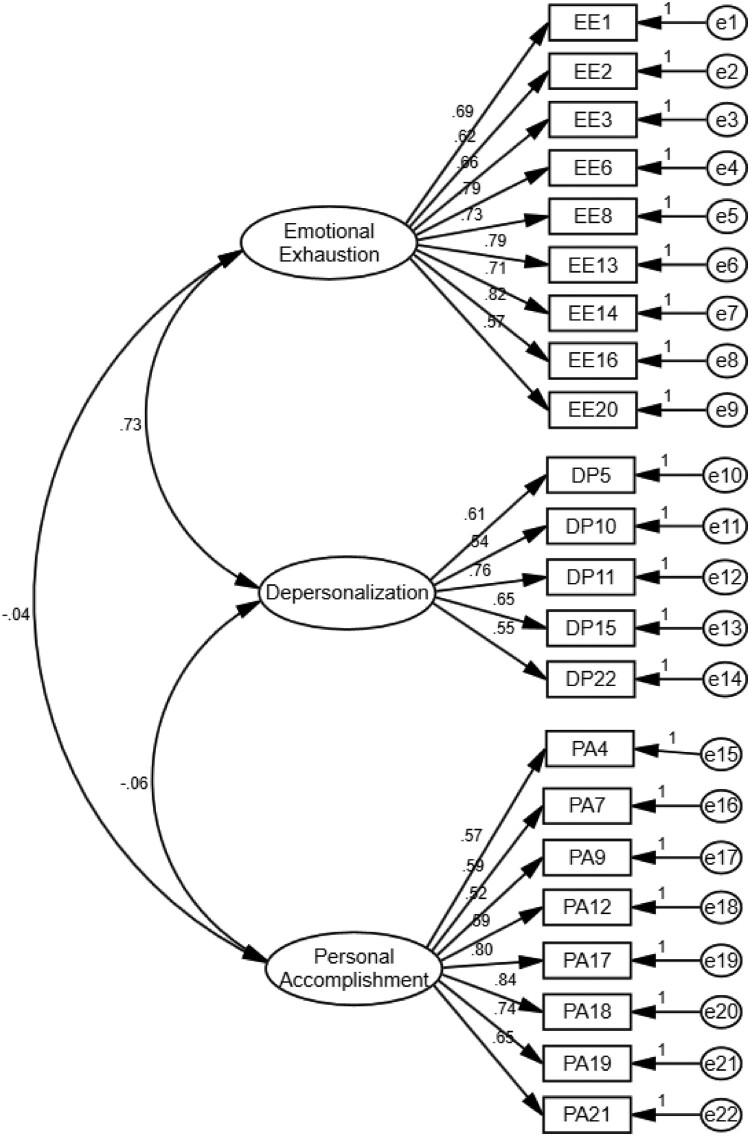
- Of the tested MBI-HSS structures, the 22-item three-factor model fit best: CFI = 0.96, TLI = 0.95, RMSEA = 0.05 (90% CI: 0.05–0.06), SRMR = 0.06.
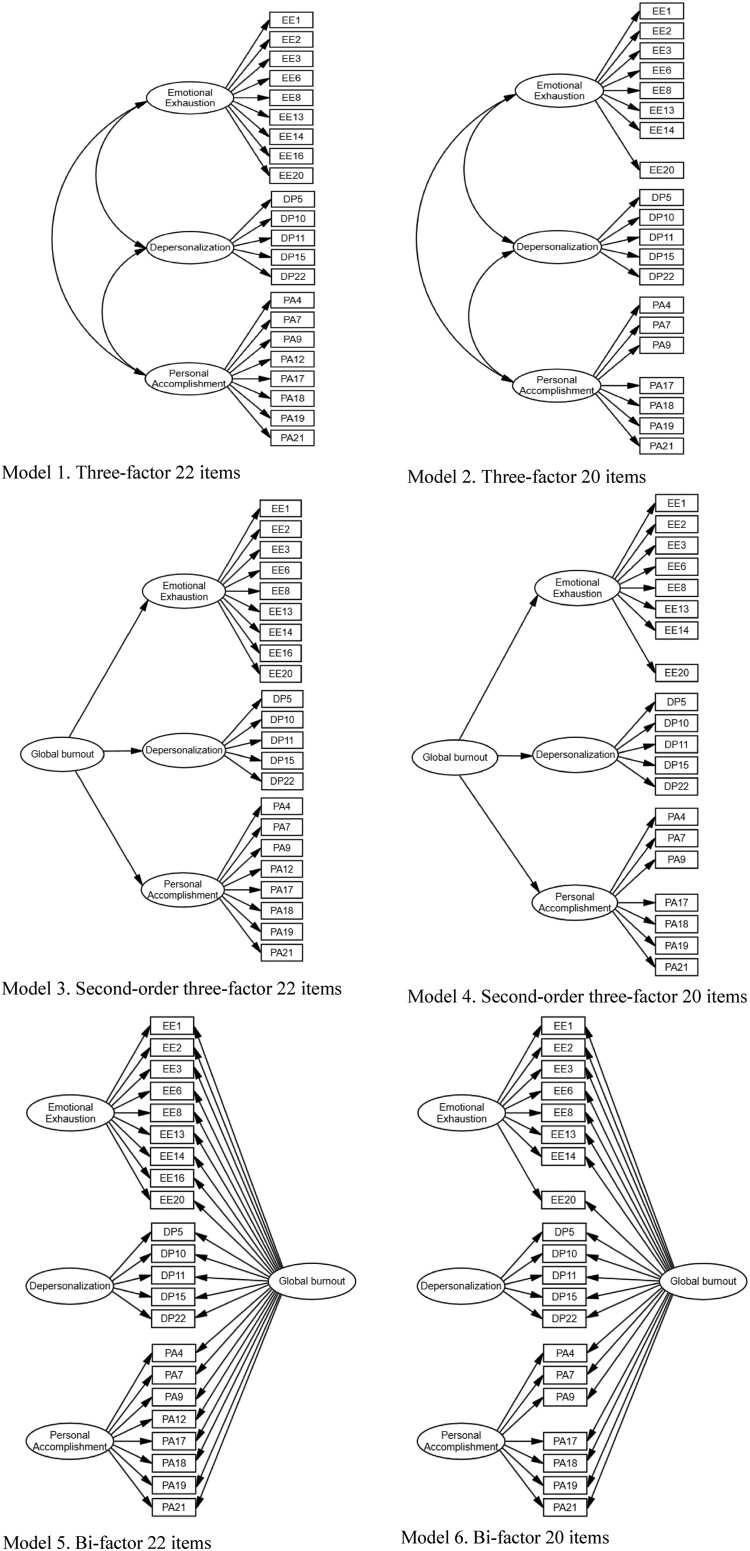
- The alternative 20-item models (removing items 12 and 16) were not supported, and the bi-factor 22-item model did not meet acceptable standards because TLI and CFI were < 0.90.
- The three dimensions showed good/acceptable reliability: Cronbach’s α = 0.91 for Emotional Exhaustion, 0.77 for Depersonalization, and 0.88 for Personal Accomplishment.
- Measurement invariance was confirmed across genders and occupations; however, the model did not fit well for the group at risk for common mental health disorders (based on DASS-21), while it fit the non-DASS group well.
Methods
- Design/sample: Cross-sectional survey of 1,162 valid questionnaires from doctors and nurses at 15 hospitals in Hanoi, Da Nang, and Ho Chi Minh City, collected in September–October 2020; 65.8% of participants were female.
- Measures: Vietnamese-translated MBI-HSS-MP (22 items) and DASS-21 for depression, anxiety, and stress risk; the MBI-HSS translation used repeated forward–backward translation and was face-tested on 54 doctors and nurses.
- Analysis: Confirmatory factor analysis compared a correlated three-factor model, second-order hierarchical model, and bi-factor model for both 22-item and 20-item versions; multiple-group CFA tested measurement invariance across gender, occupation, and mental health risk.
Limitations
- The authors state the sample is only representative of healthcare professionals in big cities, not small cities or rural areas.
- They could not conduct test–retest reliability because only 64 of 392 contacted participants completed the survey a second time.
- They could not check concurrent validity because no other burnout scale had yet been validated in Vietnam.
- The paper notes mental health status was self-reported via DASS-21 rather than clinically diagnosed, which may have affected grouping; this is stated in the paper and also evident from the design.
Model-written summary. Check it against the paper before relying on it.
Integrity signals
Registry
Cites
Statistics
Figures
Verification
Claims the paper makes
3 Valid · 0 Not valid · 13 Not checked · 30 Own results and interpretations
A result the paper reports from its own data — it cites no other source for it, so there is none to check. The quote shows it is in the paper.
In the paper
“this scale measures three distinct but related aspects of burnout, including Emotional Exhaustion, Depersonalization, and Personal Accomplishment.”
§ Reassessing the most popularly suggested measurement models and measurement invariance of the Maslach Burnout Inventory – human service survey among Vietnamese healthcare professionals > Abstract > Results
plainstates an association- Asserted: passes — The authors put it forward as true.
- Checkable: passes — It can be checked against evidence.
- Load-bearing: passes — The paper’s conclusions depend on it.
- Based: passes — The paper gives a reason why it holds.
A result the paper reports from its own data — it cites no other source for it, so there is none to check. The quote shows it is in the paper.
In the paper
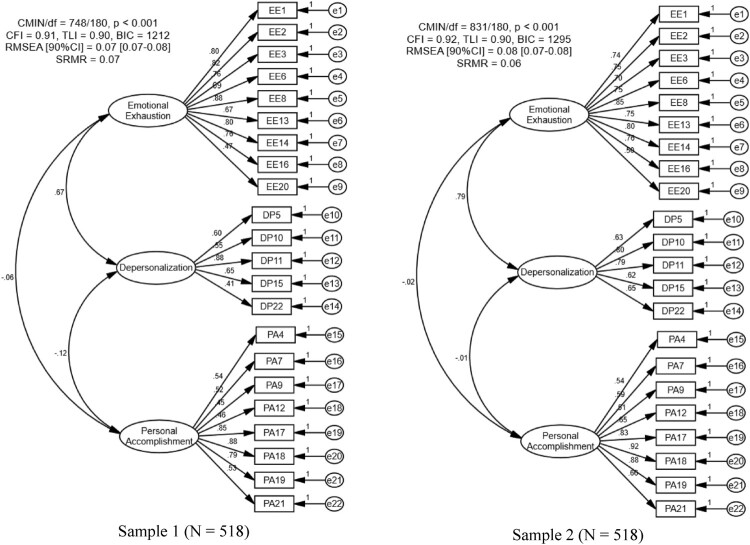
“In addition, we split the sample into two random sub-samples of equal size (n = 518), and CFA results showed that the three-factor model fitted well both data sets (see Figure 3 in Appendix).”
§ Reassessing the most popularly suggested measurement models and measurement invariance of the Maslach Burnout Inventory – human service survey among Vietnamese healthcare professionals > Results > Confirmatory factors analysis of alternative model of MBI-HSS-MP
plainn = 518- Asserted: passes — The authors put it forward as true.
- Checkable: passes — It can be checked against evidence.
- Load-bearing: passes — The paper’s conclusions depend on it.
- Based: passes — The paper gives a reason why it holds.
A result the paper reports from its own data — it cites no other source for it, so there is none to check. The quote shows it is in the paper.
In the paper
“Our findings confirmed that the 22-item MBI-HSS best fit the data”
- Also stated in: § Discussion · plain
“Our results support the original three-factor structure of MBI-HSS with 22 items as provided by Maslach and Jackson (1986).”
§ Reassessing the most popularly suggested measurement models and measurement invariance of the Maslach Burnout Inventory – human service survey among Vietnamese healthcare professionals > Abstract > Results
plain- Asserted: passes — The authors put it forward as true.
- Checkable: passes — It can be checked against evidence.
- Load-bearing: passes — The paper’s conclusions depend on it.
- Based: passes — The paper gives a reason why it holds.
- Also stated in: § Discussion · plain
A result the paper reports from its own data — it cites no other source for it, so there is none to check. The quote shows it is in the paper.
In the paper
“While both three-factor model and second-order hierarchical model demonstrated acceptable fit.”
§ Reassessing the most popularly suggested measurement models and measurement invariance of the Maslach Burnout Inventory – human service survey among Vietnamese healthcare professionals > Results > Confirmatory factors analysis of alternative model of MBI-HSS-MP
boosted- Asserted: passes — The authors put it forward as true.
- Checkable: passes — It can be checked against evidence.
- Load-bearing: passes — The paper’s conclusions depend on it.
- Based: passes — The paper gives a reason why it holds.
A result the paper reports from its own data — it cites no other source for it, so there is none to check. The quote shows it is in the paper.
In the paper
“Furthermore, results showed a strong and positive correlation between EE and DP (r = 0.725, p < 0.001)”
§ Reassessing the most popularly suggested measurement models and measurement invariance of the Maslach Burnout Inventory – human service survey among Vietnamese healthcare professionals > Results > Confirmatory factors analysis of alternative model of MBI-HSS-MP
boostedstates an association- Asserted: passes — The authors put it forward as true.
- Checkable: passes — It can be checked against evidence.
- Load-bearing: unclear — It is unclear whether the paper’s conclusions depend on it.
- Based: passes — The paper gives a reason why it holds.
19 more claims
Create a free account to see all 46 claims and to verify the 1 reference still open.
- Probably not a substantial claim. 16
- It may state two separate claims as one. 12
Self-check
Percentages, sums and reported differences re-computed from the paper’s own numbers.
Self-check results appear here once an independent check has confirmed them.
Cited works that were retracted
Works this paper cites that were later retracted, from the retraction notices publishers deposit. Major when the notice came out before this paper was published.
Rated major: it would touch a result — a value a result rests on, reported and recomputed p-values on opposite sides of the significance level, two passages that conflict with no sign which is right, or a cited work retracted before this paper was published.
In the paper
“…Laschinger & Fida, 2014), reduce their well-being (Schaufeli, Bakker, van der Heijden, & Prins, 2009), consequently has a negative impact on patients’ safety (Panagioti et al., 2018), increase medical errors and medical malpractice suits, and lower interpersonal teamwork (Dyrbye et al., 2018).”
Cited work 10.1001/jamainternmed.2018.3713 · retracted 2020-05-18 · notice 10.1001/jamainternmed.2020.1755 · this paper published 2022-01-05
Citations
Cites
1 retracted
Panagioti, M., Geraghty, K., Johnson, J., Zhou, A., Panagopoulou, E., Chew-Graham, C., Peters, D., Hodkinson, A., Riley, R., & Esmail, A. (2018) · JAMA Internal Medicine · doi:10.1001/jamainternmed.2018.3713 · Cited by 951 · cited 1×
“…Laschinger & Fida, 2014), reduce their well-being (Schaufeli, Bakker, van der Heijden, & Prins, 2009), consequently has a negative impact on patients’ safety (Panagioti et al., 2018), increase medical errors and medical malpractice suits, and lower interpersonal teamwork (Dyrbye et al., 2018).”
BackgroundRetractedHu, L., & Bentler, P. M. (1999) · Structural Equation Modeling A Multidisciplinary Journal · doi:10.1080/10705519909540118 · Cited by 108,788 · cited 1×
“For the SRMR and RMSEA, value≤0.10 and 0.08 and≤0.08 and 0.06, respectively, were considered to reflect acceptable and good fit (Brown & Cudeck, 1993; Hu & Bentler, 1999).”
MethodInfluentialnull (2016) · Philosophy Study · doi:10.17265/2159-5313/2016.09.003 · Cited by 28,317
(1991) · Cited by 15,554
The measurement of experienced burnout
Maslach, C., & Jackson, S. E. (1981) · Journal of Organizational Behavior · doi:10.1002/job.4030020205 · Cited by 14,496 · cited 2×
“The authors of this instrument hold that among the three dimensions of burnout, EE is the core dimension (Maslach & Jackson, 1981).”
BackgroundResultTesting Structural Equation Models.
Mueller, C. W., Bollen, K. A., & Long, J. S. (1994) · Contemporary Sociology · doi:10.2307/2074955 · Cited by 14,120
The job demands-resources model of burnout.
Demerouti, E., Bakker, A. B., Nachreiner, F., & Schaufeli, W. B. (2001) · Journal of Applied Psychology · doi:10.1037/0021-9010.86.3.499 · Cited by 13,643
The measurement of engagement and burnout: a two sample confirmatory factor analytic approach.
Schaufeli, W. B., Salanova, M., González-romá, V., & Bakker, A. B. (2002) · Journal of Happiness Studies · doi:10.1023/a:1015630930326 · Cited by 10,014
(1996) · Consulting Psychologists Press eBooks · Cited by 7,863
(1995) · Cited by 6,909
Constructing validity: Basic issues in objective scale development.
Clark, L. A., & Watson, D. (1995) · Psychological Assessment · doi:10.1037/1040-3590.7.3.309 · Cited by 6,567 · cited 1×
“Some authors suggested 10 participants for each item (Nunnally, 1994), or at least 300 respondents after initial pre-testing (Clark & Watson, 1995), or a sample size of 500 is generally considered very good while 1000 and above is excellent for all scales (Comrey & Lee, 2013).”
BackgroundA First Course in Factor Analysis
Comrey, A. L., & Lee, H. B. (2013) · doi:10.4324/9781315827506 · Cited by 4,546
The Copenhagen Burnout Inventory: A new tool for the assessment of burnout
Kristensen, T. S., Borritz, M., Villadsen, E., & Christensen, K. B. (2005) · Work & Stress · doi:10.1080/02678370500297720 · Cited by 3,136
(2011) · Cited by 2,664
Depression Anxiety Stress Scales
Lovibond, S. H., & Lovibond, P. F. (2011) · PsycTESTS Dataset · doi:10.1037/t01004-000 · Cited by 2,416
Structural Equation Modeling with Mplus: Basic Concepts, Applications, and Programming
Byrne, B. M. (2013) · doi:10.4324/9780203807644 · Cited by 2,063
Constructing validity: New developments in creating objective measuring instruments.
Clark, L. A., & Watson, D. (2019) · Psychological Assessment · doi:10.1037/pas0000626 · Cited by 1,470
Van de Vijver, F., & Hambleton, R. K. (1996) · European Psychologist · doi:10.1027/1016-9040.1.2.89 · Cited by 1,152 · cited 1×
“Repeated forward–backward translation procedure was adopted in this study as advised by Van de Vijver & Hambleton (1996) for burnout scale.”
MethodEmotional exhaustion and job performance: The mediating role of motivation.
Halbesleben, J. R. B., & Bowler, W. M. (2007) · Journal of Applied Psychology · doi:10.1037/0021-9010.92.1.93 · Cited by 950 · cited 1×
“Therefore, some studies only examined the impact of EE on work life of employees such as job satisfaction (Baeriswyl, Krause, & Schwaninger, 2016; Skaalvik, 2020), or job performance (Halbesleben & Bowler, 2007).”
BackgroundMeasurement Equivalence in Cross-National Research
Davidov, E., Meuleman, B., Cieciuch, J., Schmidt, P., & Billiet, J. (2014) · Annual Review of Sociology · doi:10.1146/annurev-soc-071913-043137 · Cited by 766
Schaufeli, W. B., & Taris, T. W. (2005) · Work & Stress · doi:10.1080/02678370500385913 · Cited by 696 · cited 1×
“Even though MBI-GS is the more updated version, it is innovated to measure burnout level of non-human service workers (Schaufeli & Taris, 2005).”
BackgroundTrockel, M., Bohman, B., Lesure, E., Hamidi, M. S., Welle, D., Roberts, L., & Shanafelt, T. (2018) · Academic Psychiatry · doi:10.1007/s40596-017-0849-3 · Cited by 602 · cited 1×
“More recently, the Stanford Professional Fulfilment Index, released in 2018, measures burnout in specifically physicians (Trockel et al., 2018).”
BackgroundTran, T. D., Tran, T., & Fisher, J. (2013) · BMC Psychiatry · doi:10.1186/1471-244x-13-24 · Cited by 476
Poghosyan, L., Aiken, L. H., & Sloane, D. M. (2009) · International Journal of Nursing Studies · doi:10.1016/j.ijnurstu.2009.03.004 · Cited by 408 · cited 2×
“This finding was in the same line with quite many studies examining MBI-HSS psychometric properties on healthcare professionals (e.g. Beckstead, 2002; Poghosyan et al., 2009).”
ResultThe construct validity of two burnout measures
Schaufeli, W. B., & Van Dierendonck, D. (1993) · Journal of Organizational Behavior · doi:10.1002/job.4030140703 · Cited by 405 · cited 1×
“…a three-factor model with 20 items (Hallberg & Sverke, 2004; Loera, Converso, & Viotti, 2014; Pisanti, Lombardo, Lucidi, Violani, & Lazzari, 2013; Schaufeli & Van Dierendonck, 1993), with 19 items (Gómez García, Alonso Sangregorio, & Lucía Llamazares Sánchez, 2018), with 18 items (Kanste,…”
A Cross Validation Study of the Maslach Burnout Inventory
Iwanicki, E. F., & Schwab, R. L. (1981) · Educational and Psychological Measurement · doi:10.1177/001316448104100425 · Cited by 363 · cited 1×
“…versions, studies found one-factor model (Golembiewski & Munzenrider, 1984); two-factor model (Brookings, Bolton, Brown, & McEvoy, 1985); three-factor model (Beckstead, 2002; Poghosyan, Aiken, & Sloane, 2009); or four-factor structure (Chao, McCallion, & Nickle, 2011; Iwanicki & Schwab, 1981).”
Spence Laschinger, H. K., & Fida, R. (2014) · Burnout Research · doi:10.1016/j.burn.2014.03.002 · Cited by 348 · cited 1×
“Burnout has been recorded to negatively affect healthcare workers’ mental health and job dissatisfaction (Spence Laschinger & Fida, 2014), reduce their well-being (Schaufeli, Bakker, van der Heijden, & Prins, 2009), consequently has a negative impact on patients’ safety (Panagioti et al., 2018),…”
BackgroundFactorial validity of the Maslach burnout inventory (MBI-HSS) among Spanish professionals
Gil-Monte, P. R. (2005) · Revista de Saúde Pública · doi:10.1590/s0034-89102005000100001 · Cited by 325 · cited 1×
“…& Lucía Llamazares Sánchez, 2018), with 18 items (Kanste, Miettunen, & Kyngäs, 2006), or with 15 items (Oh & Lee, 2009); while some found a four-factor model with 20 items (Gil-Monte, 2005) and 18 items (Firth, McIntee, McKeown, & Britton, 1985); or five-factor model with 19 items (Densten, 2001).”
BackgroundRomani, M., & Ashkar, K. (2014) · Libyan Journal of Medicine · doi:10.3402/ljm.v9.23556 · Cited by 323 · cited 1×
“Among occupations, healthcare professionals are especially susceptible to suffer burnout (Bartz & Maloney, 1986; Romani & Ashkar, 2014).”
BackgroundWorkaholism, burnout and well-being among junior doctors: The mediating role of role conflict
Schaufeli, W. B., Bakker, A. B., van der Heijden, F. M. M. A., & Prins, J. T. (2009) · Work & Stress · doi:10.1080/02678370902834021 · Cited by 301
The impact of COVID-19 on physician burnout globally: a review
Amanullah, S., & Ramesh Shankar, R. (2020) · Healthcare · doi:10.3390/healthcare8040421 · Cited by 276 · cited 1×
“Especially in the face of Covid-19 pandemic, burnout becomes an unavoidable challenge for those working in hospital settings globally (Amanullah & Ramesh Shankar, 2020; Gualano et al., 2021).”
BackgroundA test of the Maslach Burnout Inventory in three samples of healthcare professionals
Kalliath, T. J., O'Driscoll, M. P., Gillespie, D. F., & Bluedorn, A. C. (2000) · Work & Stress · doi:10.1080/026783700417212 · Cited by 243
Gualano, M. R., Sinigaglia, T., Lo Moro, G., Rousset, S., Cremona, A., Bert, F., & Siliquini, R. (2021) · International Journal of Environmental Research and Public Health · doi:10.3390/ijerph18158172 · Cited by 241 · cited 3×
“…the outbreak of Covid-19 pandemic, healthcare professionals experienced an exceptionally high workload and other occupational stressful conditions (Gualano et al., 2021; Magnavita et al., 2021) and hence it is hard to reach out to them; therefore, we applied convenient sampling strategy and sent…”
BackgroundMethodA Reliability Generalization Meta-Analysis of Coefficient Alpha for the Maslach Burnout Inventory
Wheeler, D. L., Vassar, M., Worley, J. A., & Barnes, L. L. B. (2011) · Educational and Psychological Measurement · doi:10.1177/0013164410391579 · Cited by 185
Magnavita, N., Chirico, F., Garbarino, S., Bragazzi, N. L., Santacroce, E., & Zaffina, S. (2021) · International Journal of Environmental Research and Public Health · doi:10.3390/ijerph18084361 · Cited by 178
Self‐reported job burnout among female human service professionals
Brookings, J. B., Bolton, B., Brown, C. E., & McEvoy, A. (1985) · Journal of Organizational Behavior · doi:10.1002/job.4030060205 · Cited by 160
Baeriswyl, S., Krause, A., & Schwaninger, A. (2016) · Frontiers in Psychology · doi:10.3389/fpsyg.2016.00663 · Cited by 147
Confirmatory factor analysis of the Maslach Burnout Inventory among Florida nurses
Beckstead, J. W. (2002) · International Journal of Nursing Studies · doi:10.1016/s0020-7489(02)00012-3 · Cited by 145 · cited 3×
“This finding was in the same line with quite many studies examining MBI-HSS psychometric properties on healthcare professionals (e.g. Beckstead, 2002; Poghosyan et al., 2009).”
ResultLoera, B., Converso, D., & Viotti, S. (2014) · PLoS ONE · doi:10.1371/journal.pone.0114987 · Cited by 138 · cited 1×
“…and even different structure, however, most of the studies, though conducted in different languages in different countries, confirmed the 3-factor structure (e.g. Hallberg & Sverke, 2004; Kim & Juye, 2008; Loera et al., 2014; Oh & Lee, 2009; Schaufeli, Salanova, González-romá, & Bakker, 2002).”
Resultde Beer, L. T., Schaufeli, W. B., De Witte, H., Hakanen, J. J., Shimazu, A., Glaser, J., Seubert, C., Bosak, J., Sinval, J., & Rudnev, M. (2020) · International Journal of Environmental Research and Public Health · doi:10.3390/ijerph17155604 · Cited by 130 · cited 2×
“Secondly, this instrument has been so popularly used in studies of burnout that, according to de Beer et al. (2020), it presents in about 90% of empirical papers on this topic.”
MethodDensten, I. L. (2001) · Journal of Organizational Behavior · doi:10.1002/job.115 · Cited by 127 · cited 2×
“…& Lucía Llamazares Sánchez, 2018), with 18 items (Kanste, Miettunen, & Kyngäs, 2006), or with 15 items (Oh & Lee, 2009); while some found a four-factor model with 20 items (Gil-Monte, 2005) and 18 items (Firth, McIntee, McKeown, & Britton, 1985); or five-factor model with 19 items (Densten, 2001).”
BackgroundThe inevitability of physician burnout: Implications for interventions.
Montgomery, A. (2014) · Burnout Research · doi:10.1016/j.burn.2014.04.002 · Cited by 124 · cited 1×
“Some even affirm that burnout is inevitable in this occupation (Montgomery, 2014).”
BackgroundSkaalvik, C. (2020) · International Journal of Leadership in Education · doi:10.1080/13603124.2020.1791964 · Cited by 121 · cited 2×
“Therefore, some studies only examined the impact of EE on work life of employees such as job satisfaction (Baeriswyl, Krause, & Schwaninger, 2016; Skaalvik, 2020), or job performance (Halbesleben & Bowler, 2007).”
BackgroundSzigeti, R., Balázs, N., Bikfalvi, R., & Urbán, R. (2017) · Stress and Health · doi:10.1002/smi.2737 · Cited by 92
Mészáros, V., Ádám, S., Szabó, M., Szigeti, R., & Urbán, R. (2014) · Stress and Health · doi:10.1002/smi.2481 · Cited by 84
Maslach Burnout Inventory: Factor Structure and Norms for British Nursing Staff
Firth, H., McIntee, J., McKeown, P., & Britton, P. G. (1985) · Psychological Reports · doi:10.2466/pr0.1985.57.1.147 · Cited by 83
Pisanti, R., Lombardo, C., Lucidi, F., Violani, C., & Lazzari, D. (2013) · Journal of Advanced Nursing · doi:10.1111/j.1365-2648.2012.06114.x · Cited by 75
Burnout among intensive care nurses
Bartz, C., & Maloney, J. P. (1986) · Research in Nursing & Health · doi:10.1002/nur.4770090210 · Cited by 73 · cited 1×
“Among occupations, healthcare professionals are especially susceptible to suffer burnout (Bartz & Maloney, 1986; Romani & Ashkar, 2014).”
BackgroundA Pragmatic Approach for Organizations to Measure Health Care Professional Well-Being
Clinic, M., Dyrbye, L. N., Meyers, D., Agency for Healthcare Research & Quality, Ripp, J., Medicine, C. F. H. A. R. I., Dalal, N., Emory University, Bird, S. B., Society for Academic Emergency Medicine, et al. (2018) · NAM Perspectives · doi:10.31478/201810b · Cited by 73 · cited 4×
“…Laschinger & Fida, 2014), reduce their well-being (Schaufeli, Bakker, van der Heijden, & Prins, 2009), consequently has a negative impact on patients’ safety (Panagioti et al., 2018), increase medical errors and medical malpractice suits, and lower interpersonal teamwork (Dyrbye et al., 2018).”
BackgroundInfluentialConstruct Validity of the Maslach Burnout Inventory: Two Swedish Health Care Samples
Hallberg, U. E., & Sverke, M. (2004) · European Journal of Psychological Assessment · doi:10.1027/1015-5759.20.4.320 · Cited by 71 · cited 2×
“…and even different structure, however, most of the studies, though conducted in different languages in different countries, confirmed the 3-factor structure (e.g. Hallberg & Sverke, 2004; Kim & Juye, 2008; Loera et al., 2014; Oh & Lee, 2009; Schaufeli, Salanova, González-romá, & Bakker, 2002).”
ResultFactor structure of the Maslach Burnout Inventory among Finnish nursing staff
Kanste, O., Miettunen, J., & Kyngäs, H. (2006) · Nursing & Health Sciences · doi:10.1111/j.1442-2018.2006.00283.x · Cited by 67
Nguyen, H. T. T., Kitaoka, K., Sukigara, M., & Thai, A. L. (2018) · Asian Nursing Research · doi:10.1016/j.anr.2018.01.003 · Cited by 66
Factor Structure and Longitudinal Invariance of the Maslach Burnout Inventory
Kim, H., & Ji, J. (2009) · Research on Social Work Practice · doi:10.1177/1049731508318550 · Cited by 64
Chao, S. F., McCallion, P., & Nickle, T. (2011) · Journal of Intellectual Disability Research · doi:10.1111/j.1365-2788.2011.01413.x · Cited by 55
Different Perspectives on Job Burnout
Maslach, C. (2004) · Contemporary Psychology · doi:10.1037/004284 · Cited by 53 · cited 1×
“Burnout is a psychological response to chronic stress (Maslach, 2004) and is often widespread among healthcare professionals.”
BackgroundOccupational Stress Among Health Worker in a National Dermatology Hospital in Vietnam, 2018
Ngoc, A. N., Thanh, X. L. T., Thi, H. L., Tuan, A. V., & Van, T. N. (2020) · Frontiers in Psychiatry · doi:10.3389/fpsyt.2019.00950 · Cited by 45
(1984) · PubMed · Cited by 41
Oh, S., & Lee, M. (2008) · Children and Youth Services Review · doi:10.1016/j.childyouth.2008.07.012 · Cited by 34 · cited 2×
“…19 items (Gómez García, Alonso Sangregorio, & Lucía Llamazares Sánchez, 2018), with 18 items (Kanste, Miettunen, & Kyngäs, 2006), or with 15 items (Oh & Lee, 2009); while some found a four-factor model with 20 items (Gil-Monte, 2005) and 18 items (Firth, McIntee, McKeown, & Britton, 1985); or…”
ResultGómez García, R., Alonso Sangregorio, M., & Lucía Llamazares Sánchez, M. (2019) · Journal of Social Service Research · doi:10.1080/01488376.2018.1480549 · Cited by 34 · cited 1×
“Reliability assessment using Cronbach’s α showed good reliability for EE and acceptable reliability for DP and PA. Previous studies reported the same results (Gómez García et al., 2018; Wheeler, Vassar, Worley, & Barnes, 2011).”
ResultTrigo, T. R., Freitas, C. C. S. D., Wang, Y.-P., Ribeiro, F. G., de Lucia, M. C. S., Siqueira, J. O., Iosifescu, D. V., Hallak, J. E. C., & Fraguas, R. (2018) · Frontiers in Psychiatry · doi:10.3389/fpsyt.2018.00695 · Cited by 21 · cited 5×
“Even though very few studies examined the measure invariance across group with vs. without risk for mental health disorders, studies such as that of Trigo et al. (2018) also found that MBI-HSS did not fit for depressive persons.”
BackgroundResultInfluentialBortoletti, F. F., Benevides-Pereira, A. M. T., Vasconcellos, E. G., Siqueira, J. D. O., Júnior, E. A., Nardozza, L. M. M., Sebastiani, R. W., & Moron, A. F. (2012) · ISRN Obstetrics and Gynecology · doi:10.5402/2012/593876 · Cited by 14 · cited 1×
“As reviewed in the introduction, different studies examining psychometric properties of MBI-HSS may come up with different reliability assessments of DP and PA, however, all of them maintain the Exhaustion Dimension (Ferreira Bortoletti et al., 2012).”
Background
Research works printed but not linked: 3
- Jöreskog, K. G. (1993). Testing structural equation models. In K. A. Bollen & J. S. Long (Eds.), Testing structural equation models (pp. 294– 316). Thousand Oaks, CA: Sage.
- Maslach, C., & Jackson, S. E. (1986). Maslach Burnout Inventory, manual research edition. Palo Alto, CA: Consulting Psychologists Press.
- Nunnally, J. C. (1994). Psychometric theory (3rd ed). New York, NY: McGraw-Hill.
Cited by
Wang, A., Duan, Y., Norton, P., Leiter, M. P., & Estabrooks, C. A. (2024) · Frontiers in Psychology · doi:10.3389/fpsyg.2024.1439470 · Cited by 57
Asfahani, A. M. (2022) · Frontiers in Psychology · doi:10.3389/fpsyg.2022.1087947 · Cited by 58
“Emotional exhaustion refers to a feeling that is characterized by chronic fatigue and low energy and is considered to be one of the main dimensions of burnout (Bui et al., 2022).”
BackgroundMwakyusa, J. R. P., & Mcharo, E. W. (2024) · Cogent Business & Management · doi:10.1080/23311975.2024.2326237 · Cited by 67
“One critical dimension of burnout is emotional exhaustion, characterized by chronic fatigue and low energy levels (Bui et al., 2022).”
Rosen, C. S., Kaplan, A. N., Nelson, D. B., Bash, H. A. J. L., Chard, K. M., Eftekhari, A., Kehle‐Forbes, S., Stirman, S. W., & Sayer, N. A. (2022) · Journal of Affective Disorders · doi:10.1016/j.jad.2022.09.141 · Cited by 31
“Because an individual item with an ordinal response format does not inherently yield a continuous variable, it is best analyzed as a categorical variable (Carifio and Perla, 2007).”
Moscu, C.-A., Marina, V., Dragomir, L., Anghele, A.-D., & Anghele, M. (2022) · Medicina · doi:10.3390/medicina58111516 · Cited by 35
Metadata
- Authors
- Bui, T. H. T., Tran, T. M. D., Nguyen, T. N. T., Vu, T. C., Ngo, X. D., Nguyen, T. H. P., & Do, T. L. H.
- Affiliations
- Faculty of Psychology, VNU University of Social Sciences and Humanities, Vietnam National University, Ha Noi, Vietnam
- Vietnam National University, Hanoi (VN)
- National Institute of Mental Health, Ha Noi, Vietnam
- Vietnam National University Ho Chi Minh City (VN)
- Vietnam Academy of Social Sciences (VN)
- Venue
- Health Psychology and Behavioral Medicine
- Publisher
- Informa UK Limited
- Published
- 2022-01-05
- Volume
- 10
- Issue
- 1
- Pages
- 104-120
- ISSN
- 2164-2850 (ISSN-L)
- PMC
- PMC8741234
- OpenAlex
- W4205969253
- Cited by
- 22
- References
- 59
- Citations by year
- 2026: 2 · 2025: 5 · 2024: 4 · 2023: 4 · 2022: 5
- FWCI
- 4.25
- Type
- journal article
- Language
- en
- Open access
- gold
- doi.org
- Licence
- Locations
- Health Psychology and Behavioral Medicine (publishedVersion, cc-by)
- PubMed Central (publishedVersion, cc-by)
- PubMed (publishedVersion)
- DOAJ (DOAJ: Directory of Open Access Journals) (submittedVersion, cc-by-sa)
- Greater South Information System
- Funders
- Vietnam National Foundation for Science and Technology Development (501.02-2020.01)
- Topics
- Social Sciences › Psychology › Social Psychology › Stress and Burnout Research
- Social Sciences › Decision Sciences › Management Science and Operations Research › Psychometric Methodologies and Testing
- Health Sciences › Medicine › Public Health, Environmental and Occupational Health › Occupational Health and Burnout
- Keywords
- burnout, measurement invariance, factor structure, emotional exhaustion, depersonalization, personal accomplishment, healthcare workers, doctors and nurses, Vietnamese translation, scale validation, gender differences, occupational differences, common mental disorders
About these checks
Registry, retraction, Cites and statistics results are computed, not judged, with one exception: a printed reference that no index lists is read once by a model before it counts as a citation error. Claims are extracted by a model and kept only when their quote appears verbatim in the text; each cited source is then checked, with a model’s help, for whether it says what the claim relies on. Those verdicts can be wrong — read the claim’s quote and the cited source before relying on one.
The claim verdicts this report counts are experimental: their accuracy is not yet measured.
A language model drew the claims from the paper on 2026-10-10, under version 3 of the claim definition (model deepseek-v4.1-flash, prompt extract-v3).
A second model labelled each claim on 2026-10-10 (model jev-1.13-20260917, definition revision gold-guideline-v0.2).
Statistics and arithmetic are recomputed, not judged.
Confidence bands are shown only for fields calibrated on our annotated test set. None is calibrated yet, so no band is shown.
What counts as a claim ›How we measure confidence ›How we check this ›
Are you an author, or do you see a problem with this page? Request a review
Data sources
Bibliographic data: Semantic Scholar, OpenAlex, Crossref.
Contains information from the Semantic Scholar Academic Graph Datasets, made available under the ODC Attribution License (ODC-BY 1.0).
Semantic Scholar’s data is described in: Kinney, R., et al. (2023). The Semantic Scholar Open Data Platform. arXiv:2301.10140.
