

The DOI matches its Crossref record; 58 of the 58 references it cites were found in a registry or an index.
Assembly of Myelin by Association of Proteolipid Protein with Cholesterol- and Galactosylceramide-Rich Membrane Domains
Open accessAbstract
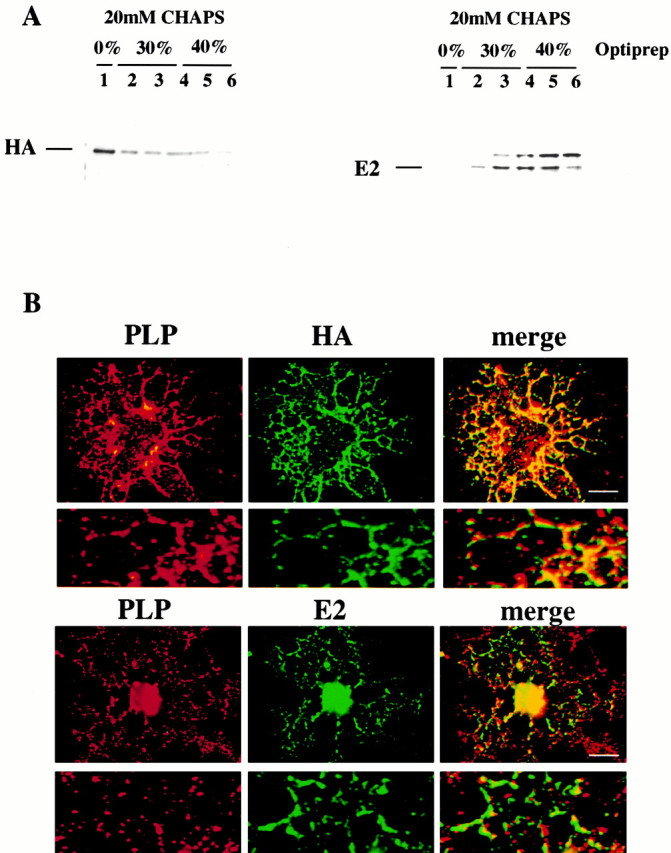
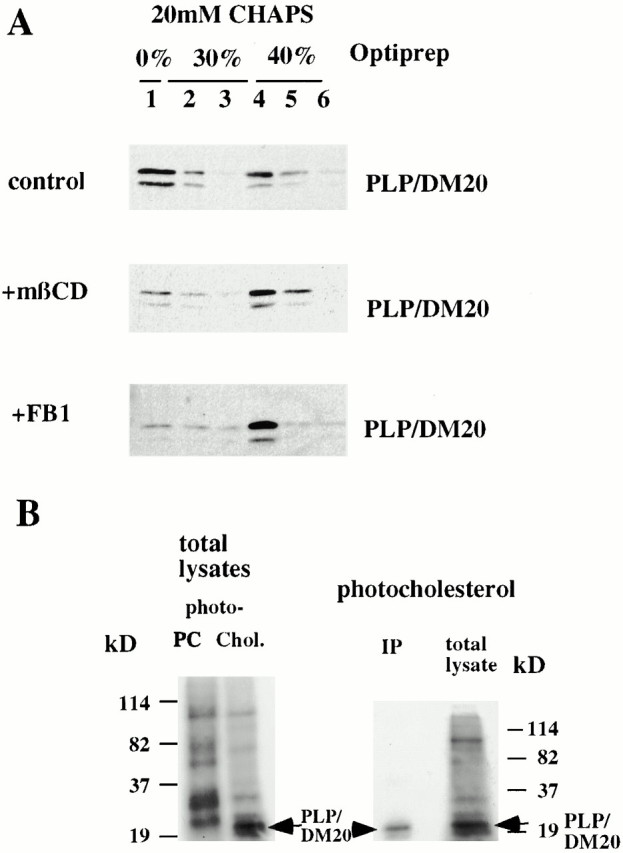
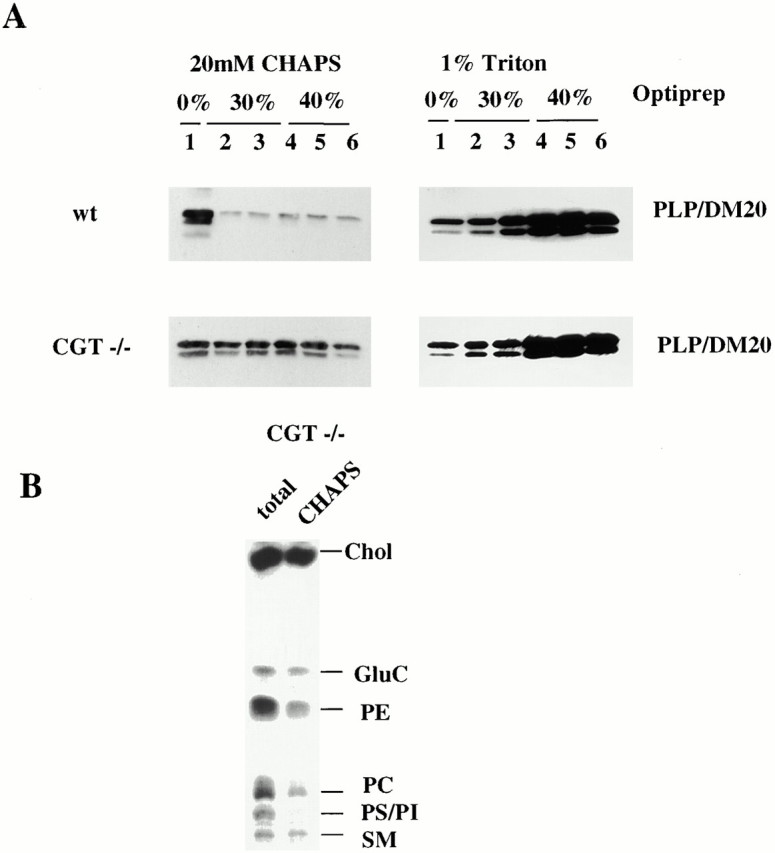
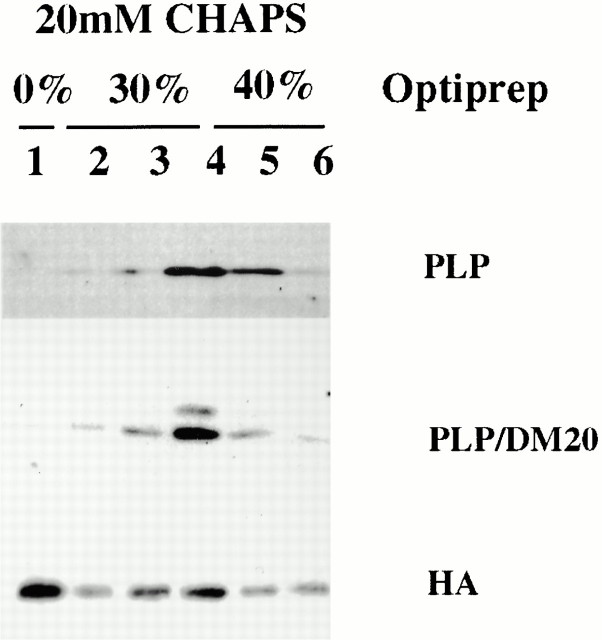
Myelin is a specialized membrane enriched in glycosphingolipids and cholesterol that contains a limited spectrum of proteins. We investigated the assembly of myelin components by oligodendrocytes and analyzed the role of lipid–protein interactions in this process. Proteolipid protein (PLP), the major myelin protein, was recovered from cultured oligodendrocytes from a low-density CHAPS-insoluble membrane fraction (CIMF) enriched in myelin lipids. PLP associated with the CIMF after leaving the endoplasmic reticulum but before exiting the Golgi apparatus, suggesting that myelin lipid and protein components assemble in the Golgi complex. The specific association of PLP with myelin lipids in CIMF was supported by the finding that it was efficiently cross-linked to photoactivable cholesterol, but not to phosphatidylcholine, which is underrepresented in both myelin and CIMF. Furthermore, depletion of cholesterol or inhibition of sphingolipid synthesis in oligodendrocytes abolished the association of PLP with CIMF. Thus, PLP may be recruited to myelin rafts, represented by CIMF, via lipid–protein interactions. In contrast to oligodendrocytes, after transfection in BHK cells, PLP is absent from isolated CIMF, suggesting that PLP requires specific lipids for raft association. In mice deficient in the enzyme ceramide galactosyl transferase, which cannot synthesize the main myelin glycosphingolipids, a large fraction of PLP no longer associates with rafts. Formation of a cholesterol- and galactosylceramide-rich membrane domain (myelin rafts) may be critical for the sorting of PLP and assembly of myelin in oligodendrocytes.
Overview
The claims and statistics of this paper haven’t been checked yet.
Run the check — free, no account needed. It reads the open-access text and checks the sources it cites.
Integrity signals
Registry
Cites
Statistics
Figures
Verification
Claims the paper makes
The claims and statistics of this paper haven’t been checked yet.
Run the check — free, no account needed. It reads the open-access text and checks the sources it cites.
Claims other papers make about this one
Each is checked against this paper’s own text: does it say what the citing paper says it does?
The source backs part of the claim, not all of it — or backs it for a different population, condition or comparison.
In the citing paper
“The extra cholesterol supply is not simply the building blocks for lipid content in the myelin sheet, but also the key for proper myelin protein assembly and sorting (Simons et al. 2000).”
From Apolipoprotein E ε4 disrupts oligodendrocyte differentiation by interfering with astrocyte‐derived lipid transport (2023) · cites this paper as Simons et al. 2000
Experimental — accuracy not yet measured
Self-check
Percentages, sums and reported differences re-computed from the paper’s own numbers.
The self-check needs the paper’s full text.
Citations
Cites
A RAPID METHOD OF TOTAL LIPID EXTRACTION AND PURIFICATION
Bligh, E. G., & Dyer, W. J. (1959) · Canadian Journal of Biochemistry and Physiology · doi:10.1139/o59-099 · Cited by 54,751
Functional rafts in cell membranes
Simons, K., & Ikonen, E. (1997) · Nature · doi:10.1038/42408 · Cited by 9,757
Srimaroeng, C., Cecile, J. P., Walden, R., & Pritchard, J. B. (2013) · Cellular Physiology and Biochemistry · doi:10.1159/000350077 · Cited by 2,989
Brown, D. A., & Rose, J. K. (1992) · Cell · doi:10.1016/0092-8674(92)90189-j · Cited by 2,921
Structure and Function of Sphingolipid- and Cholesterol-rich Membrane Rafts
Brown, D. A., & London, E. (2000) · Journal of Biological Chemistry · doi:10.1074/jbc.r000005200 · Cited by 2,344
Adams, R. D., & Victor, M. (1977) · Medical Entomology and Zoology · Cited by 1,718
ENDOCYTOSIS AND MOLECULAR SORTING
Mellman, I. (1996) · Annual Review of Cell and Developmental Biology · doi:10.1146/annurev.cellbio.12.1.575 · Cited by 1,551
Lipid sorting in epithelial cells
Simons, K., & Gerrit van, M. E. E. R. (1988) · Biochemistry · doi:10.1021/bi00417a001 · Cited by 1,373
GPI-anchored proteins are organized in submicron domains at the cell surface
Varma, R., & Mayor, S. (1998) · Nature · doi:10.1038/29563 · Cited by 1,209
Lipid Domain Structure of the Plasma Membrane Revealed by Patching of Membrane Components
Harder, T., Scheiffele, P., Verkade, P., & Simons, K. (1998) · The Journal of Cell Biology · doi:10.1083/jcb.141.4.929 · Cited by 1,186
Cited by
Sorted by citations
Biologically Active Molecules with a “Light Switch”
Mayer, G., & Heckel, A. (2006) · Angewandte Chemie International Edition · doi:10.1002/anie.200600387 · Cited by 1,113
Myelination of the Nervous System: Mechanisms and Functions
Nave, K.-A., & Werner, H. B. (2014) · Annual Review of Cell and Developmental Biology · doi:10.1146/annurev-cellbio-100913-013101 · Cited by 983
High cholesterol level is essential for myelin membrane growth
Saher, G., Brügger, B., Lappe-Siefke, C., Möbius, W., Tozawa, R.-I., Wehr, M. C., Wieland, F., Ishibashi, S., & Nave, K.-A. (2005) · Nature Neuroscience · doi:10.1038/nn1426 · Cited by 799
Myelin in the Central Nervous System: Structure, Function, and Pathology
Stadelmann, C., Timmler, S., Barrantes‐Freer, A., & Simons, M. (2019) · Physiological Reviews · doi:10.1152/physrev.00031.2018 · Cited by 799
Self-citationAxon-Glial Signaling and the Glial Support of Axon Function
Nave, K., & Trapp, B. D. (2008) · Annual Review of Neuroscience · doi:10.1146/annurev.neuro.30.051606.094309 · Cited by 664
Metadata
- Authors
- Simons, M., Krämer, E.-M., Thiele, C., Stoffel, W., & Trotter, J.
- Affiliations
- Heidelberg University (DE)
- aDepartment of Neurobiology, University of Heidelberg, 69120 Heidelberg, Germany
- University of Cologne (DE)
- Venue
- The Journal of Cell Biology
- Publisher
- Rockefeller University Press
- Published
- 2000-10-02
- Volume
- 151
- Issue
- 1
- Pages
- 143-154
- ISSN
- 0021-9525 (ISSN-L)
- 1540-8140
- PMC
- PMC2189802
- OpenAlex
- W2098744846
- Cited by
- 293
- References
- 58
- Citations by year
- 2026: 5 · 2025: 2 · 2024: 7 · 2023: 6 · 2022: 12 · 2021: 5 · 2020: 10 · 2019: 15 · 2018: 3 · 2017: 12 · 2016: 4 · 2015: 8 · 2014: 17 · 2013: 9 · 2012: 14
- FWCI
- 5.31
- Type
- journal article
- Language
- en
- Open access
- green
- www.ncbi.nlm.nih.gov
- Licence
- cc-by-nc-sa
- Locations
- The Journal of Cell Biology (publishedVersion)
- Europe PMC (PubMed Central) (publishedVersion, cc-by-nc-sa)
- PubMed Central (publishedVersion, cc-by-nc-sa)
- PubMed (publishedVersion)
- Topics
- Life Sciences › Biochemistry, Genetics and Molecular Biology › Molecular Biology › Lipid Membrane Structure and Behavior
- Life Sciences › Biochemistry, Genetics and Molecular Biology › Molecular Biology › Sphingolipid Metabolism and Signaling
- Life Sciences › Biochemistry, Genetics and Molecular Biology › Cell Biology › Caveolin-1 and cellular processes
- Keywords
- proteolipid protein, lipid rafts, oligodendrocytes, cholesterol, galactosylceramide, glycosphingolipids, protein-lipid interactions, Golgi apparatus, sphingolipid biosynthesis
- MeSH terms
- Animals, Brain Chemistry, Cell Fractionation, Cholesterol, Cholic Acids, Detergents, Endoplasmic Reticulum, Galactosylceramides, Galactosyltransferases, Golgi Apparatus, Cricetinae, Myelin Sheath, Oligodendroglia, Solubility, Glycosylphosphatidylinositols, Mice, Knockout, Myelin Proteolipid Protein, Hemagglutinin Glycoproteins, Influenza Virus, Membrane Microdomains, N-Acylsphingosine Galactosyltransferase, Mice
About these checks
Registry, retraction, Cites and statistics results are computed, not judged, with one exception: a printed reference that no index lists is read once by a model before it counts as a citation error. Claims are extracted by a model and kept only when their quote appears verbatim in the text; each cited source is then checked, with a model’s help, for whether it says what the claim relies on. Those verdicts can be wrong — read the claim’s quote and the cited source before relying on one.
Statistics and arithmetic are recomputed, not judged.
Confidence bands are shown only for fields calibrated on our annotated test set. None is calibrated yet, so no band is shown.
What counts as a claim ›How we measure confidence ›How we check this ›
Are you an author, or do you see a problem with this page? Request a review
