

Ligand crowding at a nascent signal sequence.
Open accessThe DOI matches its Crossref record; 43 of the 43 references it cites were found in a registry or an index.
Abstract
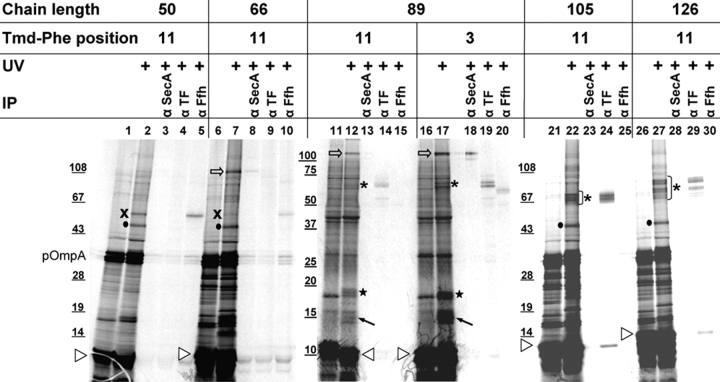
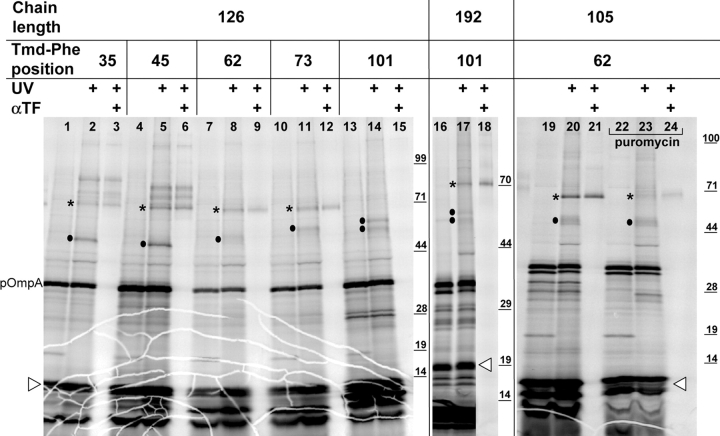
We have systematically analyzed the molecular environment of the signal sequence of a growing secretory protein from Escherichia coli using a stage- and site-specific cross-linking approach. Immediately after emerging from the ribosome, the signal sequence of pOmpA is accessible to Ffh, the protein component of the bacterial signal recognition particle, and to SecA, but it remains attached to the surface of the ribosome via protein L23. These contacts are lost upon further growth of the nascent chain, which brings the signal sequence into sole proximity to the chaperone Trigger factor (TF). In its absence, nascent pOmpA shows extended contacts with L23, and even long chains interact in these conditions proficiently with Ffh. Our results suggest that upon emergence from the ribosome, the signal sequence of an E. coli secretory protein gradually becomes sequestered by TF. Although TF thereby might control the accessibility of pOmpA's signal sequence to Ffh and SecA, it does not influence interaction of pOmpA with SecB.
Overview
The claims and statistics of this paper haven’t been checked yet.
Free: it reads the open-access text and checks the first 5 claims that cite a source we can check. Create a free account to check every claim.
Integrity signals
Registry
Cites
Statistics
Figures




Verification
Claims the paper makes
The claims and statistics of this paper haven’t been checked yet.
Free: it reads the open-access text and checks the first 5 claims that cite a source we can check. Create a free account to check every claim.
Claims other papers make about this one
Each is checked against this paper’s own text: does it say what the citing paper says it does?
In the citing paper
“In addition to this post-translational substrate recognition, SecA can bind to its substrates also co-translationally (Eisner et al., 2003; Karamyshev and Johnson, 2005; Huber et al., 2011, 2017; Figure 2). This was observed for secretory proteins, like MBP (Chun and Randall, 1994; Huber et al., 2017), but also for the membrane protein RodZ (Rawat et al., 2015; Wang et al., 2017).”
From The Dynamic SecYEG Translocon (2021) · cites this paper as Eisner et al., 2003
Self-check
Percentages, sums and reported differences re-computed from the paper’s own numbers.
The self-check needs the paper’s full text.
Citations
Cites
[6] Use of T7 RNA polymerase to direct expression of cloned genes
William Studier, F., Rosenberg, A. H., Dunn, J. J., & Dubendorff, J. W. (1990) · Methods in Enzymology · doi:10.1016/0076-6879(90)85008-c · Cited by 6,562 · cited 2×
“coli strain BL21 (DE3) pLysS (Studier et al., 1990) containing pET19b-P48 or pET10N-P48 was grown at 37 C in LB medium containing ampicillin and chloramphenicol and 0.”
MethodInfluentialThe Structural Basis of Ribosome Activity in Peptide Bond Synthesis
Nissen, P., Hansen, J., Ban, N., Moore, P. B., & Steitz, T. A. (2000) · Science · doi:10.1126/science.289.5481.920 · Cited by 2,269 · cited 3×
“Th e Jo ur na l o f C el l B io lo gy The Rockefeller University Press, 0021-9525/2003/10/35/10 $8.00 The Journal of Cell Biology, Volume 163, Number 1, October 13, 2003 35–44 http://www.jcb.org/cgi/doi/10.1083/jcb.200306069 JCB Article 35 Ligand crowding at a nascent signal sequence”
BackgroundInfluentialThe Ribosomal Exit Tunnel Functions as a Discriminating Gate
Nakatogawa, H., & Ito, K. (2002) · Cell · doi:10.1016/s0092-8674(02)00649-9 · Cited by 530 · cited 2×
“…nascent signal sequence when still traversing the ribosomal peptide tunnel, as evidence has recently accumulated for the ability of the ribosome to sense the nature of a nascent peptide when still embedded in the exit tunnel (Liao et al., 1997; Gong and Yanofsky, 2002; Nakatogawa and Ito, 2002).”
BackgroundTrigger factor and DnaK cooperate in folding of newly synthesized proteins
Deuerling, E., Schulze-Specking, A., Tomoyasu, T., Mogk, A., & Bukau, B. (1999) · Nature · doi:10.1038/23301 · Cited by 500 · cited 2×
“, 1991), and C600 tig (Deuerling et al., 1999).”
MethodSignal sequences specify the targeting route to the endoplasmic reticulum membrane.
Ng, D. T., Brown, J. D., & Walter, P. (1996) · The Journal of cell biology · doi:10.1083/jcb.134.2.269 · Cited by 472 · cited 2×
“…situation in the lower eukaryote yeast, in which the SRP-dependent route is reserved to secretory proteins with more hydrophobic signal sequences (Ng et al., 1996), the bacterial SRP selects inner membrane proteins on the basis of their longer and more hydrophobic signal anchor sequences (Valent…”
BackgroundInfluentialTruscott, K. N., Kovermann, P., Geissler, A., Merlin, A., Meijer, M., Driessen, A. J. M., Rassow, J., Pfanner, N., & Wagner, R. (2001) · Nature Structural Biology · doi:10.1038/nsb726 · Cited by 402 · cited 1×
“The PCR product was digested by BamHI and NdeI and cloned under T7 promoter control downstream of a 10His tag in pET19b (Novagen) or pET10N (Truscott et al., 2001), resulting in plasmids pET19b-P48 and pET10N-P48.”
MethodL23 protein functions as a chaperone docking site on the ribosome
Kramer, G., Rauch, T., Rist, W., Vorderwülbecke, S., Patzelt, H., Schulze-Specking, A., Ban, N., Deuerling, E., & Bukau, B. (2002) · Nature · doi:10.1038/nature01047 · Cited by 357 · cited 5×
“Th e Jo ur na l o f C el l B io lo gy The Rockefeller University Press, 0021-9525/2003/10/35/10 $8.00 The Journal of Cell Biology, Volume 163, Number 1, October 13, 2003 35–44 http://www.jcb.org/cgi/doi/10.1083/jcb.200306069 JCB Article 35 Ligand crowding at a nascent signal sequence”
BackgroundInfluentialValent, Q. A., Kendall, D. A., High, S., Kusters, R., Oudega, B., & Luirink, J. (1995) · The EMBO Journal · doi:10.1002/j.1460-2075.1995.tb00236.x · Cited by 280 · cited 1×
“Th e Jo ur na l o f C el l B io lo gy 36 The Journal of Cell Biology | Volume 163, Number 1, 2003 largely been found in contact with Trigger factor (TF) (Valent et al., 1995, 1997; Beck et al., 2000; Beha et al., 2003).”
BackgroundLiao, S., Lin, J., Do, H., & Johnson, A. E. (1997) · Cell · doi:10.1016/s0092-8674(00)80311-6 · Cited by 255 · cited 2×
“…nascent signal sequence when still traversing the ribosomal peptide tunnel, as evidence has recently accumulated for the ability of the ribosome to sense the nature of a nascent peptide when still embedded in the exit tunnel (Liao et al., 1997; Gong and Yanofsky, 2002; Nakatogawa and Ito, 2002).”
BackgroundHesterkamp, T., Hauser, S., Lütcke, H., & Bukau, B. (1996) · Proceedings of the National Academy of Sciences · doi:10.1073/pnas.93.9.4437 · Cited by 246 · cited 2×
“Th e Jo ur na l o f C el l B io lo gy The Rockefeller University Press, 0021-9525/2003/10/35/10 $8.00 The Journal of Cell Biology, Volume 163, Number 1, October 13, 2003 35–44 http://www.jcb.org/cgi/doi/10.1083/jcb.200306069 JCB Article 35 Ligand crowding at a nascent signal sequence”
BackgroundInfluentialInstruction of Translating Ribosome by Nascent Peptide
Gong, F., & Yanofsky, C. (2002) · Science · doi:10.1126/science.1073997 · Cited by 233 · cited 2×
“…nascent signal sequence when still traversing the ribosomal peptide tunnel, as evidence has recently accumulated for the ability of the ribosome to sense the nature of a nascent peptide when still embedded in the exit tunnel (Liao et al., 1997; Gong and Yanofsky, 2002; Nakatogawa and Ito, 2002).”
BackgroundThe sedimentation behaviour of ribonuclease-active and -inactive ribosomes from bacteria
Cammack, K., & Wade, H. (1965) · Biochemical Journal · doi:10.1042/bj0960671 · Cited by 231 · cited 2×
“coli strains MRE 600 (Cammack and Wade, 1965), SL119 (Lesley et al.”
BackgroundMethodSchäfer, U., Beck, K., & Müller, M. (1999) · Journal of Biological Chemistry · doi:10.1074/jbc.274.35.24567 · Cited by 214 · cited 1×
“…(Koch et al., 1999), flotation centrifugation (Neumann-Haefelin et al., 2000), immunoprecipitation on fourfold scaled-up reactions using polyclonal antibodies (Schafer et al., 1999), and purification of SecA (Helde et al., 1997), FtsY (Koch et al., 1999), and T7 RNA polymerase (Beck et al., 2000).”
MethodSelf-citationLee, H. C., & Bernstein, H. D. (2001) · Proceedings of the National Academy of Sciences · doi:10.1073/pnas.051484198 · Cited by 204 · cited 2×
“Th e Jo ur na l o f C el l B io lo gy The Rockefeller University Press, 0021-9525/2003/10/35/10 $8.00 The Journal of Cell Biology, Volume 163, Number 1, October 13, 2003 35–44 http://www.jcb.org/cgi/doi/10.1083/jcb.200306069 JCB Article 35 Ligand crowding at a nascent signal sequence”
BackgroundInfluentialTrigger Factor and DnaK possess overlapping substrate pools and binding specificities.
Deuerling, E., Patzelt, H., Vorderwülbecke, S., Rauch, T., Kramer, G., Schaffitzel, E., Mogk, A., Schulze‐Specking, A., Langen, H., & Bukau, B. (2003) · Molecular Microbiology · doi:10.1046/j.1365-2958.2003.03370.x · Cited by 203 · cited 1×
“Similar patterns of multiple TF cross-links, however, are also obtained when chemical cross-linkers are used (Beck et al., 2000; Kramer et al., 2002; Deuerling et al., 2003).”
BackgroundBeck, K., Wu, L., Brunner, J., & Müller, M. (2000) · The EMBO Journal · doi:10.1093/emboj/19.1.134 · Cited by 189 · cited 12×
“The various pOmpA derivatives were synthesized by the reconstituted transcription/translation system previously described (Koch et al., 1999; Beck et al., 2000).”
BackgroundMethodInfluentialSelf-citationBinding specificity of Escherichia coli trigger factor
Patzelt, H., Rüdiger, S., Brehmer, D., Kramer, G., Vorderwülbecke, S., Schaffitzel, E., Waitz, A., Hesterkamp, T., Dong, L., Schneider-Mergener, J., et al. (2001) · Proceedings of the National Academy of Sciences · doi:10.1073/pnas.261432298 · Cited by 183 · cited 2×
“coli proteins (Patzelt et al., 2001).”
ResultValent, Q. A., De Gier, J. L., Heijne, G. V., Kendall, D. A., Ten Hagen‐Jongman, C. M., Oudega, B., & Luirink, J. (1997) · Molecular Microbiology · doi:10.1046/j.1365-2958.1997.4431808.x · Cited by 171 · cited 4×
“…in which the SRP-dependent route is reserved to secretory proteins with more hydrophobic signal sequences (Ng et al., 1996), the bacterial SRP selects inner membrane proteins on the basis of their longer and more hydrophobic signal anchor sequences (Valent et al., 1997; de Gier et al., 1998).”
BackgroundInfluentialProtein traffic in bacteria: Multiple routes from the ribosome to and across the membrane
Müller, M., Koch, H., Beck, K., & Schäfer, U. (2000) · Progress in nucleic acid research and molecular biology · doi:10.1016/s0079-6603(00)66028-2 · Cited by 164 · cited 3×
“A controversial issue has remained if SecB was able to associate with the signal sequences of E. coli secretory proteins (for review see Muller et al., 2001).”
BackgroundInfluentialSelf-citationKoch, H.-G., Hengelage, T., Neumann-Haefelin, C., MacFarlane, J., Hoffschulte, H. K., Schimz, K.-L., Mechler, B., & Müller, M. (1999) · Molecular Biology of the Cell · doi:10.1091/mbc.10.7.2163 · Cited by 160 · cited 9×
“In contrast, for hydrophobic membrane proteins, SRP and FtsY have been demonstrated to be both necessary and sufficient for integration into the inner membrane (Koch et al., 1999; Koch and Muller, 2000; Park et al., 2002; Beha et al., 2003).”
BackgroundMethodInfluentialSelf-citationGU, S.-Q., PESKE, F., WIEDEN, H.-J., RODNINA, M. V., & WINTERMEYER, W. (2003) · RNA · doi:10.1261/rna.2196403 · Cited by 159 · cited 4×
“Both proteins dock at L23 (Kramer et al., 2002; Gu et al., 2003; Ullers et al., 2003).”
BackgroundInfluentialSignal recognition particle-depencent protein targeting, universal to all kingdoms of life
Koch, H.-G., Moser, M., & Müller, M. (2003) · Reviews of Physiology, Biochemistry and Pharmacology · doi:10.1007/s10254-002-0002-9 · Cited by 154 · cited 2×
“…SRP consisting of one protein, Ffh (also termed P48), and one 4.5S RNA, cotranslationally recognizes its substrates and in concert with its receptor, FtsY, mediates membrane targeting of nascent polypeptide chains to the SecYE translocon of the inner membrane (for review see Koch et al., 2003).”
BackgroundInfluentialSelf-citationNucleotide sequence of the gene ompA coding the outer membrane protein II*of Escherichia coli K-12
Beck, E., & Bremer, E. (1980) · Nucleic Acids Research · doi:10.1093/nar/8.13.3011 · Cited by 149 · cited 2×
“Note that due to the insertion of a Val after the NH 2 -terminal Met in the signal sequence of pOmpA encoded by p717OmpA, the numbering of individual amino acids differs by one residue from the authentic pOmpA sequence (Beck and Bremer, 1980).”
BackgroundBernabeu, C., & Lake, J. A. (1982) · Proceedings of the National Academy of Sciences · doi:10.1073/pnas.79.10.3111 · Cited by 143 · cited 2×
“…al. 37 Assuming that the most COOH-terminal 30 amino acids of each nascent pOmpA chain would be hidden in the exit tunnel of the E. coli ribosome (Bernabeu and Lake, 1982), the shortest nascent chain analyzed (pOmpA-50) would not even completely expose the 22–amino acid-long signal sequence…”
BackgroundUllers, R. S., Houben, E. N. G., Raine, A., ten Hagen-Jongman, C. M., Ehrenberg, M., Brunner, J., Oudega, B., Harms, N., & Luirink, J. (2003) · The Journal of Cell Biology · doi:10.1083/jcb.200302130 · Cited by 142 · cited 6×
“Th e Jo ur na l o f C el l B io lo gy The Rockefeller University Press, 0021-9525/2003/10/35/10 $8.00 The Journal of Cell Biology, Volume 163, Number 1, October 13, 2003 35–44 http://www.jcb.org/cgi/doi/10.1083/jcb.200306069 JCB Article 35 Ligand crowding at a nascent signal sequence”
BackgroundInfluentialSelf-citationLesley, S. A., Brow, M. A. D., & Burgess, R. R. (1991) · Journal of Biological Chemistry · doi:10.1016/s0021-9258(18)52291-2 · Cited by 141 · cited 2×
“coli strains MRE 600 (Cammack and Wade, 1965), SL119 (Lesley et al., 1991), and C600 tig (Deuerling et al.”
BackgroundMethodNeumann‐Haefelin, C., Schäfer, U., Müller, M., & Koch, H. (2000) · The EMBO Journal · doi:10.1093/emboj/19.23.6419 · Cited by 135 · cited 5×
“…were used for the preparation of native and ureaextracted INVs and the protease protection assay (Koch et al., 1999), flotation centrifugation (Neumann-Haefelin et al., 2000), immunoprecipitation on fourfold scaled-up reactions using polyclonal antibodies (Schafer et al., 1999), and…”
BackgroundMethodInfluentialSelf-citationde Gier, J.-W. L., Scotti, P. A., Sääf, A., Valent, Q. A., Kuhn, A., Luirink, J., & von Heijne, G. (1998) · Proceedings of the National Academy of Sciences · doi:10.1073/pnas.95.25.14646 · Cited by 129 · cited 1×
“…in which the SRP-dependent route is reserved to secretory proteins with more hydrophobic signal sequences (Ng et al., 1996), the bacterial SRP selects inner membrane proteins on the basis of their longer and more hydrophobic signal anchor sequences (Valent et al., 1997; de Gier et al., 1998).”
BackgroundThree-State Equilibrium of Escherichia coli Trigger Factor
Patzelt, H., Kramer, G., Rauch, T., Schönfeld, H.-J., Bukau, B., & Deuerling, E. (2002) · Biological Chemistry · doi:10.1515/bc.2002.182 · Cited by 115 · cited 5×
“Several experimental approaches to measure binding of TF to ribosomes suggest that the majority of nontranslating E. coli 50S and 70S ribosomes are in complex with TF (Patzelt et al., 2002; Blaha et al., 2003; Maier et al., 2003).”
BackgroundInfluentialInteraction of Trigger Factor with the Ribosome
Maier, R., Eckert, B., Scholz, C., Lilie, H., & Schmid, F.-X. (2003) · Journal of Molecular Biology · doi:10.1016/s0022-2836(02)01427-4 · Cited by 95 · cited 2×
“coli 50S and 70S ribosomes are in complex with TF (Patzelt et al., 2002; Blaha et al., 2003; Maier et al., 2003).”
BackgroundScotti, P. A., Valent, Q. A., Manting, E. H., Urbanus, M. L., Driessen, A. J. M., Oudega, B., & Luirink, J. (1999) · Journal of Biological Chemistry · doi:10.1074/jbc.274.42.29883 · Cited by 91 · cited 16×
“Key words: L23; nascent polypeptide chains; protein targeting; signal recognition particle; Trigger factor Abbreviations used in this paper: DSS, disuccinimidyl suberate; INV, inside-out, inner membrane vesicle; RNC, ribosome–nascent chain complex; SRP, signal recognition particle; TF, Trigger factor; Tmd-Phe, L -4’-(…”
BackgroundInfluentialTrigger Factor Retards Protein Export in Escherichia coli
Lee, H. C., & Bernstein, H. D. (2002) · Journal of Biological Chemistry · doi:10.1074/jbc.m205950200 · Cited by 83 · cited 2×
“Similarly, a retarded export of secretory proteins due to titration by TF has recently been described for TF-overproducing E. coli cells (Lee and Bernstein, 2002).”
BackgroundDissecting the Translocase and Integrase Functions of the Escherichia coli Secyeg Translocon
Koch, H.-G., & Müller, M. (2000) · The Journal of Cell Biology · doi:10.1083/jcb.150.3.689 · Cited by 67 · cited 2×
“In contrast, for hydrophobic membrane proteins, SRP and FtsY have been demonstrated to be both necessary and sufficient for integration into the inner membrane (Koch et al., 1999; Koch and Muller, 2000; Park et al., 2002; Beha et al., 2003).”
BackgroundSelf-citationIdentification of a soluble SecA/SecB complex by means of a subfractionated cell-free export system.
Hoffschulte, H. K., Drees, B., & Müller, M. (1994) · Journal of Biological Chemistry · doi:10.1016/s0021-9258(18)99951-5 · Cited by 50 · cited 1×
“In accordance with this, only SecA has thus far been detected in association with nontranslating ribosomes (Liebke, 1987; Hoffschulte et al., 1994), with its docking site on the ribosome, however, being totally unknown.”
BackgroundBehrmann, M., Koch, H.-G., Hengelage, T., Wieseler, B., Hoffschulte, H. K., & Müller, M. (1998) · Journal of Biological Chemistry · doi:10.1074/jbc.273.22.13898 · Cited by 48 · cited 3×
“though reports on a cotranslational substrate interaction by SecA exist (Chun and Randall, 1994; Behrmann et al., 1998).”
BackgroundMethodSelf-citationExport of β-Lactamase Is Independent of the Signal Recognition Particle
Beha, D., Deitermann, S., Müller, M., & Koch, H.-G. (2003) · Journal of Biological Chemistry · doi:10.1074/jbc.m300929200 · Cited by 45 · cited 4×
“In contrast, for hydrophobic membrane proteins, SRP and FtsY have been demonstrated to be both necessary and sufficient for integration into the inner membrane (Koch et al., 1999; Koch and Muller, 2000; Park et al., 2002; Beha et al., 2003).”
BackgroundInfluentialSelf-citationLocalization of the Trigger Factor Binding Site on the Ribosomal 50S Subunit
Blaha, G. M., Wilson, D. N., Stoller, G., Fischer, G. S., Willumeit‐Römer, R., & Nierhaus, K. H. (2003) · Journal of Molecular Biology · doi:10.1016/s0022-2836(02)01436-5 · Cited by 44 · cited 4×
“, 2002) and at the ribosome (Blaha et al., 2003).”
BackgroundInfluentialIn vivo studies of the role of SecA during protein export in Escherichia coli
Chun, S. Y., & Randall, L. L. (1994) · Journal of Bacteriology · doi:10.1128/jb.176.14.4197-4203.1994 · Cited by 41 · cited 2×
“though reports on a cotranslational substrate interaction by SecA exist (Chun and Randall, 1994; Behrmann et al., 1998).”
BackgroundPark, S., Jiang, F., Dalbey, R., & Phillips, G. J. (2002) · Journal of Bacteriology · doi:10.1128/jb.184.10.2642-2653.2002 · Cited by 30 · cited 2×
“In contrast, for hydrophobic membrane proteins, SRP and FtsY have been demonstrated to be both necessary and sufficient for integration into the inner membrane (Koch et al., 1999; Koch and Muller, 2000; Park et al., 2002; Beha et al., 2003).”
BackgroundInfluentialHelde, R., Wiesler, B., Wachter, E., Neubüser, A., Hoffschulte, H. K., Hengelage, T., Schimz, K. L., Stuart, R. A., & Müller, M. (1997) · Journal of Bacteriology · doi:10.1128/jb.179.12.4003-4012.1997 · Cited by 25 · cited 2×
“, 1999), and purification of SecA (Helde et al., 1997), FtsY (Koch et al.”
BackgroundMethodIs Ffh required for export of secretory proteins?
Kim, J., Rusch, S., Luirink, J., & Kendall, D. A. (2001) · FEBS Letters · doi:10.1016/s0014-5793(01)02784-3 · Cited by 25 · cited 2×
“Even if this does not seem to be an efficient process, probably due to the low affinity of Ffh for classical signal sequences (Valent et al., 1997; Kim et al., 2001) and to a potential sequestration of the signal sequence by L23, cotranslational targeting of secretory proteins to the SecY translocon bears the risk of…”
BackgroundMultiple SecA protein isoforms in Escherichia coli
Liebke, H. H. (1987) · Journal of Bacteriology · doi:10.1128/jb.169.3.1174-1181.1987 · Cited by 24 · cited 1×
“In accordance with this, only SecA has thus far been detected in association with nontranslating ribosomes (Liebke, 1987; Hoffschulte et al., 1994), with its docking site on the ribosome, however, being totally unknown.”
BackgroundA High-Yield Modification of Mutation by Overlap Extension Using Three Primers
Dilsiz, N., & Crabbe, M. J. C. (1994) · Analytical Biochemistry · doi:10.1006/abio.1994.1527 · Cited by 7 · cited 1×
“This was achieved for positions Val-11 and Phe-45 by a two-step PCR method involving three primers each (Dilsiz and Crabbe, 1994).”
Method
Research works printed but not linked: 2
- 2001, Prog. Nucleic Acid Res. Mol. Biol., 66, 107
- 2002, Biol. Chem., 383, 1611
Cited by
Molecular Chaperone Functions in Protein Folding and Proteostasis
Kim, Y. E., Hipp, M. S., Bracher, A., Hayer-Hartl, M., & Ulrich Hartl, F. (2013) · Annual Review of Biochemistry · doi:10.1146/annurev-biochem-060208-092442 · Cited by 1,475
Kramer, G., Boehringer, D., Ban, N., & Bukau, B. (2009) · Nature Structural & Molecular Biology · doi:10.1038/nsmb.1614 · Cited by 477
Structure of the signal recognition particle interacting with the elongation-arrested ribosome
Halic, M., Becker, T., Pool, M. R., Spahn, C. M. T., Grassucci, R. A., Frank, J., & Beckmann, R. (2004) · Nature · doi:10.1038/nature02342 · Cited by 417
DnaK Functions as a Central Hub in the E. coli Chaperone Network
Calloni, G., Chen, T., Schermann, S. M., Chang, H.-C., Genevaux, P., Agostini, F., Tartaglia, G. G., Hayer-Hartl, M., & Hartl, F. U. (2012) · Cell Reports · doi:10.1016/j.celrep.2011.12.007 · Cited by 380
Bacterial protein secretion through the translocase nanomachine
Papanikou, E., Karamanou, S., & Economou, A. (2007) · Nature Reviews Microbiology · doi:10.1038/nrmicro1771 · Cited by 273
Metadata
- Authors
- Eisner, G., Koch, H.-G., Beck, K., Brunner, J., & Müller, M.
- Affiliations
- University of Freiburg (DE)
- ETH Zurich (CH)
- 1Institut für Biochemie und Molekularbiologie, Universität Freiburg, D-79104 Freiburg, Germany
- ORCID
- Koch, Hans-Georg
- Venue
- The Journal of Cell Biology
- Publisher
- Rockefeller University Press
- Published
- 2003-10-06
- Volume
- 163
- Issue
- 1
- Pages
- 35-44
- ISSN
- 0021-9525 (ISSN-L)
- 1540-8140
- PMC
- PMC2173441
- OpenAlex
- W1970964125
- Cited by
- 69
- References
- 43
- Citations by year
- 2025: 1 · 2022: 1 · 2021: 3 · 2020: 2 · 2019: 7 · 2018: 2 · 2016: 2 · 2015: 1 · 2014: 1 · 2013: 3 · 2012: 1
- FWCI
- 4.95
- Type
- journal article
- Language
- en
- Open access
- green
- www.ncbi.nlm.nih.gov
- Licence
- cc-by-nc-sa
- Locations
- The Journal of Cell Biology (publishedVersion)
- Europe PMC (PubMed Central) (publishedVersion, cc-by-nc-sa)
- PubMed Central (publishedVersion, cc-by-nc-sa)
- PubMed (publishedVersion)
- FreiDok plus (Universitätsbibliothek Freiburg) (submittedVersion)
- Topics
- Life Sciences › Biochemistry, Genetics and Molecular Biology › Genetics › Bacterial Genetics and Biotechnology
- Life Sciences › Biochemistry, Genetics and Molecular Biology › Molecular Biology › RNA and protein synthesis mechanisms
- Life Sciences › Biochemistry, Genetics and Molecular Biology › Molecular Biology › Heat shock proteins research
- Keywords
- signal peptide, nascent polypeptide chains, signal recognition particle, Ffh, SecA, precipitating factors, SecB, protein secretion, secreted proteins, Escherichia coli, crosslinking
- MeSH terms
- Bacterial Outer Membrane Proteins, Bacterial Proteins, Binding Sites, Escherichia coli, Ligands, Ribosomes, Protein Sorting Signals
About these checks
Registry, retraction, Cites and statistics results are computed, not judged, with one exception: a printed reference that no index lists is read once by a model before it counts as a citation error. Claims are extracted by a model and kept only when their quote appears verbatim in the text; each cited source is then checked, with a model’s help, for whether it says what the claim relies on. Those verdicts can be wrong — read the claim’s quote and the cited source before relying on one.
Statistics and arithmetic are recomputed, not judged.
Confidence bands are shown only for fields calibrated on our annotated test set. None is calibrated yet, so no band is shown.
What counts as a claim ›How we measure confidence ›How we check this ›
Are you an author, or do you see a problem with this page? Request a review
Data sources
Bibliographic data: Semantic Scholar, OpenAlex, Crossref.
Contains information from the Semantic Scholar Academic Graph Datasets, made available under the ODC Attribution License (ODC-BY 1.0).
Semantic Scholar’s data is described in: Kinney, R., et al. (2023). The Semantic Scholar Open Data Platform. arXiv:2301.10140.
