

Retinosomes
Open accessThe DOI matches its Crossref record; 49 of the 49 references it cites were found in a registry or an index.
Abstract
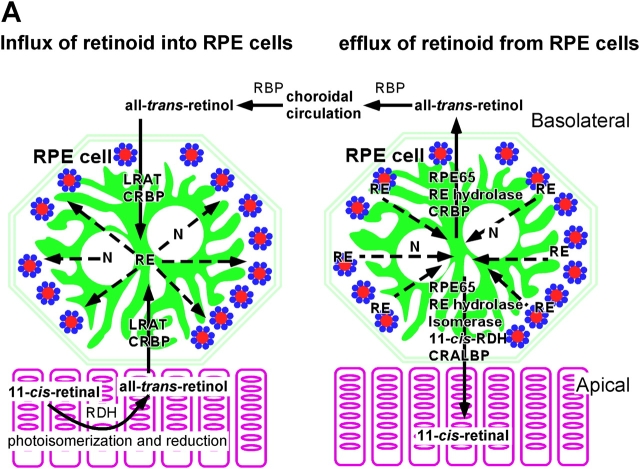
Lipid bodies form autonomous intracellular structures in many model cells and in some cells of specific tissue origin. They contain hydrophobic substances, a set of structural proteins such as perilipin or adipose differentiation-related protein, enzymes implicated in lipid metabolism, and proteins that participate in signaling and membrane trafficking. Retinosomes, particles reminiscent of lipid bodies, have been identified in retinal pigment epithelium as distinct structures compartmentalizing a metabolic intermediate involved in regeneration of the visual chromophore. These observations suggest that lipid bodies, including retinosomes, carry out specific functions that go beyond those of mere lipid storage organelles.
Overview
The claims and statistics of this paper haven’t been checked yet.
Free: it reads the open-access text and checks the first 5 claims that cite a source we can check. Create a free account to check every claim.
Integrity signals
Registry
Cites
Statistics
Figures


Verification
Claims the paper makes
The claims and statistics of this paper haven’t been checked yet.
Free: it reads the open-access text and checks the first 5 claims that cite a source we can check. Create a free account to check every claim.
Claims other papers make about this one
Each is checked against this paper’s own text: does it say what the citing paper says it does?
The source backs part of the claim, not all of it — or backs it for a different population, condition or comparison.
In the citing paper
“Because retinols and retinyl esters (but not retinals) are intrinsically fluorescent, their transformation can be followed by fluorescence induced by two-photon excitation.”
From Chemistry of the Retinoid (Visual) Cycle (2014) · cites this paper as [282]
Experimental — accuracy not yet measuredThe source backs part of the claim, not all of it — or backs it for a different population, condition or comparison.
In the citing paper
“LRAT, through its ability to catalyze the formation of retinyl esters that are readily sequestered by aggregation into lipid droplets called retinosomes, changes the mass action ratio to favor retinoid uptake from both photoreceptors and the choroidal circulation.”
From Chemistry of the Retinoid (Visual) Cycle (2014) · cites this paper as [282]
Experimental — accuracy not yet measuredThe source backs part of the claim, not all of it — or backs it for a different population, condition or comparison.
In the citing paper
“Retinosomes are located close to the RPE plasma membrane and are essential components for 11-cis-retinal production.”
From Chemistry of the Retinoid (Visual) Cycle (2014) · cites this paper as [282]
Experimental — accuracy not yet measured
Self-check
Percentages, sums and reported differences re-computed from the paper’s own numbers.
The self-check needs the paper’s full text.
Citations
Cites
Two-photon laser scanning fluorescence microscopy
Denk, W., Strickler, J. H., & Webb, W. W. (1990) · Science · doi:10.1126/science.2321027 · Cited by 9,488
Allikmets, R., Singh, N., Sun, H., Shroyer, N. F., Hutchinson, A., Chidambaram, A., Gerrard, B., Baird, L., Stauffer, D., Peiffer, A., et al. (1997) · Nature Genetics · doi:10.1038/ng0397-236 · Cited by 1,435 · cited 2×
“The significance of transport across the disk membrane is underscored by the finding that mutations in the ABCR gene in humans (Allikmets et al., 1997) or ABCR gene ablation in mice cause a buildup of bis-retinoids in photoreceptor cells (Mata et al.”
BackgroundThe Surface of Lipid Droplets Is a Phospholipid Monolayer with a Unique Fatty Acid Composition
Tauchi-Sato, K., Ozeki, S., Houjou, T., Taguchi, R., & Fujimoto, T. (2002) · Journal of Biological Chemistry · doi:10.1074/jbc.m207712200 · Cited by 753
Tansey, J. T., Sztalryd, C., Gruia-Gray, J., Roush, D. L., Zee, J. V., Gavrilova, O., Reitman, M. L., Deng, C.-X., Li, C., Kimmel, A. R., et al. (2001) · Proceedings of the National Academy of Sciences · doi:10.1073/pnas.101042998 · Cited by 734
Absence of perilipin results in leanness and reverses obesity in Leprdb/db mice
Martinez-Botas, J., Anderson, J. B., Tessier, D., Lapillonne, A., Chang, B. H.-J., Quast, M. J., Gorenstein, D., Chen, K.-H., & Chan, L. (2000) · Nature Genetics · doi:10.1038/82630 · Cited by 581
Liu, P., Ying, Y., Zhao, Y., Mundy, D. I., Zhu, M., & Anderson, R. G. W. (2004) · Journal of Biological Chemistry · doi:10.1074/jbc.m311945200 · Cited by 527
Mata, N. L., Weng, J., & Travis, G. H. (2000) · Proceedings of the National Academy of Sciences · doi:10.1073/pnas.130110497 · Cited by 456
Londos, C., Brasaemle, D. L., Schultz, C. J., Segrest, J. P., & Kimmel, A. R. (1999) · Seminars in Cell & Developmental Biology · doi:10.1006/scdb.1998.0275 · Cited by 435
Isomerization and Oxidation of Vitamin A in Cone-Dominant Retinas
Mata, N. L., Radu, R. A., Clemmons, R. S., & Travis, G. H. (2002) · Neuron · doi:10.1016/s0896-6273(02)00912-1 · Cited by 382 · cited 2×
“Interestingly, neither retinosomes nor ADRP are found in mouse or bovine retinal Müller cells, which are implicated in the cone-dominant retina (e.g., chicken) as cells functioning alternatively to RPE in 11-cis-retinal production in the course of cone photoreceptor regeneration (Mata et al., 2002).”
BackgroundMiura, S., Gan, J.-W., Brzostowski, J., Parisi, M. J., Schultz, C. J., Londos, C., Oliver, B., & Kimmel, A. R. (2002) · Journal of Biological Chemistry · doi:10.1074/jbc.m204410200 · Cited by 372
Batten, M. L., Imanishi, Y., Maeda, T., Tu, D. C., Moise, A. R., Bronson, D., Possin, D., Van Gelder, R. N., Baehr, W., & Palczewski, K. (2004) · Journal of Biological Chemistry · doi:10.1074/jbc.m312410200 · Cited by 368
Self-citationMcBee, J. K., Palczewski, K., Baehr, W., & Pepperberg, D. R. (2001) · Progress in Retinal and Eye Research · doi:10.1016/s1350-9462(01)00002-7 · Cited by 366 · cited 7×
“These differences loosely correlate with the much faster regeneration of visual pigments, particularly cones, in primates as compared with the slow regeneration process in rodents (McBee et al., 2001).”
BackgroundInfluentialSelf-citationFujimoto, Y., Itabe, H., Sakai, J., Makita, M., Noda, J., Mori, M., Higashi, Y., Kojima, S., & Takano, T. (2004) · Biochimica et Biophysica Acta (BBA) - Molecular Cell Research · doi:10.1016/j.bbamcr.2003.10.018 · Cited by 330
Pol, A., Luetterforst, R., Lindsay, M., Heino, S., Ikonen, E., & Parton, R. G. (2001) · The Journal of Cell Biology · doi:10.1083/jcb.152.5.1057 · Cited by 326
Athenstaedt, K., Zweytick, D., Jandrositz, A., Kohlwein, S. D., & Daum, G. (1999) · Journal of Bacteriology · doi:10.1128/jb.181.20.6441-6448.1999 · Cited by 315
Intracellular cholesterol transport
Maxfield, F. R., & Wüstner, D. (2002) · Journal of Clinical Investigation · doi:10.1172/jci16500 · Cited by 293
Intracellular cholesterol transport
Maxfield, F. R., & Wüstner, D. (2002) · Journal of Clinical Investigation · doi:10.1172/jci0216500 · Cited by 275
Franke, W. W., Hergt, M., & Grund, C. (1987) · Cell · doi:10.1016/0092-8674(87)90763-x · Cited by 273
G Protein-Coupled Receptor Rhodopsin: A Prospectus
Filipek, S., Stenkamp, R. E., Teller, D. C., & Palczewski, K. (2003) · Annual Review of Physiology · doi:10.1146/annurev.physiol.65.092101.142611 · Cited by 267 · cited 2×
“2 B), where it recombines with opsins to form 11-cis-retinylidene-opsins (and rhodopsin and cone pigments; for review see Filipek et al., 2003).”
BackgroundSelf-citationLipid droplets: Proteins floating on a pool of fat
Brown, D. A. (2001) · Current Biology · doi:10.1016/s0960-9822(01)00257-3 · Cited by 263
Ostermeyer, A. G., Paci, J. M., Zeng, Y., Lublin, D. M., Munro, S., & Brown, D. A. (2001) · The Journal of Cell Biology · doi:10.1083/jcb.152.5.1071 · Cited by 253
Caveolin-2 Is Targeted to Lipid Droplets, a New “Membrane Domain” in the Cell
Fujimoto, T., Kogo, H., Ishiguro, K., Tauchi, K., & Nomura, R. (2001) · The Journal of Cell Biology · doi:10.1083/jcb.152.5.1079 · Cited by 250
Imaging living cells and tissues by two-photon excitation microscopy
Piston, D. (1999) · Trends in Cell Biology · doi:10.1016/s0962-8924(98)01432-9 · Cited by 244
Molecular Genetics of Human Retinal Disease
Rattner, A., Sun, H., & Nathans, J. (1999) · Annual Review of Genetics · doi:10.1146/annurev.genet.33.1.89 · Cited by 228 · cited 2×
“Modified retinosomes are also observed in the retina, where they are the result of blinding disorders affecting the enzymes of the retinoid cycle (for review see Rattner et al., 1999; Dryja, 2000; Baehr et al., 2003).”
BackgroundGao, J., & Serrero, G. (1999) · Journal of Biological Chemistry · doi:10.1074/jbc.274.24.16825 · Cited by 214
Pol, A., Martin, S., Fernandez, M. A., Ferguson, C., Carozzi, A., Luetterforst, R., Enrich, C., & Parton, R. G. (2004) · Molecular Biology of the Cell · doi:10.1091/mbc.e03-06-0368 · Cited by 207
Targett-Adams, P., Chambers, D., Gledhill, S., Hope, R. G., Coy, J. F., Girod, A., & McLauchlan, J. (2003) · Journal of Biological Chemistry · doi:10.1074/jbc.m211289200 · Cited by 197
Noninvasive two-photon imaging reveals retinyl ester storage structures in the eye
Imanishi, Y., Batten, M. L., Piston, D. W., Baehr, W., & Palczewski, K. (2004) · The Journal of Cell Biology · doi:10.1083/jcb.200311079 · Cited by 194
Self-citationDryja, T. P. (2000) · American Journal of Ophthalmology · doi:10.1016/s0002-9394(00)00737-6 · Cited by 191 · cited 1×
“Modified retinosomes are also observed in the retina, where they are the result of blinding disorders affecting the enzymes of the retinoid cycle (for review see Rattner et al., 1999; Dryja, 2000; Baehr et al., 2003).”
BackgroundA Palmitoylation Switch Mechanism in the Regulation of the Visual Cycle
Xue, L., Gollapalli, D. R., Maiti, P., Jahng, W. J., & Rando, R. R. (2004) · Cell · doi:10.1016/j.cell.2004.05.016 · Cited by 141
HEID, H. W., SCHNÖLZER, M., & KEENAN, T. W. (1996) · Biochemical Journal · doi:10.1042/bj3201025 · Cited by 134
Mata, N. L., Moghrabi, W. N., Lee, J. S., Bui, T. V., Radu, R. A., Horwitz, J., & Travis, G. H. (2004) · Journal of Biological Chemistry · doi:10.1074/jbc.m310042200 · Cited by 123
Robenek, M. J., Severs, N. J., Schlattmann, K., Plenz, G., Zimmer, K.-P., Troyer, D., & Robenek, H. (2004) · The FASEB Journal · doi:10.1096/fj.03-0782fje · Cited by 122
Caveolin, Cholesterol, and Lipid Droplets?
van Meer, G. (2001) · The Journal of Cell Biology · doi:10.1083/jcb.152.5.f29 · Cited by 113
McBee, J. K., Kuksa, V., Alvarez, R., de Lera, A. R., Prezhdo, O., Haeseleer, F., Sokal, I., & Palczewski, K. (2000) · Biochemistry · doi:10.1021/bi001061c · Cited by 95
Self-citationRando, R. R. (1996) · Chemistry & Biology · doi:10.1016/s1074-5521(96)90105-2 · Cited by 77
Role of the hydrophobic domain in targeting caveolin-1 to lipid droplets
Ostermeyer, A. G., Ramcharan, L. T., Zeng, Y., Lublin, D. M., & Brown, D. A. (2004) · The Journal of Cell Biology · doi:10.1083/jcb.200303037 · Cited by 76
RPE65 Operates in the Vertebrate Visual Cycle by Stereospecifically Binding All-trans-Retinyl Esters
Gollapalli, D. R., Maiti, P., & Rando, R. R. (2003) · Biochemistry · doi:10.1021/bi035227w · Cited by 73
The retinoid cycle and retina disease
Baehr, W., Wu, S. M.-S., Bird, A. C., & Palczewski, K. (2003) · Vision Research · doi:10.1016/j.visres.2003.10.001 · Cited by 71
Self-citationInduction of the Adipose Differentiation-Related Protein in Liver of Etomoxir-Treated Rats
Steiner, S., Wahl, D. R., Mangold, B. L. K., Robison, R. L., Raymackers, J., Meheus, L., Anderson, N. L., & Cordier, A. (1996) · Biochemical and Biophysical Research Communications · doi:10.1006/bbrc.1996.0138 · Cited by 66
Stereoisomeric Specificity of the Retinoid Cycle in the Vertebrate Retina
Jang, G.-F., McBee, J. K., Alekseev, A. M., Haeseleer, F., & Palczewski, K. (2000) · Journal of Biological Chemistry · doi:10.1074/jbc.m004488200 · Cited by 53
Self-citationAhn, J., Beharry, S., Molday, L. L., & Molday, R. S. (2003) · Journal of Biological Chemistry · doi:10.1074/jbc.m304236200 · Cited by 48
Temporal and spatial assembly of lipid droplet-associated proteins in 3T3-L1 preadipocytes
Hwang, R., Wang, S., Yeo, H.-L., & Greenberg, A. S. (2003) · Histochemistry and Cell Biology · doi:10.1007/s00418-003-0575-7 · Cited by 48
(2002) · PubMed · Cited by 46
[21] Quantitative imaging of metabolism by two-photon excitation microscopy
Piston, D. W., & Knobel, S. M. (1999) · Methods in enzymology on CD-ROM/Methods in enzymology · doi:10.1016/s0076-6879(99)07023-8 · Cited by 45
Solubilization of Retinoids by Bile Salt/ Phospholipid Aggregates
Li, C.-Y., Zimmerman, C. L., & Wiedmann, T. S. (1996) · Pharmaceutical Research · doi:10.1023/a:1016013414457 · Cited by 36
Birnbaum, M. J. (2003) · The Journal of Cell Biology · doi:10.1083/jcb.200306008 · Cited by 35
Acute Radiolabeling of Retinoids in Eye Tissues of Normal and Rpe65-Deficient Mice
Qtaishat, N. M., Redmond, T. M., & Pepperberg, D. R. (2003) · Investigative Opthalmology & Visual Science · doi:10.1167/iovs.02-0679 · Cited by 32
Methods Issue on Nuclear Structure and Chromatin
Hager, G. L. (1999) · Methods · doi:10.1006/meth.1999.0870 · Cited by 25
Research works printed but not linked: 1
- 2002, Invest. Ophthalmol. Vis. Sci., 43, 1730
Cited by
Lipid droplets: a unified view of a dynamic organelle
Martin, S., & Parton, R. G. (2006) · Nature Reviews Molecular Cell Biology · doi:10.1038/nrm1912 · Cited by 1,169
Leber congenital amaurosis: Genes, proteins and disease mechanisms
den Hollander, A. I., Roepman, R., Koenekoop, R. K., & Cremers, F. P. M. (2008) · Progress in Retinal and Eye Research · doi:10.1016/j.preteyeres.2008.05.003 · Cited by 811
G Protein–Coupled Receptor Rhodopsin
Palczewski, K. (2006) · Annual Review of Biochemistry · doi:10.1146/annurev.biochem.75.103004.142743 · Cited by 764
Self-citationImaging lipid bodies in cells and tissues using third-harmonic generation microscopy
Débarre, D., Supatto, W., Pena, A.-M., Fabre, A., Tordjmann, T., Combettes, L., Schanne-Klein, M.-C., & Beaurepaire, E. (2006) · Nature Methods · doi:10.1038/nmeth813 · Cited by 578
Hepatic stellate cell lipid droplets: A specialized lipid droplet for retinoid storage
Blaner, W. S., O'Byrne, S. M., Wongsiriroj, N., Kluwe, J., D'Ambrosio, D. M., Jiang, H., Schwabe, R. F., Hillman, E. M. C., Piantedosi, R., & Libien, J. (2009) · Biochimica et Biophysica Acta (BBA) - Molecular and Cell Biology of Lipids · doi:10.1016/j.bbalip.2008.11.001 · Cited by 444
Metadata
- Authors
- Imanishi, Y., Gerke, V., & Palczewski, K.
- Affiliations
- University of Washington (US)
- University of Münster (DE)
- Corresponding author
- Palczewski, Krzysztof
- Venue
- The Journal of Cell Biology
- Publisher
- Rockefeller University Press
- Published
- 2004-08-16
- Volume
- 166
- Issue
- 4
- Pages
- 447-453
- ISSN
- 0021-9525 (ISSN-L)
- 1540-8140
- PMC
- PMC1360213
- OpenAlex
- W2006378422
- Cited by
- 102
- References
- 49
- Citations by year
- 2026: 3 · 2025: 1 · 2024: 4 · 2023: 3 · 2022: 4 · 2021: 5 · 2020: 4 · 2019: 1 · 2018: 3 · 2017: 2 · 2016: 8 · 2015: 1 · 2014: 6 · 2013: 4 · 2012: 7
- FWCI
- 0.88
- Type
- journal article
- Language
- en
- Open access
- green
- www.ncbi.nlm.nih.gov
- Licence
- cc-by-nc-sa
- Locations
- The Journal of Cell Biology (publishedVersion)
- Europe PMC (PubMed Central) (publishedVersion, cc-by-nc-sa)
- PubMed Central (publishedVersion, cc-by-nc-sa)
- PubMed (publishedVersion)
- Funders
- National Eye Institute (R01EY008061, EY13385, EY 08061, R01EY013385)
- Topics
- Life Sciences › Biochemistry, Genetics and Molecular Biology › Biochemistry › Lipid metabolism and biosynthesis
- Life Sciences › Biochemistry, Genetics and Molecular Biology › Cell Biology › Cellular transport and secretion
- Health Sciences › Medicine › Ophthalmology › Retinal Diseases and Treatments
- Keywords
- lipid droplets, retinal pigment epithelium, lipid metabolism, membrane trafficking, retinol
- MeSH terms
- Perilipin-1, Perilipin-2, Animals, Carrier Proteins, Cell Membrane, Cytoplasm, Immunohistochemistry, Lipids, Membrane Proteins, Mice, Transgenic, Models, Biological, Phosphoproteins, Retina, Time Factors, Tretinoin, Signal Transduction, Lipid Metabolism, Mice
About these checks
Registry, retraction, Cites and statistics results are computed, not judged, with one exception: a printed reference that no index lists is read once by a model before it counts as a citation error. Claims are extracted by a model and kept only when their quote appears verbatim in the text; each cited source is then checked, with a model’s help, for whether it says what the claim relies on. Those verdicts can be wrong — read the claim’s quote and the cited source before relying on one.
Statistics and arithmetic are recomputed, not judged.
Confidence bands are shown only for fields calibrated on our annotated test set. None is calibrated yet, so no band is shown.
What counts as a claim ›How we measure confidence ›How we check this ›
Are you an author, or do you see a problem with this page? Request a review
Data sources
Bibliographic data: Semantic Scholar, OpenAlex, Crossref.
Contains information from the Semantic Scholar Academic Graph Datasets, made available under the ODC Attribution License (ODC-BY 1.0).
Semantic Scholar’s data is described in: Kinney, R., et al. (2023). The Semantic Scholar Open Data Platform. arXiv:2301.10140.
