

The DOI matches its Crossref record; 58 of the 58 references it cites were found in a registry or an index.
Early aging–associated phenotypes in Bub3/Rae1 haploinsufficient mice
Open accessAbstract
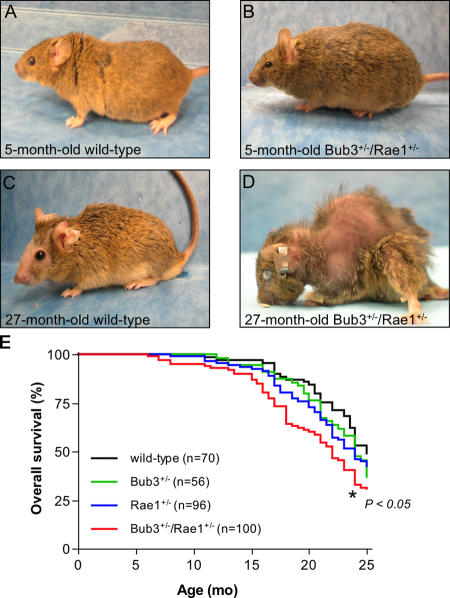
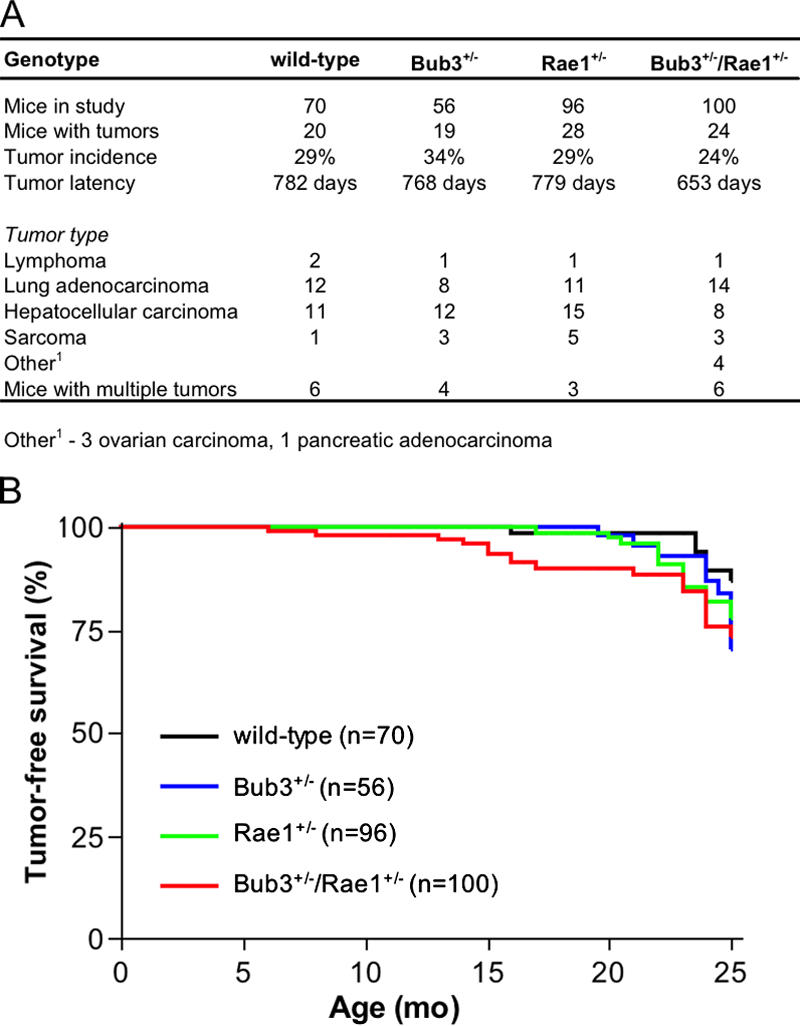
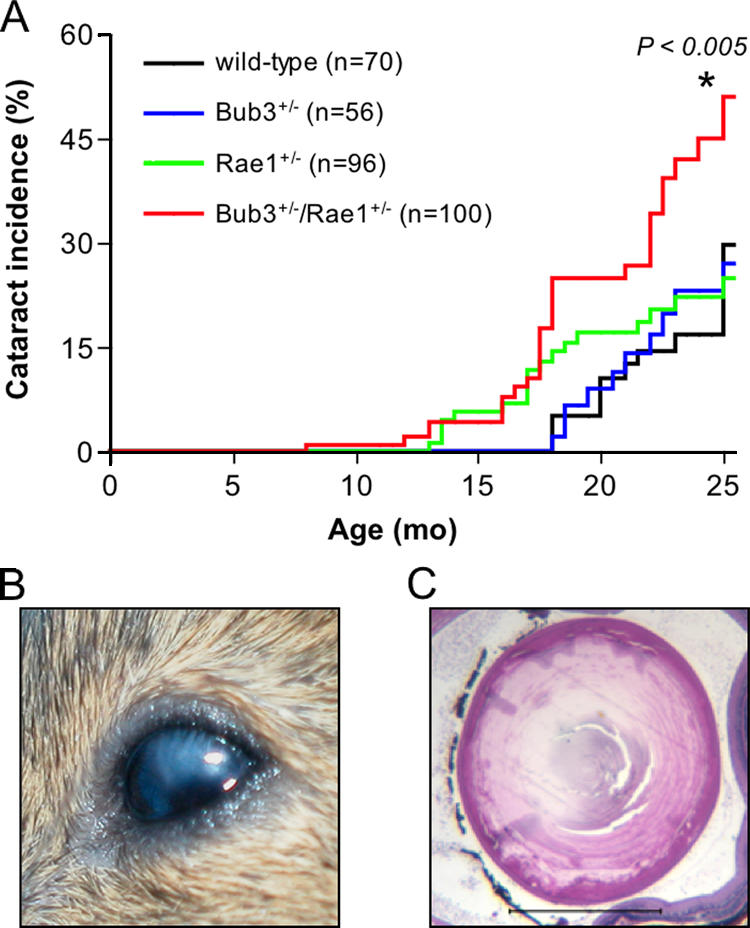
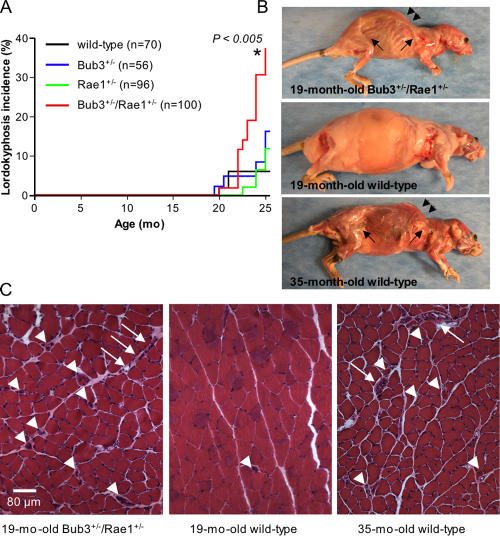
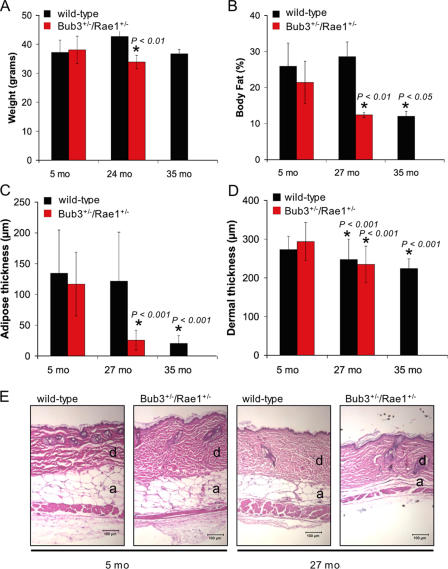
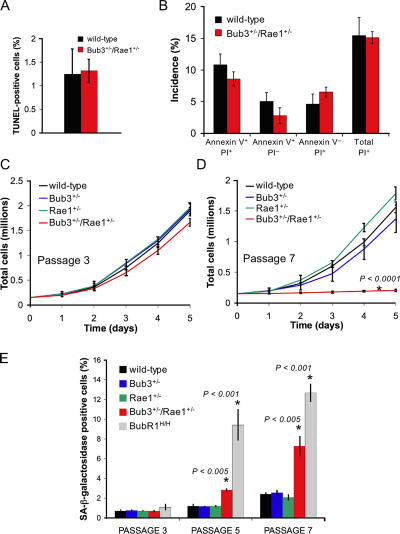
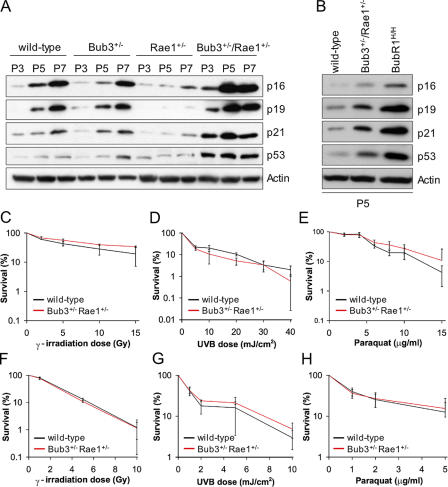
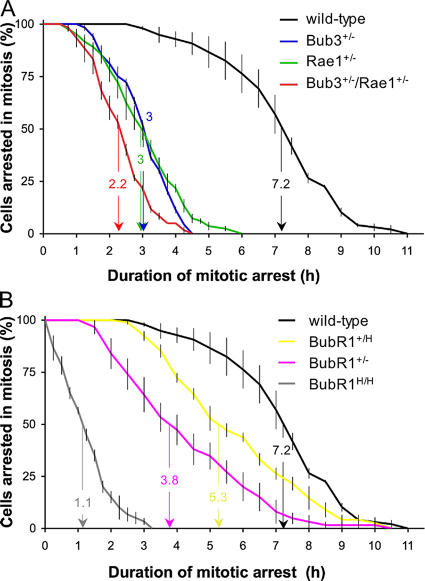
Aging is a highly complex biological process that is believed to involve multiple mechanisms. Mice that have small amounts of the mitotic checkpoint protein BubR1 age much faster than normal mice, but whether other mitotic checkpoint genes function to prevent the early onset of aging is unknown. In this study, we show that several aging-associated phenotypes appear early in mice that are double haploinsufficient for the mitotic checkpoint genes Bub3 and Rae1 but not in mice that are single haploinsufficient for these genes. Mouse embryonic fibroblasts (MEFs) from Bub3/Rae1 haploinsufficient mice undergo premature senescence and accumulate high levels of p19, p53, p21, and p16, whereas MEFs from single haploinsufficient mice do not. Furthermore, although BubR1 hypomorphic mice have less aneuploidy than Bub3/Rae1 haploinsufficient mice, they age much faster. Our findings suggest that early onset of aging-associated phenotypes in mice with mitotic checkpoint gene defects is linked to cellular senescence and activation of the p53 and p16 pathways rather than to aneuploidy.
Overview
The claims and statistics of this paper haven’t been checked yet.
Run the check — free, no account needed. It reads the open-access text and checks the sources it cites.
Integrity signals
Registry
Cites
Statistics
Figures
Verification
Claims the paper makes
The claims and statistics of this paper haven’t been checked yet.
Run the check — free, no account needed. It reads the open-access text and checks the sources it cites.
Claims other papers make about this one
Each is checked against this paper’s own text: does it say what the citing paper says it does?
In the citing paper
“reducing the level of various mitotic checkpoint genes leads to chromosomal instability, augmented aneuploidy and the phenotypic appearance of progeroid mice 36, 37”
From The common biology of cancer and ageing (2007) · cites this paper as [37]
Self-check
Percentages, sums and reported differences re-computed from the paper’s own numbers.
The self-check needs the paper’s full text.
Citations
Cites
Genetic instabilities in human cancers
Lengauer, C., Kinzler, K. W., & Vogelstein, B. (1998) · Nature · doi:10.1038/25292 · Cited by 4,168 · cited 1×
“Because aneuploidy occurs with such high frequency, it has been suggested that an euploidy is an essential step in the process of tumorigenesis (Lengauer et al., 1998).”
BackgroundSenescent cells, tumor suppression, and organismal aging: good citizens, bad neighbors
Campisi, J. (2005) · Cell · doi:10.1016/j.cell.2005.02.003 · Cited by 2,379 · cited 1×
“Combined haploinsuffi ciency of Bub3 and Rae1 results in premature senescence We next investigated whether combined haploinsuffi ciency of Bub3 and Rae1 triggers cell death or cellular senescence, which are two processes that have been linked to aging (Campisi, 2005; Lombard et al., 2005).”
BackgroundThe p53 pathway: positive and negative feedback loops
Harris, S. L., & Levine, A. J. (2005) · Oncogene · doi:10.1038/sj.onc.1208615 · Cited by 1,967
p53 mutant mice that display early ageing-associated phenotypes
Tyner, S. D., Venkatachalam, S., Choi, J., Jones, S., Ghebranious, N., Igelmann, H., Lu, X., Soron, G., Cooper, B., Brayton, C., et al. (2002) · Nature · doi:10.1038/415045a · Cited by 1,459 · cited 1×
“Reduced dermal thickness and subdermal adipose are characteristics of aged mice (de Boer et al., 2002; Tyner et al., 2002).”
BackgroundOn the road to cancer: aneuploidy and the mitotic checkpoint
Kops, G. J. P. L., Weaver, B. A. A., & Cleveland, D. W. (2005) · Nature reviews. Cancer · doi:10.1038/nrc1714 · Cited by 1,201
The signals and pathways activating cellular senescence
Ben-Porath, I., & Weinberg, R. A. (2005) · The International Journal of Biochemistry & Cell Biology · doi:10.1016/j.biocel.2004.10.013 · Cited by 1,046
DNA Repair, Genome Stability, and Aging
Lombard, D. B., Chua, K. F., Mostoslavsky, R., Franco, S., Gostissa, M., & Alt, F. W. (2005) · Cell · doi:10.1016/j.cell.2005.01.028 · Cited by 944
The Anaphase-Promoting Complex
Peters, J. (2002) · Molecular Cell · doi:10.1016/s1097-2765(02)00540-3 · Cited by 928
Sudakin, V., Chan, G. K. T., & Yen, T. J. (2001) · The Journal of Cell Biology · doi:10.1083/jcb.200102093 · Cited by 927
BubR1 insufficiency causes early onset of aging-associated phenotypes and infertility in mice
Baker, D. J., Jeganathan, K. B., Cameron, J. D., Thompson, M., Juneja, S., Kopecka, A., Kumar, R., Jenkins, R. B., de Groen, P. C., Roche, P., et al. (2004) · Nature Genetics · doi:10.1038/ng1382 · Cited by 731
Self-citation
Research works printed but not linked: 1
- 2004, Blood., 103, 1278
Cited by
Sorted by citations
Fat tissue, aging, and cellular senescence
Tchkonia, T., Morbeck, D. E., Von Zglinicki, T., Van Deursen, J., Lustgarten, J., Scrable, H., Khosla, S., Jensen, M. D., & Kirkland, J. L. (2010) · Aging Cell · doi:10.1111/j.1474-9726.2010.00608.x · Cited by 1,094
The common biology of cancer and ageing
Finkel, T., Serrano, M., & Blasco, M. A. (2007) · Nature · doi:10.1038/nature05985 · Cited by 988
Boveri revisited: chromosomal instability, aneuploidy and tumorigenesis
Holland, A. J., & Cleveland, D. W. (2009) · Nature Reviews Molecular Cell Biology · doi:10.1038/nrm2718 · Cited by 859
Aneuploidy Acts Both Oncogenically and as a Tumor Suppressor
Weaver, B. A. A., Silk, A. D., Montagna, C., Verdier-Pinard, P., & Cleveland, D. W. (2007) · Cancer Cell · doi:10.1016/j.ccr.2006.12.003 · Cited by 729
Weaver, B. A. A., & Cleveland, D. W. (2006) · Current Opinion in Cell Biology · doi:10.1016/j.ceb.2006.10.002 · Cited by 575
Metadata
- Authors
- Baker, D. J., Jeganathan, K. B., Malureanu, L., Perez-Terzic, C., Terzic, A., & van Deursen, J. M. A.
- Affiliations
- 1Department of Pediatric and Adolescent Medicine
- 3Department of Medicine,
- Venue
- The Journal of Cell Biology
- Publisher
- Rockefeller University Press
- Published
- 2006-02-13
- Volume
- 172
- Issue
- 4
- Pages
- 529-540
- ISSN
- 0021-9525 (ISSN-L)
- 1540-8140
- PMC
- PMC2063673
- OpenAlex
- W2021488377
- Cited by
- 175
- References
- 58
- Citations by year
- 2026: 2 · 2025: 2 · 2024: 7 · 2023: 3 · 2022: 4 · 2021: 7 · 2020: 2 · 2019: 10 · 2018: 9 · 2017: 7 · 2016: 8 · 2015: 9 · 2014: 12 · 2013: 13 · 2012: 11
- FWCI
- 10.16
- Type
- journal article
- Language
- en
- Open access
- green
- www.ncbi.nlm.nih.gov
- Licence
- cc-by-nc-sa
- Locations
- The Journal of Cell Biology (publishedVersion)
- PubMed Central (publishedVersion, cc-by-nc-sa)
- PubMed (publishedVersion)
- Funders
- National Cancer Institute (CA-96985, CA-77262, R01CA077262, R01CA096985)
- Topics
- Life Sciences › Biochemistry, Genetics and Molecular Biology › Cell Biology › Telomeres, Telomerase, and Senescence
- Life Sciences › Biochemistry, Genetics and Molecular Biology › Aging › Genetics, Aging, and Longevity in Model Organisms
- Life Sciences › Biochemistry, Genetics and Molecular Biology › Cell Biology › Microtubule and mitosis dynamics
- Keywords
- aging, Bub3, Rae1, BubR1, spindle assembly checkpoint, haploinsufficiency, premature senescence, cellular senescence, p53 pathway, p16, p21, p19, aneuploidy, mouse embryonic fibroblasts
- MeSH terms
- Poly-ADP-Ribose Binding Proteins, Aneuploidy, Animals, Chromosomal Proteins, Non-Histone, Haplotypes, Mice, Mutant Strains, Mutation, Neoplasms, Phenotype, Mice, Knockout, Cell Cycle Proteins, Aging, Premature, Nucleocytoplasmic Transport Proteins, Nuclear Matrix-Associated Proteins, Mice
About these checks
Registry, retraction, Cites and statistics results are computed, not judged, with one exception: a printed reference that no index lists is read once by a model before it counts as a citation error. Claims are extracted by a model and kept only when their quote appears verbatim in the text; each cited source is then checked, with a model’s help, for whether it says what the claim relies on. Those verdicts can be wrong — read the claim’s quote and the cited source before relying on one.
Statistics and arithmetic are recomputed, not judged.
Confidence bands are shown only for fields calibrated on our annotated test set. None is calibrated yet, so no band is shown.
What counts as a claim ›How we measure confidence ›How we check this ›
Are you an author, or do you see a problem with this page? Request a review
