

The DOI matches its Crossref record; 123 of the 124 references it cites were found in a registry or an index.
Metabolic regulation of chromatin modifications and gene expression
Open accessAbstract
Dynamic regulation of gene expression in response to changing local conditions is critical for the survival of all organisms. In metazoans, coherent regulation of gene expression programs underlies the development of functionally distinct cell lineages. The cooperation between transcription factors and the chromatin landscape enables precise control of gene expression in response to cell-intrinsic and cell-extrinsic signals. Many of the chemical modifications that decorate DNA and histones are adducts derived from intermediates of cellular metabolic pathways. In addition, several of the enzymes that can remove these marks use metabolites as part of their enzymatic reaction. These observations have led to the hypothesis that fluctuations in metabolite levels influence the deposition and removal of chromatin modifications. In this review, we consider the emerging evidence that cellular metabolic activity contributes to gene expression and cell fate decisions through metabolite-dependent effects on chromatin organization.
Overview
The claims and statistics of this paper haven’t been checked yet.
Run the check — free, no account needed. It reads the open-access text and checks the sources it cites.
Integrity signals
Registry
Cites
Statistics
Figures
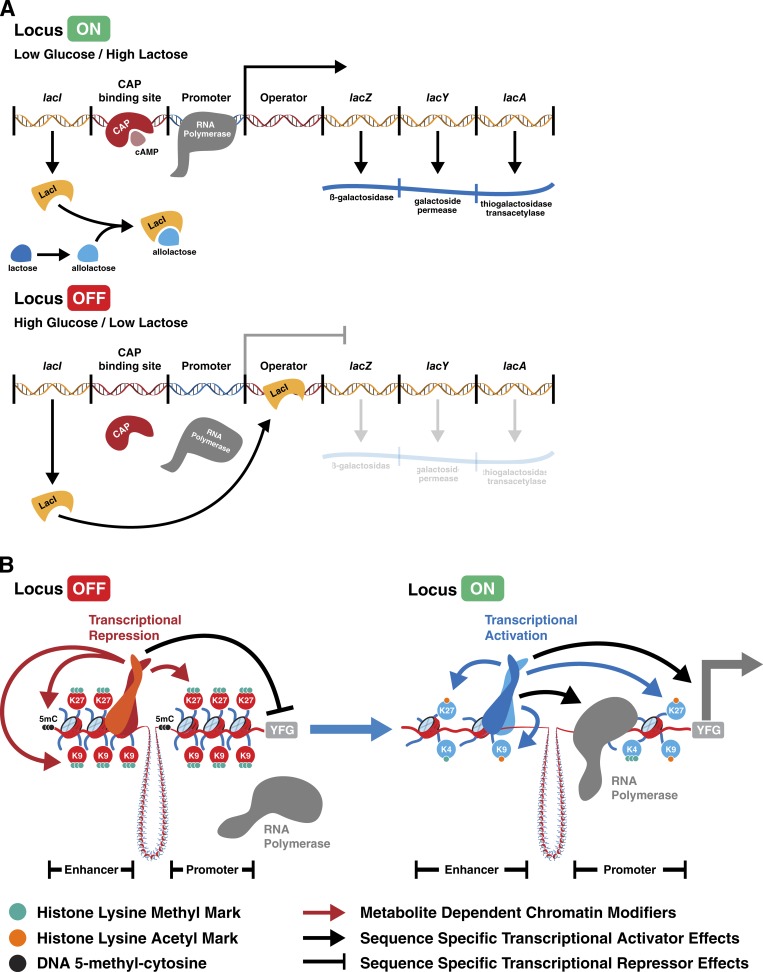
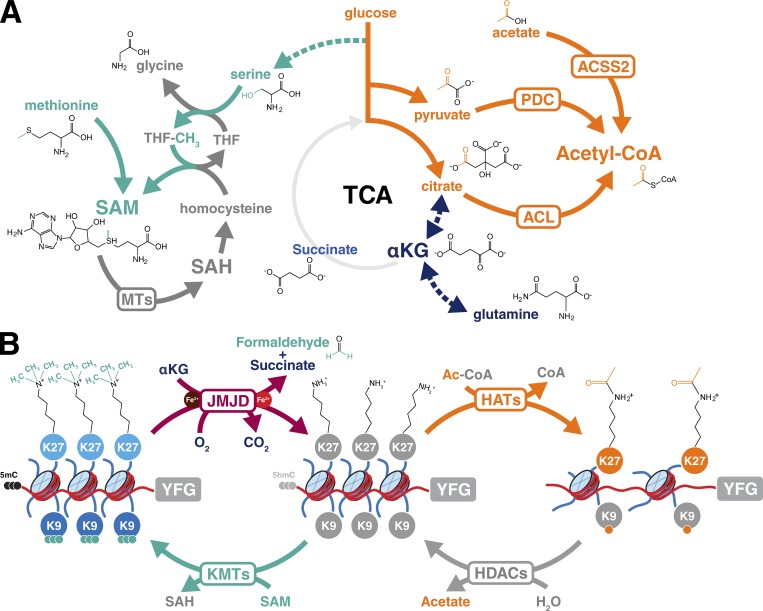
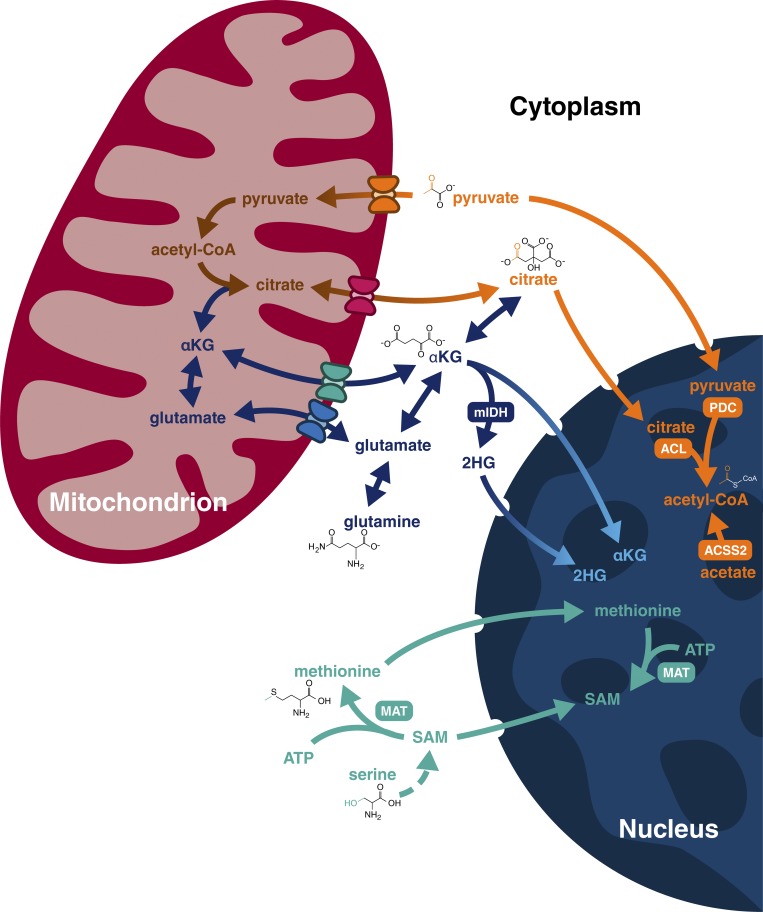
Verification
Claims the paper makes
The claims and statistics of this paper haven’t been checked yet.
Run the check — free, no account needed. It reads the open-access text and checks the sources it cites.
Claims other papers make about this one
Each is checked against this paper’s own text: does it say what the citing paper says it does?
In the citing paper
“In particular, glutamine-derived α-KG has been implicated in regulating cellular histone and DNA methylation levels98.”
From Glutamine reliance in cell metabolism (2020) · cites this paper as [98]
In the citing paper
“In these reactions, α-KG is oxidized to succinate, and increasing levels of succinate can suppress the progression of α-KG-dependent histone or DNA demethylase reactions98.”
From Glutamine reliance in cell metabolism (2020) · cites this paper as [98]
In the citing paper
“By co-opting the production and localization of select TCA cycle metabolites, cells can modulate the activity of chromatin-modifying enzymes and exert control over gene expression and cell fate (158, 159, 160).”
From Regulation and function of the mammalian tricarboxylic acid cycle (2023) · cites this paper as [159]
Self-check
Percentages, sums and reported differences re-computed from the paper’s own numbers.
The self-check needs the paper’s full text.
Citations
Cites
Takahashi, K., & Yamanaka, S. (2006) · Cell · doi:10.1016/j.cell.2006.07.024 · Cited by 26,673
Okano, M., Bell, D. W., Haber, D. A., & Li, E. (1999) · Cell · doi:10.1016/s0092-8674(00)81656-6 · Cited by 6,143
Genetic regulatory mechanisms in the synthesis of proteins.
Jacob, F., & Monod, J. (1961) · Journal of Molecular Biology · doi:10.1016/s0022-2836(61)80072-7 · Cited by 5,300
Metabolites produced by commensal bacteria promote peripheral regulatory T-cell generation
Arpaia, N., Campbell, C., Fan, X., Dikiy, S., van der Veeken, J., deRoos, P., Liu, H., Cross, J. R., Pfeffer, K., Coffer, P. J., et al. (2013) · Nature · doi:10.1038/nature12726 · Cited by 4,838
Selective inhibition of BET bromodomains
Filippakopoulos, P., Qi, J., Picaud, S., Shen, Y., Smith, W. B., Fedorov, O., Morse, E. M., Keates, T., Hickman, T. T., Felletar, I., et al. (2010) · Nature · doi:10.1038/nature09504 · Cited by 4,262
Cancer-associated IDH1 mutations produce 2-hydroxyglutarate
Dang, L., White, D. W., Gross, S., Bennett, B. D., Bittinger, M. A., Driggers, E. M., Fantin, V. R., Jang, H. G., Jin, S., Keenan, M. C., et al. (2009) · Nature · doi:10.1038/nature08617 · Cited by 4,154
Self-citationHistone demethylation mediated by the nuclear amine oxidase homolog LSD1
Shi, Y., Lan, F., Matson, C., Mulligan, P., Whetstine, J. R., Cole, P. A., Casero, R. A., & Shi, Y. (2004) · Cell · doi:10.1016/j.cell.2004.12.012 · Cited by 4,051
Expression of a single transfected cDNA converts fibroblasts to myoblasts
Davis, R. L., Weintraub, H. M., & Lassar, A. B. (1987) · Cell · doi:10.1016/0092-8674(87)90585-x · Cited by 3,388
Xu, W., Yang, H., Liu, Y., Yang, Y., Wang, P., Kim, S.-H., Ito, S., Yang, C., Wang, P., Xiao, M.-T., et al. (2011) · Cancer Cell · doi:10.1016/j.ccr.2010.12.014 · Cited by 2,875
Figueroa, M. E., Abdel-Wahab, O., Lu, C., Ward, P. S., Patel, J., Shih, A., Li, Y., Bhagwat, N., Vasanthakumar, A., Fernandez, H. F., et al. (2010) · Cancer Cell · doi:10.1016/j.ccr.2010.11.015 · Cited by 2,766
Self-citation
Cited by
Sorted by citations
Glutamine reliance in cell metabolism
Yoo, H. C., Yu, Y. C., Sung, Y., & Han, J. M. (2020) · Experimental & Molecular Medicine · doi:10.1038/s12276-020-00504-8 · Cited by 1,021
Identification of bioactive metabolites using activity metabolomics
Rinschen, M. M., Ivanisevic, J., Giera, M., & Siuzdak, G. (2019) · Nature Reviews Molecular Cell Biology · doi:10.1038/s41580-019-0108-4 · Cited by 1,008
Regulation and function of the mammalian tricarboxylic acid cycle
Arnold, P. K., & Finley, L. W. S. (2023) · Journal of Biological Chemistry · doi:10.1016/j.jbc.2022.102838 · Cited by 535
Self-citationEmerging Roles for Branched-Chain Amino Acid Metabolism in Cancer
Sivanand, S., & Heiden, M. G. V. (2020) · Cancer Cell · doi:10.1016/j.ccell.2019.12.011 · Cited by 498
Mitochondria as Signaling Organelles Control Mammalian Stem Cell Fate
Chakrabarty, R. P., & Chandel, N. S. (2021) · Cell stem cell · doi:10.1016/j.stem.2021.02.011 · Cited by 496
Metadata
- Authors
- Schvartzman, J. M., Thompson, C. B., & Finley, L. W. S.
- Affiliations
- Memorial Sloan Kettering Cancer Center (US)
- Corresponding author
- Finley, Lydia W.S.
- Venue
- Journal of Cell Biology
- Publisher
- Rockefeller University Press
- Published
- 2018-05-14
- Volume
- 217
- Issue
- 7
- Pages
- 2247-2259
- ISSN
- 0021-9525 (ISSN-L)
- 1540-8140
- PMC
- PMC6028552
- OpenAlex
- W2804524416
- Cited by
- 233
- References
- 124
- Citations by year
- 2026: 22 · 2025: 23 · 2024: 26 · 2023: 32 · 2022: 22 · 2021: 33 · 2020: 36 · 2019: 34 · 2018: 5
- FWCI
- 2.65
- Type
- journal article
- Language
- en
- Open access
- hybrid
- doi.org
- Licence
- Locations
- The Journal of Cell Biology (publishedVersion, cc-by-nc-sa)
- Europe PMC (PubMed Central) (publishedVersion, cc-by-nc-sa)
- PubMed Central (publishedVersion, cc-by-nc-sa)
- PubMed (publishedVersion)
- Funders
- Hope Funds for Cancer Research
- Damon Runyon Cancer Research Foundation (DFS-23-17)
- Memorial Sloan Kettering Cancer Center (P30 CA008748)
- Topics
- Life Sciences › Biochemistry, Genetics and Molecular Biology › Molecular Biology › Genomics and Chromatin Dynamics
- Life Sciences › Biochemistry, Genetics and Molecular Biology › Molecular Biology › Epigenetics and DNA Methylation
- Life Sciences › Biochemistry, Genetics and Molecular Biology › Molecular Biology › Chromatin Remodeling and Cancer
- Keywords
- chromatin modification, gene expression regulation, cellular metabolism, histone modifications, DNA modification, transcription factors, cell fate determination, chromatin organization
- MeSH terms
- Chromatin, Gene Expression Regulation, Histones, Humans, Cell Lineage, Chromatin Assembly and Disassembly, Epigenesis, Genetic, Metabolic Networks and Pathways
About these checks
Registry, retraction, Cites and statistics results are computed, not judged, with one exception: a printed reference that no index lists is read once by a model before it counts as a citation error. Claims are extracted by a model and kept only when their quote appears verbatim in the text; each cited source is then checked, with a model’s help, for whether it says what the claim relies on. Those verdicts can be wrong — read the claim’s quote and the cited source before relying on one.
Statistics and arithmetic are recomputed, not judged.
Confidence bands are shown only for fields calibrated on our annotated test set. None is calibrated yet, so no band is shown.
What counts as a claim ›How we measure confidence ›How we check this ›
Are you an author, or do you see a problem with this page? Request a review
