

The DOI matches its Crossref record; 54 of the 54 references it cites were found in a registry or an index.
Counterselection against Dμ Is Mediated through Immunoglobulin (Ig)α-Igβ
Abstract
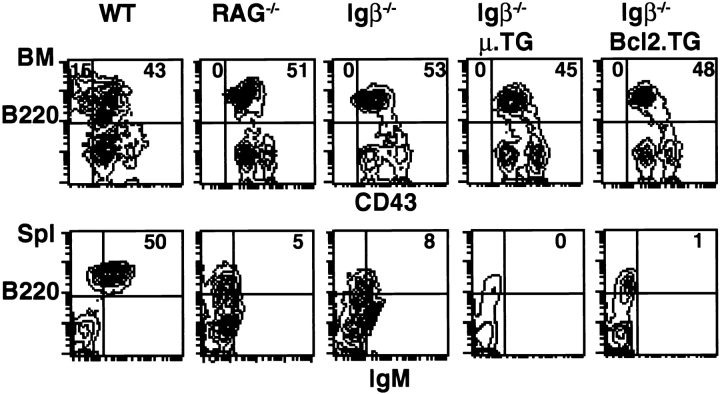
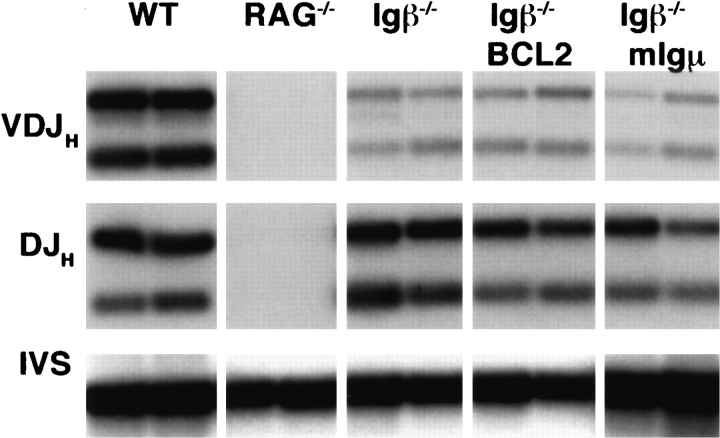
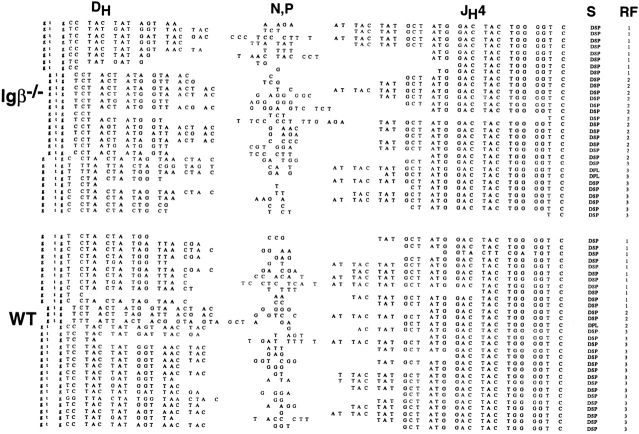
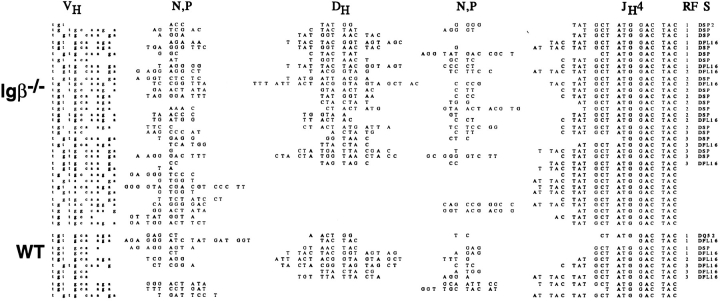
The pre-B cell receptor is a key checkpoint regulator in developing B cells. Early events that are controlled by the pre-B cell receptor include positive selection for cells express membrane immunoglobulin heavy chains and negative selection against cells expressing truncated immunoglobulins that lack a complete variable region (Dμ). Positive selection is known to be mediated by membrane immunoglobulin heavy chains through Igα-Igβ, whereas the mechanism for counterselection against Dμ has not been determined. We have examined the role of the Igα-Igβ signal transducers in counterselection against Dμ using mice that lack Igβ. We found that Dμ expression is not selected against in developing B cells in Igβ mutant mice. Thus, the molecular mechanism for counterselection against Dμ in pre-B cells resembles positive selection in that it requires interaction between mDμ and Igα-Igβ.
Overview
The claims and statistics of this paper haven’t been checked yet.
Run the check — free, no account needed. It reads the open-access text and checks the sources it cites.
Integrity signals
Registry
Cites
Statistics
Figures
Verification
Claims the paper makes
The claims and statistics of this paper haven’t been checked yet.
Run the check — free, no account needed. It reads the open-access text and checks the sources it cites.
Claims other papers make about this one
Each is checked against this paper’s own text: does it say what the citing paper says it does?
The cited source says what the claim attributes to it.
In the citing paper
“Signaling components of the antigen receptor complexes on the surface of B cell progenitors (pre-BCR)1 and B cells (BCR) are necessary for the developmental progression of B-lymphocytes (1-5”
From AKT Induces Transcriptional Activity of PU.1 through Phosphorylation-mediated Modifications within Its Transactivation Domain (2001) · cites this paper as [4]
Self-check
Percentages, sums and reported differences re-computed from the paper’s own numbers.
The self-check needs the paper’s full text.
Citations
Cites
Somatic generation of antibody diversity
Tonegawa, S. (1983) · Nature · doi:10.1038/302575a0 · Cited by 4,005
Bcl-2 gene promotes haemopoietic cell survival and cooperates with c-myc to immortalize pre-B cells
Vaux, D. L., Cory, S., & Adams, J. M. (1988) · Nature · doi:10.1038/335440a0 · Cited by 3,261
Somatic generation of antibody diversity.
Matthyssens, G., Hozumi, N., & Tonegawa, S. (1976) · PubMed · Cited by 3,237
RAG-1-deficient mice have no mature B and T lymphocytes
Mombaerts, P., Iacomini, J., Johnson, R. S., Herrup, K., Tonegawa, S., & Papaioannou, V. E. (1992) · Cell · doi:10.1016/0092-8674(92)90030-g · Cited by 2,972
RAG-2-deficient mice lack mature lymphocytes owing to inability to initiate V(D)J rearrangement
Shinkai, Y. (1992) · Cell · doi:10.1016/0092-8674(92)90029-c · Cited by 2,150
Kitamura, D., Roes, J., Kühn, R., & Rajewsky, K. (1991) · Nature · doi:10.1038/350423a0 · Cited by 1,783
Clonal selection and learning in the antibody system
Rajewsky, K. (1996) · Nature · doi:10.1038/381751a0 · Cited by 1,748
Resolution and characterization of pro-B and pre-pro-B cell stages in normal mouse bone marrow.
Hardy, R. R., Carmack, C. E., Shinton, S. A., Kemp, J. D., & Hayakawa, K. (1991) · The Journal of Experimental Medicine · doi:10.1084/jem.173.5.1213 · Cited by 1,604
Ordered rearrangement of immunoglobulin heavy chain variable region segments
Alt, F. W., Yancopoulos, G. D., Blackwell, T. K., Wood, C., Thomas, E., Boss, M., Coffman, R., Rosenberg, N., Tonegawa, S., & Baltimore, D. (1984) · The EMBO Journal · doi:10.1002/j.1460-2075.1984.tb01955.x · Cited by 733
Requirement for Ku80 in growth and immunoglobulin V(D)J recombination
Nussenzweig, A., Chen, C., Soares, V. D. C., Sanchez, M., Sokol, K. A., Nussenzweig, M. C., & Li, G. C. (1996) · Nature · doi:10.1038/382551a0 · Cited by 662
Self-citation
Cited by
Role of PI3K in the generation and survival of B cells
Werner, M., Hobeika, E., & Jumaa, H. (2010) · Immunological Reviews · doi:10.1111/j.1600-065x.2010.00934.x · Cited by 122
Rieske, P., & Pongubala, J. R. (2001) · Journal of Biological Chemistry · doi:10.1074/jbc.m007482200 · Cited by 54
Metadata
- Authors
- Gong, S., Sanchez, M., & Nussenzweig, M. C.
- Affiliations
- From the Laboratory of Molecular Immunology, The Howard Hughes Medical Institute, The Rockefeller University, New York 10021
- Venue
- The Journal of Experimental Medicine
- Publisher
- Rockefeller University Press
- Published
- 1996-12-01
- Volume
- 184
- Issue
- 6
- Pages
- 2079-2084
- ISSN
- 0022-1007
- 1540-9538
- PMC
- PMC2196397
- Cited by
- 16
- References
- 54
- Language
- en
About these checks
Registry, retraction, Cites and statistics results are computed, not judged, with one exception: a printed reference that no index lists is read once by a model before it counts as a citation error. Claims are extracted by a model and kept only when their quote appears verbatim in the text; each cited source is then checked, with a model’s help, for whether it says what the claim relies on. Those verdicts can be wrong — read the claim’s quote and the cited source before relying on one.
Statistics and arithmetic are recomputed, not judged.
Confidence bands are shown only for fields calibrated on our annotated test set. None is calibrated yet, so no band is shown.
What counts as a claim ›How we measure confidence ›How we check this ›
Are you an author, or do you see a problem with this page? Request a review
Data sources
Bibliographic data: Semantic Scholar, OpenAlex, Crossref.
Contains information from the Semantic Scholar Academic Graph Datasets, made available under the ODC Attribution License (ODC-BY 1.0).
Semantic Scholar’s data is described in: Kinney, R., et al. (2023). The Semantic Scholar Open Data Platform. arXiv:2301.10140.
