

The DOI matches its Crossref record.
Suppression of Signal Transducer and Activator of Transcription 3–Dependent B Lymphocyte Terminal Differentiation by Bcl-6
Abstract
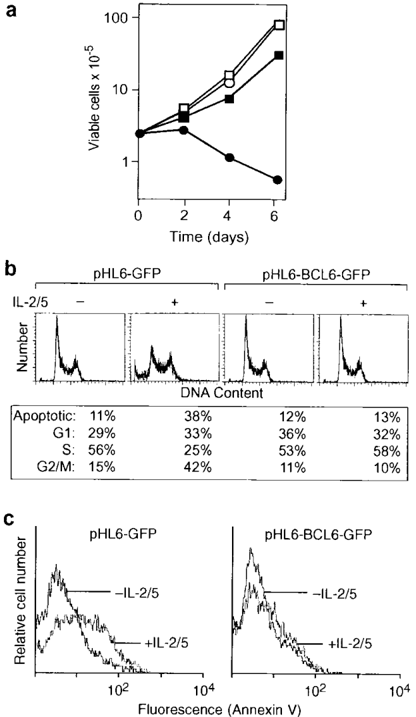
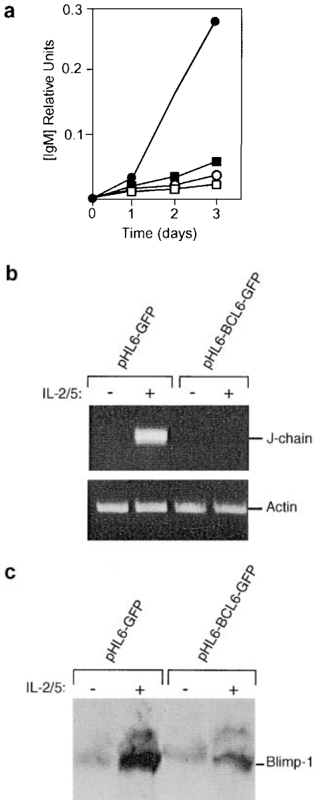
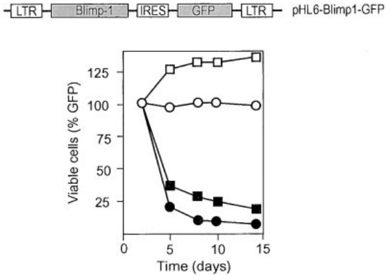
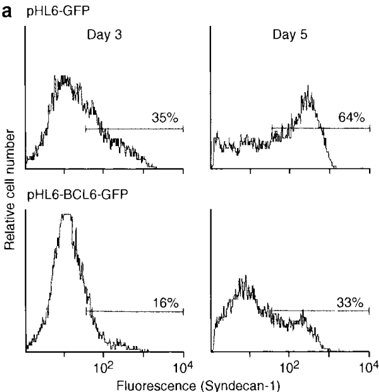
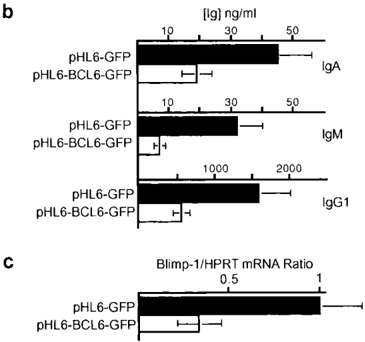
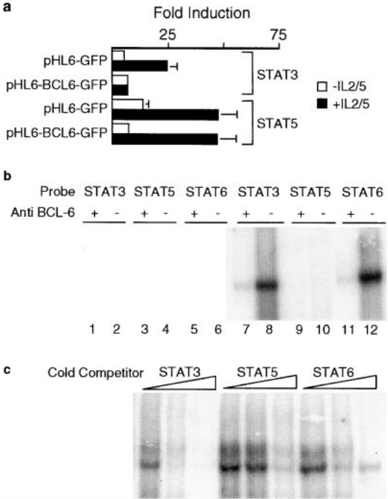
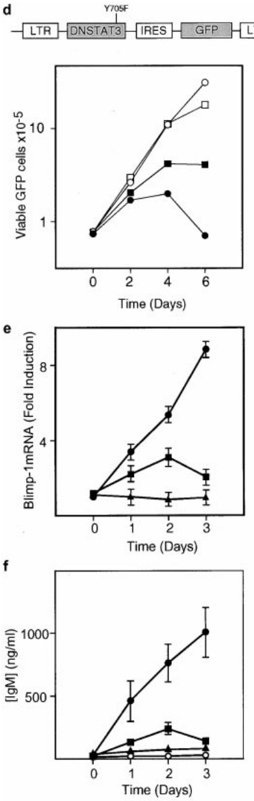
Lymphocytes usually differentiate into effector cells within days after antigen exposure, except in germinal centers where terminal differentiation is delayed while somatic hypermutation creates high-affinity antibody mutants. Here we investigate whether arrest of terminal differentiation can be mediated by BCL-6, a transcriptional repressor that is expressed by germinal center B cells and is required for this phase of B cell development. We find that BCL-6 suppresses the differentiation of transformed and primary B cells to plasma cells by inhibiting the signal transducer and activator of transcription 3–dependent expression of the major regulator of plasma cell development, the B lymphocyte–induced maturation protein (Blimp-1). This function of BCL-6 as a repressor of B lymphocyte differentiation may also underlie the association between chromosomal translocations of its gene and B cell lymphomas.
Overview
The claims and statistics of this paper haven’t been checked yet.
Run the check — free, no account needed. It reads the open-access text and checks the sources it cites.
Integrity signals
Registry
Cites
Statistics
Figures
Verification
Claims the paper makes
The claims and statistics of this paper haven’t been checked yet.
Run the check — free, no account needed. It reads the open-access text and checks the sources it cites.
Claims other papers make about this one
Each is checked against this paper’s own text: does it say what the citing paper says it does?
In the citing paper
“BLIMP-1, a gene whose expression is required for terminal differentiation to plasma cells, is a direct target of BCL-6 [35,36].”
From Deletion of murine Rhoh leads to de-repression of Bcl-6 via decreased KAISO levels and accelerates a malignancy phenotype in a murine model of lymphoma (2022) · cites this paper as [35]
In the citing paper
“BLIMP-1, a gene whose expression is required for terminal differentiation to plasma cells, is a direct target of BCL-6 [35,36].”
From Deletion of murine Rhoh leads to de-repression of Bcl-6 via decreased KAISO levels and accelerates a malignancy phenotype in a murine model of lymphoma (2022) · cites this paper as [35]
Self-check
Percentages, sums and reported differences re-computed from the paper’s own numbers.
The self-check needs the paper’s full text.
Citations
Cites
No references could be resolved yet.
Research works printed but not linked: 30
- Berek, 1991, Maturation of the immune response in germinal centers, Cell., 67, 1121, 10.1016/0092-8674(91)90289-B · DOI
- Jacob, 1991, Intraclonal generation of antibody mutants in germinal centres, Nature., 354, 389, 10.1038/354389a0 · DOI
- Baron, 1993, Identification of the gene associated with the recurring chromosomal translocations t(3;14)(q27;q32) and t(3;22)(q27;q11) in B-cell lymphomas, Proc. Natl. Acad. Sci. USA., 90, 5262, 10.1073/pnas.90.11.5262 · DOI
- Ye, 1993, Alterations of a zinc finger-encoding gene, BCL-6, in diffuse large-cell lymphoma, Science, 262, 747, 10.1126/science.8235596 · DOI
- Deweindt, 1995, The LAZ3/BCL-6 oncogene encodes a sequence-specific transcriptional inhibitora novel function for the BTB/POZ domain as an autonomous repressing domain, Cell Growth Differ., 6, 1495
- Chang, 1996, BCL-6, a POZ/zinc-finger protein, is a sequence-specific transcriptional repressor, Proc. Natl. Acad. Sci. USA., 93, 6947, 10.1073/pnas.93.14.6947 · DOI
- Seyfert, 1996, Transcriptional repression by the proto-oncogene BCL-6, Oncogene, 6, 2331
- Bardwell, 1994, The POZ domaina conserved protein-protein interaction motif, Genes Dev., 8, 1664, 10.1101/gad.8.14.1664 · DOI
- Dent, 1997, Control of inflammation, cytokine expression, and germinal center formation by BCL-6, Science., 276, 589, 10.1126/science.276.5312.589 · DOI
- Fukuda, 1997, Disruption of the BCL-6 gene results in an impaired germinal center formation, J. Exp. Med., 186, 439, 10.1084/jem.186.3.439 · DOI
- Ye, 1997, The BCL-6 proto-oncogene controls germinal-centre formation and Th2-type inflammation, Nat. Genet., 16, 161, 10.1038/ng0697-161 · DOI
- Toney, 2000, BCL-6 regulates chemokine gene transcription in macrophages, Nat. Immunol., 1, 214, 10.1038/79749 · DOI
- Shaffer, 2000, BCL-6 represses genes that function in lymphocyte differentiation, inflammation and cell cycle control, Immunity, 13, 199, 10.1016/S1074-7613(00)00020-0 · DOI · Paper page
- Turner, 1994, Blimp-1, a novel zinc finger-containing protein that can drive the maturation of B lymphocytes into immunoglobulin-secreting cells, Cell, 77, 297, 10.1016/0092-8674(94)90321-2 · DOI
- Messika, 1998, Differential effect of B lymphocyte–induced maturation protein (Blimp-1) expression on cell fate during B cell development, J. Exp. Med., 188, 515, 10.1084/jem.188.3.515 · DOI
- Keller, 1991, Identification and characterization of a novel repressor of β-interferon gene expression, Genes Dev., 5, 868, 10.1101/gad.5.5.868 · DOI
- Niu, 1998, Antigen receptor signaling induces MAP kinase-mediated phosphorylation and degradation of the BCL-6 transcription factor, Genes Dev., 12, 1953, 10.1101/gad.12.13.1953 · DOI
- Minami, 1996, STAT3 activation is a critical step in gp130-mediated terminal differentiation and growth arrest of a myeloid cell line, Proc. Natl. Acad. Sci. USA., 93, 3963, 10.1073/pnas.93.9.3963 · DOI
- Pear, 1993, Production of high-titer helper-free retroviruses by transient transfection, Proc. Natl. Acad. Sci. USA., 90, 8392, 10.1073/pnas.90.18.8392 · DOI
- Tuveson, 1993, CD19 of B cells as a surrogate kinase insert region to bind phosphatidylinositol 3-kinase, Science., 260, 986, 10.1126/science.7684160 · DOI
- Livak, 1995, Oligonucleotides with fluorescent dyes at opposite ends provide a quenched probe system useful for detecting PCR product and nucleic acid hybridization, PCR Methods Appl., 4, 357, 10.1101/gr.4.6.357 · DOI
- Rusterholz, 1999, Interleukin-2 (IL-2) regulates the accessibility of the IL-2-responsive enhancer in the IL-2 receptor α gene to transcription factors, Mol. Cell. Biol., 19, 2681, 10.1128/MCB.19.4.2681 · DOI
- Rakemann, 1999, The designer cytokine hyper-interleukin-6 is a potent activator of STAT3-dependent gene transcription in vivo and in vitro, J. Biol. Chem., 274, 1257, 10.1074/jbc.274.3.1257 · DOI
- Schreiber, 1989, Rapid detection of octamer binding proteins with ‘mini-extracts,’ prepared from a small number of cells, Nucleic Acids Res., 17, 6419, 10.1093/nar/17.15.6419 · DOI
- Harris, 1999, Transcriptional repression of Stat6-dependent interleukin-4-induced genes by BCL-6specific regulation of iepsilon transcription and immunoglobulin E switching, Mol. Cell. Biol., 19, 7264, 10.1128/MCB.19.10.7264 · DOI
- Meyer, 1998, PMA/ionomycin induces Ig κ 3′ enhancer activity which is in part mediated by a unique NFAT transcription complex, Eur. J. Immunol., 28, 1467, 10.1002/(SICI)1521-4141(199805)28:05<1467::AID-IMMU1467>3.0.CO;2-9 · DOI
- Blackman, 1986, A model system for peptide hormone action in differentiationinterleukin 2 induces a B lymphoma to transcribe the J chain gene, Cell., 47, 609, 10.1016/0092-8674(86)90625-2 · DOI
- Matsui, 1989, B cell response pathways regulated by IL-5 and IL-2. Secretory μH chain-mRNA and J chain mRNA expression are separately controlled events, J. Immunol., 142, 2918, 10.4049/jimmunol.142.8.2918 · DOI
- Lin, 1997, Repression of c-myc transcription by Blimp-1, an inducer of terminal B cell differentiation, Science., 276, 596, 10.1126/science.276.5312.596 · DOI
- Leonard, 1998, Jaks and STATsbiological implications, Annu. Rev. Immunol., 16, 293, 10.1146/annurev.immunol.16.1.293 · DOI
Cited by
Johnston, R. J., Poholek, A. C., DiToro, D., Yusuf, I., Eto, D., Barnett, B., Dent, A. L., Craft, J., & Crotty, S. (2009) · Science · doi:10.1126/science.1175870 · Cited by 1,626
Chtanova, T., Tangye, S. G., Newton, R., Frank, N., Hodge, M. R., Rolph, M. S., & Mackay, C. R. (2004) · The Journal of Immunology · doi:10.4049/jimmunol.173.1.68 · Cited by 722
Cattoretti, G., Pasqualucci, L., Ballon, G., Tam, W., Nandula, S. V., Shen, Q., Mo, T., Murty, V. V., & Dalla-Favera, R. (2005) · Cancer Cell · doi:10.1016/j.ccr.2005.03.037 · Cited by 383
Direct Repression of prdm1 by Bcl-6 Inhibits Plasmacytic Differentiation
Tunyaplin, C., Shaffer, A. L., Angelin-Duclos, C. D., Yu, X., Staudt, L. M., & Calame, K. L. (2004) · The Journal of Immunology · doi:10.4049/jimmunol.173.2.1158 · Cited by 376
Graef, P., Buchholz, V. R., Stemberger, C., Flossdorf, M., Henkel, L., Schiemann, M., Drexler, I., Höfer, T., Riddell, S. R., & Busch, D. H. (2014) · Immunity · doi:10.1016/j.immuni.2014.05.018 · Cited by 311
Ranuncolo, S. M., Polo, J. M., Dierov, J., Singer, M., Kuo, T., Greally, J., Green, R., Carroll, M., & Melnick, A. (2007) · Nature Immunology · doi:10.1038/ni1478 · Cited by 278
Arrested differentiation, the self-renewing memory lymphocyte, and vaccination
Fearon, D. T., Manders, P., & Wagner, S. D. (2001) · Science · doi:10.1126/science.1062589 · Cited by 265
Self-citationHoriguchi, H., Xu, H., Duvert, B., Ciuculescu, F., Yao, Q., Sinha, A., McGuinness, M., Harris, C., Brendel, C., Troeger, A., et al. (2022) · Small GTPases · doi:10.1080/21541248.2021.2019503 · Cited by 3
Metadata
- Authors
- Reljic, R., Wagner, S. D., Peakman, L. J., & Fearon, D. T.
- Venue
- The Journal of Experimental Medicine
- Publisher
- Rockefeller University Press
- Published
- 2000-12-18
- Volume
- 192
- Issue
- 12
- Pages
- 1841-1848
- ISSN
- 0022-1007
- 1540-9538
- Cited by
- 182
- References
- 0
- Language
- en
About these checks
Registry, retraction, Cites and statistics results are computed, not judged, with one exception: a printed reference that no index lists is read once by a model before it counts as a citation error. Claims are extracted by a model and kept only when their quote appears verbatim in the text; each cited source is then checked, with a model’s help, for whether it says what the claim relies on. Those verdicts can be wrong — read the claim’s quote and the cited source before relying on one.
Statistics and arithmetic are recomputed, not judged.
Confidence bands are shown only for fields calibrated on our annotated test set. None is calibrated yet, so no band is shown.
What counts as a claim ›How we measure confidence ›How we check this ›
Are you an author, or do you see a problem with this page? Request a review
