

The DOI matches its Crossref record.
Rapid mobilization of murine and human hematopoietic stem and progenitor cells with AMD3100, a CXCR4 antagonist
Abstract
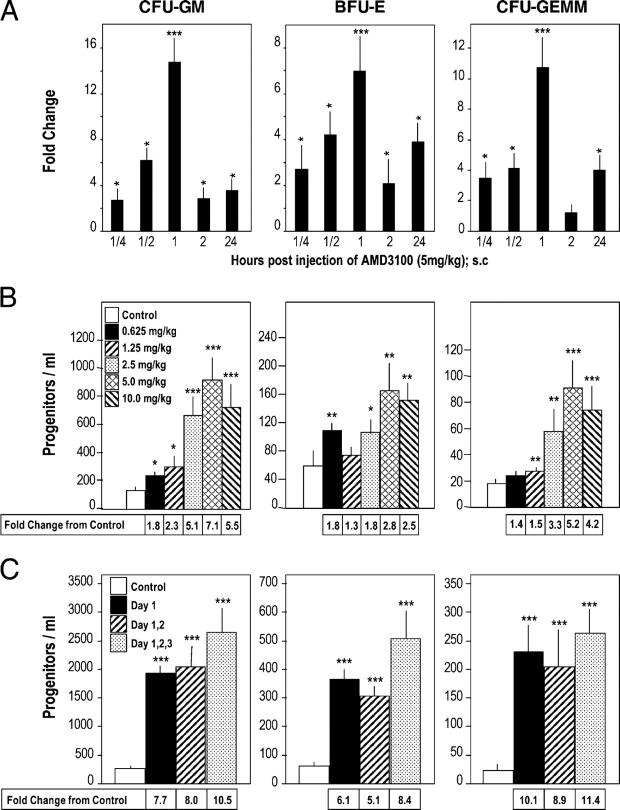
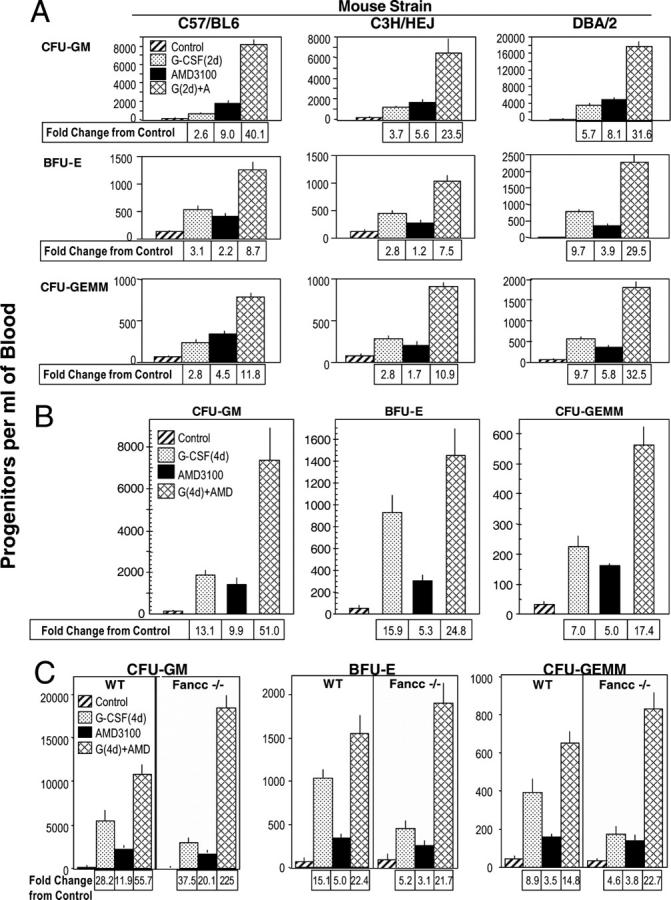
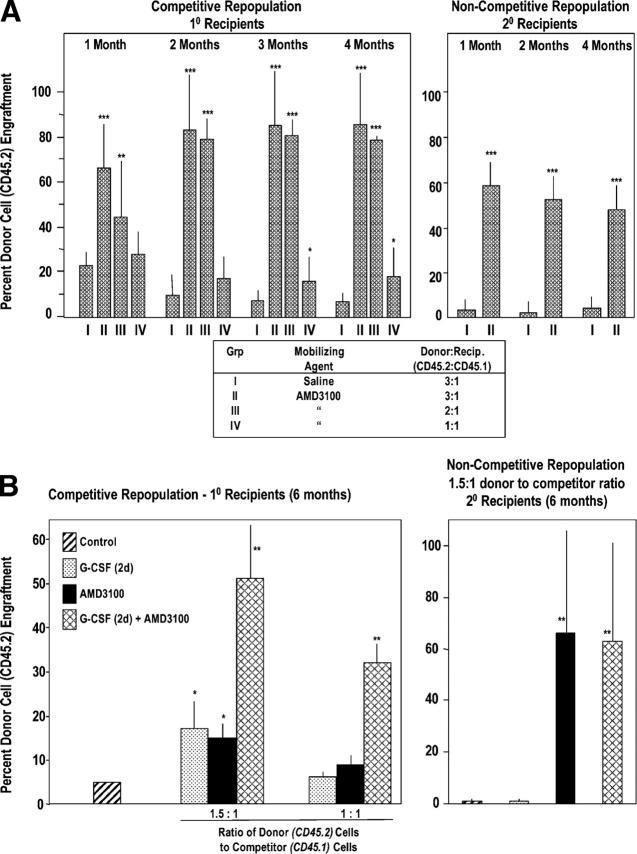
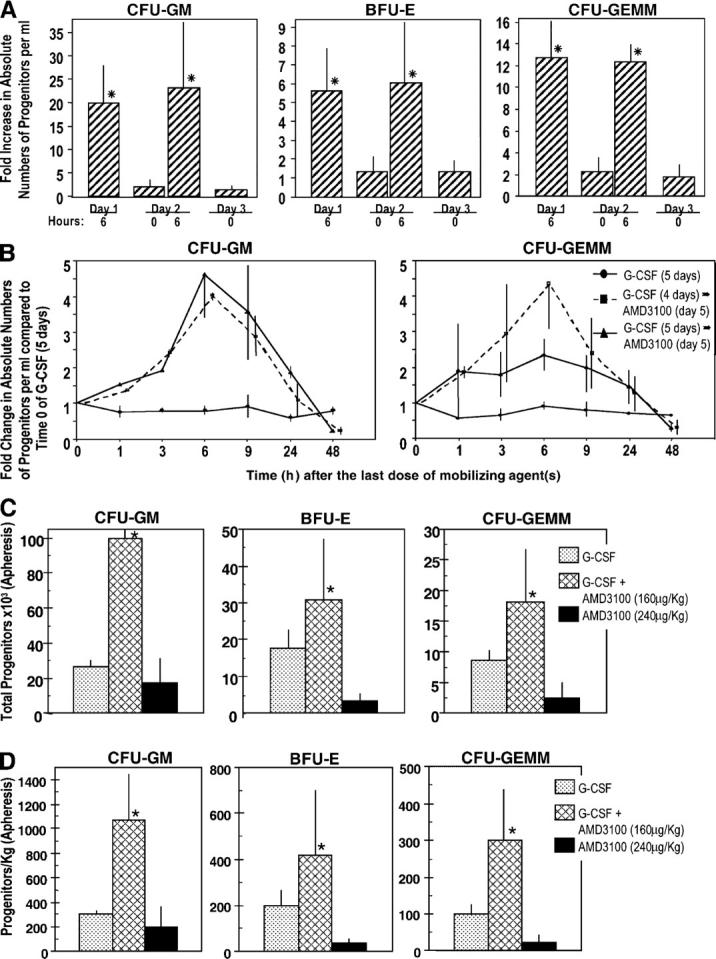
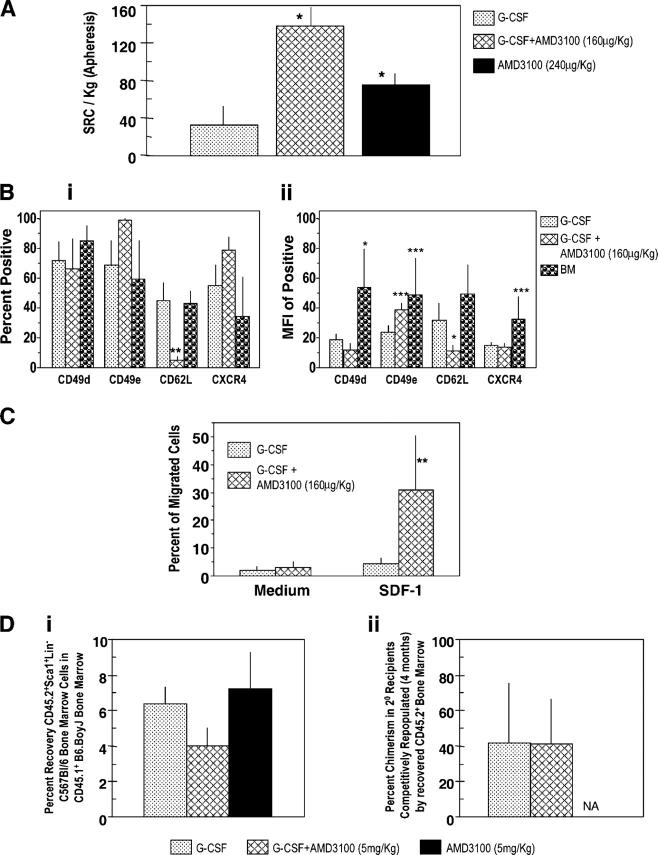
Improving approaches for hematopoietic stem cell (HSC) and hematopoietic progenitor cell (HPC) mobilization is clinically important because increased numbers of these cells are needed for enhanced transplantation. Chemokine stromal cell derived factor-1 (also known as CXCL12) is believed to be involved in retention of HSCs and HPCs in bone marrow. AMD3100, a selective antagonist of CXCL12 that binds to its receptor, CXCR4, was evaluated in murine and human systems for mobilizing capacity, alone and in combination with granulocyte colony-stimulating factor (G-CSF). AMD3100 induced rapid mobilization of mouse and human HPCs and synergistically augmented G-CSF–induced mobilization of HPCs. AMD3100 also mobilized murine long-term repopulating (LTR) cells that engrafted primary and secondary lethally-irradiated mice, and human CD34+ cells that can repopulate nonobese diabetic-severe combined immunodeficiency (SCID) mice. AMD3100 synergized with G-CSF to mobilize murine LTR cells and human SCID repopulating cells (SRCs). Human CD34+ cells isolated after treatment with G-CSF plus AMD3100 expressed a phenotype that was characteristic of highly engrafting mouse HSCs. Synergy of AMD3100 and G-CSF in mobilization was due to enhanced numbers and perhaps other characteristics of the mobilized cells. These results support the hypothesis that the CXCL12-CXCR4 axis is involved in marrow retention of HSCs and HPCs, and demonstrate the clinical potential of AMD3100 for HSC mobilization.
Overview
The claims and statistics of this paper haven’t been checked yet.
Run the check — free, no account needed. It reads the open-access text and checks the sources it cites.
Integrity signals
Registry
Cites
Statistics
Figures
Verification
Claims the paper makes
The claims and statistics of this paper haven’t been checked yet.
Run the check — free, no account needed. It reads the open-access text and checks the sources it cites.
Claims other papers make about this one
Each is checked against this paper’s own text: does it say what the citing paper says it does?
In the citing paper
“Thus, antagonizing the interaction of SDF-1 with CXCR4 on HSCs has been shown to result in HSC mobilization in healthy human volunteers and in patients with multiple myeloma and non-Hodgkin’s lymphoma who had received previous chemotherapy[82,86].”
From Finding the needle in the hay stack: Hematopoietic stem cells in Fanconi anemia (2009) · cites this paper as [82]
In the citing paper
“One such agent, AMD 3100, is a competitive small-molecule antagonist of the interaction of stromal derived factor 1 (SDF-1) and the chemokine receptor CXCR4 [82].”
From Finding the needle in the hay stack: Hematopoietic stem cells in Fanconi anemia (2009) · cites this paper as [82]
Self-check
Percentages, sums and reported differences re-computed from the paper’s own numbers.
The self-check needs the paper’s full text.
Citations
Cites
No references could be resolved yet.
Research works printed but not linked: 47
- 2003, Annu. Rev. Immunol., 21, 759, 10.1146/annurev.immunol.21.120601.141007 · DOI
- 2001, Science., 294, 1933, 10.1126/science.1064081 · DOI · Paper page
- 2003, Blood., 102, 1249, 10.1182/blood-2003-01-0318 · DOI
- 2004, Blood., 103, 1580, 10.1182/blood-2003-05-1595 · DOI
- 1995, Stem Cells., 13, 512, 10.1002/stem.5530130508 · DOI
- 1997, Blood., 9, 2736
- 2000, Br. J. Haematol., 110, 638, 10.1046/j.1365-2141.2000.02252.x · DOI
- 2001, Blood., 98, 2917, 10.1182/blood.V98.10.2917 · DOI · Paper page
- 2002, Curr. Opin. Mol. Ther., 4, 482
- 1997, J. Exp. Med., 185, 111, 10.1084/jem.185.1.111 · DOI · Paper page
- 1998, Blood., 91, 100, 10.1182/blood.V91.1.100 · DOI
- 2000, J. Clin. Invest., 105, 101, 10.1172/JCI7954 · DOI
- 2002, J. Exp. Med., 195, 1145, 10.1084/jem.20011284 · DOI
- 1999, Science, 283, 845, 10.1126/science.283.5403.845 · DOI · Paper page
- 2002, Leukemia., 16, 1992, 10.1038/sj.leu.2402684 · DOI
- 2004, Science., 305, 1000, 10.1126/science.1097071 · DOI · Paper page
- 2003, J. Immunol., 170, 421, 10.4049/jimmunol.170.1.421 · DOI
- 2003, J. Leuk. Biol., 73, 630, 10.1189/jlb.1002495 · DOI · Paper page
- 2001, J. Immunol., 166, 5027, 10.4049/jimmunol.166.8.5027 · DOI
- 2001, Blood., 97, 3354, 10.1182/blood.V97.11.3354 · DOI
- 2002, Blood., 99, 44, 10.1182/blood.V99.1.44 · DOI
- 2002, Nat. Immunol., 3, 687, 10.1038/ni813 · DOI
- 2003, Nat. Rev. Drug Discov, 2, 581, 10.1038/nrd1134 · DOI
- 2002, FEBS Lett., 527, 255, 10.1016/S0014-5793(02)03143-5 · DOI
- 2004, Stem Cells Dev., 13, 563, 10.1089/scd.2004.13.563 · DOI
- 2003, Blood., 102, 2728, 10.1182/blood-2003-02-0663 · DOI
- 2004, Supportive Cancer Therapy, 1, 165, 10.3816/SCT.2004.n.008 · DOI
- 2004, J. Clin. Oncol., 22, 1095, 10.1200/JCO.2004.07.131 · DOI · Paper page
- 2004, Transfusion., 45, 295
- 1999, J. Exp. Med., 189, 1987, 10.1084/jem.189.12.1987 · DOI
- 1980, Blood., 55, 77, 10.1182/blood.V55.1.77.77 · DOI
- 1998, Blood., 91, 4092, 10.1182/blood.V91.11.4092 · DOI · Paper page
- 1997, Stem Cells., 15, 199, 10.1002/stem.5530150826 · DOI
- 2000, Blood., 96, 1380, 10.1182/blood.V96.4.1380 · DOI
- 1995, Blood., 86, 4437, 10.1182/blood.V86.12.4437.bloodjournal86124437 · DOI
- 1997, Transfusion., 37, 507, 10.1046/j.1537-2995.1997.37597293882.x · DOI
- 1998, J. Hematol., 7, 111
- 2002, Transfusion., 42, 4, 10.1046/j.1537-2995.2002.00010.x · DOI
- 1997, Proc. Natl. Acad. Sci. USA., 94, 5320, 10.1073/pnas.94.10.5320 · DOI
- 1996, Nat. Genet., 12, 448, 10.1038/ng0496-448 · DOI
- 2000, Blood., 96, 2100, 10.1182/blood.V96.6.2100 · DOI
- 1981, J. Immunol., 126, 1614, 10.4049/jimmunol.126.4.1614 · DOI
- 2002, Exp. Hematol., 30, 1061, 10.1016/S0301-472X(02)00880-9 · DOI
- 2002, Blood., 100, 3545, 10.1182/blood.V100.10.3545 · DOI
- 2003, Blood., 102, 2285, 10.1182/blood-2002-12-3742 · DOI
- 1984, Am. J. Hematol, 16, 277, 10.1002/ajh.2830160309 · DOI
- 2002, Blood., 99, 1585, 10.1182/blood.V99.5.1585 · DOI
Cited by
Signals from the Sympathetic Nervous System Regulate Hematopoietic Stem Cell Egress from Bone Marrow
Katayama, Y., Battista, M., Kao, W.-M., Hidalgo, A., Peired, A. J., Thomas, S. A., & Frenette, P. S. (2006) · Cell · doi:10.1016/j.cell.2005.10.041 · Cited by 1,412
Bowie, M. B., McKnight, K. D., Kent, D. G., McCaffrey, L., Hoodless, P. A., & Eaves, C. J. (2006) · Journal of Clinical Investigation · doi:10.1172/jci28310 · Cited by 380
Eash, K. J., Means, J. M., White, D. W., & Link, D. C. (2009) · Blood · doi:10.1182/blood-2008-09-177287 · Cited by 313
Stem Cell Collection and Gene Transfer in Fanconi Anemia
Kelly, P. F., Radtke, S., Kalle, C. V., Balcik, B., Bohn, K., Mueller, R., Schuesler, T., Haren, M., Reeves, L., Cancelas, J. A., et al. (2007) · Molecular Therapy · doi:10.1038/sj.mt.6300033 · Cited by 180
Chemokine CXCL12 in neurodegenerative diseases: an SOS signal for stem cell-based repair
Li, M., Hale, J. S., Rich, J. N., Ransohoff, R. M., & Lathia, J. D. (2012) · Trends in Neurosciences · doi:10.1016/j.tins.2012.06.003 · Cited by 104
Metadata
- Authors
- Broxmeyer, H. E., Orschell, C. M., Clapp, D. W., Hangoc, G., Cooper, S., Plett, P. A., Liles, W. C., Li, X., Graham-Evans, B., Campbell, T. B., Calandra, G., Bridger, G., Dale, D. C., & Srour, E. F.
- Affiliations
- 1Department of Microbiology and Immunology, Indiana University School of Medicine
- 2Department of Medicine, Indiana University School of Medicine
- 7Department of Medicine, University of Washington, Seattle, WA 98195
- 3Department of Pediatrics, Indiana University School of Medicine
- 8AnorMed Inc., Langley, British Columbia, Canada, V2Y 1N5
- Venue
- The Journal of Experimental Medicine
- Publisher
- Rockefeller University Press
- Published
- 2005-04-18
- Volume
- 201
- Issue
- 8
- Pages
- 1307-1318
- ISSN
- 1540-9538
- 0022-1007
- PMC
- PMC2213145
- Cited by
- 970
- References
- 0
- Language
- en
About these checks
Registry, retraction, Cites and statistics results are computed, not judged, with one exception: a printed reference that no index lists is read once by a model before it counts as a citation error. Claims are extracted by a model and kept only when their quote appears verbatim in the text; each cited source is then checked, with a model’s help, for whether it says what the claim relies on. Those verdicts can be wrong — read the claim’s quote and the cited source before relying on one.
Statistics and arithmetic are recomputed, not judged.
Confidence bands are shown only for fields calibrated on our annotated test set. None is calibrated yet, so no band is shown.
What counts as a claim ›How we measure confidence ›How we check this ›
Are you an author, or do you see a problem with this page? Request a review
How to cite
Cite CoChat for the checks on this page, and the paper for its own findings.
- This page
- CoChat. (2026). Citation check: Rapid mobilization of murine and human hematopoietic stem and progenitor cells with AMD3100, a CXCR4 antagonist. https://app.cochat.ai/papers/10.1084/jem.20041385
- The paper
- Broxmeyer, H. E., Orschell, C. M., Clapp, D. W., Hangoc, G., Cooper, S., Plett, P. A., Liles, W. C., Li, X., Graham-Evans, B., Campbell, T. B., Calandra, G., Bridger, G., Dale, D. C., & Srour, E. F. (2005). Rapid mobilization of murine and human hematopoietic stem and progenitor cells with AMD3100, a CXCR4 antagonist. The Journal of Experimental Medicine. https://doi.org/10.1084/jem.20041385
