

Sustained desensitization to bacterial Toll-like receptor ligands after resolutionof respiratory influenza infection
Open accessThe DOI matches its Crossref record; 31 of the 31 references it cites were found in a registry or an index.
Abstract
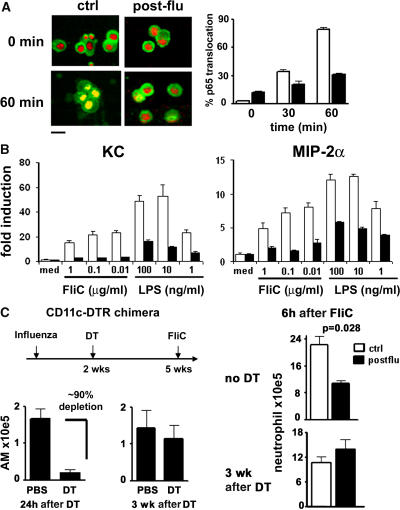
The World Health Organization estimates that lower respiratory tract infections (excluding tuberculosis) account for ∼35% of all deaths caused by infectious diseases. In many cases, the cause of death may be caused by multiple pathogens, e.g., the life-threatening bacterial pneumonia observed in patients infected with influenza virus. The ability to evolve more efficient immunity on each successive encounter with antigen is the hallmark of the adaptive immune response. However, in the absence of cross-reactive T and B cell epitopes, one lung infection can modify immunity and pathology to the next for extended periods of time. We now report for the first time that this phenomenon is mediated by a sustained desensitization of lung sentinel cells to Toll-like receptor (TLR) ligands; this is an effect that lasts for several months after resolution of influenza or respiratory syncytial virus infection and is associated with reduced chemokine production and NF-κB activation in alveolar macrophages. Although such desensitization may be beneficial in alleviating overall immunopathology, the reduced neutrophil recruitment correlates with heightened bacterial load during secondary respiratory infection. Our data therefore suggests that post-viral desensitization to TLR signals may be one possible contributor to the common secondary bacterial pneumonia associated with pandemic and seasonal influenza infection.
Overview
The claims and statistics of this paper haven’t been checked yet.
Free: it reads the open-access text and checks the first 5 claims that cite a source we can check. Create a free account to check every claim.
Integrity signals
Registry
Cites
Statistics
Figures
Verification
Claims the paper makes
The claims and statistics of this paper haven’t been checked yet.
Free: it reads the open-access text and checks the first 5 claims that cite a source we can check. Create a free account to check every claim.
Claims other papers make about this one
Each is checked against this paper’s own text: does it say what the citing paper says it does?
The source backs part of the claim, not all of it — or backs it for a different population, condition or comparison.
In the citing paper
“Late after infection, when virus has cleared (.12 days), desensitization of pattern recognition receptors to stimuli reverses this effect, preventing beneficial inflammatory responses from contributing to bacterial clearance [40].”
From Influenza virus primes mice for pneumonia from Staphylococcus aureus. (2011) · cites this paper as [40]
Experimental — accuracy not yet measuredThe cited source says what the claim attributes to it.
In the citing paper
“respiratory viruses can modulate innate and adaptive immune responses in the host, thereby promoting bacterial colonization and infection; for example, by impairing monocyte activity108, the extended desensitization of alveolar macrophages for Toll-like receptor (TLR)-ligands109, suppressing phagocytic capacity of alveolar macrophages110, and by inhibiting the production of antimicrobial peptides”
From The microbiota of the respiratory tract: gatekeeper to respiratory health (2017) · cites this paper as [109]
In the citing paper
“Third, respiratory viral infections impair innate immune responses against bacteria (128–130).”
From Respiratory viral infection-induced microbiome alterations and secondary bacterial pneumonia. (2018) · cites this paper as [129]
Self-check
Percentages, sums and reported differences re-computed from the paper’s own numbers.
The self-check needs the paper’s full text.
Citations
Cites
2 retracted
Induction of a Homeostatic Circuit in Lung Tissue by Microbial Compounds
Takabayshi, K., Corr, M., Hayashi, T., Redecke, V., Beck, L., Guiney, D. G., Sheppard, D., & Raz, E. (2008) · Immunity · doi:10.1016/j.immuni.2008.04.011 · Cited by 89
RetractedRETRACTED: Induction of a Homeostatic Circuit in Lung Tissue by Microbial Compounds
Takabayshi, K., Corr, M., Hayashi, T., Redecke, V., Beck, L., Guiney, D. G., Sheppard, D., & Raz, E. (2006) · Immunity · doi:10.1016/j.immuni.2006.02.008 · Cited by 76
RetractedPathogen Recognition and Innate Immunity
Akira, S., Uematsu, S., & Takeuchi, O. (2006) · Cell · doi:10.1016/j.cell.2006.02.015 · Cited by 11,952
Jung, S., Unutmaz, D., Wong, P., Sano, G.-I., De los Santos, K., Sparwasser, T., Wu, S., Vuthoori, S., Ko, K., Zavala, F., et al. (2002) · Immunity · doi:10.1016/s1074-7613(02)00365-5 · Cited by 1,773
Insights into the Interaction between Influenza Virus and Pneumococcus
McCullers, J. A. (2006) · Clinical Microbiology Reviews · doi:10.1128/cmr.00058-05 · Cited by 846
Prokaryotic Regulation of Epithelial Responses by Inhibition of IκB-α Ubiquitination
Neish, A. S., Gewirtz, A. T., Zeng, H., Young, A. N., Hobert, M. E., Karmali, V., Rao, A. S., & Madara, J. L. (2000) · Science · doi:10.1126/science.289.5484.1560 · Cited by 844
Role of inducible bronchus associated lymphoid tissue (iBALT) in respiratory immunity
Moyron-Quiroz, J. E., Rangel-Moreno, J., Kusser, K., Hartson, L., Sprague, F., Goodrich, S., Woodland, D. L., Lund, F. E., & Randall, T. D. (2004) · Nature Medicine · doi:10.1038/nm1091 · Cited by 821
van Rijt, L. S., Jung, S., KleinJan, A., Vos, N., Willart, M., Duez, C., Hoogsteden, H. C., & Lambrecht, B. N. (2005) · The Journal of Experimental Medicine · doi:10.1084/jem.20042311 · Cited by 623
Self-citationPostnatal acquisition of endotoxin tolerance in intestinal epithelial cells
Lotz, M., Gütle, D., Walther, S., Ménard, S., Bogdan, C., & Hornef, M. W. (2006) · The Journal of Experimental Medicine · doi:10.1084/jem.20050625 · Cited by 464
Andonegui, G., Bonder, C. S., Green, F., Mullaly, S. C., Zbytnuik, L., Raharjo, E., & Kubes, P. (2003) · Journal of Clinical Investigation · doi:10.1172/jci16510 · Cited by 408
Cited by
Items 401–406 of 406
Chernet, D. Y. (2026) · Mspace (University of Manitoba)
Zahid, A., Ismail, H., Wilson, J. C., & Grice, I. D. (2026) · Microbial Pathogenesis · doi:10.1016/j.micpath.2026.108920
Calverley, M. (2013) · Montana State University ScholarWorks (Montana State University)
The immune response in Influenza A-S. pneumoniae coinfection
Ellis, G. T. (2014) · UCL Discovery (University College London)
Dahlberg, S. (2009) · Figshare
Metadata
- Authors
- Didierlaurent, A., Goulding, J., Patel, S., Snelgrove, R., Low, L., Bebien, M., Lawrence, T., van Rijt, L. S., Lambrecht, B. N., Sirard, J.-C., & Hussell, T.
- Affiliations
- Imperial College London (GB)
- 1Kennedy Institute of Rheumatology, Imperial College London, London W6 8LH, England, UK
- 2Department of Pulmonary Medicine, Erasmus Medical Center, 3015 GE Rotterdam, Netherlands
- Erasmus MC (NL)
- Inserm (FR)
- ORCID
- Venue
- The Journal of Experimental Medicine
- Publisher
- Rockefeller University Press
- Published
- 2008-01-28
- Volume
- 205
- Issue
- 2
- Pages
- 323-329
- ISSN
- 0022-1007 (ISSN-L)
- 1540-9538
- PMC
- PMC2271005
- OpenAlex
- W2127612599
- Cited by
- 399
- References
- 31
- Citations by year
- 2026: 9 · 2025: 14 · 2024: 12 · 2023: 19 · 2022: 11 · 2021: 23 · 2020: 26 · 2019: 15 · 2018: 20 · 2017: 20 · 2016: 27 · 2015: 25 · 2014: 24 · 2013: 36 · 2012: 25
- FWCI
- 12.79
- Type
- journal article
- Language
- en
- Open access
- bronze
- doi.org
- Locations
- The Journal of Experimental Medicine (publishedVersion)
- Europe PMC (PubMed Central) (publishedVersion, cc-by-nc-sa)
- PubMed Central (publishedVersion, cc-by-nc-sa)
- PubMed (publishedVersion)
- Pure Amsterdam UMC (publishedVersion)
- Research Explorer (The University of Manchester) (publishedVersion)
- Data Archiving and Networked Services (DANS) (submittedVersion)
- RePub (Erasmus University Rotterdam) (submittedVersion, other-oa)
- HAL (submittedVersion)
- Ghent University Academic Bibliography (Ghent University) (submittedVersion)
- RePub (Erasmus University Rotterdam) (submittedVersion)
- Topics
- Life Sciences › Immunology and Microbiology › Immunology › Immune Response and Inflammation
- Life Sciences › Immunology and Microbiology › Immunology › Immune responses and vaccinations
- Life Sciences › Biochemistry, Genetics and Molecular Biology › Molecular Biology › Inflammasome and immune disorders
- Keywords
- influenza virus, respiratory syncytial virus, secondary bacterial pneumonia, alveolar macrophages, chemokine production, NF-κB activation, neutrophil recruitment
- MeSH terms
- Animals, Bacterial Infections, Bronchoalveolar Lavage Fluid, Epithelial Cells, Female, Flagellin, Ligands, Lipopolysaccharides, Mice, Inbred BALB C, Mice, Inbred C57BL, Mice, Transgenic, Neutrophils, Orthomyxoviridae Infections, Pseudomonas aeruginosa, Respiratory System, Respiratory Tract Infections, Streptococcus pneumoniae, Cytokines, NF-kappa B, Macrophages, Alveolar, Toll-Like Receptors, Mice
About these checks
Registry, retraction, Cites and statistics results are computed, not judged, with one exception: a printed reference that no index lists is read once by a model before it counts as a citation error. Claims are extracted by a model and kept only when their quote appears verbatim in the text; each cited source is then checked, with a model’s help, for whether it says what the claim relies on. Those verdicts can be wrong — read the claim’s quote and the cited source before relying on one.
Statistics and arithmetic are recomputed, not judged.
Confidence bands are shown only for fields calibrated on our annotated test set. None is calibrated yet, so no band is shown.
What counts as a claim ›How we measure confidence ›How we check this ›
Are you an author, or do you see a problem with this page? Request a review
Data sources
Bibliographic data: Semantic Scholar, OpenAlex, Crossref.
Contains information from the Semantic Scholar Academic Graph Datasets, made available under the ODC Attribution License (ODC-BY 1.0).
Semantic Scholar’s data is described in: Kinney, R., et al. (2023). The Semantic Scholar Open Data Platform. arXiv:2301.10140.
