

The DOI matches its Crossref record; 42 of the 42 references it cites were found in a registry or an index.
Regulation of T cell receptor signaling by activation-induced zinc influx
Abstract
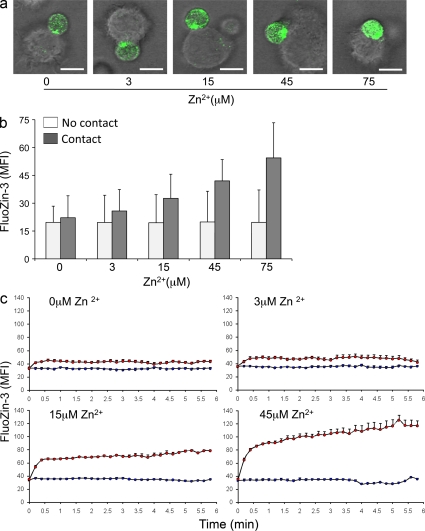
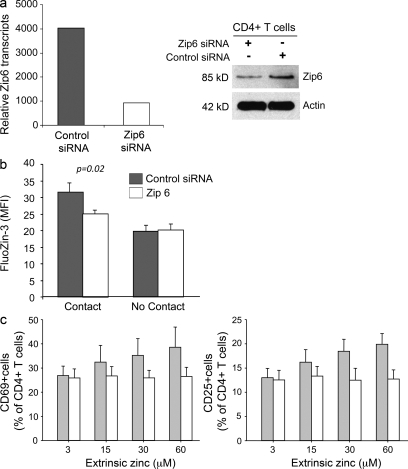
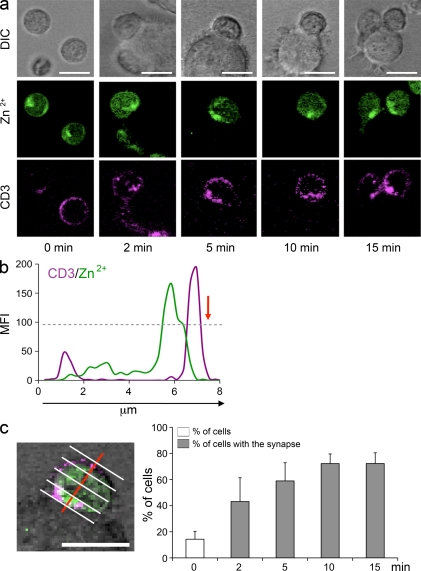
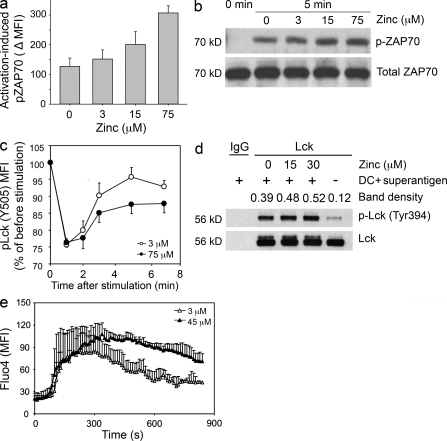
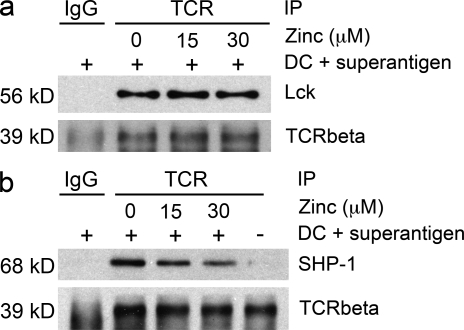
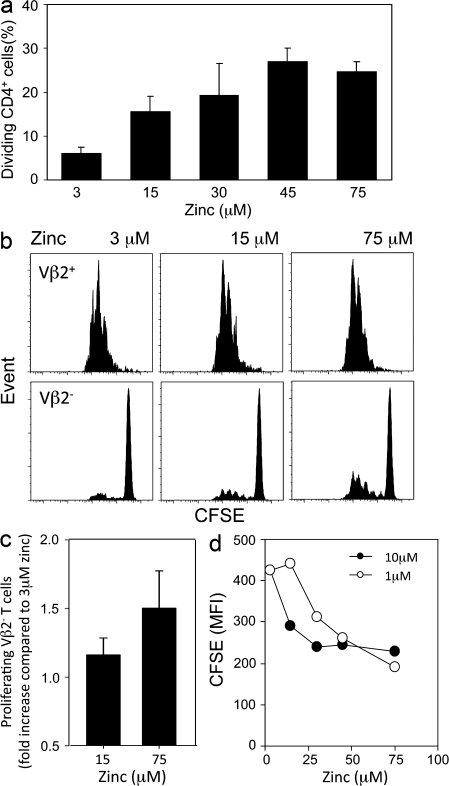
Zinc is a trace element that is essential for innate and adaptive immune responses. In addition to being a structural element of many proteins, zinc also functions as a neurotransmitter and an intracellular messenger. Temporal or spatial changes in bioavailable zinc may influence the activity of several enzymes, including kinases and phosphatases. We provide evidence that zinc functions as an ionic signaling molecule after T cell activation. Cytoplasmic zinc concentrations increased within 1 min after T cell receptor (TCR) triggering, in particular in the subsynaptic compartment. The increase depended on the extracellular zinc concentrations and was inhibited by silencing zinc transporter Zip6. Increased zinc influx reduced the recruitment of SHP-1 to the TCR activation complex, augmented ZAP70 phosphorylation and sustained calcium influx. By calibrating TCR activation thresholds, increased extracellular zinc bioavailability facilitated the induction of T cell proliferative responses to suboptimal stimuli.
Overview
The claims and statistics of this paper haven’t been checked yet.
Run the check — free, no account needed. It reads the open-access text and checks the sources it cites.
Integrity signals
Registry
Cites
Statistics
Figures
Verification
Claims the paper makes
The claims and statistics of this paper haven’t been checked yet.
Run the check — free, no account needed. It reads the open-access text and checks the sources it cites.
Claims other papers make about this one
Each is checked against this paper’s own text: does it say what the citing paper says it does?
In the citing paper
“Zinc has been shown to contribute to T cell receptor signaling by increasing ZAP70 phosphorylation (56).”
From Human RHOH deficiency causes T cell defects and susceptibility to EV-HPV infections (2012) · cites this paper as [56]
Self-check
Percentages, sums and reported differences re-computed from the paper’s own numbers.
The self-check needs the paper’s full text.
Citations
Cites
The biochemical basis of zinc physiology
Vallée, B. L., & Falchuk, K. H. (1993) · Physiological Reviews · doi:10.1152/physrev.1993.73.1.79 · Cited by 3,018
The neurobiology of zinc in health and disease
Frederickson, C. J., Koh, J.-Y., & Bush, A. I. (2005) · Nature Reviews Neuroscience · doi:10.1038/nrn1671 · Cited by 1,850
Joazeiro, C. A. P., & Weissman, A. M. (2000) · Cell · doi:10.1016/s0092-8674(00)00077-5 · Cited by 1,249
miR-181a Is an Intrinsic Modulator of T Cell Sensitivity and Selection
Li, Q.-J., Chau, J., Ebert, P. J. R., Sylvester, G., Min, H., Liu, G., Braich, R., Manoharan, M., Soutschek, J., Skare, P., et al. (2007) · Cell · doi:10.1016/j.cell.2007.03.008 · Cited by 1,157
Zinc requirements and the risks and benefits of zinc supplementation
Maret, W., & Sandstead, H. H. (2006) · Journal of Trace Elements in Medicine and Biology · doi:10.1016/j.jtemb.2006.01.006 · Cited by 1,119
Zinc transporters and the cellular trafficking of zinc
Eide, D. J. (2006) · Biochimica et Biophysica Acta (BBA) - Molecular Cell Research · doi:10.1016/j.bbamcr.2006.03.005 · Cited by 874
Phosphatase‐mediated crosstalk between MAPK signaling pathways in the regulation of cell survival
Junttila, M. R., Li, S., & Westermarck, J. (2008) · The FASEB Journal · doi:10.1096/fj.06-7859rev · Cited by 826
The LIM domain: from the cytoskeleton to the nucleus
Kadrmas, J. L., & Beckerle, M. C. (2004) · Nature Reviews Molecular Cell Biology · doi:10.1038/nrm1499 · Cited by 752
Mammalian Zinc Transporters: Nutritional and Physiologic Regulation
Lichten, L. A., & Cousins, R. J. (2009) · Annual Review of Nutrition · doi:10.1146/annurev-nutr-033009-083312 · Cited by 741
Design and Selection of Novel Cys2His2 Zinc Finger Proteins
Pabo, C. O., Peisach, E., & Grant, R. A. (2001) · Annual Review of Biochemistry · doi:10.1146/annurev.biochem.70.1.313 · Cited by 715
Function of the Src-family kinases, Lck and Fyn, in T-cell development and activation
Palacios, E. H., & Weiss, A. (2004) · Oncogene · doi:10.1038/sj.onc.1208074 · Cited by 714
Mammalian Zinc Transport, Trafficking, and Signals
Cousins, R. J., Liuzzi, J. P., & Lichten, L. A. (2006) · Journal of Biological Chemistry · doi:10.1074/jbc.r600011200 · Cited by 705
Zinc is a novel intracellular second messenger
Yamasaki, S., Sakata-Sogawa, K., Hasegawa, A., Suzuki, T., Kabu, K., Sato, E., Kurosaki, T., Yamashita, S., Tokunaga, M., Nishida, K., et al. (2007) · The Journal of Cell Biology · doi:10.1083/jcb.200702081 · Cited by 592
Identification of SLC39A4, a gene involved in acrodermatitis enteropathica
Küry, S., Dréno, B., Bezieau, S., Giraudet, S., Kharfi, M., Kamoun, R., & Moisan, J. (2002) · Nature Genetics · doi:10.1038/ng913 · Cited by 531
Krutzik, P. O., & Nolan, G. P. (2006) · Nature Methods · doi:10.1038/nmeth872 · Cited by 525
ZINC AND THE RISK FOR INFECTIOUS DISEASE
Walker, C. L. F., & Black, R. E. (2004) · Annual Review of Nutrition · doi:10.1146/annurev.nutr.23.011702.073054 · Cited by 500
Reprogramming of the immune system during zinc deficiency
Fraker, P. J., & King, L. E. (2004) · Annual Review of Nutrition · doi:10.1146/annurev.nutr.24.012003.132454 · Cited by 470
Modeling T Cell Antigen Discrimination Based on Feedback Control of Digital ERK Responses
Altan-Bonnet, G., & Germain, R. N. (2005) · PLoS Biology · doi:10.1371/journal.pbio.0030356 · Cited by 468
The SLC39 family of metal ion transporters
Eide, D. J. (2004) · Pfl�gers Archiv European Journal of Physiology · doi:10.1007/s00424-003-1074-3 · Cited by 400
Efflux and compartmentalization of zinc by members of the SLC30 family of solute carriers
Palmiter, R. D., & Huang, L. (2004) · Pflügers Archiv - European Journal of Physiology · doi:10.1007/s00424-003-1070-7 · Cited by 384
Toll-like receptor–mediated regulation of zinc homeostasis influences dendritic cell function
Kitamura, H., Morikawa, H., Kamon, H., Iguchi, M., Hojyo, S., Fukada, T., Yamashita, S., Kaisho, T., Akira, S., Murakami, M., et al. (2006) · Nature Immunology · doi:10.1038/ni1373 · Cited by 357
Protein tyrosine phosphatases and the immune response
Mustelin, T., Vang, T., & Bottini, N. (2005) · Nature Reviews Immunology · doi:10.1038/nri1530 · Cited by 354
Functional Significance of Zinc-Related Signaling Pathways in Immune Cells
Haase, H., & Rink, L. (2009) · Annual Review of Nutrition · doi:10.1146/annurev-nutr-080508-141119 · Cited by 326
Zinc Coordination Environments in Proteins as Redox Sensors and Signal Transducers
Maret, W. (2006) · Antioxidants & Redox Signaling · doi:10.1089/ars.2006.8.1419 · Cited by 307
Rink, L., & Haase, H. (2007) · Trends in Immunology · doi:10.1016/j.it.2006.11.005 · Cited by 291
Zinc Signals Are Essential for Lipopolysaccharide-Induced Signal Transduction in Monocytes
Haase, H., Ober-Blöbaum, J. L., Engelhardt, G., Hebel, S., Heit, A., Heine, H., & Rink, L. (2008) · The Journal of Immunology · doi:10.4049/jimmunol.181.9.6491 · Cited by 286
A Zinc Clasp Structure Tethers Lck to T Cell Coreceptors CD4 and CD8
Kim, P. W., Sun, Z.-Y. J., Blacklow, S. C., Wagner, G., & Eck, M. J. (2003) · Science · doi:10.1126/science.1085643 · Cited by 276
Haase, H., & Maret, W. (2003) · Experimental Cell Research · doi:10.1016/s0014-4827(03)00406-3 · Cited by 270
Roles of Zinc and Zinc Signaling in Immunity: Zinc as an Intracellular Signaling Molecule
Hirano, T., Murakami, M., Fukada, T., Nishida, K., Yamasaki, S., & Suzuki, T. (2008) · Advances in Immunology · doi:10.1016/s0065-2776(08)00003-5 · Cited by 252
Zinc transporter ZIP8 (SLC39A8) and zinc influence IFN-γ expression in activated human T cells
Aydemir, T. B., Liuzzi, J. P., McClellan, S., & Cousins, R. J. (2009) · Journal of Leukocyte Biology · doi:10.1189/jlb.1208759 · Cited by 229
Haase, H., Overbeck, S., & Rink, L. (2008) · Experimental Gerontology · doi:10.1016/j.exger.2007.12.002 · Cited by 194
Haase, H., & Maret, W. (2005) · BioMetals · doi:10.1007/s10534-005-3707-9 · Cited by 175
Laethem, F. V., Sarafova, S. D., Park, J., Tai, X., Pobezinsky, L. A., Guinter, T. I., Adoro, S., Adams, A., Sharrow, S. O., Feigenbaum, L., et al. (2007) · Immunity · doi:10.1016/j.immuni.2007.10.007 · Cited by 174
Zinc signals promote IL‐2‐dependent proliferation of T cells
Kaltenberg, J., Plum, L. M., Ober-Blöbaum, J. L., Hönscheid, A., Rink, L., & Haase, H. (2010) · European Journal of Immunology · doi:10.1002/eji.200939574 · Cited by 164
Regulation of src family tyrosine kinases in lymphocytes
Mustelin, T., & Burn, P. (1993) · Trends in Biochemical Sciences · doi:10.1016/0968-0004(93)90192-p · Cited by 139
Nishida, K., Hasegawa, A., Nakae, S., Oboki, K., Saito, H., Yamasaki, S., & Hirano, T. (2009) · The Journal of Experimental Medicine · doi:10.1084/jem.20082533 · Cited by 118
Ho, Y., Samarasinghe, R. A., Knoch, M. E., Lewis, M. E., Aizenman, E., & DeFranco, D. B. (2008) · Molecular Pharmacology · doi:10.1124/mol.108.049064 · Cited by 93
Flow Cytometric Analysis of Kinase Signaling Cascades
Perez, O. D., Krutzik, P. O., & Nolan, G. P. (2004) · Humana Press eBooks · doi:10.1385/1-59259-773-4:067 · Cited by 92
Comparing Nitrosative Versus Oxidative Stress toward Zinc Finger-dependent Transcription
Kröncke, K., Klotz, L., Suschek, C. V., & Sies, H. (2002) · Journal of Biological Chemistry · doi:10.1074/jbc.m111216200 · Cited by 77
Substitution Studies of the Second Divalent Metal Cation Requirement of Protein Tyrosine Kinase CSK
Sun, G., & Budde, R. J. A. (1999) · Biochemistry · doi:10.1021/bi982793w · Cited by 52
Lee, W., Cui, D., Cześnikiewicz‐Guzik, M., Vêncio, R. Z. N., Shmulevich, I., Aderem, A. A., Weyand, C. M., & Goronzy, J. J. (2008) · Rejuvenation Research · doi:10.1089/rej.2008.0747 · Cited by 43
Self-citationRemoval of C-Terminal Src Kinase from the Immune Synapse by a New Binding Protein
Rahmouni, S., Vang, T., Alonso, A., et al. (2005) · Molecular and Cellular Biology · doi:10.1128/mcb.25.6.2227-2241.2005 · Cited by 33
Cited by
Kambe, T., Tsuji, T., Hashimoto, A., & Itsumura, N. (2015) · Physiological Reviews · doi:10.1152/physrev.00035.2014 · Cited by 1,158
Ion channels and transporters in lymphocyte function and immunity
Feske, S., Skolnik, E. Y., & Prakriya, M. (2012) · Nature Reviews Immunology · doi:10.1038/nri3233 · Cited by 441
Mycobacterial P1-Type ATPases Mediate Resistance to Zinc Poisoning in Human Macrophages
Botella, H., Peyron, P., Levillain, F., Poincloux, R., Poquet, Y., Brandli, I., Wang, C., Tailleux, L., Tilleul, S., Charrière, G. M., et al. (2011) · Cell Host & Microbe · doi:10.1016/j.chom.2011.08.006 · Cited by 381
ZIP8 Regulates Host Defense through Zinc-Mediated Inhibition of NF-κB
Liu, M.-J., Bao, S., Gálvez-Peralta, M., Pyle, C. J., Rudawsky, A. C., Pavlovicz, R. E., Killilea, D. W., Li, C., Nebert, D. W., Wewers, M. D., et al. (2013) · Cell Reports · doi:10.1016/j.celrep.2013.01.009 · Cited by 367
Maywald, M., Wessels, I., & Rink, L. (2017) · International Journal of Molecular Sciences · doi:10.3390/ijms18102222 · Cited by 309
Metadata
- Authors
- Yu, M., Lee, W.-W., Tomar, D., Pryshchep, S., Czesnikiewicz-Guzik, M., Lamar, D. L., Li, G., Singh, K., Tian, L., Weyand, C. M., & Goronzy, J. J.
- Affiliations
- Division of Immunology and Rheumatology, Department of Medicine 1 , and 2
- Lowance Center for Human Immunology, Emory University, Atlanta, GA 30322 3
- Venue
- Journal of Experimental Medicine
- Publisher
- Rockefeller University Press
- Published
- 2011-03-21
- Volume
- 208
- Issue
- 4
- Pages
- 775-785
- ISSN
- 1540-9538
- 0022-1007
- PMC
- PMC3135340
- Cited by
- 153
- References
- 42
- Language
- en
About these checks
Registry, retraction, Cites and statistics results are computed, not judged, with one exception: a printed reference that no index lists is read once by a model before it counts as a citation error. Claims are extracted by a model and kept only when their quote appears verbatim in the text; each cited source is then checked, with a model’s help, for whether it says what the claim relies on. Those verdicts can be wrong — read the claim’s quote and the cited source before relying on one.
Statistics and arithmetic are recomputed, not judged.
Confidence bands are shown only for fields calibrated on our annotated test set. None is calibrated yet, so no band is shown.
What counts as a claim ›How we measure confidence ›How we check this ›
Are you an author, or do you see a problem with this page? Request a review
Data sources
Bibliographic data: Semantic Scholar, OpenAlex, Crossref.
Contains information from the Semantic Scholar Academic Graph Datasets, made available under the ODC Attribution License (ODC-BY 1.0).
Semantic Scholar’s data is described in: Kinney, R., et al. (2023). The Semantic Scholar Open Data Platform. arXiv:2301.10140.
