

Csnk1a1 inhibition has p53-dependent therapeutic efficacy in acute myeloid leukemia
Open accessThe DOI matches its Crossref record; 30 of the 31 references it cites were found in a registry or an index.
Abstract
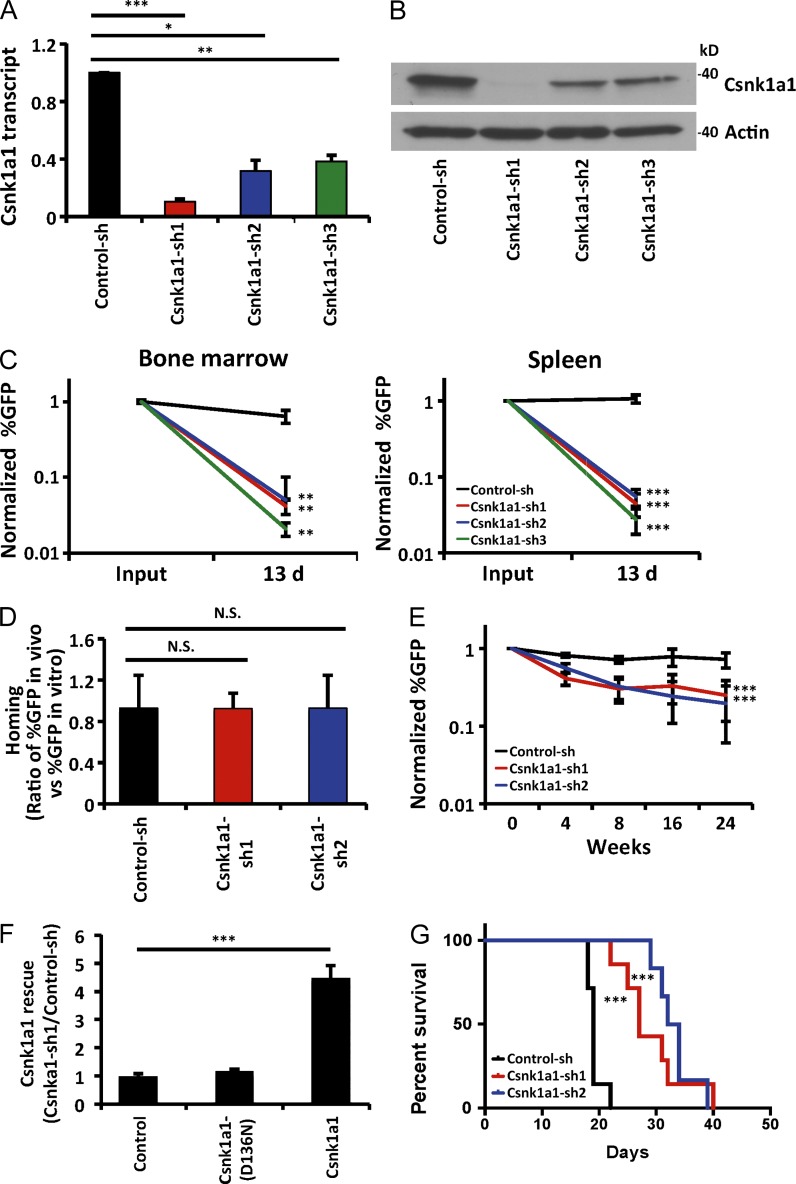
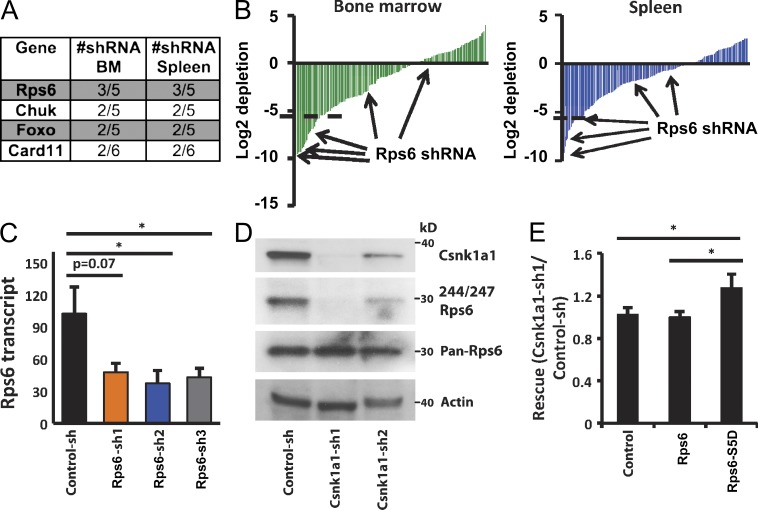
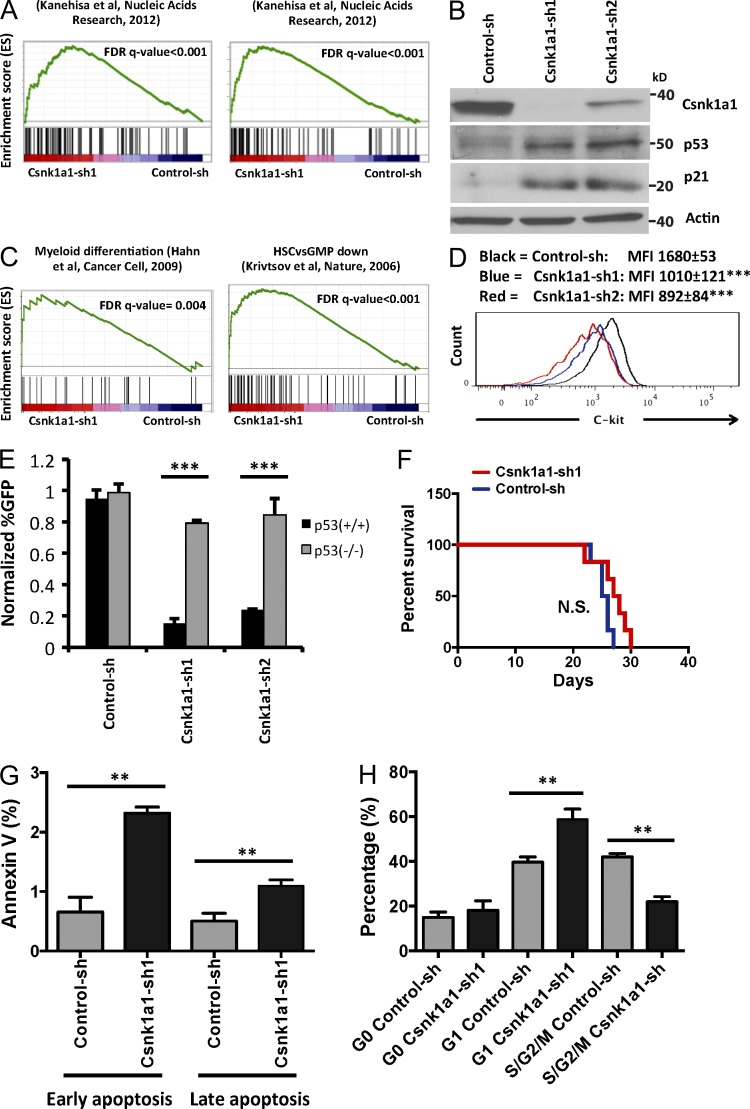
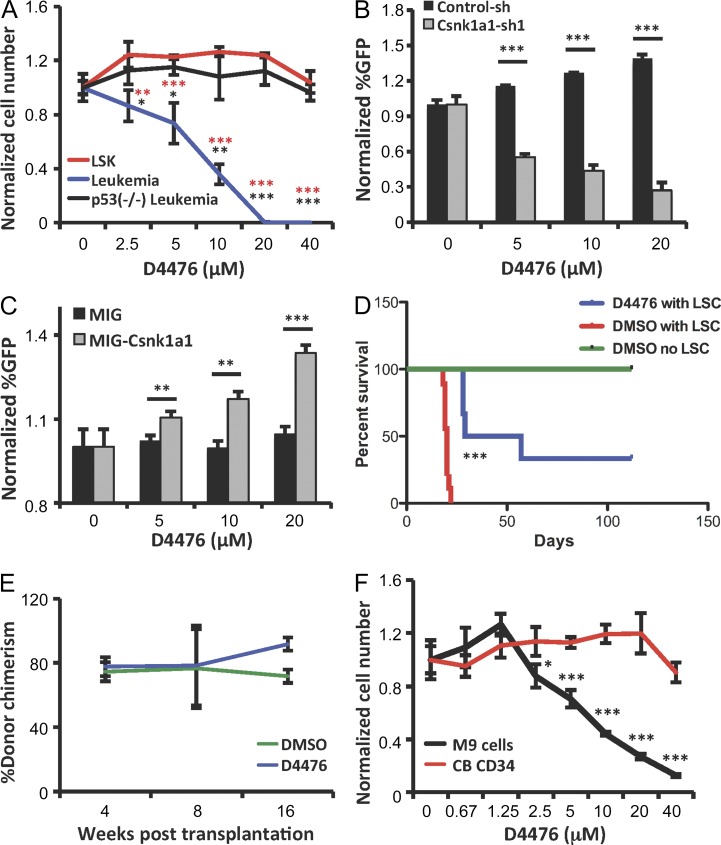
Despite extensive insights into the underlying genetics and biology of acute myeloid leukemia (AML), overall survival remains poor and new therapies are needed. We found that casein kinase 1 α (Csnk1a1), a serine-threonine kinase, is essential for AML cell survival in vivo. Normal hematopoietic stem and progenitor cells (HSPCs) were relatively less affected by shRNA-mediated knockdown of Csnk1a1. To identify downstream mediators of Csnk1a1 critical for leukemia cells, we performed an in vivo pooled shRNA screen and gene expression profiling. We found that Csnk1a1 knockdown results in decreased Rps6 phosphorylation, increased p53 activity, and myeloid differentiation. Consistent with these observations, p53-null leukemias were insensitive to Csnk1a1 knockdown. We further evaluated whether D4476, a casein kinase 1 inhibitor, would exhibit selective antileukemic effects. Treatment of leukemia stem cells (LSCs) with D4476 showed highly selective killing of LSCs over normal HSPCs. In summary, these findings demonstrate that Csnk1a1 inhibition causes reduced Rps6 phosphorylation and activation of p53, resulting in selective elimination of leukemia cells, revealing Csnk1a1 as a potential therapeutic target for the treatment of AML.
Overview
The claims and statistics of this paper haven’t been checked yet.
Free: it reads the open-access text and checks the first 5 claims that cite a source we can check. Create a free account to check every claim.
Integrity signals
Registry
Cites
Statistics
Figures
Verification
Claims the paper makes
The claims and statistics of this paper haven’t been checked yet.
Free: it reads the open-access text and checks the first 5 claims that cite a source we can check. Create a free account to check every claim.
Claims other papers make about this one
Each is checked against this paper’s own text: does it say what the citing paper says it does?
The check wasn’t confident either way, so it gives no verdict — never disputed.
In the citing paper
“it was demonstrated that because the equivalent of V388 of humans is I391 in mice, Ck1α is not degraded in mice [31].”
From Cereblon and its downstream substrates as molecular targets of immunomodulatory drugs (2016) · cites this paper as [31]
Experimental — accuracy not yet measuredIn the citing paper
“Targeted proteomic assays have been translated to the clinical laboratory setting163,164”
From Cancer therapies based on targeted protein degradation — lessons learned with lenalidomide (2021) · cites this paper as [163]
In the citing paper
“When Ck1α was further degraded upon lenalidomide treatment, this resulted in the activation of p53 leading to the induction of apoptosis.”
From Cereblon and its downstream substrates as molecular targets of immunomodulatory drugs (2016) · cites this paper as [31]
Self-check
Percentages, sums and reported differences re-computed from the paper’s own numbers.
The self-check needs the paper’s full text.
Citations
Cites
Subramanian, A., Tamayo, P., Mootha, V. K., Mukherjee, S., Ebert, B. L., Gillette, M. A., Paulovich, A., Pomeroy, S. L., Golub, T. R., Lander, E. S., et al. (2005) · Proceedings of the National Academy of Sciences · doi:10.1073/pnas.0506580102 · Cited by 53,625 · cited 1×
“Enrichment of gene expression signatures was analyzed using Gene Set Enrichment Analysis (GSEA; Subramanian et al., 2005).”
Self-citationKEGG for integration and interpretation of large-scale molecular data sets
Kanehisa, M., Goto, S., Sato, Y., Furumichi, M., & Tanabe, M. (2012) · Nucleic Acids Research · doi:10.1093/nar/gkr988 · Cited by 4,848
Control of β-Catenin Phosphorylation/Degradation by a Dual-Kinase Mechanism
Liu, C., Li, Y., Semenov, M., Han, C., Baeg, G.-H., Tan, Y., Zhang, Z., Lin, X., & He, X. (2002) · Cell · doi:10.1016/s0092-8674(02)00685-2 · Cited by 2,069
Prognostic Relevance of Integrated Genetic Profiling in Acute Myeloid Leukemia
Patel, J. P., Gönen, M., Figueroa, M. E., Fernandez, H., Sun, Z., Racevskis, J., Van Vlierberghe, P., Dolgalev, I., Thomas, S., Aminova, O., et al. (2012) · New England Journal of Medicine · doi:10.1056/nejmoa1112304 · Cited by 1,946
RNAi screen identifies Brd4 as a therapeutic target in acute myeloid leukaemia
Zuber, J., Shi, J., Wang, E., Rappaport, A. R., Herrmann, H., Sison, E. A., Magoon, D., Qi, J., Blatt, K., Wunderlich, M., et al. (2011) · Nature · doi:10.1038/nature10334 · Cited by 1,870 · cited 1×
“Genetic screens have emerged as powerful approaches to identify vulnerabilities and therapeutic opportunities in cancer cells (Luo et al., 2009; Zuber et al., 2011).”
A Lentiviral RNAi Library for Human and Mouse Genes Applied to an Arrayed Viral High-Content Screen
Moffat, J., Grueneberg, D. A., Yang, X., Kim, S. Y., Kloepfer, A. M., Hinkle, G., Piqani, B., Eisenhaure, T. M., Luo, B., Grenier, J. K., et al. (2006) · Cell · doi:10.1016/j.cell.2006.01.040 · Cited by 1,798 · cited 1×
“Lentiviral pLKO.1 vectors coexpressing shRNAs and a puromycin resistance gene were obtained from the RNAi consortium at the Broad Institute (Moffat et al., 2006).”
Self-citationThe origin and evolution of mutations in acute myeloid leukemia
Welch, J. S., Ley, T. J., Link, D. C., Miller, C. A., Larson, D. E., Koboldt, D. C., Wartman, L. D., Lamprecht, T. L., Liu, F., Xia, J., et al. (2012) · Cell · doi:10.1016/j.cell.2012.06.023 · Cited by 1,575 · cited 1×
“Although tremendous progress has been made in identifying recurrent somatic mutations that drive acute myeloid leukemia (AML) pathogenesis, many of these genetic lesions cause a loss of protein function and do not suggest clear therapeutic opportunities (Welch et al., 2012).”
Transformation from committed progenitor to leukaemia stem cell initiated by MLL–AF9
Krivtsov, A. V., Twomey, D., Feng, Z., Stubbs, M. C., Wang, Y., Faber, J., Levine, J. E., Wang, J., Hahn, W. C., Gilliland, D. G., et al. (2006) · Nature · doi:10.1038/nature04980 · Cited by 1,513 · cited 6×
“To examine whether Csnk1a1 is essential for primary mouse MLL-AF9 leukemia cells in vivo, we used lentiviruses that coexpress individual shRNAs with GFP to transduce MLL-AF9 AML cells that were enriched for leukemia stem cells (LSCs) by sorting for c-Kithigh cells (Krivtsov et al., 2006).”
InfluentialA Genome-wide RNAi Screen Identifies Multiple Synthetic Lethal Interactions with the Ras Oncogene
Luo, J., Emanuele, M. J., Li, D., Creighton, C. J., Schlabach, M. R., Westbrook, T. F., Wong, K.-K., & Elledge, S. J. (2009) · Cell · doi:10.1016/j.cell.2009.05.006 · Cited by 1,017 · cited 1×
“Genetic screens have emerged as powerful approaches to identify vulnerabilities and therapeutic opportunities in cancer cells (Luo et al., 2009; Zuber et al., 2011).”
Regulation and function of ribosomal protein S6 kinase (S6K) within mTOR signalling networks
Magnuson, B., Ekim, B., & Fingar, D. C. (2012) · Biochemical Journal · doi:10.1042/bj20110892 · Cited by 1,015 · cited 2×
“, 2011), as well as by the ribosomal S6 kinases 1 and 2 (Magnuson et al., 2012).”
Cited by
A Next Generation Connectivity Map: L1000 Platform and the First 1,000,000 Profiles
Subramanian, A., Narayan, R., Corsello, S. M., Peck, D. D., Natoli, T. E., Lu, X., Gould, J., Davis, J. F., Tubelli, A. A., Asiedu, J. K., et al. (2017) · Cell · doi:10.1016/j.cell.2017.10.049 · Cited by 3,515
Self-citationLenalidomide induces ubiquitination and degradation of CK1α in del(5q) MDS
Krönke, J., Fink, E. C., Hollenbach, P. W., MacBeth, K. J., Hurst, S. N., Udeshi, N. D., Chamberlain, P. P., Mani, D. R., Man, H. W., Gandhi, A. K., et al. (2015) · Nature · doi:10.1038/nature14610 · Cited by 863
Self-citationTherapy-related myeloid neoplasms: when genetics and environment collide
McNerney, M. E., Godley, L. A., & Le Beau, M. M. (2017) · Nature Reviews Cancer · doi:10.1038/nrc.2017.60 · Cited by 419
Core circadian clock genes regulate leukemia stem cells in AML
Puram, R. V., Kowalczyk, M. S., de Boer, C. G., Schneider, R. K., Miller, P. G., McConkey, M., Tothova, Z., Tejero, H., Heckl, D., Järås, M., et al. (2016) · Cell · doi:10.1016/j.cell.2016.03.015 · Cited by 274
“Recent studies demonstrate that leukemia-specific targets may be identified using short-hairpin RNA (shRNA) screens to interrogate multiple genes in primary AML cells in vivo (Ja¨ra˚s et al., 2014; Miller et al., 2013; Zuber et al., 2011b).”
Self-citationThe CK1 Family: Contribution to Cellular Stress Response and Its Role in Carcinogenesis
Knippschild, U., Krüger, M., Richter, J., Xu, P., GarcÃa-Reyes, B., Peifer, C., Halekotte, J., Bakulev, V., & Bischof, J. (2014) · Frontiers in Oncology · doi:10.3389/fonc.2014.00096 · Cited by 272
“activation of p53, resulting in selective elimination of leukemia cells (348)”
Background
Metadata
- Authors
- Järås, M., Miller, P. G., Chu, L. P., Puram, R. V., Fink, E. C., Schneider, R. K., Al-Shahrour, F., Peña, P., Breyfogle, L. J., Hartwell, K. A., McConkey, M. E., Cowley, G. S., Root, D. E., Kharas, M. G., Mullally, A., & Ebert, B. L.
- Affiliations
- Brigham and Women's Hospital (US)
- Division of Hematology, Department of Medicine, Brigham and Women’s Hospital, Harvard Medical School, Boston, MA 02115 1
- Department of Clinical Genetics, Lund University, 22184 Lund, Sweden 2
- Broad Institute (US)
- Memorial Sloan Kettering Cancer Center (US)
- Corresponding author
- Ebert, Benjamin L.
- ORCID
- Venue
- Journal of Experimental Medicine
- Publisher
- Rockefeller University Press
- Published
- 2014-03-10
- Volume
- 211
- Issue
- 4
- Pages
- 605-612
- ISSN
- 0022-1007 (ISSN-L)
- 1540-9538
- PMC
- PMC3978274
- OpenAlex
- W2128338459
- Cited by
- 92
- References
- 31
- Citations by year
- 2026: 1 · 2025: 6 · 2024: 8 · 2023: 4 · 2022: 6 · 2021: 11 · 2020: 10 · 2019: 4 · 2018: 9 · 2017: 12 · 2016: 6 · 2015: 8 · 2014: 7
- FWCI
- 7.80
- Type
- journal article
- Language
- en
- Open access
- bronze
- doi.org
- Locations
- The Journal of Experimental Medicine (publishedVersion)
- Europe PMC (PubMed Central) (publishedVersion, cc-by-nc-sa)
- PubMed Central (publishedVersion, cc-by-nc-sa)
- PubMed (publishedVersion)
- Digital Access to Scholarship at Harvard (DASH) (Harvard University) (submittedVersion, cc-by)
- Lund University Publications (Lund University) (submittedVersion)
- Funders
- National Heart, Lung, and Blood Institute (R01HL082945)
- National Cancer Institute (P01CA108631)
- National Institute of General Medical Sciences (T32GM007753)
- Topics
- Health Sciences › Medicine › Hematology › Acute Myeloid Leukemia Research
- Health Sciences › Medicine › Oncology › Cancer-related Molecular Pathways
- Life Sciences › Biochemistry, Genetics and Molecular Biology › Molecular Biology › Retinoids in leukemia and cellular processes
- Keywords
- acute myeloid leukemia, CSNK1A1, CK1α, p53, S6 phosphorylation, leukemia stem cells, hematopoietic stem and progenitor cells, myeloid differentiation, therapeutic target
- MeSH terms
- Animals, Humans, Phosphorylation, Leukemia, Myeloid, Acute, Tumor Suppressor Protein p53, Treatment Outcome, Cell Death, Gene Silencing, Ribosomal Protein S6, Cell Line, Tumor, Protein Kinase Inhibitors, Casein Kinase Ialpha, Mice, Small Molecule Libraries
About these checks
Registry, retraction, Cites and statistics results are computed, not judged, with one exception: a printed reference that no index lists is read once by a model before it counts as a citation error. Claims are extracted by a model and kept only when their quote appears verbatim in the text; each cited source is then checked, with a model’s help, for whether it says what the claim relies on. Those verdicts can be wrong — read the claim’s quote and the cited source before relying on one.
Statistics and arithmetic are recomputed, not judged.
Confidence bands are shown only for fields calibrated on our annotated test set. None is calibrated yet, so no band is shown.
What counts as a claim ›How we measure confidence ›How we check this ›
Are you an author, or do you see a problem with this page? Request a review
How to cite
Cite CoChat for the checks on this page, and the paper for its own findings.
- This page
- CoChat. (2026). Citation check: Csnk1a1 inhibition has p53-dependent therapeutic efficacy in acute myeloid leukemia. https://app.cochat.ai/papers/10.1084/jem.20131033
- The paper
- Järås, M., Miller, P. G., Chu, L. P., Puram, R. V., Fink, E. C., Schneider, R. K., Al-Shahrour, F., Peña, P., Breyfogle, L. J., Hartwell, K. A., McConkey, M. E., Cowley, G. S., Root, D. E., Kharas, M. G., Mullally, A., & Ebert, B. L. (2014). Csnk1a1 inhibition has p53-dependent therapeutic efficacy in acute myeloid leukemia. Journal of Experimental Medicine. https://doi.org/10.1084/jem.20131033
Data sources
Bibliographic data: Semantic Scholar, OpenAlex, Crossref.
Contains information from the Semantic Scholar Academic Graph Datasets, made available under the ODC Attribution License (ODC-BY 1.0).
Semantic Scholar’s data is described in: Kinney, R., et al. (2023). The Semantic Scholar Open Data Platform. arXiv:2301.10140.
