

Targeting the interleukin-17 immune axis for cancer immunotherapy
Open accessThe DOI matches its Crossref record; 130 of the 132 references it cites were found in a registry or an index.
Abstract
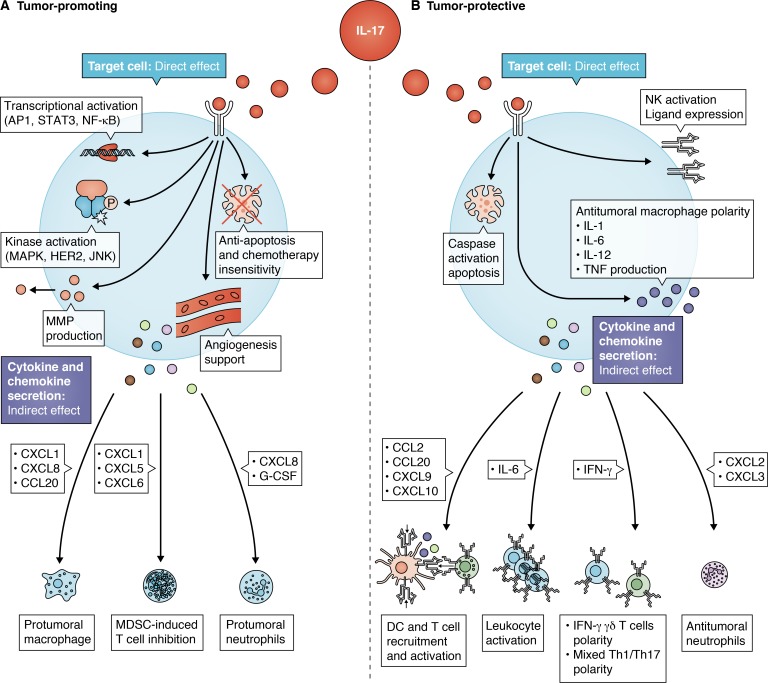
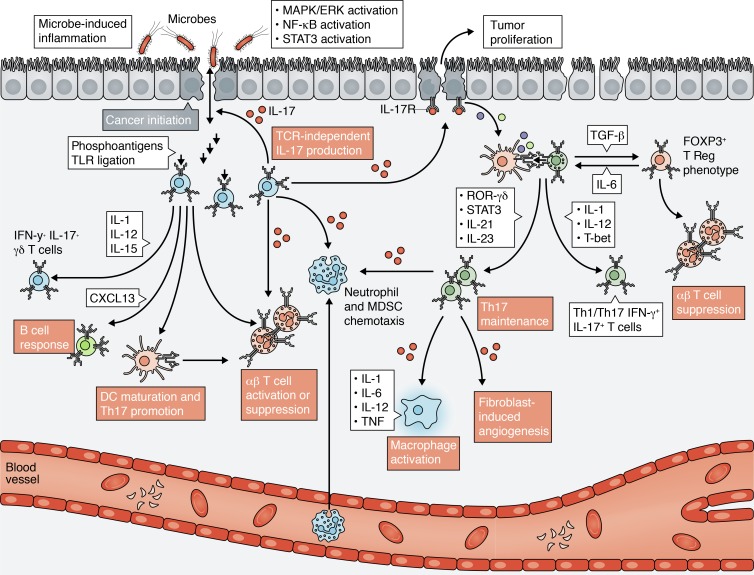
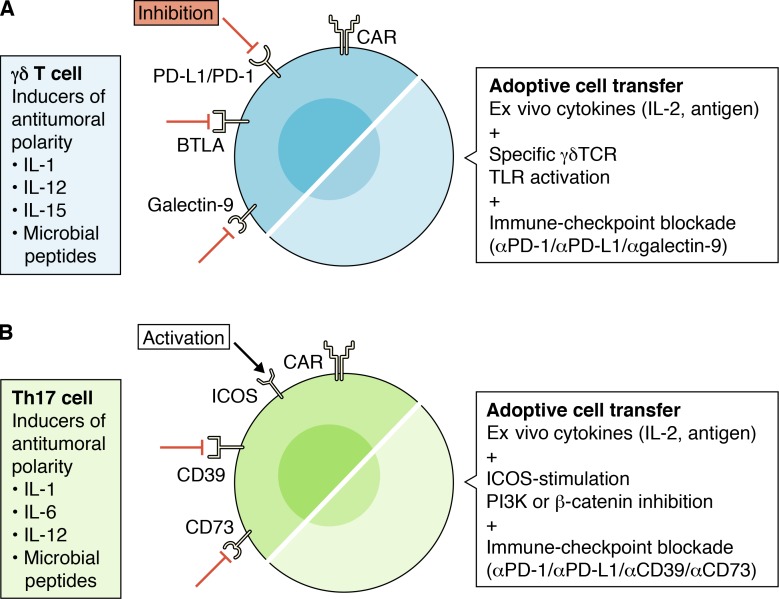
The role of IL-17 in cancer remains controversial. Emerging evidence suggests that during early oncogenesis IL-17 supports tumor growth, whereas in established tumors IL-17 production by γδ and Th17 cells potentiates antitumor immunity. Consequently, γδ and Th17 cells are attractive targets for immunotherapy in the IL-17 immune axis. To optimize IL-17–based immunotherapy, a deeper understanding of the cytokines dictating IL-17 production and the polarity of γδ and Th17 cells is critical. Here, we delve into the dichotomous roles of IL-17 in cancer and provide insight into the tumor microenvironment conducive for successful IL-17–based γδ and Th17 cell immunotherapy.
Overview
The claims and statistics of this paper haven’t been checked yet.
Free: it reads the open-access text and checks the first 5 claims that cite a source we can check. Create a free account to check every claim.
Integrity signals
Registry
Cites
Statistics
Figures
Verification
Claims the paper makes
The claims and statistics of this paper haven’t been checked yet.
Free: it reads the open-access text and checks the first 5 claims that cite a source we can check. Create a free account to check every claim.
Claims other papers make about this one
Each is checked against this paper’s own text: does it say what the citing paper says it does?
The source backs part of the claim, not all of it — or backs it for a different population, condition or comparison.
In the citing paper
“In this context, Th17-like Tregs secreting IL-17 within tumors may be advantageous for patients with malignancies [60].”
From Potential anti-tumor effects of regulatory T cells in the tumor microenvironment: a review (2024) · cites this paper as [60]
Experimental — accuracy not yet measured
Self-check
Percentages, sums and reported differences re-computed from the paper’s own numbers.
The self-check needs the paper’s full text.
Citations
Cites
PD-1 and PD-L1 Immune Checkpoint Blockade to Treat Breast Cancer
Hartkopf, A. D., Taran, F.-A., Wallwiener, M., Walter, C. B., Krämer, B., Grischke, E.-M., & Brucker, S. Y. (2016) · Breast Care · doi:10.1159/000453569 · Cited by 30,845
Adverse Renal Effects of Immune Checkpoint Inhibitors: A Narrative Review
Wanchoo, R., Karam, S., Uppal, N. N., Barta, V. S., Deray, G., Devoe, C., Launay-Vacher, V., Jhaveri, K. D., & on behalf of Cancer and Kidney International Network Workgroup on Immune Checkpoint Inhibitors (2017) · American Journal of Nephrology · doi:10.1159/000455014 · Cited by 15,256
Improved Survival with Ipilimumab in Patients with Metastatic Melanoma
Hodi, F. S., O'Day, S. J., McDermott, D. F., Weber, R. W., Sosman, J. A., Haanen, J. B., Gonzalez, R., Robert, C., Schadendorf, D., Hassel, J. C., et al. (2010) · New England Journal of Medicine · doi:10.1056/nejmoa1003466 · Cited by 15,155 · cited 1×
“…in patients whose malignancies previously carried a dismal prognosis, providing hope for those with advanced and metastatic melanoma, renal, and lung cancers (Borghaei et al., 2015; Brahmer et al., 2015; Eggermont et al., 2016; Hodi et al., 2010; Robert et al., 2015; Brahmer, J., et al. 2017.”
BackgroundNivolumab versus docetaxel in advanced nonsquamous non-small-cell lung cancer
Borghaei, H., Paz-Ares, L., Horn, L., Spigel, D. R., Steins, M., Ready, N. E., Chow, L. Q., Vokes, E. E., Felip, E., Holgado, E., et al. (2015) · New England Journal of Medicine · doi:10.1056/nejmoa1507643 · Cited by 9,335 · cited 1×
“The lack of response to immunotherapy, however, has been disappointing in a variety of other malignancies, including pancreatic cancer, in which an unfavorable, immunosuppressive tumor microenvironment precludes immunotherapy success (Brahmer et al., 2012; Royal et al., 2010).”
BackgroundNivolumab versus Docetaxel in Advanced Squamous-Cell Non–Small-Cell Lung Cancer
Brahmer, J., Reckamp, K. L., Baas, P., Crinò, L., Eberhardt, W. E. E., Poddubskaya, E., Antonia, S., Pluzanski, A., Vokes, E. E., Holgado, E., et al. (2015) · New England Journal of Medicine · doi:10.1056/nejmoa1504627 · Cited by 8,447 · cited 1×
“…using IL-2 and zalendronate (which mimics TLR ligation) has shown some efficacy in prostate cancer (Dieli et al., 2007), advanced renal cell carcinoma (Bennouna et al., 2008; Fisher et al., 2014b), non-small cell lung cancer (Nakajima et al., 2010), and neuroblastoma (Capsomidis et al., 2018).”
BackgroundSafety and activity of anti-PD-L1 antibody in patients with advanced cancer
Brahmer, J. R., Tykodi, S. S., Chow, L. Q. M., Hwu, W.-J., Topalian, S. L., Hwu, P., Drake, C. G., Camacho, L. H., Kauh, J., Odunsi, K., et al. (2012) · New England Journal of Medicine · doi:10.1056/nejmoa1200694 · Cited by 7,945 · cited 1×
“…in patients whose malignancies previously carried a dismal prognosis, providing hope for those with advanced and metastatic melanoma, renal, and lung cancers (Borghaei et al., 2015; Brahmer et al., 2015; Eggermont et al., 2016; Hodi et al., 2010; Robert et al., 2015; Brahmer, J., et al. 2017.”
BackgroundNivolumab in Previously Untreated Melanoma without BRAF Mutation
Robert, C., Long, G. V., Brady, B., Dutriaux, C., Maio, M., Mortier, L., Hassel, J. C., Rutkowski, P., McNeil, C., Kalinka-Warzocha, E., et al. (2015) · New England Journal of Medicine · doi:10.1056/nejmoa1412082 · Cited by 5,519
Tumor mutational load predicts survival after immunotherapy across multiple cancer types
Samstein, R. M., Lee, C.-H., Shoushtari, A. N., Hellmann, M. D., Shen, R., Janjigian, Y. Y., Barron, D. A., Zehir, A., Jordan, E. J., Omuro, A., et al. (2019) · Nature Genetics · doi:10.1038/s41588-018-0312-8 · Cited by 4,071
Interleukin-17 Family Members and Inflammation
Kolls, J. K., & Lindén, A. (2004) · Immunity · doi:10.1016/j.immuni.2004.08.018 · Cited by 2,372 · cited 4×
“The roles of IL-17 in the tumor microenvironment The IL-17 family comprises six cytokines (IL-17A through IL-17F) that ligate five receptors (IL-17RA through IL-17RE; Kolls and Lindén, 2004).”
BackgroundInfluentialCouzin-Frankel, J. (2013) · Science · doi:10.1126/science.342.6165.1432 · Cited by 2,051 · cited 1×
“Immunotherapy has changed the landscape of cancer treatment (Couzin-Frankel, 2013).”
Background
Cited by
IL-17 and IL-17-producing cells in protection versus pathology
Mills, K. H. G. (2023) · Nature Reviews Immunology · doi:10.1038/s41577-022-00746-9 · Cited by 1,000
Interleukins in cancer: from biology to therapy
Briukhovetska, D., Dörr, J., Endres, S., Libby, P., Dinarello, C. A., & Kobold, S. (2021) · Nature Reviews Cancer · doi:10.1038/s41568-021-00363-z · Cited by 781
Speiser, D. E., Chijioke, O., Schaeuble, K., & Münz, C. (2023) · Nature Cancer · doi:10.1038/s43018-023-00521-2 · Cited by 479
Cytotoxic CD4+ T cells in cancer: Expanding the immune effector toolbox
Oh, D. Y., & Fong, L. (2021) · Immunity · doi:10.1016/j.immuni.2021.11.015 · Cited by 467
Crosstalk Between the MSI Status and Tumor Microenvironment in Colorectal Cancer
Lin, A., Zhang, J., & Luo, P. (2020) · Frontiers in Immunology · doi:10.3389/fimmu.2020.02039 · Cited by 358
“Additionally, IL-1, IL6, and TNF play important roles in macrophage polarization, converting myeloid-derived suppressor cells (MDSCs) into M1like macrophages with antitumor functions (41).”
Background
Metadata
- Authors
- Vitiello, G. A., & Miller, G.
- Affiliations
- NYU Langone Health (US)
- Corresponding author
- Miller, George
- Venue
- Journal of Experimental Medicine
- Publisher
- Rockefeller University Press
- Published
- 2019-11-14
- Volume
- 217
- Issue
- 1
- ISSN
- 0022-1007 (ISSN-L)
- 1540-9538
- PMC
- PMC7037254
- OpenAlex
- W2988046914
- Cited by
- 151
- References
- 132
- Citations by year
- 2026: 12 · 2025: 21 · 2024: 22 · 2023: 32 · 2022: 30 · 2021: 24 · 2020: 10
- FWCI
- 1.52
- Type
- journal article
- Language
- en
- Open access
- hybrid
- doi.org
- Licence
- Locations
- The Journal of Experimental Medicine (publishedVersion, cc-by-nc-sa)
- PubMed Central (publishedVersion, cc-by-nc-sa)
- PubMed (publishedVersion)
- Funders
- National Institutes of Health (CA168611, CA203105, CA215471, CA19311, DK106025, L30 TR002111)
- Topics
- Health Sciences › Medicine › Oncology › Cancer Immunotherapy and Biomarkers
- Life Sciences › Immunology and Microbiology › Immunology › T-cell and B-cell Immunology
- Life Sciences › Immunology and Microbiology › Immunology › Psoriasis: Treatment and Pathogenesis
- Keywords
- IL-17, cancer immunotherapy, γδ T cells, Th17 cells, tumor microenvironment, antitumor immunity, tumor growth, cytokines, immunotherapy targets
- MeSH terms
- Animals, Humans, Immunotherapy, Neoplasms, Interleukin-17, Th17 Cells, Tumor Microenvironment
About these checks
Registry, retraction, Cites and statistics results are computed, not judged, with one exception: a printed reference that no index lists is read once by a model before it counts as a citation error. Claims are extracted by a model and kept only when their quote appears verbatim in the text; each cited source is then checked, with a model’s help, for whether it says what the claim relies on. Those verdicts can be wrong — read the claim’s quote and the cited source before relying on one.
Statistics and arithmetic are recomputed, not judged.
Confidence bands are shown only for fields calibrated on our annotated test set. None is calibrated yet, so no band is shown.
What counts as a claim ›How we measure confidence ›How we check this ›
Are you an author, or do you see a problem with this page? Request a review
How to cite
Cite CoChat for the checks on this page, and the paper for its own findings.
- This page
- CoChat. (2026). Citation check: Targeting the interleukin-17 immune axis for cancer immunotherapy. https://app.cochat.ai/papers/10.1084/jem.20190456
- The paper
- Vitiello, G. A., & Miller, G. (2020). Targeting the interleukin-17 immune axis for cancer immunotherapy. Journal of Experimental Medicine. https://doi.org/10.1084/jem.20190456
Data sources
Bibliographic data: Semantic Scholar, OpenAlex, Crossref.
Contains information from the Semantic Scholar Academic Graph Datasets, made available under the ODC Attribution License (ODC-BY 1.0).
Semantic Scholar’s data is described in: Kinney, R., et al. (2023). The Semantic Scholar Open Data Platform. arXiv:2301.10140.
