

Zitterbewegung (trembling motion) of electrons in semiconductors: a review
Open accessThe DOI matches its Crossref record; 85 of the 85 references it cites were found in a registry or an index; 73 of the 118 sources its claims cite were checked for support.
Abstract
We review recent research on Zitterbewegung (ZB, trembling motion) of electrons in semiconductors. A brief history of the subject is presented, the trembling motion in semi-relativistic and spin systems is considered and its main features are emphasized. ZB of charge carriers in monolayer and bilayer graphene as well as in carbon nanotubes is elaborated in some detail. We describe the effects of an external magnetic field on ZB using monolayer graphene as an example. The nature of electron ZB in crystalline solids is explained. We also review various simulations of the trembling motion in a vacuum and in semiconductors, and mention ZB-like wave phenomena in sonic and photonic periodic structures. An attempt is made to quote all the relevant literature on the subject.
Overview
CoChat Summary
TL;DR
This review surveys Zitterbewegung (trembling motion) of electrons in semiconductors, graphene, carbon nanotubes, magnetic fields, and related simulations and wave analogues. It argues ZB is a universal interference phenomenon between positive- and negative-energy states, with transient wave-packet oscillations in field-free solids and persistent multifrequency motion in quantized magnetic spectra.
Key findings
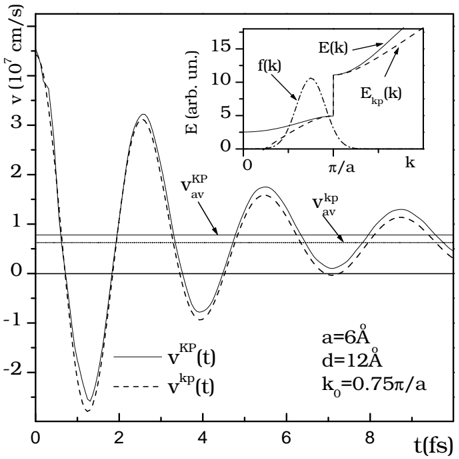
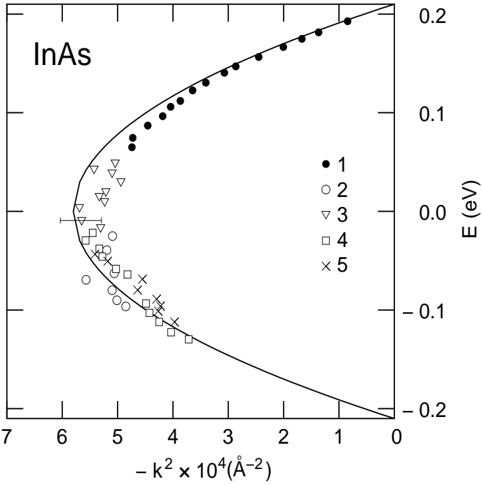
- In narrow-gap semiconductors via the relativistic analogy, the ZB frequency is ℏω_Z ≃ E_g and the ZB length is λ_Z = ℏ/m*_0 u ≃ 0.89(m_0/m*_0) Å; estimates are GaAs ~13 Å, InAs ~37 Å, InSb ~64 Å, with u ≃ 1.3×10^8 cm/s.
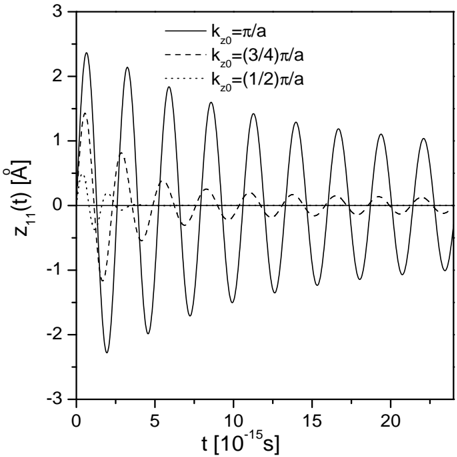
- Bilayer graphene: ZB frequency ℏω_Z = 2ℏ^2 k^2/2m*, transient; decay constant Γ_Z = ℏ k_0y/(m* d); for d = 300 Å and k_0y = 3.5×10^8 m^-1, packet spreading is not the main cause, but positive/negative subpackets separate.
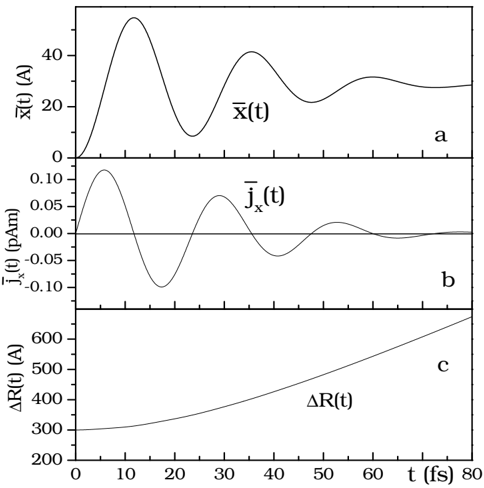
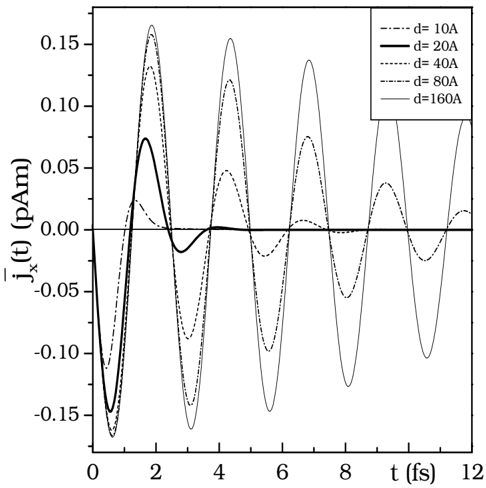
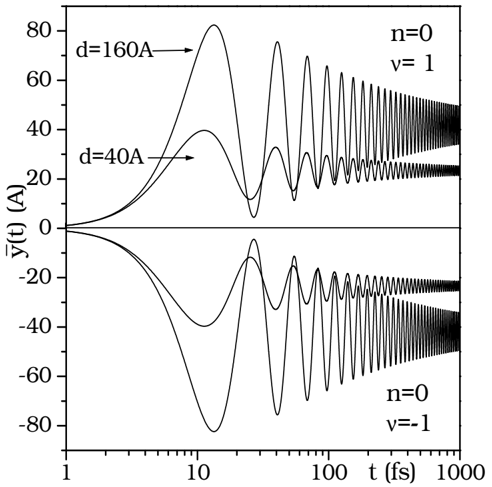
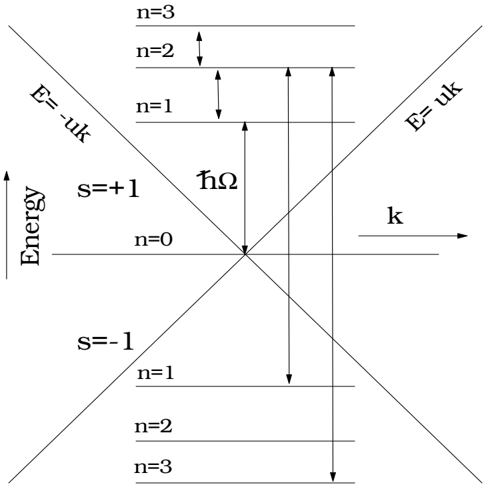
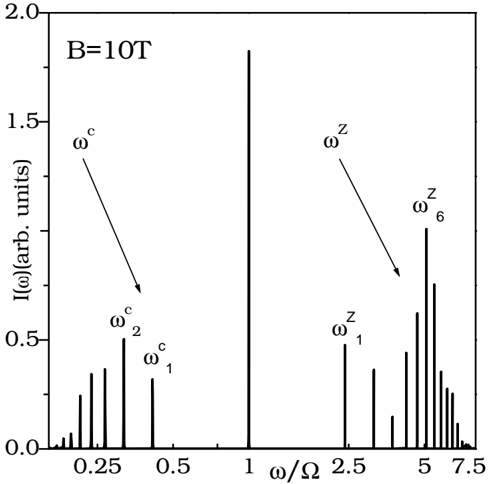
- Monolayer graphene: linear spectrum E = ±uℏk gives ω_Z = 2uk; in a magnetic field Landau levels E_ns = sℏΩ√n with Ω = √2u/L, ZB becomes permanent and multifrequency, with interband emission peaks. Carbon nanotubes: gap E_g = 2uℏ|k_nν|, ZB decays as t^-1/2 for k_0y = 0, slower than graphene.
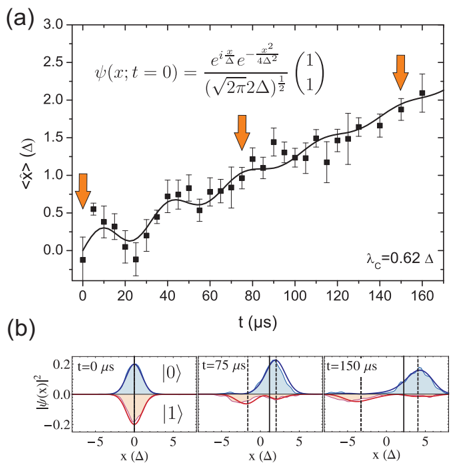
- Simulations/observations: trapped 40Ca+ ions simulated 1+1 Dirac ZB; ZB-like effects were observed in sonic crystals and photonic superlattices; direct electron ZB in semiconductors remains a challenge.
Methods
- Review article synthesizing theoretical and experimental literature on ZB; no new primary experimental sample is described.
- Uses the relativistic analogy/k·p for narrow-gap semiconductors, Dirac-like two-band Hamiltonians, wave-packet averages, Landau-level quantization, Kronig-Penney periodic potentials, and comparisons to trapped-ion/optical-lattice simulations.
- Main analysis is analytical derivation plus numerical plots/figures; cites experiments/simulations including Gerritsma et al. trapped ions, sonic crystals, and photonic superlattices.
Limitations
- Stated: the subject has been almost exclusively theoretical; direct experimental evidence for electron ZB in semiconductors remains a challenge; simulations are promising.
- Stated: copyright restrictions led the authors to quote mostly derivations and figures from their own papers.
- Evident: as a review, it does not present new primary data; many conclusions rely on cited theoretical/numerical work and simulations rather than direct semiconductor measurements.
Model-written summary. Check it against the paper before relying on it.
Integrity signals
Registry
Cites
Statistics
Figures
Verification
Claims the paper makes
22 Valid · 45 Not valid · 28 Not checked · 97 Own results and interpretations
Some cited sources support this claim and some don’t — read each source’s verdict below.
In the paper
“It was recognized that the phenomenon of ZB occurs every time one deals with two or more interacting energy bands [14-16].”
What the sources say
- Disputedcites [14] matched to “Zitterbewegung of Electronic Wave Packets in III-V Zinc-Blende Semiconductor Quantum Wells” (2005) sourceExperimental — accuracy not yet measured
The paper studies zitterbewegung in spin-orbit-coupled semiconductor quantum wells, but it does not say that multiple interacting energy bands invariably produce it. On p. 3, it explicitly states that zitterbewegung is absent when the Rashba and Dresselhaus couplings are equal in magnitude, contradicting the claim’s “every time.” (LLM, conf=0.87)
Checked by a reasoning model — may be wrong.
- Partly supportedcites [15] matched to “Unified description of Zitterbewegung for spintronic, graphene, and superconducting systems” (2006) sourceExperimental — accuracy not yet measured
On p. 1, the paper relates ZB to coupling between components of a system’s eigenstates and describes its occurrence in several nonrelativistic systems. It presents a unified treatment for a wide class of systems, but does not establish that ZB occurs every time two or more energy bands interact. (LLM, conf=0.85)
- Partly supportedcites [16] matched to “Oscillatory multiband dynamics of free particles: The ubiquity of zitterbewegung effects” (2007) sourceExperimental — accuracy not yet measured
The Introduction and Overview (pp. 1–2) describes zitterbewegung-like oscillations in several gapped or spin-split multiband models and explains them as interference between energy-band subspaces. The paper does not establish that they occur every time two or more bands interact; its analysis concerns particular free or quasi-free particle models. (LLM, conf=0.85)
plainstates a cause- Asserted: passes — The authors put it forward as true.
- Checkable: passes — It can be checked against evidence.
- Load-bearing: unclear — It is unclear whether the paper’s conclusions depend on it.
- Based: passes — The paper gives a reason why it holds.
- Disputed
At least one cited source doesn’t support this claim or points to a different paper, and none confirmed it — see the verdicts below.
In the paper
“A proof-of-principle of such simulations was recently carried out, see Figure 10 and Reference [20].”
What the sources say
- Disputedcites [20] matched to “Theory of electron Zitterbewegung in graphene probed by femtosecond laser pulses” (2009) sourceExperimental — accuracy not yet measured
The Introduction (p. 1) says electron Zitterbewegung in a vacuum is beyond current experimental possibilities. The Summary (p. 8) describes a theoretical proposal for observing Zitterbewegung in graphene, not a proof-of-principle simulation that was carried out in a vacuum. (LLM, conf=0.89)
Checked by a reasoning model — may be wrong.
plain- Asserted: passes — The authors put it forward as true.
- Checkable: passes — It can be checked against evidence.
- Load-bearing: unclear — It is unclear whether the paper’s conclusions depend on it.
- Based: passes — The paper gives a reason why it holds.
- Disputed
At least one cited source doesn’t support this claim or points to a different paper, and none confirmed it — see the verdicts below.
In the paper
“Thus, for example, the ZB resulting from the BychkovRashba spin splitting (or the so-called linear Dresselhaus spin splitting) is not characterized by a truly interband frequency, since in this situation there is no gap, but the frequency corresponding to the energy difference between the two spin branches of the same band: ℏ ω Z = E ↑ -E ↓ , see (7) and Reference [13].”
What the sources say
- Disputedcites [13] matched to “Zitterbewegung and its effects on electrons in semiconductors” (2005) sourceExperimental — accuracy not yet measured
Split into 2 atoms — 0 confirmed, 0 partially supported, 1 disputed, 0 misattributed, 1 unverifiable. Expand the claim to see per-atom verdicts.
Checked by a reasoning model — may be wrong.
plain- Asserted: passes — The authors put it forward as true.
- Checkable: passes — It can be checked against evidence.
- Load-bearing: passes — The paper’s conclusions depend on it.
- Based: passes — The paper gives a reason why it holds.
- Disputed
At least one cited source doesn’t support this claim or points to a different paper, and none confirmed it — see the verdicts below.
In the paper
“On the other hand, if the electron spectrum is discrete, ZB persists in time, sometimes in the form of collapse-revival patterns [53].”
What the sources say
- Disputedcites [53] Krueckl V, 2009, New J. Phys. sourceExperimental — accuracy not yet measured
Section 3.1 (page unavailable) says trembling motion may be neglected in the scenario studied, while other revival phenomena appear. Section 3.2 identifies the collapse and revivals as those of the wave packet’s cyclotron centre-of-mass motion, not persistent Zitterbewegung. (LLM, conf=0.87)
Checked by a reasoning model — may be wrong.
plainstates a possible cause- Asserted: passes — The authors put it forward as true.
- Checkable: passes — It can be checked against evidence.
- Load-bearing: passes — The paper’s conclusions depend on it.
- Based: passes — The paper gives a reason why it holds.
- Disputed
The cited sources that could be checked couldn’t confirm or dispute this claim.
In the paper
“recently Gerritsma et al. [20] simulated experimentally the Dirac equation and the resulting electron Zitterbewegung with the use of trapped ions and laser excitations.”
What the sources say
- Could not verifycites [20] matched to “Theory of electron Zitterbewegung in graphene probed by femtosecond laser pulses” (2009) sourceExperimental — accuracy not yet measured
The Introduction (p. 1) and Summary (p. 8) describe a proposed laser-pulse experiment in graphene, not a trapped-ion experiment. Searches for Gerritsma, trapped ions, and an experimental simulation of the Dirac equation found no passage in our copy addressing the attributed result. (LLM, conf=0.77)
plainstates a cause- Asserted: passes — The authors put it forward as true.
- Checkable: passes — It can be checked against evidence.
- Load-bearing: unclear — It is unclear whether the paper’s conclusions depend on it.
- Based: passes — The paper gives a reason why it holds.
- Could not verify
90 more claims · 26 with their cited sources checked
Create a free account to see all 192 claims and to verify the 3 references still open.
- It may state two separate claims as one. 67
- Probably not a substantial claim. 42
- The quote only partly states this claim. 1
Claims other papers make about this one
Each is checked against this paper’s own text: does it say what the citing paper says it does?
The source backs part of the claim, not all of it — or backs it for a different population, condition or comparison.
In the citing paper
“It consists of an oscillatory motion of a propagating wavepacket transverse to its ballistic trajectory despite the absence of transverse forces18.”
From Observation of Zitterbewegung in photonic microcavities (2023) · cites this paper as [18]
Experimental — accuracy not yet measuredThe source backs part of the claim, not all of it — or backs it for a different population, condition or comparison.
In the citing paper
“These experiments validate the algebraic structure of the Dirac operator but do not reveal the physical origin of the ZBW or probe internal electron geometry.”
From The Zitterbewegung in the Bivector Standard Model (2026) · cites this paper as [24]
Experimental — accuracy not yet measured
Self-check
Percentages, sums and reported differences re-computed from the paper’s own numbers.
Each contradiction between two passages listed here was confirmed by an independent check.
Rated minor: it would not touch a result — a value no result rests on, a p-value that stays on the same side of the significance level, or a conflict that is clerical, resolved elsewhere in the paper, or outside its own findings.
In the paper
§ VIII. SIMULATIONS · p. 15
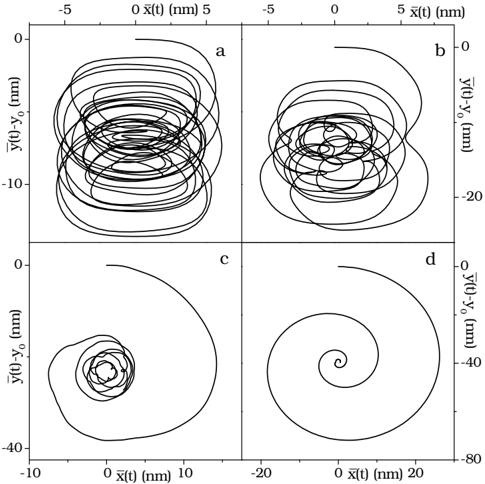
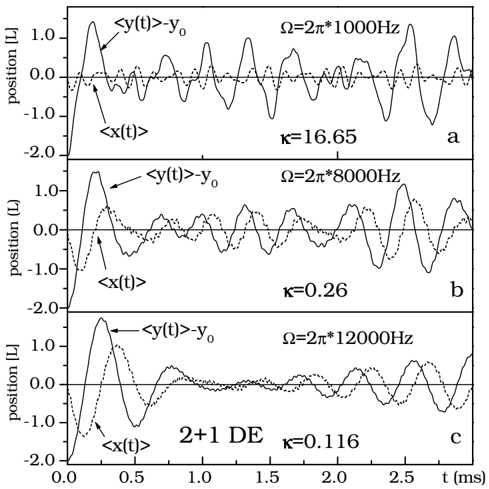
“Simulations correspond to κ = ℏ ω c / 2 mc 2 = 16.65 (a), 0.26 (b), 0.116 (c), respectively.”
§ VIII. SIMULATIONS · p. 15
“In Figure. 11 we show the calculated ZB for three values of κ : 16.65, 1.05, 0.116.”
Rated minor: it would not touch a result — a value no result rests on, a p-value that stays on the same side of the significance level, or a conflict that is clerical, resolved elsewhere in the paper, or outside its own findings.
In the paper
§ A. Bilayer graphene · p. 6
“The relative velocity is v rel = ℏ k 0 y t/m ∗ .”
§ A. Bilayer graphene · p. 6
“After the time Γ -1 Z = d/v rel the distance between the two packets equals d , so the integrals (22) are small, resulting in the diminishing Zitterbewegung amplitude. This reasoning gives the decay constant Γ Z = ℏ k 0 y /m ∗ d”
Citations
Cites
Electric Field Effect in Atomically Thin Carbon Films
Novoselov, K. S., Geim, A. K., Morozov, S. V., Jiang, D., Zhang, Y., Dubonos, S. V., Grigorieva, I. V., & Firsov, A. A. (2004) · Science · doi:10.1126/science.1102896 · Cited by 66,834
The electronic properties of graphene
Castro Neto, A. H., Guinea, F., Peres, N. M. R., Novoselov, K. S., & Geim, A. K. (2009) · Reviews of Modern Physics · doi:10.1103/revmodphys.81.109 · Cited by 24,803
The Principles of Quantum Mechanics
Dirac, P. A. M., & Polkinghorne, J. C. (1958) · Physics Today · doi:10.1063/1.3062610 · Cited by 5,409
Comparison of quantum and semiclassical radiation theories with application to the beam maser
Jaynes, E. T., & Cummings, F. W. (1963) · Proceedings of the IEEE · doi:10.1109/proc.1963.1664 · Cited by 5,353
Wallace, P. R. (1947) · Physical Review · doi:10.1103/physrev.71.622 · Cited by 5,055
Band structure of indium antimonide
Kane, E. O. (1957) · Journal of Physics and Chemistry of Solids · doi:10.1016/0022-3697(57)90013-6 · Cited by 3,701
Spin-Orbit Coupling Effects in Zinc Blende Structures
Dresselhaus, G. (1955) · Physical Review · doi:10.1103/physrev.100.580 · Cited by 3,695
Motion of Electrons and Holes in Perturbed Periodic Fields
Luttinger, J. M., & Kohn, W. (1955) · Physical Review · doi:10.1103/physrev.97.869 · Cited by 3,088
Oscillatory effects and the magnetic susceptibility of carriers in inversion layers
Bychkov, Y. A., & Rashba, E. I. (1984) · Journal of Physics C: Solid State Physics · doi:10.1088/0022-3719/17/33/015 · Cited by 2,972
Relativistic Quantum Mechanics
Bjorken, J. D., Drell, S. D., & Mansfield, J. E. (1965) · Physics Today · doi:10.1063/1.3047288 · Cited by 2,836
Research works printed but not linked: 5
- Schrödinger E, 1930, Sitz. ber. Preuss. Akad. Wiss. Phys. Math. Kl., 24, 418
- Vonsovskii S V, 1990, Teor. Mat. Fiz., 85, 211
- Zawadzki W, 1997, High Magnetic Fields in the Physics of Semiconductors II, 755
- Zawadzki W, 1970, Optical Properties of Solids, 179
- Brillouin L, 1956, Propagation des Ondes Dans Les Milieux Periodiques
Cited by
Direct observation of zitterbewegung in a Bose–Einstein condensate
LeBlanc, L. J., Beeler, M. C., Jiménez-García, K., Perry, A. R., Sugawa, S., Williams, R. A., & Spielman, I. B. (2013) · New Journal of Physics · doi:10.1088/1367-2630/15/7/073011 · Cited by 186
Ni, X., Yves, S., Krasnok, A., & Alù, A. (2023) · Chemical Reviews · doi:10.1021/acs.chemrev.2c00800 · Cited by 191
Klein tunneling in the α−T3 model
Illes, E., & Nicol, E. J. (2017) · Physical review. B./Physical review. B · doi:10.1103/physrevb.95.235432 · Cited by 131
“This has made graphene an ideal playground for directly testing ideas of relativistic physics, including Klein tunneling [6–9] and Zitterbewegung [11,12].”
MethodNon-Abelian physics in light and sound
Yang, Y., Yang, B., Ma, G., Li, J., Zhang, S., & Chan, C. T. (2024) · Science · doi:10.1126/science.adf9621 · Cited by 144
“…been generalized into a universal wave phenomenon over the past century: It describes a trembling motion resulting from wave interference of quasi-degenerate modes, and alternative systems have been proposed to simulate this effect ( 109 – 116 ), and more broadly, relativistic quantum mechanics.”
BackgroundNon-Abelian gauge field optics
Chen, Y., Zhang, R.-Y., Xiong, Z., Hang, Z. H., Li, J., Shen, J. Q., & Chan, C. T. (2019) · Nature Communications · doi:10.1038/s41467-019-10974-8 · Cited by 88
Relativistic quantum mechanics with trapped ions
Lamata, L., Casanova, J., Gerritsma, R., Roos, C. F., García-Ripoll, J. J., & Solano, E. (2011) · New Journal of Physics · doi:10.1088/1367-2630/13/9/095003 · Cited by 80
Relativistic quantum effects of Dirac particles simulated by ultracold atoms
Zhang, D.-W., Wang, Z.-D., & Zhu, S.-L. (2012) · Frontiers of Physics · doi:10.1007/s11467-011-0223-y · Cited by 68
Biswas, T., & Kanti Ghosh, T. (2018) · Journal of Physics: Condensed Matter · doi:10.1088/1361-648x/aaa60b · Cited by 48
Anomalous electron trajectory in topological insulators
Shi, L.-K., Zhang, S.-C., & Chang, K. (2013) · Physical Review B · doi:10.1103/physrevb.87.161115 · Cited by 43
Quantum simulations of relativistic quantum physics in circuit QED
Pedernales, J. S., Di Candia, R., Ballester, D., & Solano, E. (2013) · New Journal of Physics · doi:10.1088/1367-2630/15/5/055008 · Cited by 40
Revivals of Zitterbewegung of a bound localized Dirac particle
Romera, E. (2011) · Physical Review A · doi:10.1103/physreva.84.052102 · Cited by 35
Wave-packet dynamics in multilayer phosphorene
Cunha, S. M., da Costa, D. R., de Sousa, G. O., Chaves, A., Pereira, J. M., & Farias, G. A. (2019) · Physical review. B./Physical review. B · doi:10.1103/physrevb.99.235424 · Cited by 33
Spin and localization of relativistic fermions and uncertainty relations
Céleri, L. C., Kiosses, V. I., & Terno, D. R. (2016) · Physical Review A · doi:10.1103/physreva.94.062115 · Cited by 32
Dirac quantum cellular automaton in one dimension:Zitterbewegungand scattering from potential
Bisio, A., D'Ariano, G. M., & Tosini, A. (2013) · Physical Review A · doi:10.1103/physreva.88.032301 · Cited by 32
Observation of Zitterbewegung in photonic microcavities
Lovett, S., Walker, P. M., Osipov, A., Yulin, A., Naik, P. U., Whittaker, C. E., Shelykh, I. A., Skolnick, M. S., & Krizhanovskii, D. N. (2023) · Light: Science & Applications · doi:10.1038/s41377-023-01162-x · Cited by 32
Semirelativity in semiconductors: a review
Zawadzki, W. (2017) · Journal of Physics Condensed Matter · doi:10.1088/1361-648x/aa7932 · Cited by 38
“The Hamiltonian (84) has the form appearing in DE, with c replaced by u and m0c 2 by εg/2, so that it is possible to calculate the Zitterbewegung following the procedure used by Schrödinger (Zawadzki, 2005b; Zawadzki and Rusin, 2011).”
MethodSelf-citationLocalization behavior of Dirac particles in disordered graphene superlattices
Zhao, Q., Gong, J., & Müller, C. A. (2012) · Physical Review B · doi:10.1103/physrevb.85.104201 · Cited by 29
Tunneling properties in α−T3 lattices: Effects of symmetry-breaking terms
Cunha, S. M., da Costa, D. R., Pereira, J. M., Filho, R. N. C., Duppen, B. V., & Peeters, F. M. (2022) · Physical review. B./Physical review. B · doi:10.1103/physrevb.105.165402 · Cited by 28
Floquet oscillations in periodically driven Dirac systems
Junk, V., Reck, P., Gorini, C., & Richter, K. (2020) · Physical review. B./Physical review. B · doi:10.1103/physrevb.101.134302 · Cited by 27
Dynamics of Weyl quasiparticles in an optical lattice
Li, Z., Wang, H., Zhang, D.-W., Zhu, S.-L., & Xing, D. (2016) · Physical Review A · doi:10.1103/physreva.94.043617 · Cited by 29
Analog Sauter-Schwinger effect in semiconductors for spacetime-dependent fields
Linder, M. F., Lorke, A., & Schützhold, R. (2018) · Physical review. B./Physical review. B · doi:10.1103/physrevb.97.035203 · Cited by 32
Snake states and Klein tunneling in a graphene Hall bar with a pn-junction
Barbier, M., Papp, G., & Peeters, F. M. (2012) · Applied Physics Letters · doi:10.1063/1.4704667 · Cited by 24
Spin-orbit-driven electron pairing in two dimensions
Gindikin, Y., & Sablikov, V. A. (2018) · Physical review. B./Physical review. B · doi:10.1103/physrevb.98.115137 · Cited by 22
Propagation of a relativistic electron wave packet in the Dirac equation
Park, S. T. (2012) · Physical Review A · doi:10.1103/physreva.86.062105 · Cited by 22
Zitterbewegung and quantum revivals in monolayer graphene quantum dots in magnetic fields
García, T., Cordero, N. A., & Romera, E. (2014) · Physical Review B · doi:10.1103/physrevb.89.075416 · Cited by 24
Zitterbewegung study in Dirac oscillator with laser pulse
Wang, Y., Cao, J., & Xiong, S. (2012) · The European Physical Journal B · doi:10.1140/epjb/e2012-30243-7 · Cited by 25
Dynamics of quasiparticles in graphene under intense circularly polarized light
Yudin, D., Eriksson, O., & Katsnelson, M. I. (2015) · Physical Review B · doi:10.1103/physrevb.91.075419 · Cited by 22
“Such a system is very similar to narrow-gap semiconductors, which are known to exhibit the quantum relativistic effect of Zitterbewegung [52]: Indeed, by direct comparison with the celebrated Dirac equation (for which the phenomenon of Zitterbewegung was first discovered), the Compton wavelength has been identified.”
BackgroundMultimode behavior of electron Zitterbewegung induced by an electromagnetic wave in graphene
Rusin, T. M., & Zawadzki, W. (2013) · Physical Review B · doi:10.1103/physrevb.88.235404 · Cited by 23
Self-citationZitterbewegung in monolayer silicene in a magnetic field
Romera, E., Roldán, J. B., & Santos, F. D. L. (2014) · Physics Letters A · doi:10.1016/j.physleta.2014.06.040 · Cited by 20
Wave packet dynamics and zitterbewegung of heavy holes in a quantizing magnetic field
Biswas, T., & Ghosh, T. K. (2014) · Journal of Applied Physics · doi:10.1063/1.4880740 · Cited by 18
Dirac fermions in graphene using the position-dependent translation operator formalism
Aguiar, V., Cunha, S. M., da Costa, D. R., & Filho, R. N. C. (2020) · Physical review. B./Physical review. B · doi:10.1103/physrevb.102.235404 · Cited by 21
Different models of gravitating Dirac fermions in optical lattices
Celi, A. (2017) · The European Physical Journal Special Topics · doi:10.1140/epjst/e2016-60390-y · Cited by 17
Szabó, L. Z., Benedict, M. G., Czirják, A., & Földi, P. (2013) · Physical Review B · doi:10.1103/physrevb.88.075438 · Cited by 19
Dirac open-quantum-system dynamics: Formulations and simulations
Cabrera, R., Campos, A. G., Bondar, D. I., & RABITZ, H. A. (2016) · Physical Review A · doi:10.1103/physreva.94.052111 · Cited by 21
Topological sound in two dimensions
Yves, S., Ni, X., & Alù, A. (2022) · Annals of the New York Academy of Sciences · doi:10.1111/nyas.14885 · Cited by 22
Universal semiclassical equations based on the quantum metric for a two-band system
Leblanc, C., Malpuech, G., & Solnyshkov, D. D. (2021) · Physical review. B./Physical review. B · doi:10.1103/physrevb.104.134312 · Cited by 19
“Even for Hamiltonians which do not have a single length scale, the QM still can be used to determine the scales of the ZBW at rest or at high velocities, changing from the Compton to the de Broglie wavelength [44, 45]: indeed, √ gkk ∼ 1/k = ~/p at large k.”
BackgroundZitterbewegung of electrons in quantum wells and dots in the presence of an in-plane magnetic field
Biswas, T., & Ghosh, T. K. (2012) · Journal of Physics Condensed Matter · doi:10.1088/0953-8984/24/18/185304 · Cited by 30
Zitterbewegungfor ultracold atoms in the merging of Dirac points
Li, Z., Cao, H., & Fu, L. (2015) · Physical Review A · doi:10.1103/physreva.91.023623 · Cited by 20
Lavor, I. R., da Costa, D. R., Chaves, A., Sena, S. H. R., Farias, G. A., Duppen, B. V., & Peeters, F. M. (2020) · Journal of Physics Condensed Matter · doi:10.1088/1361-648x/abcd7f · Cited by 20
Effects of Electric and Magnetic Fields on Zitterbewegung of Electron Wave Packet in Borophene
Yar, A., & Ilyas, A. (2020) · Journal of the Physical Society of Japan · doi:10.7566/jpsj.89.124705 · Cited by 15
Noncommutative geometry of Zitterbewegung
Eckstein, M., Franco, N., & Miller, T. (2017) · Physical review. D/Physical review. D. · doi:10.1103/physrevd.95.061701 · Cited by 16
Time-evolution patterns of electrons in twisted bilayer graphene
Do, V. N., Le, H. A., & Bercioux, D. (2019) · Physical review. B./Physical review. B · doi:10.1103/physrevb.99.165127 · Cited by 14
Hybridization effects on wave packet dynamics in topological insulator thin films
Yar, A., Naeem, M., Khan, S. U., & Sabeeh, K. (2017) · Journal of Physics Condensed Matter · doi:10.1088/1361-648x/aa801a · Cited by 14
Scattering of a Dirac electron on a mass barrier
Matulis, A., Masir, M. R., & Peeters, F. M. (2012) · Physical Review A · doi:10.1103/physreva.86.022101 · Cited by 12
Quantum metric dependent anomalous velocity in systems subject to complex electric fields
Alon, B., Ilan, R., & Goldstein, M. (2024) · Physical review. B./Physical review. B · doi:10.1103/physrevb.110.245103 · Cited by 11
“The transiency of Zitterbewegung in Hermitian condensed matter systems has been discussed before [81] and general arguments have shown it to be a result of the finite width of the wave-packet in k -space [82].”
Steering Zitterbewegung in driven Dirac systems: From persistent modes to echoes
Reck, P., Gorini, C., & Richter, K. (2020) · Physical review. B./Physical review. B · doi:10.1103/physrevb.101.094306 · Cited by 10
Pseudospin-dependent Zitterbewegung in monolayer graphene
Serna, E., Rodríguez-Vargas, I., Pérez-Álvarez, R., & Cisneros, L. D. (2019) · Journal of Applied Physics · doi:10.1063/1.5078642 · Cited by 11
Chaotic transport of electron wave packet in Weyl semimetal slab
Yar, A., & Khan, S. U. (2019) · Physical review. E · doi:10.1103/physreve.99.052213 · Cited by 11
Floquet scattering of light and sound in Dirac optomechanics
Wurl, C., & Fehske, H. (2018) · Physical Review A · doi:10.1103/physreva.98.063812 · Cited by 11
Zitterbewegung of electrons in carbon nanotubes created by laser pulses
Rusin, T. M., & Zawadzki, W. (2014) · Journal of Physics Condensed Matter · doi:10.1088/0953-8984/26/21/215301 · Cited by 15
Self-citationLangmuir waves in semi-relativistic spinless quantum plasmas
Ivanov, A. Y., Andreev, P. A., & Kuzmenkov, L. S. (2015) · Progress of Theoretical and Experimental Physics · doi:10.1093/ptep/ptv080 · Cited by 20
Coulomb pairing of electrons in thin films with strong spin-orbit interaction
Gindikin, Y., & Sablikov, V. A. (2018) · Physica E Low-dimensional Systems and Nanostructures · doi:10.1016/j.physe.2018.12.028 · Cited by 9
Electric control of the bandgap in quantum wells with band-inverted junctions
Díaz‐Fernández, Á., Chico, L., & Domínguez-Adame, F. (2017) · Journal of Physics Condensed Matter · doi:10.1088/1361-648x/aa91a6 · Cited by 9
Plasmonic Zitterbewegung in binary graphene sheet arrays
Fan, Y., Wang, B., Huang, H., Wang, K., Long, H., & Lu, P. (2015) · Optics Letters · doi:10.1364/ol.40.002945 · Cited by 9
Observation of Conductance Fluctuation due to Zitterbewegung in InAs 2-dimentional Electron Gas
Iwasaki, Y., Hashimoto, Y., Nakamura, T., & Katsumoto, S. (2017) · Journal of Physics Conference Series · doi:10.1088/1742-6596/864/1/012054 · Cited by 7
Graphene Hall bar with an asymmetric pn-junction
Milovanović, S. P., Masir, M. R., & Peeters, F. M. (2013) · Journal of Applied Physics · doi:10.1063/1.4805350 · Cited by 8
Chiral dynamics and Zitterbewegung of Weyl quasiparticles in a magnetic field
Hu, X.-D., Li, L.-Y., Guo, Z.-X., & Li, Z. (2021) · New Journal of Physics · doi:10.1088/1367-2630/ac10fc · Cited by 7
Time diffraction and Zitterbewegung of two-dimensional massless Dirac excitations
Cruz, E., Carrillo-Bastos, R., & Villavicencio, J. (2020) · Physical review. B./Physical review. B · doi:10.1103/physrevb.101.115415 · Cited by 8
Discrete Time Dirac Quantum Walk in 3+1 Dimensions
D’Ariano, G. M., Mosco, N., Perinotti, P., & Tosini, A. (2016) · Entropy · doi:10.3390/e18060228 · Cited by 8
“6 submitted to Entropy 13 of 17 From direct computation (and neglecting the boundary terms of the commutators) it follows Vj(k) = sinw k w k cosw k w k sinw k H(k)(v k) j + w k sinw k ng0g¶ k j n˜ k, (48) and Aj(k) = 2n w2 k sin2 w k n å m<n gmgn f (j) mn mg¶ k j n˜ k ! (49) f(j) mn := (n˜ k) n¶ k j (n˜ k)m (n˜ k)m…”
BackgroundEffective photon mass and exact translating quantum relativistic structures
Haas, F., & Manrique, M. A. A. (2016) · Physics of Plasmas · doi:10.1063/1.4945627 · Cited by 7
Spin-Magnetic Moment of Dirac Electron, and Role of Zitterbewegung
Sasabe, S. (2014) · Journal of Modern Physics · doi:10.4236/jmp.2014.57064 · Cited by 12
Bilayer graphene Hall bar with a pn-junction
Milovanović, S. P., Masir, M. R., & Peeters, F. M. (2013) · Journal of Applied Physics · doi:10.1063/1.4821264 · Cited by 8
STUDY OF ZITTERBEWEGUNG AND THE RADIATED FIELDS IN GRAPHENE SYSTEM
Wang, Y.-X., HE, Y.-J., & Xiong, S. (2012) · Modern Physics Letters B · doi:10.1142/s0217984912501394 · Cited by 7
Electric Field Effects on Curved Graphene Quantum Dots
de-la-Huerta-Sainz, S., Ballesteros, Á., & Cordero, N. A. (2023) · Micromachines · doi:10.3390/mi14112035 · Cited by 6
Quantum magnetotransport oscillations in graphene nanoribbons coupled to superconductors
Takagaki, Y. (2021) · Journal of Physics Condensed Matter · doi:10.1088/1361-648x/abf8d1 · Cited by 6
“particle-antiparticle pairs in a position measurement [29].”
Zitterbewegung and Klein-tunneling phenomena for transient quantum waves
Nieto-Guadarrama, F., & Villavicencio, J. (2020) · Physical Review A · doi:10.1103/physreva.101.042104 · Cited by 7
Simulating the Majorana dynamics with ultracold atomic gases in a bilayer honeycomb lattice
Shen, X., Zhang, D.-W., Yan, H., Li, Z., & Zhu, S.-L. (2020) · Physical Review Research · doi:10.1103/physrevresearch.2.013037 · Cited by 6
Nonlocality of Foldy-Wouthuysen and related transformations for the Dirac equation
Rusin, T. M., & Zawadzki, W. (2011) · Physical Review A · doi:10.1103/physreva.84.062124 · Cited by 6
Self-citationPlunging in the Dirac sea using graphene quantum dots
Fillion‐Gourdeau, F., Lévesque, P. L., & MacLean, S. (2020) · Physical Review Research · doi:10.1103/physrevresearch.2.033472 · Cited by 6
“The Klein paradox [6,7], the Zitterbewegung [8], atomic collapse [9,10], the Schwinger process [11–18], and the Breit-Wheeler process [19] have been considered from this point of view.”
MethodZitterbewegung and symmetry switching in Klein’s four-group
Chotorlishvili, L., Zięba, P., Tralle, I. E., & Ugulava, A. (2017) · Journal of Physics A Mathematical and Theoretical · doi:10.1088/1751-8121/aa9a2c · Cited by 6
PerfectZitterbewegungoscillations in the Kitaev chain system
Zhang, Q., & Gong, J. (2016) · Physical Review A · doi:10.1103/physreva.93.032117 · Cited by 6
Converting Zitterbewegung oscillation to directed motion
Zhang, Q., Gong, J., & Oh, C. H. (2011) · Europhysics Letters (EPL) · doi:10.1209/0295-5075/96/10004 · Cited by 5
Chiral states induced by symmetry breaking terms in α − T 3 lattices
Nascimento, J. P. G., Cunha, S. M., Paz, M. L. Á., Filho, R. N. C., Pereira, J. M., Peeters, F. M., & da Costa, D. R. (2025) · Physical review. B./Physical review. B · doi:10.1103/b4tj-5rky · Cited by 7
Dirac particle under dynamical confinement: Fermi acceleration, trembling motion and quantum force
Dittrich, J., Rakhmanov, S., & Matrasulov, D. U. (2024) · Physics Letters A · doi:10.1016/j.physleta.2024.129408 · Cited by 7
Optical radiation induced chaotic dynamics of electrons in a uniform magnetic field
Yar, A., Zubair, M., & Sabeeh, K. (2019) · Journal of Physics Condensed Matter · doi:10.1088/1361-648x/ab5767 · Cited by 5
Damping of electron Zitterbewegung in carbon nanotubes
Rusin, T. M., & Zawadzki, W. (2015) · Physica E Low-dimensional Systems and Nanostructures · doi:10.1016/j.physe.2015.02.013 · Cited by 6
Self-citationTwo-photon echo method for observing electron zitterbewegung in carbon nanotubes
Rusin, T. M., & Zawadzki, W. (2014) · Semiconductor Science and Technology · doi:10.1088/0268-1242/29/12/125010 · Cited by 6
Self-citationPlasmonic analogs of Zitterbewegung in nanoscale metal waveguide arrays
Ding, S., & Wang, G. P. (2014) · Journal of the Optical Society of America B · doi:10.1364/josab.31.000603 · Cited by 4
Physics of Quanta and Quantum Fields in Graphene
Baskaran, G. (2012) · Wiley eBooks · doi:10.1002/9783527651122.ch3 · Cited by 4
Zitterbewegungof Klein-Gordon particles and its simulation by classical systems
Rusin, T. M., & Zawadzki, W. (2012) · Physical Review A · doi:10.1103/physreva.86.032103 · Cited by 5
Self-citationThe Zitterbewegung in the Bivector Standard Model
Sanctuary, B. (2026) · Axioms · doi:10.3390/axioms15020116 · Cited by 3
Zhu, J. F., Zheng, L., Wang, K., Wu, J., Zhang, R., & Chen, T. (2025) · European Journal of Mechanics - A/Solids · doi:10.1016/j.euromechsol.2025.105738 · Cited by 3
Optical Zitterbewegung effect in arrays of helical waveguides
Zhan, K., Chen, Q., Zhang, Q., Zhao, T., Qin, H., He, H., & Yao, G. (2024) · Nanophotonics · doi:10.1515/nanoph-2024-0329 · Cited by 3
“…bands in solid physics, ZB phenomena have so far predicted in a wide variety of quantum and classical physical systems, such as semiconductors [4], [5], super-conductors [6], [7], topological insulators [8], Bose–Einstein condensate [9], ultracold atoms [10], plasma [11], as well as optical…”
Current density of Majorana bound states
Abyaneh, M. Z., & Farhoudi, M. (2022) · Physics Letters A · doi:10.1016/j.physleta.2022.128475 · Cited by 3
Magnetotransport in graphene nanoribbons sandwiched by superconductors at side edges
Takagaki, Y. (2022) · Journal of Physics Condensed Matter · doi:10.1088/1361-648x/ac7024 · Cited by 4
Zitterbewegung-mediated RKKY coupling in topological insulator thin films
Ho, C. S., Tan, S. G., Siu, Z. B., & Jalil, M. B. A. (2020) · New Journal of Physics · doi:10.1088/1367-2630/ab95df · Cited by 3
Maxwell-Like Equations for Free Dirac Electrons
Bruce, S. A. (2018) · Zeitschrift für Naturforschung A · doi:10.1515/zna-2017-0328 · Cited by 3
Knuth, K. H. (2016) · The frontiers collection · doi:10.1007/978-3-319-43760-6_10 · Cited by 3
“While zitter has not yet been observed directly in electrons, there is not only indirect evi d nce that this is a real physical effect for electrons [19][10] but also eviden c that this is a real effect for fermions in general [17][56][39][44].”
BackgroundPhotonic cellular automaton simulation of relativistic quantum fields: Observation of Zitterbewegung
Suprano, A., Zia, D., Polino, E., Poderini, D., Carvacho, G., Sciarrino, F., Lugli, M., Bisio, A., & Perinotti, P. (2024) · Physical Review Research · doi:10.1103/physrevresearch.6.033136 · Cited by 2
Heat capacity of one-dimensional Kane oscillator
Babanlı, A. M. (2023) · Low Temperature Physics · doi:10.1063/10.0020868 · Cited by 2
Dynamically Characterizing the Structures of Dirac Points via Wave Packets
Liang, D.-D., 沈, X. 鑫. S., & Li, Z. (2023) · Chinese Physics Letters · doi:10.1088/0256-307x/40/11/110302 · Cited by 3
Zitterbewegung of Dirac quasiparticles emerged in a Su-Schrieffer–Heeger lattice*
Hu, Y. X., Guo, Z.-X., Zhong, Z.-M., & Li, Z. (2020) · Chinese Physics B · doi:10.1088/1674-1056/abb45b · Cited by 3
Cyclotron motion without magnetic field
Hasdeo, E. H., Frenzel, A., & Song, J. C. W. (2019) · New Journal of Physics · doi:10.1088/1367-2630/ab351c · Cited by 3
The Schrödinger Equation and Negative Energies
Bruce, S. A. (2018) · Zeitschrift für Naturforschung A · doi:10.1515/zna-2018-0321 · Cited by 2
Signature of Topological Phases in Zitterbewegung
Ghosh, S., & Manchon, A. (2016) · SPIN · doi:10.1142/s201032471640004x · Cited by 4
Time dependence of the position momentum and position velocity uncertainties in gapped graphene
Jung, E., Kim, K. S., & Park, D. (2012) · Physical Review B · doi:10.1103/physrevb.85.165418 · Cited by 2
Nematizadeh Juneghani, S., Bagheri, M., & Shokri, B. (2021) · Journal of Cosmology and Astroparticle Physics · doi:10.1088/1475-7516/2021/09/002 · Cited by 2
“Besides, researches tried to explain their observations in terms of the spin splitting due to the structural inversion asymmetry with the resulting current-induced spin precession and ZB at the Larmor frequency [54].”
BackgroundInfluentialNon-Abelian Electric Field and Zitterbewegung on a Photonic Frequency Chain
Yang, S., Wong, B. T. T., Hu, J., & Yang, Y. (2026) · Physical Review Letters · doi:10.1103/qy4y-171h · Cited by 1
Gyromagnetics of the Electron Clock
Hestenes, D. (2025) · IEEE Access · doi:10.1109/access.2025.3544654 · Cited by 3
“However, evidence is mounting that zitterbewegung is a real physical effect, observable, for example, in Bose-Einstein condensates [35] and semiconductors [36].”
Analog of Foucault precession in two-dimensional quantum harmonic oscillators with Berry curvature
Solnyshkov, D. D., Septembre, I., Ndiaye, K., & Malpuech, G. (2023) · Physical review. B./Physical review. B · doi:10.1103/physrevb.108.144306 · Cited by 2
Metadata
- Authors
- Zawadzki, W., & Rusin, T. M.
- Affiliations
- Institute of Physics (PL)
- Orange (Poland) (PL)
- Venue
- Journal of Physics: Condensed Matter
- Publisher
- IOP Publishing
- Published
- 2011-03-18
- Volume
- 23
- Issue
- 14
- Pages
- 143201
- ISSN
- 0953-8984 (ISSN-L)
- 1361-648X
- OpenAlex
- W2013670760
- Semantic Scholar
- dfe1c1fa027dd2fb8978e629c9264052367382a7
- Cited by
- 150
- References
- 79
- Citations by year
- 2026: 8 · 2025: 7 · 2024: 7 · 2023: 9 · 2022: 6 · 2021: 7 · 2020: 15 · 2019: 9 · 2018: 12 · 2017: 12 · 2016: 10 · 2015: 8 · 2014: 11 · 2013: 9 · 2012: 15
- FWCI
- 6.28
- Type
- journal article
- Language
- en
- Open access
- bronze
- doi.org
- Locations
- Journal of Physics Condensed Matter (publishedVersion)
- PubMed (publishedVersion)
- arXiv (Cornell University) (submittedVersion)
- arXiv (Cornell University)
- Topics
- Physical Sciences › Materials Science › Materials Chemistry › Graphene research and applications
- Physical Sciences › Physics and Astronomy › Condensed Matter Physics › Quantum and electron transport phenomena
- Physical Sciences › Physics and Astronomy › Condensed Matter Physics › Topological Materials and Phenomena
- Keywords
- Zitterbewegung, semiconductors, spin systems, monolayer graphene, bilayer graphene, carbon nanotubes, magnetic field effects, sonic crystals, photonic crystals, periodic structures
About these checks
Registry, retraction, Cites and statistics results are computed, not judged, with one exception: a printed reference that no index lists is read once by a model before it counts as a citation error. Claims are extracted by a model and kept only when their quote appears verbatim in the text; each cited source is then checked, with a model’s help, for whether it says what the claim relies on. Those verdicts can be wrong — read the claim’s quote and the cited source before relying on one.
The claim verdicts this report counts are experimental: their accuracy is not yet measured.
A language model drew the claims from the paper on 2026-10-10, under version 3 of the claim definition (model deepseek-v4.1-flash, prompt extract-v3).
A second model labelled each claim on 2026-10-10 (model jev-1.13-20260917, definition revision gold-guideline-v0.2).
Cited sources are checked with a language model’s help (gpt-6-sol).
Statistics and arithmetic are recomputed, not judged.
Confidence bands are shown only for fields calibrated on our annotated test set. None is calibrated yet, so no band is shown.
What counts as a claim ›How we measure confidence ›How we check this ›
Are you an author, or do you see a problem with this page? Request a review
Data sources
Bibliographic data: Semantic Scholar, OpenAlex, Crossref.
Contains information from the Semantic Scholar Academic Graph Datasets, made available under the ODC Attribution License (ODC-BY 1.0).
Semantic Scholar’s data is described in: Kinney, R., et al. (2023). The Semantic Scholar Open Data Platform. arXiv:2301.10140.
