

Simulating open quantum systems: from many-body interactions to stabilizer pumping
Open accessThe DOI matches its Crossref record; 81 of the 81 references it cites were found in a registry or an index.
Abstract
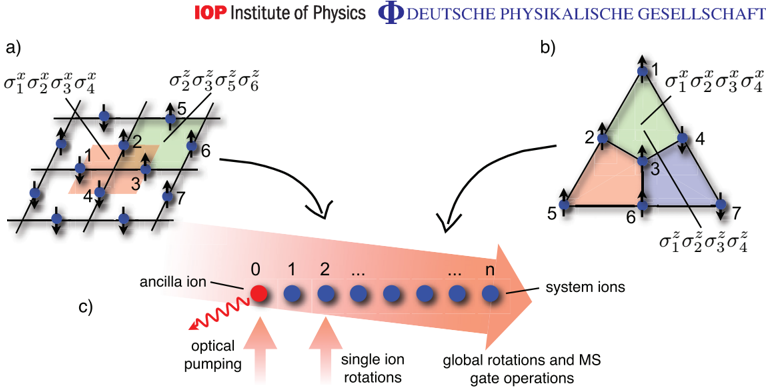
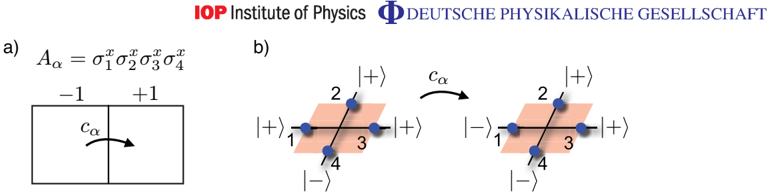
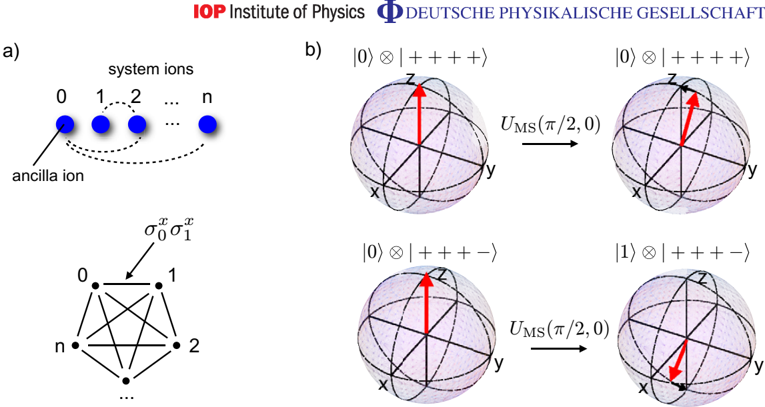
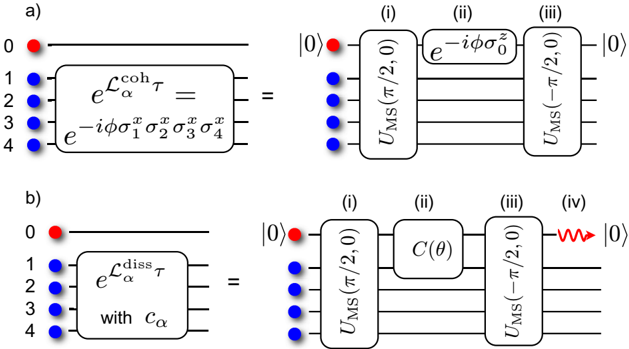
In a recent experiment, Barreiro et al (2011 Nature 470 486) demonstrated the fundamental building blocks of an open-system quantum simulator with trapped ions. Using up to five ions, dynamics were realized by sequences that combined single- and multi-qubit entangling gate operations with optical pumping. This enabled the implementation of both coherent many-body dynamics and dissipative processes by controlling the coupling of the system to an artificial, suitably tailored environment. This engineering was illustrated by the dissipative preparation of entangled two- and four-qubit states, the simulation of coherent four-body spin interactions and the quantum non-demolition measurement of a multi-qubit stabilizer operator. In this paper, we present the theoretical framework of this gate-based ('digital') simulation approach for open-system dynamics with trapped ions. In addition, we discuss how within this simulation approach, minimal instances of spin models of interest in the context of topological quantum computing and condensed matter physics can be realized in state-of-the-art linear ion-trap quantum computing architectures. We outline concrete simulation schemes for Kitaev's toric code Hamiltonian and a recently suggested color code model. The presented simulation protocols can be adapted to scalable and two-dimensional ion-trap architectures, which are currently under development.
Overview
The claims and statistics of this paper haven’t been checked yet.
Free: it reads the open-access text and checks the first 5 claims that cite a source we can check. Create a free account to check every claim.
Integrity signals
Registry
Cites
Statistics
Figures



Verification
Claims the paper makes
The claims and statistics of this paper haven’t been checked yet.
Free: it reads the open-access text and checks the first 5 claims that cite a source we can check. Create a free account to check every claim.
Claims other papers make about this one
Each is checked against this paper’s own text: does it say what the citing paper says it does?
The source backs part of the claim, not all of it — or backs it for a different population, condition or comparison.
In the citing paper
“We map products of fermionic operators onto nonlocal spin operators and decompose the resulting dynamics in efficient steps with Trotter methods, yielding an overall protocol that employs only polynomial resources.”
From Quantum Simulation of Interacting Fermion Lattice Models in Trapped Ions (2012) · cites this paper as [29]
Experimental — accuracy not yet measuredThe source backs part of the claim, not all of it — or backs it for a different population, condition or comparison.
In the citing paper
“Note that for bounded Hamiltonians, the Trotter expansion associated with the exponential of the polynomial sum of efficiently implementable nonlocal terms is also efficient [2, 29, 30], i.e., it only requires polynomial resources [35].”
From Quantum Simulation of Interacting Fermion Lattice Models in Trapped Ions (2012) · cites this paper as [29]
Experimental — accuracy not yet measured
Self-check
Percentages, sums and reported differences re-computed from the paper’s own numbers.
The self-check needs the paper’s full text.
Citations
Cites
Quantum Computation and Quantum Information
Nielsen, M. A., Chuang, I., & Grover, L. K. (2002) · American Journal of Physics · doi:10.1119/1.1463744 · Cited by 21,895
Quantum computation and quantum information
Law, J. (2001) · ACM SIGSOFT Software Engineering Notes · doi:10.1145/505482.505499 · Cited by 18,842
Many-body physics with ultracold gases
Bloch, I., Dalibard, J., & Zwerger, W. (2008) · Reviews of Modern Physics · doi:10.1103/revmodphys.80.885 · Cited by 8,114 · cited 2×
“[5] I Bloch, J Dalibard, and W Zwerger.”
BackgroundSimulating physics with computers
Feynman, R. P. (1982) · International Journal of Theoretical Physics · doi:10.1007/bf02650179 · Cited by 7,691
Fault-tolerant quantum computation by anyons
Kitaev, A. Y. (2003) · Annals of Physics · doi:10.1016/s0003-4916(02)00018-0 · Cited by 7,238 · cited 4×
“The idea of storing and processing quantum information in naturally protected quantum systems has attracted a lot of interest in recent years [35, 67].”
BackgroundMethodInfluentialNon-Abelian anyons and topological quantum computation
Nayak, C., Simon, S. H., Stern, A., Freedman, M., & Das Sarma, S. (2008) · Reviews of Modern Physics · doi:10.1103/revmodphys.80.1083 · Cited by 6,861 · cited 2×
“The idea of storing and processing quantum information in naturally protected quantum systems has attracted a lot of interest in recent years [35, 67].”
BackgroundQuantum phase transition from a superfluid to a Mott insulator in a gas of ultracold atoms
Greiner, M., Mandel, O., Esslinger, T., Hänsch, T. W., & Bloch, I. (2002) · Nature · doi:10.1038/415039a · Cited by 5,935 · cited 2×
“[6] M Greiner, O Mandel, T Esslinger, T W Hänsch, and I Bloch.”
BackgroundQuantum Computations with Cold Trapped Ions
Cirac, J. I., & Zoller, P. (1995) · Physical Review Letters · doi:10.1103/physrevlett.74.4091 · Cited by 3,733 · cited 1×
“It complements existing proposals of quantum simulation with ground state ions [41, 42, 43] or ions excited to Rydberg states [44].”
BackgroundSelf-citationCold Bosonic Atoms in Optical Lattices
Jaksch, D., Bruder, C., Cirac, J. I., Gardiner, C. W., & Zoller, P. (1998) · Physical Review Letters · doi:10.1103/physrevlett.81.3108 · Cited by 3,685 · cited 2×
“[8] D Jaksch, C Bruder, J I Cirac, C W Gardiner, and P Zoller.”
BackgroundSelf-citationLloyd, S. (1996) · Science · doi:10.1126/science.273.5278.1073 · Cited by 3,088 · cited 4×
“Recently, quantum control of open many-body systems, which amounts to engineering both the Hamiltonian time evolution of the many-body system itself as well as its coupling to the environment [2, 21], has become a major research focus.”
BackgroundInfluential
Cited by
Items 101–129 of 129
Variational quantum gate optimization at the pulse level
Greenaway, S., Petiziol, F., Zhao, H., & Mintert, F. (2024) · SciPost Physics · doi:10.21468/scipostphys.16.3.082 · Cited by 7
“…generated by such a limited set of Hamiltonian terms is only a small subset of the full Hilbert space, it is possible to describe the action of the gate to a high degree of accuracy using a significantly reduced set of measurements, in a protocol known as reduced process tomography [51–53].”
BackgroundWalschaers, M. (2018) · Springer theses · doi:10.1007/978-3-319-93151-7_8 · Cited by 3
Two-qubit gate protocols with microwave-dressed Rydberg ions in a linear Paul trap
Wilkinson, J. W. P., Bolsmann, K., Guedes, T. L. M., Müller, M., & Lesanovsky, I. (2025) · New Journal of Physics · doi:10.1088/1367-2630/add494 · Cited by 8
Self-citationMulti-mode global driving of trapped ions for quantum circuit synthesis
Richerme, P. (2025) · Quantum Science and Technology · doi:10.1088/2058-9565/ade560 · Cited by 8
“Following [3, 58], we show an example circuit for generating unitary time evolution under the 4-body Hamiltonian H = Jσ 1 x σ 2 x σ 3 x σ 4 x in Fig.”
Quantum ComputationPreprint
Bishnoi, B. (2020) · arXiv (Cornell University) · doi:10.48550/arxiv.2006.02799 · Cited by 7
“Instead, we are now working to eliminate the large collection lens and integrate the photon detectors into the ion trap chips with a detector right below each ion [161].”
BackgroundEfficient multi-qubit subspace rotations via topological quantum walksPreprint
Gu, X. Q., Allcock, J., An, S., & Liu, Y.-X. (2021) · arXiv (Cornell University) · doi:10.48550/arxiv.2111.06534 · Cited by 6
“As in the main text, we denote ion number 0 as the ancilla and define [38]”
BackgroundFour-body coupler for superconducting qubits based on Josephson parametric oscillators
Miyazaki, R., & Yamamoto, T. (2025) · Physical Review A · doi:10.1103/physreva.111.062612 · Cited by 6
Symmetry Induced Enhancement in Finite-Time Thermodynamic Trade-Off Relations
Funo, K., & Tajima, H. (2025) · Physical Review Letters · doi:10.1103/physrevlett.134.080401 · Cited by 1
Improved strategies for fermionic quantum simulation with global interactions
Kaldenbach, T. N., Schultheis, E., Stewen, N., & Breuil, G. (2026) · npj Quantum Information · doi:10.1038/s41534-026-01223-0
“We further discuss the applicability to other fermion-to-qubit mappings, and show how our techniques readily apply to qubit-excitations.”
InfluentialCorrelation enhanced autonomous quantum battery charging via structured reservoirs
Khoudiri, A., Allati, A. E., Khlifi, Y., Anouz, K. E., & Müstecaplıoğlu, Ö. E. (2026) · Physical review. E · doi:10.1103/x2s1-27k1 · Cited by 5
Mocking up a Dephasing Channel with a Minimal-Sized Environment
Wu, Z. (2012) · Chinese Physics Letters · doi:10.1088/0256-307x/29/8/080304 · Cited by 1
Preparing maximally entangled states by monitoring the environment–system interaction
Abu-Nada, A., & Salhab, M. A. (2023) · Results in Physics · doi:10.1016/j.rinp.2023.106336 · Cited by 1
Fast generation of the non-trivial ground states of the Agassi model with a quantum simulator
Zhou, H., Dai, X., Geng, J., Jin, F., & Ji, Y. (2024) · Physics Letters B · doi:10.1016/j.physletb.2024.138632 · Cited by 1
Strong symmetries in collision models and physical dilations of covariant quantum maps
Cattaneo, M. (2025) · Physical Review A · doi:10.1103/physreva.111.022209 · Cited by 3
Basic Concepts in Quantum Information
Girvin, S. M. (2014) · WORLD SCIENTIFIC eBooks · doi:10.1142/9789814460354_0005 · Cited by 4
“not 2S1. This reasoning leads us to the realization that classically the entropy of a composite system cannot be less than the entropy of the component with the largest entropy. Problem 5. Derive Eq. (52). The quantum result derived above, that each component has finite entropy but the overall system has zero entropy i…”
BackgroundResultGroenland, K., Witteveen, F., Schoutens, K., & Gerritsma, R. (2020) · arXiv (Cornell University) · Cited by 1
Algorithms Bridging Quantum Computation and Chemistry
McClean, J. R. (2015) · Digital Access to Scholarship at Harvard (DASH) (Harvard University) · Cited by 2
Thermodynamic approach to generating functions and nonequilibrium dynamics
Hickey, J. M. (2014) · Nottingham ePrints (University of Nottingham) · Cited by 1
UNIVERSITA' DEGLI STUDI DI PADOVA FACOLTA' DI INGEGNERIA
Bagno, A. (2012)
Digital quantum simulator in the presence of a bath
Zheng, Y.-C., & Ng, H. K. (2017) · Physical Review A · doi:10.1103/physreva.96.042329
Geometria da informação quântica: uma abordagem geral acerca do tempo de evolução
Pires, D. P. (2017) · Digital Library of Theses and Dissertations (Universidade de São Paulo) · doi:10.11606/t.76.2017.tde-17032017-104320 · Cited by 4
Modern Approaches to Topological Quantum Error Correction
Parrado-Rodríguez, P. (2022) · Cronfa (Swansea University) · doi:10.23889/suthesis.60302
Preparing maximally entangled states by monitoring the environment-system interaction
Abu-Nada, A., & Salhab, M. A. (2023) · International Journal of Quantum Information · doi:10.1142/s0219749923400087
Realizing quantum speed limit in open system with a PT -symmetric trapped-ion qubitPreprint
Luo, L., Lu, P., Liu, T., Liu, Y., Rao, X., Lao, Q., Wu, H., & Zhu, F. (2023) · Research Square · doi:10.21203/rs.3.rs-2843863/v1
(2023) · SciPost Physics · doi:10.21468/scipost.report.7312
(2023) · SciPost Physics · doi:10.21468/scipost.report.7117
Quantum simulation of two-level P T -symmetric systems using Hermitian Hamiltonians
Abbasi, M., Aydoğan, K., Schlimgen, A. W., & Head-Marsden, K. (2025) · Physical Review Research · doi:10.1103/gwbz-mbfw
“…to address this challenge with different meth-ods including imaginary time evolution [7, 8, 9, 10, 11] and block encodings [12, 13, 14, 15, 16, 17, 18, 19], among others [20, 21, 22, 23, 24, 25, 26, 27, 28, 29, 30, 31, 32, 33, 34, 35, 36, 37, 38, 39, 40, 41, 42, 43, 44, 45, 46, 47, 48, 49].”
Rosso, L. (2023) · theses.fr (ABES) · doi:10.70675/46c65dc3z81b8z4cdbza362z2f1d7148a247 · Cited by 1
Far-from-equilibrium dynamics and entanglement in long-range quantum systems
Schneider, J. (2022) · theses.fr (ABES) · doi:10.70675/19a4dfcdz202bz4e3aza76fz49b15523ccca
Metadata
- Authors
- Müller, M., Hammerer, K., Zhou, Y. L., Roos, C. F., & Zoller, P.
- Affiliations
- Universidad Complutense de Madrid (ES)
- Leibniz University Hannover (DE)
- National University of Defense Technology (CN)
- Austrian Academy of Sciences (AT)
- Venue
- New Journal of Physics
- Publisher
- IOP Publishing
- Published
- 2011-08-09
- Volume
- 13
- Issue
- 8
- Pages
- 085007
- ISSN
- 1367-2630 (ISSN-L)
- OpenAlex
- W2116710088
- Semantic Scholar
- 8384e5095d1b4a7f233d3fcc9bf1c2f632c4fd54
- Cited by
- 127
- References
- 81
- Citations by year
- 2026: 2 · 2025: 8 · 2024: 8 · 2023: 9 · 2022: 11 · 2021: 3 · 2020: 9 · 2019: 9 · 2018: 9 · 2017: 8 · 2016: 9 · 2015: 8 · 2014: 12 · 2013: 8 · 2012: 10
- FWCI
- 10.02
- Type
- journal article
- Language
- en
- Open access
- gold
- doi.org
- Licence
- cc-by
- Locations
- New Journal of Physics (publishedVersion, cc-by)
- arXiv (Cornell University) (submittedVersion)
- MPG.PuRe (Max Planck Society) (submittedVersion, other-oa)
- Institutional Repository of Leibniz Universität Hannover (Leibniz Universität Hannover) (submittedVersion, cc-by-nc-nd)
- arXiv (Cornell University)
- Leibniz Universität Hannover
- Funders
- European Commission
- National Natural Science Foundation of China (11074307)
- Austrian Science Fund
- Hunan Provincial Innovation Foundation for Postgraduate
- Topics
- Physical Sciences › Computer Science › Artificial Intelligence › Quantum Computing Algorithms and Architecture
- Physical Sciences › Physics and Astronomy › Atomic and Molecular Physics, and Optics › Quantum Information and Cryptography
- Physical Sciences › Physics and Astronomy › Atomic and Molecular Physics, and Optics › Quantum many-body systems
- Keywords
- open quantum systems, trapped ions, quantum simulation, optical pumping, quantum non-demolition measurement, toric code, color codes, topological quantum computation, linear ion trap, dissipative dynamics
About these checks
Registry, retraction, Cites and statistics results are computed, not judged, with one exception: a printed reference that no index lists is read once by a model before it counts as a citation error. Claims are extracted by a model and kept only when their quote appears verbatim in the text; each cited source is then checked, with a model’s help, for whether it says what the claim relies on. Those verdicts can be wrong — read the claim’s quote and the cited source before relying on one.
Statistics and arithmetic are recomputed, not judged.
Confidence bands are shown only for fields calibrated on our annotated test set. None is calibrated yet, so no band is shown.
What counts as a claim ›How we measure confidence ›How we check this ›
Are you an author, or do you see a problem with this page? Request a review
Data sources
Bibliographic data: Semantic Scholar, OpenAlex, Crossref.
Contains information from the Semantic Scholar Academic Graph Datasets, made available under the ODC Attribution License (ODC-BY 1.0).
Semantic Scholar’s data is described in: Kinney, R., et al. (2023). The Semantic Scholar Open Data Platform. arXiv:2301.10140.
