

Simulating open quantum systems: from many-body interactions to stabilizer pumping
Open accessThe DOI matches its Crossref record; 81 of the 81 references it cites were found in a registry or an index.
Abstract
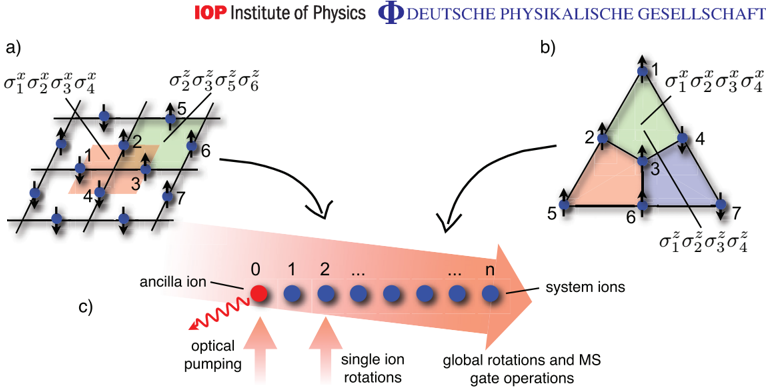
In a recent experiment, Barreiro et al (2011 Nature 470 486) demonstrated the fundamental building blocks of an open-system quantum simulator with trapped ions. Using up to five ions, dynamics were realized by sequences that combined single- and multi-qubit entangling gate operations with optical pumping. This enabled the implementation of both coherent many-body dynamics and dissipative processes by controlling the coupling of the system to an artificial, suitably tailored environment. This engineering was illustrated by the dissipative preparation of entangled two- and four-qubit states, the simulation of coherent four-body spin interactions and the quantum non-demolition measurement of a multi-qubit stabilizer operator. In this paper, we present the theoretical framework of this gate-based ('digital') simulation approach for open-system dynamics with trapped ions. In addition, we discuss how within this simulation approach, minimal instances of spin models of interest in the context of topological quantum computing and condensed matter physics can be realized in state-of-the-art linear ion-trap quantum computing architectures. We outline concrete simulation schemes for Kitaev's toric code Hamiltonian and a recently suggested color code model. The presented simulation protocols can be adapted to scalable and two-dimensional ion-trap architectures, which are currently under development.
Overview
The claims and statistics of this paper haven’t been checked yet.
Free: it reads the open-access text and checks the first 5 claims that cite a source we can check. Create a free account to check every claim.
Integrity signals
Registry
Cites
Statistics
Figures



Verification
Claims the paper makes
The claims and statistics of this paper haven’t been checked yet.
Free: it reads the open-access text and checks the first 5 claims that cite a source we can check. Create a free account to check every claim.
Claims other papers make about this one
Each is checked against this paper’s own text: does it say what the citing paper says it does?
The source backs part of the claim, not all of it — or backs it for a different population, condition or comparison.
In the citing paper
“We map products of fermionic operators onto nonlocal spin operators and decompose the resulting dynamics in efficient steps with Trotter methods, yielding an overall protocol that employs only polynomial resources.”
From Quantum Simulation of Interacting Fermion Lattice Models in Trapped Ions (2012) · cites this paper as [29]
Experimental — accuracy not yet measuredThe source backs part of the claim, not all of it — or backs it for a different population, condition or comparison.
In the citing paper
“Note that for bounded Hamiltonians, the Trotter expansion associated with the exponential of the polynomial sum of efficiently implementable nonlocal terms is also efficient [2, 29, 30], i.e., it only requires polynomial resources [35].”
From Quantum Simulation of Interacting Fermion Lattice Models in Trapped Ions (2012) · cites this paper as [29]
Experimental — accuracy not yet measured
Self-check
Percentages, sums and reported differences re-computed from the paper’s own numbers.
The self-check needs the paper’s full text.
Citations
Cites
Quantum Computation and Quantum Information
Nielsen, M. A., Chuang, I., & Grover, L. K. (2002) · American Journal of Physics · doi:10.1119/1.1463744 · Cited by 21,895
Quantum computation and quantum information
Law, J. (2001) · ACM SIGSOFT Software Engineering Notes · doi:10.1145/505482.505499 · Cited by 18,842
Many-body physics with ultracold gases
Bloch, I., Dalibard, J., & Zwerger, W. (2008) · Reviews of Modern Physics · doi:10.1103/revmodphys.80.885 · Cited by 8,114 · cited 2×
“[5] I Bloch, J Dalibard, and W Zwerger.”
BackgroundSimulating physics with computers
Feynman, R. P. (1982) · International Journal of Theoretical Physics · doi:10.1007/bf02650179 · Cited by 7,691
Fault-tolerant quantum computation by anyons
Kitaev, A. Y. (2003) · Annals of Physics · doi:10.1016/s0003-4916(02)00018-0 · Cited by 7,238 · cited 4×
“The idea of storing and processing quantum information in naturally protected quantum systems has attracted a lot of interest in recent years [35, 67].”
BackgroundMethodInfluentialNon-Abelian anyons and topological quantum computation
Nayak, C., Simon, S. H., Stern, A., Freedman, M., & Das Sarma, S. (2008) · Reviews of Modern Physics · doi:10.1103/revmodphys.80.1083 · Cited by 6,861 · cited 2×
“The idea of storing and processing quantum information in naturally protected quantum systems has attracted a lot of interest in recent years [35, 67].”
BackgroundQuantum phase transition from a superfluid to a Mott insulator in a gas of ultracold atoms
Greiner, M., Mandel, O., Esslinger, T., Hänsch, T. W., & Bloch, I. (2002) · Nature · doi:10.1038/415039a · Cited by 5,935 · cited 2×
“[6] M Greiner, O Mandel, T Esslinger, T W Hänsch, and I Bloch.”
BackgroundQuantum Computations with Cold Trapped Ions
Cirac, J. I., & Zoller, P. (1995) · Physical Review Letters · doi:10.1103/physrevlett.74.4091 · Cited by 3,733 · cited 1×
“It complements existing proposals of quantum simulation with ground state ions [41, 42, 43] or ions excited to Rydberg states [44].”
BackgroundSelf-citationCold Bosonic Atoms in Optical Lattices
Jaksch, D., Bruder, C., Cirac, J. I., Gardiner, C. W., & Zoller, P. (1998) · Physical Review Letters · doi:10.1103/physrevlett.81.3108 · Cited by 3,685 · cited 2×
“[8] D Jaksch, C Bruder, J I Cirac, C W Gardiner, and P Zoller.”
BackgroundSelf-citationLloyd, S. (1996) · Science · doi:10.1126/science.273.5278.1073 · Cited by 3,088 · cited 4×
“Recently, quantum control of open many-body systems, which amounts to engineering both the Hamiltonian time evolution of the many-body system itself as well as its coupling to the environment [2, 21], has become a major research focus.”
BackgroundInfluentialError Correcting Codes in Quantum Theory
Steane, A. M. (1996) · Physical Review Letters · doi:10.1103/physrevlett.77.793 · Cited by 2,677 · cited 1×
“for error syndrome measurements in quantum error correction and quantum computing protocols [69, 70, 71].”
BackgroundSpins in few-electron quantum dots
Hanson, R., Kouwenhoven, L. P., Petta, J. R., Tarucha, S., & Vandersypen, L. M. K. (2007) · Reviews of Modern Physics · doi:10.1103/revmodphys.79.1217 · Cited by 2,665
Good quantum error-correcting codes exist
Calderbank, A. R., & Shor, P. W. (1996) · Physical Review A · doi:10.1103/physreva.54.1098 · Cited by 2,516 · cited 1×
“for error syndrome measurements in quantum error correction and quantum computing protocols [69, 70, 71].”
BackgroundQuantum Measurement and Control
Wiseman, H. M., & Milburn, G. J. (2009) · Cambridge University Press eBooks · doi:10.1017/cbo9780511813948 · Cited by 2,119
Clarke, J., & Wilhelm, F. K. (2008) · Nature · doi:10.1038/nature07128 · Cited by 2,076
Dennis, E., Kitaev, A., Landahl, A., & Preskill, J. (2002) · Journal of Mathematical Physics · doi:10.1063/1.1499754 · Cited by 1,768
Quantum computation and quantum-state engineering driven by dissipation
Verstraete, F., Wolf, M. M., & Ignacio Cirac, J. (2009) · Nature Physics · doi:10.1038/nphys1342 · Cited by 1,570 · cited 3×
“master equations with multi-qubit quantum jump operators opens interesting perspectives for building quantum memories based on dissipation [33] or the demonstration of a novel form of quantum computing solely based on dissipation [32].”
BackgroundDennis, E., Kitaev, A., Landahl, A., & Preskill, J. (2001) · CERN Document Server (European Organization for Nuclear Research) · Cited by 1,485
Experimental entanglement of four particles
Sackett, C. A., Kielpinski, D., King, B. E., Langer, C., Meyer, V., Myatt, C. J., Rowe, M., Turchette, Q. A., Itano, W. M., Wineland, D. J., et al. (2000) · Nature · doi:10.1038/35005011 · Cited by 1,436 · cited 2×
“[61] C A Sackett, D Kielpinski, B E King, C Langer, V Meyer, C J Myatt, M Rowe, Q A Turchette, W M Itano, D J Wineland, and C Monroe.”
BackgroundQuantum states and phases in driven open quantum systems with cold atoms
Diehl, S., Micheli, A., Kantian, A., Kraus, B., Büchler, H. P., & Zoller, P. (2008) · Nature Physics · doi:10.1038/nphys1073 · Cited by 1,264
Self-citationO'Brien, J. L. (2007) · Science · doi:10.1126/science.1142892 · Cited by 1,221
NMR techniques for quantum control and computation
Vandersypen, L. M. K., & Chuang, I. L. (2005) · Reviews of Modern Physics · doi:10.1103/revmodphys.76.1037 · Cited by 1,217 · cited 1×
“σ i = 1) this can be achieved in different ways: (i) by focusing the driving laser of the MS gate operation only onto the relevant subset of ions, or (ii) by hiding the electronic population of these ions in uncoupled electronic states for the duration of the gate sequence [64], or (iii) by means of refocusing techniq…”
BackgroundEntangled states of trapped atomic ions
Blatt, R., & Wineland, D. (2008) · Nature · doi:10.1038/nature07125 · Cited by 1,188 · cited 2×
“The simulation scheme strongly makes use of the welldeveloped set of tools for the purpose of quantum state preparation, manipulation and readout of trapped ions [37, 11, 38].”
BackgroundMethodQuantum computing with trapped ions
HAFFNER, H., ROOS, C., & BLATT, R. (2008) · Physics Reports · doi:10.1016/j.physrep.2008.09.003 · Cited by 1,154
Self-citation14-Qubit Entanglement: Creation and Coherence
Monz, T., Schindler, P., Barreiro, J. T., Chwalla, M., Nigg, D., Coish, W. A., Harlander, M., Hänsel, W., Hennrich, M., & Blatt, R. (2011) · Physical Review Letters · doi:10.1103/physrevlett.106.130506 · Cited by 1,110
An open-system quantum simulator with trapped ions
Barreiro, J. T., Müller, M., Schindler, P., Nigg, D., Monz, T., Chwalla, M., Hennrich, M., Roos, C. F., Zoller, P., & Blatt, R. (2011) · Nature · doi:10.1038/nature09801 · Cited by 1,100 · cited 10×
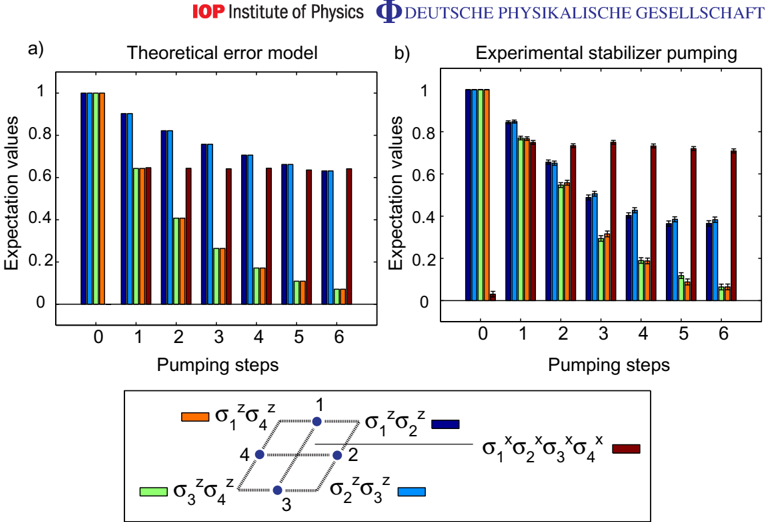
“This decay behavior, as found from a numerical simulation (see figure 6(a) and figure caption for details), has qualitatively been observed in the experiment [34].”
BackgroundMethodInfluentialSelf-citationA toolbox for lattice-spin models with polar molecules
Micheli, A., Brennen, G. K., & Zoller, P. (2006) · Nature Physics · doi:10.1038/nphys287 · Cited by 1,079
Self-citationMultiparticle Entanglement of Hot Trapped Ions
Mølmer, K., & Sørensen, A. (1999) · Physical Review Letters · doi:10.1103/physrevlett.82.1835 · Cited by 1,019 · cited 4×
“, the computational basis states are mapped to states, which are up to local rotations equivalent to GHZ states [39].”
BackgroundMethodInfluentialBuluta, I., & Nori, F. (2009) · Science · doi:10.1126/science.1177838 · Cited by 876 · cited 1×
“Since then, quantum simulation has become a very active and rapidly evolving research field on its own (see references [3, 4] for a recent overview).”
BackgroundEffective Quantum Spin Systems with Trapped Ions
Porras, D., & Cirac, J. I. (2004) · Physical Review Letters · doi:10.1103/physrevlett.92.207901 · Cited by 872 · cited 1×
“It complements existing proposals of quantum simulation with ground state ions [41, 42, 43] or ions excited to Rydberg states [44].”
BackgroundWeimer, H., Müller, M., Lesanovsky, I., Zoller, P., & Büchler, H. P. (2010) · Nature Physics · doi:10.1038/nphys1614 · Cited by 867 · cited 3×
“[54] H Weimer, M Müller, I Lesanovsky, P Zoller, and H P Büchler.”
BackgroundInfluentialSelf-citationTowards quantum chemistry on a quantum computer
Lanyon, B. P., Whitfield, J. D., Gillett, G. G., Goggin, M. E., Almeida, M. P., Kassal, I., Biamonte, J. D., Mohseni, M., Powell, B. J., Barbieri, M., et al. (2010) · Nature Chemistry · doi:10.1038/nchem.483 · Cited by 796 · cited 2×
“[13] B P Lanyon, J D Whitfield, G G Gillett, M E Goggin, M P Almeida, I Kassal, J D Biamonte, M Mohseni, B J Powell, M Barbieri, A Aspuru-Guzik, and A G White.”
BackgroundPreparation of entangled states by quantum Markov processes
Kraus, B., Büchler, H. P., Diehl, S., Kantian, A., Micheli, A., & Zoller, P. (2008) · Physical Review A · doi:10.1103/physreva.78.042307 · Cited by 760 · cited 2×
“[30] B Kraus, H P Büchler, S Diehl, A Kantian, A Micheli, and P Zoller.”
BackgroundSelf-citationQuantum simulation of frustrated Ising spins with trapped ions
Kim, K., Chang, M.-S., Korenblit, S., Islam, R., Edwards, E. E., Freericks, J. K., Lin, G.-D., Duan, L.-M., & Monroe, C. (2010) · Nature · doi:10.1038/nature09071 · Cited by 750 · cited 2×
“Recently, remarkable first experiments have demonstrated the simulation of (relativistic) single-particle dynamics in an external potential [45, 46, 47] and experimental studies of the physics of few interacting Ising spins [48] under frustration [49].”
BackgroundQuantum simulation of the Dirac equation
Gerritsma, R., Kirchmair, G., Zähringer, F., Solano, E., Blatt, R., & Roos, C. F. (2010) · Nature · doi:10.1038/nature08688 · Cited by 725 · cited 2×
“[46] R Gerritsma, G Kirchmair, F Zähringer, E Solano, R Blatt, and C F Roos.”
BackgroundSelf-citationTopological Quantum Distillation
Bombin, H., & Martin-Delgado, M. A. (2006) · Physical Review Letters · doi:10.1103/physrevlett.97.180501 · Cited by 700
Trotzky, S., Cheinet, P., Fölling, S., Feld, M., Schnorrberger, U., Rey, A. M., Polkovnikov, A., Demler, E. A., Lukin, M. D., & Bloch, I. (2008) · Science · doi:10.1126/science.1150841 · Cited by 698 · cited 2×
“[7] S Trotzky, P Cheinet, S Fölling, M Feld, U Schnorrberger, A M Rey, A Polkovnikov, E A Demler, M D Lukin, and I Bloch.”
BackgroundDecoherence of quantum superpositions through coupling to engineered reservoirs
Myatt, C. J., King, B. E., Turchette, Q. A., Sackett, C. A., Kielpinski, D., Itano, W. M., Monroe, C., & Wineland, D. J. (2000) · Nature · doi:10.1038/35002001 · Cited by 694 · cited 1×
“Whereas typically the system-environment coupling leads to detrimental effects on many-body or multi-qubit open systems [22, 23, 24, 25], the ability to control and tailor the associated dissipative processes has been identified as a useful resource: it allows one to dissipatively prepare entangled quantum states and…”
BackgroundUniversal Digital Quantum Simulation with Trapped Ions
Lanyon, B. P., Hempel, C., Nigg, D., Müller, M., Gerritsma, R., Zähringer, F., Schindler, P., Barreiro, J. T., Rambach, M., Kirchmair, G., et al. (2011) · Science · doi:10.1126/science.1208001 · Cited by 613
Self-citationReconstruction of non-classical cavity field states with snapshots of their decoherence
Deléglise, S., Dotsenko, I., Sayrin, C., Bernu, J., Brune, M., Raimond, J.-M., & Haroche, S. (2008) · Nature · doi:10.1038/nature07288 · Cited by 612 · cited 2×
“Whereas typically the system-environment coupling leads to detrimental effects on many-body or multi-qubit open systems [22, 23, 24, 25], the ability to control and tailor the associated dissipative processes has been identified as a useful resource: it allows one to dissipatively prepare entangled quantum states and…”
BackgroundSimulating a quantum magnet with trapped ions
Friedenauer, A., Schmitz, H., Glueckert, J. T., Porras, D., & Schaetz, T. (2008) · Nature Physics · doi:10.1038/nphys1032 · Cited by 602
Processing quantum information in diamond
Wrachtrup, J., & Jelezko, F. (2006) · Journal of Physics: Condensed Matter · doi:10.1088/0953-8984/18/21/s08 · Cited by 534 · cited 1×
“, arrays of coupled superconductors [17, 18], quantum dots [19] and nitrogen-vacancy centers in diamond [20].”
BackgroundTowards fault-tolerant quantum computing with trapped ions
Benhelm, J., Kirchmair, G., Roos, C. F., & Blatt, R. (2008) · Nature Physics · doi:10.1038/nphys961 · Cited by 526
Self-citationCoherent manipulation of single spins in semiconductors
Hanson, R., & Awschalom, D. D. (2008) · Nature · doi:10.1038/nature07129 · Cited by 503 · cited 1×
“Similar promising developments have been reported for solid-state systems [16] such as, e.”
BackgroundControl and Measurement of Three-Qubit Entangled States
Roos, C. F., Riebe, M., Häffner, H., Hänsel, W., Benhelm, J., Lancaster, G. P. T., Becher, C., Schmidt-Kaler, F., & Blatt, R. (2004) · Science · doi:10.1126/science.1097522 · Cited by 390 · cited 2×
“σ i = 1) this can be achieved in different ways: (i) by focusing the driving laser of the MS gate operation only onto the relevant subset of ions, or (ii) by hiding the electronic population of these ions in uncoupled electronic states for the duration of the gate sequence [64], or (iii) by means of refocusing techniq…”
BackgroundSelf-citationExperimental Repetitive Quantum Error Correction
Schindler, P., Barreiro, J. T., Monz, T., Nebendahl, V., Nigg, D., Chwalla, M., Hennrich, M., & Blatt, R. (2011) · Science · doi:10.1126/science.1203329 · Cited by 356 · cited 1×
“[59]) constitutes the dissipative ingredient for the engineering of dissipative many-body spin dynamics.”
BackgroundDynamical Phase Transitions and Instabilities in Open Atomic Many-Body Systems
Diehl, S., Tomadin, A., Micheli, A., Fazio, R., & Zoller, P. (2010) · Physical Review Letters · doi:10.1103/physrevlett.105.015702 · Cited by 350 · cited 2×
“[72] S Diehl, A Tomadin, A Micheli, R Fazio, and P Zoller.”
BackgroundSelf-citationComplete Methods Set for Scalable Ion Trap Quantum Information Processing
Home, J. P., Hanneke, D., Jost, J. D., Amini, J. M., Leibfried, D., & Wineland, D. J. (2009) · Science · doi:10.1126/science.1177077 · Cited by 283 · cited 3×
“[38] J P Home, D Hanneke, J D Jost, J M Amini, D Leibfried, and D J Wineland.”
BackgroundMethodGeneral theory of higher-order decomposition of exponential operators and symplectic integrators
Suzuki, M. (1992) · Physics Letters A · doi:10.1016/0375-9601(92)90335-j · Cited by 244 · cited 1×
“Errors from possible non-commutativity of the quasi-local terms in L are bounded [55] and can be reduced by resorting to shorter time steps τ or higher-order Trotter expansions [58].”
BackgroundExperimental Realization of Noiseless Subsystems for Quantum Information Processing
Viola, L., Fortunato, E. M., Pravia, M. A., Knill, E., Laflamme, R., & Cory, D. G. (2001) · Science · doi:10.1126/science.1064460 · Cited by 235
Quantum Simulation of the Klein Paradox with Trapped Ions
Gerritsma, R., Lanyon, B. P., Kirchmair, G., Zähringer, F., Hempel, C., Casanova, J., García-Ripoll, J. J., Solano, E., Blatt, R., & Roos, C. F. (2011) · Physical Review Letters · doi:10.1103/physrevlett.106.060503 · Cited by 204 · cited 2×
“Recently, remarkable first experiments have demonstrated the simulation of (relativistic) single-particle dynamics in an external potential [45, 46, 47] and experimental studies of the physics of few interacting Ising spins [48] under frustration [49].”
BackgroundSelf-citationExperimental multiparticle entanglement dynamics induced by decoherence
Barreiro, J. T., Schindler, P., Gühne, O., Monz, T., Chwalla, M., Roos, C. F., Hennrich, M., & Blatt, R. (2010) · Nature Physics · doi:10.1038/nphys1781 · Cited by 198 · cited 2×
“[25] J T Barreiro, P Schindler, O Gühne, T Monz, M Chwalla, C F Roos, M Hennrich, and R Blatt.”
BackgroundSelf-citationLloyd, S., & Viola, L. (2001) · Physical Review A · doi:10.1103/physreva.65.010101 · Cited by 197 · cited 3×
“As shown in [21], this can be achieved by a closed-loop simulation scenario.”
BackgroundQuantum simulation of the wavefunction to probe frustrated Heisenberg spin systems
Ma, X.-S., Dakic, B., Naylor, W., Zeilinger, A., & Walther, P. (2011) · Nature Physics · doi:10.1038/nphys1919 · Cited by 179
Optimal resources for topological two-dimensional stabilizer codes: Comparative study
Bombin, H., & Martin-Delgado, M. A. (2007) · Physical Review A · doi:10.1103/physreva.76.012305 · Cited by 178 · cited 1×
“For a detailed introduction to color code models we refer the reader to [68].”
MethodHigh-Fidelity Transport of Trapped-Ion Qubits through anX-Junction Trap Array
Blakestad, R. B., Ospelkaus, C., VanDevender, A. P., Amini, J. M., Britton, J., Leibfried, D., & Wineland, D. J. (2009) · Physical Review Letters · doi:10.1103/physrevlett.102.153002 · Cited by 167 · cited 2×
“[50] R B Blakestad, C Ospelkaus, A P VanDevender, J M Amini, J Britton, D Leibfried, and D J Wineland.”
BackgroundT-junction ion trap array for two-dimensional ion shuttling, storage, and manipulation
Hensinger, W. K., Olmschenk, S., Stick, D., Hucul, D., Yeo, M., Acton, M., Deslauriers, L., Monroe, C., & Rabchuk, J. (2006) · Applied Physics Letters · doi:10.1063/1.2164910 · Cited by 164 · cited 2×
“[51] W K Hensinger, S Olmschenk, D Stick, D Hucul, M Yeo, M Acton, L Deslauriers, C Monroe, and J Rabchuk.”
BackgroundDissipatively driven entanglement of two macroscopic atomic ensembles
Muschik, C. A., Polzik, E. S., & Cirac, J. I. (2011) · Physical Review A · doi:10.1103/physreva.83.052312 · Cited by 163 · cited 2×
“Whereas typically the system-environment coupling leads to detrimental effects on many-body or multi-qubit open systems [22, 23, 24, 25], the ability to control and tailor the associated dissipative processes has been identified as a useful resource: it allows one to dissipatively prepare entangled quantum states and…”
BackgroundT-junction ion trap array for two-dimensional ion shuttling, storage and manipulation
Hensinger, W. K., Acton, M., Deslauriers, L., Hucul, D., Monroe, C., Olmschenk, S., Rabchuk, J., Stick, D., & Yeo, M. (2005) · CERN Document Server (European Organization for Nuclear Research) · Cited by 156
Quantum memories based on engineered dissipation
Pastawski, F., Clemente, L., & Cirac, J. I. (2011) · Physical Review A · doi:10.1103/physreva.83.012304 · Cited by 153 · cited 3×
“master equations with multi-qubit quantum jump operators opens interesting perspectives for building quantum memories based on dissipation [33] or the demonstration of a novel form of quantum computing solely based on dissipation [32].”
BackgroundIon trap quantum gates with amplitude-modulated laser beams
Roos, C. F. (2008) · New Journal of Physics · doi:10.1088/1367-2630/10/1/013002 · Cited by 136 · cited 2×
“Within the Lamb-Dicke regime, where the ions are spatially confined to a region much smaller than the wavelength of the qubit transition, the MS gate operation is particularly robust and works in principle without the necessity of cooling to the motional ground state [60].”
BackgroundSelf-citationTrapped-Ion Quantum Simulator: Experimental Application to Nonlinear Interferometers
Leibfried, D., DeMarco, B., Meyer, V., Rowe, M., Ben-Kish, A., Britton, J., Itano, W. M., Jelenković, B., Langer, C., Rosenband, T., et al. (2002) · Physical Review Letters · doi:10.1103/physrevlett.89.247901 · Cited by 133 · cited 2×
“[45] D Leibfried, B DeMarco, V Meyer, M Rowe, A Ben-Kish, J Britton, W M Itano, B Jelenkovi, C Langer, T Rosenband, and D J Wineland.”
BackgroundSimulation of quantum dynamics with quantum optical systems
Jané, E., Vidal, G., Dür, W., Zoller, P., & Cirac, J. I. (2002) · CaltechAUTHORS (California Institute of Technology) · Cited by 107
Self-citationTrapped Rydberg ions: from spin chains to fast quantum gates
Müller, M., Liang, L., Lesanovsky, I., & Zoller, P. (2008) · New Journal of Physics · doi:10.1088/1367-2630/10/9/093009 · Cited by 106 · cited 2×
“It complements existing proposals of quantum simulation with ground state ions [41, 42, 43] or ions excited to Rydberg states [44].”
BackgroundSelf-citationUniversal simulation of Markovian quantum dynamics
Bacon, D., Childs, A. M., Chuang, I. L., Kempe, J., Leung, D. W., & Zhou, X. (2001) · Physical Review A · doi:10.1103/physreva.64.062302 · Cited by 103 · cited 1×
“In the literature on quantum control of open quantum systems, the required set of operations to realize different classes of quantum operations (1) as well as efficiency and universality aspects have been discussed [21, 56].”
BackgroundOptimal Surface-Electrode Trap Lattices for Quantum Simulation with Trapped Ions
Schmied, R., Wesenberg, J. H., & Leibfried, D. (2009) · Physical Review Letters · doi:10.1103/physrevlett.102.233002 · Cited by 102 · cited 2×
“However, similar protocols can be realized in scalable and two-dimensional ion-trap architectures, to whose development currently a lot of effort is devoted [50, 38, 51, 52, 53], and also on other physical simulation platforms.”
BackgroundHofmann, H. F. (2005) · Physical Review Letters · doi:10.1103/physrevlett.94.160504 · Cited by 97
Simulation of quantum dynamics with quantum optical systems
Jané, E., Vidal, G., Dür, W., Zoller, P., & Cirac, J. I. (2003) · Quantum Information and Computation · doi:10.26421/qic3.1-2 · Cited by 96
Self-citationOptical Pumping into Many-Body Entanglement
Cho, J., Bose, S., & Kim, M. S. (2011) · Physical Review Letters · doi:10.1103/physrevlett.106.020504 · Cited by 91 · cited 1×
“Whereas typically the system-environment coupling leads to detrimental effects on many-body or multi-qubit open systems [22, 23, 24, 25], the ability to control and tailor the associated dissipative processes has been identified as a useful resource: it allows one to dissipatively prepare entangled quantum states and…”
BackgroundOptimal control of entangling operations for trapped-ion quantum computing
Nebendahl, V., Häffner, H., & Roos, C. F. (2009) · Physical Review A · doi:10.1103/physreva.79.012312 · Cited by 84 · cited 3×
“[66] V Nebendahl, H Häffner, and C F Roos.”
BackgroundSelf-citationFocus on Cold and Ultracold Molecules
Carr, L. D., & Ye, J. (2009) · New Journal of Physics · doi:10.1088/1367-2630/11/5/055009 · Cited by 75
A two-dimensional lattice ion trap for quantum simulation
Clark, R. J., Lin, T., Brown, K. R., & Chuang, I. L. (2009) · Journal of Applied Physics · doi:10.1063/1.3056227 · Cited by 49 · cited 2×
“[53] R J Clark, T Linb, K R Brown, and I L Chuang.”
BackgroundQuantum simulation of interacting high-dimensional systems: The influence of noise
Dür, W., Bremner, M. J., & Briegel, H. J. (2008) · Physical Review A · doi:10.1103/physreva.78.052325 · Cited by 41 · cited 2×
“[63] W Dür, M J Bremner, and H J Briegel.”
BackgroundMethodRemapping the quantum frontier
Monroe, C., & Lukin, M. (2008) · Physics World · doi:10.1088/2058-7058/21/08/37 · Cited by 33 · cited 1×
“Since then, quantum simulation has become a very active and rapidly evolving research field on its own (see references [3, 4] for a recent overview).”
BackgroundStroboscopic Generation of Topological Protection
Herdman, C. M., Young, K. C., Scarola, V. W., Sarovar, M., & Whaley, K. B. (2010) · Physical Review Letters · doi:10.1103/physrevlett.104.230501 · Cited by 28 · cited 2×
“[31] C M Herdman, K C Young, V W Scarola, M Sarovar, and K B Whaley.”
BackgroundQuantum information processing using nuclear and electron magnetic resonance: review and prospectsPreprint
Baugh, J., Chamilliard, J., Chandrashekar, C. M., Ditty, M. J. T., Hubbard, A. A., Laflamme, R., Laforest, M., Maslov, D. A., Moussa, O., Negrevergne, C., et al. (2007) · arXiv (Cornell University) · doi:10.48550/arxiv.0710.1447 · Cited by 24 · cited 2×
“[15] J Baugh, J Chamilliard, C M Chandrashekar, M Ditty, A Hubbard, R Laflamme, M Laforest, D Maslov, O Moussa, C Negrevergne, M Silva, S Simmon, C A Ryan, D G Cory, J S Hodges, and C Ramanathan.”
BackgroundQuantum Simulation of Molecular Collisions with Superconducting QubitsPreprint
Pritchett, E., Benjamin, C., Galiautdinov, A., Geller, M. R., Sornborger, A. T., Stancil, P. C., & Martinis, J. M. (2010) · arXiv (Cornell University) · doi:10.48550/arxiv.1008.0701 · Cited by 21 · cited 2×
“[18] E J Pritchett, C Benjamin, A Galiautdinov, M R Geller, A T Sornborger, P C Stancil, and J M Martinis.”
BackgroundEntanglement Generated by Dissipation
Muschik, C. A., Krauter, H., Jensen, K., Wasilewski, W., Petersen, J. M., Cirac, J. I., & Polzik, E. S. (2011) · International Conference on Quantum Information · doi:10.1364/icqi.2011.qmh1 · Cited by 7
Coherence of large-scale entanglementPreprint
Monz, T., Schindler, P., Barreiro, J. T., Chwalla, M., Nigg, D., Coish, W. A., Harlander, M., Haensel, W., Hennrich, M., & Blatt, R. (2010) · arXiv (Cornell University) · Cited by 5
Quantum simulation of a frustrated Heisenberg spin systemPreprint
Ma, X., Dakić, B., Naylor, W. R., Zeilinger, A., & Walther, P. J. (2010) · arXiv (Cornell University) · Cited by 4
Entanglement generated by dissipationPreprint
Krauter, H., Muschik, C. A., Jensen, K., Wasilewski, W., Petersen, J. M., Cirac, J. I., & Polzik, E. S. (2010) · arXiv (Cornell University) · Cited by 3
Cited by
Quantum error correction for quantum memories
Terhal, B. M. (2015) · Reviews of Modern Physics · doi:10.1103/revmodphys.87.307 · Cited by 1,354
“We could set up such local error correction mechanism by explicitly engineering a dissipative dynamics which drives/corrects the qubits towards the code space as proposed in [3, 30].”
InfluentialProgrammable Quantum Simulations of Spin Systems with Trapped Ions
Monroe, C., Campbell, W. C., Duan, L. M., Gong, Z. X., Gorshkov, A. V., Hess, P., Islam, R., Kim, K., Linke, N., Pagano, G., et al. (2019) · arXiv · doi:10.48550/arxiv.1912.07845 · Cited by 806
Programmable quantum simulations of spin systems with trapped ions
Monroe, C., Campbell, W. C., Duan, L.-M., Gong, Z.-X., Gorshkov, A. V., Hess, P. W., Islam, R., Kim, K., Linke, N. M., Pagano, G., et al. (2021) · Reviews of Modern Physics · doi:10.1103/revmodphys.93.025001 · Cited by 802
Strategies for quantum computing molecular energies using the unitary coupled cluster ansatz
Romero, J., Babbush, R., McClean, J. R., Hempel, C., Love, P. J., & Aspuru-Guzik, A. (2019) · Quantum Science and Technology · doi:10.1088/2058-9565/aad3e4 · Cited by 726
Torrontegui, E., Ibáñez, S., Martínez-Garaot, S., Modugno, M., del Campo, A., Guéry-Odelin, D., Ruschhaupt, A., Chen, X., & Muga, J. G. (2013) · Advances In Atomic, Molecular, and Optical Physics · doi:10.1016/b978-0-12-408090-4.00002-5 · Cited by 648
“Following del Campo et al. (2012), the transitionless quantum driving can be extended as well to many-body quantum critical systems, exploiting recent advances in the simulation of coherent k-body interactions (Müller et al., 2011; Barreiro et al., 2011).”
Background
Metadata
- Authors
- Müller, M., Hammerer, K., Zhou, Y. L., Roos, C. F., & Zoller, P.
- Affiliations
- Universidad Complutense de Madrid (ES)
- Leibniz University Hannover (DE)
- National University of Defense Technology (CN)
- Austrian Academy of Sciences (AT)
- Venue
- New Journal of Physics
- Publisher
- IOP Publishing
- Published
- 2011-08-09
- Volume
- 13
- Issue
- 8
- Pages
- 085007
- ISSN
- 1367-2630 (ISSN-L)
- OpenAlex
- W2116710088
- Cited by
- 127
- References
- 81
- Citations by year
- 2026: 2 · 2025: 8 · 2024: 8 · 2023: 9 · 2022: 11 · 2021: 3 · 2020: 9 · 2019: 9 · 2018: 9 · 2017: 8 · 2016: 9 · 2015: 8 · 2014: 12 · 2013: 8 · 2012: 10
- FWCI
- 10.02
- Type
- journal article
- Language
- en
- Open access
- gold
- doi.org
- Licence
- cc-by
- Locations
- New Journal of Physics (publishedVersion, cc-by)
- arXiv (Cornell University) (submittedVersion)
- MPG.PuRe (Max Planck Society) (submittedVersion, other-oa)
- Institutional Repository of Leibniz Universität Hannover (Leibniz Universität Hannover) (submittedVersion, cc-by-nc-nd)
- arXiv (Cornell University)
- Leibniz Universität Hannover
- Funders
- European Commission
- National Natural Science Foundation of China (11074307)
- Austrian Science Fund
- Hunan Provincial Innovation Foundation for Postgraduate
- Topics
- Physical Sciences › Computer Science › Artificial Intelligence › Quantum Computing Algorithms and Architecture
- Physical Sciences › Physics and Astronomy › Atomic and Molecular Physics, and Optics › Quantum Information and Cryptography
- Physical Sciences › Physics and Astronomy › Atomic and Molecular Physics, and Optics › Quantum many-body systems
- Keywords
- open quantum systems, trapped ions, quantum simulation, optical pumping, quantum non-demolition measurement, toric code, color codes, topological quantum computation, linear ion trap, dissipative dynamics
About these checks
Registry, retraction, Cites and statistics results are computed, not judged, with one exception: a printed reference that no index lists is read once by a model before it counts as a citation error. Claims are extracted by a model and kept only when their quote appears verbatim in the text; each cited source is then checked, with a model’s help, for whether it says what the claim relies on. Those verdicts can be wrong — read the claim’s quote and the cited source before relying on one.
Statistics and arithmetic are recomputed, not judged.
Confidence bands are shown only for fields calibrated on our annotated test set. None is calibrated yet, so no band is shown.
What counts as a claim ›How we measure confidence ›How we check this ›
Are you an author, or do you see a problem with this page? Request a review
Data sources
Bibliographic data: Semantic Scholar, OpenAlex, Crossref.
Contains information from the Semantic Scholar Academic Graph Datasets, made available under the ODC Attribution License (ODC-BY 1.0).
Semantic Scholar’s data is described in: Kinney, R., et al. (2023). The Semantic Scholar Open Data Platform. arXiv:2301.10140.
