

Simulating open quantum systems: from many-body interactions to stabilizer pumping
Open accessThe DOI matches its Crossref record; 81 of the 81 references it cites were found in a registry or an index.
Abstract
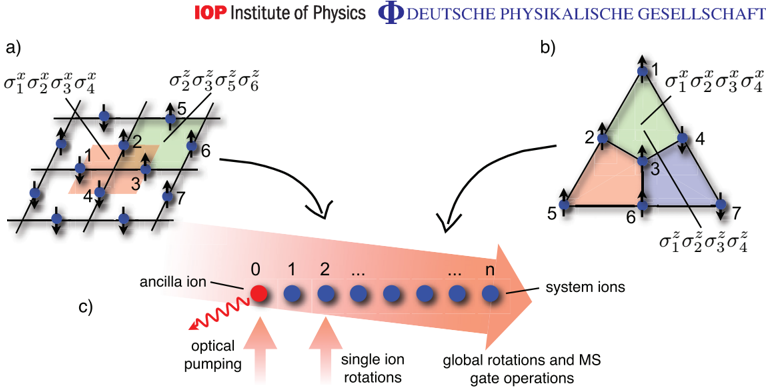
In a recent experiment, Barreiro et al (2011 Nature 470 486) demonstrated the fundamental building blocks of an open-system quantum simulator with trapped ions. Using up to five ions, dynamics were realized by sequences that combined single- and multi-qubit entangling gate operations with optical pumping. This enabled the implementation of both coherent many-body dynamics and dissipative processes by controlling the coupling of the system to an artificial, suitably tailored environment. This engineering was illustrated by the dissipative preparation of entangled two- and four-qubit states, the simulation of coherent four-body spin interactions and the quantum non-demolition measurement of a multi-qubit stabilizer operator. In this paper, we present the theoretical framework of this gate-based ('digital') simulation approach for open-system dynamics with trapped ions. In addition, we discuss how within this simulation approach, minimal instances of spin models of interest in the context of topological quantum computing and condensed matter physics can be realized in state-of-the-art linear ion-trap quantum computing architectures. We outline concrete simulation schemes for Kitaev's toric code Hamiltonian and a recently suggested color code model. The presented simulation protocols can be adapted to scalable and two-dimensional ion-trap architectures, which are currently under development.
Overview
The claims and statistics of this paper haven’t been checked yet.
Free: it reads the open-access text and checks the first 5 claims that cite a source we can check. Create a free account to check every claim.
Integrity signals
Registry
Cites
Statistics
Figures



Verification
Claims the paper makes
The claims and statistics of this paper haven’t been checked yet.
Free: it reads the open-access text and checks the first 5 claims that cite a source we can check. Create a free account to check every claim.
Claims other papers make about this one
Each is checked against this paper’s own text: does it say what the citing paper says it does?
The source backs part of the claim, not all of it — or backs it for a different population, condition or comparison.
In the citing paper
“We map products of fermionic operators onto nonlocal spin operators and decompose the resulting dynamics in efficient steps with Trotter methods, yielding an overall protocol that employs only polynomial resources.”
From Quantum Simulation of Interacting Fermion Lattice Models in Trapped Ions (2012) · cites this paper as [29]
Experimental — accuracy not yet measuredThe source backs part of the claim, not all of it — or backs it for a different population, condition or comparison.
In the citing paper
“Note that for bounded Hamiltonians, the Trotter expansion associated with the exponential of the polynomial sum of efficiently implementable nonlocal terms is also efficient [2, 29, 30], i.e., it only requires polynomial resources [35].”
From Quantum Simulation of Interacting Fermion Lattice Models in Trapped Ions (2012) · cites this paper as [29]
Experimental — accuracy not yet measured
Self-check
Percentages, sums and reported differences re-computed from the paper’s own numbers.
The self-check needs the paper’s full text.
Citations
Cites
Quantum Computation and Quantum Information
Nielsen, M. A., Chuang, I., & Grover, L. K. (2002) · American Journal of Physics · doi:10.1119/1.1463744 · Cited by 21,895
Quantum computation and quantum information
Law, J. (2001) · ACM SIGSOFT Software Engineering Notes · doi:10.1145/505482.505499 · Cited by 18,842
Many-body physics with ultracold gases
Bloch, I., Dalibard, J., & Zwerger, W. (2008) · Reviews of Modern Physics · doi:10.1103/revmodphys.80.885 · Cited by 8,114 · cited 2×
“[5] I Bloch, J Dalibard, and W Zwerger.”
BackgroundSimulating physics with computers
Feynman, R. P. (1982) · International Journal of Theoretical Physics · doi:10.1007/bf02650179 · Cited by 7,691
Fault-tolerant quantum computation by anyons
Kitaev, A. Y. (2003) · Annals of Physics · doi:10.1016/s0003-4916(02)00018-0 · Cited by 7,238 · cited 4×
“The idea of storing and processing quantum information in naturally protected quantum systems has attracted a lot of interest in recent years [35, 67].”
BackgroundMethodInfluentialNon-Abelian anyons and topological quantum computation
Nayak, C., Simon, S. H., Stern, A., Freedman, M., & Das Sarma, S. (2008) · Reviews of Modern Physics · doi:10.1103/revmodphys.80.1083 · Cited by 6,861 · cited 2×
“The idea of storing and processing quantum information in naturally protected quantum systems has attracted a lot of interest in recent years [35, 67].”
BackgroundQuantum phase transition from a superfluid to a Mott insulator in a gas of ultracold atoms
Greiner, M., Mandel, O., Esslinger, T., Hänsch, T. W., & Bloch, I. (2002) · Nature · doi:10.1038/415039a · Cited by 5,935 · cited 2×
“[6] M Greiner, O Mandel, T Esslinger, T W Hänsch, and I Bloch.”
BackgroundQuantum Computations with Cold Trapped Ions
Cirac, J. I., & Zoller, P. (1995) · Physical Review Letters · doi:10.1103/physrevlett.74.4091 · Cited by 3,733 · cited 1×
“It complements existing proposals of quantum simulation with ground state ions [41, 42, 43] or ions excited to Rydberg states [44].”
BackgroundSelf-citationCold Bosonic Atoms in Optical Lattices
Jaksch, D., Bruder, C., Cirac, J. I., Gardiner, C. W., & Zoller, P. (1998) · Physical Review Letters · doi:10.1103/physrevlett.81.3108 · Cited by 3,685 · cited 2×
“[8] D Jaksch, C Bruder, J I Cirac, C W Gardiner, and P Zoller.”
BackgroundSelf-citationLloyd, S. (1996) · Science · doi:10.1126/science.273.5278.1073 · Cited by 3,088 · cited 4×
“Recently, quantum control of open many-body systems, which amounts to engineering both the Hamiltonian time evolution of the many-body system itself as well as its coupling to the environment [2, 21], has become a major research focus.”
BackgroundInfluential
Cited by
Quantum error correction for quantum memories
Terhal, B. M. (2015) · Reviews of Modern Physics · doi:10.1103/revmodphys.87.307 · Cited by 1,354
“We could set up such local error correction mechanism by explicitly engineering a dissipative dynamics which drives/corrects the qubits towards the code space as proposed in [3, 30].”
InfluentialProgrammable Quantum Simulations of Spin Systems with Trapped Ions
Monroe, C., Campbell, W. C., Duan, L. M., Gong, Z. X., Gorshkov, A. V., Hess, P., Islam, R., Kim, K., Linke, N., Pagano, G., et al. (2019) · arXiv · doi:10.48550/arxiv.1912.07845 · Cited by 806
Programmable quantum simulations of spin systems with trapped ions
Monroe, C., Campbell, W. C., Duan, L.-M., Gong, Z.-X., Gorshkov, A. V., Hess, P. W., Islam, R., Kim, K., Linke, N. M., Pagano, G., et al. (2021) · Reviews of Modern Physics · doi:10.1103/revmodphys.93.025001 · Cited by 802
Strategies for quantum computing molecular energies using the unitary coupled cluster ansatz
Romero, J., Babbush, R., McClean, J. R., Hempel, C., Love, P. J., & Aspuru-Guzik, A. (2019) · Quantum Science and Technology · doi:10.1088/2058-9565/aad3e4 · Cited by 726
Torrontegui, E., Ibáñez, S., Martínez-Garaot, S., Modugno, M., del Campo, A., Guéry-Odelin, D., Ruschhaupt, A., Chen, X., & Muga, J. G. (2013) · Advances In Atomic, Molecular, and Optical Physics · doi:10.1016/b978-0-12-408090-4.00002-5 · Cited by 648
“Following del Campo et al. (2012), the transitionless quantum driving can be extended as well to many-body quantum critical systems, exploiting recent advances in the simulation of coherent k-body interactions (Müller et al., 2011; Barreiro et al., 2011).”
BackgroundUniversal Digital Quantum Simulation with Trapped Ions
Lanyon, B. P., Hempel, C., Nigg, D., Müller, M., Gerritsma, R., Zähringer, F., Schindler, P., Barreiro, J. T., Rambach, M., Kirchmair, G., et al. (2011) · Science · doi:10.1126/science.1208001 · Cited by 613
“y interaction (Figure 3C). The circuit decomposition for three-body interactions is a special case of a general scheme to simulate nbody spin interactions, which is derived and discussed in detail in (40). We now give simulation results with an additional transverse field. This is particularly challenging as a large nu…”
BackgroundSelf-citationQuantum Chemistry Calculations on a Trapped-Ion Quantum Simulator
Hempel, C., Maier, C., Romero, J., McClean, J., Monz, T., Shen, H., Jurcevic, P., Lanyon, B. P., Love, P., Babbush, R., et al. (2018) · Physical Review X · doi:10.1103/physrevx.8.031022 · Cited by 446
Self-citationQuantum Algorithms for Quantum Field Theories
Jordan, S. P., Lee, K. S. M., & Preskill, J. (2012) · Science · doi:10.1126/science.1217069 · Cited by 517
Universality of phase transition dynamics: Topological defects from symmetry breaking
del Campo, A., & Zurek, W. H. (2014) · International Journal of Modern Physics A · doi:10.1142/s0217751x1430018x · Cited by 364
Shortcuts to adiabaticityPreprint
Torrontegui, E., B, M. M., F, E. D. G.-O., Ruschhaupt, A., Chen, X., A, H. J. G. M., & Herriko, V. E. (2016) · Cited by 399
Engineered Open Systems and Quantum Simulations with Atoms and Ions
Müller, M., Diehl, S., Pupillo, G., & Zoller, P. (2012) · Advances In Atomic, Molecular, and Optical Physics · doi:10.1016/b978-0-12-396482-3.00001-6 · Cited by 315
“For instance, in Müller et al. (2011) it is explicitly worked out how minimal instances of complete topogical quantum error correcting codes (Bombin and Martin-Delgado, 2006) can be realized with the currently available toolbox for open-system quantum simulation with trapped ions (Barreiro et al.,…”
BackgroundSelf-citationdel Campo, A., Rams, M. M., & Zurek, W. H. (2012) · Physical Review Letters · doi:10.1103/physrevlett.109.115703 · Cited by 304
Dissipative Charging of a Quantum Battery
Barra, F. (2019) · Physical Review Letters · doi:10.1103/physrevlett.122.210601 · Cited by 261
From transistor to trapped-ion computers for quantum chemistry
Yung, M.-H., Casanova, J., Mezzacapo, A., McClean, J., Lamata, L., Aspuru-Guzik, A., & Solano, E. (2014) · Scientific Reports · doi:10.1038/srep03589 · Cited by 221
Assessing the Progress of Trapped-Ion Processors Towards Fault-Tolerant Quantum Computation
Bermudez, A., Xu, X., Nigmatullin, R., O’Gorman, J., Negnevitsky, V., Schindler, P., Monz, T., Poschinger, U. G., Hempel, C., Home, J., et al. (2017) · Physical Review X · doi:10.1103/physrevx.7.041061 · Cited by 165
“We start by describing how multi-qubit Mølmer-Sørensen (MS) gates [22, 23] can be exploited for efficient stabilizer readout [24], as experimentally demonstrated in [15].”
MethodSelf-citationQuantum simulation of generic many-body open system dynamics using classical noise
Chenu, A., Beau, M., Cao, J., & del Campo, A. (2017) · Physical Review Letters · doi:10.1103/physrevlett.118.140403 · Cited by 160
Quantum Computers as Universal Quantum Simulators: State‐of‐the‐Art and Perspectives
Tacchino, F., Chiesa, A., Carretta, S., & Gerace, D. (2019) · Advanced Quantum Technologies · doi:10.1002/qute.201900052 · Cited by 202
Digital Quantum Simulation of Minimal AdS/CFT
García-Álvarez, L., Egusquiza, I. L., Lamata, L., del Campo, A., Sonner, J., & Solano, E. (2017) · Physical Review Letters · doi:10.1103/physrevlett.119.040501 · Cited by 196
Stabilized Cat in a Driven Nonlinear Cavity: A Fault-Tolerant Error Syndrome Detector
Puri, S., Grimm, A., Campagne-Ibarcq, P., Eickbusch, A., Noh, K., Roberts, G., Jiang, L., Mirrahimi, M., Devoret, M. H., & Girvin, S. M. (2019) · Physical Review X · doi:10.1103/physrevx.9.041009 · Cited by 151
Adiabatic tracking of quantum many-body dynamics
Saberi, H., Opatrný, T., Mølmer, K., & del Campo, A. (2014) · Physical Review A · doi:10.1103/physreva.90.060301 · Cited by 145
Four-body ring-exchange interactions and anyonic statistics within a minimal toric-code Hamiltonian
Dai, H.-N., Yang, B., Reingruber, A., Sun, H. K., Xu, X., Chen, Y.-A., Yuan, Z.-S., & Pan, J.-W. (2017) · Nature Physics · doi:10.1038/nphys4243 · Cited by 171
Measurement Protocol for the Entanglement Spectrum of Cold Atoms
Pichler, H., Zhu, G., Seif, A., Zoller, P., & Hafezi, M. (2016) · Physical Review X · doi:10.1103/physrevx.6.041033 · Cited by 114
“1(c)], as can be shown using S(2) 1⁄4 1 [53,54].”
Self-citationQuantum Simulation of Interacting Fermion Lattice Models in Trapped Ions
Casanova, J., Mezzacapo, A., Lamata, L., & Solano, E. (2012) · Physical Review Letters · doi:10.1103/physrevlett.108.190502 · Cited by 118
Non-Abelian SU(2) Lattice Gauge Theories in Superconducting Circuits
Mezzacapo, A., Rico, E., Sabín, C., Egusquiza, I. L., Lamata, L., & Solano, E. (2015) · Physical Review Letters · doi:10.1103/physrevlett.115.240502 · Cited by 151
Emergence of Glasslike Dynamics for Dissipative and Strongly Interacting Bosons
Poletti, D., Barmettler, P., Georges, A., & Kollath, C. (2013) · Physical Review Letters · doi:10.1103/physrevlett.111.195301 · Cited by 119
Digital-analog quantum simulations with superconducting circuits
Lamata, L., Parra-Rodriguez, A., Sanz, M., & Solano, E. (2018) · Advances in Physics: X · doi:10.1080/23746149.2018.1457981 · Cited by 93
Quantum Simulation of Quantum Field Theories in Trapped Ions
Casanova, J., Lamata, L., Egusquiza, I. L., Gerritsma, R., Roos, C. F., García-Ripoll, J. J., & Solano, E. (2011) · Physical Review Letters · doi:10.1103/physrevlett.107.260501 · Cited by 94
Self-citationOptimized Quantum Compilation for Near-Term Algorithms with OpenPulse
Gokhale, P., Javadi-Abhari, A., Earnest, N., Shi, Y., & Chong, F. T. (2020) · 2020 53rd Annual IEEE/ACM International Symposium on Microarchitecture (MICRO) · doi:10.1109/micro50266.2020.00027 · Cited by 87
“Some of the trapped ion decompositions have already been studied in recent publications [53, 54, 55].”
BackgroundA unidirectional on-chip photonic interface for superconducting circuits
Guimond, P.-O., Vermersch, B., Juan, M. L., Sharafiev, A., Kirchmair, G., & Zoller, P. (2020) · npj Quantum Information · doi:10.1038/s41534-020-0261-9 · Cited by 102
Self-citationSteady-state entanglement of two superconducting qubits engineered by dissipation
Reiter, F., Tornberg, L., Johansson, G., & Sørensen, A. S. (2013) · Physical Review A · doi:10.1103/physreva.88.032317 · Cited by 82
“As opposed to unitary quantum computing, where decoherence and dissipation act detrimentally on the state preparation process and on the prepared state, the central idea here is to prepare non-trivial quantum states relevant for quantum information, simulation [15, 16], memories [17], or communication [18] by means of…”
BackgroundDigital quantum simulation with Rydberg atoms
Weimer, H., Müller, M., Büchler, H. P., & Lesanovsky, I. (2011) · Quantum Information Processing · doi:10.1007/s11128-011-0303-5 · Cited by 67
Self-citationEfficient Quantum Algorithm for Computing n -time Correlation Functions
Pedernales, J. S., Candia, R. D., Egusquiza, I. L., Casanova, J., & Solano, E. (2014) · Physical Review Letters · doi:10.1103/physrevlett.113.020505 · Cited by 102
Universal simulation of Markovian open quantum systems
Sweke, R., Sinayskiy, I., Bernard, D., & Petruccione, F. (2015) · Physical Review A · doi:10.1103/physreva.91.062308 · Cited by 78
Many-Body Interactions with Tunable-Coupling Transmon Qubits
Mezzacapo, A., Lamata, L., Filipp, S., & Solano, E. (2014) · Physical Review Letters · doi:10.1103/physrevlett.113.050501 · Cited by 66
Hamiltonian learning for quantum error correction
Valenti, A., van Nieuwenburg, E., Huber, S. D., & Greplová, E. (2019) · Physical Review Research · doi:10.1103/physrevresearch.1.033092 · Cited by 82
Quantum Simulator for Transport Phenomena in Fluid Flows
Mezzacapo, A., Sanz, M., Lamata, L., Egusquiza, I. L., Succi, S., & Solano, E. (2015) · Scientific Reports · doi:10.1038/srep13153 · Cited by 60
Scalable and Parallel Tweezer Gates for Quantum Computing with Long Ion Strings
Olsacher, T., Postler, L., Schindler, P., Monz, T., Zoller, P., & Sieberer, L. M. (2020) · PRX Quantum · doi:10.1103/prxquantum.1.020316 · Cited by 62
Self-citationBotzung, T., Diehl, S., & Müller, M. (2021) · Physical review. B./Physical review. B · doi:10.1103/physrevb.104.184422 · Cited by 66
Self-citationDigital quantum simulation of many-body non-Markovian dynamics
Sweke, R., Sanz, M., Sinayskiy, I., Petruccione, F., & Solano, E. (2016) · Physical Review A · doi:10.1103/physreva.94.022317 · Cited by 55
N -Body Interactions between Trapped Ion Qubits via Spin-Dependent Squeezing
Katz, O., Cetina, M., & Monroe, C. R. (2022) · Physical Review Letters · doi:10.1103/physrevlett.129.063603 · Cited by 84
Demonstration of three- and four-body interactions between trapped-ion spins
Katz, O., Feng, L., Risinger, A., Monroe, C. R., & Cetina, M. (2023) · Nature Physics · doi:10.1038/s41567-023-02102-7 · Cited by 99
“Given only two-qubit interactions, the construction of a single Pauli string of order n > 2 can be realized with 2 n two-qubit gates or a couple of multiqubit MS gates 1,12,62–64 .”
BackgroundHamiltonian learning for quantum error correction
Valenti, A., van Nieuwenburg, E., Huber, S. D., & Greplová, E. (2019) · Repository for Publications and Research Data (ETH Zurich) · doi:10.3929/ethz-b-000377386 · Cited by 54
Variational Quantum Simulation for Quantum Chemistry
Li, Y., Hu, J., Zhang, X., Song, Z., & Yung, M. (2019) · Advanced Theory and Simulations · doi:10.1002/adts.201800182 · Cited by 66
Quantum Algorithms for Fermionic Quantum Field TheoriesPreprint
Jordan, S. P., Lee, K. S. M., & Preskill, J. P. (2014) · arXiv (Cornell University) · doi:10.48550/arxiv.1404.7115 · Cited by 181
Rydberg excitation of trapped cold ions: a detailed case study
Schmidt‐Kaler, F., Feldker, T., Kolbe, D., Walz, J., Müller, M., Zoller, P., Li, W., & Lesanovsky, I. (2011) · New Journal of Physics · doi:10.1088/1367-2630/13/7/075014 · Cited by 51
Self-citationIntroduction to Quantum Algorithms for Physics and Chemistry
Yung, M., Whitfield, J. D., Boixo, S., Tempel, D. G., & Aspuru‐Guzik, A. (2014) · Advances in Chemical Physics · doi:10.1002/9781118742631.ch03 · Cited by 50
Gutiérrez, M., Müller, M., & Bermúdez, A. (2019) · Physical Review A · doi:10.1103/physreva.99.022330 · Cited by 49
Self-citationPhoton-assisted-tunneling toolbox for quantum simulations in ion traps
Bermudez, A., Schaetz, T., & Porras, D. (2012) · New Journal of Physics · doi:10.1088/1367-2630/14/5/053049 · Cited by 45
Measurement-Free Fault-Tolerant Quantum Error Correction in Near-Term Devices
Heußen, S., Locher, D. F., & Müller, M. (2024) · PRX Quantum · doi:10.1103/prxquantum.5.010333 · Cited by 62
Self-citationControlling quantum critical dynamics of isolated systems
del Campo, A., & Sengupta, K. (2015) · The European Physical Journal Special Topics · doi:10.1140/epjst/e2015-02350-4 · Cited by 52
Kreula, J. M., Clark, S. R., & Jaksch, D. (2016) · Scientific Reports · doi:10.1038/srep32940 · Cited by 44
Stabilizer Quantum Error Correction Toolbox for Superconducting Qubits
Nigg, S. E., & Girvin, S. M. (2013) · Physical Review Letters · doi:10.1103/physrevlett.110.243604 · Cited by 51
Symmetry-protected coherent relaxation of open quantum systems
van Caspel, M., & Gritsev, V. (2018) · Physical Review A · doi:10.1103/physreva.97.052106 · Cited by 46
“For such systems, bulk dephasing corresponds to local magnetic fluctuations within the trap, although there are also methods to control the dissipation [34].”
MethodCharacterization of qubit chains by Feynman probes
Tamascelli, D., Benedetti, C., Olivares, S., & Paris, M. G. A. (2016) · Physical Review A · doi:10.1103/physreva.94.042129 · Cited by 40
Hickey, J. M., Genway, S., Lesanovsky, I., & Garrahan, J. P. (2013) · Physical Review B · doi:10.1103/physrevb.87.184303 · Cited by 42
Measurement-Free Topological Protection Using Dissipative Feedback
Fujii, K., Negoro, M., Imoto, N., & Kitagawa, M. (2014) · Physical Review X · doi:10.1103/physrevx.4.041039 · Cited by 35
Quantum Algorithms and Applications for Open Quantum Systems
Delgado-Granados, L. H., Krogmeier, T. J., Sager-Smith, L. M., Avdic, I., Hu, Z., Sajjan, M., Abbasi, M., Smart, S. E., Narang, P., Kais, S., et al. (2025) · Chemical Reviews · doi:10.1021/acs.chemrev.4c00428 · Cited by 68
Programmable N -Body Interactions with Trapped Ions
Katz, O., Cetina, M., & Monroe, C. R. (2023) · PRX Quantum · doi:10.1103/prxquantum.4.030311 · Cited by 57
Synthesizing Five-Body Interaction in a Superconducting Quantum Circuit
Zhang, K., Li, H., Zhang, P., Yuan, J., Chen, J., Ren, W., Wang, Z., Song, C., Wang, D., Wang, H., et al. (2022) · Physical Review Letters · doi:10.1103/physrevlett.128.190502 · Cited by 43
Fermionic models with superconducting circuits
Heras, U. L., García-Álvarez, L., Mezzacapo, A., Solano, E., & Lamata, L. (2015) · EPJ Quantum Technology · doi:10.1140/epjqt/s40507-015-0021-5 · Cited by 31
Ultrafast adiabatic quantum algorithm for the NP-complete exact cover problem
Wang, H., & Wu, L.-A. (2016) · Scientific Reports · doi:10.1038/srep22307 · Cited by 30
Continuous measurement of an atomic current
Laflamme, C., Yang, D., & Zoller, P. (2017) · Physical Review A · doi:10.1103/physreva.95.043843 · Cited by 26
Self-citationMeasurement-Based Quantum Computation on Symmetry Breaking Thermal States
Fujii, K., Nakata, Y., Ohzeki, M., & Murao, M. (2013) · Physical Review Letters · doi:10.1103/physrevlett.110.120502 · Cited by 32
Jin, Z., Su, S., & Zhang, S. (2019) · Physical Review A · doi:10.1103/physreva.100.052332 · Cited by 21
Hardware-efficient fermionic simulation with a cavity–QED system
Zhu, G., Subaşı, Y., Whitfield, J. D., & Hafezi, M. (2018) · npj Quantum Information · doi:10.1038/s41534-018-0065-3 · Cited by 27
Cooling of many-body systems via selective interactions
Grimaudo, R., Lamata, L., Solano, E., & MESSINA, A. (2018) · Physical Review A · doi:10.1103/physreva.98.042330 · Cited by 21
Dynamic generation of topologically protected self-correcting quantum memory
Becker, D., Tanamoto, T., Hutter, A., Pedrocchi, F. L., & Loss, D. (2013) · Physical Review A · doi:10.1103/physreva.87.042340 · Cited by 21
Diffusive Limit of Non-Markovian Quantum Jumps
Luoma, K., Strunz, W. T., & Piilo, J. (2020) · Physical Review Letters · doi:10.1103/physrevlett.125.150403 · Cited by 24
4 Focus on topological quantum computation
Pachos, J. K., & Simon, S. H. (2014) · White Rose Research Online (University of Leeds, The University of Sheffield, University of York) · Cited by 19
Engineered Open Systems and Quantum Simulations with Atoms and IonsPreprint
Müller, M., Diehl, S., Pupillo, G., & Zoller, P. (2012) · arXiv (Cornell University) · doi:10.48550/arxiv.1203.6595 · Cited by 19
“For instance, in Müller et al. (2011) it is explicitly worked out how minimal instances of complete topogical quantum error correcting codes (Bombin and Martin-Delgado, 2006) can be realized with the currently available toolbox for open-system quantum simulation with trapped ions (Barreiro et al.,…”
BackgroundSelf-citationHuffman, E., Vera, M. G., & Banerjee, D. (2022) · Physical review. D/Physical review. D. · doi:10.1103/physrevd.106.094502 · Cited by 33
Toward Heisenberg-Limited Rabi Spectroscopy
Shaniv, R., Manovitz, T., Shapira, Y., Akerman, N., & Ozeri, R. (2018) · Physical Review Letters · doi:10.1103/physrevlett.120.243603 · Cited by 18
Baggio, G., Ticozzi, F., & Viola, L. (2012) · IEEE Conference on Decision and Control (CDC) · doi:10.1109/cdc.2012.6426787 · Cited by 15
“In particular, we will illustrate how the “stabilizer pumping” strategy proposed in [3], [11] fits into our general “splitting-subspace” framework, and how control actions achieving stabilization of arbitrary pure target states can be explicitly synthesized.”
BackgroundSpin‐Chain‐Star Systems: Entangling Multiple Chains of Spin Qubits
Grimaudo, R., de Castro, A. S. M., Messina, A., & Valenti, D. (2022) · Fortschritte der Physik · doi:10.1002/prop.202200042 · Cited by 15
A digital quantum simulation of the Agassi model
Pérez-Fernández, P., Arias, J. M., García-Ramos, J. E., & Lamata, L. (2022) · Physics Letters B · doi:10.1016/j.physletb.2022.137133 · Cited by 19
“be carried out efficiently with trapped ions [27, 28].”
BackgroundResource analysis of quantum algorithms for coarse-grained protein folding models
Linn, H., Lyngfelt, I., García-Álvarez, L., & Johansson, G. (2024) · Physical Review Research · doi:10.1103/physrevresearch.6.033112 · Cited by 18
Quantifying spatial correlations of general quantum dynamics
Rivas, ́., & Müller, M. (2015) · RWTH Publications (RWTH Aachen) · Cited by 12
Self-citationExponential lifetime improvement in topological quantum memories
Bardyn, C.-E., & Karzig, T. (2016) · Physical review. B./Physical review. B · doi:10.1103/physrevb.94.094303 · Cited by 12
“, circuit-QED systems, digital (or gate-based) quantum simulation could be considered [51].”
BackgroundMinimal instances for toric code ground states
Lang, N., & Büchler, H. P. (2012) · Physical Review A · doi:10.1103/physreva.86.022336 · Cited by 16
Entanglement measures in ion-trap quantum simulators without full tomography
Pedernales, J. S., Candia, R. D., Schindler, P., Monz, T., Hennrich, M., Casanova, J., & Solano, E. (2014) · Physical Review A · doi:10.1103/physreva.90.012327 · Cited by 11
Signal processing techniques for efficient compilation of controlled rotations in trapped ions
Groenland, K., Witteveen, F., Schoutens, K., & Gerritsma, R. (2020) · New Journal of Physics · doi:10.1088/1367-2630/ab8830 · Cited by 20
“Lastly, we note that our results may also be of interest for the engineering of related many-body interactions in trapped ion quantum simulators [48, 49] and may be a starting point for implementing more general many-body interactions decomposed out of native quantum gates [50, 51].”
Analogue Quantum Simulation with Fixed-Frequency Transmon Qubits
Greenaway, S., Smith, A., Mintert, F., & Malz, D. (2024) · Quantum · doi:10.22331/q-2024-02-22-1263 · Cited by 11
“While the focus of this work is on the evaluation of analogue quantum simulations on FF qubits, TLS coupling has been identified as a key source of decoherence in superconducting platforms [42], and so a focus on addressing this problem could have wide-reaching implications beyond this application.”
BackgroundProbabilistic eigensolver with a trapped-ion quantum processor
Zhang, J.-N., Arrazola, Í., Casanova, J., Lamata, L., Kim, K., & Solano, E. (2020) · Physical Review A · doi:10.1103/physreva.101.052333 · Cited by 9
“The third term, σ̂ 1σ̂ z 2σ̂ z 3, can be implemented by combining the controlled-not (C-NOT) gates [8] or the MS gates [29] with single-qubit z-rotations.”
BackgroundDissipative versus conditional generation of Gaussian entanglement and spin squeezing
Vasilyev, D. V., Muschik, C. A., & Hammerer, K. (2013) · Physical Review A · doi:10.1103/physreva.87.053820 · Cited by 10
Self-citationQuantum weak and modular values in enlarged Hilbert spaces
Ho, L. B., & Imoto, N. (2018) · Physical Review A · doi:10.1103/physreva.97.012112 · Cited by 10
Rajakumar, J., Moondra, J., Gard, B., Gupta, S., & Herold, C. D. (2022) · Physical Review A · doi:10.1103/physreva.106.022606 · Cited by 12
“Similar controls were also proposed to generate four-body spin interactions [30].”
BackgroundStabilizing quantum simulations of lattice gauge theories by dissipation
Schmale, T., & Weimer, H. (2024) · Physical Review Research · doi:10.1103/physrevresearch.6.033306 · Cited by 9
Characterizing Quantum Instruments: From Nondemolition Measurements to Quantum Error Correction
Stricker, R., Vodola, D., Erhard, A., Postler, L., Meth, M., Ringbauer, M., Schindler, P., Blatt, R., Müller, M., & Monz, T. (2022) · PRX Quantum · doi:10.1103/prxquantum.3.030318 · Cited by 14
Self-citationGrimaudo, R., Vitanov, N. V., de Castro, A. S. M., Valenti, D., & MESSINA, A. (2022) · Fortschritte der Physik · doi:10.1002/prop.202200010 · Cited by 9
tqix.pis: A toolbox for quantum dynamics simulation of spin ensembles in Dicke basis
Viet, N. T., Chuong, N. T., Huyen, V. T. N., & Ho, L. B. (2023) · Computer Physics Communications · doi:10.1016/j.cpc.2023.108686 · Cited by 8
“Finally, the definition of a global MølmerSørensen transformation is an entangling gate that operates on all particles of the ensemble [48]”
BackgroundSpectral Signatures of Vibronic Coupling in Trapped Cold Ionic Rydberg Systems
Wilkinson, J. W. P., Li, W., & Lesanovsky, I. (2024) · Physical Review Letters · doi:10.1103/physrevlett.132.223401 · Cited by 11
“As we will demonstrate, the relative positions of the ions (i.e., the distances between the ions) are small enough that we can neglect retardation effects due to the electric potentials [16], yet large enough that we can ignore exchange interactions between the valence electrons [17].”
Exploring many-body interactions through quantum Fisher information
Cieśliński, P., Kurzyński, P., Sowiński, T., Kłobus, W., & Laskowski, W. (2024) · Physical Review A · doi:10.1103/physreva.110.012407 · Cited by 7
Improving direct state measurements by using rebits in real enlarged Hilbert spaces
Ho, L. B. (2018) · Physics Letters A · doi:10.1016/j.physleta.2018.10.047 · Cited by 6
Doubled lattice Chern–Simons–Yang–Mills theories with discrete gauge group
Caspar, S., Mesterházy, D., Olesen, T. Z., Vlasii, N. D., & Wiese, U. ‐. (2016) · Annals of Physics · doi:10.1016/j.aop.2016.08.017 · Cited by 6
Bouten, L., Vissers, G., & Schmidt‐Kaler, F. (2019) · Physical Review A · doi:10.1103/physreva.100.022323 · Cited by 5
Liu, S.-L., Xie, Q., Shan, W., Ianconescu, R., Ran, D., & Xia, Y. (2022) · Quantum Information Processing · doi:10.1007/s11128-022-03753-w · Cited by 5
Switchable particle statistics with an embedding quantum simulator
Cheng, X.-H., Arrazola, Í., Pedernales, J. S., Lamata, L., Chen, X., & Solano, E. (2017) · Physical Review A · doi:10.1103/physreva.95.022305 · Cited by 5
“These cases can be implemented via purely analog or digital-analog techniques [46, 47].”
BackgroundDoubled lattice Chern–Simons–Yang–Mills theories with discrete gauge group
Caspar, S., Mesterhazy, D., Olesen, T. A. Z., Vlasii, N. D., & Wiese, U. ‐. (2016) · doi:10.7892/boris.88664 · Cited by 5
Martins, W. S., Wilkinson, J. W. P., Hennrich, M., & Lesanovsky, I. (2025) · Physical Review A · doi:10.1103/physreva.111.043106 · Cited by 6
Li, D., Shao, X., & Yi, X. X. (2020) · Annalen der Physik · doi:10.1002/andp.201900399 · Cited by 3
Metadata
- Authors
- Müller, M., Hammerer, K., Zhou, Y. L., Roos, C. F., & Zoller, P.
- Affiliations
- Universidad Complutense de Madrid (ES)
- Leibniz University Hannover (DE)
- National University of Defense Technology (CN)
- Austrian Academy of Sciences (AT)
- Venue
- New Journal of Physics
- Publisher
- IOP Publishing
- Published
- 2011-08-09
- Volume
- 13
- Issue
- 8
- Pages
- 085007
- ISSN
- 1367-2630 (ISSN-L)
- OpenAlex
- W2116710088
- Cited by
- 127
- References
- 81
- Citations by year
- 2026: 2 · 2025: 8 · 2024: 8 · 2023: 9 · 2022: 11 · 2021: 3 · 2020: 9 · 2019: 9 · 2018: 9 · 2017: 8 · 2016: 9 · 2015: 8 · 2014: 12 · 2013: 8 · 2012: 10
- FWCI
- 10.02
- Type
- journal article
- Language
- en
- Open access
- gold
- doi.org
- Licence
- cc-by
- Locations
- New Journal of Physics (publishedVersion, cc-by)
- arXiv (Cornell University) (submittedVersion)
- MPG.PuRe (Max Planck Society) (submittedVersion, other-oa)
- Institutional Repository of Leibniz Universität Hannover (Leibniz Universität Hannover) (submittedVersion, cc-by-nc-nd)
- arXiv (Cornell University)
- Leibniz Universität Hannover
- Funders
- European Commission
- National Natural Science Foundation of China (11074307)
- Austrian Science Fund
- Hunan Provincial Innovation Foundation for Postgraduate
- Topics
- Physical Sciences › Computer Science › Artificial Intelligence › Quantum Computing Algorithms and Architecture
- Physical Sciences › Physics and Astronomy › Atomic and Molecular Physics, and Optics › Quantum Information and Cryptography
- Physical Sciences › Physics and Astronomy › Atomic and Molecular Physics, and Optics › Quantum many-body systems
- Keywords
- open quantum systems, trapped ions, quantum simulation, optical pumping, quantum non-demolition measurement, toric code, color codes, topological quantum computation, linear ion trap, dissipative dynamics
About these checks
Registry, retraction, Cites and statistics results are computed, not judged, with one exception: a printed reference that no index lists is read once by a model before it counts as a citation error. Claims are extracted by a model and kept only when their quote appears verbatim in the text; each cited source is then checked, with a model’s help, for whether it says what the claim relies on. Those verdicts can be wrong — read the claim’s quote and the cited source before relying on one.
Statistics and arithmetic are recomputed, not judged.
Confidence bands are shown only for fields calibrated on our annotated test set. None is calibrated yet, so no band is shown.
What counts as a claim ›How we measure confidence ›How we check this ›
Are you an author, or do you see a problem with this page? Request a review
Data sources
Bibliographic data: Semantic Scholar, OpenAlex, Crossref.
Contains information from the Semantic Scholar Academic Graph Datasets, made available under the ODC Attribution License (ODC-BY 1.0).
Semantic Scholar’s data is described in: Kinney, R., et al. (2023). The Semantic Scholar Open Data Platform. arXiv:2301.10140.
