

Quantum simulator of an open quantum system using superconducting qubits: exciton transport in photosynthetic complexes
Open accessThe DOI matches its Crossref record; 76 of the 76 references it cites were found in a registry or an index.
Abstract
Open quantum system approaches are widely used in the description of physical, chemical and biological systems. A famous example is electronic excitation transfer in the initial stage of photosynthesis, where harvested energy is transferred with remarkably high efficiency to a reaction center. This transport is affected by the motion of a structured vibrational environment, which makes simulations on a classical computer very demanding. Here we propose an analog quantum simulator of complex open system dynamics with a precisely engineered quantum environment. Our setup is based on superconducting circuits, a well established technology. As an example, we demonstrate that it is feasible to simulate exciton transport in the Fenna–Matthews–Olson photosynthetic complex. Our approach allows for a controllable single-molecule simulation and the investigation of energy transfer pathways as well as non-Markovian noise-correlation effects.
Overview
The claims and statistics of this paper haven’t been checked yet.
Free: it reads the open-access text and checks the first 5 claims that cite a source we can check. Create a free account to check every claim.
Integrity signals
Registry
Cites
Statistics
Figures


Verification
Claims the paper makes
The claims and statistics of this paper haven’t been checked yet.
Free: it reads the open-access text and checks the first 5 claims that cite a source we can check. Create a free account to check every claim.
Claims other papers make about this one
Each is checked against this paper’s own text: does it say what the citing paper says it does?
The source backs part of the claim, not all of it — or backs it for a different population, condition or comparison.
In the citing paper
“Consequently, trapped ions can be exploited to solve dynamical problems involving linearly or non-linearly coupled oscillators, e.g., spin-boson models4142, that are difficult to solve either analytically or numerically with a classical computer.”
From From transistor to trapped-ion computers for quantum chemistry (2014) · cites this paper as [42]
Experimental — accuracy not yet measured
Self-check
Percentages, sums and reported differences re-computed from the paper’s own numbers.
The self-check needs the paper’s full text.
Citations
Cites
Quantum Computation and Quantum Information
Nielsen, M. A., Chuang, I., & Grover, L. K. (2002) · American Journal of Physics · doi:10.1119/1.1463744 · Cited by 21,895
Quantum computation and quantum information
Law, J. (2001) · ACM SIGSOFT Software Engineering Notes · doi:10.1145/505482.505499 · Cited by 18,842
Simulating physics with computers
Feynman, R. P. (1982) · International Journal of Theoretical Physics · doi:10.1007/bf02650179 · Cited by 7,691
The Theory of Open Quantum Systems
Breuer, H.-P., & Petruccione, F. (2007) · doi:10.1093/acprof:oso/9780199213900.001.0001 · Cited by 5,938
Theory of open quantum systems
Xu, R., & Yan, Y. (2002) · The Journal of Chemical Physics · doi:10.1063/1.1474579 · Cited by 5,922 · cited 1×
“From a system–bath model like equation (1), one can derive a master equation for the density matrix by using, for example, Redfield theory with the secular approximation [64].”
MethodDynamics of the dissipative two-state system
Leggett, A. J., Chakravarty, S., Dorsey, A. T., Fisher, M. P. A., Garg, A., & Zwerger, W. (1987) · Reviews of Modern Physics · doi:10.1103/revmodphys.59.1 · Cited by 5,109 · cited 1×
“It is known that complete information about the effect of the environment on a quantum system is determined by the spectral density (SD) function [34], which is de-fined by for site j .”
BackgroundEvidence for wavelike energy transfer through quantum coherence in photosynthetic systems
Engel, G. S., Calhoun, T. R., Read, E. L., Ahn, T.-K., Mančal, T., Cheng, Y.-C., Blankenship, R. E., & Fleming, G. R. (2007) · Nature · doi:10.1038/nature05678 · Cited by 3,315 · cited 1×
“The recent observations [11, 12] of quantum beatings and long-lived quantum coherence in several photosynthetic light-harvesting complexes, such as the FMO complex in the green sulfur bacterium Chlorobium tepidum or the reaction center of the purple bacterium Rhodobacter sphaeroides , suggest…”
BackgroundIrreversibility and Generalized Noise
Callen, H. B., & Welton, T. A. (1951) · Physical Review · doi:10.1103/physrev.83.34 · Cited by 3,051 · cited 2×
“[47] H.”
BackgroundClarke, J., & Wilhelm, F. K. (2008) · Nature · doi:10.1038/nature07128 · Cited by 2,076 · cited 2×
“, for the observation of Rabi oscillations in a flux qubit [43, 45].”
BackgroundA Continued-Fraction Representation of the Time-Correlation Functions
Mori, H. (1965) · Progress of Theoretical Physics · doi:10.1143/ptp.34.399 · Cited by 1,799 · cited 1×
“To avoid this, the parallel combination of resonators used to implement the desired spectral density can be mapped, for example, to a linear chain of oscillators [55–57], such that only a single resonator would need to be coupled directly to each qubit, see Figure S2 in the Supporting Information.”
Research works printed but not linked: 1
- Kreisbeck C and Kramer T 2012 arXiv:1203.1485 · arXiv
Cited by
Superconducting Qubits: Current State of Play
Kjaergaard, M., Schwartz, M. E., Braumüller, J., Krantz, P., Wang, J. I.-J., Gustavsson, S., & Oliver, W. D. (2020) · Annual Review of Condensed Matter Physics · doi:10.1146/annurev-conmatphys-031119-050605 · Cited by 1,544
Superconducting Qubits: Current State of PlayPreprint
Kjærgaard, M., Schwartz, M. E., Braumüller, J., Krantz, P., Wang, J. I.-J., Gustavsson, S., & Oliver, W. D. (2020) · DSpace@MIT (Massachusetts Institute of Technology) · Cited by 1,192
Ultrastrong coupling regimes of light-matter interaction
Forn-Díaz, P., Lamata, L., Rico, E., Kono, J., & Solano, E. (2019) · Reviews of Modern Physics · doi:10.1103/revmodphys.91.025005 · Cited by 1,086
“A theoretical proposal of such a quantum simulator was already put forward (Mostame et al., 2012) using superconducting flux qubits.”
MethodQuantum information processing with superconducting circuits: a review
Wendin, G. (2017) · Reports on Progress in Physics · doi:10.1088/1361-6633/aa7e1a · Cited by 890
Can one trust quantum simulators?
Hauke, P., Cucchietti, F. M., Tagliacozzo, L., Deutsch, I., & Lewenstein, M. (2012) · Reports on Progress in Physics · doi:10.1088/0034-4885/75/8/082401 · Cited by 315
Quantum Computation of Electronic Transitions Using a Variational Quantum Eigensolver
Parrish, R. M., Hohenstein, E. G., McMahon, P. L., & Martínez, T. J. (2019) · Physical Review Letters · doi:10.1103/physrevlett.122.230401 · Cited by 282
Nonperturbative Treatment of non-Markovian Dynamics of Open Quantum Systems
Tamascelli, D., Smirne, A., Huelga, S. F., & Plenio, M. B. (2018) · Physical Review Letters · doi:10.1103/physrevlett.120.030402 · Cited by 240
From transistor to trapped-ion computers for quantum chemistry
Yung, M.-H., Casanova, J., Mezzacapo, A., McClean, J., Lamata, L., Aspuru-Guzik, A., & Solano, E. (2014) · Scientific Reports · doi:10.1038/srep03589 · Cited by 221
“, spin-boson models [41, 42], that are difficult to solve either analytically or numerically with a classical computer.”
BackgroundSelf-citationEnvironment-Assisted Quantum Transport in a 10-qubit Network
Maier, C., Brydges, T., Jurcevic, P., Trautmann, N., Hempel, C., Lanyon, B. P., Hauke, P., Blatt, R., & Roos, C. F. (2019) · Physical Review Letters · doi:10.1103/physrevlett.122.050501 · Cited by 180
Quantum effects in biology: golden rule in enzymes, olfaction, photosynthesis and magnetodetection
Brookes, J. C. (2017) · Proceedings of the Royal Society A: Mathematical, Physical and Engineering Sciences · doi:10.1098/rspa.2016.0822 · Cited by 147
Entangled Photon-Pair Two-Dimensional Fluorescence Spectroscopy (EPP-2DFS)
Raymer, M. G., Marcus, A. H., Widom, J. R., & Vitullo, D. L. P. (2013) · The Journal of Physical Chemistry B · doi:10.1021/jp405829n · Cited by 158
Efficient Quantum Algorithms for Simulating Lindblad Evolution
Cleve, R., & Wang, C. (2016) · DROPS (Schloss Dagstuhl – Leibniz Center for Informatics) · doi:10.4230/lipics.icalp.2017.17 · Cited by 180
“Examples exist in quantum physics [19, 34], quantum chemistry [24, 27], and quantum biology [10, 13, 25].”
BackgroundMultiqubit spectroscopy of Gaussian quantum noise
Paz-Silva, G. A., Norris, L., & Viola, L. (2017) · Physical Review A · doi:10.1103/physreva.95.022121 · Cited by 142
Studying light-harvesting models with superconducting circuits
Potočnik, A., Bargerbos, A., Schröder, F. A. Y. N., Khan, S. A., Collodo, M. C., Gasparinetti, S., Salathé, Y., Creatore, C., Eichler, C., Türeci, H. E., et al. (2018) · Nature Communications · doi:10.1038/s41467-018-03312-x · Cited by 115
Adiabatic Quantum Algorithm for Search Engine Ranking
Garnerone, S., Zanardi, P., & Lidar, D. A. (2012) · Physical Review Letters · doi:10.1103/physrevlett.108.230506 · Cited by 102
Light Bipolarons Stabilized by Peierls Electron-Phonon Coupling
Sous, J., Chakraborty, M., Krems, R. V., & Berciu, M. (2018) · Physical Review Letters · doi:10.1103/physrevlett.121.247001 · Cited by 109
Ritschel, G., Roden, J., Strunz, W. T., & Eisfeld, A. (2011) · New Journal of Physics · doi:10.1088/1367-2630/13/11/113034 · Cited by 88
Self-citationCoherent exciton-vibrational dynamics and energy transfer in conjugated organics
Nelson, T., Ondarse-Alvarez, D., Oldani, N., Rodríguez-Hernández, B., Alfonso‐Hernandez, L., Galindo, J. F., Kleiman, V. D., Fernández-Alberti, S., Roitberg, A. E., & Tretiak, S. (2018) · Nature Communications · doi:10.1038/s41467-018-04694-8 · Cited by 89
Ritschel, G., & Eisfeld, A. (2014) · The Journal of Chemical Physics · doi:10.1063/1.4893931 · Cited by 98
Self-citationQuantum simulation of the spin-boson model with a microwave circuit
Leppäkangas, J., Braumüller, J., Hauck, M., Reiner, J.-M., Schwenk, I., Zanker, S., Fritz, L., Ustinov, A. V., Weides, M. P., & Marthaler, M. (2018) · Physical Review A · doi:10.1103/physreva.97.052321 · Cited by 73
Quantum Simulation of Energy Transport with Embedded Rydberg Aggregates
Schönleber, D. W., Eisfeld, A., Genkin, M., Whitlock, S., & Wüster, S. (2015) · Physical Review Letters · doi:10.1103/physrevlett.114.123005 · Cited by 78
Self-citationGuimarães, J. D., Lim, J., Vasilevskiy, M. I., Huelga, S. F., & Plenio, M. B. (2023) · PRX Quantum · doi:10.1103/prxquantum.4.040329 · Cited by 74
Schaetz, T., Monroe, C. R., & Esslinger, T. (2013) · New Journal of Physics · doi:10.1088/1367-2630/15/8/085009 · Cited by 60
Analog superconducting quantum simulator for Holstein polarons
Mei, F., Stojanović, V. M., Siddiqi, I. A., & Tian, L. (2013) · Physical Review B · doi:10.1103/physrevb.88.224502 · Cited by 63
Tunable Holstein model with cold polar molecules
Herrera, F., & Krems, R. V. (2011) · Physical Review A · doi:10.1103/physreva.84.051401 · Cited by 65
Simulating Markovian Open Quantum Systems Using Higher-Order Series Expansion
Li, X., & Wang, C. (2022) · DROPS (Schloss Dagstuhl – Leibniz Center for Informatics) · doi:10.4230/lipics.icalp.2023.87 · Cited by 62
Quantum simulation of spin-boson models with structured bath
Sun, K., Kang, M., Nuomin, H., Schwartz, G., Beratan, D. N., Brown, K. R., & Kim, J. (2025) · Nature Communications · doi:10.1038/s41467-025-59296-y · Cited by 95
“Experimentally realizing the dynamics of spin-boson models in a programmable fashion is an exciting challenge 10 – 13 , which can lead to new quantum simulation approaches that reach beyond classically tractable limit.”
Quantum Algorithms and Applications for Open Quantum Systems
Delgado-Granados, L. H., Krogmeier, T. J., Sager-Smith, L. M., Avdic, I., Hu, Z., Sajjan, M., Abbasi, M., Smart, S. E., Narang, P., Kais, S., et al. (2025) · Chemical Reviews · doi:10.1021/acs.chemrev.4c00428 · Cited by 68
“41,43,44,69– 92 1 Existing quantum algorithms have been used to explore a variety of problems relevant to chem-3 istry, 93,94 biology, 95–100 condensed matter, 47,101–105 electrodynamics, 106 and materials science.”
MODIS Retrievals of Cloud Effective Radius in Marine Stratocumulus Exhibit No Significant Bias
Witte, M., Yuan, T., Chuang, P. Y., Platnick, S. E., Meyer, K., Wind, G., & Jonsson, H. H. (2018) · Geophysical Research Letters · doi:10.1029/2018gl079325 · Cited by 51
Quantum simulation of quantum channels in nuclear magnetic resonance
Xin, T., Wei, S.-J., Pedernales, J. S., Solano, E., & Long, G. (2017) · Physical Review A · doi:10.1103/physreva.96.062303 · Cited by 53
Temperature Control in Dissipative Cavities by Entangled Dimers
Dağ, C. B., Niedenzu, W., Özaydin, F., Müstecaplıoğlu, Ö. E., & Kurizki, G. (2019) · The Journal of Physical Chemistry C · doi:10.1021/acs.jpcc.8b11445 · Cited by 50
León‐Montiel, R. D. J., Quiroz-Juarez, M. A., Quintero‐Torres, R., Domínguez‐Juárez, J. L., Moya-Cessa, H. M., Torres, J. P., & Aragón, J. L. (2015) · Scientific Reports · doi:10.1038/srep17339 · Cited by 45
Quantum Simulation of Dissipative Processes without Reservoir Engineering
Candia, R. D., Pedernales, J. S., del Campo, A., Solano, E., & Casanova, J. (2015) · Scientific Reports · doi:10.1038/srep09981 · Cited by 51
Quantum Simulation of Small-Polaron Formation with Trapped Ions
Stojanović, V. M., Shi, T., Bruder, C., & Cirac, J. I. (2012) · Physical Review Letters · doi:10.1103/physrevlett.109.250501 · Cited by 43
Classical master equation for excitonic transport under the influence of an environment
Eisfeld, A., & Briggs, J. S. (2012) · Physical Review E · doi:10.1103/physreve.85.046118 · Cited by 47
Self-citationCoherent and incoherent theories for photosynthetic energy transfer
Tao, M.-J., Zhang, N.-N., Wen, P.-Y., Deng, F.-G., Ai, Q., & Long, G.-L. (2019) · Science Bulletin · doi:10.1016/j.scib.2019.12.009 · Cited by 46
Exact classical noise master equations: Applications and connections
Kiely, A. (2021) · Europhysics Letters (EPL) · doi:10.1209/0295-5075/134/10001 · Cited by 55
Kim, C. W., Nichol, J. M., Jordan, A. N., & Franco, I. (2022) · PRX Quantum · doi:10.1103/prxquantum.3.040308 · Cited by 43
“The strategy to use quantum circuits to introduce dissipation in analog simulation was first suggested by Mostame et al.[35, 54] for flux qubits inductively coupled to RLC circuits.”
MethodTrautmann, N., & Hauke, P. (2018) · Physical Review A · doi:10.1103/physreva.97.023606 · Cited by 41
Two-Unitary Decomposition Algorithm and Open Quantum System Simulation
Suri, N., Barreto, J., Hadfield, S., Wiebe, N., Wudarski, F., & Marshall, J. (2023) · Quantum · doi:10.22331/q-2023-05-15-1002 · Cited by 49
“…noise in quantum circuits [12, 13, 14, 15, 16, 17], and is fundamental to a wide variety of phenomena such as thermalization [18, 19], non-equilibrium steady states [20, 21, 22], transport in strongly correlated systems [23, 24] as well as applications in quantum biology [25, 26, 27, 28].”
BackgroundEmulation of complex open quantum systems using superconducting qubits
Mostame, S., Huh, J., Kreisbeck, C., Kerman, A. J., Fujita, T., Eisfeld, A., & Aspuru‐Guzik, A. (2016) · Quantum Information Processing · doi:10.1007/s11128-016-1489-3 · Cited by 40
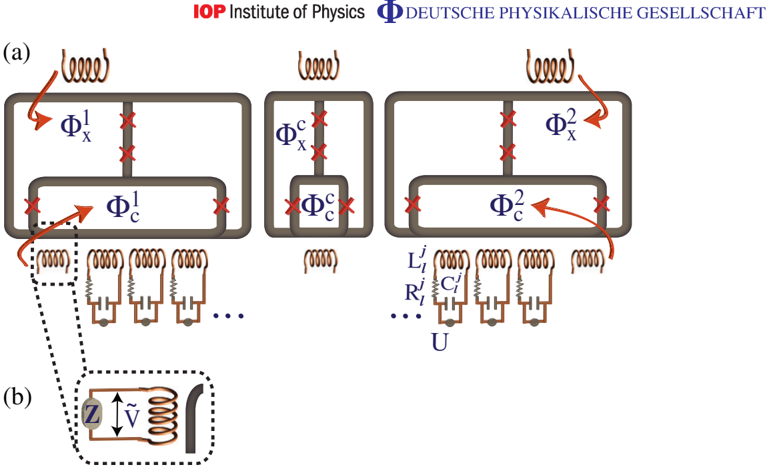
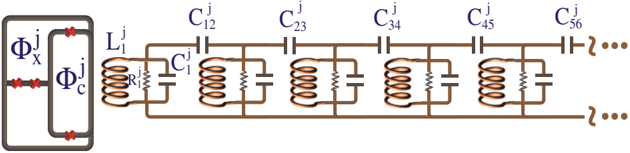
“In order to reproduce the quantum dynamics of the open system given by the above Hamiltonian, let us consider a chain of N gradiometric flux qubits [27,37] with tunable σzσz-couplings [38,39] and a single LC oscillator coupled to each qubit, as shown in Fig.”
MethodSelf-citationGiant Interatomic Energy-Transport Amplification with Nonreciprocal Photonic Topological Insulators
Doyeux, P., Gangaraj, S. A. H., Hanson, G. W., & Antezza, M. (2017) · Physical Review Letters · doi:10.1103/physrevlett.119.173901 · Cited by 35
Geller, M. R., Martinis, J. M., Sornborger, A. T., Stancil, P. C., Pritchett, E., You, H., & Galiautdinov, A. (2015) · Physical Review A · doi:10.1103/physreva.91.062309 · Cited by 38
Interference in a Prototype of a Two-Dimensional Ion Trap Array Quantum Simulator
Hakelberg, F., Kiefer, P., Wittemer, M., Warring, U., & Schaetz, T. (2019) · Physical Review Letters · doi:10.1103/physrevlett.123.100504 · Cited by 30
Quantum circuit design for accurate simulation of qudit channels
Wang, D., & Sanders, B. C. (2015) · New Journal of Physics · doi:10.1088/1367-2630/17/4/043004 · Cited by 34
Continuous-variable gate decomposition for the Bose-Hubbard model
Kalajdzievski, T. Z., Weedbrook, C., & Rebentrost, P. (2018) · Physical Review A · doi:10.1103/physreva.97.062311 · Cited by 27
Self-citationThermalization of Finite Many-Body Systems by a Collision Model
Arısoy, O., Campbell, S., & Müstecaplıoğlu, Ö. E. (2019) · Entropy · doi:10.3390/e21121182 · Cited by 31
“[34] Sarah Mostame, Patrick Rebentrost, Alexander Eisfeld, Andrew J.”
BackgroundQuantum algorithm for solving open-system dynamics on quantum computers using noise
Leppäkangas, J., Vogt, N., Fratus, K. R., Bark, K., Vaitkus, J. A., Stadler, P., Reiner, J.-M., Zanker, S., & Marthaler, M. (2023) · Physical Review A · doi:10.1103/physreva.108.062424 · Cited by 25
Sous, J., Chakraborty, M., Adolphs, C. P. J., Krems, R. V., & Berciu, M. (2017) · Scientific Reports · doi:10.1038/s41598-017-01228-y · Cited by 25
Efficient quantum simulation of open quantum system dynamics on noisy quantum computers
Sun, S., Shih, L.-C., & Cheng, Y. (2024) · Physica Scripta · doi:10.1088/1402-4896/ad1c27 · Cited by 26
“…al [ 29 ] proposed to simulate the quantum Brownian motion by engineering an arti fi cial reservoir coupled to a single trapped ion, and Aspuru-Guzik and coworkers [ 26 ] proposed an superconducting analog open quantum simulator for Fenna-Matthews-Olson complex, where the required system-bath…”
BackgroundQuantum chemistry and charge transport in biomolecules with superconducting circuits
García-Álvarez, L., Las Heras, U., Mezzacapo, A., Sanz, M., Solano, E., & Lamata, L. (2016) · Scientific Reports · doi:10.1038/srep27836 · Cited by 20
When is a quantum cellular automaton (QCA) a quantum lattice gas automaton (QLGA)?
Shakeel, A., & Love, P. J. (2013) · Journal of Mathematical Physics · doi:10.1063/1.4821640 · Cited by 24
“…field of quantum computation [36, 47, 48, 57, 68, 71] and has been subsequently developed in the field of quantum simulation, which has attracted considerable theoretical and experimental attention in recent years with applications in physics, chemistry and biology [5, 30, 33, 34, 37, 46, 66, 70].”
BackgroundEffects of gate errors in digital quantum simulations of fermionic systems
Reiner, J.-M., Zanker, S., Schwenk, I., Leppäkangas, J., Wilhelm, F. K., Schön, G., & Marthaler, M. (2018) · Quantum Science and Technology · doi:10.1088/2058-9565/aad5ba · Cited by 27
Simulation of open-quantum-system dynamics using the quantum Zeno effect
Patsch, S., Maniscalco, S., & Koch, C. P. (2020) · Physical Review Research · doi:10.1103/physrevresearch.2.023133 · Cited by 26
Linear-algebraic bath transformation for simulating complex open quantum systems
Huh, J., Mostame, S., Fujita, T., Yung, M., & Aspuru‐Guzik, A. (2014) · New Journal of Physics · doi:10.1088/1367-2630/16/12/123008 · Cited by 27
Self-citationRecompilation-enhanced simulation of electron–phonon dynamics on IBM quantum computers
Jaderberg, B., Eisfeld, A., Jaksch, D., & Mostame, S. (2022) · New Journal of Physics · doi:10.1088/1367-2630/ac8a69 · Cited by 21
Self-citationPolaronic effects in one- and two-band quantum systems
Yin, T., Cocks, D., & Hofstetter, W. (2015) · Physical Review A · doi:10.1103/physreva.92.063635 · Cited by 19
On the Controversial Nature of the 825 nm Exciton Band in the FMO Protein Complex
Kell, A., Acharya, K., Zazubovich, V., & Jankowiak, R. (2014) · The Journal of Physical Chemistry Letters · doi:10.1021/jz5001165 · Cited by 21
Simulating open-system molecular dynamics on analog quantum computers
Olaya-Agudelo, V. C., Stewart, B., Valahu, C. H., MacDonell, R. J., Millican, M. J., Matsos, V. G., Scuccimarra, F., Tan, T. R., & Kassal, I. (2025) · Physical Review Research · doi:10.1103/physrevresearch.7.023215 · Cited by 20
Non-Markovian qubit dynamics in a circuit-QED setup
Cárdenas, P. C., Paternostro, M., & Semião, F. L. (2015) · Physical Review A · doi:10.1103/physreva.91.022122 · Cited by 18
Tunable electromagnetically induced transparency in a composite superconducting system
Wang, X., Li, H., Chen, D., Liu, W.-X., & Li, F. (2016) · Optics Communications · doi:10.1016/j.optcom.2016.01.024 · Cited by 18
Decoherence Control of Nitrogen-Vacancy Centers
Lei, C., Peng, S., Ju, C., Yung, M., & Du, J. (2017) · Scientific Reports · doi:10.1038/s41598-017-12280-z · Cited by 23
Parity-Engineered Light-Matter Interaction
Goetz, J., Deppe, F., Fedorov, K. G., Eder, P., Fischer, M., Pogorzalek, S., Xie, E., Marx, A., & Gross, R. (2018) · Physical Review Letters · doi:10.1103/physrevlett.121.060503 · Cited by 21
Simulating open quantum systems with giant atoms
Chen, G., & Kockum, A. F. (2025) · Quantum Science and Technology · doi:10.1088/2058-9565/adb2bd · Cited by 23
“The frequency ω will in turn set the effective relaxation rate Γ of the qubit to the environment (the waveguide), as well as the strength g of its interaction with other qubits through the waveguide. usually require additional parametric (or otherwise tunable) couplers [51–55].”
Quantum simulation of clustered photosynthetic light harvesting in a superconducting quantum circuit
Tao, M., Hua, M., Zhang, N., He, W., Ai, Q., & Deng, F. (2020) · Quantum Engineering · doi:10.1002/que2.53 · Cited by 17
“[33] mimicked a complicated environment with a given spectral density for the EET in photosynthetic complexes by using inductorresistor-capacitor oscillators [33].”
Bipolarons bound by repulsive phonon-mediated interactions
Sous, J., Berciu, M., & Krems, R. V. (2017) · Physical Review A · doi:10.1103/physreva.96.063619 · Cited by 16
Long-Range Nonequilibrium Coherent Tunneling Induced by Fractional Vibronic Resonances
Kessing, R. K., Yang, P.-Y., Manmana, S. R., & Cao, J. (2022) · The Journal of Physical Chemistry Letters · doi:10.1021/acs.jpclett.2c01455 · Cited by 16
Strategies to simulate dephasing-assisted quantum transport on digital quantum computers
Gallina, F., Bruschi, M., & Fresch, B. (2022) · New Journal of Physics · doi:10.1088/1367-2630/ac512f · Cited by 15
“Recent quantum simulations of ENAQT on analog quantum devices (photonic setups [20,21] ultracold atoms [22], superconducting circuits [23–25], nuclear spin systems [26] and trapped atoms [27]) confirmed the theoretical predictions and offer a controlled environment to further test the effects of…”
BackgroundChin, A. W., Mangaud, É., Atabek, O., & Desouter-Lecomte, M. (2018) · Physical Review A · doi:10.1103/physreva.97.063823 · Cited by 16
Guimarães, J. D., Ruiz-Molero, A., Lim, J., Vasilevskiy, M. I., Huelga, S. F., & Plenio, M. B. (2024) · Physical Review A · doi:10.1103/physreva.109.052224 · Cited by 14
Diffusive to Nonergodic Dipolar Transport in a Dissipative Atomic Medium
Whitlock, S., Wildhagen, H., Weimer, H., & Weidemüller, M. (2019) · Physical Review Letters · doi:10.1103/physrevlett.123.213606 · Cited by 15
“works [45–47] and superconducting qubits [48, 49], with excellent control concerning disorder, dimensionality, dissipation and long-range interactions.”
BackgroundHamiltonian quantum simulation with bounded-strength controls
Bookatz, A. D., Wocjan, P., & Viola, L. (2014) · New Journal of Physics · doi:10.1088/1367-2630/16/4/045021 · Cited by 17
Floquet stroboscopic divisibility in non-Markovian dynamics
Bastidas, V. M., Kyaw, T. H., Tangpanitanon, J., Romero, G., Kwek, L.-C., & Angelakis, D. G. (2018) · New Journal of Physics · doi:10.1088/1367-2630/aadcbd · Cited by 13
Trapped Ion Architecture for Multi‐Dimensional Quantum Simulations
Warring, U., Hakelberg, F., Kiefer, P., Wittemer, M., & Schaetz, T. (2020) · Advanced Quantum Technologies · doi:10.1002/qute.201900137 · Cited by 14
Fistul, M. V., Neyenhuys, O., Bocaz, A. B., Lisitskiy, M., & Eremin, I. (2022) · Physical review. B./Physical review. B · doi:10.1103/physrevb.105.104516 · Cited by 12
The Kitaev–Feynman clock for open quantum systems
Tempel, D. G., & Aspuru‐Guzik, A. (2014) · New Journal of Physics · doi:10.1088/1367-2630/16/11/113066 · Cited by 14
Self-citationQuantum phase transition in a multiconnected Jaynes-Cummings lattice
Xue, J. Y., Seo, K., Tian, L., & Xiang, T. (2017) · Physical review. B./Physical review. B · doi:10.1103/physrevb.96.174502 · Cited by 15
Non-Markovian dynamics in ultracold Rydberg aggregates
Genkin, M., Schönleber, D. W., Wüster, S., & Eisfeld, A. (2016) · Journal of Physics B Atomic Molecular and Optical Physics · doi:10.1088/0953-4075/49/13/134001 · Cited by 12
Self-citationEmergence of a negative resistance in noisy coupled linear oscillators
Quiroz-Juarez, M. A., Aragón, J. L., León‐Montiel, R. D. J., Vázquez‐Medina, R., Domínguez‐Juárez, J. L., & Quintero‐Torres, R. (2016) · Europhysics Letters (EPL) · doi:10.1209/0295-5075/116/50004 · Cited by 10
Protecting quantum coherences from static noise and disorder
Kropf, C. M. (2020) · Physical Review Research · doi:10.1103/physrevresearch.2.033311 · Cited by 12
Simulation of Nonradiative Energy Transfer in Photosynthetic Systems Using a Quantum Computer
Guimarães, J. D., Tavares, C., Barbosa, L. S., & Vasilevskiy, M. I. (2020) · Complexity · doi:10.1155/2020/3510676 · Cited by 9
“[37, 41, 52], using superconducting qubits, and [54] employing a Nuclear Magnetic Resonance (NMR) simulator [58].”
MethodCharge dynamics in quantum-circuit refrigeration: Thermalization and microwave gain
Hsu, H., Silveri, M., Sevriuk, V., Möttönen, M., & Catelani, G. (2021) · AVS Quantum Science · doi:10.1116/5.0062868 · Cited by 9
Two-dimensional spectroscopy of Rydberg gases
Mukherjee, K., Goswami, H. P., Whitlock, S., Wüster, S., & Eisfeld, A. (2020) · New Journal of Physics · doi:10.1088/1367-2630/ab9984 · Cited by 9
“While we focus on the specific case of Rydberg atoms, microwave domain 2D spectroscopy can more generally be useful whenever quantum dynamics involves energy differences in the microwave realm, such as in quantum dots [34], Nitrogen-vacancycenters or superconducting circuit arrays [35, 16, 17], and much of this sectio…”
BackgroundSelf-citationEnhancement of quantum excitation transport by photonic nonreciprocity
Gangaraj, S. A. H., Ying, L., Monticone, F., & Yu, Z. (2022) · Physical Review A · doi:10.1103/physreva.106.033501 · Cited by 9
Engineering thermal reservoirs for ultracold dipole–dipole-interacting Rydberg atoms
Schönleber, D. W., Bentley, C. D., & Eisfeld, A. (2018) · New Journal of Physics · doi:10.1088/1367-2630/aa9c97 · Cited by 11
Self-citationEnvironmental effects controlled
Barreiro, J. T. (2011) · Nature Physics · doi:10.1038/nphys2150 · Cited by 8
Harnessing intrinsic noise for quantum simulation of open quantum systems
Dambal, S., Sone, A., & Zhang, Y. (2026) · Physical Review A · doi:10.1103/q31d-1b36 · Cited by 7
Quantum phase transition of nonlocal Ising chain with transverse field in a resonator
Zhang, Y., Luo, X.-W., Guo, G., Zhou, Z.-W., & Zhou, X. (2014) · Physical Review B · doi:10.1103/physrevb.90.094510 · Cited by 8
Reconstructing the ideal results of a perturbed analog quantum simulator
Schwenk, I., Reiner, J.-M., Zanker, S., Tian, L., Leppäkangas, J., & Marthaler, M. (2018) · Physical Review A · doi:10.1103/physreva.97.042310 · Cited by 7
Zuniga-Hansen, N., Chi, Y.-C., & Byrd, M. (2012) · Physical Review A · doi:10.1103/physreva.86.042335 · Cited by 7
Estimating the Error of an Analog Quantum Simulator by Additional Measurements
Schwenk, I., Zanker, S., Reiner, J.-M., Leppäkangas, J., & Marthaler, M. (2017) · Physical Review Letters · doi:10.1103/physrevlett.119.240502 · Cited by 6
On uncorrelated inter-monomer Förster energy transfer in Fenna–Matthews–Olson complexes
Kell, A., Khmelnitskiy, A. Y., Reinot, T., & Jankowiak, R. (2019) · Journal of The Royal Society Interface · doi:10.1098/rsif.2018.0882 · Cited by 6
Repeated interaction scheme for the quantum simulation of non-Markovian electron transfer dynamics
Sørensen, L. N., Teynor, M. S., & Solomon, G. C. (2025) · The Journal of Chemical Physics · doi:10.1063/5.0268071 · Cited by 6
Quantum simulation of noisy quantum networks
Riera-Sàbat, F., Miguel-Ramiro, J., & Dür, W. (2026) · Quantum Science and Technology · doi:10.1088/2058-9565/ae8b1f · Cited by 5
“Someworks have analyzed the possibilities of quantum simulation using quantum devices in the context of open system dynamics, both in an analog [17, 54–57] and digital [15, 58–65] fashion.”
Classical-quantum correspondence in noise-based dissipative systems
Zeng, J., Xu, G., Huang, W., & Yao, Y. (2024) · Physical Review A · doi:10.1103/physreva.110.062219 · Cited by 4
“Their interesting correspondence has been applied into quantum simulations, achieving numerous open systems such as the light-harvesting model, Bose–Hubbard model, and Ising chain [21–24].”
MethodQuantum biology, quantum simulation and quantum coherent devices
Chen, R.-H., Dong, J., Yang, W., Ai, Q., & Long, G.-L. (2026) · Science China Physics Mechanics and Astronomy · doi:10.1007/s11433-026-3070-9 · Cited by 3
“Most existing methods for photosynthetic energy transfer rely on approximations that are valid only in restricted parameter regimes, while numerically exact approaches often su ff er from high computational cost.”
Analyzing the spectral density of a perturbed analog quantum simulator using the Keldysh formalism
Zanker, S., Schwenk, I., Reiner, J.-M., Leppäkangas, J., & Marthaler, M. (2018) · Physical review. B./Physical review. B · doi:10.1103/physrevb.97.214301 · Cited by 4
Two-particle quantum correlations in stochastically-coupled networks
León‐Montiel, R. D. J., Méndez, V., Quiroz-Juarez, M. A., Ortega, A., Benet, L., Pérez-Leija, A., & Busch, K. (2019) · New Journal of Physics · doi:10.1088/1367-2630/ab1c79 · Cited by 3
Role of the multiple-excitation manifold in a driven quantum simulator of an antenna complex
Chin, A. W., Dé, B. L., Mangaud, É., Atabek, O., & Desouter-Lecomte, M. (2020) · Physical Review A · doi:10.1103/physreva.102.023708 · Cited by 3
Automated quantum system modeling with machine learning
Mukherjee, K., Schachenmayer, J., Whitlock, S., & Wüster, S. (2025) · Quantum Science and Technology · doi:10.1088/2058-9565/ada79a · Cited by 4
“Similar models can describe bulk semi-conductors [7] or superconducting circuits [8].”
Metadata
- Authors
- Mostame, S., Rebentrost, P., Eisfeld, A., Kerman, A. J., Tsomokos, D. I., & Aspuru-Guzik, A.
- Affiliations
- Harvard University (US)
- MIT Lincoln Laboratory (US)
- University of London (GB)
- Venue
- New Journal of Physics
- Publisher
- IOP Publishing
- Published
- 2012-10-10
- Volume
- 14
- Issue
- 10
- Pages
- 105013
- ISSN
- 1367-2630 (ISSN-L)
- OpenAlex
- W2095928421
- Cited by
- 104
- References
- 74
- Citations by year
- 2026: 2 · 2025: 7 · 2024: 3 · 2023: 4 · 2022: 7 · 2021: 2 · 2020: 10 · 2019: 11 · 2018: 15 · 2017: 13 · 2016: 5 · 2015: 9 · 2014: 9 · 2013: 4 · 2012: 2
- FWCI
- 7.56
- Type
- journal article
- Language
- en
- Open access
- gold
- doi.org
- Licence
- cc-by
- Locations
- New Journal of Physics (publishedVersion, cc-by)
- arXiv (Cornell University) (submittedVersion)
- Funders
- U.S. Department of Energy (DESC0001088)
- Engineering and Physical Sciences Research Council (EP/G045771/1)
- Topics
- Physical Sciences › Physics and Astronomy › Atomic and Molecular Physics, and Optics › Quantum Information and Cryptography
- Physical Sciences › Physics and Astronomy › Atomic and Molecular Physics, and Optics › Quantum Mechanics and Applications
- Physical Sciences › Physics and Astronomy › Atomic and Molecular Physics, and Optics › Spectroscopy and Quantum Chemical Studies
- Keywords
- open quantum systems, quantum simulation, superconducting qubits, exciton transport, photosynthesis, Fenna-Matthews-Olson complex, non-Markovian noise, energy transfer pathways, quantum circuits
About these checks
Registry, retraction, Cites and statistics results are computed, not judged, with one exception: a printed reference that no index lists is read once by a model before it counts as a citation error. Claims are extracted by a model and kept only when their quote appears verbatim in the text; each cited source is then checked, with a model’s help, for whether it says what the claim relies on. Those verdicts can be wrong — read the claim’s quote and the cited source before relying on one.
Statistics and arithmetic are recomputed, not judged.
Confidence bands are shown only for fields calibrated on our annotated test set. None is calibrated yet, so no band is shown.
What counts as a claim ›How we measure confidence ›How we check this ›
Are you an author, or do you see a problem with this page? Request a review
Data sources
Bibliographic data: Semantic Scholar, OpenAlex, Crossref.
Contains information from the Semantic Scholar Academic Graph Datasets, made available under the ODC Attribution License (ODC-BY 1.0).
Semantic Scholar’s data is described in: Kinney, R., et al. (2023). The Semantic Scholar Open Data Platform. arXiv:2301.10140.
