

Quantum simulations of relativistic quantum physics in circuit QED
Open accessThe DOI matches its Crossref record; 35 of the 35 references it cites were found in a registry or an index.
Abstract
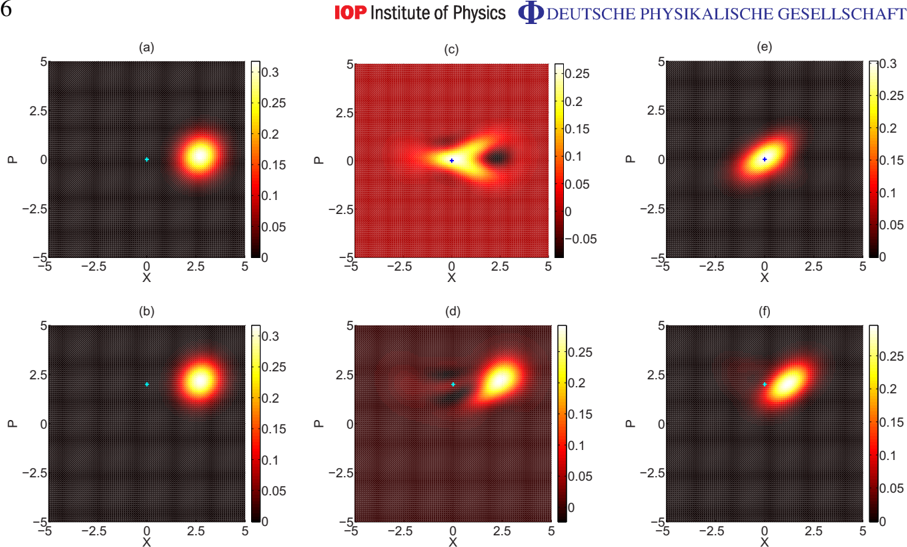
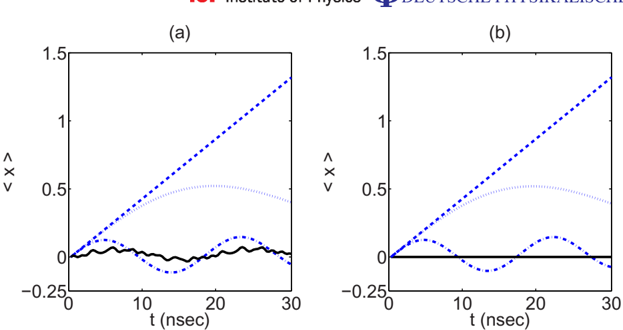
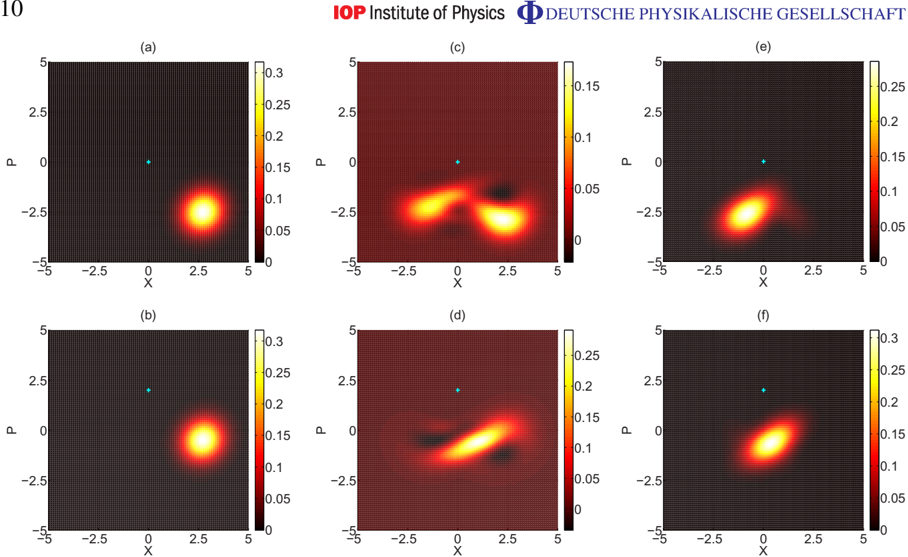
We present a scheme for simulating relativistic quantum physics in circuit quantum electrodynamics. By using three classical microwave drives, we show that a superconducting qubit strongly coupled to a resonator field mode can be used to simulate the dynamics of the Dirac equation and Klein paradox in all regimes. Using the same setup we also propose the implementation of the Foldy–Wouthuysen canonical transformation, after which the time derivative of the position operator becomes a constant of the motion.
Overview
The claims and statistics of this paper haven’t been checked yet.
Free: it reads the open-access text and checks the first 5 claims that cite a source we can check. Create a free account to check every claim.
Integrity signals
Registry
Cites
Statistics
Figures
Verification
Claims the paper makes
The claims and statistics of this paper haven’t been checked yet.
Free: it reads the open-access text and checks the first 5 claims that cite a source we can check. Create a free account to check every claim.
Claims other papers make about this one
Each is checked against this paper’s own text: does it say what the citing paper says it does?
The source backs part of the claim, not all of it — or backs it for a different population, condition or comparison.
In the citing paper
“We note that the phase space quantum interference effects were previously predicted for some special states with both positive and negative components [11], but the presence of such effects without ZB has not been revealed.”
From Revealing inherent quantum interference and entanglement of a Dirac particle (2023) · cites this paper as [11]
Experimental — accuracy not yet measuredThe cited source says what the claim attributes to it.
In the citing paper
“The Hamiltonian in equation ( 11) has the same form as the Hamiltonian for a one-dimensional Dirac particle in equation ( 7), where the terms √ 2g * and δ q /2 are associated with the speed of light and mass, respectively [33].”
From Efficient protocol for exploring the quantum interference and entanglement of Dirac particles (2025) · cites this paper as [33]
The cited source says what the claim attributes to it.
In the citing paper
“As demonstrated in [33], the non-classical features of Dirac evolution occur mainly in the intermediate relativistic regime.That is, the ZB effect only be observed in intermediate regime where mc is comparable with p in equation ( 7).”
From Efficient protocol for exploring the quantum interference and entanglement of Dirac particles (2025) · cites this paper as [33]
In the citing paper
“For electrons moving at relativistic speeds, the amplitude of the ZB effect that one can anticipate is approximately 10 -4 nm [33], making the direct observation of the ZB effect quite challenging.”
From Efficient protocol for exploring the quantum interference and entanglement of Dirac particles (2025) · cites this paper as [33]
Self-check
Percentages, sums and reported differences re-computed from the paper’s own numbers.
The self-check needs the paper’s full text.
Citations
Cites
Simulating physics with computers
Feynman, R. P. (1982) · International Journal of Theoretical Physics · doi:10.1007/bf02650179 · Cited by 7,691
Comparison of quantum and semiclassical radiation theories with application to the beam maser
Jaynes, E. T., & Cummings, F. W. (1963) · Proceedings of the IEEE · doi:10.1109/proc.1963.1664 · Cited by 5,353
Quantum theory, the Church–Turing principle and the universal quantum computer
Deutsch, D. (1985) · Proceedings of the Royal Society of London. A. Mathematical and Physical Sciences · doi:10.1098/rspa.1985.0070 · Cited by 4,597
Chiral tunnelling and the Klein paradox in graphene
Katsnelson, M. I., Novoselov, K. S., & Geim, A. K. (2006) · Nature Physics · doi:10.1038/nphys384 · Cited by 3,896
Strong coupling of a single photon to a superconducting qubit using circuit quantum electrodynamics
Wallraff, A., Schuster, D. I., Blais, A., Frunzio, L., Huang, R. S., Majer, J., Kumar, S., Girvin, S. M., & Schoelkopf, R. J. (2004) · Nature · doi:10.1038/nature02851 · Cited by 3,796
The quantum theory of the electron
Dirac, P. A. M. (1928) · Proceedings of the Royal Society of London. Series A, Containing Papers of a Mathematical and Physical Character · doi:10.1098/rspa.1928.0023 · Cited by 3,657
Lloyd, S. (1996) · Science · doi:10.1126/science.273.5278.1073 · Cited by 3,088
Blais, A., Huang, R.-S., Wallraff, A., Girvin, S. M., & Schoelkopf, R. J. (2004) · Physical Review A · doi:10.1103/physreva.69.062320 · Cited by 2,989
On the Dirac Theory of Spin 1/2 Particles and Its Non-Relativistic Limit
Foldy, L. L., & Wouthuysen, S. A. (1950) · Physical Review · doi:10.1103/physrev.78.29 · Cited by 2,183
Thaller, B. (1992) · doi:10.1007/978-3-662-02753-0 · Cited by 1,530
Die Reflexion von Elektronen an einem Potentialsprung nach der relativistischen Dynamik von Dirac
Klein, O. (1929) · Zeitschrift f�r Physik · doi:10.1007/bf01339716 · Cited by 1,080
Buluta, I., & Nori, F. (2009) · Science · doi:10.1126/science.1177838 · Cited by 876
Synthesizing arbitrary quantum states in a superconducting resonator
Hofheinz, M., Wang, H., Ansmann, M., Bialczak, R. C., Lucero, E., Neeley, M., O'Connell, A. D., Sank, D., Wenner, J., Martinis, J. M., et al. (2009) · Nature · doi:10.1038/nature08005 · Cited by 873
Towards quantum chemistry on a quantum computer
Lanyon, B. P., Whitfield, J. D., Gillett, G. G., Goggin, M. E., Almeida, M. P., Kassal, I., Biamonte, J. D., Mohseni, M., Powell, B. J., Barbieri, M., et al. (2010) · Nature Chemistry · doi:10.1038/nchem.483 · Cited by 796
Quantum simulation of the Dirac equation
Gerritsma, R., Kirchmair, G., Zähringer, F., Solano, E., Blatt, R., & Roos, C. F. (2010) · Nature · doi:10.1038/nature08688 · Cited by 725
Self-citationDirac Equation and Quantum Relativistic Effects in a Single Trapped Ion
Lamata, L., León, J., Schätz, T., & Solano, E. (2007) · Physical Review Letters · doi:10.1103/physrevlett.98.253005 · Cited by 300
Self-citationBozyigit, D., Lang, C., Steffen, L., Fink, J. M., Eichler, C., Baur, M., Bianchetti, R., Leek, P. J., Filipp, S., da Silva, M. P., et al. (2011) · Nature Physics · doi:10.1038/nphys1845 · Cited by 240
Classical Simulation of Relativistic Zitterbewegung in Photonic Lattices
Dreisow, F., Heinrich, M., Keil, R., Tünnermann, A., Nolte, S., Longhi, S., & Szameit, A. (2010) · Physical Review Letters · doi:10.1103/physrevlett.105.143902 · Cited by 235
Quantum Simulation of the Klein Paradox with Trapped Ions
Gerritsma, R., Lanyon, B. P., Kirchmair, G., Zähringer, F., Hempel, C., Casanova, J., García-Ripoll, J. J., Solano, E., Blatt, R., & Roos, C. F. (2011) · Physical Review Letters · doi:10.1103/physrevlett.106.060503 · Cited by 204
Self-citationExperimental State Tomography of Itinerant Single Microwave Photons
Eichler, C., Bozyigit, D., Lang, C., Steffen, L., Fink, J., & Wallraff, A. (2011) · Physical Review Letters · doi:10.1103/physrevlett.106.220503 · Cited by 199
Tuning the Gap of a Superconducting Flux Qubit
Paauw, F. G., Fedorov, A., Harmans, C. J. P. M., & Mooij, J. E. (2009) · Physical Review Letters · doi:10.1103/physrevlett.102.090501 · Cited by 176
Photonic Realization of the Quantum Rabi Model
Crespi, A., Longhi, S., & Osellame, R. (2012) · Physical Review Letters · doi:10.1103/physrevlett.108.163601 · Cited by 155
Zitterbewegung (trembling motion) of electrons in semiconductors: a review
Zawadzki, W., & Rusin, T. M. (2011) · Journal of Physics: Condensed Matter · doi:10.1088/0953-8984/23/14/143201 · Cited by 150
Quantum Simulation of the Ultrastrong-Coupling Dynamics in Circuit Quantum Electrodynamics
Ballester, D., Romero, G., García-Ripoll, J. J., Deppe, F., & Solano, E. (2012) · Physical Review X · doi:10.1103/physrevx.2.021007 · Cited by 119
Self-citationQuantum Simulation of Interacting Fermion Lattice Models in Trapped Ions
Casanova, J., Mezzacapo, A., Lamata, L., & Solano, E. (2012) · Physical Review Letters · doi:10.1103/physrevlett.108.190502 · Cited by 118
Self-citationThe Foldy–Wouthuysen transformation
Costella, J. P., & McKellar, B. H. J. (1995) · American Journal of Physics · doi:10.1119/1.18017 · Cited by 102
Klein tunneling and Dirac potentials in trapped ions
Casanova, J., García-Ripoll, J. J., Gerritsma, R., Roos, C. F., & Solano, E. (2010) · Physical Review A · doi:10.1103/physreva.82.020101 · Cited by 86
Self-citationMenzel, E. P., Deppe, F., Mariantoni, M., Araque Caballero, M. Á., Baust, A., Niemczyk, T., Hoffmann, E., Marx, A., Solano, E., & Gross, R. (2010) · Physical Review Letters · doi:10.1103/physrevlett.105.100401 · Cited by 84
Self-citationNetworks of nonlinear superconducting transmission line resonators
Leib, M., Deppe, F., Marx, A., Gross, R., & Hartmann, M. J. (2012) · New Journal of Physics · doi:10.1088/1367-2630/14/7/075024 · Cited by 82
The Zitterbewegung of a free localized Dirac particle
Lock, J. A. (1979) · American Journal of Physics · doi:10.1119/1.11697 · Cited by 81
Relativistic quantum mechanics with trapped ions
Lamata, L., Casanova, J., Gerritsma, R., Roos, C. F., García-Ripoll, J. J., & Solano, E. (2011) · New Journal of Physics · doi:10.1088/1367-2630/13/9/095003 · Cited by 80
Self-citationDigital Quantum Simulation of the Holstein Model in Trapped Ions
Mezzacapo, A., Casanova, J., Lamata, L., & Solano, E. (2012) · Physical Review Letters · doi:10.1103/physrevlett.109.200501 · Cited by 77
Self-citationKlein Tunneling of a Quasirelativistic Bose-Einstein Condensate in an Optical Lattice
Salger, T., Grossert, C., Kling, S., & Weitz, M. (2011) · Physical Review Letters · doi:10.1103/physrevlett.107.240401 · Cited by 70
The Foldy-Wouthuysen transformation
Costella, J. P., & McKellar, B. H. J. (1995) · CERN Document Server (European Organization for Nuclear Research) · Cited by 69
Zitterbewegung of quasiparticles in superconductors
Lurié, D., & Cremer, S. (1970) · Physica · doi:10.1016/0031-8914(70)90004-2 · Cited by 41
Research works printed but not linked: 1
- Schrödinger E 1930 Sitz. Preuss. Akad. Wiss. Phys. Math. Kl. 24 418
Cited by
Georgescu, I. M., Ashhab, S., & Nori, F. (2014) · Reviews of Modern Physics · doi:10.1103/revmodphys.86.153 · Cited by 2,932
“There have also been related proposals using trapped ions (Casanova et al., 2012, 2011), cavity QED systems (Barrett et al., 2013) and superconducting circuits (Marcos et al., 2013; Pedernales et al., 2013).”
BackgroundSuperconducting Qubits: Current State of Play
Kjaergaard, M., Schwartz, M. E., Braumüller, J., Krantz, P., Wang, J. I.-J., Gustavsson, S., & Oliver, W. D. (2020) · Annual Review of Condensed Matter Physics · doi:10.1146/annurev-conmatphys-031119-050605 · Cited by 1,544
Superconducting Qubits: Current State of PlayPreprint
Kjærgaard, M., Schwartz, M. E., Braumüller, J., Krantz, P., Wang, J. I.-J., Gustavsson, S., & Oliver, W. D. (2020) · DSpace@MIT (Massachusetts Institute of Technology) · Cited by 1,192
Ultrastrong coupling regimes of light-matter interaction
Forn-Díaz, P., Lamata, L., Rico, E., Kono, J., & Solano, E. (2019) · Reviews of Modern Physics · doi:10.1103/revmodphys.91.025005 · Cited by 1,086
Self-citationMany-body quantum electrodynamics networks: Non-equilibrium condensed matter physics with light
Hur, K. L., Henriet, L., Petrescu, A., Plekhanov, K., Roux, G., & Schirò, M. (2016) · Comptes Rendus Physique · doi:10.1016/j.crhy.2016.05.003 · Cited by 131
Metadata
- Authors
- Pedernales, J. S., Di Candia, R., Ballester, D., & Solano, E.
- Affiliations
- University of the Basque Country (ES)
- Ikerbasque (ES)
- Corresponding author
- Ballester, D
- Venue
- New Journal of Physics
- Publisher
- IOP Publishing
- Published
- 2013-05-15
- Volume
- 15
- Issue
- 5
- Pages
- 055008
- ISSN
- 1367-2630 (ISSN-L)
- OpenAlex
- W2154613209
- Cited by
- 40
- References
- 35
- Citations by year
- 2026: 1 · 2025: 2 · 2024: 1 · 2023: 2 · 2022: 1 · 2021: 1 · 2020: 4 · 2019: 6 · 2018: 3 · 2017: 6 · 2016: 2 · 2015: 3 · 2014: 6 · 2013: 2
- FWCI
- 2.23
- Type
- journal article
- Language
- en
- Open access
- gold
- doi.org
- Licence
- cc-by
- iopscience.iop.org/info/page/text-and-data-mining (tdm)
- creativecommons.org/licenses/by/3.0/ (vor)
- Locations
- New Journal of Physics (publishedVersion, cc-by)
- arXiv (Cornell University) (submittedVersion)
- Communities in ADDI (Universidad del Pais Vasco) (submittedVersion, other-oa)
- Communities in ADDI (University of the Basque Country) (submittedVersion, other-oa)
- LA Referencia (Red Federada de Repositorios Institucionales de Publicaciones Científicas) (submittedVersion, cc-by)
- DOAJ (DOAJ: Directory of Open Access Journals) (submittedVersion)
- UCL Discovery (University College London) (submittedVersion)
- Hispana (submittedVersion, cc-by)
- Tesis Doctorals en Xarxa (Consorci de Serveis Universitaris de Catalunya) (submittedVersion, other-oa)
- arXiv (Cornell University)
- Funders
- Eusko Jaurlaritza (IT-472-10, IT472)
- Euskal Herriko Unibertsitatea (11/55, UFI 11/55)
- Engineering and Physical Sciences Research Council (EP/H050434/1)
- Topics
- Physical Sciences › Physics and Astronomy › Atomic and Molecular Physics, and Optics › Quantum Mechanics and Applications
- Physical Sciences › Physics and Astronomy › Atomic and Molecular Physics, and Optics › Quantum Information and Cryptography
- Physical Sciences › Computer Science › Artificial Intelligence › Quantum Computing Algorithms and Architecture
- Keywords
- circuit quantum electrodynamics, Dirac equation, Klein paradox, superconducting qubits, microwave drive, Foldy-Wouthuysen transformation, relativistic quantum mechanics, first integrals
About these checks
Registry, retraction, Cites and statistics results are computed, not judged, with one exception: a printed reference that no index lists is read once by a model before it counts as a citation error. Claims are extracted by a model and kept only when their quote appears verbatim in the text; each cited source is then checked, with a model’s help, for whether it says what the claim relies on. Those verdicts can be wrong — read the claim’s quote and the cited source before relying on one.
Statistics and arithmetic are recomputed, not judged.
Confidence bands are shown only for fields calibrated on our annotated test set. None is calibrated yet, so no band is shown.
What counts as a claim ›How we measure confidence ›How we check this ›
Are you an author, or do you see a problem with this page? Request a review
Data sources
Bibliographic data: Semantic Scholar, OpenAlex, Crossref.
Contains information from the Semantic Scholar Academic Graph Datasets, made available under the ODC Attribution License (ODC-BY 1.0).
Semantic Scholar’s data is described in: Kinney, R., et al. (2023). The Semantic Scholar Open Data Platform. arXiv:2301.10140.
