

Learning the quantum algorithm for state overlap
Open accessThe DOI matches its Crossref record; 29 of the 30 references it cites were found in a registry or an index.
Abstract
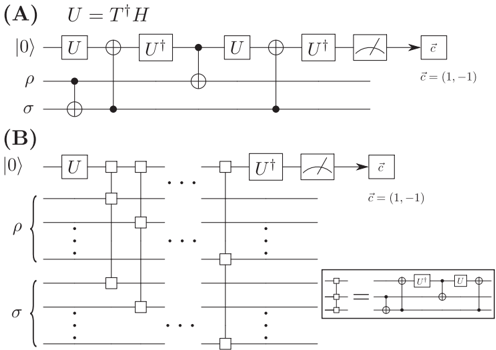
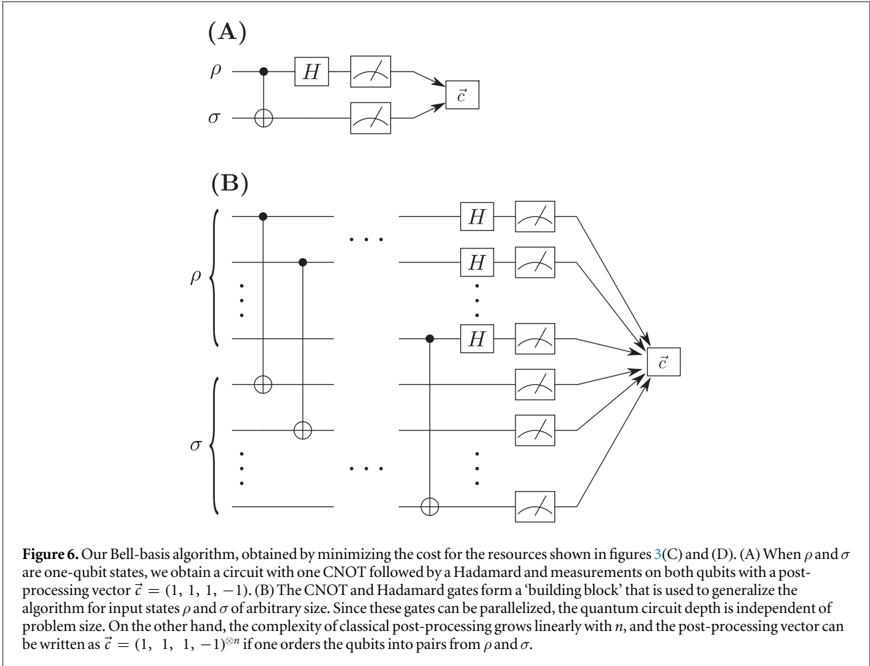
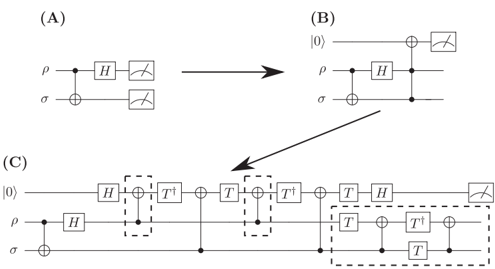
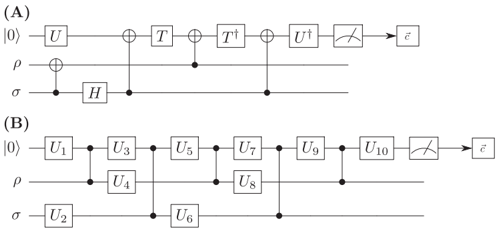
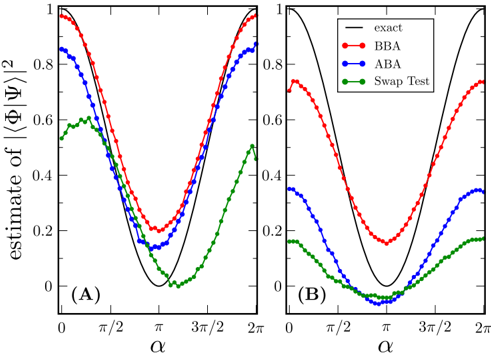
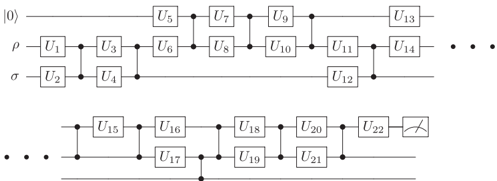
Short-depth algorithms are crucial for reducing computational error on near-term quantum computers, for which decoherence and gate infidelity remain important issues. Here we present a machine-learning approach for discovering such algorithms. We apply our method to a ubiquitous primitive: computing the overlap between two quantum states ρ and σ . The standard algorithm for this task, known as the Swap Test, is used in many applications such as quantum support vector machines, and, when specialized to ρ = σ , quantifies the Renyi entanglement. Here, we find algorithms that have shorter depths than the Swap Test, including one that has a constant depth (independent of problem size). Furthermore, we apply our approach to the hardware-specific connectivity and gate sets used by Rigetti's and IBM's quantum computers and demonstrate that the shorter algorithms that we derive significantly reduce the error—compared to the Swap Test—on these computers.
Overview
The claims and statistics of this paper haven’t been checked yet.
Free: it reads the open-access text and checks the first 5 claims that cite a source we can check. Create a free account to check every claim.
Integrity signals
Registry
Cites
Statistics
Figures
Verification
Claims the paper makes
The claims and statistics of this paper haven’t been checked yet.
Free: it reads the open-access text and checks the first 5 claims that cite a source we can check. Create a free account to check every claim.
Self-check
Percentages, sums and reported differences re-computed from the paper’s own numbers.
The self-check needs the paper’s full text.
Citations
Cites
Surface codes: Towards practical large-scale quantum computation
Fowler, A. G., Mariantoni, M., Martinis, J. M., & Cleland, A. N. (2012) · Physical Review A · doi:10.1103/physreva.86.032324 · Cited by 3,059
Quantum Support Vector Machine for Big Data Classification
Rebentrost, P., Mohseni, M., & Lloyd, S. (2014) · Physical Review Letters · doi:10.1103/physrevlett.113.130503 · Cited by 1,951 · cited 1×
“In quantum supervised learning [30, 31], which subsumes quantum support vector machines [32], the Swap Test is used to assign each data vector to a cluster.”
MethodKhaneja, N., Reiss, T., Kehlet, C., Schulte-Herbrüggen, T., & Glaser, S. J. (2005) · Journal of Magnetic Resonance · doi:10.1016/j.jmr.2004.11.004 · Cited by 1,854
Mitarai, K., Negoro, M., Kitagawa, M., & Fujii, K. (2018) · Physical Review A · doi:10.1103/physreva.98.032309 · Cited by 1,639 · cited 1×
“The circuit is then trained to perform a given task by tuning these parameters [6, 7].”
MethodBuhrman, H., Cleve, R., Watrous, J., & de Wolf, R. (2001) · Physical Review Letters · doi:10.1103/physrevlett.87.167902 · Cited by 1,190
Quantum algorithms for supervised and unsupervised machine learning
Lloyd, S., Mohseni, M., & Rebentrost, P. (2013) · arXiv · doi:10.48550/arxiv.1307.0411 · Cited by 542 · cited 1×
“In quantum supervised learning [30, 31], which subsumes quantum support vector machines [32], the Swap Test is used to assign each data vector to a cluster.”
MethodA blueprint for demonstrating quantum supremacy with superconducting qubits
Neill, C., Roushan, P., Kechedzhi, K., Boixo, S., Isakov, S. V., Smelyanskiy, V., Megrant, A., Chiaro, B., Dunsworth, A., Arya, K., et al. (2018) · Science · doi:10.1126/science.aao4309 · Cited by 458 · cited 1×
“Quantum supremacy [1] may be coming soon [2].”
BackgroundA generative modeling approach for benchmarking and training shallow quantum circuits
Benedetti, M., Garcia-Pintos, D., Perdomo, O., Leyton-Ortega, V., Nam, Y., & Perdomo-Ortiz, A. (2019) · npj Quantum Information · doi:10.1038/s41534-019-0157-8 · Cited by 379 · cited 2×
“This motivates the idea of an automated approach for discovering and optimizing quantum algorithms [6–19].”
MethodOpen Quantum Assembly Language
Cross, A. W., Bishop, L. S., Smolin, J. A., & Gambetta, J. M. (2017) · arXiv · doi:10.48550/arxiv.1707.03429 · Cited by 310 · cited 1×
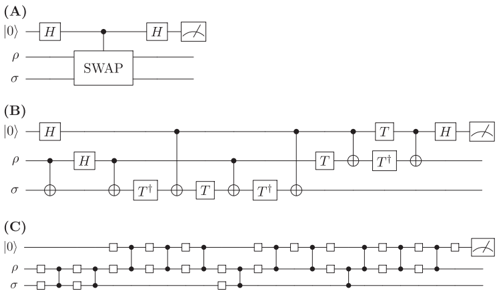
“Figure 2(B) and (C) respectively show decompositions of the Swap Test for IBM’s and Rigetti’s quantum computers [28, 29].”
MethodQuantum computing and the entanglement frontier
Preskill, J. (2012) · arXiv · doi:10.48550/arxiv.1203.5813 · Cited by 308 · cited 1×
“Quantum supremacy [1] may be coming soon [2].”
Background
Research works printed but not linked: 6
- Ball P 2018 The era of quantum computing is here. Outlook: cloudy Quanta Mag. [available at: http://quantamagazine.org/the-era- of-quantum-computing-is-here-outlook-cloudy-20180124/]
- Khatri S et al 2018 Quantum-assisted quantum compiling arXiv:1807.00800 · arXiv
- Hachtel G D and Somenzi F 1996 Logic Synthesis and Verification Algorithms (Boston, MA: Kluwer)
- Linke N M et al 2017 Measuring the Renyi entropy of a two-site Fermi-Hubbard model on a trapped ion quantum computer arXiv:1712.08581 · arXiv
- Smith R S, Curtis M J and Zeng W J 2016 A practical quantum instruction set architecture arXiv:1608.03355 · arXiv
- Wiebe N, Kapoor A and Svore K 2014 Quantum algorithms for nearest-neighbor methods for supervised and unsupervised learning Quantum Inf. Comput. 15 0318-58
Cited by
Items 101–200 of 288
Error mitigation with Clifford quantum-circuit data
Czarnik, P., Arrasmith, A., Coles, P. J., & Cincio, L. (2021) · Quantum · doi:10.22331/q-2021-11-26-592 · Cited by 27
“To reduce circuit depth for our H we apply circuit compilation techniques of [12] obtaining a circuit of depth 24 with 12 CNOTs and 12 non-Clifford R Z rotations, see Appendix E for details.”
MethodInfluentialSelf-citationQuantum kernel estimation-based quantum support vector regression
Zhou, X., Yu, J., Tan, J., & Jiang, T. (2024) · Quantum Information Processing · doi:10.1007/s11128-023-04231-7 · Cited by 39
“This is achieved through techniques like the SWAP test [34] and inversion test [27].”
Unified framework for quantum classification
Nghiem, N. A., Chen, S. Y.-C., & Wei, T.-C. (2021) · Physical Review Research · doi:10.1103/physrevresearch.3.033056 · Cited by 47
“In addition, SWAP test performance can be further improved by using methods introduced in [52].”
MethodSimulating quench dynamics on a digital quantum computer with data-driven error mitigation
Sopena, A., Gordon, M. H., Sierra, G., & López, E. (2021) · Quantum Science and Technology · doi:10.1088/2058-9565/ac0e7a · Cited by 32
Quantum neural network autoencoder and classifier applied to an industrial case study
Mangini, S., Marruzzo, A., Piantanida, M., Gerace, D., Bajoni, D., & Macchiavello, C. (2022) · Quantum Machine Intelligence · doi:10.1007/s42484-022-00070-4 · Cited by 44
Error mitigation with Clifford quantum-circuit data
Czarnik, P., Arrasmith, A., Coles, P. J., & Cincio, L. (2020) · arXiv · doi:10.48550/arxiv.2005.10189 · Cited by 27
Self-citationLearning Shallow Quantum Circuits
Huang, H.-Y., Liu, Y., Broughton, M., Kim, I. H., Anshu, A., Landau, Z. A., & McClean, J. R. (2024) · ACM Symposium on Theory of Computing (STOC) · doi:10.1145/3618260.3649722 · Cited by 101
“Various applications of learning shallow quantum circuits have been explored, ranging from compressing quantum circuits for implementing a unitary [19, 26, 60, 61, 80], speeding up quantum dynamics [20, 28, 40, 59, 92], to learning generative models for sampling from predicted distributions [12,…”
Variational quantum packaged deflation for arbitrary excited states
Wen, J., Lv, D., Yung, M., & Long, G. (2021) · Quantum Engineering · doi:10.1002/que2.80 · Cited by 32
Entanglement detection with quantum support vector machine (QSVM) on near-term quantum devices
Mahdian, M., & Mousavi, Z. B. (2025) · Scientific Reports · doi:10.1038/s41598-025-95897-9 · Cited by 34
“Finally, the expression R = 1 − 2 S =1 M i describes a calculation where the result R is influenced by the number of shots S and M (number of counts for the basis | 1 ⟩ ) [46, 48, 49].”
Nonlinear transformations in quantum computation
Holmes, Z., Coble, N. J., Sornborger, A. T., & Subaşı, Y. (2023) · Physical Review Research · doi:10.1103/physrevresearch.5.013105 · Cited by 65
Self-citationEntangled Datasets for Quantum Machine LearningPreprint
Schatzki, L., Arrasmith, A., Coles, P. J., & Cerezo, M. (2021) · arXiv (Cornell University) · doi:10.48550/arxiv.2109.03400 · Cited by 96
“For instance, estimating in a quantum circuit the purity of a pure quantum state (which measures the amount of mixedness, and quantifies the bipartite entanglement), requires two copies of the input state [63, 73].”
BackgroundSelf-citationNew Single-Preparation Methods for Unsupervised Quantum Machine Learning Problems
Deville, Y., & Deville, A. (2021) · IEEE Transactions on Quantum Engineering · doi:10.1109/tqe.2021.3121797 · Cited by 24
“:3) of such kets; 2) the squared modulus of this dot product, which is called the overlap of these kets (see [65, p. 120], [68], or [69]); or 3) the distance between the points associated with such kets, as, e.g., discussed in [10], [65], and [67].”
Retrieving Quantum Information with Active Learning
Ding, Y., Martín‐Guerrero, J. D., Sanz, M., Magdalena‐Benedito, R., Chen, X., & Solano, E. (2020) · Physical Review Letters · doi:10.1103/physrevlett.124.140504 · Cited by 25
“There are recent works suggesting applications of AL to quantum information [24], employing a definition of AL which is different to ours, assisting experimental design like other machine learning algorithms [25, 26].”
Distributed quantum architecture search
Situ, H., He, Z., Zheng, S., & Li, L. (2024) · Physical Review A · doi:10.1103/physreva.110.022403 · Cited by 23
“Although the Swap Test serves as a standard algorithm for this purpose across various applications, the learned algorithms exhibit significantly reduced depths, with one achieving constant depth.”
Quantum algorithms for scientific computing
Au-Yeung, R., Camino, B., Rathore, O., & Kendon, V. M. (2024) · Reports on Progress in Physics · doi:10.1088/1361-6633/ad85f0 · Cited by 44
Toward Cosmological Simulations of Dark Matter on Quantum Computers
Mocz, P., & Szasz, A. (2021) · The Astrophysical Journal · doi:10.3847/1538-4357/abe6ac · Cited by 38
“There has been some recent progress in using machine learning to optimize quantum circuits, including for computing overlaps (Cincio et al. 2018), a special case of the wavefunction multiplication appearing in our cost functions.”
MethodManenti, R., & Motta, M. (2023) · Oxford University Press eBooks · doi:10.1093/oso/9780198787488.005.0002 · Cited by 20
Implications of Quantum Science on Industry 4.0: Challenges and Opportunities
Ahuja, N. J., & Dutt, S. (2022) · Lecture notes on data engineering and communications technologies · doi:10.1007/978-3-031-04613-1_6 · Cited by 21
Quantum Computing and Resilient Design Perspectives for Cybersecurity of Feedback Systems
Rangan, K. K., Halloun, J. A., Oyama, H., Cherney, S., Assoumani, I. A., Jairazbhoy, N., Durand, H., & Ng, S. K. (2022) · IFAC-PapersOnLine · doi:10.1016/j.ifacol.2022.07.526 · Cited by 18
“, Cincio et al. (2018)) have even suggested using machine learning to develop quantum algorithms.”
BackgroundInference-Based Quantum Sensing
Alderete, C. H., Gordon, M. H., Sauvage, F., Sone, A., Sornborger, A. T., Coles, P. J., & Cerezo, M. (2022) · Physical Review Letters · doi:10.1103/physrevlett.129.190501 · Cited by 29
“[31] Lukasz Cincio, Yiğit Subaşı, Andrew T Sornborger, and Patrick J Coles, “Learning the quantum algorithm for state overlap,” New Journal of Physics 20, 113022 (2018).”
BackgroundMethodSelf-citationYordanov, Y. S., Barnes, C. H. W., & Arvidsson-Shukur, D. R. M. (2022) · Physical Review A · doi:10.1103/physreva.106.032434 · Cited by 28
Quantification of entanglement and coherence with purity detection
Zhang, T., Smith, G., Smolin, J. A., Liu, L., Peng, X.-J., Zhao, Q., Girolami, D., Ma, X., Yuan, X., & Lu, H. (2024) · npj Quantum Information · doi:10.1038/s41534-024-00857-2 · Cited by 26
Classification with Quantum Measurements
Gonzalez, F. A., Vargas-Calderón, V., & Vinck-Posada, H. (2021) · Journal of the Physical Society of Japan · doi:10.7566/jpsj.90.044002 · Cited by 23
Quantum Machine Learning: A comprehensive review on optimization of machine learning algorithms
Divya, R., & Peter, J. D. (2021) · International Conference on Microelectronics, Signals & Systems (ICMSS) · doi:10.1109/icmss53060.2021.9673630 · Cited by 22
Optimal Quantum Dataset for Learning a Unitary Transformation
Yu, Z., Zhao, X., Zhao, B., & Wang, X. (2023) · Physical Review Applied · doi:10.1103/physrevapplied.19.034017 · Cited by 23
Optimizing edge-state transfer in a Su-Schrieffer-Heeger chain via hybrid analog-digital strategies
Romero, S. V., Chen, X., Platero, G., & Ban, Y. (2024) · Physical Review Applied · doi:10.1103/physrevapplied.21.034033 · Cited by 26
“These overlaps can be computed in quantum circuits due to SWAP tests [47, 48],where the required number of qubits equals the number needed to encode both overlapping states [49, 50].”
BackgroundQuantum algorithms for the generalized eigenvalue problem
Liang, J., Shen, S., Li, M., & Fei, S.-M. (2021) · Quantum Information Processing · doi:10.1007/s11128-021-03370-z · Cited by 20
“In [41,42], the modified swap test reduces the depth of circuit to O(1) using parallel Bell-basis measurements and classical logic.”
MethodVariational approach to the quantum separability problem
Consiglio, M., Apollaro, T. J. G., & Wieśniak, M. (2022) · Physical Review A · doi:10.1103/physreva.106.062413 · Cited by 23
Neural quantum kernels: Training quantum kernels with quantum neural networks
Rodriguez-Grasa, P., Ban, Y., & Sanz, M. (2025) · Physical Review Research · doi:10.1103/xphb-x2g4 · Cited by 41
Benchmarking Quantum Gates and Circuits
Tripathi, V., Kowsari, D., Saurav, K., Zhang, H., Levenson-Falk, E. M., & Lidar, D. A. (2025) · Chemical Reviews · doi:10.1021/acs.chemrev.4c00870 · Cited by 41
Quantum mean embedding of probability distributions
Kübler, J., Muandet, K., & Schölkopf, B. (2019) · MPG.PuRe (Max Planck Society) · Cited by 16
Progress toward practical quantum cryptanalysis by variational quantum cloning
Coyle, B., Doosti, M., Kashefi, E., & Kumar, N. (2022) · Physical Review A · doi:10.1103/physreva.105.042604 · Cited by 21
“46,83 .”
BackgroundMethodExperimental quantum learning of a spectral decomposition
Geller, M. R., Holmes, Z., Coles, P. J., & Sornborger, A. T. (2021) · Physical Review Research · doi:10.1103/physrevresearch.3.033200 · Cited by 19
“[41] Lukasz Cincio, Yiğit Subaşı, Andrew T Sornborger, and Patrick J Coles, “Learning the quantum algorithm for state overlap,” New Journal of Physics 20, 113022 (2018).”
BackgroundSelf-citationQubit-efficient exponential suppression of errorsPreprint
Czarnik, P., Arrasmith, A., Cincio, Ł., & Coles, P. J. (2021) · arXiv (Cornell University) · doi:10.48550/arxiv.2102.06056 · Cited by 45
“[14] Lukasz Cincio, Yiğit Subaşı, Andrew T Sornborger, and Patrick J Coles, “Learning the quantum algorithm for state overlap,” New Journal of Physics 20, 113022 (2018).”
BackgroundSelf-citationManenti, R., & Motta, M. (2023) · doi:10.1093/oso/9780198787488.001.0001 · Cited by 29
Enhancing variational quantum state diagonalization using reinforcement learning techniques
Kundu, A., Bedełek, P., Ostaszewski, M., Danaci, O., Patel, Y. J., Dunjko, V., & Miszczak, J. A. (2024) · New Journal of Physics · doi:10.1088/1367-2630/ad1b7f · Cited by 27
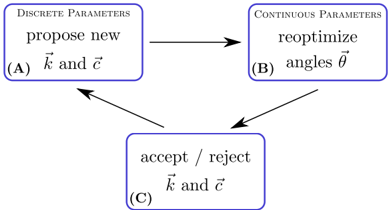
“The new structure is approved or rejected based on a simulated annealing scheme [7].”
MethodSequential optimal selections of single-qubit gates in parameterized quantum circuits
Wada, K., Raymond, R., Sato, Y., & Watanabe, H. C. (2024) · Quantum Science and Technology · doi:10.1088/2058-9565/ad4583 · Cited by 32
Quantum mean embedding of probability distributions
Kübler, J. M., Muandet, K., & Schölkopf, B. (2019) · Physical Review Research · doi:10.1103/physrevresearch.1.033159 · Cited by 20
A continuous variable Born machine
Čepaitė, I., Coyle, B., & Kashefi, E. (2022) · Quantum Machine Intelligence · doi:10.1007/s42484-022-00063-3 · Cited by 22
“QML has employed PQC’s for several problems, including classification, [4–8], generative modelling, [9–13], and problems in quantum information and computation themselves [14–19].”
MethodDeterministic and Entanglement-Efficient Preparation of Amplitude-Encoded Quantum Registers
Gundlapalli, P., & Lee, J. (2022) · Physical Review Applied · doi:10.1103/physrevapplied.18.024013 · Cited by 21
“While attempts have been made to also optimize the circuit’s topology [12, 17], it is likely that this will only aggravate the severeness of the optimization problem when scaled to larger system sizes.”
BackgroundGarcia‐Buendia, N., Muñoz-Montoro, A. J., Cortina, R., Marín, J. M. M., & Moyano‐Fuentes, J. (2024) · IEEE Access · doi:10.1109/access.2024.3411307 · Cited by 20
“The Quantum-computing theme deals with papers about qubits [35], [60], quantum algorithms [42], [61], quantum circuits [39], [62], quantum information and communication [63], [64], computational complexity [52], [65], etc.”
BackgroundSearch space pruning for quantum architecture search
He, Z., Su, J., Chen, C., Pan, M., & Situ, H. (2022) · The European Physical Journal Plus · doi:10.1140/epjp/s13360-022-02714-7 · Cited by 16
“Current QAS algorithms use different intelligence algorithms to search through the exponentially large space, including simulated annealing algorithms [6,7,25], genetic algorithms [5,27,29,38], reinforcement learning [16,46], differentiable search [44] and meta-learning [15].”
MethodKernel-based quantum regressor models learning non-Markovianity
Tancara, D., Dinani, H. T., Norambuena, A., Fanchini, F. F., & Coto, R. (2023) · Physical Review A · doi:10.1103/physreva.107.022402 · Cited by 15
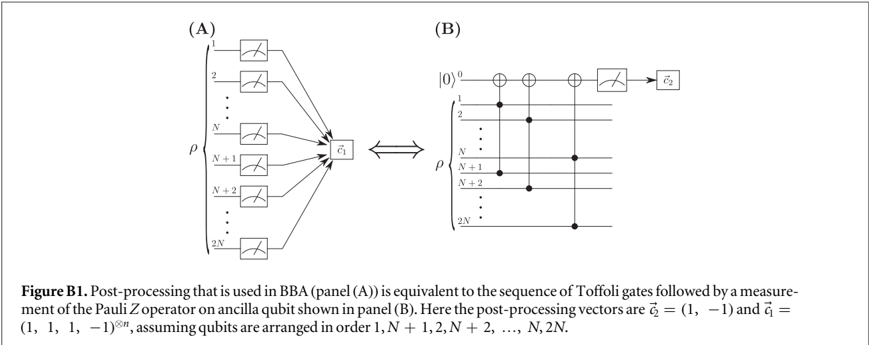
“The Bell-basis algorithm (BBA) considers less resources than the previous one (ABA), but demands Bellbasis measurements on all the system qubits [59].”
BackgroundMethodInfluentialQuantum circuit compilation for nearest-neighbor architecture based on reinforcement learning
Li, Y., Liu, W., Li, M., & Li, Y. (2023) · Quantum Information Processing · doi:10.1007/s11128-023-04050-w · Cited by 18
“[36] presented a machinelearning approach for computing state overlap.”
BackgroundAdaptive projected variational quantum dynamics
Linteau, D., Barison, S., Lindner, N. H., & Carleo, G. (2024) · Physical Review Research · doi:10.1103/physrevresearch.6.023130 · Cited by 18
Evaluation of phase shifts for nonrelativistic elastic scattering using quantum computers
Turro, F., Wendt, K., Quaglioni, S., Pederiva, F., & Roggero, A. (2024) · Physical Review C · doi:10.1103/physrevc.110.054604 · Cited by 23
Quantum partial least squares regression algorithm for multiple correlation problem
Hou, Y., Li, J., Chen, X., & Tian, Y. (2021) · Chinese Physics B · doi:10.1088/1674-1056/ac1b84 · Cited by 11
The battle of clean and dirty qubits in the era of partial error correction
Bultrini, D., Wang, S., Czarnik, P., Gordon, M. H., Cerezo, M., Coles, P. J., & Cincio, Ł. (2023) · Quantum · doi:10.22331/q-2023-07-13-1060 · Cited by 29
“In this section we numerically investigate the behavior of the gradient of a cost function for the Hamiltonian Variational Ansatz (HVA) using both a single-qubit local depolarizing noise model and a model based on a trapped-ion quantum computer [42, 43].”
BackgroundMethodSelf-citationQuantifying the Difference between Many-Body Quantum States
Girolami, D., & Anzà, F. (2021) · Physical Review Letters · doi:10.1103/physrevlett.126.170502 · Cited by 14
Improving the efficiency of learning-based error mitigation
Czarnik, P., McKerns, M. M., Sornborger, A. T., & Cincio, Ł. (2025) · Quantum · doi:10.22331/q-2025-05-05-1727 · Cited by 33
“Finally, circuit compilation methods can be used to reduce noise severity in combination with the error mitigation meth-ods mentioned above [33–37].”
Self-citationEEG-Based Dementia Classification Using CS-EMD Synchrony Features and Quantum Machine Learning
Ho, R., Hung, K., Chui, K. T., Fu, Y., & Wu, H. C. (2025) · IEEE Transactions on Consumer Electronics · doi:10.1109/tce.2025.3548303 · Cited by 13
“In the implementation of this method, two quantum states, | q x (cid:6) and | q x (cid:4) (cid:6) , are prepared on the qubits using amplitude embedding S(x) and S(x’) , and their overlap is measured with a SWAP test [39].”
Faster variational quantum algorithms with quantum kernel-based surrogate models
Smith, A. W. R., Paige, A. J., & Kim, M. S. (2023) · Quantum Science and Technology · doi:10.1088/2058-9565/aceb87 · Cited by 17
TANDEITNIK, D. R., & Guerreiro, T. (2024) · Quantum Information Processing · doi:10.1007/s11128-024-04317-w · Cited by 14
Non-Boolean quantum amplitude amplification and quantum mean estimation
Shyamsundar, P. (2023) · Quantum Information Processing · doi:10.1007/s11128-023-04146-3 · Cited by 26
“Several algorithms [53–55], including the Swap test [44], can be used for estimating this overlap.”
MethodAncilla-free continuous-variable SWAP test
Volkoff, T. J., & Subaşı, Y. (2022) · Quantum · doi:10.22331/q-2022-09-08-800 · Cited by 21
“It was later shown that this version of the SWAP test can be identified by an algorithm that optimizes quantum circuits with respect to depth, in this case two [14].”
BackgroundSelf-citationUnified multivariate trace estimation and quantum error mitigation
Liang, J., Lv, Q.-Q., Wang, Z., & Fei, S.-M. (2023) · Physical Review A · doi:10.1103/physreva.107.012606 · Cited by 14
Quantum Similarity Testing with Convolutional Neural Networks
Wu, Y., Zhu, Y., Bai, G., Wang, Y., & Chiribella, G. (2023) · Physical Review Letters · doi:10.1103/physrevlett.130.210601 · Cited by 28
“[7] Lukasz Cincio, Yiğit Subaşı, Andrew T Sornborger, and”
Cross-platform verification in quantum networks
Knörzer, J., Malz, D., & Cirac, J. I. (2023) · Physical Review A · doi:10.1103/physreva.107.062424 · Cited by 17
“The Bell-basis measurement [28, 29] in Fig.”
BackgroundQuantum density estimation with density matrices: Application to quantum anomaly detection
Useche, D. H., Bustos-Brinez, O. A., Gallego-Mejia, J. A., & Gonzalez, F. A. (2024) · Physical Review A · doi:10.1103/physreva.109.032418 · Cited by 12
“The m CNOT gates have the same depth as a single CNOT, as they can be parallelized in a quantum computer [61].”
BackgroundThompson, N. L., Nguyen, N. H., Behrman, E., & Steck, J. E. (2020) · Quantum Information Processing · doi:10.1007/s11128-020-02877-1 · Cited by 14
“This inherent difficulty is another reason machine learning techniques are enticing [39]: If we can determine methods where the machines themselves develop and refine the algorithms they are using, we circumvent part of this intrinsic challenge of quantum computing.”
BackgroundSupervised graph classification for chiral quantum walks
Kryukov, A., Abramov, R., Fedichkin, L. E., Alodjants, A. P., & Melnikov, A. A. (2022) · Physical Review A · doi:10.1103/physreva.105.022208 · Cited by 9
Swap Test-based characterization of decoherence in universal quantum computers
Ripper, P., do Amaral, G. C., & Temporão, G. P. (2023) · Quantum Information Processing · doi:10.1007/s11128-023-03961-y · Cited by 10
“We also present the outcomes from our research from previous works about the ST [19, 20, 27, 28] followed by shortcomings of this technique.”
BackgroundMethodExploring ab initio machine synthesis of quantum circuits
Meister, R., Gustiani, C., & Benjamin, S. C. (2023) · New Journal of Physics · doi:10.1088/1367-2630/ace077 · Cited by 14
“Dynamic expansion of a given ansatz circuit has been explored by VQE methods [42–44] and in more general contexts [39, 40, 46].”
MethodThe SWITCH test for discriminating quantum evolutions
Chamorro‐Posada, P., & García-Escartín, J. C. (2023) · Journal of Physics A Mathematical and Theoretical · doi:10.1088/1751-8121/acecc5 · Cited by 11
“The circuit in figure 7 shows the destructive SWAP test presented in [34] and later redis-covered by a machine learning algorithm [57].”
The topology of data hides in quantum thermal states
Scali, S., Umeano, C., & Kyriienko, O. (2024) · APL Quantum · doi:10.1063/5.0209201 · Cited by 16
Experimental Direct Quantum Fidelity Learning via a Data-Driven Approach
Qin, H., Che, L., Wei, C., Xu, F., Huang, Y., & Xin, T. (2024) · Physical Review Letters · doi:10.1103/physrevlett.132.190801 · Cited by 17
Parallel-in-time quantum simulation via Page and Wootters quantum time
Diaz, N. L., Braccia, P., Larocca, M., Matera, J. M., Rossignoli, R., & Cerezo, M. (2025) · Physical Review Research · doi:10.1103/wpnf-4nnn · Cited by 19
“The algorithm is based on Bell-basis measurements as described in [45].”
InfluentialMatching Point Sets with Quantum Circuit Learning
Noormandipour, M., & Wang, H. (2022) · IEEE International Conference on Acoustics Speech and Signal Processing · doi:10.1109/icassp43922.2022.9746800 · Cited by 8
Active learning for the optimal design of multinomial classification in physics
Ding, Y., Martín‐Guerrero, J. D., Song, Y., Magdalena‐Benedito, R., & Chen, X. (2022) · Physical Review Research · doi:10.1103/physrevresearch.4.013213 · Cited by 7
Stochastic Approximation of Variational Quantum Imaginary Time Evolution
Gacon, J., Zoufal, C., Carleo, G., & Woerner, S. (2023) · IEEE International Conference on Quantum Computing and Engineering (QCE) · doi:10.1109/qce57702.2023.10367741 · Cited by 21
“…ϵ > 0 is the perturbation magnitude, and with the fidelity There exist a variety of techniques to compute the fidelity F of two quantum states prepared with quantum circuits | ϕ ( θ ) ⟩ and | ϕ ( ω ) ⟩ , such as the Swap Test [17] and variations thereof [18] or randomized measurements [19].”
MethodClassical-Quantum Noise Mitigation for NISQ HardwarePreprint
Shaw, A. (2021) · arXiv (Cornell University) · doi:10.48550/arxiv.2105.08701 · Cited by 12
Quantum-Enhanced Convolutional Neural Networks for Image Classification
Qayyum, T., Tariq, A., Haseeb, M. W., Lakas, A., Serhani, M. A., & Trabelsi, Z. (2023) · IEEE Future Networks World Forum (FNWF) · doi:10.1109/fnwf58287.2023.10520509 · Cited by 8
“Wang et al. [16] proposed a quantum-inspired regularization method for classical CNNs. Cincio et al. [17] extended these ideas to the quantum domain, showing that QCNNs can potentially mitigate overfitting by leveraging quantum regularization techniques.”
MethodQuantum classifiers with a trainable kernel
Xu, L., Zhang, X., Li, M., & Shen, S.-Q. (2024) · Physical Review Applied · doi:10.1103/physrevapplied.21.054056 · Cited by 17
A partial least squares regression model based on variational quantum algorithm
Hou, Y., Li, J., Chen, X., & Ye, C. (2022) · Laser Physics Letters · doi:10.1088/1612-202x/ac81b6 · Cited by 6
“Then, U 1 is employed to compute the Hilbert–Schmidt inner products between ρ 0 A and | e 1 ⟩ and between ρ 0 B and | e ′ 1 ⟩ , which can be implemented by Bell-basis measurement method [7].”
QuYBE - An Algebraic Compiler for Quantum Circuit Compression
Gulania, S., He, Z., Peng, B., Govind, N., & Alexeev, Y. (2022) · IEEE/ACM Symposium on Edge Computing (SEC) · doi:10.1109/sec54971.2022.00060 · Cited by 7
Dynamic full quantum one-way function based on quantum circuit mapping
Tang, Y., Shang, T., & Liu, J. (2023) · Quantum Information Processing · doi:10.1007/s11128-023-04065-3 · Cited by 6
“Besides, there are more precise estimation algorithms of the overlap based on the collective measurement [28], quantum mean estimation [29] or machine learning [30].”
MethodQuantum algorithm for smoothed particle hydrodynamics
Au-Yeung, R., Williams, A. J., Kendon, V. M., & Lind, S. (2023) · Computer Physics Communications · doi:10.1016/j.cpc.2023.108909 · Cited by 14
“Therefore we load data into quantum computers by encoding it into the qubit state There is no broad consensus on how best to encode classical data into qubits before loading into a quantum random access memory (QRAM)”
Energy Risk Analysis With Dynamic Amplitude Estimation and Piecewise Approximate Quantum Compiling
Ghosh, K., Yogaraj, K., Agliardi, G., Sabino, P., Fernández-Campoamor, M., Bernabé-Moreno, J., Cortiana, G., Shehab, O., & O’Meara, C. (2024) · IEEE Transactions on Quantum Engineering · doi:10.1109/tqe.2024.3425969 · Cited by 11
Simple Mitigation Strategy for a Systematic Gate Error in IBMQ
Bultrini, D., Gordon, M. H., López, E., & Sierra, G. (2021) · Journal of Applied Mathematics and Physics · doi:10.4236/jamp.2021.96083 · Cited by 11
“There are many distinct approaches towards this goal, with two common methods being: optimizing quantum circuits through compilation and machine learning [6] [7] [8] and classical post-processing.”
MethodNeural network agent playing spin Hamiltonian games on a quantum computer
Sotnikov, O. M., & Mazurenko, V. V. (2020) · Journal of Physics A Mathematical and Theoretical · doi:10.1088/1751-8121/ab73ad · Cited by 6
NEURAL NETWORK AGENT PLAYING SPIN HAMILTONIAN GAMES ON A QUANTUM COMPUTER
Sotnikov, O. M., & Mazurenko, V. V. (2020) · Electronic Archive of Ural Federal University (ELAR UrFU) · Cited by 6
Decompositions of multiple controlled- Z gates on various qubit-coupling graphs
Nakanishi, K. M., Satoh, T., & Todo, S. (2024) · Physical Review A · doi:10.1103/physreva.110.012604 · Cited by 8
Variational estimation of capacity bounds for quantum channels
Rehman, J. U., Hong, S., Kim, Y., & Shin, H. (2022) · Physical Review A · doi:10.1103/physreva.105.032616 · Cited by 5
Sketching the Best Approximate Quantum Compiling Problem
Madden, L., Akhriev, A., & Simonetto, A. (2022) · IEEE International Conference on Quantum Computing and Engineering (QCE) · doi:10.1109/qce53715.2022.00071 · Cited by 11
“Works for the best approximate quantum compilation problems appeared in the literature as [11]–[17].”
BackgroundQuantum computing fidelity susceptibility using automatic differentiation
Matteo, O. D., & Woloshyn, R. M. (2022) · Physical Review A · doi:10.1103/physreva.106.052429 · Cited by 11
Benchmarking Adaptative Variational Quantum Algorithms on QUBO Instances
Turati, G., Dacrema, M. F., & Cremonesi, P. (2023) · IEEE International Conference on Quantum Computing and Engineering (QCE) · doi:10.1109/qce57702.2023.00053 · Cited by 11
“Other Adaptative VQAs are based on a genetic approach [8]–[10], while others develop variational ansatzes using Machine Learning techniques [11], [12].”
Hernandez, R. O., Champagne, B. R., & Soldera, A. (2024) · The Journal of Physical Chemistry A · doi:10.1021/acs.jpca.4c01234 · Cited by 6
Quantum topological data analysis via the estimation of the density of states
Scali, S., Umeano, C., & Kyriienko, O. (2024) · Physical Review A · doi:10.1103/physreva.110.042616 · Cited by 16
Application of large language models to quantum state simulation
Zhou, S., Chen, R., An, Z., Zhang, C., & Hou, S. (2025) · Science China Physics Mechanics and Astronomy · doi:10.1007/s11433-024-2598-y · Cited by 18
Optimal quantum state transformations based on machine learning
Zhao, T.-H., Wang, M., & Zhou, B. (2021) · Quantum Information Processing · doi:10.1007/s11128-021-03148-3 · Cited by 7
Calculation of Gibbs partition function with imaginary time evolution on near-term quantum computers
Matsumoto, K. T., Shingu, Y., Endo, S., Kawabata, S., Watabe, S., Nikuni, T., Hakoshima, H., & Matsuzaki, Y. (2022) · Japanese Journal of Applied Physics · doi:10.35848/1347-4065/ac5152 · Cited by 10
Optimizing the walk coin in the quantum random walk search algorithm through machine learningPreprint
Tonchev, H., & Danev, P. (2021) · arXiv (Cornell University) · doi:10.48550/arxiv.2105.08020 · Cited by 6
“Examples of quantum algorithms designed in this way are the quantum algorithm for solving inhomogeneous linear partial differential equations [60], Deutsch–Jozsa algorithm with oracle constructed by supervise learning [61], the quantum error correction algorithm [62], and so on.”
MethodEnhancement of radial basis function model via quantum kernel estimation
Zhou, X., Zhang, M., Cui, Q., & Jiang, T. (2025) · Journal of Mathematical Analysis and Applications · doi:10.1016/j.jmaa.2025.129254 · Cited by 6
Li, X., Feng, F., Zhang, J., Liu, J., Xue, J., Li, M., Liu, W., & Zhang, Q. (2025) · IEEE Transactions on Microwave Theory and Techniques · doi:10.1109/tmtt.2025.3619571 · Cited by 5
“However, some quantum algorithms can access the probability of real and imaginary parts of quantum states through multiple measurements and many controlled operators, i.e., Hadamard test and Hadamard-overlap test [32], [33].”
Emerging Paradigm of Quantum Machine Learning: Knowledge Insights and Future Prospects
Rawat, K. S., & Sharma, T. K. (2026) · IEEE Transactions on Artificial Intelligence · doi:10.1109/tai.2026.3669545 · Cited by 7
“Promising strategies include HQCL frameworks, low-depth circuits, parallel architectures, hybrid encodings, and improved state initialization [95], [132].”
Hernandez, R. O., Soldera, A., & Champagne, B. R. (2024) · The Journal of Physical Chemistry A · doi:10.1021/acs.jpca.4c06960 · Cited by 4
Experimental benchmarking of quantum state overlap estimation strategies with photonic systems
Zhan, H., Wang, B., Mi, M., Xie, J., Xu, L., Zhang, A., & Zhang, L. (2025) · Light Science & Applications · doi:10.1038/s41377-025-01755-8 · Cited by 8
“There have been efforts to further improve the implementation of the swap test through variational quantum approaches to fi nd shorter-depth algorithms 38 , as well as to estimate both the amplitude and phase of the inner product h ψ j ϕ i 39 .”
Predicting properties of quantum systems by regression on a quantum computer
Kardashin, A., Balkybek, Y., Palyulin, V. V., & Antipin, K. V. (2025) · Physical Review Research · doi:10.1103/physrevresearch.7.013201 · Cited by 6
“Additionally, one can apply QML for simulating the dynamics of ∗ andrey.kardashin@skoltech.ru quantum systems [49], detecting and classifying entan-glement in quantum states [50, 51], and even discovering quantum algorithms [52] as well as error correction codes [53].”
Quantum Orbital Minimization Method for Excited States Calculation on a Quantum Computer
Bierman, J., Li, Y., & Lu, J. (2022) · Journal of Chemical Theory and Computation · doi:10.1021/acs.jctc.2c00218 · Cited by 12
A quantum scheme of state overlap based on quantum mean estimation and support vector machine
Liu, W., & Yin, H.-W. (2022) · Physica A Statistical Mechanics and its Applications · doi:10.1016/j.physa.2022.128117 · Cited by 6
Metadata
- Authors
- Cincio, L., Subaşı, Y., Sornborger, A. T., & Coles, P. J.
- Affiliations
- Los Alamos National Laboratory (US)
- Corresponding author
- Cincio, Lukasz
- ORCID
- Subaşı, Yiğit
- Venue
- New Journal of Physics
- Publisher
- IOP Publishing
- Published
- 2018-11-15
- Volume
- 20
- Issue
- 11
- Pages
- 113022
- ISSN
- 1367-2630 (ISSN-L)
- OpenAlex
- W2790264742
- Cited by
- 282
- References
- 24
- Citations by year
- 2026: 20 · 2025: 26 · 2024: 38 · 2023: 60 · 2022: 40 · 2021: 47 · 2020: 22 · 2019: 25 · 2018: 4
- FWCI
- 13.81
- Type
- journal article
- Language
- en
- Open access
- gold
- doi.org
- Licence
- cc-by
- iopscience.iop.org/info/page/text-and-data-mining (tdm)
- creativecommons.org/licenses/by/3.0/ (vor)
- Locations
- New Journal of Physics (publishedVersion, cc-by)
- arXiv (Cornell University) (submittedVersion)
- DOAJ (DOAJ: Directory of Open Access Journals) (submittedVersion)
- OSTI OAI (U.S. Department of Energy Office of Scientific and Technical Information) (submittedVersion)
- arXiv (Cornell University)
- Funders
- U.S. Department of Energy (J. Robert Oppenheimer fellowship)
- Los Alamos National Laboratory (Beyond Moore’s Law project, LDRD program)
- Topics
- Physical Sciences › Computer Science › Artificial Intelligence › Quantum Computing Algorithms and Architecture
- Physical Sciences › Physics and Astronomy › Atomic and Molecular Physics, and Optics › Quantum Information and Cryptography
- Physical Sciences › Physics and Astronomy › Atomic and Molecular Physics, and Optics › Quantum many-body systems
- Keywords
- swap test, quantum support vector machine, near-term quantum devices, gate infidelity, decoherence
About these checks
Registry, retraction, Cites and statistics results are computed, not judged, with one exception: a printed reference that no index lists is read once by a model before it counts as a citation error. Claims are extracted by a model and kept only when their quote appears verbatim in the text; each cited source is then checked, with a model’s help, for whether it says what the claim relies on. Those verdicts can be wrong — read the claim’s quote and the cited source before relying on one.
Statistics and arithmetic are recomputed, not judged.
Confidence bands are shown only for fields calibrated on our annotated test set. None is calibrated yet, so no band is shown.
What counts as a claim ›How we measure confidence ›How we check this ›
Are you an author, or do you see a problem with this page? Request a review
Data sources
Bibliographic data: Semantic Scholar, OpenAlex, Crossref.
Contains information from the Semantic Scholar Academic Graph Datasets, made available under the ODC Attribution License (ODC-BY 1.0).
Semantic Scholar’s data is described in: Kinney, R., et al. (2023). The Semantic Scholar Open Data Platform. arXiv:2301.10140.
