

Learning the quantum algorithm for state overlap
Open accessThe DOI matches its Crossref record; 29 of the 30 references it cites were found in a registry or an index.
Abstract
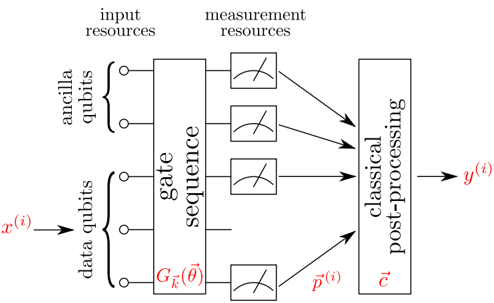
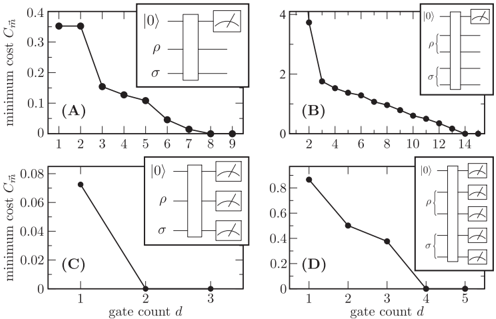
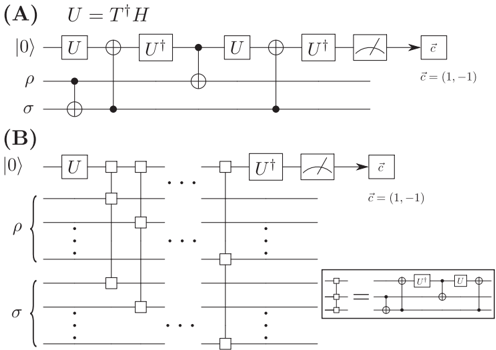
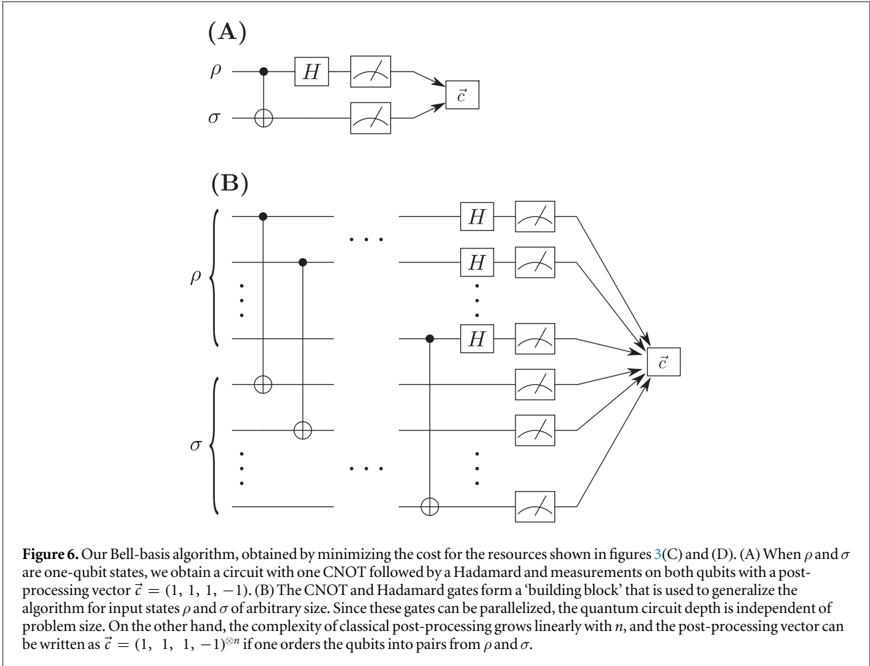
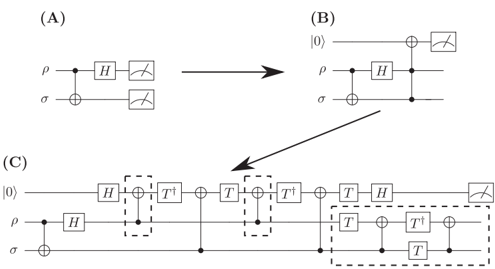
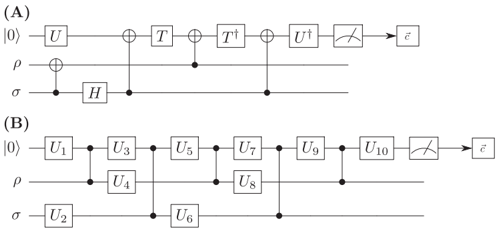
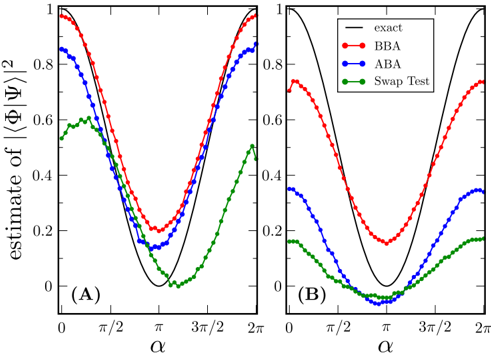
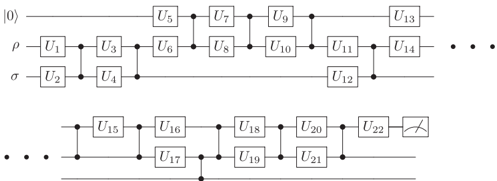
Short-depth algorithms are crucial for reducing computational error on near-term quantum computers, for which decoherence and gate infidelity remain important issues. Here we present a machine-learning approach for discovering such algorithms. We apply our method to a ubiquitous primitive: computing the overlap between two quantum states ρ and σ . The standard algorithm for this task, known as the Swap Test, is used in many applications such as quantum support vector machines, and, when specialized to ρ = σ , quantifies the Renyi entanglement. Here, we find algorithms that have shorter depths than the Swap Test, including one that has a constant depth (independent of problem size). Furthermore, we apply our approach to the hardware-specific connectivity and gate sets used by Rigetti's and IBM's quantum computers and demonstrate that the shorter algorithms that we derive significantly reduce the error—compared to the Swap Test—on these computers.
Overview
The claims and statistics of this paper haven’t been checked yet.
Free: it reads the open-access text and checks the first 5 claims that cite a source we can check. Create a free account to check every claim.
Integrity signals
Registry
Cites
Statistics
Figures
Verification
Claims the paper makes
The claims and statistics of this paper haven’t been checked yet.
Free: it reads the open-access text and checks the first 5 claims that cite a source we can check. Create a free account to check every claim.
Self-check
Percentages, sums and reported differences re-computed from the paper’s own numbers.
The self-check needs the paper’s full text.
Citations
Cites
Surface codes: Towards practical large-scale quantum computation
Fowler, A. G., Mariantoni, M., Martinis, J. M., & Cleland, A. N. (2012) · Physical Review A · doi:10.1103/physreva.86.032324 · Cited by 3,059
Quantum Support Vector Machine for Big Data Classification
Rebentrost, P., Mohseni, M., & Lloyd, S. (2014) · Physical Review Letters · doi:10.1103/physrevlett.113.130503 · Cited by 1,951 · cited 1×
“In quantum supervised learning [30, 31], which subsumes quantum support vector machines [32], the Swap Test is used to assign each data vector to a cluster.”
MethodKhaneja, N., Reiss, T., Kehlet, C., Schulte-Herbrüggen, T., & Glaser, S. J. (2005) · Journal of Magnetic Resonance · doi:10.1016/j.jmr.2004.11.004 · Cited by 1,854
Mitarai, K., Negoro, M., Kitagawa, M., & Fujii, K. (2018) · Physical Review A · doi:10.1103/physreva.98.032309 · Cited by 1,639 · cited 1×
“The circuit is then trained to perform a given task by tuning these parameters [6, 7].”
MethodBuhrman, H., Cleve, R., Watrous, J., & de Wolf, R. (2001) · Physical Review Letters · doi:10.1103/physrevlett.87.167902 · Cited by 1,190
Quantum algorithms for supervised and unsupervised machine learning
Lloyd, S., Mohseni, M., & Rebentrost, P. (2013) · arXiv · doi:10.48550/arxiv.1307.0411 · Cited by 542 · cited 1×
“In quantum supervised learning [30, 31], which subsumes quantum support vector machines [32], the Swap Test is used to assign each data vector to a cluster.”
MethodA blueprint for demonstrating quantum supremacy with superconducting qubits
Neill, C., Roushan, P., Kechedzhi, K., Boixo, S., Isakov, S. V., Smelyanskiy, V., Megrant, A., Chiaro, B., Dunsworth, A., Arya, K., et al. (2018) · Science · doi:10.1126/science.aao4309 · Cited by 458 · cited 1×
“Quantum supremacy [1] may be coming soon [2].”
BackgroundA generative modeling approach for benchmarking and training shallow quantum circuits
Benedetti, M., Garcia-Pintos, D., Perdomo, O., Leyton-Ortega, V., Nam, Y., & Perdomo-Ortiz, A. (2019) · npj Quantum Information · doi:10.1038/s41534-019-0157-8 · Cited by 379 · cited 2×
“This motivates the idea of an automated approach for discovering and optimizing quantum algorithms [6–19].”
MethodOpen Quantum Assembly Language
Cross, A. W., Bishop, L. S., Smolin, J. A., & Gambetta, J. M. (2017) · arXiv · doi:10.48550/arxiv.1707.03429 · Cited by 310 · cited 1×
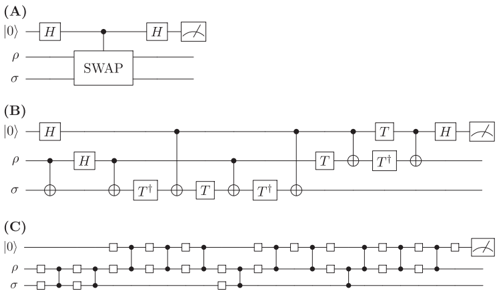
“Figure 2(B) and (C) respectively show decompositions of the Swap Test for IBM’s and Rigetti’s quantum computers [28, 29].”
MethodQuantum computing and the entanglement frontier
Preskill, J. (2012) · arXiv · doi:10.48550/arxiv.1203.5813 · Cited by 308 · cited 1×
“Quantum supremacy [1] may be coming soon [2].”
Background
Research works printed but not linked: 6
- Ball P 2018 The era of quantum computing is here. Outlook: cloudy Quanta Mag. [available at: http://quantamagazine.org/the-era- of-quantum-computing-is-here-outlook-cloudy-20180124/]
- Khatri S et al 2018 Quantum-assisted quantum compiling arXiv:1807.00800 · arXiv
- Hachtel G D and Somenzi F 1996 Logic Synthesis and Verification Algorithms (Boston, MA: Kluwer)
- Linke N M et al 2017 Measuring the Renyi entropy of a two-site Fermi-Hubbard model on a trapped ion quantum computer arXiv:1712.08581 · arXiv
- Smith R S, Curtis M J and Zeng W J 2016 A practical quantum instruction set architecture arXiv:1608.03355 · arXiv
- Wiebe N, Kapoor A and Svore K 2014 Quantum algorithms for nearest-neighbor methods for supervised and unsupervised learning Quantum Inf. Comput. 15 0318-58
Cited by
Items 201–288 of 288
Superresolving collective quantum measurements
de Almeida, J. O., Lewenstein, M., & Skotiniotis, M. (2025) · Physical Review A · doi:10.1103/9w4p-5d9j · Cited by 7
VQ‐Rice: Integrating Variational Quantum Models for Intelligent Rice Disease Classification
Verma, D. S., Mishra, J. K., Kumar, A., Saudagar, A. K. J., & Mahato, S. (2025) · International Journal of Intelligent Systems · doi:10.1155/int/9911441 · Cited by 5
“…Small qubit count (NISQ) Model interpretability [13] Medium Medium Data requirements [14] High Lower (for simple VQCs) Suitability for noisy data [15] Low High (probabilistic resilience) Tis study [26] assessed adiabatic quantum computing (AQC) for neural network compression tasks and evaluated…”
InfluentialLiu, W., Li, Y.-Z., Yin, H.-W., Wang, Z.-R., & Wu, J. (2024) · EPJ Quantum Technology · doi:10.1140/epjqt/s40507-024-00259-5 · Cited by 3
Resource-Efficient Cross-Platform Verification with Modular Superconducting Devices
Dalton, K., Knörzer, J., Hoehne, F., Song, Y., Flasby, A., Zanuz, D. C., Panah, M. B., Besedin, I. S., Besse, J.-C., & Wallraff, A. J. (2025) · PRX Quantum · doi:10.1103/czph-xpzs · Cited by 8
“If quantum information can be shared among the modules A and B , it is possible to perform a SWAP-test [33] or Bell-basis measurements [35, 36] between them to carry out distributed inner product estimation.”
Variational learning the SDC quantum protocol with gradient-based optimization
Situ, H., Huang, Z., Zou, X., & Zheng, S. (2019) · Quantum Information Processing · doi:10.1007/s11128-019-2348-9 · Cited by 3
Implementation of a simultaneous message-passing protocol using optical vortices
Szatkowski, M., Koechlin, J., & Lopez-Mago, D. (2020) · Optics & Laser Technology · doi:10.1016/j.optlastec.2020.106516 · Cited by 3
“Alternatives methods to realize the referee’s task can be found in the references [22, 23, 24].”
BackgroundMethodTowards Quantum Image Processing for Electron Microscopy
dos Reis, R., Dravid, V. P., & Ribet, S. M. (2021) · Microscopy and Microanalysis · doi:10.1017/s1431927621005031 · Cited by 3
Towards solving the BCS Hamiltonian gap in near-term quantum computers
Sá, N., Oliveira, I. S., & Roditi, I. (2022) · Results in Physics · doi:10.1016/j.rinp.2022.106131 · Cited by 8
Dimensionality Reduction with Variational Encoders Based on Subsystem Purification
Selvarajan, R., Sajjan, M., Humble, T. S., & Kais, S. (2023) · Mathematics · doi:10.3390/math11224678 · Cited by 7
“Post-processing of measurements with input as 2 copies of |ρ〉 is used to compute Tr(ρ2) [5]”
MethodImplementing NChooseK on IBM Q Quantum Computer Systems
Khetawat, H., Atrey, A., Li, G., Mueller, F., & Pakin, S. (2019) · Lecture notes in computer science · doi:10.1007/978-3-030-21500-2_13 · Cited by 4
“[3] to find shorter-depth equivalents.”
Deterministic, scalable, and entanglement efficient initialization of arbitrary quantum statesPreprint
Gundlapalli, P., & Lee, J. (2021) · arXiv (Cornell University) · Cited by 3
Variational quantum entanglement classification discrimination
Wang, S., Shen, Y., Liu, X., Zhang, H., & Wang, Y. (2024) · Physica A Statistical Mechanics and its Applications · doi:10.1016/j.physa.2024.129530 · Cited by 4
A linear photonic swap test circuit for quantum kernel estimation
Baldazzi, A., Leone, N., Sanna, M., Azzini, S., & Pavesi, L. (2024) · Quantum Science and Technology · doi:10.1088/2058-9565/ad7be7 · Cited by 8
“Swap test implementations have thus far been realized using superconducting qubits and trapped ions [29, 30].”
ABO3 materials clustering with quantum swap-test algorithm
Naseri, M., Lourenço, M. P., Prasad, V. K., Shukla, R., Naseri, Y., Diaz, G. S., Gaur, D. R., Gusarov, S., & Salahub, D. R. (2025) · Computational Materials Science · doi:10.1016/j.commatsci.2025.114178 · Cited by 3
Using Machine Learning for Quantum Annealing Accuracy Prediction
Barbosa, A., Pelofske, E., Hahn, G., & Djidjev, H. N. (2021) · Algorithms · doi:10.3390/a14060187 · Cited by 15
“For instance, machine learning is employed to help tune the behavior of quantum systems, such as computing the overlap of two quantum states [5], quantum circuit optimization [6,7], or readout of states with higher assignment fidelities under noise conditions [8].”
Emulating the Deutsch-Josza algorithm with an inverse-designed terahertz gradient-index lens
Blackwell, A. N., Yahiaoui, R., Chen, Y.-H., Chen, P., Searles, T. A., & Chase, Z. (2023) · Optics Express · doi:10.1364/oe.495919 · Cited by 3
Attraction domain analysis for steady states of Markovian open quantum systems
Zhang, S., & Zhang, G. (2023) · Automatica · doi:10.1016/j.automatica.2023.111263 · Cited by 2
Quantum kernels for classifying dynamical singularities in a multiqubit system
Tancara, D., Fredes, J., & Norambuena, A. (2024) · Quantum Science and Technology · doi:10.1088/2058-9565/ad5228 · Cited by 2
Li, C.-T., & Cheng, H. (2025) · Quantum Science and Technology · doi:10.1088/2058-9565/adaede · Cited by 8
Computable Model-Independent Bounds for Adversarial Quantum Machine Learning
Li, B., Alpcan, T., Thapa, C., & Parampalli, U. (2025) · IEEE Transactions on Quantum Engineering · doi:10.1109/tqe.2025.3569922 · Cited by 8
“In addition, when estimating the bound for the quantum perturbation attack we have proposed, the pairwise trace distance can be inferred from a swap test [75] or an overlap estimation algorithm [76], [77].”
Space-time trade-off in networked virtual distillation
Araki, T., Goodwin, J. F., & Koczor, B. (2025) · Physical Review A · doi:10.1103/t828-wvgl · Cited by 5
“While this is its traditional non-destructive implementation, it is known that the swap test can also be performed destructively as in Figure 9f, where the ancilla qubit is removed and the C-SWAP gate is replaced by a BSM [58, 59].”
Koide‐Majima, N., & Majima, K. (2021) · Physical Review A · doi:10.1103/physreva.104.062411 · Cited by 4
Variational quantum semi-supervised classifier based on label propagation
Hou, Y.-Y., Li, J., Chen, X., & Ye, C. (2023) · Chinese Physics B · doi:10.1088/1674-1056/acb9fb · Cited by 3
The Role of Initial Entanglement in Adaptive Gibbs State Preparation on Quantum Computers
Economou, S. E., Warren, A., & Barnes, E. (2023) · IEEE International Conference on Acoustics Speech and Signal Processing · doi:10.1109/icassp49357.2023.10094697 · Cited by 7
“Instead, it relies only on the ability to measure an observable of the data system and the state purity, which can be measured using e.g. the SWAP test [16, 17, 18, 19, 12].”
MethodAdversarial training of quantum Born machinePreprint
Situ, H., He, Z., Li, L., & Zheng, S. (2018) · arXiv (Cornell University) · Cited by 4
Quantum fidelity kernel with a trapped-ion simulation platform
Martínez‐Peña, R., Soriano, M. C., & Zambrini, R. (2024) · Physical Review A · doi:10.1103/physreva.109.042612 · Cited by 2
“Classical machine learning techniques can help here [58, 59], and full tomography allows us to obtain the quantum kernel as well [60].”
BackgroundFinding eigenvectors with a quantum variational algorithm
García-Escartín, J. C. (2024) · Quantum Information Processing · doi:10.1007/s11128-024-04461-3 · Cited by 3
“This is the destructive SWAP test explained in [19], which was later rediscovered by an AI driven search [20].”
Improving Gaussian process with quantum kernel estimation
Zhou, X., Cui, Q., Zhang, M., & Jiang, T. (2025) · Quantum Information Processing · doi:10.1007/s11128-024-04642-0 · Cited by 1
“…quantum (NISQ) computers [46, 47] in the realm of ML. QKE method focuses solely on estimating the inner products between quantum states, namely the quantum kernel and the usual method of estimating the fidelity between two states is by using the swap test [48, 49] and inversion test [38].”
Quantum network-based prediction of cancer driver genes
Marques, P., Wichert, A., Magano, D., & Coutinho, B. C. (2026) · Physical Review A · doi:10.1103/lrw9-cvbh · Cited by 1
Hamiltonian expressibility for ansatz selection in variational quantum algorithms
Brozzi, F., Turati, G., Dacrema, M. F., Caruso, F., & Cremonesi, P. (2026) · Quantum Machine Intelligence · doi:10.1007/s42484-026-00407-3 · Cited by 4
“…2019; Tang et al. 2021; Yordanov et al. 2021; Feniou et al. 2023; Zhu et al. 2022; Rat-tew et al. 2020; Chivilikhin et al. 2020; Heras et al. 2016; Cincio et al. 2018; Du et al. 2022a; Bilkis et al. 2023; Ostaszewski et al. 2021a), as well as reinforcement learning-based techniques (Kuo et al.…”
Gravitational-wave matched filtering on a quantum computer
Veske, D., Tüysüz, C., Amico, M., Bronn, N. T., Lanes, O., Bartos, I., Márka, Z., Will, S., & Márka, S. (2024) · Physica Scripta · doi:10.1088/1402-4896/ad579f · Cited by 2
Quantum transfer component analysis for domain adaptationPreprint
He, X., Lyu, C., Hsieh, M.-H., & Wang, X. (2019) · arXiv (Cornell University) · doi:10.48550/arxiv.1912.09113 · Cited by 3
“[49] L.”
A Parameterised Quantum Circuit Approach to Point Set Matching.Preprint
Noormandipour, M., & Wang, H. (2021) · arXiv (Cornell University) · Cited by 1
Probing many-body localization by excited-state VQEPreprint
Liu, S., Zhang, S., Hsieh, C., Zhang, S., & Yao, H. (2021) · arXiv (Cornell University) · doi:10.48550/arxiv.2111.13719 · Cited by 1
Manenti, R., & Motta, M. (2023) · Oxford University Press eBooks · doi:10.1093/oso/9780198787488.005.0003 · Cited by 1
Silva, M. P. D., & Johnson, B. (2019)
Quantum Algorithms with Applications to Simulating Physical Systems
Chowdhury, A. C. N. (2019) · UNM’s Digital Repository (University of New Mexico)
On the Theory of Modern Quantum Algorithms.Preprint
Biamonte, J. (2020) · arXiv (Cornell University)
Experimental pairwise entanglement estimation for an N-qubit systemPreprint
Behrman, E., Thompson, N., Nguyen, N., & Steck, J. E. (2019) · doi:10.36227/techrxiv.11398401
Experimental pairwise entanglement estimation for an N-qubit systemPreprint
Behrman, E., Thompson, N., Nguyen, N., & Steck, J. E. (2019) · doi:10.36227/techrxiv.11398401.v1
EVOLVING QUANTUM ERROR CORRECTION CODES
TANDEITNIK, D. R. (2022) · doi:10.17771/pucrio.acad.59800
A family of unitaries for the quantum period finding algorithm
Francis, J. G., & Shaji, A. (2023) · Quantum Information Processing · doi:10.1007/s11128-023-04079-x
“Lukaz et al [7] demonstrate a machine learning approach to discovering short-depth algorithms for reducing computational errors on near term quantum computers.”
BackgroundManenti, R., & Motta, M. (2023) · Oxford University Press eBooks · doi:10.1093/oso/9780198787488.003.0006
Microwave resonators for superconducting devices
Manenti, R., & Motta, M. (2023) · Oxford University Press eBooks · doi:10.1093/oso/9780198787488.003.0013
(2023) · Oxford University Press eBooks · doi:10.1093/oso/9780198787488.002.0003
The rotating wave approximation
Manenti, R., & Motta, M. (2023) · Oxford University Press eBooks · doi:10.1093/oso/9780198787488.005.0001
Manenti, R., & Motta, M. (2023) · Oxford University Press eBooks · doi:10.1093/oso/9780198787488.003.0004
Manenti, R., & Motta, M. (2023) · Oxford University Press eBooks · doi:10.1093/oso/9780198787488.003.0007
Quantum simulation of Hamiltonian eigenstates
Manenti, R., & Motta, M. (2023) · Oxford University Press eBooks · doi:10.1093/oso/9780198787488.003.0012
Manenti, R., & Motta, M. (2023) · Oxford University Press eBooks · doi:10.1093/oso/9780198787488.003.0002
Quantum simulation of Hamiltonian dynamics
Manenti, R., & Motta, M. (2023) · Oxford University Press eBooks · doi:10.1093/oso/9780198787488.003.0011
Manenti, R., & Motta, M. (2023) · Oxford University Press eBooks · doi:10.1093/oso/9780198787488.003.0009
The molecular Hamiltonian in second quantization
Manenti, R., & Motta, M. (2023) · Oxford University Press eBooks · doi:10.1093/oso/9780198787488.005.0004
Manenti, R., & Motta, M. (2023) · Oxford University Press eBooks · doi:10.1093/oso/9780198787488.003.0005
Manenti, R., & Motta, M. (2023) · Oxford University Press eBooks · doi:10.1093/oso/9780198787488.003.0008
Oblivious amplitude amplification lemma
Manenti, R., & Motta, M. (2023) · Oxford University Press eBooks · doi:10.1093/oso/9780198787488.005.0005
Manenti, R., & Motta, M. (2023) · Oxford University Press eBooks · doi:10.1093/oso/9780198787488.005.0006
Manenti, R., & Motta, M. (2023) · Oxford University Press eBooks · doi:10.1093/oso/9780198787488.003.0003
Manenti, R., & Motta, M. (2023) · Oxford University Press eBooks · doi:10.1093/oso/9780198787488.003.0001
Manenti, R., & Motta, M. (2023) · Oxford University Press eBooks · doi:10.1093/oso/9780198787488.003.0014
(2023) · Oxford University Press eBooks · doi:10.1093/oso/9780198787488.002.0005
(2023) · Oxford University Press eBooks · doi:10.1093/oso/9780198787488.002.0004
Manenti, R., & Motta, M. (2023) · Oxford University Press eBooks · doi:10.1093/oso/9780198787488.003.0010
MVITA, M. J., Zulu, N. G., Thethwayo, B., & Makhamisa, S. (2023) · International Conference on Industrial Engineering and Operations Management (IEOM) · doi:10.46254/eu6.20230207
Shang, T. (2024) · Springer eBooks · doi:10.1007/978-981-97-6722-9_8
Scalable quantum dynamics compilation via quantum machine learning
Zhang, Y., Wiersema, R., Carrasquilla, J., Cincio, Ł., & Kim, Y. B. (2026) · Physical Review Research · doi:10.1103/wswv-nq6d · Cited by 25
Learning complexity gradually in quantum machine learning models
Recio-Armengol, E., Schreiber, F. J., Eisert, J., & Bravo-Prieto, C. (2026) · Physical Review Research · doi:10.1103/wnlr-q9xd · Cited by 4
“One possible direction is to extend these methods to tasks beyond quantum phase recognition, such as unitary learning [45, 64–67] or quantum error correction [56, 68].”
Nonunitary Gates Using Measurements Only
Azses, D., Ruhman, J., & Sela, E. (2024) · Physical Review Letters · doi:10.1103/physrevlett.133.260603 · Cited by 7
“To measure this quantity on reduced density matrices one usually uses the so-called SWAP test [50, 51].”
Variational Optical Phase Learning on a Continuous-Variable Quantum Compiler
Feldman, M. A., Volkoff, T. J., Hong, S., Marvinney, C. E., Holmes, Z., Pooser, R. C., Sornborger, A. T., & Marino, A. M. (2026) · PRX Quantum · doi:10.1103/7l8z-zn2m
Self-citationA geometric quantum speed limit: Theoretical insights and photonic implementation
Wang, Q., Wang, B., Wang, J., & Zhang, L. (2025) · Science China Physics Mechanics and Astronomy · doi:10.1007/s11433-025-2691-9
Tools to Design Algorithms for Implementing Control Over Quantum Computers
Narasimhan, S., Halloun, J. A., Nieman, K., & Durand, H. (2025) · Proceedings of the ... American Control Conference/Proceedings of the American Control Conference · doi:10.23919/acc63710.2025.11107665
“Drawing inspiration from [7], we discuss an optimization-based approach to circuit design from a controller safety enhancement perspective.”
InfluentialCondition for the generation of the secret key in a BB84 like quantum key distribution protocol
Jain, R., & Adhikari, S. (2026) · The European Physical Journal D · doi:10.1140/epjd/s10053-026-01215-x
Exploring Quantum Weight Enumerators From the n -Qubit Parallelized SWAP Test
Shi, F., Guo, K., Zhang, X., & Zhao, Q. (2025) · IEEE Transactions on Information Theory · doi:10.1109/tit.2025.3634135 · Cited by 2
“The overlap between two n -partite states ρ and σ , i.e., Tr( ρσ ) can be computed from the standard SWAP test [29], [30], [31], [32], [33], [34].”
InfluentialImaginary time spectral transforms for excited-state preparation
Millar, D. A., Anderson, L. W., Altamura, E., Wallis, O., Sahin, M., Crain, J. N., & Thomson, S. J. (2026) · Physical Review Research · doi:10.1103/v4rc-gmcx · Cited by 2
“…a quantum computer; however, we found the Hilbert-Schmidt distance to be significantly more numerically stable than all alternatives we tested: We have thus traded the problematic matrix inverse for a variational update step that can be performed classically or on near-term quantum hardware [31,32].”
Dai, J., Vidwans, A., Wan, E. H., Miller, A. X., & Soley, M. B. (2026) · Journal of Chemical Theory and Computation · doi:10.1021/acs.jctc.5c01939 · Cited by 1
Hernández, R., Soldera, A., & Champagne, B. R. (2025) · Physical Chemistry Chemical Physics · doi:10.1039/d5cp03805g
Quantum-Enhanced Facial Biometrics: A Hybrid Framework with Post-Quantum Security
Singh, S., Thakur, A., Hasan, M., & Bhatia, G. S. (2025) · Quantum Reports · doi:10.3390/quantum7040064
“The SWAP test has been widely used in quantum information processing since its early formulation in fingerprinting protocols [26], and more recent work has analyzed and optimized its use in state-overlap evaluation and learning algorithms [27].”
Digital Quantum Simulation of Wavepacket Correlations in a Chemical Reaction
Mohtashim, S. I., & Kais, S. (2026) · Entropy · doi:10.3390/e28020144
Multipartite entanglement measure: genuine to absolutely maximally entangled
Rahul, V., & Aravinda, S. (2026) · Quantum Information Processing · doi:10.1007/s11128-026-05141-0 · Cited by 1
Variational compilation of native gates for efficient trapped-ion Hamiltonian simulation
Wang, P., Li, C. Z., Shi, H., & Chen, P. (2026) · Chinese Physics B · doi:10.1088/1674-1056/ae6b33
Mahanta, A., Kaur, J., Kumar, K. S., & Jain, M. (2026) · International Conference on Smart Electronic Devices and Intelligent Systems (ICSEDIS) · doi:10.1109/icsedis68157.2026.11518232
“…QGL and variational quantum circuit (VQC) methods are mostly based on the assumption of error-free implementation and neglect thermodynamic expenses and cause barren plateaus, loss of gradients, and noise-driven optimization instability on NISQ devices (McClean et al., 2018), (Cincio et al., 2018).”
Quantum Circuit Transpilation: A Comprehensive Overview
Karmakar, D., Chatterjee, K., & Kole, D. K. (2026) · Lecture notes in networks and systems · doi:10.1007/978-981-95-0497-8_43
Training the classification capability of large-scale quantum cellular automata
Boneberg, M., Kochsiek, S., Perfetto, G., & Lesanovsky, I. (2026) · Physical Review A · doi:10.1103/gds1-9vhy · Cited by 2
Information processing in quantum thermodynamic systems: An autonomous Hamiltonian approach
Anonymous, Doucet, E., Touil, A., Deffner, S., & Sone, A. (2026) · Physical review. E · doi:10.1103/rwkz-dc5z · Cited by 2
“For instance, when p = 2 , the corresponding Hilbert–Schmidt distance can be efficiently obtained via the SWAP test by computing the state overlap [105]; therefore, the quantity based on the Schatten p -norm can be both numerically tractable and experimentally implementable.”
Mercadier, M. (2026) · SSRN Electronic Journal · doi:10.2139/ssrn.7273323
Vedhanth, M., Mahadevi, S., & Kumar, A. G. (2026) · IEEE Access · doi:10.1109/access.2026.3742327
“In parallel, the practical necessity of deploying VQAs on hardware-constrained quantum processors has motivated a growing body of work on quantum circuit compression – reducing the number of parameterized rotation gates while preserving circuit functionality [10], [11].”
Learning Shallow Quantum Circuits
Huang, H.-Y., Liu, Y., Broughton, M., Kim, I., Anshu, A., Landau, Z. A., & McClean, J. R. (2026) · SIAM Journal on Computing · doi:10.1137/24m1689946
Noise-Aware Quantum Kernel-Based Streaming Anomaly Detection Under Concept Drift for Sensor Data
Purushothaman, R., Shanbhag, J., Keshava, R., Elengovan, A. K., & Parikh, M. (2026) · International Conference on Intelligent Systems and Artificial Intelligence Applications (ISAA) · doi:10.1109/isaa67392.2026.11726391
“Some more current works started to reveal the negative impact of quantum noise and barren plateaus on learning performance [21], [22].”
Metadata
- Authors
- Cincio, L., Subaşı, Y., Sornborger, A. T., & Coles, P. J.
- Affiliations
- Los Alamos National Laboratory (US)
- Corresponding author
- Cincio, Lukasz
- ORCID
- Subaşı, Yiğit
- Venue
- New Journal of Physics
- Publisher
- IOP Publishing
- Published
- 2018-11-15
- Volume
- 20
- Issue
- 11
- Pages
- 113022
- ISSN
- 1367-2630 (ISSN-L)
- OpenAlex
- W2790264742
- Cited by
- 282
- References
- 24
- Citations by year
- 2026: 20 · 2025: 26 · 2024: 38 · 2023: 60 · 2022: 40 · 2021: 47 · 2020: 22 · 2019: 25 · 2018: 4
- FWCI
- 13.81
- Type
- journal article
- Language
- en
- Open access
- gold
- doi.org
- Licence
- cc-by
- iopscience.iop.org/info/page/text-and-data-mining (tdm)
- creativecommons.org/licenses/by/3.0/ (vor)
- Locations
- New Journal of Physics (publishedVersion, cc-by)
- arXiv (Cornell University) (submittedVersion)
- DOAJ (DOAJ: Directory of Open Access Journals) (submittedVersion)
- OSTI OAI (U.S. Department of Energy Office of Scientific and Technical Information) (submittedVersion)
- arXiv (Cornell University)
- Funders
- U.S. Department of Energy (J. Robert Oppenheimer fellowship)
- Los Alamos National Laboratory (Beyond Moore’s Law project, LDRD program)
- Topics
- Physical Sciences › Computer Science › Artificial Intelligence › Quantum Computing Algorithms and Architecture
- Physical Sciences › Physics and Astronomy › Atomic and Molecular Physics, and Optics › Quantum Information and Cryptography
- Physical Sciences › Physics and Astronomy › Atomic and Molecular Physics, and Optics › Quantum many-body systems
- Keywords
- swap test, quantum support vector machine, near-term quantum devices, gate infidelity, decoherence
About these checks
Registry, retraction, Cites and statistics results are computed, not judged, with one exception: a printed reference that no index lists is read once by a model before it counts as a citation error. Claims are extracted by a model and kept only when their quote appears verbatim in the text; each cited source is then checked, with a model’s help, for whether it says what the claim relies on. Those verdicts can be wrong — read the claim’s quote and the cited source before relying on one.
Statistics and arithmetic are recomputed, not judged.
Confidence bands are shown only for fields calibrated on our annotated test set. None is calibrated yet, so no band is shown.
What counts as a claim ›How we measure confidence ›How we check this ›
Are you an author, or do you see a problem with this page? Request a review
Data sources
Bibliographic data: Semantic Scholar, OpenAlex, Crossref.
Contains information from the Semantic Scholar Academic Graph Datasets, made available under the ODC Attribution License (ODC-BY 1.0).
Semantic Scholar’s data is described in: Kinney, R., et al. (2023). The Semantic Scholar Open Data Platform. arXiv:2301.10140.
