

Learning the quantum algorithm for state overlap
Open accessThe DOI matches its Crossref record; 29 of the 30 references it cites were found in a registry or an index.
Abstract
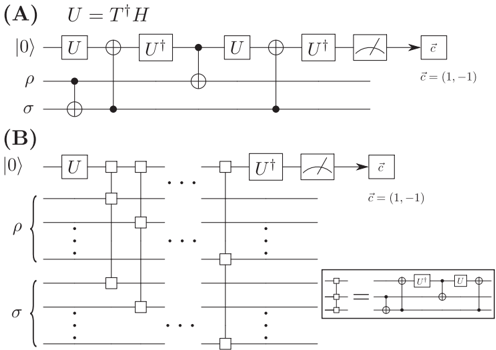
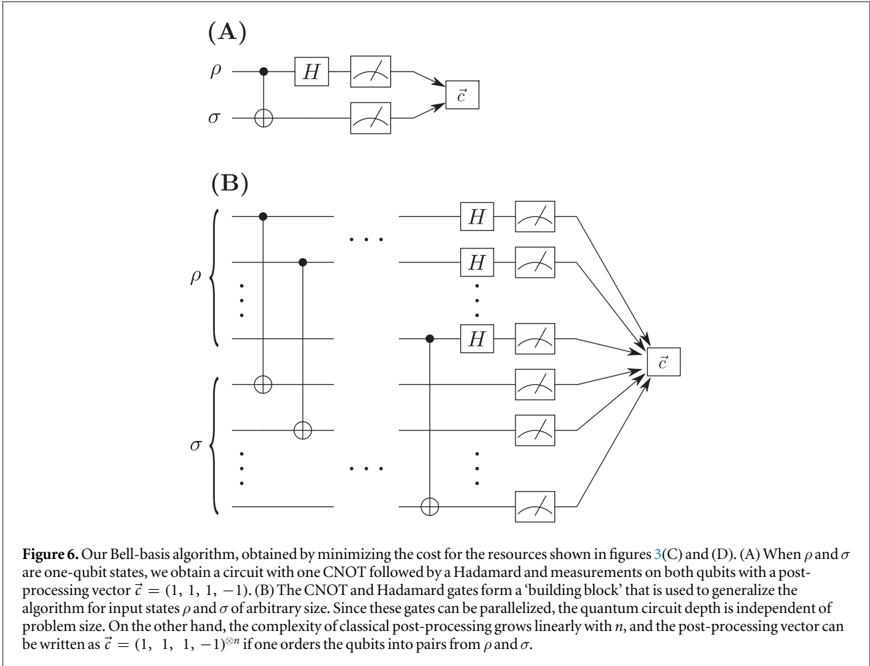
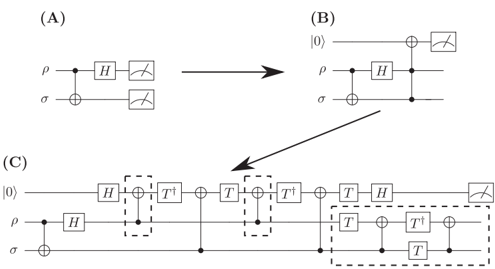
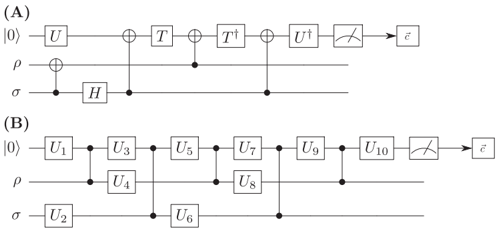
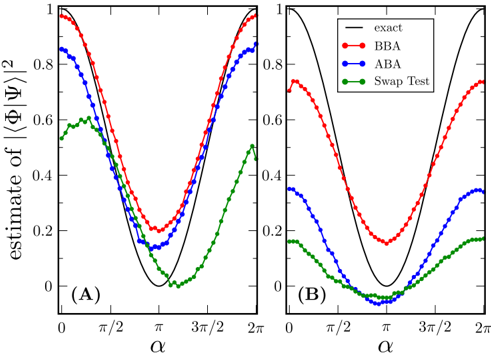
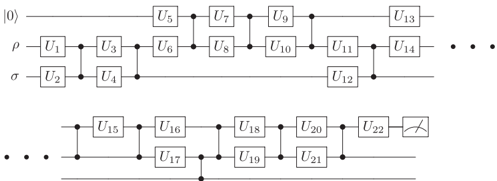
Short-depth algorithms are crucial for reducing computational error on near-term quantum computers, for which decoherence and gate infidelity remain important issues. Here we present a machine-learning approach for discovering such algorithms. We apply our method to a ubiquitous primitive: computing the overlap between two quantum states ρ and σ . The standard algorithm for this task, known as the Swap Test, is used in many applications such as quantum support vector machines, and, when specialized to ρ = σ , quantifies the Renyi entanglement. Here, we find algorithms that have shorter depths than the Swap Test, including one that has a constant depth (independent of problem size). Furthermore, we apply our approach to the hardware-specific connectivity and gate sets used by Rigetti's and IBM's quantum computers and demonstrate that the shorter algorithms that we derive significantly reduce the error—compared to the Swap Test—on these computers.
Overview
The claims and statistics of this paper haven’t been checked yet.
Free: it reads the open-access text and checks the first 5 claims that cite a source we can check. Create a free account to check every claim.
Integrity signals
Registry
Cites
Statistics
Figures
Verification
Claims the paper makes
The claims and statistics of this paper haven’t been checked yet.
Free: it reads the open-access text and checks the first 5 claims that cite a source we can check. Create a free account to check every claim.
Self-check
Percentages, sums and reported differences re-computed from the paper’s own numbers.
The self-check needs the paper’s full text.
Citations
Cites
Surface codes: Towards practical large-scale quantum computation
Fowler, A. G., Mariantoni, M., Martinis, J. M., & Cleland, A. N. (2012) · Physical Review A · doi:10.1103/physreva.86.032324 · Cited by 3,059
Quantum Support Vector Machine for Big Data Classification
Rebentrost, P., Mohseni, M., & Lloyd, S. (2014) · Physical Review Letters · doi:10.1103/physrevlett.113.130503 · Cited by 1,951 · cited 1×
“In quantum supervised learning [30, 31], which subsumes quantum support vector machines [32], the Swap Test is used to assign each data vector to a cluster.”
MethodKhaneja, N., Reiss, T., Kehlet, C., Schulte-Herbrüggen, T., & Glaser, S. J. (2005) · Journal of Magnetic Resonance · doi:10.1016/j.jmr.2004.11.004 · Cited by 1,854
Mitarai, K., Negoro, M., Kitagawa, M., & Fujii, K. (2018) · Physical Review A · doi:10.1103/physreva.98.032309 · Cited by 1,639 · cited 1×
“The circuit is then trained to perform a given task by tuning these parameters [6, 7].”
MethodBuhrman, H., Cleve, R., Watrous, J., & de Wolf, R. (2001) · Physical Review Letters · doi:10.1103/physrevlett.87.167902 · Cited by 1,190
Quantum algorithms for supervised and unsupervised machine learning
Lloyd, S., Mohseni, M., & Rebentrost, P. (2013) · arXiv · doi:10.48550/arxiv.1307.0411 · Cited by 542 · cited 1×
“In quantum supervised learning [30, 31], which subsumes quantum support vector machines [32], the Swap Test is used to assign each data vector to a cluster.”
MethodA blueprint for demonstrating quantum supremacy with superconducting qubits
Neill, C., Roushan, P., Kechedzhi, K., Boixo, S., Isakov, S. V., Smelyanskiy, V., Megrant, A., Chiaro, B., Dunsworth, A., Arya, K., et al. (2018) · Science · doi:10.1126/science.aao4309 · Cited by 458 · cited 1×
“Quantum supremacy [1] may be coming soon [2].”
BackgroundA generative modeling approach for benchmarking and training shallow quantum circuits
Benedetti, M., Garcia-Pintos, D., Perdomo, O., Leyton-Ortega, V., Nam, Y., & Perdomo-Ortiz, A. (2019) · npj Quantum Information · doi:10.1038/s41534-019-0157-8 · Cited by 379 · cited 2×
“This motivates the idea of an automated approach for discovering and optimizing quantum algorithms [6–19].”
MethodOpen Quantum Assembly Language
Cross, A. W., Bishop, L. S., Smolin, J. A., & Gambetta, J. M. (2017) · arXiv · doi:10.48550/arxiv.1707.03429 · Cited by 310 · cited 1×
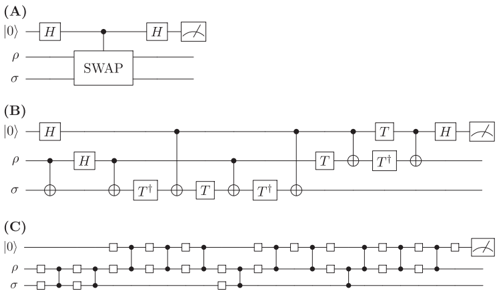
“Figure 2(B) and (C) respectively show decompositions of the Swap Test for IBM’s and Rigetti’s quantum computers [28, 29].”
MethodQuantum computing and the entanglement frontier
Preskill, J. (2012) · arXiv · doi:10.48550/arxiv.1203.5813 · Cited by 308 · cited 1×
“Quantum supremacy [1] may be coming soon [2].”
Background
Research works printed but not linked: 6
- Ball P 2018 The era of quantum computing is here. Outlook: cloudy Quanta Mag. [available at: http://quantamagazine.org/the-era- of-quantum-computing-is-here-outlook-cloudy-20180124/]
- Khatri S et al 2018 Quantum-assisted quantum compiling arXiv:1807.00800 · arXiv
- Hachtel G D and Somenzi F 1996 Logic Synthesis and Verification Algorithms (Boston, MA: Kluwer)
- Linke N M et al 2017 Measuring the Renyi entropy of a two-site Fermi-Hubbard model on a trapped ion quantum computer arXiv:1712.08581 · arXiv
- Smith R S, Curtis M J and Zeng W J 2016 A practical quantum instruction set architecture arXiv:1608.03355 · arXiv
- Wiebe N, Kapoor A and Svore K 2014 Quantum algorithms for nearest-neighbor methods for supervised and unsupervised learning Quantum Inf. Comput. 15 0318-58
Cited by
Variational quantum algorithms
Cerezo, M., Arrasmith, A., Babbush, R., Benjamin, S. C., Endo, S., Fujii, K., McClean, J. R., Mitarai, K., Yuan, X., Cincio, L., et al. (2021) · Nature Reviews Physics · doi:10.1038/s42254-021-00348-9 · Cited by 3,385
“The first term here is evaluated as in VQE, while the second term can be obtained by computing the state overlap between |ψ̃G〉 and |ψ(θ)〉 [91, 92].”
BackgroundSelf-citationSupervised learning with quantum-enhanced feature spaces
Havlíček, V., Córcoles, A. D., Temme, K., Harrow, A. W., Kandala, A., Chow, J. M., & Gambetta, J. M. (2019) · Nature · doi:10.1038/s41586-019-0980-2 · Cited by 2,572
“If only the value of the fidelity is needed, as is the case for our algorithm, the authors propose, c.f. [27] section III.”
MethodQuantum computational chemistry
McArdle, S., Endo, S., Aspuru-Guzik, A., Benjamin, S. C., & Yuan, X. (2020) · Reviews of Modern Physics · doi:10.1103/revmodphys.92.015003 · Cited by 1,621
Parameterized quantum circuits as machine learning models
Benedetti, M., Lloyd, E., Sack, S., & Fiorentini, M. (2019) · Quantum Science and Technology · doi:10.1088/2058-9565/ab4eb5 · Cited by 1,144
“Cincio et al. [90] train circuits to implement the SWAP test (see Fig.”
MethodNoise-Induced Barren Plateaus in Variational Quantum Algorithms
Wang, S., Fontana, E., Cerezo, M., Sharma, K., Sone, A., Cincio, L., & Coles, P. J. (2020) · arXiv · doi:10.48550/arxiv.2007.14384 · Cited by 791
Self-citationNoise-induced barren plateaus in variational quantum algorithms
Wang, S., Fontana, E., Cerezo, M., Sharma, K., Sone, A., Cincio, L., & Coles, P. J. (2021) · Nature Communications · doi:10.1038/s41467-021-27045-6 · Cited by 773
Self-citationChallenges and opportunities in quantum machine learning
Cerezo, M., Verdon, G., Huang, H.-Y., Cincio, L., & Coles, P. J. (2022) · Nature Computational Science · doi:10.1038/s43588-022-00311-3 · Cited by 689
“For example, one can apply machine learning to quantum applications like discovering quantum algorithms [8] or optimizing quantum experiments [9, 10], or one can use a quantum neural network to process either classical or quantum information [11].”
MethodSelf-citationHybrid Quantum-Classical Algorithms and Quantum Error Mitigation
Endo, S., Cai, Z., Benjamin, S. C., & Yuan, X. (2021) · Journal of the Physical Society of Japan · doi:10.7566/jpsj.90.032001 · Cited by 566
Generalization in quantum machine learning from few training data
Caro, M. C., Huang, H.-Y., Cerezo, M., Sharma, K., Sornborger, A., Cincio, L., & Coles, P. J. (2022) · Nature Communications · doi:10.1038/s41467-022-32550-3 · Cited by 476
Self-citationVariational Quantum Computation of Excited States
Higgott, O., Wang, D., & Brierley, S. (2019) · Quantum · doi:10.22331/q-2019-07-01-156 · Cited by 463
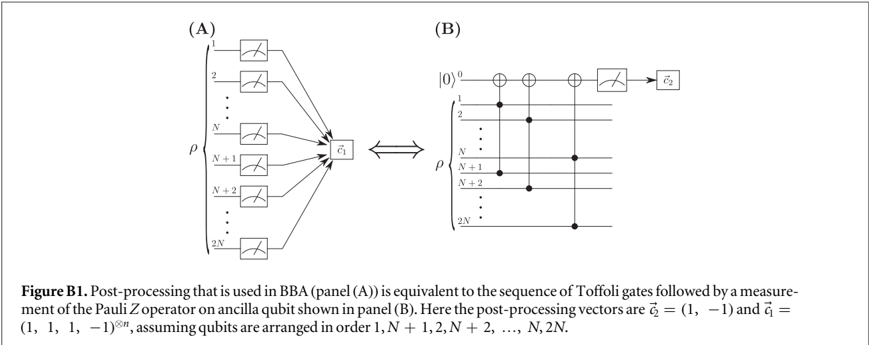
“[4, 10] that the same outcome distribution can be attained more efficiently without an ancilla, using parallel Bell-basis measurements and classical logic.”
MethodQuantum-assisted quantum compiling
Khatri, S., LaRose, R., Poremba, A., Cincio, L., Sornborger, A. T., & Coles, P. J. (2019) · Quantum · doi:10.22331/q-2019-05-13-140 · Cited by 382
“, using temporal planning [7, 8], machine learning [9], and other techniques [10–17].”
BackgroundMethodSelf-citationVariational Quantum Linear Solver
Bravo-Prieto, C., LaRose, R., Cerezo, M., Subasi, Y., Cincio, L., & Coles, P. J. (2019) · arXiv · doi:10.48550/arxiv.1909.05820 · Cited by 284
Self-citationDistributed quantum computing: A survey
Caleffi, M., Amoretti, M., Ferrari, D., Illiano, J., Manzalini, A., & Cacciapuoti, A. S. (2024) · Computer Networks · doi:10.1016/j.comnet.2024.110672 · Cited by 256
Barren plateaus in variational quantum computing
Larocca, M., Thanasilp, S., Wang, S., Sharma, K., Biamonte, J., Coles, P. J., Cincio, L., McClean, J. R., Holmes, Z., & Cerezo, M. (2025) · Nature Reviews Physics · doi:10.1038/s42254-025-00813-9 · Cited by 257
Self-citationVariational Quantum Linear Solver
Bravo-Prieto, C., LaRose, R., Cerezo, M., Subasi, Y., Cincio, L., & Coles, P. J. (2023) · Quantum · doi:10.22331/q-2023-11-22-1188 · Cited by 260
“[47, 71].”
BackgroundInfluentialSelf-citationVariational quantum algorithms for discovering Hamiltonian spectra
Jones, T., Endo, S., McArdle, S., Yuan, X., & Benjamin, S. C. (2019) · Physical Review A · doi:10.1103/physreva.99.062304 · Cited by 256
Quantum Algorithm Implementations for Beginners
J., A., Adedoyin, A., Ambrosiano, J., Anisimov, P., Casper, W., Chennupati, G., Coffrin, C., Djidjev, H., Gunter, D., Karra, S., et al. (2018) · arXiv · doi:10.48550/arxiv.1804.03719 · Cited by 256
Self-citationQuantum Algorithm Implementations for Beginners
J., A., Adedoyin, A., Ambrosiano, J., Anisimov, P., Casper, W., Chennupati, G., Coffrin, C., Djidjev, H., Gunter, D., Karra, S., et al. (2022) · ACM Transactions on Quantum Computing · doi:10.1145/3517340 · Cited by 245
“ows: e 1 = Tr(Σ)∗(1+ p 1−2(1−P))/2 (79) e 2 = Tr (Σ)∗( 1− p 2P))/. (80) We remark that recently (after completion of this review article), a simpler algorithm for computing purity P was given in Ref. [27]. While the results presented in what follows use the approach in Ref. [57], the approach in Ref. [27] could lead t…”
ResultSelf-citationReal- and Imaginary-Time Evolution with Compressed Quantum Circuits
Lin, S.-H., Dilip, R., Green, A. G., Smith, A., & Pollmann, F. (2021) · PRX Quantum · doi:10.1103/prxquantum.2.010342 · Cited by 206
Variational quantum state diagonalization
LaRose, R., Tikku, A., O’Neel-Judy, É., Cincio, L., & Coles, P. J. (2019) · npj Quantum Information · doi:10.1038/s41534-019-0167-6 · Cited by 199
“The algorithm used to update the structure of U(α) is probabilistic and resembles the one presented in [38].”
BackgroundMethodInfluentialSelf-citationNoise resilience of variational quantum compiling
Sharma, K., Khatri, S., Cerezo, M., & Coles, P. J. (2020) · New Journal of Physics · doi:10.1088/1367-2630/ab784c · Cited by 196
“Several promising error mitigation strategies have recently emerged, including zero-noise extrapolation [2], quasi-probability decomposition [2], post-selection [3, 4], noise-aware compiling [5], and machine learning for circuit-depth compression [6].”
BackgroundSelf-citationOverview and Comparison of Gate Level Quantum Software Platforms
LaRose, R. (2019) · Quantum · doi:10.22331/q-2019-03-25-130 · Cited by 179
“In-deed, cloud quantum computing has already been used to calculate the deuteron binding energy [14] and test subroutines in machine learning algorithms [15, 16].”
MethodQASMBench: A Low-Level Quantum Benchmark Suite for NISQ Evaluation and Simulation
Li, A., Stein, S., Krishnamoorthy, S., & Ang, J. (2023) · ACM Transactions on Quantum Computing · doi:10.1145/3550488 · Cited by 183
“From the hardware perspective, the development of QC testbeds have already proceeded to a stage where small working prototypes are available through cloud service, such as IBM-Q [59], Microsoft Azure [92], Amazon Braket [50], and Rigetti [110], showing encouraging results [22, 37].”
Hardware-efficient variational quantum algorithms for time evolution
Benedetti, M., Fiorentini, M., & Lubasch, M. (2021) · Physical Review Research · doi:10.1103/physrevresearch.3.033083 · Cited by 161
“[42] Lukasz Cincio, Yiğit Subaşı, Andrew T Sornborger, and Patrick J Coles, “Learning the quantum algorithm for state overlap,” New Journal of Physics 20, 113022 (2018).”
BackgroundMethodHardware-efficient variational quantum algorithms for time evolution
Benedetti, M., Fiorentini, M., & Lubasch, M. (2020) · arXiv · doi:10.48550/arxiv.2009.12361 · Cited by 176
“[42] Lukasz Cincio, Yiğit Subaşı, Andrew T Sornborger, and Patrick J Coles, “Learning the quantum algorithm for state overlap,” New Journal of Physics 20, 113022 (2018).”
BackgroundMethodReal- and Imaginary-Time Evolution with Compressed Quantum Circuits
Lin, S.-H., Dilip, R., Green, A. G., Smith, A., & Pollmann, F. (2021) · UCL Discovery (University College London) · Cited by 192
Digitization of scalar fields for quantum computing
Klco, N., & Savage, M. J. (2019) · Physical Review A · doi:10.1103/physreva.99.052335 · Cited by 167
Variational algorithms for linear algebra
Xu, X., Sun, J., Endo, S., Li, Y., Benjamin, S. C., & Yuan, X. (2021) · Science Bulletin · doi:10.1016/j.scib.2021.06.023 · Cited by 163
Quantum generative adversarial network for generating discrete distribution
Situ, H., He, Z., Wang, Y., Li, L., & Zheng, S. (2020) · Information Sciences · doi:10.1016/j.ins.2020.05.127 · Cited by 162
“Parameterized quantum circuits are also used in other machine learning parameterized models [45, 42, 35, 16, 30].”
MethodNoise resilience of variational quantum compiling
Sharma, K., Khatri, S., Cerezo, M., & Coles, P. J. (2020) · Civil War Book Review · Cited by 184
Self-citationArtificial intelligence and machine learning for quantum technologies
Krenn, M., Landgraf, J., Foesel, T., & Marquardt, F. (2023) · Physical Review A · doi:10.1103/physreva.107.010101 · Cited by 162
“An important application for this task is the hardware-aware design of circuits[117, 118].”
Differentiable quantum architecture search
Zhang, S.-X., Hsieh, C.-Y., Zhang, S., & Yao, H. (2022) · Quantum Science and Technology · doi:10.1088/2058-9565/ac87cd · Cited by 158
Machine learning method for state preparation and gate synthesis on photonic quantum computers
Arrazola, J. M., Bromley, T. R., Izaac, J., Myers, C. R., Brádler, K., & Killoran, N. (2019) · Quantum Science and Technology · doi:10.1088/2058-9565/aaf59e · Cited by 131
Group-Invariant Quantum Machine Learning
Larocca, M., Sauvage, F., Sbahi, F. M., Verdon, G., Coles, P. J., & Cerezo, M. (2022) · PRX Quantum · doi:10.1103/prxquantum.3.030341 · Cited by 248
Self-citationCompiler Design for Distributed Quantum Computing
Ferrari, D., Cacciapuoti, A. S., Amoretti, M., & Caleffi, M. (2021) · IEEE Transactions on Quantum Engineering · doi:10.1109/tqe.2021.3053921 · Cited by 190
“on , must be optimized so that the depth of the compiled circuit i.e., the equivalent quantum circuit satisfying all the constrains imposed by the quantum processor is minimized [24], [25], [27], [28]. III. COMPILERS FOR DISTRIBUTED QUANTUM COMPUTING As highlighted in Section I, the demand for large-scale quantumcompu…”
BackgroundTraining quantum embedding kernels on near-term quantum computers
Hubregtsen, T., Wierichs, D., Gil-Fuster, E., Derks, P.-J. H. S., Faehrmann, P. K., & Meyer, J. J. (2022) · Physical Review A · doi:10.1103/physreva.106.042431 · Cited by 218
Quantum eigenvalue estimation via time series analysis
Somma, R. D. (2019) · New Journal of Physics · doi:10.1088/1367-2630/ab5c60 · Cited by 142
Methodology for replacing indirect measurements with direct measurements
Mitarai, K., & Fujii, K. (2019) · Physical Review Research · doi:10.1103/physrevresearch.1.013006 · Cited by 139
Variational quantum state eigensolver
Cerezo, M., Sharma, K., Arrasmith, A., & Coles, P. J. (2022) · npj Quantum Information · doi:10.1038/s41534-022-00611-6 · Cited by 136
“In addition, these methods can be combined with more sophisticated ansatzes, such as a variable-structure ansatz [6, 41] where the structure of the ansatz is not fixed, and where the gate placement becomes an optimizable hyper-parameter.”
BackgroundMethodSelf-citationYao.jl: Extensible, Efficient Framework for Quantum Algorithm Design
Luo, X.-Z., Liu, J.-G., Zhang, P., & Wang, L. (2020) · Quantum · doi:10.22331/q-2020-10-11-341 · Cited by 157
Quantum machine learning in high energy physics
Guan, W., Perdue, G., Pesah, A. C., Schuld, M., Terashi, K., Vallecorsa, S., & Vlimant, J.-R. (2021) · Machine Learning Science and Technology · doi:10.1088/2632-2153/abc17d · Cited by 191
“Several application of machine learning on quantum data have been developed, including clustering of quantum states [104], detecting anomalies on a quantum device [107], learning algorithms to estimate the fidelity or the purity of a state [108, 109], learning phases of matter [106] and classifying quantum states [110…”
MethodMachine Learning of Noise-Resilient Quantum Circuits
Cincio, L., Rudinger, K., Sarovar, M., & Coles, P. J. (2021) · PRX Quantum · doi:10.1103/prxquantum.2.010324 · Cited by 111
“Using techniques developed in [6], which attempt to find exact implementations that consist of as few gates as possible, we perform training without the noise model (but with the connectivity restrictions of the device).”
MethodSelf-citationVariational Quantum Fidelity Estimation
Cerezo, M., Poremba, A., Cincio, L., & Coles, P. J. (2020) · Quantum · doi:10.22331/q-2020-03-26-248 · Cited by 116
“Since the SSFB are expressed as traces of products of density matrices, they can be efficiently measured on a quantum computer [26–29].”
BackgroundMethodInfluentialSelf-citationMachine Learning for Long-Distance Quantum Communication
Wallnöfer, J., Melnikov, A. A., Dür, W., & Briegel, H. J. (2020) · PRX Quantum · doi:10.1103/prxquantum.1.010301 · Cited by 114
Theory for Equivariant Quantum Neural Networks
Nguyen, Q. T., Schatzki, L., Braccia, P., Ragone, M., Coles, P. J., Sauvage, F., Larocca, M., & Cerezo, M. (2024) · PRX Quantum · doi:10.1103/prxquantum.5.020328 · Cited by 233
“We also note that, while not explicitly mentioned, some recent quantum algorithms can be analyzed from an equivariance point of view [21, 23, 97– 99].”
BackgroundSelf-citationQuantum Krylov subspace algorithms for ground- and excited-state energy estimation
Cortes, C. L., & Gray, S. K. (2022) · Physical Review A · doi:10.1103/physreva.105.022417 · Cited by 175
“[42] Lukasz Cincio, Yiğit Subaşı, Andrew T Sornborger, and Patrick J Coles, “Learning the quantum algorithm for state overlap,” New Journal of Physics 20, 113022 (2018).”
BackgroundMethodIdentification of Symmetry-Protected Topological States on Noisy Quantum Computers
Azses, D., Haenel, R., Naveh, Y., Raussendorf, R., Sela, E., & Dalla Torre, E. G. (2020) · Physical Review Letters · doi:10.1103/physrevlett.125.120502 · Cited by 108
A superconducting quantum simulator based on a photonic-bandgap metamaterial
Zhang, X., Kim, E., Mark, D. K., Choi, S., & Painter, O. J. (2023) · Science · doi:10.1126/science.ade7651 · Cited by 168
Recent advances for quantum classifiers
Li, W., & Deng, D.-L. (2021) · Science China Physics Mechanics and Astronomy · doi:10.1007/s11433-021-1793-6 · Cited by 137
Universal variational quantum computation
Biamonte, J. (2021) · Physical Review A · doi:10.1103/physreva.103.l030401 · Cited by 102
“[16]).”
Quantum machine learning: from physics to software engineering
Melnikov, A. A., Kordzanganeh, M., Alodjants, A. P., & Lee, R. (2023) · Advances in Physics X · doi:10.1080/23746149.2023.2165452 · Cited by 180
“In addition to designing new experiments, ML helps in designing new quantum algorithms [281] and protocols [282].”
MethodSimultaneous Perturbation Stochastic Approximation of the Quantum Fisher Information
Gacon, J., Zoufal, C., Carleo, G., & Woerner, S. (2021) · Quantum · doi:10.22331/q-2021-10-20-567 · Cited by 94
“If our state has n qubits and the circuit corresponding to U has depth m, the swap test requires a circuit width of 2n, but only leads to a depth of m + O(1) [32].”
BackgroundTheoretical guarantees for permutation-equivariant quantum neural networks
Schatzki, L., Larocca, M., Nguyen, Q. T., Sauvage, F., & Cerezo, M. (2024) · npj Quantum Information · doi:10.1038/s41534-024-00804-1 · Cited by 199
“This is evidently not general, as one could have several consecutive layers which are not individually equivariant, but compose to an equivariant unitary for certain θ [18, 131].”
BackgroundUnified approach to data-driven quantum error mitigation
Lowe, A., Gordon, M. H., Czarnik, P., Arrasmith, A., Coles, P. J., & Cincio, Ł. (2021) · Physical Review Research · doi:10.1103/physrevresearch.3.033098 · Cited by 136
“[6] Lukasz Cincio, Yiğit Subaşı, Andrew T Sornborger, and Patrick J Coles, “Learning the quantum algorithm for state overlap,” New Journal of Physics 20, 113022 (2018).”
BackgroundMethodSelf-citationNeural predictor based quantum architecture search
Zhang, S.-X., Hsieh, C.-Y., Zhang, S., & Yao, H. (2021) · Machine Learning: Science and Technology · doi:10.1088/2632-2153/ac28dd · Cited by 88
“[42] L.”
MethodReal-Time Evolution for Ultracompact Hamiltonian Eigenstates on Quantum Hardware
Klymko, K., Mejuto-Zaera, C., Cotton, S. J., Wudarski, F., Urbánek, M., Hait, D., Head‐Gordon, M., Whaley, K. B., Moussa, J. E., Wiebe, N., et al. (2022) · PRX Quantum · doi:10.1103/prxquantum.3.020323 · Cited by 151
Adversarial quantum circuit learning for pure state approximation
Benedetti, M., Grant, E., Wossnig, L., & Severini, S. (2019) · New Journal of Physics · doi:10.1088/1367-2630/ab14b5 · Cited by 81
“In [34] the authors implemented such via a variationally trained circuit.”
MethodVariational Quantum Gibbs State Preparation with a Truncated Taylor Series
Wang, Y., Li, G., & Wang, X. (2021) · Physical Review Applied · doi:10.1103/physrevapplied.16.054035 · Cited by 124
“1), named destructive Swap test [56, 59].”
Gujju, Y., Matsuo, A., & Raymond, R. (2024) · Physical Review Applied · doi:10.1103/physrevapplied.21.067001 · Cited by 138
Variational quantum algorithm for estimating the quantum Fisher information
Beckey, J. L., Cerezo, M., Sone, A., & Coles, P. J. (2022) · Physical Review Research · doi:10.1103/physrevresearch.4.013083 · Cited by 118
“The terms in E(ρθ, ρθ+δ) and R(ρθ, ρθ+δ) of the form Tr[ρ(2)θ] or Tr[ρθρθ+δ] can be computed with 2n qubits by means of the destructive swap test [66].”
MethodInfluentialSelf-citationVariational Quantum Algorithm for Estimating the Quantum Fisher Information
Beckey, J. L., Cerezo, M., Sone, A., & Coles, P. J. (2020) · arXiv · doi:10.48550/arxiv.2010.10488 · Cited by 77
“The terms in E(ρθ, ρθ+δ) and R(ρθ, ρθ+δ) of the form Tr[ρ(2)θ] or Tr[ρθρθ+δ] can be computed with 2n qubits by means of the destructive swap test [66].”
MethodInfluentialSelf-citationComputable and Operationally Meaningful Multipartite Entanglement Measures
Beckey, J. L., Gigena, N., Coles, P. J., & Cerezo, M. (2021) · Physical Review Letters · doi:10.1103/physrevlett.127.140501 · Cited by 109
Self-citationVariational consistent histories as a hybrid algorithm for quantum foundations
Arrasmith, A., Cincio, L., Sornborger, A. T., Zurek, W. H., & Coles, P. J. (2019) · Nature Communications · doi:10.1038/s41467-019-11417-0 · Cited by 66
Self-citationThermofield dynamics: Quantum chaos versus decoherence
Xu, Z., Chenu, A., Prosen, T., & del Campo, A. (2021) · Physical review. B./Physical review. B · doi:10.1103/physrevb.103.064309 · Cited by 74
Production of photonic universal quantum gates enhanced by machine learning
Sabapathy, K. K., Qi, H., Izaac, J., & Weedbrook, C. (2019) · Physical Review A · doi:10.1103/physreva.100.012326 · Cited by 73
Beyond the Swap Test: Optimal Estimation of Quantum State Overlap
Fanizza, M., Rosati, M., Skotiniotis, M., Calsamiglia, J., & Giovannetti, V. (2020) · Physical Review Letters · doi:10.1103/physrevlett.124.060503 · Cited by 84
Classical shadows for quantum process tomography on near-term quantum computers
Levy, R., Luo, D., & Clark, B. K. (2024) · Physical Review Research · doi:10.1103/physrevresearch.6.013029 · Cited by 136
A semi-agnostic ansatz with variable structure for variational quantum algorithms
Bilkis, M., Cerezo, M., Verdon, G., Coles, P. J., & Cincio, L. (2023) · Quantum Machine Intelligence · doi:10.1007/s42484-023-00132-1 · Cited by 58
“This method was able to discover a short-depth version of the swap test to compute state overlaps [55], and in [54] it was shown to drastically improve the discovered circuit performance in the presence of noise.”
Self-citationVerdon, G., McCourt, T., Luzhnica, E., Singh, V., Leichenauer, S., & Hidary, J. D. (2019) · arXiv (Cornell University) · doi:10.48550/arxiv.1909.12264 · Cited by 52
“The fidelities (quantum state overlap) between the output of our ansatz and the time-evolved data state were estimated via the quantum swap test [32].”
MethodVariational learning of Grover's quantum search algorithm
Morales, M. E. S., Tlyachev, T., & Biamonte, J. (2018) · Physical Review A · doi:10.1103/physreva.98.062333 · Cited by 57
Nonstabilizerness determining the hardness of direct fidelity estimation
Leone, L., Oliviero, S. F. E., & Hamma, A. (2023) · Physical Review A · doi:10.1103/physreva.107.022429 · Cited by 85
Quantum algorithm for visual tracking
Yu, C., Gao, F., Liu, C., Huynh, D. Q., Reynolds, M. A., & Wang, J. B. (2019) · Physical Review A · doi:10.1103/physreva.99.022301 · Cited by 63
“The task of estimating the state overlap can also be done by recent machine-learning-found quantum algorithms [31], which have shorter and even constant depth and thus may be more promising on near-term quantum computers than the canonical swap test.”
BackgroundError mitigation for variational quantum algorithms through mid-circuit measurements
Botelho, L., Glos, A., Kundu, A., Miszczak, J. A., Salehi, Ö., & Zimborás, Z. (2022) · Physical Review A · doi:10.1103/physreva.105.022441 · Cited by 80
Cornelius, J., Xu, Z., Saxena, A., Chenu, A., & del Campo, A. (2022) · Physical Review Letters · doi:10.1103/physrevlett.128.190402 · Cited by 67
Robust quantum compilation and circuit optimisation via energy minimisation
Jones, T., & Benjamin, S. C. (2018) · arXiv · doi:10.48550/arxiv.1811.03147 · Cited by 54
Strong bound between trace distance and Hilbert-Schmidt distance for low-rank states
Coles, P. J., Cerezo, M., & Cincio, Ł. (2019) · Physical Review A · doi:10.1103/physreva.100.022103 · Cited by 64
“were prepared on a quantum computer) it is known that their Hilbert-Schmidt distance is efficiently computable (logarithmic in matrix dimension) on a quantum computer [7, 8].”
MethodSelf-citationRobust quantum compilation and circuit optimisation via energy minimisation
Jones, T., & Benjamin, S. C. (2022) · Quantum · doi:10.22331/q-2022-01-24-628 · Cited by 121
“a quantity that can be evaluated experimentally via a swap-test circuit [34].”
BackgroundEntanglement spectroscopy with a depth-two quantum circuit
Subaşı, Y., Cincio, L., & Coles, P. J. (2019) · Journal of Physics A: Mathematical and Theoretical · doi:10.1088/1751-8121/aaf54d · Cited by 53
“[11] Lukasz Cincio, Yiğit Subaşı, Andrew T Sornborger, and Patrick J Coles.”
BackgroundInfluentialSelf-citationBest Approximate Quantum Compiling Problems
Madden, L., & Simonetto, A. (2022) · ACM Transactions on Quantum Computing · doi:10.1145/3505181 · Cited by 88
Quantum versus classical generative modelling in finance
Coyle, B., Henderson, M., Le, J. C. J., Kumar, N., Paini, M., & Kashefi, E. (2021) · Quantum Science and Technology · doi:10.1088/2058-9565/abd3db · Cited by 88
Markovian Quantum Neuroevolution for Machine Learning
Lu, Z., Shen, P.-X., & Deng, D.-L. (2021) · Physical Review Applied · doi:10.1103/physrevapplied.16.044039 · Cited by 54
Quantum Architecture Search: A Survey
Martyniuk, D., Jung, J., & Paschke, A. (2024) · IEEE International Conference on Quantum Computing and Engineering (QCE) · doi:10.1109/qce60285.2024.00198 · Cited by 92
“…[24], VAns [27], Rotoselect [71], Compilation VAns [27], QAQC [72], NACL [39] Combinatorial Optimization (QAOA) AAS [36] Quantum Program Synthesis [73] Observable Extraction NACL [39] State Preparation NACL [39] Monte-CarloTreeSearch Error Detection [58] Linear Equations [58] Ground State…”
Variational quantum compiling with double Q-learning
He, Z., Li, L., Zheng, S., Li, Y., & Situ, H. (2021) · New Journal of Physics · doi:10.1088/1367-2630/abe0ae · Cited by 70
“Variable structure ansatzes have been considered in [23] to discover quantum algorithms for computing the overlap between two states, which have shorter depths than the swap test.”
BackgroundQASMBench: A Low-level QASM Benchmark Suite for NISQ Evaluation and SimulationPreprint
Li, A., Stein, S., Krishnamoorthy, S., & Ang, J. (2020) · arXiv (Cornell University) · doi:10.48550/arxiv.2005.13018 · Cited by 46
“From the hardware perspective, the development of QC testbeds have already proceeded to a stage where small working prototypes are available through cloud service, such as IBM-Q [59], Microsoft Azure [92], Amazon Braket [50], and Rigetti [110], showing encouraging results [22, 37].”
Symbiotic evolution of photonics and artificial intelligence: a comprehensive review
Feng, F., Huo, D., Zhang, Z., Lou, Y., Wang, S., Gu, Z., Liu, D., Duan, X., Wang, D., Liu, X., et al. (2025) · Advanced Photonics · doi:10.1117/1.ap.7.2.024001 · Cited by 51
Unifying and benchmarking state-of-the-art quantum error mitigation techniques
Bultrini, D., Gordon, M. H., Czarnik, P., Arrasmith, A., Cerezo, M., Coles, P. J., & Cincio, Ł. (2023) · Quantum · doi:10.22331/q-2023-06-06-1034 · Cited by 86
“[35] Lukasz Cincio, Yiğit Subaşı, Andrew T Sornborger, and Patrick J Coles, “Learning the quantum algorithm for state overlap,” New Journal of Physics 20, 113022 (2018).”
BackgroundSelf-citationConstruction of Green's functions on a quantum computer: Quasiparticle spectra of molecules
Kosugi, T., & Matsushita, Y. (2020) · Physical Review A · doi:10.1103/physreva.101.012330 · Cited by 59
Symmetry enhanced variational quantum spin eigensolver
Lyu, C., Xu, X., Yung, M., & Bayat, A. (2023) · Quantum · doi:10.22331/q-2023-01-19-899 · Cited by 60
“The second approach utilizes the swap test [102, 103] which demands doubling the number of qubits and requires complex many-body controlled gates.”
MethodVariational quantum eigensolver for dynamic correlation functions
Chen, H., Nusspickel, M., Tilly, J., & Booth, G. H. (2021) · Physical Review A · doi:10.1103/physreva.104.032405 · Cited by 47
Acharya, J., Issa, I., Shende, N. V., & Wagner, A. B. (2020) · IEEE Journal on Selected Areas in Information Theory · doi:10.1109/jsait.2020.3015235 · Cited by 90
Quantum computing model of an artificial neuron with continuously valued input data
Mangini, S., Tacchino, F., Gerace, D., Macchiavello, C., & Bajoni, D. (2020) · Machine Learning Science and Technology · doi:10.1088/2632-2153/abaf98 · Cited by 52
Tilly, J., Jones, G. A., Chen, H., Wossnig, L., & Grant, E. (2020) · Physical Review A · doi:10.1103/physreva.102.062425 · Cited by 47
A Variational Quantum Linear Solver Application to Discrete Finite-Element Methods
Trahan, C. J., Loveland, M., Davis, N. A., & Ellison, E. (2023) · Entropy · doi:10.3390/e25040580 · Cited by 53
“Though it was not investigated in this study, variable ansatz optimization was shown to improve convergence in some cases in [52,62].”
ResultQuantum pattern recognition on real quantum processing units
Das, S., Zhang, J., Martina, S., Suter, D., & Caruso, F. (2023) · Quantum Machine Intelligence · doi:10.1007/s42484-022-00093-x · Cited by 38
“Later in Cincio et al. (2018), the authors used machine learning approach to find the optimized circuit for calculating the overlap between two states, and they rediscovered the destructive swap test as the optimum algorithm.”
MethodQubit-efficient entanglement spectroscopy using qubit resets
Yirka, J., & Subaşı, Y. (2021) · Quantum · doi:10.22331/q-2021-09-02-535 · Cited by 55
“[42] related this algorithm to the Hong-Ou-Mandel effect in the context of quantum optics and referred to it as a destructive Swap Test, while [41] emphasized that it can be implemented with constant depth in a quantum computer.”
MethodInfluentialSelf-citationSub-quantum Fisher information
Cerezo, M., Sone, A., Beckey, J. L., & Coles, P. J. (2021) · Quantum Science and Technology · doi:10.1088/2058-9565/abfbef · Cited by 43
Self-citationProbing many-body localization by excited-state variational quantum eigensolver
Liu, S., Zhang, S., Hsieh, C., Zhang, S., & Yao, H. (2023) · Physical review. B./Physical review. B · doi:10.1103/physrevb.107.024204 · Cited by 44
Variational quantum time evolution without the quantum geometric tensor
Gacon, J., Nys, J., Rossi, R., Woerner, S., & Carleo, G. (2024) · Physical Review Research · doi:10.1103/physrevresearch.6.013143 · Cited by 47
Sun, Y., & Luo, S. (2021) · Physical Review A · doi:10.1103/physreva.103.042423 · Cited by 30
Variational quantum linear solver with a dynamic ansatz
Patil, H. P., Wang, Y., & Krstić, P. (2022) · Physical Review A · doi:10.1103/physreva.105.012423 · Cited by 43
Metadata
- Authors
- Cincio, L., Subaşı, Y., Sornborger, A. T., & Coles, P. J.
- Affiliations
- Los Alamos National Laboratory (US)
- Corresponding author
- Cincio, Lukasz
- ORCID
- Subaşı, Yiğit
- Venue
- New Journal of Physics
- Publisher
- IOP Publishing
- Published
- 2018-11-15
- Volume
- 20
- Issue
- 11
- Pages
- 113022
- ISSN
- 1367-2630 (ISSN-L)
- OpenAlex
- W2790264742
- Cited by
- 282
- References
- 24
- Citations by year
- 2026: 20 · 2025: 26 · 2024: 38 · 2023: 60 · 2022: 40 · 2021: 47 · 2020: 22 · 2019: 25 · 2018: 4
- FWCI
- 13.81
- Type
- journal article
- Language
- en
- Open access
- gold
- doi.org
- Licence
- cc-by
- iopscience.iop.org/info/page/text-and-data-mining (tdm)
- creativecommons.org/licenses/by/3.0/ (vor)
- Locations
- New Journal of Physics (publishedVersion, cc-by)
- arXiv (Cornell University) (submittedVersion)
- DOAJ (DOAJ: Directory of Open Access Journals) (submittedVersion)
- OSTI OAI (U.S. Department of Energy Office of Scientific and Technical Information) (submittedVersion)
- arXiv (Cornell University)
- Funders
- U.S. Department of Energy (J. Robert Oppenheimer fellowship)
- Los Alamos National Laboratory (Beyond Moore’s Law project, LDRD program)
- Topics
- Physical Sciences › Computer Science › Artificial Intelligence › Quantum Computing Algorithms and Architecture
- Physical Sciences › Physics and Astronomy › Atomic and Molecular Physics, and Optics › Quantum Information and Cryptography
- Physical Sciences › Physics and Astronomy › Atomic and Molecular Physics, and Optics › Quantum many-body systems
- Keywords
- swap test, quantum support vector machine, near-term quantum devices, gate infidelity, decoherence
About these checks
Registry, retraction, Cites and statistics results are computed, not judged, with one exception: a printed reference that no index lists is read once by a model before it counts as a citation error. Claims are extracted by a model and kept only when their quote appears verbatim in the text; each cited source is then checked, with a model’s help, for whether it says what the claim relies on. Those verdicts can be wrong — read the claim’s quote and the cited source before relying on one.
Statistics and arithmetic are recomputed, not judged.
Confidence bands are shown only for fields calibrated on our annotated test set. None is calibrated yet, so no band is shown.
What counts as a claim ›How we measure confidence ›How we check this ›
Are you an author, or do you see a problem with this page? Request a review
Data sources
Bibliographic data: Semantic Scholar, OpenAlex, Crossref.
Contains information from the Semantic Scholar Academic Graph Datasets, made available under the ODC Attribution License (ODC-BY 1.0).
Semantic Scholar’s data is described in: Kinney, R., et al. (2023). The Semantic Scholar Open Data Platform. arXiv:2301.10140.
