

Learning the quantum algorithm for state overlap
Open accessThe DOI matches its Crossref record; 29 of the 30 references it cites were found in a registry or an index.
Abstract
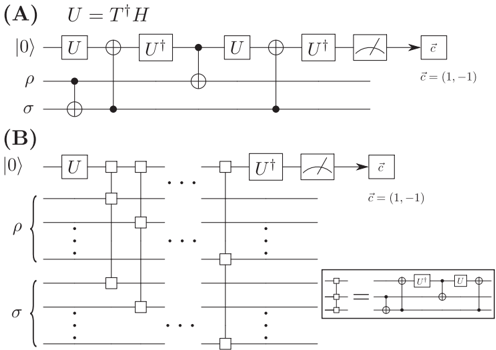
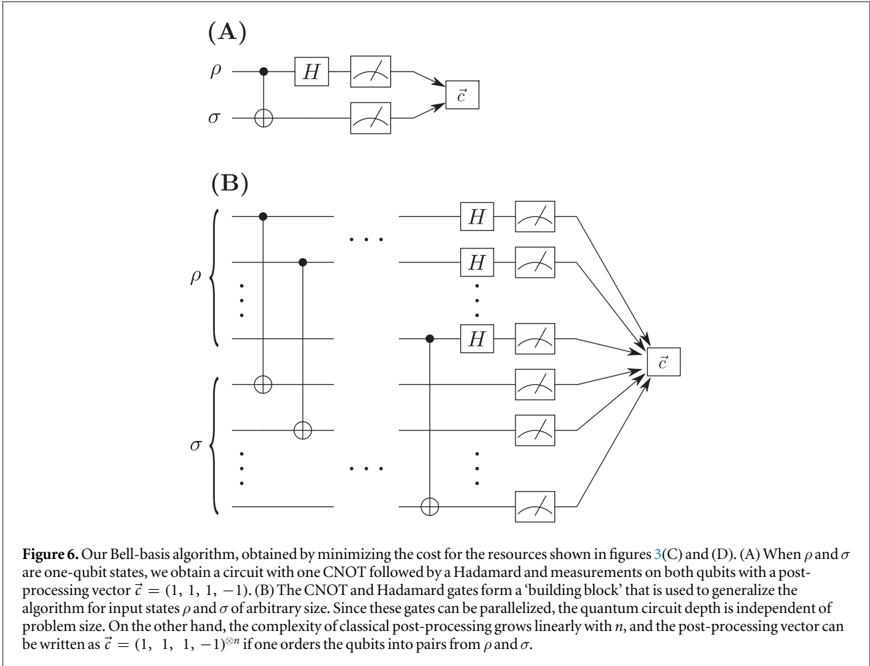
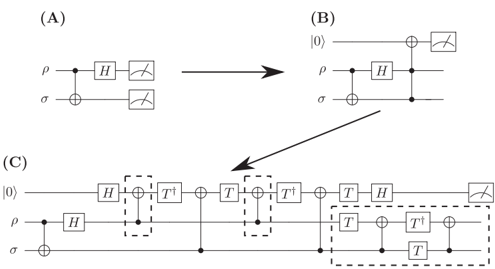
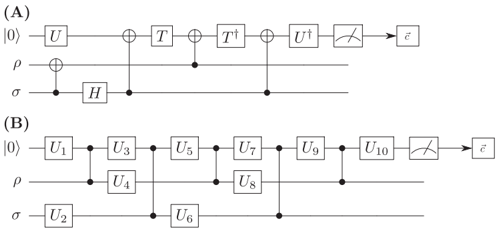
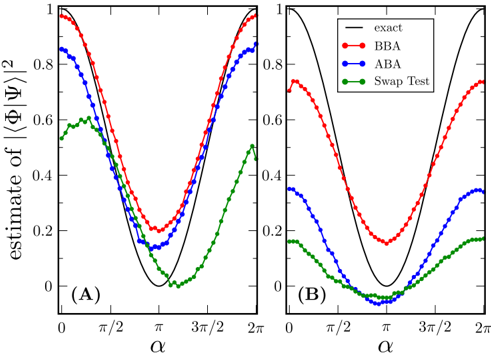
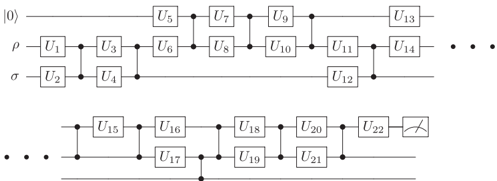
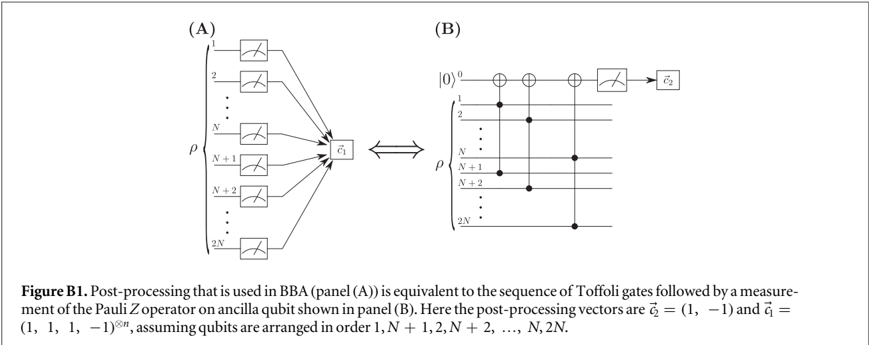
Short-depth algorithms are crucial for reducing computational error on near-term quantum computers, for which decoherence and gate infidelity remain important issues. Here we present a machine-learning approach for discovering such algorithms. We apply our method to a ubiquitous primitive: computing the overlap between two quantum states ρ and σ . The standard algorithm for this task, known as the Swap Test, is used in many applications such as quantum support vector machines, and, when specialized to ρ = σ , quantifies the Renyi entanglement. Here, we find algorithms that have shorter depths than the Swap Test, including one that has a constant depth (independent of problem size). Furthermore, we apply our approach to the hardware-specific connectivity and gate sets used by Rigetti's and IBM's quantum computers and demonstrate that the shorter algorithms that we derive significantly reduce the error—compared to the Swap Test—on these computers.
Overview
The claims and statistics of this paper haven’t been checked yet.
Free: it reads the open-access text and checks the first 5 claims that cite a source we can check. Create a free account to check every claim.
Integrity signals
Registry
Cites
Statistics
Figures
Verification
Claims the paper makes
The claims and statistics of this paper haven’t been checked yet.
Free: it reads the open-access text and checks the first 5 claims that cite a source we can check. Create a free account to check every claim.
Self-check
Percentages, sums and reported differences re-computed from the paper’s own numbers.
The self-check needs the paper’s full text.
Citations
Cites
Surface codes: Towards practical large-scale quantum computation
Fowler, A. G., Mariantoni, M., Martinis, J. M., & Cleland, A. N. (2012) · Physical Review A · doi:10.1103/physreva.86.032324 · Cited by 3,059
Quantum Support Vector Machine for Big Data Classification
Rebentrost, P., Mohseni, M., & Lloyd, S. (2014) · Physical Review Letters · doi:10.1103/physrevlett.113.130503 · Cited by 1,951 · cited 1×
“In quantum supervised learning [30, 31], which subsumes quantum support vector machines [32], the Swap Test is used to assign each data vector to a cluster.”
MethodKhaneja, N., Reiss, T., Kehlet, C., Schulte-Herbrüggen, T., & Glaser, S. J. (2005) · Journal of Magnetic Resonance · doi:10.1016/j.jmr.2004.11.004 · Cited by 1,854
Mitarai, K., Negoro, M., Kitagawa, M., & Fujii, K. (2018) · Physical Review A · doi:10.1103/physreva.98.032309 · Cited by 1,639 · cited 1×
“The circuit is then trained to perform a given task by tuning these parameters [6, 7].”
MethodBuhrman, H., Cleve, R., Watrous, J., & de Wolf, R. (2001) · Physical Review Letters · doi:10.1103/physrevlett.87.167902 · Cited by 1,190
Quantum algorithms for supervised and unsupervised machine learning
Lloyd, S., Mohseni, M., & Rebentrost, P. (2013) · arXiv · doi:10.48550/arxiv.1307.0411 · Cited by 542 · cited 1×
“In quantum supervised learning [30, 31], which subsumes quantum support vector machines [32], the Swap Test is used to assign each data vector to a cluster.”
MethodA blueprint for demonstrating quantum supremacy with superconducting qubits
Neill, C., Roushan, P., Kechedzhi, K., Boixo, S., Isakov, S. V., Smelyanskiy, V., Megrant, A., Chiaro, B., Dunsworth, A., Arya, K., et al. (2018) · Science · doi:10.1126/science.aao4309 · Cited by 458 · cited 1×
“Quantum supremacy [1] may be coming soon [2].”
BackgroundA generative modeling approach for benchmarking and training shallow quantum circuits
Benedetti, M., Garcia-Pintos, D., Perdomo, O., Leyton-Ortega, V., Nam, Y., & Perdomo-Ortiz, A. (2019) · npj Quantum Information · doi:10.1038/s41534-019-0157-8 · Cited by 379 · cited 2×
“This motivates the idea of an automated approach for discovering and optimizing quantum algorithms [6–19].”
MethodOpen Quantum Assembly Language
Cross, A. W., Bishop, L. S., Smolin, J. A., & Gambetta, J. M. (2017) · arXiv · doi:10.48550/arxiv.1707.03429 · Cited by 310 · cited 1×
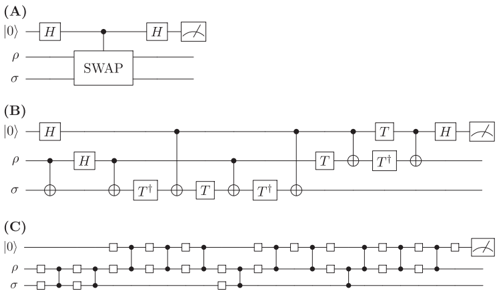
“Figure 2(B) and (C) respectively show decompositions of the Swap Test for IBM’s and Rigetti’s quantum computers [28, 29].”
MethodQuantum computing and the entanglement frontier
Preskill, J. (2012) · arXiv · doi:10.48550/arxiv.1203.5813 · Cited by 308 · cited 1×
“Quantum supremacy [1] may be coming soon [2].”
BackgroundFive two-bit quantum gates are sufficient to implement the quantum Fredkin gate
Smolin, J. A., & DiVincenzo, D. P. (1996) · Physical Review A · doi:10.1103/physreva.53.2855 · Cited by 276
Programming languages and compiler design for realistic quantum hardware
Chong, F. T., Franklin, D., & Martonosi, M. (2017) · Nature · doi:10.1038/nature23459 · Cited by 230 · cited 1×
“We emphasize that our work goes beyond quantum compiling, which has received recent attention [11–16].”
BackgroundSwap test and Hong–Ou–Mandel effect are equivalent
Garcia-Escartin, J. C., & Chamorro-Posada, P. (2013) · Physical Review A · doi:10.1103/physreva.87.052330 · Cited by 182
A software methodology for compiling quantum programs
Häner, T., Steiger, D. S., Svore, K., & Troyer, M. (2018) · Quantum Science and Technology · doi:10.1088/2058-9565/aaa5cc · Cited by 170
Gottesman, D., & Chuang, I. L. (2001) · arXiv (Cornell University) · doi:10.48550/arxiv.quant-ph/0105032 · Cited by 161 · cited 1×
“There is a well-known algorithm for this task called the Swap Test [22, 23].”
MethodPatel, R. B., Ho, J., Ferreyrol, F., Ralph, T. C., & Pryde, G. J. (2016) · Science Advances · doi:10.1126/sciadv.1501531 · Cited by 156
Compiling quantum circuits to realistic hardware architectures using temporal planners
Venturelli, D., Do, M., Rieffel, E., & Frank, J. (2018) · Quantum Science and Technology · doi:10.1088/2058-9565/aaa331 · Cited by 135
Basic circuit compilation techniques for an ion-trap quantum machine
Maslov, D. (2017) · New Journal of Physics · doi:10.1088/1367-2630/aa5e47 · Cited by 119
Compiling quantum algorithms for architectures with multi-qubit gates
Martinez, E. A., Monz, T., Nigg, D., Schindler, P., & Blatt, R. (2016) · New Journal of Physics · doi:10.1088/1367-2630/18/6/063029 · Cited by 112
Evolutionary Approach to Quantum and Reversible Circuits Synthesis
Lukáč, M., Perkowski, M. A., Goi, H., Pivtoraiko, M., Yu, C. H., Chung, K., Jeech, H., Kim, B.-G., & Kim, Y.-D. (2003) · Artificial Intelligence Review · doi:10.1023/b:aire.0000006605.86111.79 · Cited by 108 · cited 1×
“Gepp and Stocks [9] reviewmuch of the early work to evolve quantumalgorithms using genetic programming such as [10] (for more recent work see for example [19]).”
BackgroundOn the CNOT -cost of TOFFOLI gates
Shende, V. V., & Markov, I. L. (2009) · Quantum Information and Computation · doi:10.26421/qic8.5-6-8 · Cited by 99
Svore, K. M., Hastings, M. B., & Freedman, M. H. (2014) · Quantum Information and Computation · doi:10.26421/qic14.3-4-7 · Cited by 98 · cited 1×
“A key aspect of our approach that aided this algorithm’s discovery was to allow for non-trivial classical post-processing, a strategy that has been used previously to shrink the depth of quantum algorithms [36].”
MethodDeep Learning for Logic Optimization Algorithms
Haaswijk, W., Collins, E., Seguin, B., Soeken, M., Kaplan, F., Susstrunk, S. E., & Micheli, G. D. (2018) · IEEE International Symposium on Circuits and Systems proceedings · doi:10.1109/iscas.2018.8351885 · Cited by 86 · cited 1×
“[21] shows how logic optimization algorithms can be discovered automatically through the use of deep learning.”
BackgroundDesigning High-Fidelity Single-Shot Three-Qubit Gates: A Machine-Learning Approach
Zahedinejad, E., Ghosh, J., & Sanders, B. C. (2016) · Physical Review Applied · doi:10.1103/physrevapplied.6.054005 · Cited by 81
Entanglement spectroscopy on a quantum computer
Johri, S., Steiger, D. S., & Troyer, M. (2017) · Physical Review B · doi:10.1103/physrevb.96.195136 · Cited by 66 · cited 2×
“[27, 33]).”
MethodGenetic Algorithms for Digital Quantum Simulations
Las Heras, U., Alvarez-Rodriguez, U., Solano, E., & Sanz, M. (2016) · Physical Review Letters · doi:10.1103/physrevlett.116.230504 · Cited by 61
A review of procedures to evolve quantum algorithms
Gepp, A., & Stocks, P. (2009) · Genetic Programming and Evolvable Machines · doi:10.1007/s10710-009-9080-7 · Cited by 46
Generating three-qubit quantum circuits with neural networks
Swaddle, M., Noakes, L., Smallbone, H., Salter, L., & Wang, J. B. (2017) · Physics Letters A · doi:10.1016/j.physleta.2017.08.043 · Cited by 28 · cited 1×
“Machine-learning techniques have also been used to decompose small scale unitaries into one and two-body gates [17, 18].”
MethodSimulating the transverse Ising model on a quantum computer: Error correction with the surface code
You, H., Geller, M. R., & Stancil, P. C. (2013) · Physical Review A · doi:10.1103/physreva.87.032341 · Cited by 21 · cited 1×
“Furthermore, NTQCs do not currently have enough qubits and sufficient gate fi-delities to fully leverage the benefit of quantum error-correcting codes [4, 5].”
BackgroundImplementation of a quantum Fredkin gate using an entanglement resource
Ferreyrol, F., Ralph, T. C., & Pryde, G. J. (2013) · Conference on Lasers and Electro-Optics Europe & European Quantum Electronics Conference (CLEO/Europe-EQEC) · doi:10.1109/cleoe-iqec.2013.6801703 · Cited by 2
Research works printed but not linked: 6
- Ball P 2018 The era of quantum computing is here. Outlook: cloudy Quanta Mag. [available at: http://quantamagazine.org/the-era- of-quantum-computing-is-here-outlook-cloudy-20180124/]
- Khatri S et al 2018 Quantum-assisted quantum compiling arXiv:1807.00800 · arXiv
- Hachtel G D and Somenzi F 1996 Logic Synthesis and Verification Algorithms (Boston, MA: Kluwer)
- Linke N M et al 2017 Measuring the Renyi entropy of a two-site Fermi-Hubbard model on a trapped ion quantum computer arXiv:1712.08581 · arXiv
- Smith R S, Curtis M J and Zeng W J 2016 A practical quantum instruction set architecture arXiv:1608.03355 · arXiv
- Wiebe N, Kapoor A and Svore K 2014 Quantum algorithms for nearest-neighbor methods for supervised and unsupervised learning Quantum Inf. Comput. 15 0318-58
Cited by
Variational quantum algorithms
Cerezo, M., Arrasmith, A., Babbush, R., Benjamin, S. C., Endo, S., Fujii, K., McClean, J. R., Mitarai, K., Yuan, X., Cincio, L., et al. (2021) · Nature Reviews Physics · doi:10.1038/s42254-021-00348-9 · Cited by 3,385
“The first term here is evaluated as in VQE, while the second term can be obtained by computing the state overlap between |ψ̃G〉 and |ψ(θ)〉 [91, 92].”
BackgroundSelf-citationSupervised learning with quantum-enhanced feature spaces
Havlíček, V., Córcoles, A. D., Temme, K., Harrow, A. W., Kandala, A., Chow, J. M., & Gambetta, J. M. (2019) · Nature · doi:10.1038/s41586-019-0980-2 · Cited by 2,572
“If only the value of the fidelity is needed, as is the case for our algorithm, the authors propose, c.f. [27] section III.”
MethodQuantum computational chemistry
McArdle, S., Endo, S., Aspuru-Guzik, A., Benjamin, S. C., & Yuan, X. (2020) · Reviews of Modern Physics · doi:10.1103/revmodphys.92.015003 · Cited by 1,621
Parameterized quantum circuits as machine learning models
Benedetti, M., Lloyd, E., Sack, S., & Fiorentini, M. (2019) · Quantum Science and Technology · doi:10.1088/2058-9565/ab4eb5 · Cited by 1,144
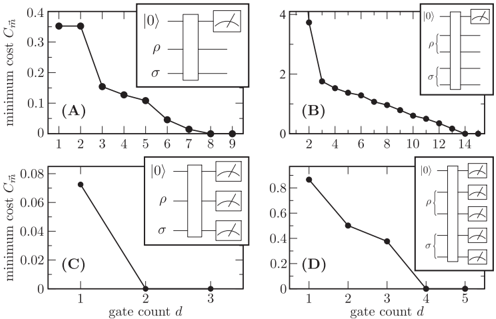
“Cincio et al. [90] train circuits to implement the SWAP test (see Fig.”
MethodNoise-Induced Barren Plateaus in Variational Quantum Algorithms
Wang, S., Fontana, E., Cerezo, M., Sharma, K., Sone, A., Cincio, L., & Coles, P. J. (2020) · arXiv · doi:10.48550/arxiv.2007.14384 · Cited by 791
Self-citation
Metadata
- Authors
- Cincio, L., Subaşı, Y., Sornborger, A. T., & Coles, P. J.
- Affiliations
- Los Alamos National Laboratory (US)
- Corresponding author
- Cincio, Lukasz
- ORCID
- Subaşı, Yiğit
- Venue
- New Journal of Physics
- Publisher
- IOP Publishing
- Published
- 2018-11-15
- Volume
- 20
- Issue
- 11
- Pages
- 113022
- ISSN
- 1367-2630 (ISSN-L)
- OpenAlex
- W2790264742
- Cited by
- 282
- References
- 24
- Citations by year
- 2026: 20 · 2025: 26 · 2024: 38 · 2023: 60 · 2022: 40 · 2021: 47 · 2020: 22 · 2019: 25 · 2018: 4
- FWCI
- 13.81
- Type
- journal article
- Language
- en
- Open access
- gold
- doi.org
- Licence
- cc-by
- iopscience.iop.org/info/page/text-and-data-mining (tdm)
- creativecommons.org/licenses/by/3.0/ (vor)
- Locations
- New Journal of Physics (publishedVersion, cc-by)
- arXiv (Cornell University) (submittedVersion)
- DOAJ (DOAJ: Directory of Open Access Journals) (submittedVersion)
- OSTI OAI (U.S. Department of Energy Office of Scientific and Technical Information) (submittedVersion)
- arXiv (Cornell University)
- Funders
- U.S. Department of Energy (J. Robert Oppenheimer fellowship)
- Los Alamos National Laboratory (Beyond Moore’s Law project, LDRD program)
- Topics
- Physical Sciences › Computer Science › Artificial Intelligence › Quantum Computing Algorithms and Architecture
- Physical Sciences › Physics and Astronomy › Atomic and Molecular Physics, and Optics › Quantum Information and Cryptography
- Physical Sciences › Physics and Astronomy › Atomic and Molecular Physics, and Optics › Quantum many-body systems
- Keywords
- swap test, quantum support vector machine, near-term quantum devices, gate infidelity, decoherence
About these checks
Registry, retraction, Cites and statistics results are computed, not judged, with one exception: a printed reference that no index lists is read once by a model before it counts as a citation error. Claims are extracted by a model and kept only when their quote appears verbatim in the text; each cited source is then checked, with a model’s help, for whether it says what the claim relies on. Those verdicts can be wrong — read the claim’s quote and the cited source before relying on one.
Statistics and arithmetic are recomputed, not judged.
Confidence bands are shown only for fields calibrated on our annotated test set. None is calibrated yet, so no band is shown.
What counts as a claim ›How we measure confidence ›How we check this ›
Are you an author, or do you see a problem with this page? Request a review
Data sources
Bibliographic data: Semantic Scholar, OpenAlex, Crossref.
Contains information from the Semantic Scholar Academic Graph Datasets, made available under the ODC Attribution License (ODC-BY 1.0).
Semantic Scholar’s data is described in: Kinney, R., et al. (2023). The Semantic Scholar Open Data Platform. arXiv:2301.10140.
