

Evaluating the use of biomass energy with carbon capture and storage in low emission scenarios
Open accessThe DOI matches its Crossref record; 68 of the 68 references it cites were found in a registry or an index.
Abstract
Biomass Energy with Carbon Capture and Storage (BECCS) is heavily relied upon in scenarios of future emissions that are consistent with limiting global mean temperature increase to 1.5 °C or 2 °C above pre-industrial. These temperature limits are defined in the Paris Agreement in order to reduce the risks and impacts of climate change. Here, we explore the use of BECCS technologies in a reference scenario and three low emission scenarios generated by an integrated assessment model (IMAGE). Using these scenarios we investigate the feasibility of key implicit and explicit assumptions about these BECCS technologies, including biomass resource, land use, CO 2 storage capacity and carbon capture and storage (CCS) deployment rate. In these scenarios, we find that half of all global CO 2 storage required by 2100 occurs in USA, Western Europe, China and India, which is compatible with current estimates of regional CO 2 storage capacity. CCS deployment rates in the scenarios are very challenging compared to historical rates of fossil, renewable or nuclear technologies and are entirely dependent on stringent policy action to incentivise CCS. In the scenarios, half of the biomass resource is derived from agricultural and forestry residues and half from dedicated bioenergy crops grown on abandoned agricultural land and expansion into grasslands (i.e. land for forests and food production is protected). Poor governance of the sustainability of bioenergy crop production can significantly limit the amount of CO 2 removed by BECCS, through soil carbon loss from direct and indirect land use change. Only one-third of the bioenergy crops are grown in regions associated with more developed governance frameworks. Overall, the scenarios in IMAGE are ambitious but consistent with current relevant literature with respect to assumed biomass resource, land use and CO 2 storage capacity.
Overview
The claims and statistics of this paper haven’t been checked yet.
Free: it reads the open-access text and checks the first 5 claims that cite a source we can check. Create a free account to check every claim.
Integrity signals
Registry
Cites
Statistics
Figures

Verification
Claims the paper makes
The claims and statistics of this paper haven’t been checked yet.
Free: it reads the open-access text and checks the first 5 claims that cite a source we can check. Create a free account to check every claim.
Self-check
Percentages, sums and reported differences re-computed from the paper’s own numbers.
The self-check needs the paper’s full text.
Citations
Cites
Riahi, K., van Vuuren, D. P., Kriegler, E., Edmonds, J., O’Neill, B. C., Fujimori, S., Bauer, N., Calvin, K., Dellink, R., Fricko, O., et al. (2017) · Global Environmental Change · doi:10.1016/j.gloenvcha.2016.05.009 · Cited by 6,607
Self-citationKyoto Protocol to the United Nations Framework Convention on Climate Change
(2018) · International Law Documents · doi:10.1017/9781316577226.067 · Cited by 4,351
Sitch, S., Smith, B., Prentice, I. C., Arneth, A., Bondeau, A., Cramer, W., Kaplan, J. O., Levis, S., Lucht, W., Sykes, M. T., et al. (2003) · Global Change Biology · doi:10.1046/j.1365-2486.2003.00569.x · Cited by 3,238 · cited 1×
“IMAGE uses the LPJml model (Sitch et al 2003, Bondeau et al 2007) in combination with the MAGICC climate emulator model to represent the carbon cycle and climate system.”
MethodDirect Capture of CO2 from Ambient Air
Sanz-Pérez, E. S., Murdock, C. R., Didas, S. A., & Jones, C. W. (2016) · Chemical Reviews · doi:10.1021/acs.chemrev.6b00173 · Cited by 2,406 · cited 1×
“Other options include, for instance, direct air capture with storage of CO2 and enhanced weathering (some individual studies have looked into these options) (e.g. Sanz-Perez et al 2016).”
BackgroundIPCC Special Report on Renewable Energy Sources and Climate Change Mitigation
Revel, D. (2011) · OpenEdition (OpenEdition) · doi:10.58079/o8wx · Cited by 2,175
Dynamics of global forest area: Results from the FAO Global Forest Resources Assessment 2015
Keenan, R. J., Reams, G. A., Achard, F., de Freitas, J. V., Grainger, A., & Lindquist, E. (2015) · Forest Ecology and Management · doi:10.1016/j.foreco.2015.06.014 · Cited by 1,656
Beneficial biofuels—the food, energy, and environment trilemma
Tilman, D., Socolow, R., Foley, J. A., Hill, J., Larson, E., Lynd, L., Pacala, S., Reilly, J., Searchinger, T., Somerville, C., et al. (2009) · Science · doi:10.1126/science.1177970 · Cited by 1,596
Biophysical and economic limits to negative CO2 emissions
Smith, P., Davis, S. J., Creutzig, F., Fuss, S., Minx, J., Gabrielle, B., Kato, E., Jackson, R. B., Cowie, A., Kriegler, E., et al. (2016) · Nature Climate Change · doi:10.1038/nclimate2870 · Cited by 1,440 · cited 1×
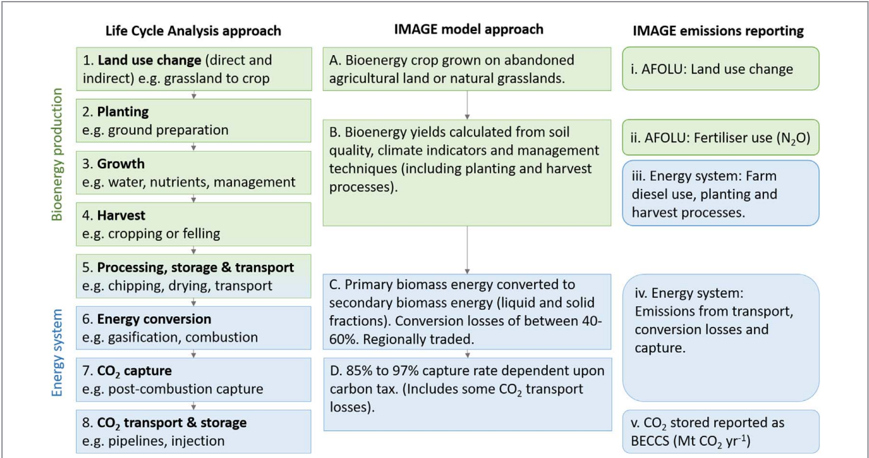
“Left column depicts the stages in a generalised BECCS system as it may be analysed in a LCA (stages 1–8) (modified from Thornley et al (2015) and Smith and Torn (2013)).”
MethodSelf-citationModelling the role of agriculture for the 20th century global terrestrial carbon balance
BONDEAU, A., SMITH, P. C., ZAEHLE, S., SCHAPHOFF, S., LUCHT, W., CRAMER, W., GERTEN, D., LOTZE‐CAMPEN, H., MÜLLER, C., REICHSTEIN, M., et al. (2007) · Global Change Biology · doi:10.1111/j.1365-2486.2006.01305.x · Cited by 1,296
The trouble with negative emissions
Anderson, K., & Peters, G. (2016) · Science · doi:10.1126/science.aah4567 · Cited by 1,252 · cited 2×
“…by IAMs in recent years, a default mitigation strategy emerges that would be consistent with the Paris Agreement’s targets: pathways show an early peak in emissions, followed by rapid emission reductions and finally a period of net negative emissions (Fuss et al 2014, Anderson and Peters 2016).”
BackgroundResult
Research works printed but not linked: 8
- 12. Carbon Sequestration Leadership Forum (CSLF) 2007 Estimation of CO 2 Storage capacity in Geological Media (Washington:
- GCCSI, 2016, The Global Storage Portfolio
- GCCSI, 2016, The Global Status of CCS: Summary Report
- Gough C, Glob. Sustain.
- Hendriks C, 2004, Ecofys Utrecht
- Jackson R, 2017, Environ. Res. Lett., 12
- Jones C D, 2016, Environ. Res. Lett., 11
- Larkin A, 2017, Clim. Policy
Cited by
Items 101–113 of 113
A nature-based solution for energy efficiency, sustainability, and human well-being
Foroughi, R., & Daneshgar, F. (2026) · International Journal of Sustainable Development & World Ecology · doi:10.1080/13504509.2026.2640409 · Cited by 1
“Moreover, the true costs associated with resource extraction, including environmental degradation and social harm, are rarely reflected in economic plans, leaving future generations to bear the consequences (Vaughan et al. 2018).”
Machine learning reveals insufficient carbon capture storage deployment to meet climate goals
Li, X., Sun, Y., Tang, Y., Peng, H., & Duan, H. (2026) · Global Environmental Change · doi:10.1016/j.gloenvcha.2026.103157 · Cited by 1
Clery, D. S. (2019) · White Rose eTheses Online (University of Leeds, The University of Sheffield, University of York) · Cited by 1
Integrated Assessment Models must better constrain CO2 geological storage projectionsPreprint
de Jonge‐Anderson, I., Johnson, G., Merfort, A., Strefler, J., & Roberts, J. J. (2025) · Research Square · doi:10.21203/rs.3.rs-7400102/v1 · Cited by 1
Introductory Chapter: CO2 Sequestration
Frazão, L. A., Silva, J. C., & Silva-Olaya, A. M. (2020) · IntechOpen eBooks · doi:10.5772/intechopen.91747
Ball, T. (2021) · Geoscientific model development · doi:10.5194/gmd-2021-169-ac1
Ball, T. S., Vaughan, N. E., Powell, T. W., et al. (2021) · Geoscientific model development · doi:10.5194/gmd-2021-169-rc1
Ball, T., Vaughan, N. E., Powell, T. W., et al. (2021) · Geoscientific model development · doi:10.5194/gmd-2021-169-rc2
Mosquera, E. E., Cabrera, G., & Forero, C. R. (2024) · Ingeniería y Competitividad · doi:10.25100/iyc.v26i2.13360 · Cited by 1
Revising emissions and climate scenarios with a compact Earth system model
Quilcaille, Y. (2018) · theses.fr (ABES) · doi:10.70675/0fa41a60z61a5z49dbzaf15z6240b4c0e438
Schippers, E. J. (2022) · theses.fr (ABES) · doi:10.70675/bc6750b0z7582z4e83zb3b0z94ce5654b9ea · Cited by 1
Metadata
- Authors
- Vaughan, N. E., Gough, C., Mander, S., Littleton, E. W., Welfle, A., Gernaat, D. E. H. J., & van Vuuren, D. P.
- Affiliations
- University of East Anglia (GB)
- University of Manchester (GB)
- University of Exeter (GB)
- Netherlands Environmental Assessment Agency (NL)
- Corresponding author
- Vaughan, Naomi E
- ORCID
- Venue
- Environmental Research Letters
- Publisher
- IOP Publishing
- Published
- 2018-03-28
- Volume
- 13
- Issue
- 4
- Pages
- 044014
- ISSN
- 1748-9326 (ISSN-L)
- OpenAlex
- W2794779044
- Semantic Scholar
- 06722bd8b09142c753410125641688556d2cebbc
- Cited by
- 114
- References
- 68
- Citations by year
- 2026: 4 · 2025: 7 · 2024: 13 · 2023: 14 · 2022: 15 · 2021: 22 · 2020: 18 · 2019: 14 · 2018: 7
- FWCI
- 23.19
- Type
- journal article
- Language
- en
- Open access
- gold
- doi.org
- Licence
- cc-by
- iopscience.iop.org/info/page/text-and-data-mining (tdm, 1 d)
- creativecommons.org/licenses/by/3.0/ (vor, 1 d)
- Locations
- Environmental Research Letters (publishedVersion, cc-by)
- UEA Digital Repository (University of East Anglia) (submittedVersion)
- DOAJ (DOAJ: Directory of Open Access Journals) (submittedVersion)
- Utrecht University Repository (Utrecht University) (submittedVersion, other-oa)
- Figshare (submittedVersion)
- Open Research Exeter (University of Exeter) (submittedVersion, cc-by)
- Research Explorer (The University of Manchester) (submittedVersion, other-oa)
- Funders
- Natural Environment Research Council (NE/P019951/1)
- Topics
- Social Sciences › Economics, Econometrics and Finance › Economics and Econometrics › Climate Change Policy and Economics
- Physical Sciences › Chemical Engineering › Filtration and Separation › Carbon Dioxide Capture Technologies
- Physical Sciences › Engineering › Electrical and Electronic Engineering › Integrated Energy Systems Optimization
- Keywords
- bioenergy with carbon capture and storage, low-emission scenarios, climate change mitigation, CO2 storage capacity, energy crops, land use change, soil carbon loss
About these checks
Registry, retraction, Cites and statistics results are computed, not judged, with one exception: a printed reference that no index lists is read once by a model before it counts as a citation error. Claims are extracted by a model and kept only when their quote appears verbatim in the text; each cited source is then checked, with a model’s help, for whether it says what the claim relies on. Those verdicts can be wrong — read the claim’s quote and the cited source before relying on one.
Statistics and arithmetic are recomputed, not judged.
Confidence bands are shown only for fields calibrated on our annotated test set. None is calibrated yet, so no band is shown.
What counts as a claim ›How we measure confidence ›How we check this ›
Are you an author, or do you see a problem with this page? Request a review
Data sources
Bibliographic data: Semantic Scholar, OpenAlex, Crossref.
Contains information from the Semantic Scholar Academic Graph Datasets, made available under the ODC Attribution License (ODC-BY 1.0).
Semantic Scholar’s data is described in: Kinney, R., et al. (2023). The Semantic Scholar Open Data Platform. arXiv:2301.10140.
