

The DOI matches its Crossref record; 81 of the 81 references it cites were found in a registry or an index.
Effects of Hydrogen Sulfide on the Microbiome: From Toxicity to Therapy
Open accessAbstract
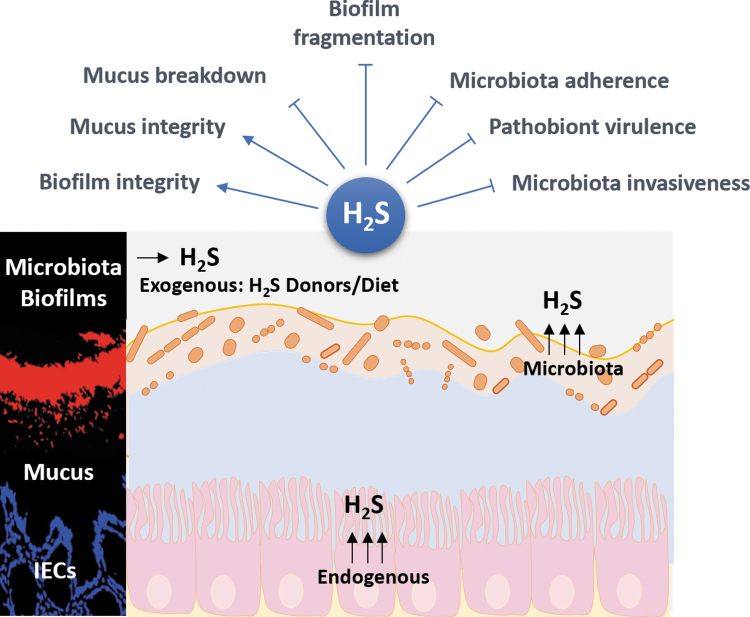
Significance: Hydrogen sulfide (H 2 S), an important regulator of physiology and health, helps resolve inflammation and promotes tissue repair in the gastrointestinal tract. Recent Advances: Gut microbiota live as a multispecies biofilm in close interaction with the upper mucus layer lining the epithelium. The relative abundance, spatial organization, and function of these microorganisms affect a broad range of health outcomes. This article provides a state-of-the-art review of our understanding of the cross talk between H 2 S, the gut microbiota, and health. H 2 S can have toxic or therapeutic effects, depending on its concentration and source. When produced at excessive concentrations by local microbiota, H 2 S may cause mucus disruption and inflammation and contribute to development of cancer. In contrast, low levels of endogenous or exogenous H 2 S directly stabilize mucus layers, prevent fragmentation and adherence of the microbiota biofilm to the epithelium, inhibit the release of invasive pathobionts, and help resolve inflammation and tissue injury. Although scarce, research findings suggest that dietary H 2 S obtained from plants or ingestion of the H 2 S precursor, L-cysteine, may also modulate the abundance and function of microbiota. Critical Issues: A critical issue is the lack of understanding of the metagenomic, transcriptomic, and proteomic alterations that characterize the interactions between H 2 S and gut microbiota to shape health outcomes. Future Directions: The ambivalent roles of H 2 S in the gut offer a fertile ground for research on such critical issues. The findings will improve our understanding of how H 2 S modulates the microbiota to affect body function and will help identify novel therapeutic strategies. Antioxid. Redox Signal . 36, 211–219.
Overview
The claims and statistics of this paper haven’t been checked yet.
Run the check — free, no account needed. It reads the open-access text and checks the sources it cites.
Integrity signals
Registry
Cites
Statistics
Figures
Verification
Claims the paper makes
The claims and statistics of this paper haven’t been checked yet.
Run the check — free, no account needed. It reads the open-access text and checks the sources it cites.
Claims other papers make about this one
Each is checked against this paper’s own text: does it say what the citing paper says it does?
In the citing paper
“However, H2S exhibits a dual effect, being cytoprotective at low concentrations but toxic at high concentrations [58].”
From Healthy Human Fecal Microbiota Transplantation into Mice Attenuates MPTP-Induced Neurotoxicity via AMPK/SOD2 Pathway (2023) · cites this paper as [58]
Self-check
Percentages, sums and reported differences re-computed from the paper’s own numbers.
The self-check needs the paper’s full text.
Citations
Cites
Current understanding of the human microbiome
Gilbert, J. A., Blaser, M. J., Caporaso, J. G., Jansson, J. K., Lynch, S. V., & Knight, R. (2018) · Nature Medicine · doi:10.1038/nm.4517 · Cited by 2,609
The possible role of hydrogen sulfide as an endogenous neuromodulator
Abe, K., & Kimura, H. (1996) · Journal of Neuroscience · doi:10.1523/jneurosci.16-03-01066.1996 · Cited by 2,240
The gut microbiota–brain axis in behaviour and brain disorders
Morais, L. H., Schreiber, H. L., & Mazmanian, S. K. (2021) · Nature Reviews Microbiology · doi:10.1038/s41579-020-00460-0 · Cited by 2,149
Control of pathogens and pathobionts by the gut microbiota
Kamada, N., Chen, G. Y., Inohara, N., & Núñez, G. (2013) · Nature Immunology · doi:10.1038/ni.2608 · Cited by 1,625
Hydrogen sulfide-based therapeutics: exploiting a unique but ubiquitous gasotransmitter
Wallace, J. L., & Wang, R. (2015) · Nature Reviews Drug Discovery · doi:10.1038/nrd4433 · Cited by 882
Self-citationHydrogen sulfide is an endogenous stimulator of angiogenesis
Papapetropoulos, A., Pyriochou, A., Altaany, Z., Yang, G., Marazioti, A., Zhou, Z., Jeschke, M. G., Branski, L. K., Herndon, D. N., Wang, R., et al. (2009) · Proceedings of the National Academy of Sciences · doi:10.1073/pnas.0908047106 · Cited by 868
Bäckhed, F., Fraser, C. M., Ringel, Y., Sanders, M. E., Sartor, R. B., Sherman, P. M., Versalovic, J., Young, V., & Finlay, B. B. (2012) · Cell Host & Microbe · doi:10.1016/j.chom.2012.10.012 · Cited by 836
The Battle for Iron between Bacterial Pathogens and Their Vertebrate Hosts
Skaar, E. P. (2010) · PLoS Pathogens · doi:10.1371/journal.ppat.1000949 · Cited by 796
H 2 S: A Universal Defense Against Antibiotics in Bacteria
Shatalin, K. Y., Shatalina, E., Mironov, A. S., & Nudler, E. (2011) · Science · doi:10.1126/science.1209855 · Cited by 769
Interactions of commensal and pathogenic microorganisms with the intestinal mucosal barrier
Martens, E. C., Neumann, M., & Desai, M. S. (2018) · Nature Reviews Microbiology · doi:10.1038/s41579-018-0036-x · Cited by 711
Research works printed but not linked: 1
- Du Toit A. The health benefits of hydrogen sulphide. Nat Rev Mol Cell Biol, 16: 68, 2015. · DOI
Cited by
Sorted by citations
Items 101–150 of 150
Impact of Phosphogypsum on Viability of Trichuris suis Eggs in Anaerobic Digestion of Swine Manure
Boyko, О. О., Brygadyrenko, V. V., Chernysh, Y., Chubur, V., & Roubík, H. (2025) · Microorganisms · doi:10.3390/microorganisms13051165 · Cited by 3
A Whiff of Sulfur: One Wind a Day Keeps the Doctor Away
Tiganescu, E., Lämmermann, M. A., Ney, Y., Abdin, A. Y., Nasim, M. J., & Jacob, C. (2022) · Antioxidants · doi:10.3390/antiox11061036 · Cited by 4
Hydrogen Sulfide Has a Minor Impact on Human Gut Microbiota Across Age Groups
Liu, L., Lemons, J. M. S., Firrman, J., Mahalak, K. K., Chetty, V. J., Narrowe, A. B., Higgins, S., Moustafa, A. M., Baudot, A., Deyaert, S., et al. (2025) · Sci · doi:10.3390/sci7030102 · Cited by 2
High-Fat Diet: A Paradoxical Factor in the Setting of Type 1 Diabetes
Lu, W.-Y., Rong, S.-J., Liu, S., Yang, C., Liu, Y.-C., Al-Siddiqi, H., Sun, F., & Wang, C.-Y. (2025) · Nutrition Reviews · doi:10.1093/nutrit/nuaf184 · Cited by 2
Nguyen, A. T., Johnson, R., Rafuse, M., Zhao, A., Madukwe, D., Battistella, A., & Tan, W. (2025) · Acta Biomaterialia · doi:10.1016/j.actbio.2025.12.032 · Cited by 2
Zhou, Y., & Tao, E. (2026) · Frontiers in Nutrition · doi:10.3389/fnut.2025.1694831 · Cited by 3
Targeting the Gut in Sepsis: Therapeutic Potential of Medical Gases
Yumoto, T., Obara, T., Naito, H., & Nakao, A. (2026) · Biomolecules · doi:10.3390/biom16020199 · Cited by 2
The Gut-Brain-Cardiac Axis: How Microbiota Influence Cognitive and Cardiovascular Health
Kumar, V., Singh, B., Ayyagari, A., Chaudhari, D. N., & Ahire, J. J. (2026) · Current Microbiology · doi:10.1007/s00284-026-04857-7 · Cited by 2
Chen, Y., Mao, Z., Lian, H., Li, Q., Wang, C., & Li, Y. (2026) · Journal of Controlled Release · doi:10.1016/j.jconrel.2026.114875 · Cited by 2
A changing gut virome ecological landscape with longevity
Wilmanski, T. M., & Gibbons, S. M. (2023) · Trends in Microbiology · doi:10.1016/j.tim.2023.07.013 · Cited by 2
He, J., Qi, P., Zhang, D., Zeng, Y., Zhao, P., & Wang, P. (2023) · Microchimica Acta · doi:10.1007/s00604-023-06071-9 · Cited by 2
Profir, M., Roşu, O. A., Gașpar, B. S., & Creţoiu, S. M. (2024) · Interdisciplinary cancer research · doi:10.1007/16833_2024_305 · Cited by 2
Suttle, N. F., Sangwan, N., & Knox, D. P. (2022) · Journal of Comparative Pathology · doi:10.1016/j.jcpa.2022.08.001 · Cited by 2
Lü, N., Yao, Y., Gao, M., Liu, Z., Xie, H., Liu, J., & Jiao, Q. (2025) · International Archives of Allergy and Immunology · doi:10.1159/000546793 · Cited by 1
Pei, J., Chen, L., Pushparaj, R., Huang, P., Pan, G., Sun, C., Gao, X., Zhang, L., Manirujjaman, M., Huang, C.-K., et al. (2026) · eGastroenterology · doi:10.1136/egastro-2025-100321 · Cited by 1
Lee, D., Jeong, H., Gwon, H., Lee, K., Kim, J.-Y., Shim, J.-J., & Lee, J.-H. (2026) · Journal of Microbiology and Biotechnology · doi:10.4014/jmb.2604.04063 · Cited by 1
Molecular Interplay of Oxidative Stress and Gut Microbiome in Aging
Bari, A. B. A., Krishnan, M., & Babu, S. (2024) · Springer eBooks · doi:10.1007/978-981-99-8803-7_7 · Cited by 1
Impact of the Gastrointestinal Tract Microbiota on Cardiovascular Health and Pathophysiology
Akyıldız, A. G., Biondi‐Zoccai, G., & Biase, D. D. (2022) · Journal of Cardiovascular Pharmacology · doi:10.1097/fjc.0000000000001273 · Cited by 1
Sulfide is a keystone metabolite for gut homeostasis and immunityPreprint
Band, V. I., Gribonika, I., Stacy, A., Bouladoux, N. J., Mistry, S., Burns, A. S., Pérez‐Chaparro, P. J., Chau, J., Enamorado, M., Nagai, M., et al. (2025) · bioRxiv (Cold Spring Harbor Laboratory) · doi:10.1101/2025.03.06.641928 · Cited by 1
Cu-doped SnO2/rGO nanocomposites for ultrasensitive H2S detection under low temperaturePreprint
Sun, J., Chen, T., Xue, N., Wang, W., Jiang, K., Zhou, T., & Quan, H. (2022) · Research Square · doi:10.21203/rs.3.rs-2332849/v1
Neurological Interactions with Microbiomes
Saar, R., & Dodd, S. A. S. (2023) · doi:10.1002/9781119862611.ch16
de Oliveira, J. P. (2023) · Digital Library of Theses and Dissertations (Universidade de São Paulo) · doi:10.11606/t.42.2023.tde-07022024-154042
Antony, A. T., Mohseni, F. S., Toubon, G., Guðnadóttir, U., Engstrand, L. G., Fransson, E., Schuppe‐Koistinen, I., Brusselaers, N., & Hugerth, L. W. (2025) · medRxiv · doi:10.1101/2025.10.08.25337564
Vishnu, Kaur, J., & Palanisamy, K. (2025) · Journal of Basic Microbiology · doi:10.1002/jobm.70116
Yu, S., Wang, X., Li, Z., Jin, D., Yu, M., Li, J., Li, Y., Liu, X., Zhang, Q., Liu, Y., et al. (2024) · Figshare · doi:10.6084/m9.figshare.26682349
Ab initio Whole Cell Kinetic Model of Desulfovibrio desulfuricans L4 (ddsAAR26)
RajKumar, A. A., Kang, C. K. N., Verma, S., Nanthakumarvani, D., Abul-Hasan, S., Perumal, L. H., & Ling, M. H. (2026) · Journal of Clinical Immunology & Microbiology · doi:10.46889/jcim.2026.7103
Kang, H., Feng, Y., Wang, B., Chen, Z., Li, J., & Chen, Z. (2026) · Pharmacological Research · doi:10.1016/j.phrs.2026.108108 · Cited by 1
Aburto-Hole, J., Pincheira, P. I. R., Acuna, P. F., Uribe, L., Bilbao, D. C., & Hernández, D. (2026) · Environments · doi:10.3390/environments13030135
Personalized gastroenterology: colorectal cancer
Parvez, A., Jafar, F., Siddique, M. Z. H., Parveen, N., Das, P., & Qureshi, K. A. (2026) · Elsevier eBooks · doi:10.1016/b978-0-443-40483-2.00039-x
Chao, S., Li, S., Zhong, J., Peng, X., Li, Y., Shi, M., Hu, X., & Liu, B. (2026) · Foods · doi:10.3390/foods15081325
Aryal, B., Ariyo, O. W., Kwakye, J., Sovi, S., Ghareeb, A. F. A., Hartono, E., Milfort, M. C., Fuller, A. L., Romdhane Rekaya, A., & Aggrey, S. E. (2026) · Poultry Science · doi:10.1016/j.psj.2026.106947
Tian, S., Huang, E., Zhang, G., Song, J., Zhong, W., Zhang, J., Liu, X., Yang, M., Wang, H., Liu, C., et al. (2026) · Brain Behavior and Immunity · doi:10.1016/j.bbi.2026.106801
Valerii, M. C., Fabbri, E., Spigarelli, R., Bernacchi, A., Valbonesi, P., Turroni, S., D’Amico, F., & Spisni, E. (2026) · Environmental Pollution · doi:10.1016/j.envpol.2026.128418
The impact of hydrogen sulfide on gut microbiota of diabetic mice with lower limb arterial ischemia
Qiu, X., Li, W., Zhang, M., Lei, S., (5190), H. C., Wang, X., Miao, Y., Yu, Z., Wu, Y., & Hou, Z. (2026) · BMC Microbiology · doi:10.1186/s12866-026-05167-5
Crafting probiotics a self-polymerized smart outfit for effective ulcerative colitis treatment
Wang, Z., Zhang, Y., Lu, Y., Cong, Z., Rong, F., Li, Z., Chen, J., & Wang, Y. (2026) · Journal of Nanobiotechnology · doi:10.1186/s12951-026-04650-5
Gut microbiota from health to disease: A role for biofilms?
Buret, A. G., & Allain, T. (2026) · Elsevier eBooks · doi:10.1016/b978-0-443-40306-4.00011-9
Self-citationWound healing and barrier integrity: Cellular and molecular players in gastric mucosal repair
Gemici, B. (2026) · Elsevier eBooks · doi:10.1016/b978-0-443-40306-4.00001-6
Maric, T., Vorobyeva, A., Bazhin, A. A., Khodakivskyi, P. V., Mikhaylov, G., Solodnikova, E. S., Collins, J. W., D’Alessandro, P. L., Göpfert, C., Sordet‐Dessimoz, J., et al. (2026) · Chemical & Biomedical Imaging · doi:10.1021/cbmi.6c00075
Wang, H., Jiang, L., Zhong, L., Zhang, H., Li, Y., Zhai, Z., Liu, W., Ma, M., Chen, Q. F., & Xl, T. (2026) · Frontiers in Physiology · doi:10.3389/fphys.2026.1891419
Smirnova, G. V., Tyulenev, A. V., Sutormina, L., Forte, E., Borisov, V. B., & Oktyabrsky, O. N. (2026) · International Journal of Molecular Sciences · doi:10.3390/ijms27156983
Валерьевна, Т. Е., Николаевич, Т. М., & Novochadov, V. V. (2026) · Ural Medical Journal · doi:10.52420/umj.25.4.80
Hayes, J. A., Buchinger, B., Lunger, A. W., Khanvilkar, T., Gasparrini, W., Fernez, M. T., Morrissette, M., Strandwitz, P., Koppes, A., Koppes, R., et al. (2026) · Metabolic Engineering · doi:10.1016/j.ymben.2026.102540
Metabolic shifts driven by host‐microbial interactions
Nair, T., Stuhr, N. L., Weathers, B. A., & Curran, S. P. (2026) · FEBS Journal · doi:10.1111/febs.70704
Metaproteomic portrait of the gut microbiome in children with Down syndromePreprint
Marzano, V., Pirona, I., Rapisarda, F., Marangelo, C., Macari, G., Mortera, S. L., Vernocchi, P., Agolini, E., Dallapiccola, B., Novelli, A., et al. (2026) · Research Square · doi:10.21203/rs.3.rs-10623142/v1
IgA deficiency reveals a microbiota-dependent pathway to gluten sensitivity
Ball, R. A. W., Mohammed, A. D., Jolly, A., Johnson, K. F., Sklenicka, S., Kucherina, M., Peacock, T. E., Liu, E., Hogan, K. M., Baird, M., et al. (2026) · Gut Microbes · doi:10.1080/19490976.2026.2724175
Interplay Between the Gut Microbiome and Oxidative Stress in Type 2 Diabetes
Kim, J.-W., Lee, Y., Kim, K., & Ko, S.-H. (2026) · Antioxidants · doi:10.3390/antiox15101278
Zhao, C., Lu, H., Liu, F., & Qiao, Y. (2026) · Microorganisms · doi:10.3390/microorganisms14102361
Metadata
- Authors
- Buret, A. G., Allain, T., Motta, J.-P., & Wallace, J. L.
- Affiliations
- Host–Parasite Interactions Program, Inflammation Research Network, Biological Sciences, University of Calgary, Calgary, Canada.
- University of Calgary (CA)
- Inserm (FR)
- Venue
- Antioxidants & Redox Signaling
- Publisher
- SAGE Publications
- Published
- 2022-02
- Volume
- 36
- Issue
- 4-6
- Pages
- 211-219
- ISSN
- 1523-0864 (ISSN-L)
- 1557-7716
- PMC
- PMC8861923
- OpenAlex
- W3133888684
- Cited by
- 151
- References
- 81
- Citations by year
- 2026: 33 · 2025: 29 · 2024: 30 · 2023: 32 · 2022: 23
- FWCI
- 6.90
- Type
- journal article
- Language
- en
- Open access
- hybrid
- doi.org
- Licence
- Locations
- Antioxidants and Redox Signaling (publishedVersion, cc-by-nc)
- PubMed Central (publishedVersion, cc-by-nc)
- PubMed (publishedVersion)
- HAL (submittedVersion)
- Funders
- Canadian Institutes of Health Research
- Topics
- Life Sciences › Biochemistry, Genetics and Molecular Biology › Molecular Biology › Gut microbiota and health
- Life Sciences › Biochemistry, Genetics and Molecular Biology › Biochemistry › Sulfur Compounds in Biology
- Health Sciences › Medicine › Gastroenterology › Helicobacter pylori-related gastroenterology studies
- Keywords
- hydrogen sulfide, gut microbiota, mucus layer, inflammation resolution, tissue repair, gastrointestinal cancer, pathobionts, cysteine, microbiota-metabolite interactions
- MeSH terms
- Gastrointestinal Microbiome, Hydrogen Sulfide, Proteomics, Gastrointestinal Tract, Microbiota
About these checks
Registry, retraction, Cites and statistics results are computed, not judged, with one exception: a printed reference that no index lists is read once by a model before it counts as a citation error. Claims are extracted by a model and kept only when their quote appears verbatim in the text; each cited source is then checked, with a model’s help, for whether it says what the claim relies on. Those verdicts can be wrong — read the claim’s quote and the cited source before relying on one.
Statistics and arithmetic are recomputed, not judged.
Confidence bands are shown only for fields calibrated on our annotated test set. None is calibrated yet, so no band is shown.
What counts as a claim ›How we measure confidence ›How we check this ›
Are you an author, or do you see a problem with this page? Request a review
