

The DOI matches its Crossref record; 17 of the 17 references it cites were found in a registry or an index.
Accuracy and Safety of Dexcom G7 Continuous Glucose Monitoring in Adults with Diabetes
Open accessAbstract
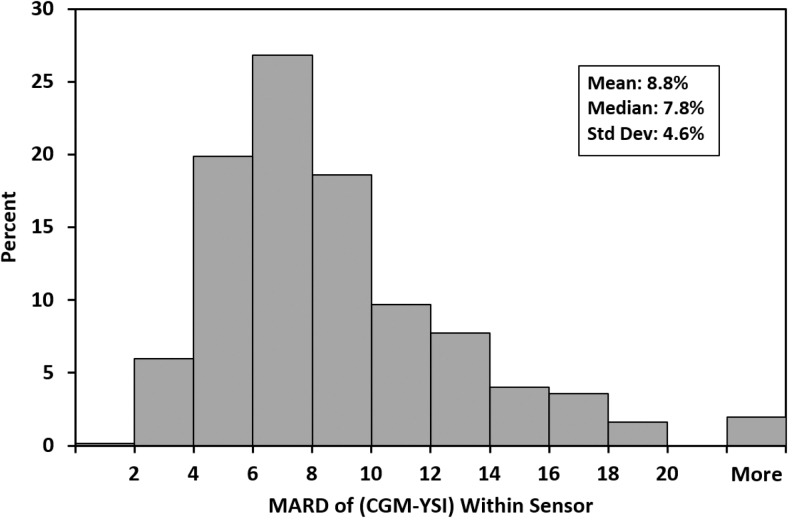
Background: We evaluated the accuracy and safety of a seventh generation (G7) Dexcom continuous glucose monitor (CGM) during 10.5 days of use in adults with diabetes. Methods: Adults with either type 1 or type 2 diabetes (on intensive insulin therapy or not) participated at 12 investigational sites in the United States. In-clinic visits were conducted on days 1 or 2, 4 or 7, and on the second half of day 10 or the first half of day 11 for frequent comparisons with comparator blood glucose measurements obtained with the YSI 2300 Stat Plus glucose analyzer. Participants wore sensors concurrently on the upper arm and abdomen. Accuracy evaluation included the proportion of CGM values within 15% of comparator glucose levels >100 mg/dL or within 15 mg/dL of comparator levels ≤100 mg/dL (%15/15), along with the %20/20 and %30/30 agreement rates. The mean absolute relative difference (MARD) between temporally matched CGM and comparator values was also calculated. Results: Data from 316 participants (619 sensors, 77,774 matched pairs) were analyzed. For arm- and abdomen-placed sensors, overall MARDs were 8.2% and 9.1%, respectively. Overall %15/15, %20/20, and %30/30 agreement rates were 89.6%, 95.3%, and 98.8% for arm-placed sensors and were 85.5%, 93.2%, and 98.1% for abdomen-placed sensors. Across days of wear, glucose concentration ranges, and rates of change, %20/20 agreement rates varied by no more than 9% from the overall %20/20. No serious adverse events were reported. Conclusions: The G7 CGM provides accurate glucose readings with single-digit MARD with arm or abdomen placement in adults with diabetes. Clinicaltrials.gov: NCT04794478
Overview
The claims and statistics of this paper haven’t been checked yet.
Run the check — free, no account needed. It reads the open-access text and checks the sources it cites.
Integrity signals
Registry
Cites
Statistics
Figures
Verification
Claims the paper makes
The claims and statistics of this paper haven’t been checked yet.
Run the check — free, no account needed. It reads the open-access text and checks the sources it cites.
Claims other papers make about this one
Each is checked against this paper’s own text: does it say what the citing paper says it does?
The check wasn’t confident either way, so it gives no verdict — never disputed.
In the citing paper
“In a meta-analysis and systematic review of 15 randomized clinical trials and observational studies (783 255 patients) comparing intensive control (HbA1C <7.5%) vs standard care in adults 60 years or older or frail adults of any age with type 2 diabetes, there was no difference in mortality, but intensive control was associated with both a reduction in microvascular and macrovascular complications”
From Diagnosis and Treatment of Type 2 Diabetes in Adults (2025) · cites this paper as [45]
Experimental — accuracy not yet measured
Self-check
Percentages, sums and reported differences re-computed from the paper’s own numbers.
The self-check needs the paper’s full text.
Citations
Cites
State of Type 1 Diabetes Management and Outcomes from the T1D Exchange in 2016–2018
Foster, N. C., Beck, R. W., Miller, K. M., Clements, M. A., Rickels, M. R., DiMeglio, L. A., Maahs, D. M., Tamborlane, W. V., Bergenstal, R., Smith, E., et al. (2019) · Diabetes Technology & Therapeutics · doi:10.1089/dia.2018.0384 · Cited by 1,907
Self-citationBeck, R. W., Riddlesworth, T., Ruedy, K., Ahmann, A., Bergenstal, R., Haller, S., Kollman, C., Kruger, D., McGill, J. B., Polonsky, W., et al. (2017) · JAMA · doi:10.1001/jama.2016.19975 · Cited by 1,185
Lind, M., Polonsky, W., Hirsch, I. B., Heise, T., Bolinder, J., Dahlqvist, S., Schwarz, E., Ólafsdóttir, A. F., Frid, A., Wedel, H., et al. (2017) · JAMA · doi:10.1001/jama.2016.19976 · Cited by 705
Martens, T., Beck, R. W., Bailey, R., Ruedy, K. J., Calhoun, P., Peters, A. L., Pop-Busui, R., Philis-Tsimikas, A., Bao, S., Umpierrez, G., et al. (2021) · JAMA · doi:10.1001/jama.2021.7444 · Cited by 543
Self-citationAssessing Sensor Accuracy for Non-Adjunct Use of Continuous Glucose Monitoring
Kovatchev, B. P., Patek, S. D., Ortiz, E. A., & Breton, M. D. (2015) · Diabetes Technology & Therapeutics · doi:10.1089/dia.2014.0272 · Cited by 234
Wadwa, R. P., Laffel, L. M., Shah, V. N., & Garg, S. K. (2018) · Diabetes Technology & Therapeutics · doi:10.1089/dia.2018.0150 · Cited by 203
Self-citationShah, V. N., Laffel, L. M., Wadwa, R. P., & Garg, S. K. (2018) · Diabetes Technology & Therapeutics · doi:10.1089/dia.2018.0143 · Cited by 197
Self-citationKarter, A. J., Parker, M. M., Moffet, H. H., Gilliam, L. K., & Dlott, R. (2021) · JAMA · doi:10.1001/jama.2021.6530 · Cited by 191
Rate-of-Change Dependence of the Performance of Two CGM Systems During Induced Glucose Swings
Pleus, S., Schoemaker, M., Morgenstern, K., Schmelzeisen‐Redeker, G., Haug, C., Link, M., Zschornack, E., & Freckmann, G. (2015) · Journal of Diabetes Science and Technology · doi:10.1177/1932296815578716 · Cited by 84
Performance of the Dexcom G6 Continuous Glucose Monitoring System in Pregnant Women with Diabetes
CASTORINO, K. N., Polsky, S., O’Malley, G., Levister, C. M., Nelson, K., Farfan, C. C., BRACKETT, S. J., Puhr, S., & Levy, C. J. (2020) · Diabetes Technology & Therapeutics · doi:10.1089/dia.2020.0085 · Cited by 80
Self-citationBailey, T. S., Zisser, H., & Chang, A. (2009) · Diabetes Technology & Therapeutics · doi:10.1089/dia.2009.0075 · Cited by 71
Self-citationGuillot, F. H., Jacobs, P. G., Wilson, L. M., Youssef, J. E., Gabo, V. B., Branigan, D. L., Tyler, N. S., Ramsey, K., Riddell, M. C., & Castle, J. R. (2020) · Biosensors · doi:10.3390/bios10100138 · Cited by 50
Comparison of Continuous Glucose Monitoring Accuracy Between Abdominal and Upper Arm Insertion Sites
Steineck, I. I. K., Mahmoudi, Z., Ranjan, A. G., Schmidt, S., Jørgensen, J. B., & Nørgaard, K. (2019) · Diabetes Technology & Therapeutics · doi:10.1089/dia.2019.0014 · Cited by 40
Welsh, J. B., Zhang, X., Puhr, S., Johnson, T. K., Walker, T. C., Balo, A. K., & Price, D. A. (2018) · Journal of Diabetes Science and Technology · doi:10.1177/1932296818798816 · Cited by 34
Self-citationPerformance and Usability of Three Systems for Continuous Glucose Monitoring in Direct Comparison
Freckmann, G., Link, M., Kamecke, U., Haug, C., Baumgartner, B., & Weitgasser, R. (2019) · Journal of Diabetes Science and Technology · doi:10.1177/1932296819826965 · Cited by 34
Moser, O., Pandis, M., Aberer, F., Kojzar, H., Hochfellner, D. A., Elsayed, H., Motschnig, M., Augustin, T., Kreuzer, P., Pieber, T. R., et al. (2018) · Diabetes Obesity and Metabolism · doi:10.1111/dom.13598 · Cited by 22
Litchman, M. L., Wawrzynski, S. E., Woodruff, W. S., Arrington, J. B., Nguyen, Q. C., & Gee, P. M. (2019) · JMIR Public Health and Surveillance · doi:10.2196/11024 · Cited by 8
Research works printed but not linked: 1
- Calhoun P, , Puhr S, , Welsh JB, et al.: Lag time of a sixth-generation continuous glucose monitoring system. J Diabetes Sci Technol, 2018; 13:308.
Cited by
Sorted by citations
Continuous glucose monitoring and metrics for clinical trials: an international consensus statement
Battelino, T., Alexander, C. M., Amiel, S. A., Arreaza-Rubin, G., Beck, R. W., Bergenstal, R. M., Buckingham, B. A., Carroll, J., Ceriello, A., Chow, E., et al. (2023) · The Lancet Diabetes & Endocrinology · doi:10.1016/s2213-8587(22)00319-9 · Cited by 831
Self-citationWearable Electrochemical Glucose Sensors in Diabetes Management: A Comprehensive Review
Saha, T., Del Caño, R., Mahato, K., De la Paz, E., Chen, C., Ding, S., Yin, L., & Wang, J. (2023) · Chemical Reviews · doi:10.1021/acs.chemrev.3c00078 · Cited by 442
Fahim, Y. A., Hasani, I. W., Kabba, S., & Ragab, W. M. (2025) · European Journal of Medical Research · doi:10.1186/s40001-025-03196-w · Cited by 329
7. Diabetes Technology: Standards of Care in Diabetes — 2023
ElSayed, N. A., Aleppo, G., Aroda, V. R., Bannuru, R. R., Brown, F. M., Bruemmer, D., Collins, B. S., Hilliard, M. E., Isaacs, D., Johnson, E. L., et al. (2023) · Diabetes Care · doi:10.2337/dc23-s007 · Cited by 301
7. Diabetes Technology: Standards of Care in Diabetes—2024
American Diabetes Association Professional Practice Committee, ElSayed, N. A., Aleppo, G., Bannuru, R. R., Bruemmer, D., Collins, B. S., Ekhlaspour, L., Hilliard, M. E., Johnson, E. L., Khunti, K., et al. (2024) · Diabetes Care · doi:10.2337/dc24-s007 · Cited by 281
Metadata
- Authors
- Garg, S. K., Kipnes, M., Castorino, K., Bailey, T. S., Akturk, H. K., Welsh, J. B., Christiansen, M. P., Balo, A. K., Brown, S. A., Reid, J. L., & Beck, S. E.
- Affiliations
- University of Colorado Anschutz (US)
- DGD Clinic, San Antonio, Texas, USA.
- Sansum Diabetes Research Institute (US)
- AMCR Institute (US)
- Department of Medicine and Pediatrics, Barbara Davis Center for Diabetes, University of Colorado, Aurora, Colorado, USA.
- Dexcom (United States) (US)
- Diablo Clinical Research (US)
- University of Virginia (US)
- Corresponding author
- Garg, Satish K.
- ORCID
- Venue
- Diabetes Technology & Therapeutics
- Publisher
- SAGE Publications
- Published
- 2022-05-31
- Volume
- 24
- Issue
- 6
- Pages
- 373-380
- ISSN
- 1520-9156 (ISSN-L)
- 1557-8593
- PMC
- PMC9208857
- OpenAlex
- W4212853509
- Cited by
- 179
- References
- 17
- Citations by year
- 2026: 44 · 2025: 63 · 2024: 37 · 2023: 23 · 2022: 12
- FWCI
- 25.02
- Type
- journal article
- Language
- en
- Open access
- hybrid
- doi.org
- Licence
- Locations
- Diabetes Technology & Therapeutics (publishedVersion, cc-by)
- PubMed Central (publishedVersion, cc-by)
- PubMed (publishedVersion)
- Topics
- Health Sciences › Medicine › Endocrinology, Diabetes and Metabolism › Diabetes Management and Research
- Health Sciences › Medicine › Endocrinology, Diabetes and Metabolism › Diabetes Treatment and Management
- Health Sciences › Medicine › Endocrinology, Diabetes and Metabolism › Diabetes Management and Education
- Keywords
- Dexcom G7, continuous glucose monitoring, type 1 diabetes, type 2 diabetes, sensor accuracy, mean absolute relative difference, sensor placement, intensive insulin therapy, device safety
- MeSH terms
- Adult, Blood Glucose, Diabetes Mellitus, Type 1, Diabetes Mellitus, Type 2, Glucose, Humans, Blood Glucose Self-Monitoring, Reproducibility of Results
About these checks
Registry, retraction, Cites and statistics results are computed, not judged, with one exception: a printed reference that no index lists is read once by a model before it counts as a citation error. Claims are extracted by a model and kept only when their quote appears verbatim in the text; each cited source is then checked, with a model’s help, for whether it says what the claim relies on. Those verdicts can be wrong — read the claim’s quote and the cited source before relying on one.
Statistics and arithmetic are recomputed, not judged.
Confidence bands are shown only for fields calibrated on our annotated test set. None is calibrated yet, so no band is shown.
What counts as a claim ›How we measure confidence ›How we check this ›
Are you an author, or do you see a problem with this page? Request a review
