

Maternal Dietary Patterns and Birth Outcomes: A Systematic Review and Meta-Analysis
Open accessThe DOI matches its Crossref record; 84 of the 85 references it cites were found in a registry or an index.
Abstract
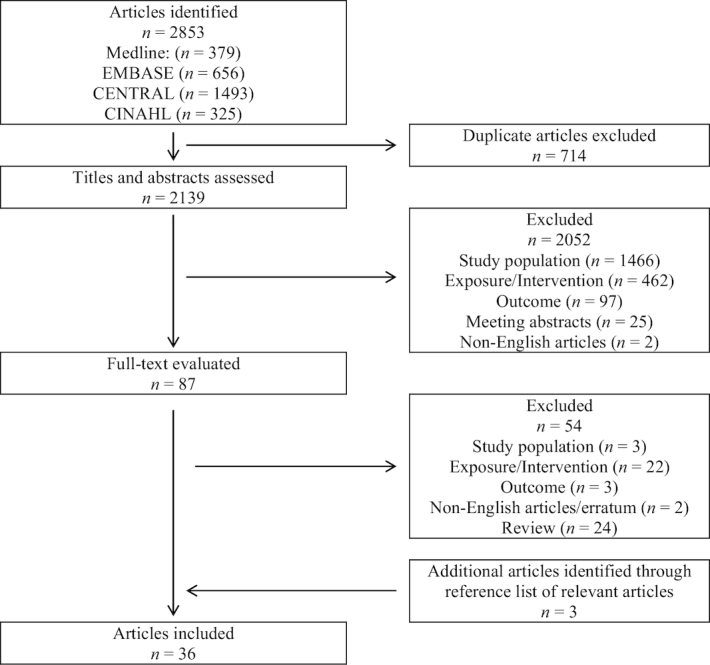
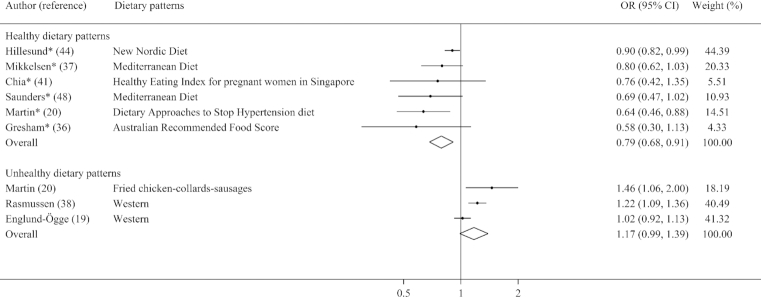
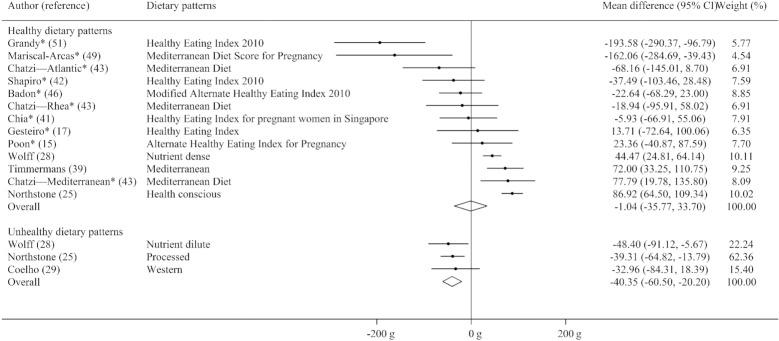
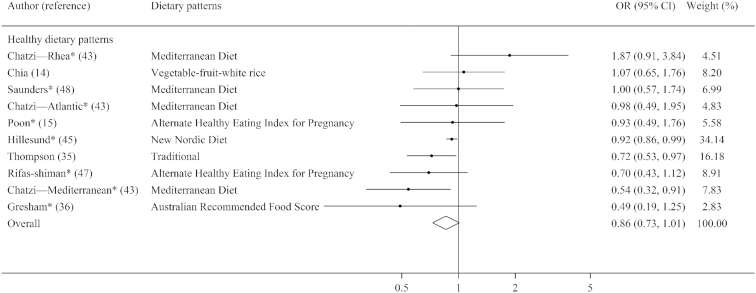
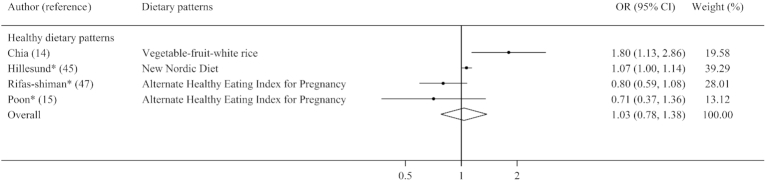
Findings on the relations of maternal dietary patterns during pregnancy and risk of preterm birth and offspring birth size remain inconclusive. We aimed to systematically review and quantify these associations. We searched MEDLINE, Embase, CENTRAL, and CINAHL up to December 2017. Three authors independently conducted a literature search, study selection, data extraction, and quality assessment. Summary effect sizes were calculated with random effects models and studies were summarized narratively if results could not be pooled. We included 36 studies and pooled results from 25 observational studies (167,507 participants). Two common dietary patterns-"healthy" and "unhealthy"-were identified. Healthy dietary patterns-characterized by high intakes of vegetables, fruits, wholegrains, low-fat dairy, and lean protein foods-were associated with lower risk of preterm birth (OR for top compared with bottom tertile: 0.79; 95% CI: 0.68, 0.91; I2 = 32%) and a weak trend towards a lower risk of small-for-gestational-age (OR: 0.86; 95% CI: 0.73, 1.01; I2 = 34%). Only statistically data-driven healthy dietary patterns, and not dietary index-based patterns, were associated with higher birth weight (mean difference: 67 g; 95% CI: 37, 96 g; I2 = 75%). Unhealthy dietary patterns-characterized by high intakes of refined grains, processed meat, and foods high in saturated fat or sugar-were associated with lower birth weight (mean difference: -40 g; 95% CI: -61, -20 g; I2 = 0%) and a trend towards a higher risk of preterm birth (OR: 1.17; 95% CI: 0.99, 1.39; I2 = 76%). Data from observational studies indicate that greater adherence to healthy dietary patterns during pregnancy is significantly related to lower risk of preterm birth. No consistent associations with birth weight and small- or large-for-gestational-age were observed.
Overview
The claims and statistics of this paper haven’t been checked yet.
Free: it reads the open-access text and checks the first 5 claims that cite a source we can check. Create a free account to check every claim.
Integrity signals
Registry
Cites
Statistics
Figures
Verification
Claims the paper makes
The claims and statistics of this paper haven’t been checked yet.
Free: it reads the open-access text and checks the first 5 claims that cite a source we can check. Create a free account to check every claim.
Self-check
Percentages, sums and reported differences re-computed from the paper’s own numbers.
The self-check needs the paper’s full text.
Citations
Cites
Preferred Reporting Items for Systematic Reviews and Meta-Analyses: the PRISMA statement
Moher, D., Liberati, A., Tetzlaff, J., Altman, D. G., & for the PRISMA Group (2009) · BMJ · doi:10.1136/bmj.b2535 · Cited by 83,823
Preferred reporting items for systematic reviews and meta-analyses: the PRISMA Statement.
(2009) · PubMed Central · Cited by 44,859
Preferred reporting items for systematic reviews and meta-analyses: The PRISMA statement
Moher, D., Liberati, A., Tetzlaff, J., Altman, D. G., & the PRISMA Group* (2009) · Annals of Internal Medicine · doi:10.7326/0003-4819-151-4-200908180-00135 · Cited by 37,554
Cochrane Handbook for Systematic Reviews of Interventions: Cochrane Book Series
(2008) · doi:10.1002/9780470712184 · Cited by 25,048 · cited 2×
“Publication bias was assessed by visual inspection of a funnel plot and Egger’s test (34).”
Stang, A. (2010) · European Journal of Epidemiology · doi:10.1007/s10654-010-9491-z · Cited by 17,396 · cited 4×
“All studies except for 5 (24, 25, 28, 48, 49) were of high quality (NOS score ≥ 7) (Supplemental Table 1).”
InfluentialCicchetti, D. V. (1994) · Psychological Assessment · doi:10.1037/1040-3590.6.4.284 · Cited by 9,349 · cited 1×
“The inter-rater agreement for each subscale was reasonably good (intraclass correlation coefficient values between 0.75 and 0.93) (13).”
InfluentialEpidemiology and causes of preterm birth
Goldenberg, R. L., Culhane, J. F., Iams, J. D., & Romero, R. (2008) · The Lancet · doi:10.1016/s0140-6736(08)60074-4 · Cited by 7,801
Cochrane Handbook for Systematic Reviews of Interventions
Tarsilla, M. (2010) · Journal of MultiDisciplinary Evaluation · doi:10.56645/jmde.v6i14.284 · Cited by 5,178
Blencowe, H., Cousens, S., Oestergaard, M. Z., Chou, D., Moller, A.-B., Narwal, R., Adler, A., Vera Garcia, C., Rohde, S., Say, L., et al. (2012) · The Lancet · doi:10.1016/s0140-6736(12)60820-4 · Cited by 4,568
Dietary pattern analysis: a new direction in nutritional epidemiology
Hu, F. B. (2002) · Current Opinion in Lipidology · doi:10.1097/00041433-200202000-00002 · Cited by 4,029 · cited 1×
“Furthermore, if certain dietary components of the index-based dietary pattern are not relevant to birth weight (72) or if most people are not meeting dietary recommendations, the association between the given index and birth weight could be attenuated (73).”
Research works printed but not linked: 1
- Dietary Guidelines Advisory Committee Scientific report of the 2015 Dietary Guidelines Advisory Committee. Washington (DC): USDA and US Department of Health and Human Services, 2015. PMC4717899 26773024
Cited by
Items 201–271 of 271
Planning for the future: maternity services in 2035
Kamali, H., Moloney-Geany, S., Draycott, T. J., & Mahmood, T. (2020) · Elsevier eBooks · doi:10.1016/b978-0-12-817921-5.00033-3
ASPECTOS NUTRICIONAIS NA PREMATURIDADE
Korkes, H. A., Pimentel, C., & Fernandes, I. (2022) · doi:10.22533/at.ed.81822100824
VITALIDADE FETAL NA PREMATURIDADE
Rodrigues, T. C. G. F., Coutinho, C. M., & Cavalli, R. D. C. (2022) · doi:10.22533/at.ed.81822100813
PREMATURIDADE E TRIAGEM NEONATAL
Fonseca, A. A., Micheletti, C., & Fonseca, J. H. R. (2022) · doi:10.22533/at.ed.81822100825
ASPECTOS NEUROLÓGICOS E ORTOPÉDICOS NO DESENVOLVIMENTO DO PREMATURO
dos Santos, M. L. L., & Abreu, F. P. (2022) · doi:10.22533/at.ed.81822100819
O PAPEL DAS ORGANIZAÇÕES NÃO GOVERNAMENTAIS (ONGS) NO CONTEXTO DA PREMATURIDADE
Hennemann, A. C., neris, D. S., & Suguitani, D. (2022) · doi:10.22533/at.ed.81822100823
CUSTOS DA ASSISTÊNCIA A PREMATURIDADE
de Mello, F. B., & Goulart, A. L. (2022) · doi:10.22533/at.ed.81822100826
Kyrkou, C., Fotakis, C., Dimitropoulou, A., Tsakoumaki, F., Zoumpoulakis, P. G., Menexes, G. C., Βiliaderis, C. G., Athanasiadis, A. P., & Michaelidou, A.-M. (2023) · Metabolites · doi:10.3390/metabo13090977
Features of nutrition behavior of Kazakhstani adult population 2021: cross-sectional studyPreprint
Намазбаева, Ж. Е., Smailova, D. S., Mukasheva, G., Zhamakurova, A., Kuanyshkalieva, A., Karibayeva, I. K., Kauysheva, A., Otyzbayeva, N., Glushkova, N., Kulzhanov, M., et al. (2023) · Research Square · doi:10.21203/rs.3.rs-3339483/v1
Prognosis of pregnancy and perinatal outcomes in the presence of polycystic ovary syndrome
Kulakova, S. A., & Gomon, A. I. (2023) · Medical alphabet · doi:10.33667/2078-5631-2023-19-39-43
Comportamentos relacionados à saúde na perspectiva do cuidado obstétrico
Paulino, D. S. M. (2020) · doi:10.47749/t/unicamp.2020.1246517
Nutrition During Pregnancy: Myths and Facts
Ненартович, И. А. (2023) · Репродуктивное здоровье Восточная Европа · doi:10.34883/pi.2023.13.6.011
Association between the Dietary Inflammatory Index and the Risk of Cesarean Delivery
Sheikholmolooki, F., Djazayery, A., & Abbasi, B. (2024) · Iranian Journal of Public Health · doi:10.18502/ijph.v53i7.16056
“Some previous studies have examined the effect of healthy eating patterns on birth outcomes (18) or the impact of quality improvement in reducing unnecessary cesarean sections (19).”
BackgroundHow Diet Impacts the Relationship between Intimate Partner Aggression and Child Conduct Problems
Houchen, O. (2024) · Open Access Victoria University of Wellington | Te Herenga Waka (Figshare) · doi:10.26686/wgtn.26378731
Fetal nutrition and disease in later life
Langley-Evans, S. (2021) · Wiley eBooks · doi:10.1002/9781119717577.ch4
Cambios en la adherencia a patrones alimentarios de mujeres embarazadas de Córdoba, Argentina.
Lambert, V., Miranda, V. S., Vallejos, F., Grande, M. D. C., Muñoz, S. E., & Román, M. D. (2024) · Revista de Salud Pública · doi:10.31052/1853.1180.v.nespecial.47031
Cheng, C., Pei, Y., Shan, G., & Liu, Y. (2025) · Journal of Perinatology · doi:10.1038/s41372-024-02195-9
Villalba, B. L., Puig, B. M., Belinchón, A. G., & Morales‐Suárez‐Varela, M. (2025) · Medicina de Familia SEMERGEN · doi:10.1016/j.semerg.2025.102454
Donofry, S. D., Damon, S. T., Jouppi, R. J., Davis, J. A., Conlon, R. P. K., Call, C. C., & Levine, M. D. (2025) · SSRN Electronic Journal · doi:10.2139/ssrn.5244654
Vilmundardóttir, V. K., Þórisdóttir, B., Ramel, A., & Geirsdóttir, Ó. G. (2025) · Nutrients · doi:10.3390/nu17162583
“…and birth outcomes found dietary patterns rich in refined grains, processed meat, saturated fat and sugar to be associated with lower birth weight ( − 40 g 95% − 61, − 20), whilst finding a weak (unsignificant) protective trend for healthy dietary patterns and risk of low birth weight [48].”
Obeso, A., Jelenkovic, A., Drouard, G., Kaprio, J. A., & Silventoinen, K. (2025) · Early Human Development · doi:10.1016/j.earlhumdev.2025.106373
“Never-theless, other intrauterine conditions, such as maternal nutrition [60], placental function [12,13,61], and hormonal environment [62], may play a crucial role in shaping both birth size characteristics and subsequent BMI development.”
Kurihayashi, A. Y., Schneider, B. C., Figueiredo, A. C. C., Silva, G. T., Campos, A. D. D. S., Paula, D. P., Mucci, D. D. B., Allen, L. H., & Kac, G. (2025) · Maternal and Child Nutrition · doi:10.1111/mcn.70089 · Cited by 1
“Several studies found that an unhealthy maternal diet can be associated with gestational diabetes mellitus, pre ‐ eclampsia, maternal depression, low birth weight, preterm birth, and being small for gestational age (Chia et al. 2019; Opie et al. 2020; Paula et al. 2022).”
Mass migration and natives’ health at birth: Evidence from Syrian refugee inflows to Turkey
Khelifa, S. (2025) · Journal of Comparative Economics · doi:10.1016/j.jce.2025.08.003
Cultural and Traditional Dietary Practices Among African Pregnant Women: A Scoping Review
Varela, P., Bouroutzoglou, M., Nanou, C., Papadogeorgou, P., Stamouli, E. K., & Δελτσίδου, Ά. (2025) · Cureus · doi:10.7759/cureus.97508 · Cited by 4
Liang, X., Cheng, L., Xiao, X., Zhang, R., Zang, X., Zhu, H., Li, N., Xu, G., & Chen, M. (2025) · Research Square · doi:10.21203/rs.3.rs-8048579/v1
Borge, T. C., Biele, G., Papadopoulou, E., Andersen, L. F., Jacka, F. N., Eggesbø, M. Å., Caspersen, I. H., Aase, H., Meltzer, H. M., & Brantsæter, A. L. (2021) · Figshare · doi:10.6084/m9.figshare.14183732
Borge, T. C., Biele, G., Papadopoulou, E., Andersen, L. F., Jacka, F. N., Eggesbø, M. Å., Caspersen, I. H., Aase, H., Meltzer, H. M., & Brantsæter, A. L. (2021) · Figshare · doi:10.6084/m9.figshare.14183750
Raab, R., Hoffmann, J., Spies, M., Geyer, K., Meyer, D. M., Günther, J., & Hauner, H. (2022) · Figshare · doi:10.6084/m9.figshare.19396149
Kpordoxah, M. R., Adiak, A. A., Issah, A.-N., Yeboah, D., Abdulai, N., & Boah, M. (2024) · Figshare · doi:10.6084/m9.figshare.26660879
Santarossa, S., Redding, A., Connell, M. L., Kao, K., Susick, L., & Kerver, J. M. (2024) · Figshare · doi:10.6084/m9.figshare.26675582
Li, T., He, Y., Wang, N., Feng, C., Zhou, P., Qi, Y., Wang, Z., Lin, X., Mao, D., Sun, Z., et al. (2024) · Figshare · doi:10.6084/m9.figshare.26943582
Borge, T. C., Biele, G., Papadopoulou, E., Andersen, L. F., Jacka, F. N., Eggesbø, M. Å., Caspersen, I. H., Aase, H., Meltzer, H. M., & Brantsæter, A. L. (2021) · Figshare · doi:10.6084/m9.figshare.14183747
Schwedhelm, C., Lipsky, L. M., Shearrer, G. E., Betts, G. M., Liu, A., Iqbal, K., Faith, M. S., & Nansel, T. R. (2021) · Figshare · doi:10.6084/m9.figshare.15047502
Borge, T. C., Biele, G., Papadopoulou, E., Andersen, L. F., Jacka, F. N., Eggesbø, M. Å., Caspersen, I. H., Aase, H., Meltzer, H. M., & Brantsæter, A. L. (2021) · Figshare · doi:10.6084/m9.figshare.14183723
Borge, T. C., Biele, G., Papadopoulou, E., Andersen, L. F., Jacka, F. N., Eggesbø, M. Å., Caspersen, I. H., Aase, H., Meltzer, H. M., & Brantsæter, A. L. (2021) · Figshare · doi:10.6084/m9.figshare.14183738
Borge, T. C., Biele, G., Papadopoulou, E., Andersen, L. F., Jacka, F. N., Eggesbø, M. Å., Caspersen, I. H., Aase, H., Meltzer, H. M., & Brantsæter, A. L. (2021) · Figshare · doi:10.6084/m9.figshare.14183756
Schwedhelm, C., Lipsky, L. M., Shearrer, G. E., Betts, G. M., Liu, A., Iqbal, K., Faith, M. S., & Nansel, T. R. (2021) · Figshare · doi:10.6084/m9.figshare.15047499
Schwedhelm, C., Lipsky, L. M., Shearrer, G. E., Betts, G. M., Liu, A., Iqbal, K., Faith, M. S., & Nansel, T. R. (2021) · Figshare · doi:10.6084/m9.figshare.15047496
Demilew, Y. M., Alene, G. D., & Belachew, T. (2020) · Figshare · doi:10.6084/m9.figshare.12212036
Borge, T. C., Biele, G., Papadopoulou, E., Andersen, L. F., Jacka, F. N., Eggesbø, M. Å., Caspersen, I. H., Aase, H., Meltzer, H. M., & Brantsæter, A. L. (2021) · Figshare · doi:10.6084/m9.figshare.14183735
Demilew, Y. M., Alene, G. D., & Belachew, T. (2020) · Figshare · doi:10.6084/m9.figshare.12212027
Demilew, Y. M., Alene, G. D., & Belachew, T. (2020) · Figshare · doi:10.6084/m9.figshare.12212048
Borge, T. C., Biele, G., Papadopoulou, E., Andersen, L. F., Jacka, F. N., Eggesbø, M. Å., Caspersen, I. H., Aase, H., Meltzer, H. M., & Brantsæter, A. L. (2021) · Figshare · doi:10.6084/m9.figshare.14183726
Schwedhelm, C., Lipsky, L. M., Shearrer, G. E., Betts, G. M., Liu, A., Iqbal, K., Faith, M. S., & Nansel, T. R. (2021) · Figshare · doi:10.6084/m9.figshare.15047505
Borge, T. C., Biele, G., Papadopoulou, E., Andersen, L. F., Jacka, F. N., Eggesbø, M. Å., Caspersen, I. H., Aase, H., Meltzer, H. M., & Brantsæter, A. L. (2021) · Figshare · doi:10.6084/m9.figshare.14183729
Canavan, C. R., D’cruze, T., Kennedy, M. A., Hatchell, K. E., Boardman, M., Suresh, A., Goodman, D., & Dev, A. (2022) · Figshare · doi:10.6084/m9.figshare.18968199
Borge, T. C., Biele, G., Papadopoulou, E., Andersen, L. F., Jacka, F. N., Eggesbø, M. Å., Caspersen, I. H., Aase, H., Meltzer, H. M., & Brantsæter, A. L. (2021) · Figshare · doi:10.6084/m9.figshare.14183741
Salatas, C., Hobbs, M., Bloomfield, F. H., Alexander, T., & Wall, C. R. (2025) · Health & Place · doi:10.1016/j.healthplace.2025.103597
Suwannarin, N., Nishihama, Y., Isobe, T., Okubo, H., & Nakayama, S. F. (2025) · Environment International · doi:10.1016/j.envint.2025.110041
Maternal antenatal health and infant growth outcomes: a Microbiome Understanding in Maternity Study
Stevenson, E., Susic, D. F., Craig, M. E., Henry, A., & Gow, M. L. (2026) · Journal of Developmental Origins of Health and Disease · doi:10.1017/s2040174425100378
Hu, J., Li, C., Liu, Y., Yang, X., Li, M., Yin, S., Zheng, L., Wu, S., Ge, W., Liu, C., et al. (2026) · European Journal of Nutrition · doi:10.1007/s00394-026-03932-w
“However, existing studies failed to examine the trimester-specific association of maternal dietary patterns during pregnancy with fetal growth [6 ], which may help indicate the sensitive window for prenatal dietary guidance.”
Donofry, S. D., Dämon, S., Jouppi, R. J., Davis, J. A., Kolko, R. P., Call, C. C., & Levine, M. D. (2026) · Appetite · doi:10.1016/j.appet.2026.108545 · Cited by 2
de Punder, K., Godara, M., Speckle, N., Martens, D. S., Klawitter, H., Moog, N. K., Lazarides, C., Nave, S. G. L., Henrich, W., Heim, C. C., et al. (2026) · Brain Behavior & Immunity - Health · doi:10.1016/j.bbih.2026.101269
“For example, suboptimal maternal diet and nutritional status during pregnancy are associated with unfavorable pregnancy outcomes, including preterm birth, low infant birth weight (Chia et al., 2019; Gete et al., 2020; Martin et al., 2015) and preeclampsia (Perry et al., 2022).”
Mei, X., Yang, Y., Wen, Y., Zhang, X., Li, Z., Yang, T., & Li, L. (2026) · Frontiers in Nutrition · doi:10.3389/fnut.2026.1799829
“…studies have found that maternal obesity, particularly during pregnancy, predisposes offspring to an increased risk of metabolic syndrome (MS) (60–62), while maternal dietary interventions during this critical period can confer long-term beneficial effects on offspring metabolic outcomes (63).”
Boutros, P. H., Fares, J. E. H., Bassil, M., & Koski, K. G. (2026) · PLoS ONE · doi:10.1371/journal.pone.0351497
“Meta-analyses also link MeD adherence to improved maternal outcomes, including lower obesity, reduced gestational diabetes, improved blood pressure, and better sleep [2], which may contribute to favorable AGA outcomes.”
Lee, S., & Appleton, A. A. (2026) · BMC Pregnancy and Childbirth · doi:10.1186/s12884-026-09506-2 · Cited by 1
“Preterm birth, intrauterine growth restriction, and small birth size can indicate the quality of the intrauterine environment [1], and are associated with increased risks of neonatal mortality, morbidity, developmental impairments, and chronic diseases later in life [3, 4].”
Lazzeri, B., Constante, H. M., Batalha, M. A., Vaz, J. D. S., Gomes, C. D. B., Mastroeni, S. S. D. B. S., Mastroeni, M. F., Kac, G., Sartorelli, D. S., Drehmer, M., et al. (2026) · Nutrients · doi:10.3390/nu18132068
Fenton, S., Taylor, R., Hutchesson, M., Pannu, P. K., Ooi, K. J., & Collins, C. E. (2026) · Proceedings of The Nutrition Society · doi:10.1017/s0029665126103188
Ngwenya, M. W., Makunyane, C. M., Mphasha, M. H., Aivalli, P., Mensah, F. A., Akinseinde, S., Badejo, J.-F., McAuliffe, F. M., Phillips, C. M., & Muthelo, L. (2026) · Frontiers in Global Women s Health · doi:10.3389/fgwh.2026.1850855
“These perspectives are consistent with existing evidence demonstrating that improved dietary quality during pregnancy is associated with positive birth outcomes, including reduced risk of adverse outcomes such as low birth weight and preterm birth (19).”
Doherty, E. L., Dilworth, S., Rice, A., Wedesweiler, T., Shrestha, R., Greenwood, S., Foster, M., Lewis, J., Daly, J., Wyse, R., et al. (2026) · JMIR Formative Research · doi:10.2196/98438
“Smoking, alcohol consumption, gestational weight gain outside of recommended ranges, poor dietary intake, and physical inactivity are well-established risk factors that adversely affect obstetric outcomes and have lasting consequences for maternal and child health [4-8].”
Ooi, K. J., Fenton, S., Taylor, R., Hinwood, M., Pannu, P. K., Hutchesson, M., & Collins, C. E. (2026) · Journal of Pregnancy · doi:10.1155/jp/7824916
“Further, higher diet quality is also associated with lower risk of preterm birth, stillbirth, and low birth weight babies [46, 47].”
Association between maternal nutrition and preterm birth: a scoping review
Annesley, Z., Corbett, G. A., & McAuliffe, F. M. (2026) · American Journal of Obstetrics & Gynecology MFM · doi:10.1016/j.ajogmf.2026.102084
Pregnancy diet based on ancestral patterns increases growth in subcortical fetal brain regions
Iannotti, L. L., Andrande, G. V., Piedra, S. T., Zimmerman, R., Hahn, E., Camana, P., Baldeon, D., Silva, P., Ponguillo, K. A. B., Gallegos-Riofrío, C. A., et al. (2026) · Proceedings of the National Academy of Sciences · doi:10.1073/pnas.2602218123
“Strong evidence suggests the harmful effects of these trends, though few intervention studies have examined locally adapted healthy dietary patterns beyond the Mediterranean or Dietary Approaches to Stop Hypertension (DASH) diets, unsustainable in many parts of the world (16–19).”
Moody, Z. K., Joseph, A. T., Gill, R., Persaud, R., Gurreri, A., Manikkuttiyil, C., Ahmed, A., Golakoti, S., Villamil, S., Ghotra, R., et al. (2026) · Cureus · doi:10.7759/cureus.115649
“Adequate maternal nutrition before and during pregnancy is essential for healthy fetal growth and development [5,6].”
Chua, G. L. H., Duncan, M. J., Collins, C. E., Taylor, R., Ooi, K. J., Pennell, C. E., Grace, T., Pannu, P. K., & Fenton, S. (2026) · Maternal and Child Nutrition · doi:10.1111/mcn.70256
“…quality during pregnancy is associated with higher gestational weight gain, gestational hypertension (Abdollahi et al. 2021), lower birth weight (Chia et al. 2019), and preterm birth (Chia et al. 2019), the observed association between short sleep duration and poorer dietary outcomes highlights…”
Rousseau, R., Teoh, C. M., & Koh, G. Y. (2026) · Metabolites · doi:10.3390/metabo16100722
“Greater adherence to protective dietary patterns during pregnancy has been associated with more appropriate gestational weight gain and lower risks of adverse pregnancy outcomes, including gestational diabetes mellitus (GDM) and preterm birth [21,22,25].”
InfluentialThe oral und systemic health risks of sugar consumption: an umbrella review
Woelber, J. P., Wirth, N., Dallmer-Zerbe, A., & Tennert, C. (2026) · Clinical Oral Investigations · doi:10.1007/s00784-026-07191-1
“One study found higher birth weight [120], one found lower birth weight [ 119 ], and one found no correlation [ 118].”
InfluentialNotario-Barandiarán, L., Coto, S. D., Martínez‐Camblor, P., Martínez‐Graciá, C., Suárez-Martínez, C., Santaella, M., Prieto-Sanchez, M. T., Sánchez-Ferrer, M. L., Morales, E., Karagas, M. R., et al. (2026) · Clinical Nutrition · doi:10.1016/j.clnu.2026.106812
Metadata
- Authors
- Chia, A.-R., Chen, L.-W., Lai, J. S., Wong, C. H., Neelakantan, N., van Dam, R. M., & Chong, M. F.-F.
- Affiliations
- University College Dublin (IE)
- Agency for Science, Technology and Research (SG)
- National University of Singapore (SG)
- Corresponding author
- Chong, Mary Foong-Fong
- ORCID
- Venue
- Advances in Nutrition
- Publisher
- Elsevier BV
- Published
- 2019-07
- Volume
- 10
- Issue
- 4
- Pages
- 685-695
- ISSN
- 2156-5376 (ISSN-L)
- 2161-8313
- PMC
- PMC6628847
- OpenAlex
- W2942597709
- Cited by
- 271
- References
- 85
- Citations by year
- 2026: 31 · 2025: 33 · 2024: 55 · 2023: 37 · 2022: 39 · 2021: 46 · 2020: 23 · 2019: 5
- FWCI
- 3.35
- Type
- journal article
- Language
- en
- Open access
- hybrid
- doi.org
- Licence
- cc-by-nc
- www.elsevier.com/tdm/userlicense/1.0/ (tdm)
- www.elsevier.com/legal/tdmrep-license (tdm)
- creativecommons.org/licenses/by-nc/4.0/ (vor)
- Locations
- Advances in Nutrition (publishedVersion, cc-by-nc)
- PubMed Central (publishedVersion, cc-by-nc)
- PubMed (publishedVersion)
- National University of Singapore (submittedVersion)
- Topics
- Health Sciences › Medicine › Public Health, Environmental and Occupational Health › Nutritional Studies and Diet
- Health Sciences › Medicine › Pediatrics, Perinatology and Child Health › Birth, Development, and Health
- Health Sciences › Medicine › Pediatrics, Perinatology and Child Health › Maternal and Neonatal Healthcare
- Keywords
- maternal dietary patterns, pregnancy, preterm birth, birth weight, small for gestational age, large for gestational age, healthy eating patterns, unhealthy dietary patterns, dietary adherence, refined grains, processed meat, saturated fat, sugar, fruit and vegetable intake, whole grains, low-fat dairy, lean protein
- MeSH terms
- Diet, Healthy, Adult, Birth Weight, Diet, Feeding Behavior, Female, Gestational Age, Humans, Infant, Low Birth Weight, Infant, Newborn, Pregnancy, Risk Factors, Maternal Nutritional Physiological Phenomena, Premature Birth, Young Adult, Observational Studies as Topic
About these checks
Registry, retraction, Cites and statistics results are computed, not judged, with one exception: a printed reference that no index lists is read once by a model before it counts as a citation error. Claims are extracted by a model and kept only when their quote appears verbatim in the text; each cited source is then checked, with a model’s help, for whether it says what the claim relies on. Those verdicts can be wrong — read the claim’s quote and the cited source before relying on one.
Statistics and arithmetic are recomputed, not judged.
Confidence bands are shown only for fields calibrated on our annotated test set. None is calibrated yet, so no band is shown.
What counts as a claim ›How we measure confidence ›How we check this ›
Are you an author, or do you see a problem with this page? Request a review
Data sources
Bibliographic data: Semantic Scholar, OpenAlex, Crossref.
Contains information from the Semantic Scholar Academic Graph Datasets, made available under the ODC Attribution License (ODC-BY 1.0).
Semantic Scholar’s data is described in: Kinney, R., et al. (2023). The Semantic Scholar Open Data Platform. arXiv:2301.10140.
