

How countries can reduce child stunting at scale: lessons from exemplar countries
Open accessThe DOI matches its Crossref record; 39 of the 40 references it cites were found in a registry or an index.
Abstract
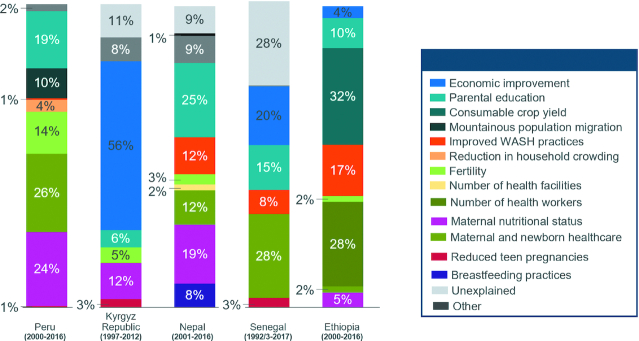
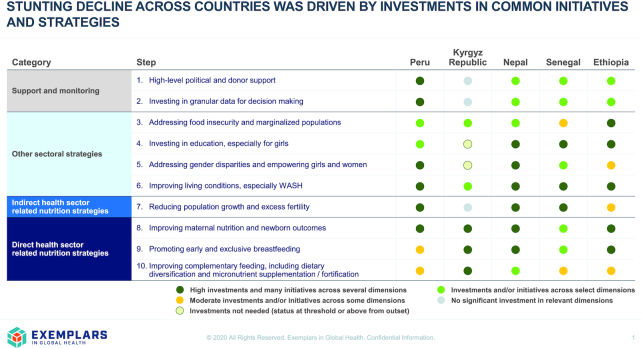
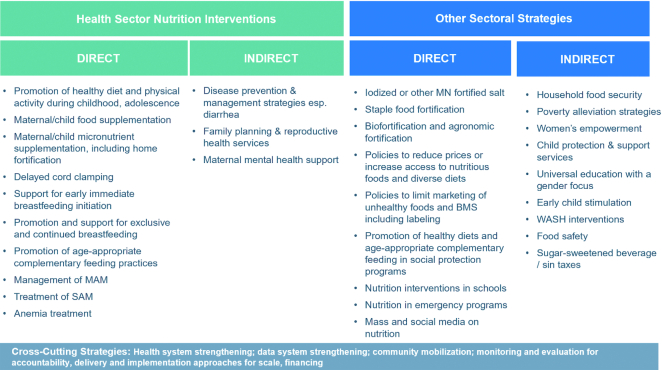
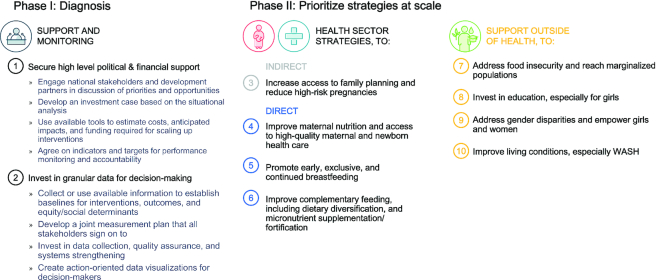
BACKGROUND: Child stunting and linear growth faltering have declined over the past few decades and several countries have made exemplary progress. OBJECTIVES: To synthesize findings from mixed methods studies of exemplar countries to provide guidance on how to accelerate reduction in child stunting. METHODS: We did a qualitative and quantitative synthesis of findings from existing literature and 5 exemplar country studies (Nepal, Ethiopia, Peru, Kyrgyz Republic, Senegal). Methodology included 4 broad research activities: 1) a series of descriptive analyses of cross-sectional data from demographic and health surveys and multiple indicator cluster surveys; 2) multivariable analysis of quantitative drivers of change in linear growth; 3) interviews and focus groups with national experts and community stakeholders and mothers; and 4) a review of policy and program evolution related to nutrition. RESULTS: Several countries have dramatically reduced child stunting prevalence, with or without closing geographical, economic, and other population inequalities. Countries made progress through interventions from within and outside the health sector, and despite significant heterogeneity and differences in context, contributions were comparable from health and nutrition sectors (40% of change) and other sectors (50%), previously called nutrition-specific and -sensitive strategies. Improvements in maternal education, maternal nutrition, maternal and newborn care, and reductions in fertility/reduced interpregnancy intervals were strong contributors to change. A roadmap to reducing child stunting at scale includes several steps related to diagnostics, stakeholder consultations, and implementing direct and indirect nutrition interventions related to the health sector and nonhealth sector . CONCLUSIONS: Our results show that child stunting reduction is possible even in diverse and challenging contexts. We propose that our framework of organizing nutrition interventions as direct/indirect and inside/outside the health sector should be considered when mapping causal pathways of child stunting and planning interventions and strategies to accelerate stunting reduction to achieve the 2030 Sustainable Development Goals.
Overview
The claims and statistics of this paper haven’t been checked yet.
Free: it reads the open-access text and checks the first 5 claims that cite a source we can check. Create a free account to check every claim.
Integrity signals
Registry
Cites
Statistics
Figures
Verification
Claims the paper makes
The claims and statistics of this paper haven’t been checked yet.
Free: it reads the open-access text and checks the first 5 claims that cite a source we can check. Create a free account to check every claim.
Claims other papers make about this one
Each is checked against this paper’s own text: does it say what the citing paper says it does?
The cited source says what the claim attributes to it.
In the citing paper
“The substantial progress in reducing the tuberculosis burden in children might reflect recent trends showing marked decreases in child mortality,54 global improvements in child nutrition outcomes,55, 56 increasing tuberculosis case finding and services for children,57, 58, 59 and continued reductions in vertical HIV transmission.60, 61”
Self-check
Percentages, sums and reported differences re-computed from the paper’s own numbers.
The self-check needs the paper’s full text.
Citations
Cites
Maternal and child undernutrition and overweight in low-income and middle-income countries
Black, R. E., Victora, C. G., Walker, S. P., Bhutta, Z. A., Christian, P., de Onis, M., Ezzati, M., Grantham-McGregor, S., Katz, J., Martorell, R., et al. (2013) · The Lancet · doi:10.1016/s0140-6736(13)60937-x · Cited by 8,475
Self-citationAbarca-Gómez, L., Abdeen, Z. A., Hamid, Z. A., Abu-Rmeileh, N. M., Acosta-Cazares, B., Acuin, C., Adams, R. J., Aekplakorn, W., Afsana, K., Aguilar-Salinas, C. A., et al. (2017) · The Lancet · doi:10.1016/s0140-6736(17)32129-3 · Cited by 7,482
Self-citationMaternal and child undernutrition: global and regional exposures and health consequences
Black, R. E., Allen, L. H., Bhutta, Z. A., Caulfield, L. E., de Onis, M., Ezzati, M., Mathers, C., & Rivera, J. (2008) · The Lancet · doi:10.1016/s0140-6736(07)61690-0 · Cited by 6,443 · cited 2×
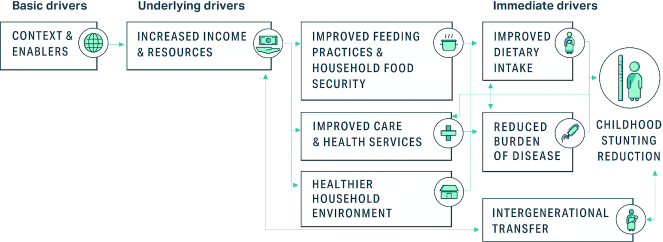
“(6, 7) (2008, 2013) was used to guide all analyses and inferences (Figure 1).”
BackgroundMethodSelf-citationBhutta, Z. A., Das, J. K., Rizvi, A., Gaffey, M. F., Walker, N., Horton, S., Webb, P., Lartey, A., & Black, R. E. (2013) · The Lancet · doi:10.1016/s0140-6736(13)60996-4 · Cited by 3,093
Self-citationEarly childhood development coming of age: science through the life course
Black, M. M., Walker, S. P., Fernald, L. C. H., Andersen, C. T., DiGirolamo, A. M., Lu, C., McCoy, D. C., Fink, G., Shawar, Y. R., Shiffman, J., et al. (2017) · The Lancet · doi:10.1016/s0140-6736(16)31389-7 · Cited by 3,014
What works? Interventions for maternal and child undernutrition and survival
Bhutta, Z. A., Ahmed, T., Black, R. E., Cousens, S., Dewey, K., Giugliani, E., Haider, B. A., Kirkwood, B., Morris, S. S., Sachdev, H., et al. (2008) · The Lancet · doi:10.1016/s0140-6736(07)61693-6 · Cited by 2,258
Self-citationRuel, M. T., & Alderman, H. (2013) · The Lancet · doi:10.1016/s0140-6736(13)60843-0 · Cited by 1,820
Dynamics of the double burden of malnutrition and the changing nutrition reality
Popkin, B. M., Corvalan, C., & Grummer-Strawn, L. M. (2020) · The Lancet · doi:10.1016/s0140-6736(19)32497-3 · Cited by 1,709 · cited 6×
“Recent case studies of success have identified these same factors as contributing to change in undernutrition over time in a set of LMICs (20).”
BackgroundInfluentialWorldwide Timing of Growth Faltering: Revisiting Implications for Interventions
Victora, C. G., de Onis, M., Hallal, P. C., Blössner, M., & Shrimpton, R. (2010) · Pediatrics · doi:10.1542/peds.2009-1519 · Cited by 1,466 · cited 1×
“The bulk of linear growth faltering seen in children aged <5 y occurs within 1000 d after conception (1, 2).”
BackgroundSelf-citationBlencowe, H., Krasevec, J., de Onis, M., Black, R. E., An, X., Stevens, G. A., Borghi, E., Hayashi, C., Estevez, D., Cegolon, L., et al. (2019) · The Lancet Global Health · doi:10.1016/s2214-109x(18)30565-5 · Cited by 1,242 · cited 1×
“With the global drive to improve data capture around birth weight (28), this might improve over time.”
BackgroundSelf-citation
Cited by
Items 201–247 of 247
IMPLEMENTATION OF POLICY TO REDUCE STUNTING IN MAJENE REGENCY, WEST SULAWESI PROVINCE
Sadek, M. A. A., Rahmah, M., & Hamdi, M. (2025) · J-3P (Jurnal Pembangunan Pemberdayaan Pemerintahan) · doi:10.33701/j-3p.v10i1.4618
Diana, N. N. P., Wirawan, N. N., & Rahmawati, W. (2026) · AcTion Aceh Nutrition Journal · doi:10.30867/action.v11i1.3032
“Childhood stunting, characterized by reduced height for age, reflects chronic undernutrition and remains a significant public health issue in many developing nations (Bhutta et al., 2020).”
Kagoyire, C. (2026) · Lund University Publications (Lund University) · Cited by 1
Kilamlya, V. M., & Lusasi, J. E. (2026) · Research Square · doi:10.21203/rs.3.rs-8763772/v1
Alam, M. A., Hasan, S. M. T., Nishan, A. A., Mahfuz, M., Kosek, M. N., Lima, A. Â. M., Maciel, B. L. L., & Ahmed, T. (2026) · PLoS ONE · doi:10.1371/journal.pone.0329596
Muryanto, Ratminto, R., Ikhwan, H., & Listyaningsih, U. (2026) · Asian Journal of Social and Humanities · doi:10.59888/ajosh.v4i4.663
Rani, D., & Lhungdim, H. (2026) · BMC Public Health · doi:10.1186/s12889-026-27171-0
“Despite these persistent trends, certain “Success Outlier” nations have achieved an Average Annual Rate of Reduction (AARR) ≥ 4.0%, demonstrating that this trajectory can be structurally altered [13].”
InfluentialMultidimensional analysis of nutritional status among children under 5 years in Africa, 1990–2024
Li, Y., Li, W., Chen, M., & Zhang, L. (2026) · Scientific Reports · doi:10.1038/s41598-026-55642-2
Sunarya, A., Milwan, M., & Sari, J. A. (2026) · Public Policy And Administration · doi:10.13165/vpa-26-25-2-05
Nordhagen, S., Beal, T., Beesabathuni, K., Ganguly, S., Knight, F., Koupparis, K., Lok, X. X. C., Mbuya, M. N. N., Parwal, A., & Tata, S. (2026) · doi:10.12688/verixiv.3283.1
PENINGKATAN PENGETAHUAN IBU BALITA MENGGUNAKAN MEDIA LEMBAR BALIK PENCEGAHAN STUNTING
Retnaningsih, Y., Meilani, N., Waryana, W., Dwianugerah, T. K., & Rasyid, F. A. (2026) · GEMAKES Jurnal Pengabdian Kepada Masyarakat · doi:10.36082/gemakes.v6i2.2780
Incidencia del Programa Vaso de Leche en la nutrición de niños menores de tres años, Bambamarca-Perú
Suárez-Medina, I., Suárez, C., & Uria, B. (2026) · Revista Acciones Médicas · doi:10.35622/j.ram.2026.02.002
Bhuyan, H., Barman, B., Manjunatha, V. K., Talukdar, K., Ojah, M., Priya, N., V, Behera, S., Mohanty, J. R., Panda, P., & Pradhan, S. (2026) · Research Square · doi:10.21203/rs.3.rs-9761460/v1
Krisnanik, E., Adrezob, M., Kraugusteeliana, K., Yulistiawan, B. S., & Susramae, I. G. (2026) · International Journal of Basic and Applied Science · doi:10.35335/ijobas.v14i3.834
Oswal, D., Angolkar, M., Mahantashetti, N. S., Sebastiån, M. S., Singh, M., Haritay, S., & Godbole, M. M. (2026) · American Journal of Clinical Nutrition · doi:10.1016/j.ajcnut.2026.101429
Opaleke, D. O., Adam, R. O., Makinde, E. O., & Alasi, S. O. (2026) · Evaluation and Program Planning · doi:10.1016/j.evalprogplan.2026.102802
Ginanjar, R. A. F., Siregar, M. B., Sutjipto, H., & Kustanto, A. (2026) · SSRN Electronic Journal · doi:10.2139/ssrn.7160667
Schwendler, T., Sankhon, R. H., Jensen, L., Fofana, M. L., Daffé, M., Camara, F., Zoma, R., Balde, I., & Kodish, S. R. (2026) · The International Journal of Health Planning and Management · doi:10.1002/hpm.70105
“Political frameworks across systems in Guinea show promise given the growing consensus that a multisectoral approach is needed to improve MIYCN, but certain HANCI indicators act as facilitators and barriers to nutrition‐related political commitments [9–11 , 97– 99].”
Opondo, C. O., Kamadi, J., Amisi, J. A., Camplain, R. L., Pastakia, S. D., Gletsu-Miller, N. A., Ludema, C., & Rosenberg, M. S. (2026) · medRxiv · doi:10.64898/2026.07.23.26358820
Hadi, S. P. I., Cahyati, W. H., & Farida, E. (2026) · BIO Web of Conferences · doi:10.1051/bioconf/202624704007
Análisis bibliométrico de la inseguridad alimentaria y la malnutrición en poblaciones vulnerables
Villca, X. M. V. (2026) · Esprint Investigación · doi:10.61347/ei.v5iesp.1.324
Kusnadi, E., Ramdaniati, S., Raharjo, B. B., & Yuniastuti, A. (2026) · Glosains Jurnal Sains Global Indonesia · doi:10.59784/glosains.v7i4.882
Wahyuningsih, E., Kholifah, S., Chawa, A. F., & Utaminingsih, A. (2026) · Women s Studies · doi:10.1080/00497878.2026.2726920
Pemberdayaan ibu rumah tangga nelayan melalui edukasi gizi dan MP-ASI sehat untuk cegah stunting
Rahman, S. N., Samsiana, S., Syukroni, I., & Santos, H. A. D. (2025) · SELAPARANG Jurnal Pengabdian Masyarakat Berkemajuan · doi:10.31764/jpmb.v9i6.36140
“Pemahaman yang baik tentang konsep MP-ASI, gizi seimbang, dan keamanan pangan rumah tangga memungkinkan ibu menyediakan makanan yang sesuai dengan kebutuhan tumbuh kembang anak(Bhutta et al., 2020).”
A Review of Health Promotion Strategies in Preventing Stunting in Indonesia
Ardian, R. Y., Ulfa, M., Rajikan, R., Akça, N., & Çakmak, A. (2026) · Amerta Nutrition · doi:10.20473/amnt.v10i3.2026.557-568
“Meanwhile, Senegal's efforts emphasise early childhood nutrition, including exclusive breastfeeding and vitamin A supplementation, which have contributed to a significant decline in stunting rates 38,40 .”
Odhiambo, J. A., Makokha, A., & Masibo, P. (2025) · Primary Health Care Practice Journal · doi:10.11604/phcp.2025.3.8.48474
Akbarjono, A., Satria, I., & Yunarman, S. (2026) · Journal of Education and Health Promotion · doi:10.4103/jehp.jehp_1023_25
Friani, S. R., Situngkir, L. S., & Silitonga, R. (2022) · International Journal of Community Service (IJCS) · doi:10.55299/ijcs.v1i2.1547
Ramzan, S., Akbar, M. I., & Batool, A. (2025) · ApexMed Journal of Health Sciences
Sihombing, D. J. C. (2024) · Jurnal Info Sains Informatika dan Sains
Stunting Di Desa Blimbing Kecamatan Gudo Kabupaten Jombang
Ginting, A. P., Tjahjo, E. D., & dewanty, K. A. (2023) · Health Information Jurnal Penelitian
Sihombing, D. J. C. (2024) · Jurnal Info Sains Informatika dan Sains
Sihombing, D. J. C. (2024) · Jurnal Info Sains Informatika dan Sains
Bela, S. R. A., Melkior, T., Andeina, S., Achad, G. I., & Ismi, A. R. (2025) · Jurnal Pengabdian Masyarakat dan Riset Pendidikan
Upaya Penurunan Stunting Melalui Pendekatan Multi-Sektoral: Suatu Tinjauan Riteratur
Wahyuni, J. D., Tshalasha, R., Anggraini, S. P., Saputra, B., & Adnan, M. F. (2026) · Jurnal Ilmu Komunikasi dan Sosial Politik
Aksir, M. I., & Hasmyati, H. (2026) · Jurnal Penelitian Pengembangan Pembelajaran dan Teknologi (JP3T)
Nurlia, R. (2025) · Hasanuddin University Repository
Widyaningsih, Y. I., Jannah, A., Pongtambing, Y. S., Ramdani, R., & Putri, M. D. (2026) · Paramacitra Jurnal Pengabdian Masyarakat
Implementation to accelerate stunting reduction in Sinjai District
Firman, F., Alwi, A., & Susanti, G. (2024) · The International Journal of Politics and Sociology Research
Sihombing, D. J. C. (2024) · Jurnal Info Sains Informatika dan Sains
Abdullah, D., & Fharel, M. (2025) · Nusantara Hasana Journal · doi:10.59003/nhj.v4i9.1371
Community-Based Nutrition Intervention by PT Borneo Indo Bara: A CSR Case Study
Arifin, Z., & Hafizianor, H. (2025) · Indonesian Journal of Social Responsibility · doi:10.36782/ijsr.v8i01.502
“Although longer-term effects require more analysis and longitudinal data, the initial implementation offers a scalable approach that merits replication (Bhutta et al., 2020); (Afandi et al., 2023).”
Rivaz, R., Esfehani, A. J., Zeraati, T., Nematy, M., & Sobhani, S. R. (2026) · Advances in Public Health · doi:10.1155/adph/2136782
Aqmarina, N., & Hardiyanti, T. O. (2026) · Plexus Medical Journal · doi:10.20961/plexus.v5i5.2774
“Compared to prior studies, such as Bhutta et al. (2020), which underscored the need for holistic strategies to combat malnutrition, these findings suggest that the SDGs have fostered greater interdisciplinary engagement.”
Kayitesi, C., Mutemberezi, F., & Habyarimana, J. B. (2026) · Cogent Economics & Finance · doi:10.1080/23322039.2026.2749255
Empowering Posyandu Cadres through Community-Based Stunting Prevention Education
Sari, I. N., Triwahyudi, Y., Febriani, M., & Kurniawan, A. (2025) · Bisma Bimbingan Swadaya Masyarakat · doi:10.59689/xrv0fq80
Nienaber, M. (2026) · Nelson Mandela University Research Repository
Metadata
- Authors
- Bhutta, Z. A., Akseer, N., Keats, E. C., Vaivada, T., Baker, S., Horton, S. E., Katz, J., Menon, P., Piwoz, E., Shekar, M., Victora, C., & Black, R.
- Affiliations
- Aga Khan University (PK)
- Hospital for Sick Children (CA)
- United States Agency for International Development (US)
- University of Waterloo (CA)
- Johns Hopkins University (US)
- International Food Policy Research Institute (US)
- Gates Foundation (US)
- World Bank (US)
- Universidade Federal de Pelotas (BR)
- Corresponding author
- Bhutta, Zulfiqar A
- ORCID
- Venue
- The American Journal of Clinical Nutrition
- Publisher
- Elsevier BV
- Published
- 2020-09
- Volume
- 112
- Issue
- Suppl 2
- Pages
- 894S-904S
- ISSN
- 0002-9165 (ISSN-L)
- PMC
- PMC7487427
- OpenAlex
- W3045232500
- Cited by
- 187
- References
- 40
- Citations by year
- 2026: 26 · 2025: 41 · 2024: 46 · 2023: 20 · 2022: 33 · 2021: 14 · 2020: 6
- FWCI
- 2.24
- Type
- journal article
- Language
- en
- Open access
- hybrid
- doi.org
- Licence
- cc-by
- www.elsevier.com/tdm/userlicense/1.0/ (tdm)
- creativecommons.org/licenses/by/4.0/ (vor)
- Locations
- American Journal of Clinical Nutrition (publishedVersion, cc-by)
- PubMed Central (publishedVersion, cc-by)
- PubMed (publishedVersion)
- eCommons - AKU (Aga Khan University) (submittedVersion)
- IFPRI E-brary (International Food Policy Research Institute) (submittedVersion, other-oa)
- International Food Policy Research Institute (International Food Policy Research Institute) (submittedVersion, other-oa)
- Funders
- Gates Ventures
- Topics
- Health Sciences › Nursing › Nutrition and Dietetics › Child Nutrition and Water Access
- Health Sciences › Medicine › Pediatrics, Perinatology and Child Health › Public Health and Nutrition
- Health Sciences › Medicine › Pediatrics, Perinatology and Child Health › Global Maternal and Child Health
- Keywords
- child stunting, linear growth faltering, stunting reduction, nutrition interventions, maternal education, maternal nutrition, maternal and newborn care, interpregnancy interval, fertility decline, nutrition policy, Sustainable Development Goals
- MeSH terms
- Adult, Child, Preschool, Cross-Sectional Studies, Developing Countries, Evaluation Studies as Topic, Female, Growth Disorders, Humans, Infant, Male, Nutritional Status, Multivariate Analysis, Maternal Nutritional Physiological Phenomena, Young Adult
About these checks
Registry, retraction, Cites and statistics results are computed, not judged, with one exception: a printed reference that no index lists is read once by a model before it counts as a citation error. Claims are extracted by a model and kept only when their quote appears verbatim in the text; each cited source is then checked, with a model’s help, for whether it says what the claim relies on. Those verdicts can be wrong — read the claim’s quote and the cited source before relying on one.
Statistics and arithmetic are recomputed, not judged.
Confidence bands are shown only for fields calibrated on our annotated test set. None is calibrated yet, so no band is shown.
What counts as a claim ›How we measure confidence ›How we check this ›
Are you an author, or do you see a problem with this page? Request a review
Data sources
Bibliographic data: Semantic Scholar, OpenAlex, Crossref.
Contains information from the Semantic Scholar Academic Graph Datasets, made available under the ODC Attribution License (ODC-BY 1.0).
Semantic Scholar’s data is described in: Kinney, R., et al. (2023). The Semantic Scholar Open Data Platform. arXiv:2301.10140.
