

Selecting an Appropriate Caliper Can Be Essential for Achieving Good Balance With Propensity Score Matching
Open accessThe DOI matches its Crossref record; 23 of the 25 references it cites were found in a registry or an index.
Abstract
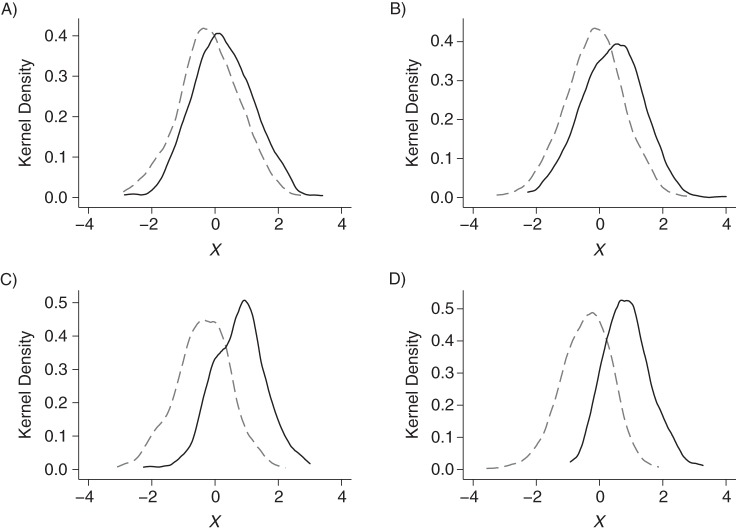
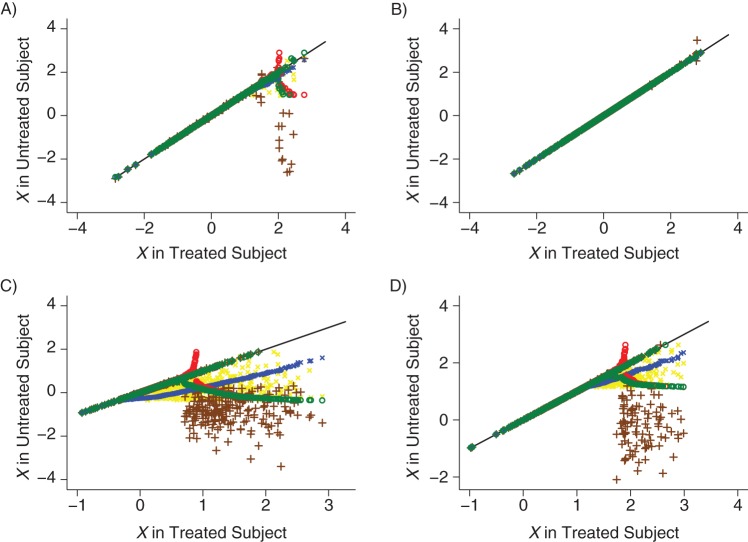
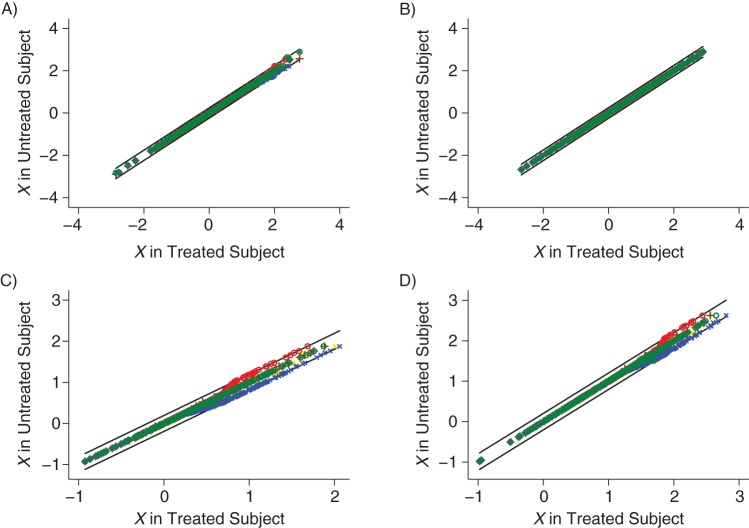
Matching on the propensity score is widely used to estimate the effect of an exposure in observational studies. However, the quality of the matches can be affected by decisions made during the matching process, particularly the order in which subjects are selected for matching and the maximum permitted difference between matched subjects (the "caliper"). This study used simulations to explore the effects of these decisions on both the imbalance of covariates and the closeness of matching, while allowing the numbers of potential matches and strengths of association between the confounding variable and the exposure to vary. It was found that, without a caliper, substantial bias was possible, particularly with a relatively small reservoir of potential matches and strong confounder-exposure association. Use of the recommended caliper reduced the bias considerably, but bias remained if subjects were selected by increasing or decreasing propensity score. A tighter caliper led to greatly reduced bias and closer matches, although some subjects could not be matched. This study suggests that a narrow caliper can improve the performance of propensity score matching. In situations where it is impossible to find appropriate matches for all exposed subjects, it is better to select subjects in order of the best available matches, rather than increasing or decreasing the propensity score.
Overview
The claims and statistics of this paper haven’t been checked yet.
Free: it reads the open-access text and checks the first 5 claims that cite a source we can check. Create a free account to check every claim.
Integrity signals
Registry
Cites
Statistics
Figures
Verification
Claims the paper makes
The claims and statistics of this paper haven’t been checked yet.
Free: it reads the open-access text and checks the first 5 claims that cite a source we can check. Create a free account to check every claim.
Claims other papers make about this one
Each is checked against this paper’s own text: does it say what the citing paper says it does?
In the citing paper
“Most of the literature suggests that the calliper method outperforms other methods such as nearest neighbour with and without replacement and optimal matching [55] and gives better results if it is difficult to find the matches from the control group [56].”
Self-check
Percentages, sums and reported differences re-computed from the paper’s own numbers.
The self-check needs the paper’s full text.
Citations
Cites
The central role of the propensity score in observational studies for causal effects
ROSENBAUM, P. R., & RUBIN, D. B. (1983) · Biometrika · doi:10.1093/biomet/70.1.41 · Cited by 31,241 · cited 4×
“It can be difficult to find appropriate matches when trying to match on several variables, but Rosenbaum and Rubin (7) showed that matching on the propensity score (the conditional probability of exposure given a set of covariates) could produce samples with the same distribution of covariates in exposed and unexposed…”
BackgroundInfluentialSOME PRACTICAL GUIDANCE FOR THE IMPLEMENTATION OF PROPENSITY SCORE MATCHING
Caliendo, M., & Kopeinig, S. (2008) · Journal of Economic Surveys · doi:10.1111/j.1467-6419.2007.00527.x · Cited by 6,238 · cited 1×
“2 standard deviations), more recent papers on the practicalities of matching have not given recommendations for setting a caliper (12, 13).”
BackgroundMatching Methods for Causal Inference: A Review and a Look Forward
Stuart, E. A. (2010) · Statistical Science · doi:10.1214/09-sts313 · Cited by 5,478 · cited 2×
“2 standard deviations), more recent papers on the practicalities of matching have not given recommendations for setting a caliper (12, 13).”
BackgroundPropensity Score-Matching Methods for Nonexperimental Causal Studies
Dehejia, R. H., & Wahba, S. (2002) · Review of Economics and Statistics · doi:10.1162/003465302317331982 · Cited by 4,846
Rosenbaum, P. R., & Rubin, D. B. (1985) · The American Statistician · doi:10.2307/2683903 · Cited by 4,774 · cited 6×
“It can be difficult to find appropriate matches when trying to match on several variables, but Rosenbaum and Rubin (7) showed that matching on the propensity score (the conditional probability of exposure given a set of covariates) could produce samples with the same distribution of covariates in exposed and unexposed…”
BackgroundMethodInfluentialAustin, P. C. (2011) · Pharmaceutical Statistics · doi:10.1002/pst.433 · Cited by 3,949 · cited 5×
“In practice, a wide variety of calipers is used (1) and, with the exception of Austin (11) (who recommended reducing the caliper from 0.25 standard deviations to 0.2 standard deviations), more recent papers on the practicalities of matching have not given recommendations for setting a caliper (12,…”
BackgroundMethodInfluentialA critical appraisal of propensity‐score matching in the medical literature between 1996 and 2003
Austin, P. C. (2008) · Statistics in Medicine · doi:10.1002/sim.3150 · Cited by 1,249
Matching Using Estimated Propensity Scores: Relating Theory to Practice
Rubin, D. B., & Thomas, N. (1996) · Biometrics · doi:10.2307/2533160 · Cited by 1,074
Matching Using Estimated Propensity Scores: Relating Theory to Practice
Thomas, N. (2006) · Matched Sampling for Causal Effects · doi:10.1017/cbo9780511810725.024 · Cited by 1,018 · cited 1×
“In order to be able to find suitable matches for all exposed subjects, the number of controls available needs to be greater than the number of exposed subjects; the ratio typically lies in the range of 2–20, although it may be higher (8).”
BackgroundControlling Bias in Observational Studies: A Review
Cochran, W. G. (2006) · Matched Sampling for Causal Effects · doi:10.1017/cbo9780511810725.005 · Cited by 958 · cited 5×
“It can be difficult to find appropriate matches when trying to match on several variables, but Rosenbaum and Rubin (7) showed that matching on the propensity score (the conditional probability of exposure given a set of covariates) could produce samples with the same distribution of covariates in exposed and unexposed…”
MethodInfluential
Cited by
Items 301–371 of 371
Impact of Police Diversion on Re-Offending by Young People
Little, S. (2015) · Griffith Research Online · doi:10.25904/1912/2299 · Cited by 4
Are Corporate General Counsels Effective Monitors - Evidence from Stock Price Crash Risk?Preprint
Mamun, M. A., Balachandran, B., Duong, H. N., & Gul, F. A. (2018) · SSRN Electronic Journal · doi:10.2139/ssrn.3270178 · Cited by 1
Financial risk, vulnerability and equity of access to healthcare services in Kenya
Njagi, P. (2021) · Research Publications (Maastricht University) · doi:10.26481/dis.20210624nm · Cited by 1
Letter to the editor: The effect of hydroxychloroquine on COVID-19
Demir, C., & Demır, A. U. (2021) · Journal of Infection and Public Health · doi:10.1016/j.jiph.2021.12.006 · Cited by 1
Smith, G. D. (2014) · Scholarship@Western (Western University)
Wainaina, P. (2016) · eDiss (Georg-August-Universität Göttingen) · doi:10.53846/goediss-5659
Statistical Tool in Integrated Oncology: Propensity Score Methods
Ali, M. S. (2017) · Journal of Integrative Oncology · doi:10.4172/2329-6771.1000201
“Sub classification using the PS can provide ATE or ATT by using different weights when pooling the stratum specific treatment effects [7-9,17].”
MethodNguyen, L., Häkkinen, U., & Jurvanen, H. (2018) · Nordic Journal of Health Economics · doi:10.5617/njhe.4538 · Cited by 1
“Since a narrow calliper can improve the performance of propensity score matching by greatly reducing bias and giving closer matches (Lunt, 2014), we chose a tighter calliper than the recommended calliper.”
BackgroundPierce, E. J. (2018) · ThinkIR: The University of Louisville's Institutional Repository (University of Louisville) · doi:10.18297/etd/3126
“The 1:1 matched analysis was performed using caliper width based on the propensity score (178).”
MethodRACIAL VARIATION IN THE USE OF ONCOTYPE DX TESTING FOR WOMEN WITH BREAST CANCER
Roberts, M. C. (2015) · Carolina Digital Repository (University of North Carolina at Chapel Hill) · doi:10.17615/7x41-v087
Ravn, R. L. (2019) · VBN Forskningsportal (Aalborg Universitet) · doi:10.54337/aau306033214 · Cited by 3
Hoo, Y. R., Joseph, G., Moqueet, N. S., & Chellaraj, G. (2019) · World Bank, Washington, DC eBooks · doi:10.1596/1813-9450-9059
“The combination of caliper restriction and matching with multiple neighbors balances the trade-off between bias and sample variance (Caliendo & Kopeinig, 2008; Lunt, 2013).”
BackgroundImaging and therapy in multiple sclerosis
Brown, J. W. L. (2020) · Apollo (University of Cambridge) · doi:10.17863/cam.52109
Machine Learning Methods for Causal Inference with Observational Biomedical Data
Averitt, A. (2020) · doi:10.7916/d8-je06-eh12 · Cited by 1
“This is very common when using propensity scores (Austin 2011a; Lunt 2014).”
MethodInfluentialPeijen, R. (2020) · Tilburg University Research Portal
嚥下障害を有する高齢者における胃瘻栄養と中心静脈栄養の長期アウトカムの比較:傾向スコアマッチングを用いた解析(二次出版)
真崎, 茂., & 河本, 俊. (2020) · doi:10.11244/ejspen.2.4_252
Jardine, E. (2021) · Journal of Cyber Policy · doi:10.1080/23738871.2021.1953557 · Cited by 1
Response to the letter to the editor
Güner, R., Hasanoğlu, İ., Kayaaslan, B., Aypak, A., Akıncı, E., Bodur, H., Eser, F., Kalem, A. K., Küçükşahin, O., Ateş, İ., et al. (2021) · Journal of Infection and Public Health · doi:10.1016/j.jiph.2021.12.007
The Influences of Undermatching on College Completion for Students From Varying High School Settings
Kang, C. (2019) · American Educational Research Association Annual Meeting (AERA) · doi:10.3102/1432990
Shakerian, F., Rafati, A., Pouraliakbar, H., Pasebani, Y., & Sarreshtehdari, A. (2022) · Research Square · doi:10.21203/rs.3.rs-2056101/v1
Housing value variation across high-tech zones
Zandiatashbar, A. (2023) · Elsevier eBooks · doi:10.1016/b978-0-323-90166-6.00006-6
Do Captured Boards Undermine Shareholders' Value? Evidence from Crash Risk in the Us MarketPreprint
Mamun, M. A., Henry, D., & Balachandran, B. (2023) · SSRN Electronic Journal · doi:10.2139/ssrn.4660802
The youth elite football players
(2024) · Frontiers research topics · doi:10.3389/978-2-8325-4711-3
Léger, M. (2022) · theses.fr (ABES) · doi:10.70675/9bb005c0zfecfz46a6zaa16z03027138657c
The Intended and Unintended Consequences of Large Electricity Subsidies: Evidence from MongoliaPreprint
Narantungalag, O., Hasan, S. A., & Berka, M. (2024) · SSRN Electronic Journal · doi:10.2139/ssrn.4873560
Blohm, F. S., Nygaard, S. S., Jørgensen, T. S. H., & Lund, R. (2024) · Social Science & Medicine · doi:10.1016/j.socscimed.2024.117088
Intensity Bursts in WallStreetBets Discussion and Stock Markets TradingPreprint
Wei, S., Otsubo, Y., & Poon, S. (2024) · SSRN Electronic Journal · doi:10.2139/ssrn.5030887
Extracorporeal Membrane Oxygenation Outcomes: COVID-19 Pneumonia vs Non–COVID-19 Pneumonia
Koyner, F. J. G., Barrera, N. I., Teferi, A. M., Jou, K., Cerrud-Rodriguez, R. C., & Chong, D. H. (2025) · American Journal of Critical Care · doi:10.4037/ajcc2025524
Andrisani, G., Antonelli, G., Fukuchi, T., Frazzoni, L., Hamanaka, J., Hassan, C., Parente, G., Matteo, F. M. D., & Hirasawa, K. (2025) · Endoscopy · doi:10.1055/s-0045-1806625
The Effect of the End of Hiring Incentives on Job and Employment SecurityPreprint
Ardito, C., Berton, F., Pacelli, L., & Zanatta, M. (2025) · SSRN Electronic Journal · doi:10.2139/ssrn.5362834
Liu, G., Qiao, L., Li, D., Lu, H., Liu, G., Zhang, D., Chen, X., Liu, Y., Yuan, J., Liu, W., et al. (2025) · SSRN Electronic Journal · doi:10.2139/ssrn.5370501
Dolja‐Gore, X., Paul, S. S., Clemson, L. M., Lord Stephen, R., Close, J. C., Tiedemann, A., Laura, H., & Sherrington, C. (2025) · Home Health Care Management & Practice · doi:10.1177/10848223251345743
“24,27 Since the Stepping On program aims to reduce the risk of falls and maintain independence for older frail community members (those aged 75 and over) 28 , health service use was described for the subset of the participants in the old and old-est old age groups (75-84 vs 85 + ).”
Li, Q., Zhang, M.-H., Fan, H., Liu, H.-W., & Hou, M. (2025) · Naunyn-Schmiedeberg's Archives of Pharmacology · doi:10.1007/s00210-025-04653-3
“Following the matching process, covariate balance was assessed using standardized mean differences (SMD), with an SMD of 0.1 or less deemed satisfactory (Austin 2011a, 2011b; Lunt 2014).”
InfluentialCoston, T. D., Wright, S. W., Hantrakun, V., Rudd, K. E., Chamnan, P., Wongsuvan, G., West, T. E., & Limmathurotsakul, D. (2025) · Critical Care Medicine · doi:10.1097/ccm.0000000000006932 · Cited by 1
Are Educated Individuals More or Less Likely to Vote? Evidence From Rural Bangladesh
Murshed, R. (2025) · Journal of International Development · doi:10.1002/jid.70047
Yamamoto, R., Cestero, R. F., Yoshizawa, J., Maeshima, K., & Sasaki, J. (2021) · Figshare · doi:10.6084/m9.figshare.16935548
Additional file 1 of Effect of musculature on mortality, a retrospective cohort study
Shaver, A. L., Platek, M. E., Singh, A. K., Ma, S. J., Farrugia, M. K., Wilding, G., Ray, A. D., Ochs‐Balcom, H. M., & Noyes, K. (2022) · Figshare · doi:10.6084/m9.figshare.20128536
Hirose, W., Harigai, M., Amano, K., Hidaka, T., Itoh, K., Aoki, K., Nakashima, M., Nagasawa, H., Komano, Y., & Nanki, T. (2021) · Figshare · doi:10.6084/m9.figshare.16551021
Bussière, C., Chauvin, P., Josselin, J., & Sevilla‐Dedieu, C. (2022) · Figshare · doi:10.6084/m9.figshare.21384368
Approaches to Evaluating Teaching for Mastery in Secondary Mathematics Education
SHEPHERD, R. (2023) · Durham e-Theses (Durham University)
Impact of land use on functional plant diversity: A new assessment method demonstrated in Germany
van Baren, S. (. (2019) · Research Repository (Delft University of Technology)
Welfare Effects of Social Cash Transfer Programs: Evidence from Egypt's Takaful and Karamah ProgramsPreprint
Ibrahim, H. (2025) · SSRN Electronic Journal · doi:10.2139/ssrn.5427834
Predictors of Treatment Outcomes for Patients with Opioid Use Disorder
Naji, L. (2024) · MacSphere (McMaster University) · doi:10.71548/24986
Essays on Corporate Tax Avoidance, Sustainability, and Tax Transparency
Willkomm, S. (2023) · Kölner Universitäts PublikationsServer (Universität zu Köln) · Cited by 1
Li, Y., Liu, J., Sun, Y., Wang, Y., Hu, Y., Wen, J., Chen, Y., & Cong, C. (2026) · Frontiers in Medicine · doi:10.3389/fmed.2026.1756862
Corr, F., Kareem, F., Bättig, L., Caspari, B., Kapahnke, K., Heinig, S., Behringer, S. P., Schulz, E. R., Yildiz, Y., Hejrati, N., et al. (2026) · Brain and Spine · doi:10.1016/j.bas.2026.105959
“Propensity scores were estimated via logistic regression, and nearest neighbor matching was performed without replacement, applying a caliper of 0.25 standard deviations of the propensity score to minimize poor matches (Lunt, 2014).”
InfluentialNationwide outcomes of cardiovascular surgery in patients with Parkinson disease
Ferre, J. D., Cabulong, A. P., Zhou, G., Maigrot, J. A., Koroukian, S. M., Schiltz, N. K., Blackstone, E. H., & Soltesz, E. G. (2026) · JTCVS Open · doi:10.1016/j.xjon.2026.101698
“15,17 Covariates balance before and after matching were assessed using standardized differences between those with and without PD (Figure E1).”
Zhang, Q., Zhang, J., Tang, C., Hodges, L. B., & Guthrie, J. F. (2026) · Journal of Nutrition · doi:10.1016/j.tjnut.2026.101513
Boudemaghe, T. (2016) · theses.fr (ABES) · doi:10.70675/e56319c8z7e17z4592z91b3z69cec09d75fd · Cited by 1
Laborde‐Castérot, H. (2016) · theses.fr (ABES) · doi:10.70675/661aa058z8c46z4294z8382z36123ab52bc2 · Cited by 1
“…sont proposées, intéressant le choix des paires (‘full matching’, ‘greedy matching’, ‘caliper’, ‘nearest neighbor’, ‘Mahalanobis distance’,…)(Austin 2011, Lunt 2014, Austin and Stuart 2015), le nombre de témoin(s) par individu exposé (Austin 2010), l’existence ou non d’une remise (témoins…”
Causal inference, predictive modeling and medical decision-making.
Nguyên, T. L. (2016) · theses.fr (ABES) · doi:10.70675/19759d3fzb112z4ce5z9663zf5e4bfbac1df
Rademaker, E., van der Woude, J. M., den Berg, R. V., Brohet, R. M., Snaebjornsson, P., de Hingh, I. H. J. T., Kok, N. F. M., Consten, E. C. J., van Westreenen, H. L., Tanis, P. J., et al. (2026) · European Journal of Cancer · doi:10.1016/j.ejca.2026.116705
COMMENT: "THE IMPACT OF CORPORATE SUSTAINABILITY ONPreprint
King, A. A. (2026) · SSRN Electronic Journal · doi:10.2139/ssrn.6652618
Praxedes, L. B. F., & Filho, S. E. A. (2026) · Anais do Simpósio Brasileiro de Sistemas de Informação (SBSI) · doi:10.5753/sbsi.2026.248775
“Esta escolha baseia-se nas recomendações de Lunt (2014), que sugere o uso de calipers mais estreitos para reduzir o viés remanescente e aumentar a precisão do pareamento, garantindo que as unidades comparadas sejam o mais similares possível.”
Sen, L. C., Uddin, M. J., Shathi, I. J., Salekin, N., Shourove, J. H., Rahman, M. M., Zhang, C., Hamer, D. H., & Islam, G. M. R. (2026) · PLoS ONE · doi:10.1371/journal.pone.0349064
Verhey, J. T., Tarabichi, S., Novicoff, W. M., Mont, M. A., Browne, J. A., Bingham, J. S., Spangehl, M. J., & Clarke, H. D. (2026) · The Journal of Arthroplasty · doi:10.1016/j.arth.2026.05.061
Garcia, R. L., Lorenzana, E. A., & Barajas, J. R. (2026) · Systems and Information Engineering Design Symposium · doi:10.1109/sieds69358.2026.11540279
“…of the logit-transformed propensity score — the standard established by Cochran and Rubin's theoretical work on bias reduction through caliper matching [16] and operationalized for the propensity score context by Austin [17] — which has since been widely adopted in applied evaluation research [18].”
Zhang, X., Jhou, H., Chen, H.-Y., Xiao, N., Chen, P., & Lee, C. (2026) · JCO Oncology Practice · doi:10.1200/op-25-01316
Yang, Q., Meng, Y., Li, X., Yang, Y., Wu, X., Yu, P., Yan, X., Wang, B. B., Zhang, Z., Zhang, X., et al. (2026) · Pediatric Surgery International · doi:10.1007/s00383-026-06501-8
“For PSM , 1:1 nearest-neighbor matching was performed within a cali - per width of 0.05 in full-cohort analysis [27].”
InfluentialGhafarian, A. M., Samani, A., Saad, J. A., Ghafarian, M., Wajahath, M., Foster, S., Lim, S., Sutton, A., Vélez, F. G. S., Battaglini, D., et al. (2026) · Journal of Clinical Medicine · doi:10.3390/jcm15124790
“Nearest-neighbor caliper matching has been shown to minimize estimation bias while maintaining sample efficiency in observational studies, and the 0.1 standard deviation caliper has been widely applied in published propensity-matched analyses [21,22].”
InfluentialLee, S. I., An, M. H., Kim, M.-G., Kim, H., & Park, S. S. (2026) · Precision and Future Medicine · doi:10.23838/pfm.2026.00065
“PSM was performed using a greedy near-est-neighbor algorithm with a caliper of 0.01, implemented in the ‘PSMATCH’ package in R (R Foundation for Statistical Computing) [47].”
InfluentialCreating value at a cost: assessing the performance of work integration social enterprises
Baláž, V., Jeck, T., & Balog, M. (2026) · Social enterprise journal · doi:10.1108/sej-02-2025-0033
Uprety, R., Ogini, F., & Wingate, L. T. (2026) · Cureus · doi:10.7759/cureus.112374
“Another important concept in PSM is the use of a caliper, which refers to the maximum allowable difference in propensity scores between matched individuals [10].”
Park, J., Miley, E. N., Zhong, X., & Gray, C. F. (2026) · The Journal of Arthroplasty · doi:10.1016/j.arth.2026.07.029
Gallant, B. P., Widdowson, K., Hu, A., Plummer, R., Aulet, T., Sturrock, P. R., Peponis, T., Maykel, J., Lapane, K. L., & Alavi, K. (2026) · Journal of Gastrointestinal Surgery · doi:10.1016/j.gassur.2026.102563
Zhang, B., Zhang, D., Wang, B.-J., Wu, Q.-L., & Xu, R. (2026) · Environmental Pollution · doi:10.1016/j.envpol.2026.129218
Zarei, M., Moradi, G., Farjam, M., Dehghan, A., Nouri, B., & Roshani, D. (2026) · Addiction and Health · doi:10.34172/ahj.1676
Sridharan, K., & Sivaramakrishnan, G. (2026) · AI · doi:10.3390/ai7110462
Changes in family structure and children’s screen time: a longitudinal study of Australian children
Shifera, N., Pagano, R., & Sanders, T. (2026) · European Journal of Pediatrics · doi:10.1007/s00431-026-07569-z
Metadata
- Authors
- Lunt, M.
- Affiliations
- University of Manchester (GB)
- Corresponding author
- Lunt, Mark
- ORCID
- Lunt, Mark
- Venue
- American Journal of Epidemiology
- Publisher
- Oxford University Press (OUP)
- Published
- 2013-10-10
- Volume
- 179
- Issue
- 2
- Pages
- 226-235
- ISSN
- 0002-9262 (ISSN-L)
- 1476-6256
- PMC
- PMC3873103
- OpenAlex
- W2154872949
- Cited by
- 358
- References
- 25
- Citations by year
- 2026: 30 · 2025: 50 · 2024: 21 · 2023: 35 · 2022: 31 · 2021: 39 · 2020: 36 · 2019: 39 · 2018: 24 · 2017: 16 · 2016: 15 · 2015: 16 · 2014: 6
- FWCI
- 10.88
- Type
- journal article
- Language
- en
- Open access
- hybrid
- doi.org
- Licence
- cc-by-nc
- Locations
- American Journal of Epidemiology (publishedVersion, cc-by-nc)
- Europe PMC (PubMed Central) (publishedVersion, cc-by-nc)
- PubMed Central (publishedVersion, cc-by-nc)
- PubMed (publishedVersion)
- Research Explorer (The University of Manchester) (publishedVersion)
- Funders
- Versus Arthritis (/17552)
- Topics
- Physical Sciences › Mathematics › Statistics and Probability › Advanced Causal Inference Techniques
- Physical Sciences › Mathematics › Statistics and Probability › Statistical Methods in Epidemiology
- Social Sciences › Decision Sciences › Statistics, Probability and Uncertainty › Meta-analysis and systematic reviews
- Keywords
- propensity score matching, covariate imbalance, matching bias, confounding, observational studies
- MeSH terms
- Epidemiologic Methods, Humans, Bias, Propensity Score
About these checks
Registry, retraction, Cites and statistics results are computed, not judged, with one exception: a printed reference that no index lists is read once by a model before it counts as a citation error. Claims are extracted by a model and kept only when their quote appears verbatim in the text; each cited source is then checked, with a model’s help, for whether it says what the claim relies on. Those verdicts can be wrong — read the claim’s quote and the cited source before relying on one.
Statistics and arithmetic are recomputed, not judged.
Confidence bands are shown only for fields calibrated on our annotated test set. None is calibrated yet, so no band is shown.
What counts as a claim ›How we measure confidence ›How we check this ›
Are you an author, or do you see a problem with this page? Request a review
Data sources
Bibliographic data: Semantic Scholar, OpenAlex, Crossref.
Contains information from the Semantic Scholar Academic Graph Datasets, made available under the ODC Attribution License (ODC-BY 1.0).
Semantic Scholar’s data is described in: Kinney, R., et al. (2023). The Semantic Scholar Open Data Platform. arXiv:2301.10140.
