

The DOI matches its Crossref record; 22 of the 22 references it cites were found in a registry or an index.
Man against machine: diagnostic performance of a deep learning convolutional neural network for dermoscopic melanoma recognition in comparison to 58 dermatologists
Open accessAbstract
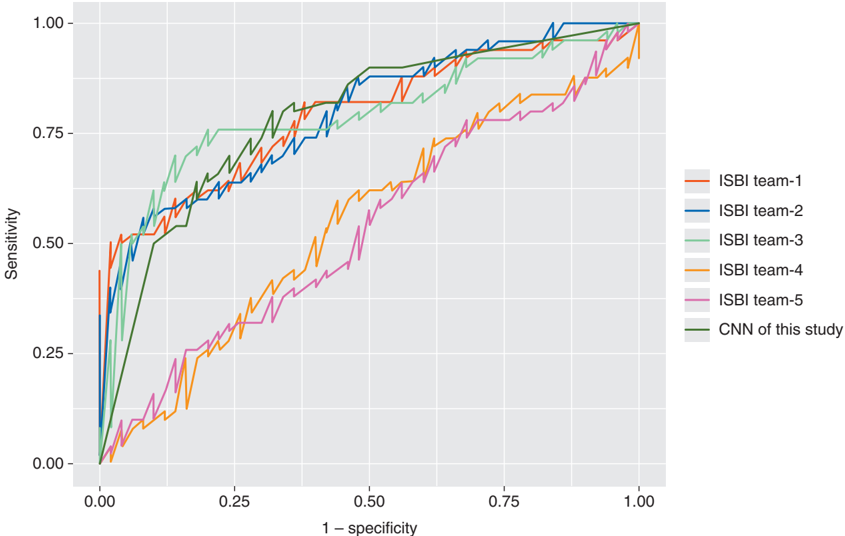
Background Deep learning convolutional neural networks (CNN) may facilitate melanoma detection, but data comparing a CNN's diagnostic performance to larger groups of dermatologists are lacking. Methods Google's Inception v4 CNN architecture was trained and validated using dermoscopic images and corresponding diagnoses. In a comparative cross-sectional reader study a 100-image test-set was used (level-I: dermoscopy only; level-II: dermoscopy plus clinical information and images). Main outcome measures were sensitivity, specificity and area under the curve (AUC) of receiver operating characteristics (ROC) for diagnostic classification (dichotomous) of lesions by the CNN versus an international group of 58 dermatologists during level-I or -II of the reader study. Secondary end points included the dermatologists' diagnostic performance in their management decisions and differences in the diagnostic performance of dermatologists during level-I and -II of the reader study. Additionally, the CNN's performance was compared with the top-five algorithms of the 2016 International Symposium on Biomedical Imaging (ISBI) challenge. Results In level-I dermatologists achieved a mean (±standard deviation) sensitivity and specificity for lesion classification of 86.6% (±9.3%) and 71.3% (±11.2%), respectively. More clinical information (level-II) improved the sensitivity to 88.9% (±9.6%, P = 0.19) and specificity to 75.7% (±11.7%, P < 0.05). The CNN ROC curve revealed a higher specificity of 82.5% when compared with dermatologists in level-I (71.3%, P < 0.01) and level-II (75.7%, P < 0.01) at their sensitivities of 86.6% and 88.9%, respectively. The CNN ROC AUC was greater than the mean ROC area of dermatologists (0.86 versus 0.79, P < 0.01). The CNN scored results close to the top three algorithms of the ISBI 2016 challenge. Conclusions For the first time we compared a CNN's diagnostic performance with a large international group of 58 dermatologists, including 30 experts. Most dermatologists were outperformed by the CNN. Irrespective of any physicians' experience, they may benefit from assistance by a CNN's image classification. Clinical trial number This study was registered at the German Clinical Trial Register (DRKS-Study-ID: DRKS00013570; https://www.drks.de/drks_web/).
Overview
The claims and statistics of this paper haven’t been checked yet.
Free: it reads the open-access text and checks the first 5 claims that cite a source we can check. Create a free account to check every claim.
Integrity signals
Registry
Cites
Statistics
Figures





Verification
Claims the paper makes
The claims and statistics of this paper haven’t been checked yet.
Free: it reads the open-access text and checks the first 5 claims that cite a source we can check. Create a free account to check every claim.
Claims other papers make about this one
Each is checked against this paper’s own text: does it say what the citing paper says it does?
The source backs part of the claim, not all of it — or backs it for a different population, condition or comparison.
In the citing paper
“A series of works have demonstrated that CNNs can match the performance of board-certified dermatologists at classifying malignant skin lesions from benign ones 7,93,94 .”
From Deep learning-enabled medical computer vision (2021) · cites this paper as [93]
Experimental — accuracy not yet measuredThe source backs part of the claim, not all of it — or backs it for a different population, condition or comparison.
In the citing paper
“For instance, AI is shown to diagnose skin cancer more efficiently than dermatologists [54].”
From Use of AI-based tools for healthcare purposes: a survey study from consumers’ perspectives (2020) · cites this paper as [54]
Experimental — accuracy not yet measuredThe cited source says what the claim attributes to it.
In the citing paper
“Several algorithms incorporating artificial intelligence (AI) have been developed to help interpret both clinical11,12,13,14,15 and dermoscopic16,17,18,19,20,21,22,23 images for a variety of skin conditions”
In the citing paper
“These studies have sequentially tested increasing numbers of dermatologists (25-7 57-93 , 157-94 ), consistently demonstrating a sensitivity and specificity in classification that matches or even exceeds physician levels.”
From Deep learning-enabled medical computer vision (2021) · cites this paper as [93]
Self-check
Percentages, sums and reported differences re-computed from the paper’s own numbers.
The self-check needs the paper’s full text.
Citations
Cites
The publisher hasn’t deposited this paper’s reference list.
Cited by
Items 101–167 of 167
Artificial intelligence in medical education: Are we ready for it?
Imran, N., & Jawaid, M. (2020) · Pakistan Journal of Medical Sciences · doi:10.12669/pjms.36.5.3042 · Cited by 56
Alsobhi, M., Sachdev, H. S., Chevidikunnan, M. F., Basuodan, R., K U, D. K., & Khan, F. (2022) · International Journal of Environmental Research and Public Health · doi:10.3390/ijerph192315919 · Cited by 53
Background selection schema on deep learning-based classification of dermatological disease
Zhou, J., Wu, Z., Jiang, Z., Huang, K., Guo, K., & Zhao, S. (2022) · Computers in Biology and Medicine · doi:10.1016/j.compbiomed.2022.105966 · Cited by 53
Artificial intelligence in medical education: promise, pitfalls, and practical pathways
Saroha, S. (2025) · Advances in Medical Education and Practice · doi:10.2147/amep.s523255 · Cited by 53
Interactive 3D U-net for the segmentation of the pancreas in computed tomography scans
Boers, T. G. W., Hu, Y., Gibson, E., Barratt, D. C., Bonmati, E., Krdzalic, J., van der Heijden, F., Hermans, J. J., & Huisman, H. J. (2020) · Physics in Medicine & Biology · doi:10.1088/1361-6560/ab6f99 · Cited by 51
From data to diagnosis: skin cancer image datasets for artificial intelligence
Wen, D., Soltan, A., Trucco, E., & Matin, R. N. (2024) · Clinical and Experimental Dermatology · doi:10.1093/ced/llae112 · Cited by 59
Clinical protein science in translational medicine targeting malignant melanoma
Gil, J., Betancourt, L. H., Pla, I., Sanchez, A., Appelqvist, R., Miliotis, T., Kuras, M., Oskolas, H., Kim, Y., Horvath, Z., et al. (2019) · Cell Biology and Toxicology · doi:10.1007/s10565-019-09468-6 · Cited by 45
Chen, J. Y., Fernandez, K., Fadadu, R. P., Reddy, R., Kim, M.-O., Tan, J., & Wei, M. L. (2025) · JAMA Dermatology · doi:10.1001/jamadermatol.2024.4382 · Cited by 43
De, A., Mishra, N., & Chang, H.-T. (2024) · PeerJ Computer Science · doi:10.7717/peerj-cs.1884 · Cited by 42
Micocci, M., Borsci, S., Thakerar, V., Walne, S., Manshadi, Y., Edridge, F., Mullarkey, D., Buckle, P., & Hanna, G. B. (2021) · Journal of Clinical Medicine · doi:10.3390/jcm10143101 · Cited by 39
Sangers, T. E., Wakkee, M., Moolenburgh, F. J., Nijsten, T., & Lugtenberg, M. (2022) · Archives of Dermatological Research · doi:10.1007/s00403-022-02492-3 · Cited by 38
“In dermatology, deep neural networks (DNNs) have been reported to achieve, and even outperform, the level of accuracy of dermatologists when classifying images of skin lesions [1, 2].”
BackgroundArtificial intelligence for melanoma diagnosis: how can we deliver on the promise?
Mar, V. J., & Soyer, H. P. (2018) · Annals of Oncology · doi:10.1093/annonc/mdy193 · Cited by 37
Zhong, F., He, K., Ji, M., Chen, J., Gao, T., Li, S., Zhang, J., & Li, C. (2024) · Scientific Reports · doi:10.1038/s41598-024-59436-2 · Cited by 37
Artificial Intelligence in Anesthetic Care: A Survey of Physician Anesthesiologists
Estrada Alamo, C. E., Diatta, F., Monsell, S. E., & Lane-Fall, M. B. (2024) · Anesthesia & Analgesia · doi:10.1213/ane.0000000000006752 · Cited by 36
Helenason, J., Ekström, C., Falk, M., & Papachristou, P. (2024) · Scandinavian Journal of Primary Health Care · doi:10.1080/02813432.2023.2283190 · Cited by 33
Weinert, L., Müller, J., Svensson, L., & Heinze, O. (2022) · JMIR Medical Informatics · doi:10.2196/34678 · Cited by 33
Escalé-Besa, A., Vidal-Alaball, J., Miró Catalina, Q., Gracia, V. H. G., Marin-Gomez, F. X., & Fuster-Casanovas, A. (2024) · Healthcare · doi:10.3390/healthcare12121192 · Cited by 29
The Value of Physical Examination in the Era of Telemedicine
Lee, P. S., Koo, S., & Panter, S. (2021) · Journal of the Royal College of Physicians of Edinburgh · doi:10.4997/jrcpe.2021.122 · Cited by 29
Use of Artificial Intelligence in Skin Cancer Diagnosis and Management
Wada, M., Ge, Z., Gilmore, S. J., & Mar, V. J. (2020) · Medical Journal of Australia · doi:10.5694/mja2.50759 · Cited by 22
Enhancing skin lesion classification: a CNN approach with human baseline comparison
Ajabani, D., Shaikh, Z. A., Yousef, A., Ali, K., & Albahar, M. A. (2025) · PeerJ Computer Science · doi:10.7717/peerj-cs.2795 · Cited by 18
Zhao, X., Liu, M., Wu, S., Zhang, B., Burjoo, A., Yang, Y., & Xu, D. (2023) · Quantitative Imaging in Medicine and Surgery · doi:10.21037/qims-22-965 · Cited by 15
Govindu, S., Devi, O. R., Sitharam, M., Koreddi, V., Kumar, M. K., & Sunitha, M. (2026) · Biomedical Signal Processing and Control · doi:10.1016/j.bspc.2025.108929 · Cited by 7
Mehta, D., Betz-Stablein, B., Nguyen, T. D., Gal, Y., Bowling, A., Haskett, M., Sashindranath, M., Bonnington, P., Mar, V., Soyer, H. P., et al. (2023) · arXiv · doi:10.48550/arxiv.2311.01009 · Cited by 3
“AI techniques, including deep learning and machine learning models, have demonstrated promising results [8, 9] and even outperformed dermatologists in certain tasks of skin cancer classification [10, 11].”
BackgroundSCD-NAS: Towards Zero-Cost Training in Melanoma Diagnosis
Xu, H., Su, X. Q., Sowmya, A., Katz, I. A., & Wang, D. (2024) · IEEE International Conference on Multimedia and Expo (ICME) · doi:10.1109/icme57554.2024.10687537 · Cited by 1
Soellner, M., & Koenigstorfer, J. (2022) · Figshare · doi:10.6084/m9.figshare.21099105
Li, D., Li, C., Gao, W., & Shi, H. (2026) · Journal of Visualized Experiments · doi:10.3791/69449
Image class translation distance: a novel interpretable feature for image classification
Bowen, M. K., & Wilson, J. W. (2026) · SPIE Medical Imaging: Computer-Aided Diagnosis · doi:10.1117/12.3085623
Réseaux profonds pour la classification des opinions multilingue
Medrouk, L. (2018) · theses.fr (ABES) · doi:10.70675/4b3af625zb1eez43dez9207z79a711da3520
Geffard, E. (2020) · theses.fr (ABES) · doi:10.70675/e800a440z07edz4807z8c23zf939c9a40b71 · Cited by 3
Wang, X., Saeed, A. K., Johnson, B., & Rodriguez, B. M. (2026) · Multimodal Image Exploitation and Learning · doi:10.1117/12.3095144
Yadav, R. K., Nandi, A., Kumar, V., Moriwal, R., & Kumar, M. (2026) · Scientific Reports · doi:10.1038/s41598-026-60659-8
de Abreu, I. T., Monteiro, F. S., Almeida‐Silva, G., Amaral, I. P., Soares, I., & Reis, M. D. (2026) · Dermatology · doi:10.1159/drm/ackag015
Optimization-driven feature selection for enhanced skin cancer detection using deep learning
Thorat, A., & Jadhav, C. R. (2026) · Cluster Computing · doi:10.1007/s10586-026-06575-y
Baji, S. R., Bagal, S. B., & Chaudhari, S. (2026) · Lecture notes in networks and systems · doi:10.1007/978-3-032-33584-5_34
Akram, M. A., Ahmad, S. A., Qadri, N. N., Javed, U., & He, D. (2026) · Electronics · doi:10.3390/electronics15184170
Vers une diabétologie augmentée par l’IA : état des lieux et perspectives
Fagherazzi, G. (2026) · EMC - Endocrinologie - Nutrition · doi:10.1016/s1155-1941(25)48886-6
Kropiwnicka, A., Habirek, K. S., Porażko, M. M., Żurakowska-Zadrożna, A. K., Krupska, A., Czarnecka, J. A., Marcinkowska, Z. M., Gugulska, J. Z., Kieres, M., Wójcik, K. K., et al. (2026) · International Journal of Innovative Technologies in Social Science · doi:10.31435/ijitss.3(51).2026.6064
Enhanced EfficientNet-B4 with Squeeze-and-Excitation Mechanisms for Skin Cancer Detection
Bajpai, Y., Gupta, D., & Mahapatra, S. (2026) · Lecture notes in electrical engineering · doi:10.1007/978-3-032-27343-7_48
Habeeb, R., Abiyev, R. H., & Dimililer, K. (2026) · Electronics · doi:10.3390/electronics15184308
Classification of Skin Cancer Image Using Resnet-50 with 3-Fold Cross-Validation Technique
Saloni, M., Kumar, A., & Chandran, S. (2026) · International Conference on Computing, Intelligence, and Application (CIACON) · doi:10.1109/ciacon70148.2026.11689285
Omics-Nano-CRISPR Strategies for Combating Skin Cancer in the AI Age
Chauhan, A. S., Durgapal, S., Pandit, J., & Raghav, A. (2026) · IGI Global eBooks · doi:10.4018/979-8-3373-9715-3.ch009
Abbas, F., & Naseer, I. (2026) · International Journal of Innovations in Science and Technology · doi:10.33411/ijist/2034
Question-Driven Decision Tree via Knowledge Distillation for Interpretable Prediction
Yao, X., Zhang, Z., Chen, Q., & Hong, Y. (2026) · Lecture notes in computer science · doi:10.1007/978-3-032-38079-1_43
DermAgent: A Multi-tool Agentic System for Evidence-Grounded and Traceable Reasoning in Dermatology
Liu, Y., Yan, S., Hu, M., Ju, L., Li, X., Tang, F., Feng, W., & Ge, Z. (2026) · Lecture notes in computer science · doi:10.1007/978-3-032-38062-3_16 · Cited by 3
Kesimal, K., & Özcan, H. (2026) · International Conference on Advanced Computer Information Technologies (ACIT) · doi:10.1109/acit69831.2026.11700101
A Mobile Application for Early Detection of Skin Cancer
Afifi, S. M., Aboulmagd, B., Kaur, R., Poulis, Y., Taha, R., Salem, M. A.-M., Hamed, M., & Radüntz, T. (2026) · Lecture notes in networks and systems · doi:10.1007/978-3-032-39783-6_27
Blüthgen, S., & Greis, C. (2026) · Dermatology Practical & Conceptual · doi:10.5826/dpc.160s1a7727
An Inspectable Vision-Language and Convolutional Ensemble for Facial Pigmented Lesion Diagnosis
Zafeiriou, A., Kallipolitis, A., Τζιομάκα, Μ., & Maglogiannis, I. G. (2026) · World Congress on Medical Physics and Biomedical Engineering, September 7 - 12, 2009, Munich, Germany · doi:10.1007/978-3-032-39674-7_20
Szyc, Ł., Amir, Y., Subramaniam, P., Trzeciakiewicz, M., Dronnik, E., von Au, L., Singh, R., Ratschow, A., Ahlberg, S., Reinhold, U., et al. (2026) · Dermatology Practical & Conceptual · doi:10.5826/dpc.160s1a7730
A Multi-Disease Prediction System with Integrated Explainable AI (XAI)
Kshirsagar, R., Kothari, R. M., Lhase, P., & Sheikh, S. (2026) · International Conference on Innovation & Growth in Next-Gen Intelligent Technology & Engineering (IGNITE) · doi:10.1109/ignite69592.2026.11705746
Salsano, A., Costanzo, L. D., Brescia, C., Ligrone, L., & Lembo, S. (2026) · Dermatology Practical & Conceptual · doi:10.5826/dpc.160s1a7734
Madhavan, S., & Sophia, P. E. (2026) · International Conference on Soft Computing for Security Applications (ICSCSA) · doi:10.1109/icscsa69367.2026.11708558
Self-Guided Integrated Gradient Method for Attribution
Henry, S., Ruget, A., Scholes, S., & Leach, J. (2026) · 2026 IEEE/CVF Conference on Computer Vision and Pattern Recognition- FINDINGS Track (CVPRF) · doi:10.1109/cvprf71909.2026.00322
An Automated Image Analysis System for the Localization and Classification of Skin Cancer Lesions
Panwar, A., Maurya, A., Bhati, J., Shukla, M. K., & Sharma, P. (2026) · International Conference on Advancements in Smart, Secure and Intelligent Computing (ASSIC) · doi:10.1109/assic70037.2026.11716928
Baalakumar, N. N., Prabakar, S., Nandhakumaran, S., Hari Prasanna, S., Hari Prasath, T., & Dhanush, J. (2026) · International Conference on Smart Systems for Electrical, Electronics, Communication and Computer Engineering (ICSSEECC) · doi:10.1109/icsseecc69062.2026.11721996
Pham, D. N., Chan, W. H., Conway, J., Ali, I., & Cockerell, C. J. (2026) · Cancers · doi:10.3390/cancers18203277
Shakir, H. M., Al-Imareen, N., Al-Saidi, M., & Zalfani, M. (2026) · Diagnostics · doi:10.3390/diagnostics16203368
Vollmer, A. S., Winkler, J. K., Toberer, F., Kommoss, K. S., Blum, A., Hofmann‐Wellenhof, R., Stolz, W., Enk, A., & Haenssle, H. A. (2026) · JDDG Journal der Deutschen Dermatologischen Gesellschaft · doi:10.1111/ddg.70530
Self-citationMohamed, N. A. R. (2026) · Discover Artificial Intelligence · doi:10.1007/s44163-026-02551-y
Deep Learning Architectures for Early Detection of Skin Cancer
Gupta, P. K., Gupta, S., & Agarwal, C. (2026) · Lecture notes in networks and systems · doi:10.1007/978-3-032-10303-1_10
Title: diagnostic performance of FotoFinder AIMEE in routine specialist dermatology practice
van der Westhuizen, J. C., van der Westhuizen, B., Moola, H., & Visser, W. I. (2026) · EJC Skin Cancer · doi:10.1016/j.ejcskn.2026.101166
Elmetwalli, A., Algehainy, N. A., Altemani, F. H., Alanazi, M. A., & Altemani, A. H. (2026) · International Journal of Pharmaceutics · doi:10.1016/j.ijpharm.2026.127586
A Comprehensive Survey on Melanoma Detection Using Image Processing and Machine Learning Techniques
Paria, A., Prof. Nandini, K., Gowda, S. B., Saleem, A. L., Thahniyath, G., & B, B. K. (2026) · doi:10.1109/incect72370.2026.11742698
Manchala, B., Akarapu, R. B., & Reddy, K. P. (2026) · doi:10.1109/incect72370.2026.11742970
Kohli, A., Gupta, M., Kumar, R., & Konduru, S. C. (2026) · doi:10.1109/incect72370.2026.11742746
Villalba, S. G. O., Villalba, X. J. O., & Guerrero, E. R. J. (2026) · ASCE MAGAZINE · doi:10.70577/asce.v5i4.1134
Ramya, R., & Jaisankar, N. (2026) · Frontiers in Artificial Intelligence · doi:10.3389/frai.2026.1936676
Metadata
- Authors
- Haenssle, H. A., Fink, C., Schneiderbauer, R., Toberer, F., Buhl, T., Blum, A., Kalloo, A., Hassen, A. B. H., Thomas, L., Enk, A., Uhlmann, L., Alt, C., Arenbergerova, M., Bakos, R., Baltzer, A., Bertlich, I., Blum, A., Bokor-Billmann, T., Bowling, J., Braghiroli, N., Braun, R., Buder-Bakhaya, K., Buhl, T., Cabo, H., Cabrijan, L., Cevic, N., Classen, A., Deltgen, D., Fink, C., Georgieva, I., Hakim-Meibodi, L.-E., Hanner, S., Hartmann, F., Hartmann, J., Haus, G., Hoxha, E., Karls, R., Koga, H., Kreusch, J., Lallas, A., Majenka, P., Marghoob, A., Massone, C., Mekokishvili, L., Mestel, D., Meyer, V., Neuberger, A., Nielsen, K., Oliviero, M., Pampena, R., Paoli, J., Pawlik, E., Rao, B., Rendon, A., Russo, T., Sadek, A., Samhaber, K., Schneiderbauer, R., Schweizer, A., Toberer, F., Trennheuser, L., Vlahova, L., Wald, A., Winkler, J., Wölbing, P., & Zalaudek, I.
- Affiliations
- Heidelberg University (DE)
- Memorial Sloan Kettering Cancer Center (US)
- University of Passau (DE)
- Lyon 1 Université (FR)
- Corresponding author
- Haenssle, H.A.
- ORCID
- Venue
- Annals of Oncology
- Publisher
- Elsevier BV
- Published
- 2018-08
- Volume
- 29
- Issue
- 8
- Pages
- 1836-1842
- ISSN
- 0923-7534 (ISSN-L)
- OpenAlex
- W2806853752
- Cited by
- 1,571
- References
- 0
- Citations by year
- 2026: 117 · 2025: 202 · 2024: 224 · 2023: 217 · 2022: 185 · 2021: 215 · 2020: 187 · 2019: 185 · 2018: 36
- FWCI
- 58.54
- Type
- journal article
- Language
- en
- Open access
- hybrid
- doi.org
- Licence
- cc-by-nc-nd
- www.elsevier.com/tdm/userlicense/1.0/ (tdm)
- www.elsevier.com/open-access/userlicense/1.0/ (vor, 450 d)
- Locations
- Annals of Oncology (publishedVersion, cc-by-nc-nd)
- PubMed (publishedVersion)
- ArTS Archivio della ricerca di Trieste (University of Trieste https://www.units.it/) (submittedVersion, other-oa)
- Lund University Publications (Lund University) (submittedVersion)
- GoeScholar The Publication Server of the Georg-August-Universität Göttingen (Georg-August-Universität Göttingen) (submittedVersion, other-oa)
- Topics
- Health Sciences › Medicine › Oncology › Cutaneous Melanoma Detection and Management
- Physical Sciences › Computer Science › Artificial Intelligence › AI in cancer detection
- Health Sciences › Health Professions › Health Information Management › Artificial Intelligence in Healthcare
- Keywords
- melanoma, dermoscopy, convolutional neural networks, Inception-v4, computer-aided diagnosis, skin lesion classification, sensitivity and specificity, clinical decision support, artificial intelligence in dermatology
- MeSH terms
- Dermatologists, Deep Learning, Clinical Competence, Cross-Sectional Studies, Humans, Image Processing, Computer-Assisted, International Cooperation, Melanoma, Retrospective Studies, ROC Curve, Skin, Skin Neoplasms, Dermoscopy
About these checks
Registry, retraction, Cites and statistics results are computed, not judged, with one exception: a printed reference that no index lists is read once by a model before it counts as a citation error. Claims are extracted by a model and kept only when their quote appears verbatim in the text; each cited source is then checked, with a model’s help, for whether it says what the claim relies on. Those verdicts can be wrong — read the claim’s quote and the cited source before relying on one.
Statistics and arithmetic are recomputed, not judged.
Confidence bands are shown only for fields calibrated on our annotated test set. None is calibrated yet, so no band is shown.
What counts as a claim ›How we measure confidence ›How we check this ›
Are you an author, or do you see a problem with this page? Request a review
Data sources
Bibliographic data: Semantic Scholar, OpenAlex, Crossref.
Contains information from the Semantic Scholar Academic Graph Datasets, made available under the ODC Attribution License (ODC-BY 1.0).
Semantic Scholar’s data is described in: Kinney, R., et al. (2023). The Semantic Scholar Open Data Platform. arXiv:2301.10140.
