

Assessment of Heat Stress Exposure among Construction Workers in the Hot Desert Climate of Saudi Arabia
Open accessThe DOI matches its Crossref record; 92 of the 106 references it cites were found in a registry or an index; 8 of the 53 sources its claims cite were checked for support.
Abstract
OBJECTIVES: Excessive heat exposure poses significant risks to workers in hot climates. This study assessed the intensity and duration of heat stress exposure among workers performing residential construction in southeastern Saudi Arabia (SA) during the summer, June-September 2016. Objectives were to: identify work factors related to heat stress exposure; measure environmental heat exposure at the construction sites; assess the heat stress risk among workers using the wet bulb globe temperature (WBGT) index; and determine if temperature-humidity indices can be appropriate alternatives to WBGT for managing heat stress risk at the construction sites. METHODS: Worksite walkthrough surveys and environmental monitoring were performed, indoors and outdoors, at 10 construction sites in Al-Ahsa Province. A heat stress exposure assessment was conducted according to the American Conference of Governmental Industrial Hygienists (ACGIH®) guidelines, which uses the WBGT index. WBGT measurements from two instruments were compared. Alternative heat stress indices were compared to the WBGT: the heat index (HI) and humidex (HD) index. RESULTS: Construction workers were exposed to excessive heat stress, indoors and outdoors over a large part of the work day. Complying with a midday outdoor work ban (12-3 p.m.) was not effective in reducing heat stress risk. The highest intensity of exposure was outdoors from 9 a.m. to 12 p.m.; a period identified with the highest hourly mean WBGT values (31-33°C) and the least allowable working time according to ACGIH® guidelines. Comparison of the alternative indices showed that the HI is more reliable than the HD as a surrogate for the WBGT index in the climate studied. CONCLUSION: The extreme heat exposure represents a serious risk. The severity of heat stress and its impact are projected to increase due to climate change, emphasizing the need for immediate improvement of the current required protective measures and the development of occupational heat stress exposure guidelines in SA.
Overview
CoChat Summary
TL;DR
This field study monitored heat conditions at 10 residential construction sites in Al-Ahsa Province, Saudi Arabia, during June–September 2016 and found very high heat stress exposure indoors and outdoors for much of the workday. The heat index (HI) tracked WBGT closely and was judged a practical surrogate for managing heat stress risk in this climate.
Key findings
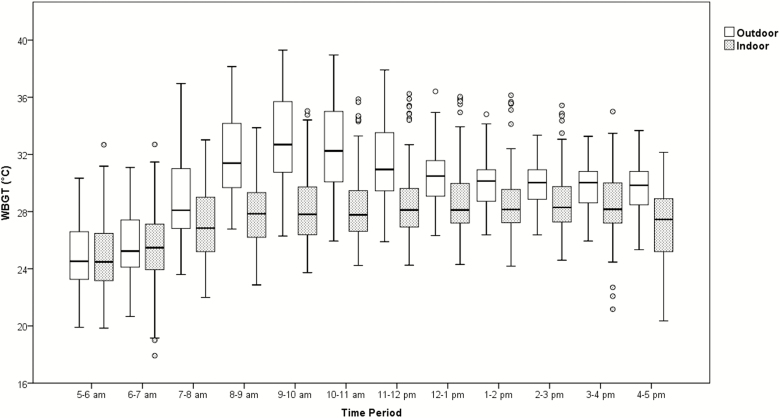
- At the 10 sites, outdoor WBGT rose to a peak of 33.0 ± 3.1°C at 9 a.m. and indoor WBGT peaked at 28.8°C between 9 a.m. and 12 p.m.
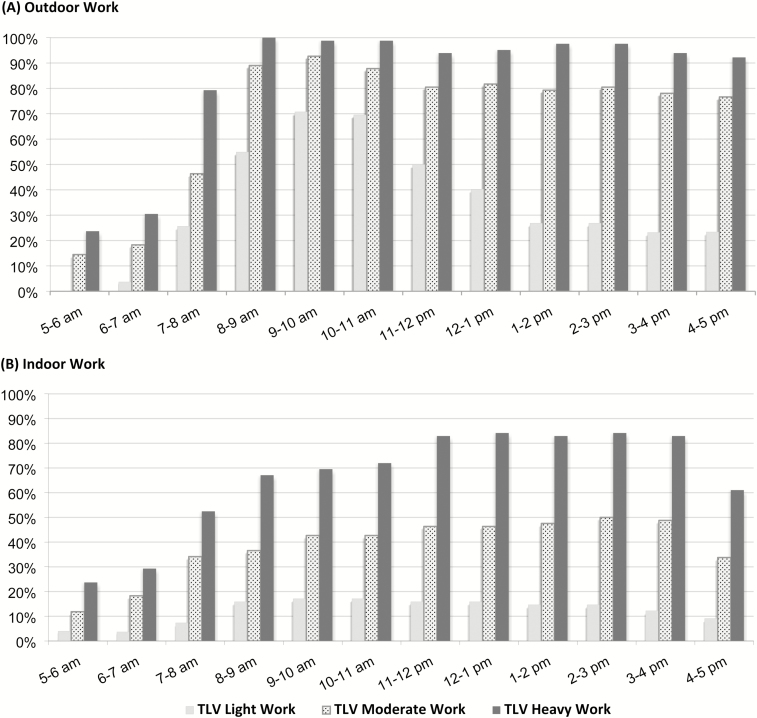
- Outdoor WBGT exceeded ACGIH TLVs during 8 a.m.–5 p.m. for 92–100% of the time for heavy work, 77–93% for moderate work, and 23–71% for light work; indoor exceedances were 61–84%, 34–50%, and 9–17%, respectively.
- The midday outdoor work ban (12–3 p.m.) was not effective in reducing heat stress risk, though complying with it reduced total exposure time by 185 h over the summer months for workers in compliant companies.
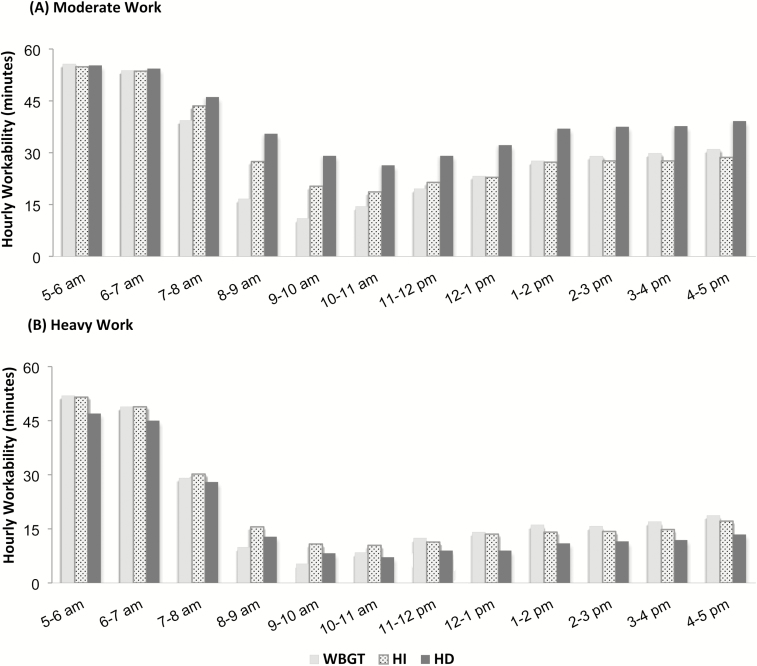
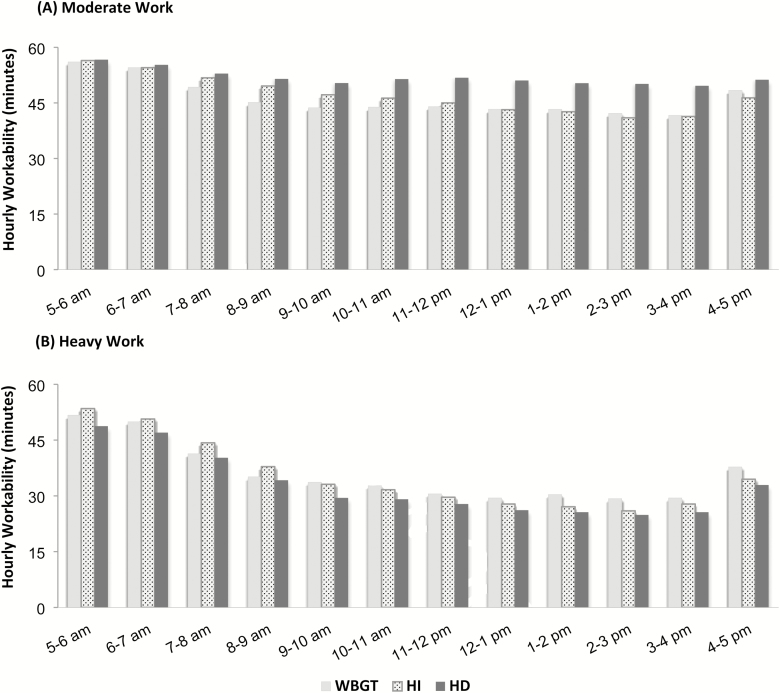
- Agreement between WBGT and HI for allowable working hours was almost perfect: κw = 0.85 and 0.89 for moderate work indoors/outdoors, and κw = 0.88 and 0.90 for heavy work indoors/outdoors.
Methods
- Observational field study with qualitative walkthrough surveys and quantitative environmental monitoring at 10 residential construction sites in Al-Ahsa Province during June–September 2016.
- Environmental heat exposure was measured indoors and outdoors using WBGT every 15 min from 5 a.m. to 5 p.m. across 81 days; a pilot comparison found strong agreement between two WBGT instruments (r² = 0.99; P < 0.05).
- Analysis used ACGIH TLVs and calculated hourly workability/allowable working time (HWA) for light, moderate, and heavy workloads; Cohen’s weighted kappa compared WBGT-based HWA with HWA from HI and humidex (HD).
Limitations
- The paper states it did not investigate the short- and long-term health impacts of continuous work during the 12-hour workday.
- The authors note that they did not monitor workers’ physiological responses or actual metabolic rates, so they could not account for these factors; they also say self-pacing may have led to overestimation of risk.
- Evident from the text: monitoring covered only June–September 2016, only 10 sites in one province, and only daytime hours from 5 a.m. to 5 p.m., so broader seasonal and regional generalizability is limited.
Model-written summary. Check it against the paper before relying on it.
Integrity signals
Registry
Cites
Statistics
Figures
Verification
Claims the paper makes
7 Valid · 0 Not valid · 22 Not checked · 61 Own results and interpretations
The cited sources support only part of this claim — read each source’s verdict below.
In the paper
“The negative impacts of heat stress will likely increase due to climate change (Spector and Sheffield, 2014; Acharya et al., 2018), particularly in countries in arid and tropical zones (Kjellstrom et al., 2009; Andrews et al., 2018).”
- Also stated in: § Conclusion · hedged
“The severity of heat stress and its impact are projected to increase due to climate change, emphasizing the need for immediate improvement of the current required protective measures and the development of occupational heat stress exposure guidelines in SA.”
§ Assessment of Heat Stress Exposure among Construction Workers in the Hot Desert Climate of Saudi Arabia > Introduction
What the sources say
- Not matchedcites Spector and Sheffield, 2014
An author–year citation the paper’s reference list doesn’t settle. We don’t search these by name.
- Supportedcites Acharya et al., 2018 matched to “Assessing Heat Stress and Health among Construction Workers in a Changing Climate: A Review” (2018) source
The Introduction states that projected increases in extreme heat due to climate change are expected to increase construction workers’ vulnerability to heat stress. Acharya et al. is cited for that first clause; the separate claim about arid and tropical zones is attributed to other sources. (LLM, conf=0.91)
- Partly supportedcites Kjellstrom et al., 2009 matched to “The Direct Impact of Climate Change on Regional Labor Productivity” (2009) sourceExperimental — accuracy not yet measured
The Results (page unavailable) project heat-related labour-productivity losses in several tropical regions, supporting the claim for those areas. The Introduction says heat strain can occur in arid climates, but the paper does not identify arid regions as particularly affected by future climate change; its tabulated projection for North Africa/Middle East is comparatively small. (LLM, conf=0.82)
hedgedstates a possible cause- Asserted: passes — The authors put it forward as true.
- Checkable: passes — It can be checked against evidence.
- Load-bearing: passes — The paper’s conclusions depend on it.
- Based: passes — The paper gives a reason why it holds.
- Also stated in: § Conclusion · hedged
The cited sources support only part of this claim — read each source’s verdict below.
In the paper
“The practice of self-pacing by workers through the reduction of their metabolic rate to a safe level has been identified as a protective response to heat stress exposure in construction and other work settings (Mairiaux and Malchaire, 1985; Miller et al., 2011; Nag et al., 2013; Peiffer and Abbiss, 2013; Methner and Eisenberg, 2018).”
§ Assessment of Heat Stress Exposure among Construction Workers in the Hot Desert Climate of Saudi Arabia > Discussion
What the sources say
- Not checked — no full text of the sourcecites Mairiaux and Malchaire, 1985 matched to “Workers self-pacing in hot conditions: a case study” (1985) source
- Not checked — no full text of the sourcecites Miller et al., 2011 matched to “Self-pacing as a protective mechanism against the effects of heat stress” (2011) source
- Partly supportedcites Nag et al., 2013 matched to “Critical body temperature profile as indicator of heat stress vulnerability” (2013) sourceExperimental — accuracy not yet measured
Nag et al. (2013) do identify self-pacing as protective: the Discussion/main text states 'The workers had options of self-pacing their rate of work, as a protective thermoregulatory behavior, and sustaining a level of work in severe hot conditions', and the Abstract and Results infer from ~90% of workers having T_cr within 38 °C 'their self-adjustment strategy in pacing work and regulating T_cr'. Two parts of the claim are not in our copy: the mechanism is stated as pacing the rate of work and controlling core temperature, never as a measured or stated reduction of metabolic rate to a safe level; and the settings studied are informal foundry/sheet-metal, ceramic-pottery and stone-quarry work in Gujarat and Rajasthan, India (Materials and Methods), not construction — so the 'construction' element of the bundled citation rests on other works. Verdict limited to what this source carries. (LLM, conf=0.78)
plainstates a cause- Asserted: passes — The authors put it forward as true.
- Checkable: passes — It can be checked against evidence.
- Load-bearing: passes — The paper’s conclusions depend on it.
- Based: passes — The paper gives a reason why it holds.
The cited sources support only part of this claim — read each source’s verdict below.
In the paper
“At the global level, our findings are consistent with the level of summer heat exposure (hourly mean WBGT values) reported at outdoor construction sites in other studies in tropical and subtropical countries (Kähkönen et al., 1992; Inaba and Mirbod, 2007; Miller and Bates, 2007; Maiti, 2008; Pérez-Alonso et al., 2011; Rowlinson and Jia, 2014; Venugopal et al., 2016).”
§ Assessment of Heat Stress Exposure among Construction Workers in the Hot Desert Climate of Saudi Arabia > Discussion
What the sources say
- Not checked — no full text of the sourcecites Kähkönen et al., 1992 matched to “Estimation of heat stress in Tanzania by using ISO heat stress indices” (1992) source
- Partly supportedcites Inaba and Mirbod, 2007 matched to “Comparison of subjective symptoms and hot prevention measures in summer between traffic control workers and construction workers in Japan” (2007) sourceExperimental — accuracy not yet measured
Our copy does report summer heat-exposure levels at an outdoor construction site: 'Measurement of thermal condition' states dry-bulb, wet-bulb and globe temperatures were measured at two parts of the construction site once per 30 min between 9:00 and 16:30 over 6 d from 31 July to 9 August 2001, and 'Results'/'Work environmental conditions in the summer' give the resulting means (28.1°C at 9:00 to 32.0°C at 1:30 at the morning-assembly place; 26.5°C to 29.8°C on the 3rd floor). What the source does not support is the framing qualifier: 'Subjects and questionnaire' locates the study in Gifu city, Japan — a temperate setting, not a tropical or subtropical country — and the values are 30-minute rather than hourly means. So the citation backs 'a study reporting summer WBGT at outdoor construction sites' but not the tropical/subtropical grouping the citing sentence assigns to it. (LLM, conf=0.72)
- Not matchedcites Miller and Bates, 2007
An author–year citation the paper’s reference list doesn’t settle. We don’t search these by name.
plain- Asserted: passes — The authors put it forward as true.
- Checkable: passes — It can be checked against evidence.
- Load-bearing: unclear — It is unclear whether the paper’s conclusions depend on it.
- Based: passes — The paper gives a reason why it holds.
A result the paper reports from its own data — it cites no other source for it, so there is none to check. The quote shows it is in the paper.
In the paper
“Workers at companies that did not comply with the ban worked 10 h with two meal breaks (30 min each).”
§ Assessment of Heat Stress Exposure among Construction Workers in the Hot Desert Climate of Saudi Arabia > Results > Working environment Nine major jobs and work activities involved in constructing residential buildings were identified based on field observations and onsite discussion with workers and management (Supplementary Table S2, available at Annals of Occupational Hygiene online). All construction workers were Indian nationals, while all construction managers were Saudi nationals. These construction activities were performed 6 days per week by teams of 2–10 workers. Depending on arrival time at the site, the typical work day began between 5 a.m. and 6 a.m. and was supposed to end at 12 p.m. as required by the 3-h midday outdoor work ban. Early start times were designed to take advantage of cooler morning hours to maintain productivity while complying with the midday work ban. However, it was observed that four of the worksites (owned by two of the companies) did not comply with the work ban; their onsite work activities, both indoor and outdoor, continued until 3 p.m. Workers at companies that complied with the work ban worked a maximum of 7 h with only a breakfast break (15–20 min). Workers at companies that did not comply with the ban worked 10 h with two meal breaks (30 min each). The latter companies provided workers with breakfast at approximately 8 a.m. and lunch at approximately 1 p.m. At each site, in general, workers were provided access to one 19-l drinking water cooler for a team of 2–4 workers or two water coolers for 5 or more workers. Commonly, we observed two coolers for a team of <10 workers. Water coolers were filled with water once at the start of the work day. On study days, bottles of water kept in a cooler were made available to workers being observed. Access to and consumption of water during the study will be addressed in a separate publication. All the worksites lacked air-conditioned resting facilities, onsite toilets, and nearby sources of water for refilling drinking water containers. The availability of shaded rest areas varied by job and site. Generally, all workers wore the same clothing, consisting of long-sleeved shirts, long pants, work boots or shoes, baseball caps or head scarves, and polyester or rubber gloves.
plain- Asserted: passes — The authors put it forward as true.
- Checkable: passes — It can be checked against evidence.
- Load-bearing: unclear — It is unclear whether the paper’s conclusions depend on it.
- Based: passes — The paper gives a reason why it holds.
- Rests on an assumption not shown here.
A result the paper reports from its own data — it cites no other source for it, so there is none to check. The quote shows it is in the paper.
In the paper
“for a heavy workload it was exceeded 61–84% of the time”
§ Assessment of Heat Stress Exposure among Construction Workers in the Hot Desert Climate of Saudi Arabia > Results > Assessment of heat stress exposure risk
plain- Asserted: passes — The authors put it forward as true.
- Checkable: passes — It can be checked against evidence.
- Load-bearing: passes — The paper’s conclusions depend on it.
- Based: passes — The paper gives a reason why it holds.
35 more claims
Create a free account to see all 90 claims and to verify the 8 references still open.
- Probably not a substantial claim. 22
- It may state two separate claims as one. 34
Citations
Cites
The Measurement of Observer Agreement for Categorical Data
Landis, J. R., & Koch, G. G. (1977) · Biometrics · doi:10.2307/2529310 · Cited by 81,148
Weighted kappa: nominal scale agreement provision for scaled disagreement or partial credit
Cohen, J. (1968) · Psychological Bulletin · doi:10.1037/h0026256 · Cited by 8,736
Lanczos Filtering in One and Two Dimensions
Duchon, C. E. (1979) · Journal of Applied Meteorology · doi:10.1175/1520-0450(1979)018<1016:lfioat>2.0.co;2 · Cited by 2,398
Steadman, R. G. (1979) · Journal of Applied Meteorology · doi:10.1175/1520-0450(1979)018<0861:taospi>2.0.co;2 · Cited by 1,154
Future temperature in southwest Asia projected to exceed a threshold for human adaptability
Pal, J. S., & Eltahir, E. A. B. (2016) · Nature Climate Change · doi:10.1038/nclimate2833 · Cited by 749
Methods to Calculate the Heat Index as an Exposure Metric in Environmental Health Research
Anderson, G. B., Bell, M. L., & Peng, R. D. (2013) · Environmental Health Perspectives · doi:10.1289/ehp.1206273 · Cited by 573
Humidity: a review and primer on atmospheric moisture and human health
Davis, R. E., McGregor, G. R., & Enfield, K. B. (2016) · Environmental Research · doi:10.1016/j.envres.2015.10.014 · Cited by 472
The Direct Impact of Climate Change on Regional Labor Productivity
Kjellstrom, T., Kovats, R. S., Lloyd, S. J., Holt, T., & Tol, R. S. J. (2009) · Archives of Environmental & Occupational Health · doi:10.1080/19338240903352776 · Cited by 448
Personal factors in thermal comfort assessment: clothing properties and metabolic heat production
Havenith, G., Holmér, I., & Parsons, K. (2002) · Energy and Buildings · doi:10.1016/s0378-7788(02)00008-7 · Cited by 376
Buchholz, B., Paquet, V., Punnett, L., Lee, D., & Moir, S. (1996) · Applied Ergonomics · doi:10.1016/0003-6870(95)00078-x · Cited by 374
Research works printed but not linked: 7
- American Conference of Governmental Industrial Hygienists (ACGIH) (2009) Heat Stress and Strain: TLV® Physical Agents. Cincinnati, OH: ACGIH.
- Dargin J (2009) Saudi arabia, UAE promote energy from sun and wind. Oil Gas J; 107: 18– 22.
- IBM (2016) SPSS Statistics for Windows, version 24. Armonk, NY: IBM.
- International Organization for Standardization (ISO) (2017) ISO 7243, ergonomics of the thermal environment — assessment of heat stress using the WBGT (wet bulb globe temperature) index. Geneva, Switzerland: ISO.
- Masterton J, Richardson F (1979) Humidex: a method of quantifying human discomfort due to excessive heat and humidity. Downsview, Canada: Environment Canada, Atmospheric Environment Service. OCLC number: 6952677.
- Miller V, Bates G (2007) Hydration of outdoor workers in north-west Australia. J Occup Health Saf Aust NZ; 23: 79– 87.
- The Center for Construction Research and Training (CPWR). (2018) The construction chart book: the U.S. construction industry and its workers. Silver Spring, MD: CPWR Available at https://www.cpwr.com/sites/default/files/publications/The_6th_Edition_Construction_eChart_Book.pdf. Accessed 29 November 2018.
Cited by
Climate Change and Weather Extremes in the Eastern Mediterranean and Middle East
Zittis, G., Almazroui, M., Alpert, P., Ciais, P., Cramer, W., Dahdal, Y., Fnais, M., Francis, D., Hadjinicolaou, P., Howari, F., et al. (2022) · Reviews of Geophysics · doi:10.1029/2021rg000762 · Cited by 704
“ities, such as construction and agriculture, are already challenged (Al-Bouwarthan et al., 2019).”
BackgroundImpacts of Climate Change on Outdoor Workers and Their Safety: Some Research Priorities
Moda, H. M., Filho, W. L., & Minhas, A. (2019) · International Journal of Environmental Research and Public Health · doi:10.3390/ijerph16183458 · Cited by 171
“, [41] Scenario based assessments Mixed methods Assessment of work factors related to heat stress exposure among construction workers Construction workers –Saudi Arabia Extreme heat exposure, climate change impact and construction workers Development of occupational heat exposure guidelines Call for assessment of both…”
BackgroundWeather-Related Construction Delays in a Changing Climate: A Systematic State-of-the-Art Review
Schuldt, S., Nicholson, M., Adams, Y. A., & Delorit, J. D. (2021) · Sustainability · doi:10.3390/su13052861 · Cited by 172
Shakerian, S., Habibnezhad, M., Ojha, A., Lee, G., Liu, Y., Jebelli, H., & Lee, S. H. (2021) · Safety Science · doi:10.1016/j.ssci.2021.105395 · Cited by 131
Mani, Z. A., & Goniewicz, K. (2023) · Sustainability · doi:10.3390/su151914279 · Cited by 159
The impacts of climate change on occupational heat strain in outdoor workers: A systematic review
Habibi, P., Moradi, G., Dehghan, H., Moradi, A., & Heydari, A. (2021) · Urban Climate · doi:10.1016/j.uclim.2021.100770 · Cited by 102
An Occupational Heat–Health Warning System for Europe: The HEAT-SHIELD Platform
Morabito, M., Messeri, A., Noti, P. A., Casanueva, A., Crisci, A., Kotlarski, S., Orlandini, S., Schwierz, C., Spirig, C., Kingma, B., et al. (2019) · International Journal of Environmental Research and Public Health · doi:10.3390/ijerph16162890 · Cited by 84
“In addition, the use of meteorological data for occupational heat stress assessment is actually limited because weather stations do not traditionally and directly measure some important climate factors useful for WBGT calculation [83,84].”
BackgroundA review of construction workforce health challenges and strategies in extreme weather conditions
Karthick, S., Kermanshachi, S., Pamidimukkala, A., & Namian, M. (2022) · International Journal of Occupational Safety and Ergonomics · doi:10.1080/10803548.2022.2082138 · Cited by 88
Al-Bouwarthan, M., Quinn, M., Kriebel, D., & Wegman, D. H. (2020) · International Journal of Environmental Research and Public Health · doi:10.3390/ijerph17113775 · Cited by 76
“Wet Bulb Globe Temperatures (WBGT) levels exceeded the limits set by the American Conference of Governmental Industrial Hygienists (ACGIH) for full-day work on a high percentage of working days during the summer months (June–September), thus requiring restrictions on work activities [35].”
BackgroundMethodInfluentialSelf-citationGariazzo, C., Taiano, L., Bonafede, M., Leva, A., Morabito, M., de'Donato, F. K., & Marinaccio, A. (2022) · Environment International · doi:10.1016/j.envint.2022.107677 · Cited by 70
Analysis of Outdoor Thermal Discomfort Over the Kingdom of Saudi Arabia
Dasari, H. P., Desamsetti, S., Langodan, S., Viswanadhapalli, Y., & Hoteit, I. (2021) · GeoHealth · doi:10.1029/2020gh000370 · Cited by 56
Al-Bouwarthan, M., Quinn, M., Kriebel, D., & Wegman, D. H. (2020) · Annals of Work Exposures and Health · doi:10.1093/annweh/wxaa029 · Cited by 62
Self-citationClimate change and its environmental and health effects from 2015 to 2022: A scoping review
Abdul-Nabi, S. S., Karaki, V. A., Khalil, A., & Zahran, T. E. (2025) · Heliyon · doi:10.1016/j.heliyon.2025.e42315 · Cited by 74
Karthick, S., Kermanshachi, S., & Pamidimukkala, A. (2022) · Journal of Legal Affairs and Dispute Resolution in Engineering and Construction · doi:10.1061/jladah.ladr-882 · Cited by 44
Augmented human thermal discomfort in urban centers of the Arabian Peninsula
Ullah, S., Aldossary, A., Ullah, W., & Al‐Ghamdi, S. G. (2024) · Scientific Reports · doi:10.1038/s41598-024-54766-7 · Cited by 47
Hashiguchi, N., Kodama, K., Lim, Y., Che, C., Kuroishi, S., Miyazaki, Y., Kobayashi, T. R., Kitahara, S., & Tateyama, K. (2020) · Sensors · doi:10.3390/s20133786 · Cited by 36
Cooling intervention studies among outdoor occupational groups: A review of the literature
Chicas, R. C., Xiuhtecutli, N., Dickman, N. E., Scammell, M. K., Steenland, K., Hertzberg, V., & McCauley, L. (2020) · American Journal of Industrial Medicine · doi:10.1002/ajim.23175 · Cited by 36
Short- and Long-Term Health Challenges of Transportation Workforce due to Extreme Weather Conditions
Karthick, S., Kermanshachi, S., Rouhanizadeh, B., & Namian, M. (2021) · Tran-SET Conference: Transportation Consortium of South-Central States (Tran-SET) · doi:10.1061/9780784483787.005 · Cited by 37
Bonafede, M., Levi, M., Pietrafesa, E., Binazzi, A., Marinaccio, A., Morabito, M., Pinto, I., de'Donato, F. K., Grasso, V., Costantini, T., et al. (2022) · International Journal of Environmental Research and Public Health · doi:10.3390/ijerph19138196 · Cited by 34
“The challenges derived from heat exposure to workers’ health and productivity [10] have already been identified as significant problems in tropical areas and are becoming more and more common also in the USA and in EU countries; not only outdoor workers, such as farmers and construction workers [11,12], but also indoo…”
BackgroundSu, Y., Cheng, L., Cai, W., LEE, J. K. W., Zhong, S., Chen, S., Li, T., Huang, X., & Huang, C. (2020) · Environmental Research · doi:10.1016/j.envres.2020.109532 · Cited by 33
Impact of climate change on occupational health and safety: A review of methodological approaches
Ferrari, G. N., Leal, G. C. L., de Souza, R. C. T., & Galdámez, E. V. C. (2022) · Work · doi:10.3233/wor-211303 · Cited by 43
“…from questionnaires, surveys and inter-views; 12 of these combined this qualitative data with quantitative data collected from the workplace, such as temperature measures [111–122], while 5 combined it with quantitative data regarding physiological characteristics from the workers [123–127].”
Amoatey, P., Al-Jabri, K. S., & Al-Saadi, S. N. (2022) · International Journal of Energy Research · doi:10.1002/er.8734 · Cited by 27
“These population groups include firefighters, security persons, and construction workers who may be exposed to hot/cold indoor and outdoor environments.(129,130) Furthermore, people working in thermal power plants and manufacturing industries, including institutional buildings in developing countries, are also exposed…”
BackgroundVimercati, L., Cavone, D., Caputi, A., Delfino, M. C., Maria, L. D., Ferri, G. M., & Serio, G. (2019) · BMC Research Notes · doi:10.1186/s13104-019-4675-4 · Cited by 28
Hwang, J., Jeong, J., Lee, M., Jeong, J., & Lee, J. (2023) · Sustainable Cities and Society · doi:10.1016/j.scs.2023.104431 · Cited by 29
Extreme heat and work injuries in Kuwait’s hot summers
Alahmad, B., Al-Hemoud, A. M., Al-Bouwarthan, M., Khraishah, H., Kamel, M. I., Akrouf, Q., Wegman, D. H., Bernstein, A. S., & Koutrakis, P. (2023) · Occupational and Environmental Medicine · doi:10.1136/oemed-2022-108697 · Cited by 30
Self-citationEsfahani, M. T., Awolusi, I., & Hatipkarasulu, Y. (2024) · International Journal of Environmental Research and Public Health · doi:10.3390/ijerph21121681 · Cited by 39
Fatima, S. H., Rothmore, P., Giles, L. C., & Bi, P. (2023) · Safety Science · doi:10.1016/j.ssci.2023.106197 · Cited by 31
Ouyang, Y., & Luo, X. (2024) · Safety Science · doi:10.1016/j.ssci.2024.106705 · Cited by 29
Evening humid-heat maxima near the southern Persian/Arabian Gulf
Raymond, C., Matthews, T. K. R., & Tuholske, C. P. (2024) · Communications Earth & Environment · doi:10.1038/s43247-024-01763-3 · Cited by 32
“Consequently, there is strong evidence of serious and worsening heat-related health impacts in the region, including on mortality 10,11 , labor 12,13 , and religious and cultural activities 14 , that together constitute a threat of cascading and increasingly unpredictable societal risks 15 .”
Ojha, A., Shayesteh, S., Sharifironizi, A., Liu, Y., & Jebelli, H. (2024) · Automation in Construction · doi:10.1016/j.autcon.2024.105670 · Cited by 22
Xu, C., Wei, R., & Tong, H. (2025) · Sustainability · doi:10.3390/su17083747 · Cited by 18
Boakye, M. K., Adanu, S. K., Adu-Gyamfi, C., et al. (2023) · La Medicina del lavoro · doi:10.23749/mdl.v114i3.14240 · Cited by 17
Ierardi, A. M., & Pavilonis, B. (2020) · Journal of Occupational and Environmental Hygiene · doi:10.1080/15459624.2020.1776300 · Cited by 21
“The risk of heat-related illness among those in the employed in the construction industry (Acharya et al. 2018; Al-Bouwarthan et al. 2019; Ahmed et al. 2020), in the military (Epstein et al. 2012; Barnes et al. 2019), and, to a lesser extent, in foundries (Zakaria et al. 2005) has been previously…”
BackgroundVenugopal, V., Lennqvist, R., Latha, P. K., Shanmugam, R., Suraya, A., Jakobsson, K., & Kjellstrom, T. E. (2021) · Environmental Research · doi:10.1016/j.envres.2021.111343 · Cited by 16
Lee, M., Jeong, J., Jeong, J., & Lee, J. (2021) · International Journal of Environmental Research and Public Health · doi:10.3390/ijerph18115573 · Cited by 19
Afshari, D., Moradi, S., Angali, K. A., & Shirali, G. A. (2019) · The International Journal of Occupational and Environmental Medicine · doi:10.15171/ijoem.2019.1582 · Cited by 20
“Combined application of the environmental and physiological measurements seems to be better for the evaluation of heat stress and strain in hot-dry climates.(6,31,35)”
BackgroundIntervention for stress management among skilled construction workers
Iremeka, F. U., Okeke, S. A. C., Agu, P. U., Isilebo, N. C., Aneke, M., Ezepue, E. I., Ezenwaji, I. O., Ezenwaji, C. O., Edikpa, E. C., Chukwu, C. J., et al. (2021) · Medicine · doi:10.1097/md.0000000000026621 · Cited by 24
Climate Change and Occupational Heat Strain Among Women Workers: A Systematic Review
Habibi, P., Heydari, A., Dehghan, H., Moradi, A., & Moradi, G. (2024) · Indian Journal of Occupational and Environmental Medicine · doi:10.4103/ijoem.ijoem_320_21 · Cited by 27
“[15] The role of training in tolerating and eliminating heat stress exposure and physiological responses in some studies under different climate conditions has been discussed.”
Evaluation of Heat Stress Levels Inside Greenhouses during Summer in Korea
Jung, W., & Kim, H. (2022) · International Journal of Environmental Research and Public Health · doi:10.3390/ijerph191912497 · Cited by 14
“The heat exposure level in outdoor work, such as in construction, increases to an average of 33 ◦C or a maximum of more than 40 ◦C, approximately between 10:00 and 12:00, when the sunlight is the strongest [21].”
BackgroundNarocki, C. (2022) · SSRN Electronic Journal · doi:10.2139/ssrn.4013353 · Cited by 20
Masood, M. A., Khaled, R., Bin-Ismail, A., Semerjian, L., & Abass, K. M. (2024) · PLoS ONE · doi:10.1371/journal.pone.0312251 · Cited by 21
de Oliveira, B. F. A., Jacobson, L. D. S. V., Perez, L. P., da Silveira, I. H., Junger, W. L., & Hacon, S. D. S. (2020) · Sustainability in Debate · doi:10.18472/sustdeb.v11n3.2020.33970 · Cited by 29
Patel, G. P. T., & Banik, T. (2021) · International Journal of Current Microbiology and Applied Sciences · doi:10.20546/ijcmas.2021.1002.325 · Cited by 16
Mashhadi, A. H., Handy, R. G., Farhadmanesh, M., Rashidi, A., Honda, T., Sleeth, D. K., & Henry, T. (2022) · Journal of Construction Engineering and Management · doi:10.1061/(asce)co.1943-7862.0002368 · Cited by 13
Abuwaer, N., Ullah, S., Vinodhkumar, B., & Al‐Ghamdi, S. G. (2025) · City and Environment Interactions · doi:10.1016/j.cacint.2025.100241 · Cited by 21
Ojha, A., Shakerian, S., Habibnezhad, M., & Jebelli, H. (2022) · Lecture notes in civil engineering · doi:10.1007/978-981-19-0503-2_23 · Cited by 18
Nazneen, S., Choi, S. D., & Ibarra-Mejía, G. (2025) · International Journal of Environmental Research and Public Health · doi:10.3390/ijerph22111651 · Cited by 10
From disastrous heat waves to extreme rains: Effects of weather shocks on entrepreneurship
Churchill, S. A., Munyanyi, M. E., Trinh, T., & Wiklund, J. (2024) · Journal of Business Venturing Insights · doi:10.1016/j.jbvi.2024.e00469 · Cited by 12
Elshamy, M. M. N. A., Elghaish, F., & Brooks, T. (2025) · Smart and Sustainable Built Environment · doi:10.1108/sasbe-10-2024-0419 · Cited by 10
Developing an IoT-Enabled Smart Helmet for Worker Safety: Technical Feasibility and Business Model
Raghunath, S., & Ghaffar, S. H. (2025) · Safety · doi:10.3390/safety11030089 · Cited by 10
Bera, M., & Nag, P. K. (2025) · Theoretical and Applied Climatology · doi:10.1007/s00704-025-05922-0 · Cited by 11
“This involves designing buildings and workspaces with passive or active cooling solutions, such as air conditioning and fans, and ensuring adequate airflow through enhanced venti - lation (Al-Bouwarthan et al. 2019; Hanna et al. 2011; Lee et al. 2018; Lundgren et al. 2013).”
InfluentialLi, J., Guo, P., Sun, Y., Liu, Z., Zhang, X., & Pei, X. (2022) · Sustainability · doi:10.3390/su14020997 · Cited by 11
“Especially, construction workers, couriers, and takeaway delivery workers who work under high temperature exposure are mobile sensitive groups that need urgent attention under heat waves [65,66].”
BackgroundWu, X., Ge, Y., Gong, D., Zhang, X., Hu, S., & Liu, Q. (2023) · The Science of The Total Environment · doi:10.1016/j.scitotenv.2022.161253 · Cited by 7
Figueroa-Solis, E., Gimeno, D., Rojas-Garbanzo, M., Whitehead, L., Zhang, K., & Delclos, G. L. (2023) · International Journal of Environmental Research and Public Health · doi:10.3390/ijerph20021308 · Cited by 9
Tetzlaff, E. J., Richards, B. J., Wagar, K. E., Harris‐Mostert, R. C., Journeay, W. S., O’Connor, F. K., & Kenny, G. P. (2024) · NEW SOLUTIONS A Journal of Environmental and Occupational Health Policy · doi:10.1177/10482911241298948 · Cited by 9
Heat Stress among Steel Workers in Al Jubail,Saudi Arabia
Alshammary, N. F., Salama, K. F., & Zafar, M. (2020) · Journal of Ecophysiology and Occupational Health · doi:10.18311/jeoh/2020/24661 · Cited by 8
Khan, N., Ismail, Z., Asiri, M. I., Behlil, F., Jamal, M. H., Othman, I. K., Jumain, M., Sharrar, L., Ishak, D. S. M., & Shahid, S. (2025) · Earth Systems and Environment · doi:10.1007/s41748-025-00903-9 · Cited by 13
Nowrouzi‐Kia, B., Choi, C., Premji, R., Sathananthan, A., Balakrishnar, K., Haritos, A. M., Long, B.-Z. S., Mazur, M., & Bani‐Fatemi, A. (2026) · PLOS Global Public Health · doi:10.1371/journal.pgph.0005888 · Cited by 11
Nizam, C. M., Ismail, A. R., & Husshin, N. (2021) · Journal of Advanced Research in Fluid Mechanics and Thermal Sciences · doi:10.37934/arfmts.85.1.161168 · Cited by 8
“Heat Stress have been reported to give adverse impact on construction workers health [33].”
BackgroundInfluence of environmental factors on the spread of COVID-19 in Saudi Arabia
Asdaq, S. M. B., Rabbani, S. I., Alamri, A. S., et al. (2022) · PeerJ · doi:10.7717/peerj.12732 · Cited by 7
Golbabaei, F., Karami, E., Shahi, M., Safari, Z., & Azrah, K. (2022) · International Journal of Occupational Safety and Ergonomics · doi:10.1080/10803548.2022.2062928 · Cited by 8
“The relatively unpredictable increase in temperature values in the early morning hours observed in this study has also been observed in a real study of sugarcane harvesters in Costa Rica and a study of construction workers outside Saudi Arabia [2,6,42], which is probably due to the initial value equal to 20 °C for the…”
BackgroundResultInfluentialEl-Gamal, F., Ghandoura, A. N., Alammari, A., Alghamdi, B., Babhair, L., & Alsabhani, S. (2021) · World Family Medicine Journal/Middle East Journal of Family Medicine · doi:10.5742/mewfm.2021.94120 · Cited by 7
A review of heat stress evaluation indices in extremely hot environments
Feng, G., Zang, Y., Sun, J., & Liu, Y. (2022) · E3S Web of Conferences · doi:10.1051/e3sconf/202235603003 · Cited by 9
Bagader, A., & Sultan, B. (2022) · Journal of Civil Engineering Research & Technology · doi:10.47363/jcert/2022(4)127 · Cited by 6
Mirzaei, E., Kouhnavard, B., Daneshmandi, H., Seif, M., & Zamanian, Z. (2024) · Work · doi:10.3233/wor-220372 · Cited by 11
“In many industries, in addition to the natural heat of the region, industrial processes may intensify it [5].”
Analysis of the Effect of Outdoor Thermal Comfort on Construction Accidents by Subcontractor Types
Song, M., Jeong, J., Kumi, L., & Mun, H. (2024) · Sustainability · doi:10.3390/su16124906 · Cited by 7
Temporal and spatial changes in thermal sensations of workers on construction scaffolding
Lipecki, T., Szer, I., & Szer, J. (2025) · Energy and Buildings · doi:10.1016/j.enbuild.2025.115543 · Cited by 6
Pourvakhshoori, N., Poursadeghiyan, M., Khankeh, H. R., Harouni, G. G., & Farrokhi, M. (2020) · Journal of Environmental Health Science and Engineering · doi:10.1007/s40201-020-00463-2 · Cited by 8
Physical Work in Humid Heat Impairs Postural Balance during Simulated Construction Tasks at Height
Tan, B., Alhadad, S. B., TAN, G. Z. Y., TAN, P. M. S., Lemke, B., & LEE, J. K. W. (2025) · Medicine & Science in Sports & Exercise · doi:10.1249/mss.0000000000003666 · Cited by 5
“…the mode of exercise (treadmill walking) used in the present study only involved the lower-body musculature, whereas construction workers often perform varying work activities that also engage the upper body (e.g., walking while carrying heavy materials, fixing and bending steel bars) (71,72).”
Vinodhkumar, B., Athira, U. N., Ullah, S., Rao, K. K., Osuri, K. K., & Al‐Ghamdi, S. G. (2025) · Environmental Research Letters · doi:10.1088/1748-9326/ade31d · Cited by 14
“Furthermore, various studies indicate that the AP region is particularly susceptible to diminished labor capacity and productivity (Dunne et al 2013, Al-Bouwarthan et al 2019, Flouris et al 2019).”
Heat stress and heat-related illnesses among male and female refugee agricultural workers in Lebanon
Habib, R. R., Fakih, L., Nakib, G. A., Saad, L., Awada, F., Kanaan, M. F., Awad, Z., Flunker, J. C., Spector, J. T., & Nuwayhid, I. A. (2025) · International Journal of Industrial Ergonomics · doi:10.1016/j.ergon.2025.103836 · Cited by 7
Sharma, M., Suri, N. M., Kant, S., & Alam, M. S. (2022) · Human Factors and Ergonomics in Manufacturing & Service Industries · doi:10.1002/hfm.20960 · Cited by 7
“Although, several research studies have also utilized portable heat stress monitors (having smaller black globe size) for investigating heat exposure levels under different work environments (Al‐Bouwarthan et al., 2019; Cooper et al., 2017; Fahed et al., 2018; Ioannou et al., 2019; Nazarian et al., 2021; Rabeiy, 2019).”
BackgroundTermal konfor ve metabolik oran eşiti faktörlerini içeren personel çizelgeleme modeli
Adem, A., & Dağdeviren, M. (2020) · Gazi Üniversitesi Mühendislik-Mimarlık Fakültesi Dergisi · doi:10.17341/gazimmfd.685805 · Cited by 5
Heat stress and human reproduction: effects and pathogenesis
Akhigbe, R. E., Omole, A. I., Oyedokun, P. A., Odetayo, A. F., Ashamu, E. A., & Akhigbe, T. M. (2025) · Journal of Thermal Biology · doi:10.1016/j.jtherbio.2025.104302 · Cited by 8
Al-Maadid, A. A., Ali, M. S. B., & Bergougui, B. (2026) · World Development Perspectives · doi:10.1016/j.wdp.2026.100767 · Cited by 4
Mousavi, S. M., Dehghan, H., & Yazdanirad, S. (2026) · International Journal of Biometeorology · doi:10.1007/s00484-025-03093-1 · Cited by 7
“For example, Al-Bouwarthan et al. (2019) found that WBGT underestimated the heat strain of outdoor workers in Al-Ahsa, Saudi Arabia, particularly during midday hours with peak solar radiation (Al-Bouwarthan et al. 2019).”
Ijaz, M., Ahmad, S. R., Akram, M., & Carter, W. S. (2024) · Indoor and Built Environment · doi:10.1177/1420326x241229431 · Cited by 6
Heat stress in landfill environments: Evaluating worker exposure and occupational risks
Abidin, A. U., Munawaroh, A. L., Rosinta, A., & Sulistiyani, A. T. (2025) · Case Studies in Chemical and Environmental Engineering · doi:10.1016/j.cscee.2025.101097 · Cited by 6
Climate change and human health: Primary, secondary, and tertiary effects
Butler, C. D. (2024) · Elsevier eBooks · doi:10.1016/b978-0-443-18515-1.00007-1 · Cited by 8
COP26 Visions for a Net Zero Future – Regional Profile for the Arabian PeninsulaPreprint
Short, S. W., Molini, A., Santamarina, J. C., & Friedrich, L. (2021) · doi:10.33774/coe-2021-29q7b · Cited by 7
Climate Resilience in Cities of the EU’s Southern Neighbourhood: Opportunities for the EU Green Deal
Abdullah, H., Elgendy, K., & Knaepen, H. (2021) · doi:10.55317/casc016 · Cited by 4
Ali, M. T., Rashid, M. H., & Khalid, M. (2026) · Building and Environment · doi:10.1016/j.buildenv.2026.114370 · Cited by 4
Mirhosseini, S. A., Chang, R., Omrany, H., Zou, Y., & Liu, Y. (2026) · Smart and Sustainable Built Environment · doi:10.1108/sasbe-02-2025-0101 · Cited by 3
Labaran, Y. H., Günal, A. Y., & Saini, G. (2024) · Turkish Journal of Engineering · doi:10.31127/tuje.1471660 · Cited by 14
Altuwaijri, H. A., & Kafy, A. ‐. A. (2025) · Air Quality Atmosphere & Health · doi:10.1007/s11869-025-01780-x · Cited by 6
“In contrast, northern regions like Tabuk experience cooler win - ters, sometimes near freezing, highlighting the geographi - cal differences in heat stress (Al-Bouwarthan et al. 2019).”
Achuthan, K., Gandaseca, S., & Bakar, B. F. A. (2020) · Journal of Experimental Biology and Agricultural Sciences · doi:10.18006/2020.8(6).859.866 · Cited by 3
Nizam, C. M., Ismail, A. R., Sukadrin, E. H., Mokhtar, N. K., Abdullah, A., Jusoh, N., & Husshin, N. (2021) · Lecture notes in mechanical engineering · doi:10.1007/978-981-16-4115-2_45 · Cited by 5
Moohialdin, A., Lamari, F., Miska, M., & Trigunarsyah, B. (2023) · Journal of Construction Engineering and Management · doi:10.1061/jcemd4.coeng-13332 · Cited by 5
A Review on Heat Stress Issues Among Workers at Automotive Service Centre
Rahman, M. N. A., & Adnan, A. A. (2023) · Journal of Advanced Research in Applied Sciences and Engineering Technology · doi:10.37934/araset.32.3.334341 · Cited by 4
Workers’ Fatigue in Construction Projects, Assessment, Detection, and Mitigation, A Review
Tafazzoli, M., Namian, M., & Al-Bayati, A. J. (2023) · EPiC series in built environment · doi:10.29007/rc7t · Cited by 5
Heat Resilience: A Matter of Both Adaptation and Mitigation for the GCC
Mir, J. E. (2024) · Contributions to economics · doi:10.1007/978-3-031-73090-0_3 · Cited by 3
A Decision-Making Framework for Total Ergonomic Risk Score Computation in Companies
Adem, A., & Dağdeviren, M. (2022) · International Journal of Information Technology & Decision Making · doi:10.1142/s0219622022500134 · Cited by 5
Projected avoidance of heat risk in the Arabian Peninsula under carbon neutrality scenarios
Ullah, S., Vinodhkumar, B., Athira, U. N., Ullah, W., Al‐Ansari, T. A., & Al‐Ghamdi, S. G. (2025) · Environmental and Sustainability Indicators · doi:10.1016/j.indic.2025.100999 · Cited by 4
Buqammaz, M., Almatrouk, J., Kile, M. L., & Kincl, L. D. (2026) · Current Environmental Health Reports · doi:10.1007/s40572-026-00525-x · Cited by 2
“We identified 19 studies and governmental documents [ 9, 15, 27, 29–31, 33, 34, 36, 39–41, 49–53, 55, 63, ] that reported heat stress policies from nine different MENA countries: the UAE ( n = 8), Saudi Arabia ( n = 4), Kuwait ( n = 3), Qatar ( n = 4), Oman ( n = 2), Bahrain ( n = 1), Egypt ( n =…”
Heat Exposure and Health Outcomes in Construction Workers: A Systematic Review and Meta-Analysis
Nowrouzi‐Kia, B., Chattu, V. K., Sunil, T., Carnide, N., Thomson, H., Premji, R., Sathananthan, A., Choi, C., & Ledo, J. M. (2026) · Environmental Health Insights · doi:10.1177/11786302261426720 · Cited by 8
“Four studies 52-55 were excluded because they did not report the prevalence rates or sample sizes.”
Mosca, D., & Martini, M. (2026) · Tropical Medicine and Infectious Disease · doi:10.3390/tropicalmed11030079 · Cited by 5
Heat-related illnesses in Saudi Arabia: Prevention, early recognition, and public health strategies
Almohammadi, A. A. (2026) · Journal of Umm Al-Qura University for Medical Sciences · doi:10.1007/s44361-025-00018-w · Cited by 9
Drone Shadow Cloud: A New Concept to Protect Individuals from Danger Sun Exposure in GCC Countries
Chaari, M. Z., Al-Kuwari, E. S., Loreno, C., & Aghzout, O. (2023) · Studies in computational intelligence · doi:10.1007/978-3-031-28715-2_3 · Cited by 2
Sharma, M., Alam, M. S., Sharma, K., & Kataria, K. K. (2024) · Work · doi:10.1177/10519815241289664 · Cited by 7
“For monitoring the thermal work environments, a standardized heat stress monitoring device, i.e., Kestrel 5400 heat stress tracker pro, USA (commonly used in numerous research studies 30 – 32 ) has been used.”
Roofers’ Perceptions on Topics of Heat Safety
Sands, K. S., & Suh, M. J. (2025) · International Journal of Construction Education and Research · doi:10.1080/15578771.2025.2460492 · Cited by 2
“Al-Bouwarthan et al. (2019) investigated construction workers’ risk of developing kidney injury and found that exposure to summer heat may lead to the development of kidney injury.”
Metadata
- Authors
- Al-Bouwarthan, M., Quinn, M. M., Kriebel, D., & Wegman, D. H.
- Affiliations
- University of Massachusetts Lowell (US)
- Corresponding author
- Al-Bouwarthan, Mohammed
- Venue
- Annals of Work Exposures and Health
- Publisher
- Oxford University Press (OUP)
- Published
- 2019-05-03
- Volume
- 63
- Issue
- 5
- Pages
- 505-520
- ISSN
- 2398-7308 (ISSN-L)
- 2398-7316
- PMC
- PMC6527521
- OpenAlex
- W2947262234
- Cited by
- 158
- References
- 106
- Citations by year
- 2026: 27 · 2025: 25 · 2024: 22 · 2023: 16 · 2022: 26 · 2021: 23 · 2020: 13 · 2019: 5
- FWCI
- 11.50
- Type
- journal article
- Language
- en
- Open access
- hybrid
- doi.org
- Licence
- Locations
- Annals of Work Exposures and Health (publishedVersion, cc-by-nc)
- PubMed Central (publishedVersion, cc-by-nc)
- PubMed (publishedVersion)
- Funders
- Saudi Ministry of Education
- Imam Abdulrahman Bin Faisal University
- Topics
- Health Sciences › Medicine › Physiology (medical) › Thermoregulation and physiological responses
- Health Sciences › Medicine › Public Health, Environmental and Occupational Health › Occupational Health and Safety in Workplaces
- Social Sciences › Safety Research › Occupational Health and Safety Research
- Keywords
- heat stress, construction workers, housing construction, wet bulb globe temperature, heat index, humidex, occupational heat exposure, hot arid climate, Saudi Arabia
- MeSH terms
- Desert Climate, Environmental Monitoring, Hot Temperature, Humans, Humidity, Saudi Arabia, Seasons, Occupational Health, Occupational Exposure, Heat Stress Disorders, Construction Industry
About these checks
Registry, retraction, Cites and statistics results are computed, not judged, with one exception: a printed reference that no index lists is read once by a model before it counts as a citation error. Claims are extracted by a model and kept only when their quote appears verbatim in the text; each cited source is then checked, with a model’s help, for whether it says what the claim relies on. Those verdicts can be wrong — read the claim’s quote and the cited source before relying on one.
The claim verdicts this report counts are experimental: their accuracy is not yet measured.
A language model drew the claims from the paper on 2026-10-10, under version 3 of the claim definition (model deepseek-v4.1-flash, prompt extract-v3).
A second model labelled each claim on 2026-10-10 (model jev-1.13-20260917, definition revision gold-guideline-v0.2).
Cited sources are checked with a language model’s help (gpt-6-sol and qwen3.8-omni-flash).
Statistics and arithmetic are recomputed, not judged.
Confidence bands are shown only for fields calibrated on our annotated test set. None is calibrated yet, so no band is shown.
What counts as a claim ›How we measure confidence ›How we check this ›
Are you an author, or do you see a problem with this page? Request a review
Data sources
Bibliographic data: Semantic Scholar, OpenAlex, Crossref.
Contains information from the Semantic Scholar Academic Graph Datasets, made available under the ODC Attribution License (ODC-BY 1.0).
Semantic Scholar’s data is described in: Kinney, R., et al. (2023). The Semantic Scholar Open Data Platform. arXiv:2301.10140.
