

Assessment of Heat Stress Exposure among Construction Workers in the Hot Desert Climate of Saudi Arabia
Open accessThe DOI matches its Crossref record; 92 of the 106 references it cites were found in a registry or an index; 8 of the 53 sources its claims cite were checked for support.
Abstract
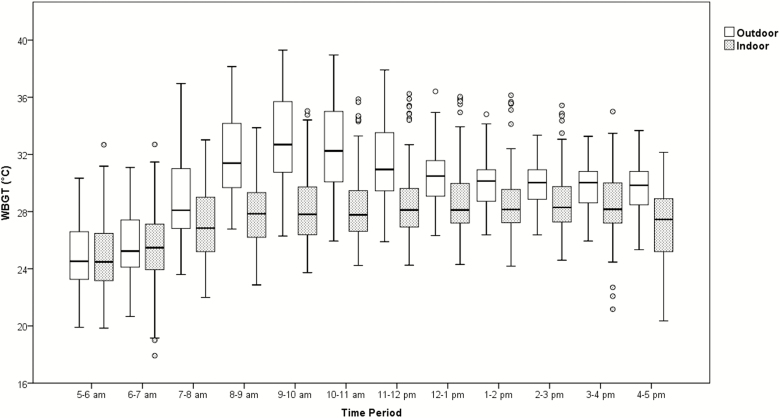
OBJECTIVES: Excessive heat exposure poses significant risks to workers in hot climates. This study assessed the intensity and duration of heat stress exposure among workers performing residential construction in southeastern Saudi Arabia (SA) during the summer, June-September 2016. Objectives were to: identify work factors related to heat stress exposure; measure environmental heat exposure at the construction sites; assess the heat stress risk among workers using the wet bulb globe temperature (WBGT) index; and determine if temperature-humidity indices can be appropriate alternatives to WBGT for managing heat stress risk at the construction sites. METHODS: Worksite walkthrough surveys and environmental monitoring were performed, indoors and outdoors, at 10 construction sites in Al-Ahsa Province. A heat stress exposure assessment was conducted according to the American Conference of Governmental Industrial Hygienists (ACGIH®) guidelines, which uses the WBGT index. WBGT measurements from two instruments were compared. Alternative heat stress indices were compared to the WBGT: the heat index (HI) and humidex (HD) index. RESULTS: Construction workers were exposed to excessive heat stress, indoors and outdoors over a large part of the work day. Complying with a midday outdoor work ban (12-3 p.m.) was not effective in reducing heat stress risk. The highest intensity of exposure was outdoors from 9 a.m. to 12 p.m.; a period identified with the highest hourly mean WBGT values (31-33°C) and the least allowable working time according to ACGIH® guidelines. Comparison of the alternative indices showed that the HI is more reliable than the HD as a surrogate for the WBGT index in the climate studied. CONCLUSION: The extreme heat exposure represents a serious risk. The severity of heat stress and its impact are projected to increase due to climate change, emphasizing the need for immediate improvement of the current required protective measures and the development of occupational heat stress exposure guidelines in SA.
Overview
CoChat Summary
TL;DR
This field study monitored heat conditions at 10 residential construction sites in Al-Ahsa Province, Saudi Arabia, during June–September 2016 and found very high heat stress exposure indoors and outdoors for much of the workday. The heat index (HI) tracked WBGT closely and was judged a practical surrogate for managing heat stress risk in this climate.
Key findings
- At the 10 sites, outdoor WBGT rose to a peak of 33.0 ± 3.1°C at 9 a.m. and indoor WBGT peaked at 28.8°C between 9 a.m. and 12 p.m.
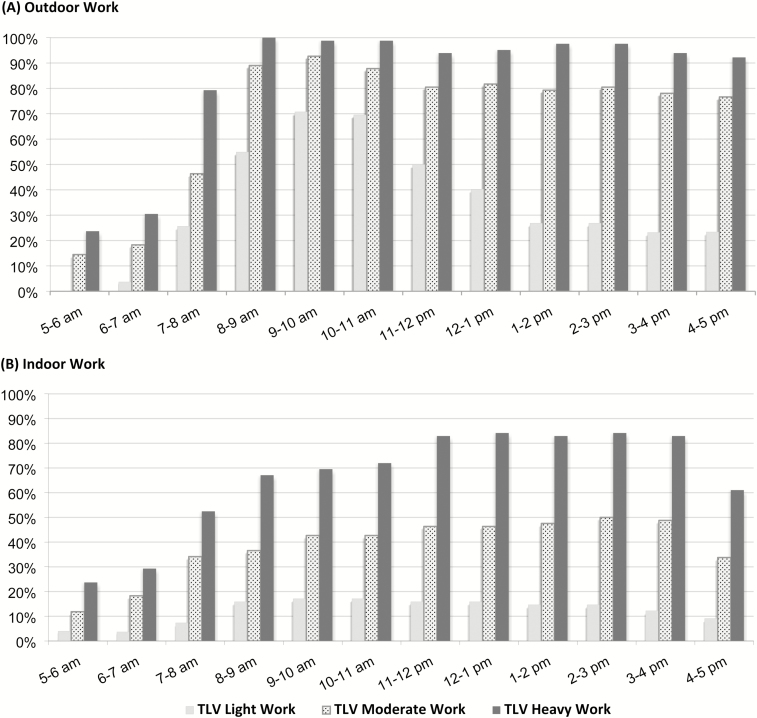
- Outdoor WBGT exceeded ACGIH TLVs during 8 a.m.–5 p.m. for 92–100% of the time for heavy work, 77–93% for moderate work, and 23–71% for light work; indoor exceedances were 61–84%, 34–50%, and 9–17%, respectively.
- The midday outdoor work ban (12–3 p.m.) was not effective in reducing heat stress risk, though complying with it reduced total exposure time by 185 h over the summer months for workers in compliant companies.
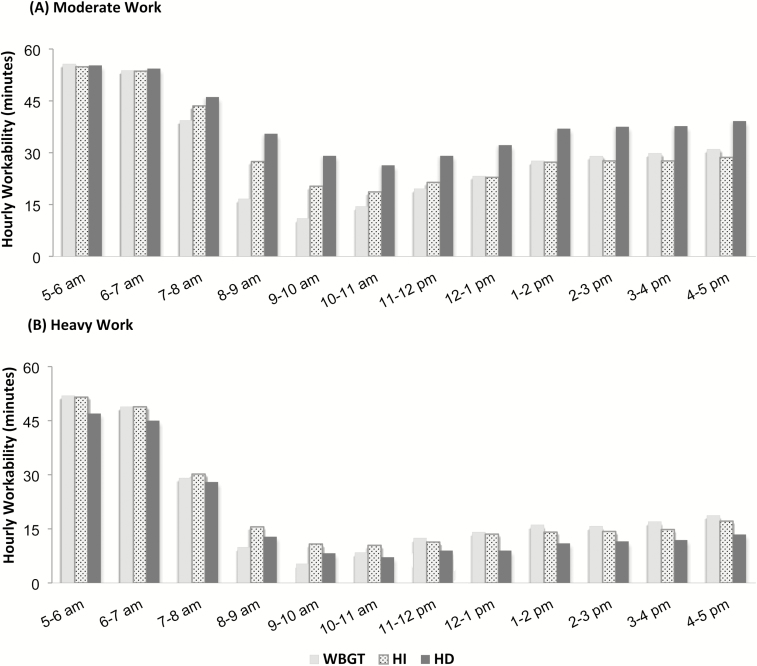
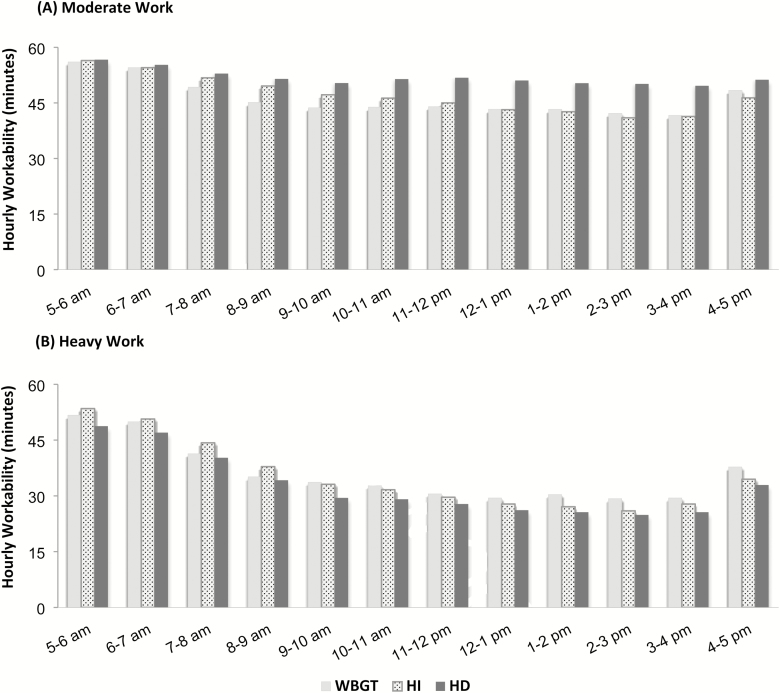
- Agreement between WBGT and HI for allowable working hours was almost perfect: κw = 0.85 and 0.89 for moderate work indoors/outdoors, and κw = 0.88 and 0.90 for heavy work indoors/outdoors.
Methods
- Observational field study with qualitative walkthrough surveys and quantitative environmental monitoring at 10 residential construction sites in Al-Ahsa Province during June–September 2016.
- Environmental heat exposure was measured indoors and outdoors using WBGT every 15 min from 5 a.m. to 5 p.m. across 81 days; a pilot comparison found strong agreement between two WBGT instruments (r² = 0.99; P < 0.05).
- Analysis used ACGIH TLVs and calculated hourly workability/allowable working time (HWA) for light, moderate, and heavy workloads; Cohen’s weighted kappa compared WBGT-based HWA with HWA from HI and humidex (HD).
Limitations
- The paper states it did not investigate the short- and long-term health impacts of continuous work during the 12-hour workday.
- The authors note that they did not monitor workers’ physiological responses or actual metabolic rates, so they could not account for these factors; they also say self-pacing may have led to overestimation of risk.
- Evident from the text: monitoring covered only June–September 2016, only 10 sites in one province, and only daytime hours from 5 a.m. to 5 p.m., so broader seasonal and regional generalizability is limited.
Model-written summary. Check it against the paper before relying on it.
Integrity signals
Registry
Cites
Statistics
Figures
Verification
Claims the paper makes
7 Valid · 0 Not valid · 22 Not checked · 61 Own results and interpretations
The cited sources support only part of this claim — read each source’s verdict below.
In the paper
“The negative impacts of heat stress will likely increase due to climate change (Spector and Sheffield, 2014; Acharya et al., 2018), particularly in countries in arid and tropical zones (Kjellstrom et al., 2009; Andrews et al., 2018).”
- Also stated in: § Conclusion · hedged
“The severity of heat stress and its impact are projected to increase due to climate change, emphasizing the need for immediate improvement of the current required protective measures and the development of occupational heat stress exposure guidelines in SA.”
§ Assessment of Heat Stress Exposure among Construction Workers in the Hot Desert Climate of Saudi Arabia > Introduction
What the sources say
- Not matchedcites Spector and Sheffield, 2014
An author–year citation the paper’s reference list doesn’t settle. We don’t search these by name.
- Supportedcites Acharya et al., 2018 matched to “Assessing Heat Stress and Health among Construction Workers in a Changing Climate: A Review” (2018) source
The Introduction states that projected increases in extreme heat due to climate change are expected to increase construction workers’ vulnerability to heat stress. Acharya et al. is cited for that first clause; the separate claim about arid and tropical zones is attributed to other sources. (LLM, conf=0.91)
- Partly supportedcites Kjellstrom et al., 2009 matched to “The Direct Impact of Climate Change on Regional Labor Productivity” (2009) sourceExperimental — accuracy not yet measured
The Results (page unavailable) project heat-related labour-productivity losses in several tropical regions, supporting the claim for those areas. The Introduction says heat strain can occur in arid climates, but the paper does not identify arid regions as particularly affected by future climate change; its tabulated projection for North Africa/Middle East is comparatively small. (LLM, conf=0.82)
hedgedstates a possible cause- Asserted: passes — The authors put it forward as true.
- Checkable: passes — It can be checked against evidence.
- Load-bearing: passes — The paper’s conclusions depend on it.
- Based: passes — The paper gives a reason why it holds.
- Also stated in: § Conclusion · hedged
The cited sources support only part of this claim — read each source’s verdict below.
In the paper
“The practice of self-pacing by workers through the reduction of their metabolic rate to a safe level has been identified as a protective response to heat stress exposure in construction and other work settings (Mairiaux and Malchaire, 1985; Miller et al., 2011; Nag et al., 2013; Peiffer and Abbiss, 2013; Methner and Eisenberg, 2018).”
§ Assessment of Heat Stress Exposure among Construction Workers in the Hot Desert Climate of Saudi Arabia > Discussion
What the sources say
- Not checked — no full text of the sourcecites Mairiaux and Malchaire, 1985 matched to “Workers self-pacing in hot conditions: a case study” (1985) source
- Not checked — no full text of the sourcecites Miller et al., 2011 matched to “Self-pacing as a protective mechanism against the effects of heat stress” (2011) source
- Partly supportedcites Nag et al., 2013 matched to “Critical body temperature profile as indicator of heat stress vulnerability” (2013) sourceExperimental — accuracy not yet measured
Nag et al. (2013) do identify self-pacing as protective: the Discussion/main text states 'The workers had options of self-pacing their rate of work, as a protective thermoregulatory behavior, and sustaining a level of work in severe hot conditions', and the Abstract and Results infer from ~90% of workers having T_cr within 38 °C 'their self-adjustment strategy in pacing work and regulating T_cr'. Two parts of the claim are not in our copy: the mechanism is stated as pacing the rate of work and controlling core temperature, never as a measured or stated reduction of metabolic rate to a safe level; and the settings studied are informal foundry/sheet-metal, ceramic-pottery and stone-quarry work in Gujarat and Rajasthan, India (Materials and Methods), not construction — so the 'construction' element of the bundled citation rests on other works. Verdict limited to what this source carries. (LLM, conf=0.78)
plainstates a cause- Asserted: passes — The authors put it forward as true.
- Checkable: passes — It can be checked against evidence.
- Load-bearing: passes — The paper’s conclusions depend on it.
- Based: passes — The paper gives a reason why it holds.
The cited sources support only part of this claim — read each source’s verdict below.
In the paper
“At the global level, our findings are consistent with the level of summer heat exposure (hourly mean WBGT values) reported at outdoor construction sites in other studies in tropical and subtropical countries (Kähkönen et al., 1992; Inaba and Mirbod, 2007; Miller and Bates, 2007; Maiti, 2008; Pérez-Alonso et al., 2011; Rowlinson and Jia, 2014; Venugopal et al., 2016).”
§ Assessment of Heat Stress Exposure among Construction Workers in the Hot Desert Climate of Saudi Arabia > Discussion
What the sources say
- Not checked — no full text of the sourcecites Kähkönen et al., 1992 matched to “Estimation of heat stress in Tanzania by using ISO heat stress indices” (1992) source
- Partly supportedcites Inaba and Mirbod, 2007 matched to “Comparison of subjective symptoms and hot prevention measures in summer between traffic control workers and construction workers in Japan” (2007) sourceExperimental — accuracy not yet measured
Our copy does report summer heat-exposure levels at an outdoor construction site: 'Measurement of thermal condition' states dry-bulb, wet-bulb and globe temperatures were measured at two parts of the construction site once per 30 min between 9:00 and 16:30 over 6 d from 31 July to 9 August 2001, and 'Results'/'Work environmental conditions in the summer' give the resulting means (28.1°C at 9:00 to 32.0°C at 1:30 at the morning-assembly place; 26.5°C to 29.8°C on the 3rd floor). What the source does not support is the framing qualifier: 'Subjects and questionnaire' locates the study in Gifu city, Japan — a temperate setting, not a tropical or subtropical country — and the values are 30-minute rather than hourly means. So the citation backs 'a study reporting summer WBGT at outdoor construction sites' but not the tropical/subtropical grouping the citing sentence assigns to it. (LLM, conf=0.72)
- Not matchedcites Miller and Bates, 2007
An author–year citation the paper’s reference list doesn’t settle. We don’t search these by name.
plain- Asserted: passes — The authors put it forward as true.
- Checkable: passes — It can be checked against evidence.
- Load-bearing: unclear — It is unclear whether the paper’s conclusions depend on it.
- Based: passes — The paper gives a reason why it holds.
A result the paper reports from its own data — it cites no other source for it, so there is none to check. The quote shows it is in the paper.
In the paper
“Workers at companies that did not comply with the ban worked 10 h with two meal breaks (30 min each).”
§ Assessment of Heat Stress Exposure among Construction Workers in the Hot Desert Climate of Saudi Arabia > Results > Working environment Nine major jobs and work activities involved in constructing residential buildings were identified based on field observations and onsite discussion with workers and management (Supplementary Table S2, available at Annals of Occupational Hygiene online). All construction workers were Indian nationals, while all construction managers were Saudi nationals. These construction activities were performed 6 days per week by teams of 2–10 workers. Depending on arrival time at the site, the typical work day began between 5 a.m. and 6 a.m. and was supposed to end at 12 p.m. as required by the 3-h midday outdoor work ban. Early start times were designed to take advantage of cooler morning hours to maintain productivity while complying with the midday work ban. However, it was observed that four of the worksites (owned by two of the companies) did not comply with the work ban; their onsite work activities, both indoor and outdoor, continued until 3 p.m. Workers at companies that complied with the work ban worked a maximum of 7 h with only a breakfast break (15–20 min). Workers at companies that did not comply with the ban worked 10 h with two meal breaks (30 min each). The latter companies provided workers with breakfast at approximately 8 a.m. and lunch at approximately 1 p.m. At each site, in general, workers were provided access to one 19-l drinking water cooler for a team of 2–4 workers or two water coolers for 5 or more workers. Commonly, we observed two coolers for a team of <10 workers. Water coolers were filled with water once at the start of the work day. On study days, bottles of water kept in a cooler were made available to workers being observed. Access to and consumption of water during the study will be addressed in a separate publication. All the worksites lacked air-conditioned resting facilities, onsite toilets, and nearby sources of water for refilling drinking water containers. The availability of shaded rest areas varied by job and site. Generally, all workers wore the same clothing, consisting of long-sleeved shirts, long pants, work boots or shoes, baseball caps or head scarves, and polyester or rubber gloves.
plain- Asserted: passes — The authors put it forward as true.
- Checkable: passes — It can be checked against evidence.
- Load-bearing: unclear — It is unclear whether the paper’s conclusions depend on it.
- Based: passes — The paper gives a reason why it holds.
- Rests on an assumption not shown here.
A result the paper reports from its own data — it cites no other source for it, so there is none to check. The quote shows it is in the paper.
In the paper
“for a heavy workload it was exceeded 61–84% of the time”
§ Assessment of Heat Stress Exposure among Construction Workers in the Hot Desert Climate of Saudi Arabia > Results > Assessment of heat stress exposure risk
plain- Asserted: passes — The authors put it forward as true.
- Checkable: passes — It can be checked against evidence.
- Load-bearing: passes — The paper’s conclusions depend on it.
- Based: passes — The paper gives a reason why it holds.
35 more claims
Create a free account to see all 90 claims and to verify the 8 references still open.
- Probably not a substantial claim. 22
- It may state two separate claims as one. 34
Citations
Cites
The Measurement of Observer Agreement for Categorical Data
Landis, J. R., & Koch, G. G. (1977) · Biometrics · doi:10.2307/2529310 · Cited by 81,148
Weighted kappa: nominal scale agreement provision for scaled disagreement or partial credit
Cohen, J. (1968) · Psychological Bulletin · doi:10.1037/h0026256 · Cited by 8,736
Lanczos Filtering in One and Two Dimensions
Duchon, C. E. (1979) · Journal of Applied Meteorology · doi:10.1175/1520-0450(1979)018<1016:lfioat>2.0.co;2 · Cited by 2,398
Steadman, R. G. (1979) · Journal of Applied Meteorology · doi:10.1175/1520-0450(1979)018<0861:taospi>2.0.co;2 · Cited by 1,154
Future temperature in southwest Asia projected to exceed a threshold for human adaptability
Pal, J. S., & Eltahir, E. A. B. (2016) · Nature Climate Change · doi:10.1038/nclimate2833 · Cited by 749
Methods to Calculate the Heat Index as an Exposure Metric in Environmental Health Research
Anderson, G. B., Bell, M. L., & Peng, R. D. (2013) · Environmental Health Perspectives · doi:10.1289/ehp.1206273 · Cited by 573
Humidity: a review and primer on atmospheric moisture and human health
Davis, R. E., McGregor, G. R., & Enfield, K. B. (2016) · Environmental Research · doi:10.1016/j.envres.2015.10.014 · Cited by 472
The Direct Impact of Climate Change on Regional Labor Productivity
Kjellstrom, T., Kovats, R. S., Lloyd, S. J., Holt, T., & Tol, R. S. J. (2009) · Archives of Environmental & Occupational Health · doi:10.1080/19338240903352776 · Cited by 448
Personal factors in thermal comfort assessment: clothing properties and metabolic heat production
Havenith, G., Holmér, I., & Parsons, K. (2002) · Energy and Buildings · doi:10.1016/s0378-7788(02)00008-7 · Cited by 376
Buchholz, B., Paquet, V., Punnett, L., Lee, D., & Moir, S. (1996) · Applied Ergonomics · doi:10.1016/0003-6870(95)00078-x · Cited by 374
Almazroui, M., Islam, M. N., Jones, P. D., Athar, H., & Rahman, M. A. (2012) · Atmospheric Research · doi:10.1016/j.atmosres.2012.02.013 · Cited by 322
Gubernot, D. M., Anderson, G. B., & Hunting, K. L. (2015) · American Journal of Industrial Medicine · doi:10.1002/ajim.22381 · Cited by 259
Assessing Heat Stress and Health among Construction Workers in a Changing Climate: A Review
Acharya, P., Boggess, B., & Zhang, K. (2018) · International Journal of Environmental Research and Public Health · doi:10.3390/ijerph15020247 · Cited by 237
Li, X., Chow, K. H., Zhu, Y., & Lin, Y. (2016) · Building and Environment · doi:10.1016/j.buildenv.2015.09.005 · Cited by 211
Construction work and risk of occupational disability: a ten year follow up of 14 474 male workers
Arndt, V, Rothenbacher, D., Daniel, U., Zschenderlein, B., Schuberth, S., & Brenner, H. (2005) · Occupational and Environmental Medicine · doi:10.1136/oem.2004.018135 · Cited by 207
Havenith, G., & van Middendorp, H. (1990) · European Journal of Applied Physiology and Occupational Physiology · doi:10.1007/bf00236062 · Cited by 198
Occupational heat stress assessment and protective strategies in the context of climate change
Gao, C., Kuklane, K., Östergren, P.-O., & Kjellstrom, T. (2018) · International Journal of Biometeorology · doi:10.1007/s00484-017-1352-y · Cited by 198
Safety and Health in the Construction Industry
Ringen, K., Seegal, J. L., & England, A. (1995) · Annual Review of Public Health · doi:10.1146/annurev.pu.16.050195.001121 · Cited by 185
Advancing the framework for considering the effects of climate change on worker safety and health
Schulte, P. A., Bhattacharya, A., Butler, C. R., Chun, H. K., Jacklitsch, B., Jacobs, T., Kiefer, M., Lincoln, J., Pendergrass, S., Shire, J., et al. (2016) · Journal of Occupational and Environmental Hygiene · doi:10.1080/15459624.2016.1179388 · Cited by 180
Rowlinson, S., YunyanJia, A., Li, B., & ChuanjingJu, C. (2014) · Accident Analysis & Prevention · doi:10.1016/j.aap.2013.08.011 · Cited by 176
Thermal environment assessment reliability using temperature–humidity indices
d’AMBROSIO ALFANO, F. R., PALELLA, B. I., & RICCIO, G. (2011) · Industrial Health · doi:10.2486/indhealth.ms1097 · Cited by 149
Yi, W., & Chan, A. (2017) · International Journal of Environmental Research and Public Health · doi:10.3390/ijerph14091055 · Cited by 147
Havenith, G., Coenen, J. M. L., Kistemaker, L., & Kenney, W. L. (1998) · European Journal of Applied Physiology · doi:10.1007/s004210050327 · Cited by 146
Perceived heat stress and health effects on construction workers
Dutta, P., Rajiva, A., Andhare, D., Azhar, G., Tiwari, A., Sheffield, P., & Ahmedabad Heat and Climate Study Group (2015) · Indian Journal of Occupational and Environmental Medicine · doi:10.4103/0019-5278.174002 · Cited by 145
Tawatsupa, B., Lim, L.-Y., Kjellstrom, T., Seubsman, S.-A., Sleigh, A., & The Thai Cohort Study team (2010) · Global Health Action · doi:10.3402/gha.v3i0.5034 · Cited by 143
Andrews, O., Le Quéré, C., Kjellstrom, T., Lemke, B., & Haines, A. (2018) · The Lancet Planetary Health · doi:10.1016/s2542-5196(18)30240-7 · Cited by 136
Heat exposure in sugarcane harvesters in Costa rica
Crowe, J., Wesseling, C., Solano, B. R., Umaña, M. P., Ramírez, A. R., Kjellstrom, T., Morales, D., & Nilsson, M. (2013) · American Journal of Industrial Medicine · doi:10.1002/ajim.22204 · Cited by 134
Tawatsupa, B., Lim, L. L.-Y., Kjellstrom, T., Seubsman, S.-A., Sleigh, A., & Study Team, T. T. C. (2012) · Journal of Epidemiology · doi:10.2188/jea.je20110082 · Cited by 133
SMITH, D. L., PETRUZZELLO, S. J., KRAMER, J. M., & MISNER, J. E. (1997) · Ergonomics · doi:10.1080/001401397188125 · Cited by 133
Alkolibi, F. M. (2002) · Climatic Change · doi:10.1023/a:1015777403153 · Cited by 132
Prediction of Workplace Wet Bulb Global Temperature
Bernard, T. E. (1999) · Applied Occupational and Environmental Hygiene · doi:10.1080/104732299303296 · Cited by 128
Occupational and Environmental Health: Recognizing and Preventing Disease and Injury
Slovak, A. J. M. (2012) · Occupational Medicine · doi:10.1093/occmed/kqr102 · Cited by 126
The Assessment of the Thermal Environment. A Review
Macpherson, R. K. (1962) · Occupational and Environmental Medicine · doi:10.1136/oem.19.3.151 · Cited by 118
Roghanchi, P., & Kocsis, K. C. (2017) · Safety and Health at Work · doi:10.1016/j.shaw.2017.04.002 · Cited by 114
Chang, F.-L., Sun, Y., Chuang, K.-H., & Hsu, D.-J. (2008) · Applied Ergonomics · doi:10.1016/j.apergo.2008.04.017 · Cited by 109
Construction accident causality: An institutional analysis of heat illness incidents on site
Rowlinson, S., & Jia, Y. A. (2015) · Safety Science · doi:10.1016/j.ssci.2015.04.021 · Cited by 105
The Effects of Continuous Hot Weather Training on Risk of Exertional Heat Illness
WALLACE, R. F., KRIEBEL, D., PUNNETT, L., WEGMAN, D. H., WENGER, C. B., GARDNER, J. W., & GONZALEZ, R. R. (2005) · Medicine & Science in Sports & Exercise · doi:10.1249/01.mss.0000150018.90213.aa · Cited by 98
Self-citationSelf-pacing as a protective mechanism against the effects of heat stress
Miller, V., Bates, G., Schneider, J. D., & Thomsen, J. (2011) · Annals of Occupational Hygiene · doi:10.1093/annhyg/mer012 · Cited by 94
Does hot weather affect work-related injury? A case-crossover study in Guangzhou, China
Sheng, R., Li, C., Wang, Q., Yang, L., Bao, J., Wang, K., Ma, R., Gao, C., Lin, S., Zhang, Y., et al. (2018) · International Journal of Hygiene and Environmental Health · doi:10.1016/j.ijheh.2018.01.005 · Cited by 91
A climatological study of the sea and land breezes in the Arabian Gulf region
Eager, R. E., Raman, S., Wootten, A., Westphal, D. L., Reid, J. S., & Al Mandoos, A. (2008) · Journal of Geophysical Research: Atmospheres · doi:10.1029/2007jd009710 · Cited by 84
Estimating weather impact on the duration of construction activities
Moselhi, O., Gong, D.-C., & El‐Rayes, K. (1997) · Canadian Journal of Civil Engineering · doi:10.1139/l96-122 · Cited by 76
Re-evaluating Occupational Heat Stress in a Changing Climate
(2014) · The Annals of Occupational Hygiene · doi:10.1093/annhyg/meu073 · Cited by 73
Petitti, D. B., Harlan, S. L., Chowell-Puente, G., & Ruddell, D. (2013) · PLoS ONE · doi:10.1371/journal.pone.0062596 · Cited by 70
Occupational Health Conditions in Extreme Environments
(2003) · The Annals of Occupational Hygiene · doi:10.1093/annhyg/meg033 · Cited by 70
Climatic and psychosocial risks of heat illness incidents on construction site
Jia, Y. A., Rowlinson, S., & Ciccarelli, M. (2016) · Applied Ergonomics · doi:10.1016/j.apergo.2015.08.008 · Cited by 70
Using the Thermal Work Limit as an Environmental Determinant of Heat Stress for Construction Workers
Chan, A. P. C., Yi, W., Chan, D. W. M., & Wong, D. P. (2013) · Journal of Management in Engineering · doi:10.1061/(asce)me.1943-5479.0000162 · Cited by 69
Workload assessment in building construction related activities in India
Maiti, R. (2008) · Applied Ergonomics · doi:10.1016/j.apergo.2007.11.010 · Cited by 67
Exertional heat illness: knowledge and behavior among construction workers
El-Shafei, D. A., Bolbol, S. A., Allah, M. B. A., & Abdelsalam, A. E. (2018) · Environmental Science and Pollution Research · doi:10.1007/s11356-018-3211-8 · Cited by 66
Rowlinson, S., & Jia, Y. A. (2014) · Annals Of Occupational Hygiene · doi:10.1093/annhyg/met070 · Cited by 64
INABA, R., & MIRBOD, S. M. (2007) · Industrial Health · doi:10.2486/indhealth.45.91 · Cited by 61
Bernard, T. E., & Iheanacho, I. (2015) · Journal of Occupational and Environmental Hygiene · doi:10.1080/15459624.2014.989365 · Cited by 58
Tak, S., Buchholz, B., Punnett, L., Moir, S., Paquet, V. L., Fulmer, S., Marucci‐Wellman, H., & Wegman, D. H. (2010) · Applied Ergonomics · doi:10.1016/j.apergo.2010.10.001 · Cited by 53
Self-citationLamarche, D. T., Meade, R. D., D'Souza, A. W., Flouris, A. D., Hardcastle, S. G., Sigal, R. J., Boulay, P., & Kenny, G. P. (2017) · Journal of Occupational and Environmental Hygiene · doi:10.1080/15459624.2017.1321844 · Cited by 53
Wittbrodt, M. T., Sawka, M. N., Mizelle, J. C., Wheaton, L. A., & Millard-Stafford, M. L. (2018) · Physiological Reports · doi:10.14814/phy2.13805 · Cited by 53
Heat strain and hydration of Japanese construction workers during work in summer
Ueno, S., Sakakibara, Y., Hisanaga, N., Oka, T., & Yamaguchi-Sekino, S. (2018) · Annals of Work Exposures and Health · doi:10.1093/annweh/wxy012 · Cited by 51
Proceedings 26th Annual ARCOM Conference
Egbu, C., & Lou, E. C. W. (2010) · Research Explorer (The University of Manchester) · Cited by 49
Pérez-Alonso, J., Ferre, Á. J. C., Carreño-Ortega, Á., & López, J. S.-H. (2011) · Building and Environment · doi:10.1016/j.buildenv.2011.02.014 · Cited by 45
The physical demands of electrical utilities work in North America
Meade, R. D., Lauzon, M., Poirier, M. P., Flouris, A. D., & Kenny, G. P. (2016) · Journal of Occupational and Environmental Hygiene · doi:10.1080/15459624.2015.1077966 · Cited by 45
Venugopal, V., Chinnadurai, J., Lucas, R., Vishwanathan, V., Rajiva, A., & Kjellstrom, T. (2016) · The International Journal of the Constructed Environment · doi:10.18848/2154-8587/cgp/v07i02/25-36 · Cited by 45
Liu, X., Song, Y., Yi, W., Wang, X., & Zhu, J. (2018) · Journal of Construction Engineering and Management · doi:10.1061/(asce)co.1943-7862.0001495 · Cited by 43
Workers self-pacing in hot conditions: a case study
Mairiaux, P., & Malchaire, J. (1985) · Applied Ergonomics · doi:10.1016/0003-6870(85)90209-1 · Cited by 42
Human health risk assessment due to global warming–a case study of the Gulf countries
Husain, T., & Chaudhary, J. R. (2008) · International Journal of Environmental Research and Public Health · doi:10.3390/ijerph5040204 · Cited by 41
Exposure to ambient heat and urolithiasis among outdoor workers in Guangzhou, China
Luo, H., Turner, L., Hurst, C. P., Mai, H., Zhang, Y., & Tong, S. (2013) · The Science of The Total Environment · doi:10.1016/j.scitotenv.2013.11.042 · Cited by 40
Occupational Health in the Construction Industry
Snashall, D. (2024) · MDPI eBooks · doi:10.3390/books978-3-7258-1056-7 · Cited by 39
Assessment of construction workers’ hydration status using urine specific gravity
Montazer, S., Farshad, A., Monazzam, M., Eyvazlou, M., Yaraghi, A., & Mirkazemi, R. (2013) · International Journal of Occupational Medicine and Environmental Health · doi:10.2478/s13382-013-0143-x · Cited by 38
Influence of occupational heat stress on labour productivity–a case study from Chennai, India
Chinnadurai, J., Venugopal, V., P, K., & R, P. (2016) · International Journal of Productivity and Performance Management · doi:10.1108/ijppm-08-2014-0121 · Cited by 36
(2014) · Cited by 35
Simulating Effects of Weather on Construction
Benjamin, N. B. H., & Greenwald, T. W. (1973) · Journal of the Construction Division · doi:10.1061/jcceaz.0000372 · Cited by 34
Thermal Stress in North Western Australian Iron Ore Mining Staff
Peiffer, J. J., & Abbiss, C. R. (2012) · The Annals of Occupational Hygiene · doi:10.1093/annhyg/mes084 · Cited by 34
Effect of WBGT index measurement location on heat stress category classification
CHEUVRONT, S. N., CARUSO, E. M., HEAVENS, K. R., KARIS, A. J., SANTEE, W. R., TROYANOS, C., & D’HEMECOURT, P. (2015) · Medicine & Science in Sports & Exercise · doi:10.1249/mss.0000000000000624 · Cited by 34
BERNARD, T. E., & BARROW, C. A. (2013) · Industrial Health · doi:10.2486/indhealth.2012-0160 · Cited by 33
Dyslipidemia in industrial workers in hot environments
Vangelova, K., Deyanov, C., & Ivanova, M. (2006) · Central European Journal of Public Health · doi:10.21101/cejph.b0049 · Cited by 33
Study of heat exposure during Hajj (pilgrimage)
Noweir, M. H., Bafail, A. O., & Jomoah, I. M. (2008) · Environmental Monitoring and Assessment · doi:10.1007/s10661-007-0120-6 · Cited by 32
Critical body temperature profile as indicator of heat stress vulnerability
NAG, P., DUTTA, P., & NAG, A. (2013) · Industrial Health · doi:10.2486/indhealth.2012-0108 · Cited by 30
Heat stress intervention research in construction: gaps and recommendations
Yang, Y., & Chan, A. P. C. (2017) · Industrial Health · doi:10.2486/indhealth.2016-0047 · Cited by 30
Methner, M. M., & Eisenberg, J. (2018) · Journal of Occupational and Environmental Hygiene · doi:10.1080/15459624.2018.1456663 · Cited by 28
Practical on-site measurement of heat strain with the use of a perceptual strain index
Chan, A. P. C., & Yang, Y. (2016) · International Archives of Occupational and Environmental Health · doi:10.1007/s00420-015-1073-7 · Cited by 27
Garzón-Villalba, X. P., Wu, Y., Ashley, C. D., & Bernard, T. E. (2017) · Annals of Work Exposures and Health · doi:10.1093/annweh/wxx034 · Cited by 23
Noweir, M. H., & Bafail, A. O. (2007) · Environmental Monitoring and Assessment · doi:10.1007/s10661-007-0019-2 · Cited by 20
Nature and Trend of Urban Growth in Saudi Arabia: The Case of Al-Ahsa Province – Eastern Region
Abdelatti, H., Elhadary, Y. A. E., & Babiker, A. A. (2017) · Resources and Environment · Cited by 20
van der Molen, H. F., Mol, E., Kuijer, P., & Frings‐Dresen, M. H. W. (2006) · Applied Ergonomics · doi:10.1016/j.apergo.2006.06.007 · Cited by 14
Estimation of heat stress in Tanzania by using ISO heat stress indices
Kähkönen, E., Swai, D., Dyauli, E., & Monyo, R. (1992) · Applied Ergonomics · doi:10.1016/0003-6870(92)90080-f · Cited by 11
(2013) · Cited by 10
Study of heat exposure in the work environment in Jeddah
Noweir, M. H., Moreb, A. A., & Bafail, A. O. (1996) · Environmental Monitoring and Assessment · doi:10.1007/bf00398868 · Cited by 8
Physical Load Among Construction Workers and Analysis with Objective Ergonomics Research Method
Roja, Ž., Kaļķis, H., Reinholds, I., et al. (2016) · Advances in intelligent systems and computing · doi:10.1007/978-3-319-41694-6_1 · Cited by 7
Agriculture in al-hassa oasis, Saudi Arabia: a review of development
Al-Jabr, M. A. (1984) · Durham e-Theses (Durham University) · Cited by 5
Al-Dhafiri, A. M., Al-Ayed, M. S., & Mahfoodh, M. B. (2000) · Journal of the Air & Waste Management Association · doi:10.1080/10473289.2000.10464148 · Cited by 4
Krake, A. M. (2017) · Oxford University Press eBooks · doi:10.1093/oso/9780190662677.003.0014 · Cited by 4
Heat stress assessment in the industrial facilities (A case study)
Jefri, M. A., Al‐Idrisi, M. M., Al‐Jiffry, M. S., Jamil, A., & Erturk, F. (1990) · Journal of Environmental Science and Health . Part A: Environmental Science and Engineering and Toxicology · doi:10.1080/10934529009375552 · Cited by 3
Larrañaga, M. D., & Bernard, T. E. (2011) · Patty's Industrial Hygiene · doi:10.1002/0471435139.hyg022.pub2 · Cited by 3
(2002) · doi:10.1061/(asce)0733-9364(2002)128:5(427
(2012)
Research works printed but not linked: 7
- American Conference of Governmental Industrial Hygienists (ACGIH) (2009) Heat Stress and Strain: TLV® Physical Agents. Cincinnati, OH: ACGIH.
- Dargin J (2009) Saudi arabia, UAE promote energy from sun and wind. Oil Gas J; 107: 18– 22.
- IBM (2016) SPSS Statistics for Windows, version 24. Armonk, NY: IBM.
- International Organization for Standardization (ISO) (2017) ISO 7243, ergonomics of the thermal environment — assessment of heat stress using the WBGT (wet bulb globe temperature) index. Geneva, Switzerland: ISO.
- Masterton J, Richardson F (1979) Humidex: a method of quantifying human discomfort due to excessive heat and humidity. Downsview, Canada: Environment Canada, Atmospheric Environment Service. OCLC number: 6952677.
- Miller V, Bates G (2007) Hydration of outdoor workers in north-west Australia. J Occup Health Saf Aust NZ; 23: 79– 87.
- The Center for Construction Research and Training (CPWR). (2018) The construction chart book: the U.S. construction industry and its workers. Silver Spring, MD: CPWR Available at https://www.cpwr.com/sites/default/files/publications/The_6th_Edition_Construction_eChart_Book.pdf. Accessed 29 November 2018.
Cited by
Climate Change and Weather Extremes in the Eastern Mediterranean and Middle East
Zittis, G., Almazroui, M., Alpert, P., Ciais, P., Cramer, W., Dahdal, Y., Fnais, M., Francis, D., Hadjinicolaou, P., Howari, F., et al. (2022) · Reviews of Geophysics · doi:10.1029/2021rg000762 · Cited by 704
“ities, such as construction and agriculture, are already challenged (Al-Bouwarthan et al., 2019).”
BackgroundImpacts of Climate Change on Outdoor Workers and Their Safety: Some Research Priorities
Moda, H. M., Filho, W. L., & Minhas, A. (2019) · International Journal of Environmental Research and Public Health · doi:10.3390/ijerph16183458 · Cited by 171
“, [41] Scenario based assessments Mixed methods Assessment of work factors related to heat stress exposure among construction workers Construction workers –Saudi Arabia Extreme heat exposure, climate change impact and construction workers Development of occupational heat exposure guidelines Call for assessment of both…”
BackgroundWeather-Related Construction Delays in a Changing Climate: A Systematic State-of-the-Art Review
Schuldt, S., Nicholson, M., Adams, Y. A., & Delorit, J. D. (2021) · Sustainability · doi:10.3390/su13052861 · Cited by 172
Shakerian, S., Habibnezhad, M., Ojha, A., Lee, G., Liu, Y., Jebelli, H., & Lee, S. H. (2021) · Safety Science · doi:10.1016/j.ssci.2021.105395 · Cited by 132
Mani, Z. A., & Goniewicz, K. (2023) · Sustainability · doi:10.3390/su151914279 · Cited by 159
Metadata
- Authors
- Al-Bouwarthan, M., Quinn, M. M., Kriebel, D., & Wegman, D. H.
- Affiliations
- University of Massachusetts Lowell (US)
- Corresponding author
- Al-Bouwarthan, Mohammed
- Venue
- Annals of Work Exposures and Health
- Publisher
- Oxford University Press (OUP)
- Published
- 2019-05-03
- Volume
- 63
- Issue
- 5
- Pages
- 505-520
- ISSN
- 2398-7308 (ISSN-L)
- 2398-7316
- PMC
- PMC6527521
- OpenAlex
- W2947262234
- Cited by
- 158
- References
- 106
- Citations by year
- 2026: 27 · 2025: 25 · 2024: 22 · 2023: 16 · 2022: 26 · 2021: 23 · 2020: 13 · 2019: 5
- FWCI
- 11.50
- Type
- journal article
- Language
- en
- Open access
- hybrid
- doi.org
- Licence
- Locations
- Annals of Work Exposures and Health (publishedVersion, cc-by-nc)
- PubMed Central (publishedVersion, cc-by-nc)
- PubMed (publishedVersion)
- Funders
- Saudi Ministry of Education
- Imam Abdulrahman Bin Faisal University
- Topics
- Health Sciences › Medicine › Physiology (medical) › Thermoregulation and physiological responses
- Health Sciences › Medicine › Public Health, Environmental and Occupational Health › Occupational Health and Safety in Workplaces
- Social Sciences › Safety Research › Occupational Health and Safety Research
- Keywords
- heat stress, construction workers, housing construction, wet bulb globe temperature, heat index, humidex, occupational heat exposure, hot arid climate, Saudi Arabia
- MeSH terms
- Desert Climate, Environmental Monitoring, Hot Temperature, Humans, Humidity, Saudi Arabia, Seasons, Occupational Health, Occupational Exposure, Heat Stress Disorders, Construction Industry
About these checks
Registry, retraction, Cites and statistics results are computed, not judged, with one exception: a printed reference that no index lists is read once by a model before it counts as a citation error. Claims are extracted by a model and kept only when their quote appears verbatim in the text; each cited source is then checked, with a model’s help, for whether it says what the claim relies on. Those verdicts can be wrong — read the claim’s quote and the cited source before relying on one.
The claim verdicts this report counts are experimental: their accuracy is not yet measured.
A language model drew the claims from the paper on 2026-10-10, under version 3 of the claim definition (model deepseek-v4.1-flash, prompt extract-v3).
A second model labelled each claim on 2026-10-10 (model jev-1.13-20260917, definition revision gold-guideline-v0.2).
Cited sources are checked with a language model’s help (gpt-6-sol and qwen3.8-omni-flash).
Statistics and arithmetic are recomputed, not judged.
Confidence bands are shown only for fields calibrated on our annotated test set. None is calibrated yet, so no band is shown.
What counts as a claim ›How we measure confidence ›How we check this ›
Are you an author, or do you see a problem with this page? Request a review
Data sources
Bibliographic data: Semantic Scholar, OpenAlex, Crossref.
Contains information from the Semantic Scholar Academic Graph Datasets, made available under the ODC Attribution License (ODC-BY 1.0).
Semantic Scholar’s data is described in: Kinney, R., et al. (2023). The Semantic Scholar Open Data Platform. arXiv:2301.10140.
