

ProteinBERT: a universal deep-learning model of protein sequence and function
Open accessPublished version of a preprint
The DOI matches its Crossref record; 48 of the 48 references it cites were found in a registry or an index.
Abstract
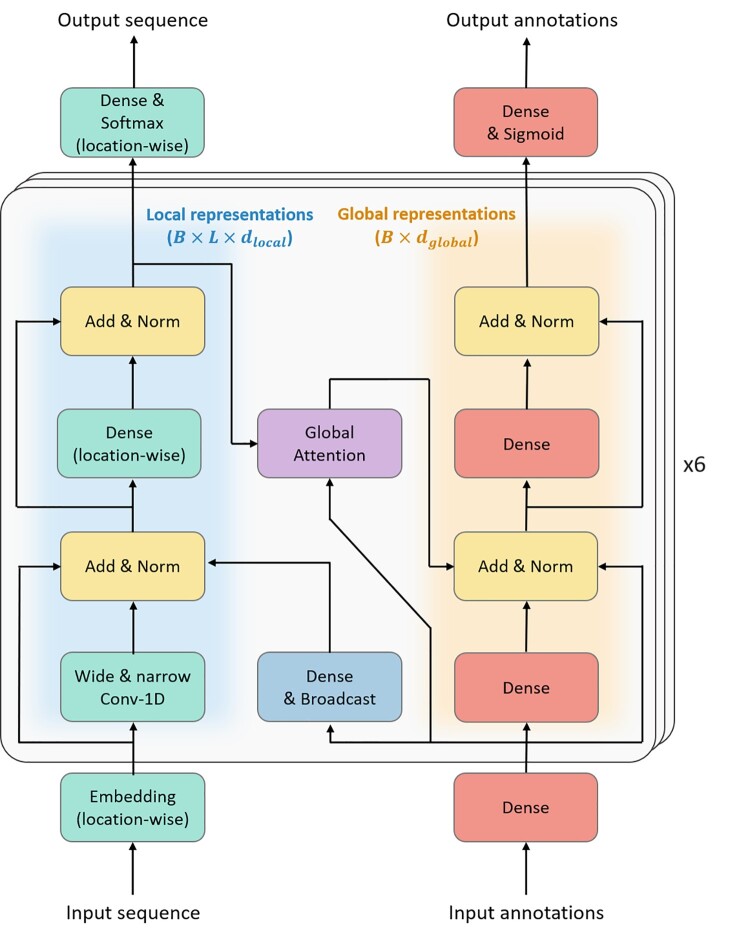
Summary: Self-supervised deep language modeling has shown unprecedented success across natural language tasks, and has recently been repurposed to biological sequences. However, existing models and pretraining methods are designed and optimized for text analysis. We introduce ProteinBERT, a deep language model specifically designed for proteins. Our pretraining scheme combines language modeling with a novel task of Gene Ontology (GO) annotation prediction. We introduce novel architectural elements that make the model highly efficient and flexible to long sequences. The architecture of ProteinBERT consists of both local and global representations, allowing end-to-end processing of these types of inputs and outputs. ProteinBERT obtains near state-of-the-art performance, and sometimes exceeds it, on multiple benchmarks covering diverse protein properties (including protein structure, post-translational modifications and biophysical attributes), despite using a far smaller and faster model than competing deep-learning methods. Overall, ProteinBERT provides an efficient framework for rapidly training protein predictors, even with limited labeled data. Availability and implementation: Code and pretrained model weights are available at https://github.com/nadavbra/protein_bert. Supplementary information: Supplementary data are available at Bioinformatics online.
Overview
The claims and statistics of this paper haven’t been checked yet.
Free: it reads the open-access text and checks the first 5 claims that cite a source we can check. Create a free account to check every claim.
Integrity signals
Registry
Cites
Statistics
Figures

Verification
Claims the paper makes
The claims and statistics of this paper haven’t been checked yet.
Free: it reads the open-access text and checks the first 5 claims that cite a source we can check. Create a free account to check every claim.
Claims other papers make about this one
Each is checked against this paper’s own text: does it say what the citing paper says it does?
The source backs part of the claim, not all of it — or backs it for a different population, condition or comparison.
In the citing paper
“In biology applications, deep learning has been employed to learn the structure of DNA and protein sequences [6,7]”
From Challenges in AI-driven Biomedical Multimodal Data Fusion and Analysis (2025) · cites this paper as [7]
Experimental — accuracy not yet measured
Self-check
Percentages, sums and reported differences re-computed from the paper’s own numbers.
The self-check needs the paper’s full text.
Citations
Cites
Basic local alignment search tool
Altschul, S. F., Gish, W., Miller, W., Myers, E. W., & Lipman, D. J. (1990) · Journal of Molecular Biology · doi:10.1006/jmbi.1990.9999 · Cited by 98,669
Gapped BLAST and PSI-BLAST: a new generation of protein database search programs
Altschul, S. (1997) · Nucleic Acids Research · doi:10.1093/nar/25.17.3389 · Cited by 73,302
BERT: Pre-training of Deep Bidirectional Transformers for Language Understanding
Devlin, J., Chang, M.-W., Lee, K., & Toutanova, K. (2019) · Proceedings of the 2019 Conference of the North American Chapter of the Association for Computational Linguistics: Human Language Technologies, Volume 1 (Long and Short Papers) · doi:10.18653/v1/n19-1423 · Cited by 54,325
Gene Ontology: tool for the unification of biology
Ashburner, M., Ball, C. A., Blake, J. A., Botstein, D., Butler, H., Cherry, J. M., Davis, A. P., Dolinski, K., Dwight, S. S., Eppig, J. T., et al. (2000) · Nature Genetics · doi:10.1038/75556 · Cited by 43,206
Pan, S. J., & Yang, Q. (2010) · IEEE Transactions on Knowledge and Data Engineering · doi:10.1109/tkde.2009.191 · Cited by 23,387 · cited 1×
“According to the transfer-learning paradigm, a model is first pre-trained on one task, and then fine-tuned on other downstream tasks of interest [7–9].”
MethodLanguage Models are Few-Shot Learners
Brown, T. B., Mann, B., Ryder, N., Subbiah, M., Kaplan, J., Dhariwal, P., Neelakantan, A., Shyam, P., Sastry, G., Askell, A., et al. (2020) · arXiv · doi:10.48550/arxiv.2005.14165 · Cited by 23,372
Advances in neural information processing systems 7
(1996) · Computers & Mathematics with Applications · doi:10.1016/s0898-1221(96)90463-0 · Cited by 14,281
Exploring the Limits of Transfer Learning with a Unified Text-to-Text Transformer
Raffel, C., Shazeer, N., Roberts, A., Lee, K., Narang, S., Matena, M., Zhou, Y., Li, W., & Liu, P. J. (2019) · arXiv · doi:10.48550/arxiv.1910.10683 · Cited by 10,929
XLNet: Generalized Autoregressive Pretraining for Language Understanding
Yang, Z., Dai, Z., Yang, Y., Carbonell, J., Salakhutdinov, R., & Le, Q. V. (2019) · arXiv · doi:10.48550/arxiv.1906.08237 · Cited by 6,687
Pfam: the protein families database
Finn, R. D., Bateman, A., Clements, J., Coggill, P., Eberhardt, R. Y., Eddy, S. R., Heger, A., Hetherington, K., Holm, L., Mistry, J., et al. (2014) · Nucleic Acids Research · doi:10.1093/nar/gkt1223 · Cited by 6,148
ALBERT: A Lite BERT for Self-supervised Learning of Language Representations
Lan, Z., Chen, M., Goodman, S., Gimpel, K., Sharma, P., & Soricut, R. (2019) · arXiv · doi:10.48550/arxiv.1909.11942 · Cited by 4,308 · cited 1×
“To pretrain ProteinBERT, we introduce a novel pretraining task of protein annotation prediction which is highly suited to proteins (unlike sentence order prediction and other natural language centric tasks [46]).”
MethodSignalP 5.0 improves signal peptide predictions using deep neural networks
Almagro Armenteros, J. J., Tsirigos, K. D., Sønderby, C. K., Petersen, T. N., Winther, O., Brunak, S., von Heijne, G., & Nielsen, H. (2019) · Nature Biotechnology · doi:10.1038/s41587-019-0036-z · Cited by 4,284
Universal Language Model Fine-tuning for Text Classification
Howard, J., & Ruder, S. (2018) · Proceedings of the 56th Annual Meeting of the Association for Computational Linguistics (Volume 1: Long Papers) · doi:10.18653/v1/p18-1031 · Cited by 4,100
PhosphoSitePlus, 2014: mutations, PTMs and recalibrations
Hornbeck, P. V., Zhang, B., Murray, B., Kornhauser, J. M., Latham, V., & Skrzypek, E. (2015) · Nucleic Acids Research · doi:10.1093/nar/gku1267 · Cited by 3,411
Rives, A., Meier, J., Sercu, T., Goyal, S., Lin, Z., Liu, J., Guo, D., Ott, M., Zitnick, C. L., Ma, J., et al. (2021) · Proceedings of the National Academy of Sciences · doi:10.1073/pnas.2016239118 · Cited by 3,286
Rives, A., Meier, J., Sercu, T., Goyal, S., Lin, Z., Liu, J., Guo, D., Ott, M., Zitnick, C. L., Ma, J., et al. (2019) · doi:10.1101/622803 · Cited by 3,280 · cited 5×
“Existing works show that, other things being equal, larger models and additional pretraining computation time correlates with improved model performance [2, 5, 20].”
BackgroundMethodInfluentialProtTrans: Toward Understanding the Language of Life Through Self-Supervised Learning
Elnaggar, A., Heinzinger, M., Dallago, C., Rehawi, G., Wang, Y., Jones, L., Gibbs, T., Feher, T., Angerer, C., Steinegger, M., et al. (2022) · IEEE Transactions on Pattern Analysis and Machine Intelligence · doi:10.1109/tpami.2021.3095381 · Cited by 2,329
ELECTRA: Pre-training Text Encoders as Discriminators Rather Than Generators
Clark, K., Luong, M.-T., Le, Q. V., & Manning, C. D. (2020) · arXiv · doi:10.48550/arxiv.2003.10555 · Cited by 1,844
UniRef: comprehensive and non-redundant UniProt reference clusters
Suzek, B. E., Huang, H., McGarvey, P., Mazumder, R., & Wu, C. H. (2007) · Bioinformatics · doi:10.1093/bioinformatics/btm098 · Cited by 1,613
Improved protein structure prediction using predicted interresidue orientations
Yang, J., Anishchenko, I., Park, H., Peng, Z., Ovchinnikov, S., & Baker, D. (2020) · Proceedings of the National Academy of Sciences · doi:10.1073/pnas.1914677117 · Cited by 1,421
Big Bird: Transformers for Longer Sequences
Zaheer, M., Guruganesh, G., Dubey, A., Ainslie, J., Alberti, C., Ontanon, S., Pham, P., Ravula, A., Wang, Q., Yang, L., et al. (2020) · arXiv · doi:10.48550/arxiv.2007.14062 · Cited by 1,349
Unified rational protein engineering with sequence-based deep representation learning
Alley, E. C., Khimulya, G., Biswas, S., AlQuraishi, M., & Church, G. M. (2019) · Nature Methods · doi:10.1038/s41592-019-0598-1 · Cited by 1,131
SuperGLUE: A Stickier Benchmark for General-Purpose Language Understanding Systems
Wang, A., Pruksachatkun, Y., Nangia, N., Singh, A., Michael, J., Hill, F., Levy, O., & Bowman, S. R. (2019) · arXiv · doi:10.48550/arxiv.1905.00537 · Cited by 1,051
Boutet, E., Lieberherr, D., Tognolli, M., Schneider, M., Bansal, P., Bridge, A. J., Poux, S., Bougueleret, L., & Xenarios, I. (2016) · Methods in Molecular Biology · doi:10.1007/978-1-4939-3167-5_2 · Cited by 807
CTRL: A Conditional Transformer Language Model for Controllable Generation
Keskar, N. S., McCann, B., Varshney, L. R., Xiong, C., & Socher, R. (2019) · arXiv · doi:10.48550/arxiv.1909.05858 · Cited by 751
Evaluating Protein Transfer Learning with TAPE
Rao, R., Bhattacharya, N., Thomas, N., Duan, Y., Chen, X., Canny, J., Abbeel, P., & Song, Y. S. (2019) · doi:10.1101/676825 · Cited by 719
Rethinking Attention with Performers
Choromanski, K., Likhosherstov, V., Dohan, D., Song, X., Gane, A., Sarlos, T., Hawkins, P., Davis, J., Mohiuddin, A., Kaiser, L., et al. (2020) · arXiv · doi:10.48550/arxiv.2009.14794 · Cited by 695
Modeling aspects of the language of life through transfer-learning protein sequences
Heinzinger, M., Elnaggar, A., Wang, Y., Dallago, C., Nechaev, D., Matthes, F., & Rost, B. (2019) · BMC Bioinformatics · doi:10.1186/s12859-019-3220-8 · Cited by 606 · cited 1×
“A few recent studies have pretrained deep neural language models on protein sequences (e.g. ESM [20], TAPE-Transformer [21], UDSMProt [22], UniRep [23]) [24–26].”
BackgroundModeling the language of life – Deep Learning Protein Sequences
Heinzinger, M., Elnaggar, A., Wang, Y., Dallago, C., Nechaev, D., Matthes, F., & Rost, B. (2019) · doi:10.1101/614313 · Cited by 606
Local fitness landscape of the green fluorescent protein
Sarkisyan, K. S., Bolotin, D. A., Meer, M. V., Usmanova, D. R., Mishin, A. S., Sharonov, G. V., Ivankov, D. N., Bozhanova, N. G., Baranov, M. S., Soylemez, O., et al. (2016) · Nature · doi:10.1038/nature17995 · Cited by 591
Du, D., Tan, L., Wang, Y., Peng, B., Weinstein, J. N., Wondisford, F. E., Su, X., & Lorenzi, P. L. (2019) · BMC Bioinformatics · doi:10.1186/s12859-019-2669-9 · Cited by 549
Global analysis of protein folding using massively parallel design, synthesis, and testing
Rocklin, G. J., Chidyausiku, T. M., Goreshnik, I., Ford, A., Houliston, S., Lemak, A., Carter, L., Ravichandran, R., Mulligan, V. K., Chevalier, A., et al. (2017) · Science · doi:10.1126/science.aan0693 · Cited by 501
Big Self-Supervised Models are Strong Semi-Supervised Learners
Chen, T., Kornblith, S., Swersky, K., Norouzi, M., & Hinton, G. E. (2020) · arXiv (Cornell University) · doi:10.48550/arxiv.2006.10029 · Cited by 421
Andreeva, A., Kulesha, E., Gough, J., & Murzin, A. G. (2020) · Nucleic Acids Research · doi:10.1093/nar/gkz1064 · Cited by 373
The language of proteins: NLP, machine learning & protein sequences
Ofer, D., Brandes, N., & Linial, M. (2021) · Computational and Structural Biotechnology Journal · doi:10.1016/j.csbj.2021.03.022 · Cited by 339
Self-citationSCOP2 prototype: a new approach to protein structure mining
Andreeva, A., Howorth, D., Chothia, C., Kulesha, E., & Murzin, A. G. (2014) · Nucleic Acids Research · doi:10.1093/nar/gkt1242 · Cited by 335
Critical assessment of methods of protein structure prediction (CASP)—Round XII
Moult, J., Fidelis, K., Kryshtafovych, A., Schwede, T., & Tramontano, A. (2018) · Proteins: Structure, Function, and Bioinformatics · doi:10.1002/prot.25415 · Cited by 326
Learning protein sequence embeddings using information from structure
Bepler, T., & Berger, B. (2019) · arXiv · doi:10.48550/arxiv.1902.08661 · Cited by 219
ProGen: Language Modeling for Protein Generation
Madani, A., McCann, B., Naik, N., Keskar, N. S., Anand, N., Eguchi, R. R., Huang, P.-S., & Socher, R. (2020) · bioRxiv (Cold Spring Harbor Laboratory) · doi:10.1101/2020.03.07.982272 · Cited by 212
The Shannon information entropy of protein sequences
Strait, B. J., & Dewey, T. G. (1996) · Biophysical Journal · doi:10.1016/s0006-3495(96)79210-x · Cited by 191
UDSMProt: universal deep sequence models for protein classification
Strodthoff, N., Wagner, P., Wenzel, M., & Samek, W. (2020) · Bioinformatics · doi:10.1093/bioinformatics/btaa003 · Cited by 189
Transfer learning for text classification
Shulman, J., & Ng, A. Y. (2005) · neural information processing systems · Cited by 185
ProFET: Feature engineering captures high-level protein functions
Ofer, D., & Linial, M. (2015) · Bioinformatics · doi:10.1093/bioinformatics/btv345 · Cited by 120
Self-citationTransforming the Language of Life: Transformer Neural Networks for Protein Prediction TasksPreprint
Nambiar, A., Liu, S., Hopkins, M., Heflin, M., Maslov, S., & Ritz, A. (2020) · bioRxiv (Cold Spring Harbor Laboratory) · doi:10.1101/2020.06.15.153643 · Cited by 54
On the Relation between Position Information and Sentence Length in Neural Machine Translation
Neishi, M., & Yoshinaga, N. (2019) · Conference on Computational Natural Language Learning · doi:10.18653/v1/k19-1031 · Cited by 44
NeuroPID: a predictor for identifying neuropeptide precursors from metazoan proteomes
Ofer, D., & Michal Linial, B. (2013) · Bioinformatics · doi:10.1093/bioinformatics/btt725 · Cited by 43
Self-citationASAP: a machine learning framework for local protein properties
Brandes, N., Ofer, D., & Linial, M. (2016) · Database · doi:10.1093/database/baw133 · Cited by 25
Self-citation
Research works printed but not linked: 2
- Abadi, 2016, 12th USENIX Symposium on Operating Systems Design and Implementation (OSDI16), 265
- Radford, 2019, Language models are unsupervised multitask learners, OpenAI Blog, 1, 9
Cited by
ProtGPT2 is a deep unsupervised language model for protein design
Ferruz, N., Schmidt, S., & Höcker, B. (2022) · Nature Communications · doi:10.1038/s41467-022-32007-7 · Cited by 795
DeepLoc 2.0: multi-label subcellular localization prediction using protein language models
Thumuluri, V., Almagro Armenteros, J. J., Johansen, A. R., Nielsen, H., & Winther, O. (2022) · Nucleic Acids Research · doi:10.1093/nar/gkac278 · Cited by 723
ProGen2: Exploring the boundaries of protein language models
Nijkamp, E., Ruffolo, J. A., Weinstein, E. N., Naik, N., & Madani, A. (2023) · Cell Systems · doi:10.1016/j.cels.2023.10.002 · Cited by 480
Genome-wide prediction of disease variant effects with a deep protein language model
Brandes, N., Goldman, G., Wang, C. H., Ye, C. J., & Ntranos, V. (2023) · Nature Genetics · doi:10.1038/s41588-023-01465-0 · Cited by 421
Self-citationHow to build the virtual cell with artificial intelligence: Priorities and opportunities
Bunne, C., Roohani, Y., Rosen, Y., Gupta, A., Zhang, X., Roed, M., Alexandrov, T., AlQuraishi, M., Brennan, P., Burkhardt, D. B., et al. (2024) · Cell · doi:10.1016/j.cell.2024.11.015 · Cited by 393
Metadata
- Authors
- Brandes, N., Ofer, D., Peleg, Y., Rappoport, N., & Linial, M.
- Affiliations
- Hebrew University of Jerusalem (IL)
- Deep Trading Ltd. , Haifa 3508401, Israel
- Ben-Gurion University of the Negev (IL)
- Department of Biological Chemistry, The Alexander Silberman Institute of Life Sciences, The Hebrew University of Jerusalem, Jerusalem 9190401, Israel
- Corresponding author
- Brandes, Nadav
- Venue
- Bioinformatics
- Publisher
- Oxford University Press (OUP)
- Published
- 2022-02-10
- Volume
- 38
- Issue
- 8
- Pages
- 2102-2110
- ISSN
- 1367-4803 (ISSN-L)
- 1367-4811
- PMC
- PMC9386727
- OpenAlex
- W4205773061
- Cited by
- 1,009
- References
- 44
- Citations by year
- 2026: 248 · 2025: 355 · 2024: 241 · 2023: 127 · 2022: 34
- FWCI
- 62.19
- Type
- journal article
- Language
- en
- Open access
- hybrid
- doi.org
- Licence
- Locations
- Bioinformatics (publishedVersion, cc-by)
- bioRxiv (Cold Spring Harbor Laboratory) (acceptedVersion, cc-by)
- PubMed Central (publishedVersion, cc-by)
- PubMed (publishedVersion)
- Funders
- Israel Science Foundation (2753/20)
- Topics
- Life Sciences › Biochemistry, Genetics and Molecular Biology › Molecular Biology › Machine Learning in Bioinformatics
- Life Sciences › Biochemistry, Genetics and Molecular Biology › Molecular Biology › Protein Structure and Dynamics
- Physical Sciences › Computer Science › Artificial Intelligence › Machine Learning in Healthcare
- Keywords
- protein sequence representation, protein function prediction, protein structure prediction, long sequence modeling
- MeSH terms
- Deep Learning, Amino Acid Sequence, Language, Natural Language Processing, Proteins
About these checks
Registry, retraction, Cites and statistics results are computed, not judged, with one exception: a printed reference that no index lists is read once by a model before it counts as a citation error. Claims are extracted by a model and kept only when their quote appears verbatim in the text; each cited source is then checked, with a model’s help, for whether it says what the claim relies on. Those verdicts can be wrong — read the claim’s quote and the cited source before relying on one.
Statistics and arithmetic are recomputed, not judged.
Confidence bands are shown only for fields calibrated on our annotated test set. None is calibrated yet, so no band is shown.
What counts as a claim ›How we measure confidence ›How we check this ›
Are you an author, or do you see a problem with this page? Request a review
Data sources
Bibliographic data: Semantic Scholar, OpenAlex, Crossref.
Contains information from the Semantic Scholar Academic Graph Datasets, made available under the ODC Attribution License (ODC-BY 1.0).
Semantic Scholar’s data is described in: Kinney, R., et al. (2023). The Semantic Scholar Open Data Platform. arXiv:2301.10140.
